
Self-Study UPSC Maths Optional Test Series
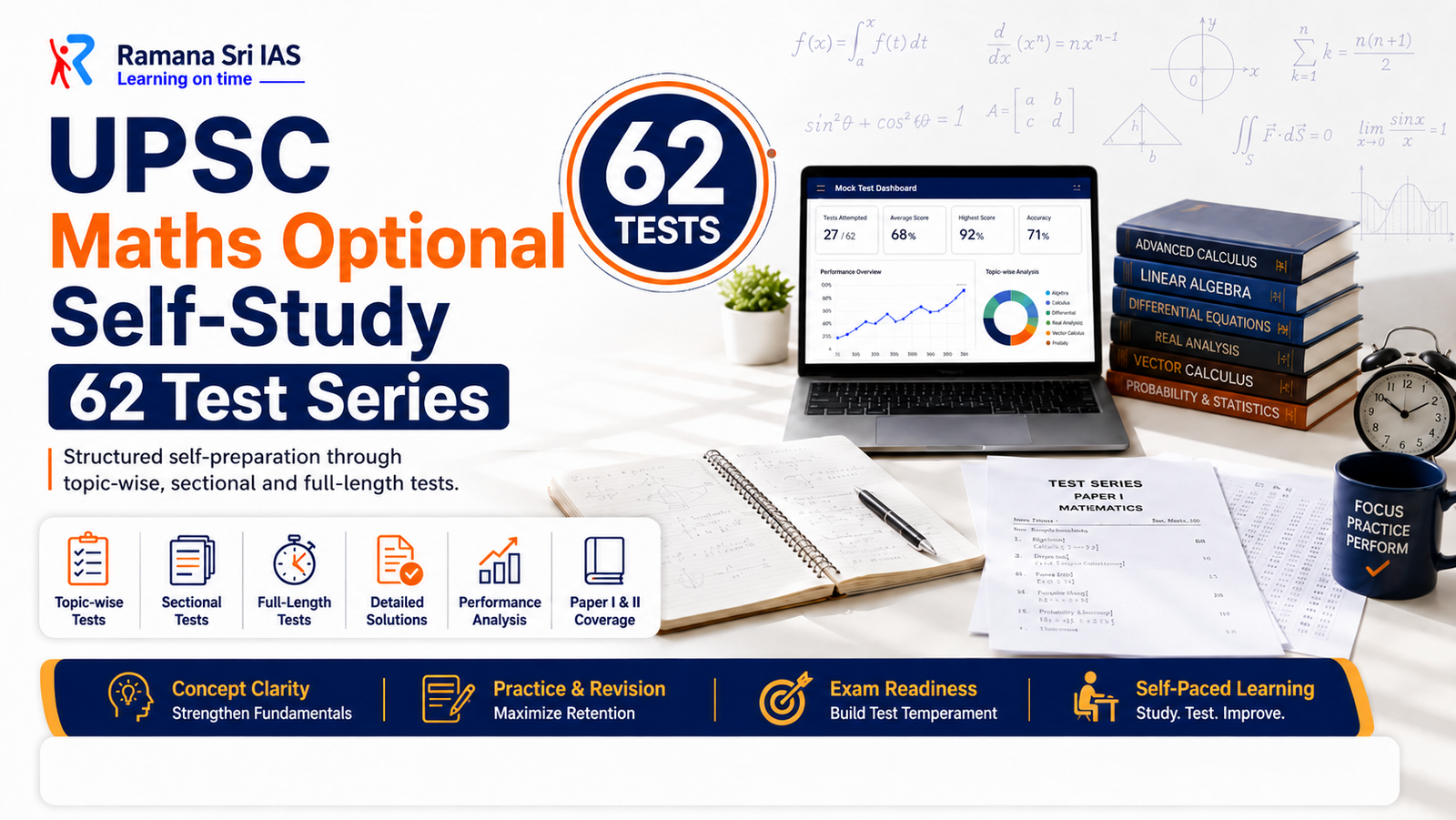
UPSC Maths Optional Self-Study 62 Test Series 2026
A well-defined and structured UPSC Maths Optional Self-Study 62 Test Series 2026 for aspirants who want complete syllabus practice, answer-writing discipline, topic-wise revision and full-length Mains-style preparation.
Self-Study 62 Test Series for UPSC Maths Optional
The 62 Test Series is designed for students who want to revise the full UPSC Mathematics Optional syllabus through a disciplined test-based plan. Instead of random preparation, this program gives students a systematic sequence of topic-wise tests, sectional tests, mixed revision tests and full-length practice.
Mathematics Optional rewards clarity, repeated practice, accuracy and neat answer presentation. A long-format test plan helps students identify weak areas, improve problem-solving speed and build confidence before the UPSC Mains examination.
Best for:
Aspirants who have completed or nearly completed the syllabus and now want disciplined answer-writing practice through a complete 62-test self-study structure.
Why 62 Tests Can Improve Your Maths Optional Preparation
Extensive Coverage
The test sequence covers major UPSC Maths Optional areas across Paper I and Paper II, helping students revise the syllabus in a planned manner.
Real Exam Discipline
Regular tests build the habit of solving questions within fixed time, managing pressure and writing answers in a Mains-oriented format.
Weak Area Identification
A long test series helps students clearly understand which topics need more revision before Mains.
Answer Presentation Practice
Students learn to write step-by-step mathematical answers with clarity, accuracy and proper structure.
Who Should Join the 62 Test Series?
Students Doing Self-Study
Students preparing without daily classroom support can use the test sequence as a disciplined roadmap for revision.
Students Who Completed Syllabus
Aspirants who completed the syllabus can use the 62 tests to check preparation quality and improve exam-readiness.
Repeat Aspirants
Repeat candidates can use this plan to identify old mistakes, revise weak areas and improve answer writing.
Students Targeting High Optional Marks
Serious aspirants can use the test series to improve consistency, accuracy and time management.
How to Use the 62 Test Series Properly
1
Revise the topic before writing the test.
2
Write the test in a fixed time limit like a real exam.
3
Check mistakes in formula, concept, method and presentation.
4
Revise weak topics immediately after every test.
5
Use mixed and full-length tests for final Mains-level practice.
62-Test Structure
UPSC Maths Optional Self-Study 62 Test Series 2026 Plan
This official Ramana Sri IAS Self-Study Program Schedule gives a complete 62-test structure covering ODE, PDE, Analytical Geometry, Linear Programming, Numerical Analysis, Modern Algebra, Linear Algebra, Real Analysis, Calculus, Complex Analysis, Vector Analysis, Dynamics & Statics, Mechanics & Fluid Dynamics, sectional tests and full-length practice.
| Test No. | Test Topic | Module |
|---|---|---|
| Test-01 | Formulation of differential equations; equations of first order and first degree; integrating factor; orthogonal trajectory; equations of first order but not of first degree; Clairaut’s equation; singular solution. | ODE |
| Test-02 | Second and higher order linear equations with constant coefficients; complementary function; particular integral and general solution; second order linear equations with variable coefficients; Euler-Cauchy equation. | ODE |
| Test-03 | Determination of complete solution when one solution is known using method of variation of parameters. | ODE |
| Test-04 | Laplace and inverse Laplace transforms and their properties; Laplace transforms of elementary functions; application to initial value problems for second order linear equations with constant coefficients. | ODE |
| Test-05 | Family of surfaces in three dimensions and formulation of partial differential equations; solution of quasi-linear partial differential equations of the first order. | PDE |
| Test-06 | Linear partial differential equations of the second order with constant coefficients. | PDE |
| Test-07 | Cauchy’s method of characteristics; canonical form; Laplace equation and its solutions; equation of a vibrating string; heat equation. | PDE |
| Test-08 | Cartesian and polar coordinates in three dimensions; plane; straight lines; shortest distance between two skew lines. | AG |
| Test-09 | Sphere. | AG |
| Test-10 | Cone and cylinder. | AG |
| Test-11 | Paraboloid, ellipsoid, hyperboloid of one and two sheets and their properties. | AG |
| Test-12 | Second degree equations in three variables and reduction to canonical forms. | AG |
| Test-13 | Linear programming problems; basic solution; basic feasible solution and optimal solution; graphical method and simplex method of solutions; duality. | LPP |
| Test-14 | Transportation and assignment problems. | LPP |
| Test-15 | Numerical methods: solution of algebraic and transcendental equations of one variable by bisection, Regula-Falsi and Newton-Raphson methods; solution of system of linear equations by Gaussian elimination, Gauss-Jordan and Gauss-Seidel methods; Newton’s interpolation and Lagrange’s interpolation. | NA & CP |
| Test-16 | Numerical integration: trapezoidal rule, Simpson’s rules and Gaussian quadrature formula; numerical solution of ordinary differential equations by Euler and Runge-Kutta methods. | NA & CP |
| Test-17 | Binary system; arithmetic and logical operations on numbers; octal and hexadecimal systems; conversion to and from decimal systems; algebra of binary numbers; elements of computer systems and memory; basic logic gates and truth tables; Boolean algebra; normal forms; representation of unsigned integers, signed integers, reals, double precision reals and long integers; algorithms and flow charts for numerical analysis problems. | NA & CP |
| Test-18 | Groups, subgroups, cyclic groups, cosets and Lagrange’s theorem. | MA |
| Test-19 | Normal subgroups, quotient groups, homomorphism of groups, basic isomorphism theorems, permutation groups and Cayley’s theorem. | MA |
| Test-20 | Rings, integral domains, fields, subrings and ideals. | MA |
| Test-21 | Homomorphism of rings; principal ideal domains; Euclidean domains; unique factorization domains; quotient fields. | MA |
| Test-22 | Vector spaces over R and C; linear dependence and independence; subspaces; bases; dimension. | LA |
| Test-23 | Linear transformations, rank and nullity, and matrix of a linear transformation. | LA |
| Test-24 | Algebra of matrices; row and column reduction; echelon form; congruence and similarity; rank of a matrix; inverse of a matrix; solution of system of linear equations; eigenvalues and eigenvectors; characteristic polynomial; Cayley-Hamilton theorem; symmetric, skew-symmetric, Hermitian, skew-Hermitian, orthogonal and unitary matrices and their eigenvalues. | LA |
| Test-25 | Real number system as an ordered field with least upper bound property; sequences; limit of a sequence; Cauchy sequence; completeness of real line; series and convergence; absolute and conditional convergence of series of real and complex terms; rearrangement of series. | RA |
| Test-26 | Continuity and uniform continuity of functions; properties of continuous functions on compact sets; Riemann integral; improper integrals. | RA |
| Test-27 | Fundamental theorems of integral calculus; uniform convergence; continuity, differentiability and integrability for sequences and series of functions; partial derivatives of functions of several variables; maxima and minima. | RA |
| Test-28 | Real numbers; functions of a real variable; limits; continuity; differentiability; mean value theorem; Taylor’s theorem with remainders; indeterminate forms; maxima and minima; asymptotes; curve tracing. | CAL |
| Test-29 | Functions of two or three variables: limits, continuity, partial derivatives, maxima and minima, Lagrange’s method of multipliers and Jacobian. | CAL |
| Test-30 | Riemann’s definition of definite integrals; indefinite integrals; infinite and improper integrals; double and triple integrals; areas, surface and volumes. | CAL |
| Test-31 | Analytic functions; Cauchy-Riemann equations; Cauchy’s theorem; Cauchy’s integral formula; power series representation of an analytic function. | CA |
| Test-32 | Taylor’s series; singularities; Laurent’s series; Cauchy’s residue theorem; contour integration. | CA |
| Test-33 | Scalar and vector fields; differentiation of vector field of a scalar variable; gradient, divergence and curl in Cartesian and cylindrical coordinates; higher order derivatives. | VA |
| Test-34 | Vector identities and vector equations; application to geometry; curves in space; curvature and torsion; Serret-Frenet formulae; Gauss and Stokes theorems; Green’s identities. | VA |
| Test-35 | Rectilinear motion; simple harmonic motion; motion in a plane; projectiles; constrained motion. | D & S |
| Test-36 | Work and energy; conservation of energy; Kepler’s laws; orbits under central forces; equilibrium of a system of particles. | D & S |
| Test-37 | Work and potential energy; friction; common catenary; principle of virtual work; stability of equilibrium; equilibrium of forces in three dimensions. | D & S |
| Test-38 | Generalized coordinates; D’Alembert’s principle and Lagrange’s equations; Hamilton equations; moment of inertia. | M & FD |
| Test-39 | Motion of rigid bodies in two dimensions; equation of continuity; Euler’s equation of motion for inviscid flow; streamlines; path of a particle; potential flow. | M & FD |
| Test-40 | Two-dimensional and axisymmetric motion; sources and sinks; vortex motion; Navier-Stokes equation for a viscous fluid. | M & FD |
| Test-41 | Linear Algebra. | Sectional Revision |
| Test-42 | Calculus. | Sectional Revision |
| Test-43 | Analytical Geometry. | Sectional Revision |
| Test-44 | Ordinary Differential Equations. | Sectional Revision |
| Test-45 | Vector Analysis. | Sectional Revision |
| Test-46 | Dynamics and Statics. | Sectional Revision |
| Test-47 | Modern Algebra. | Sectional Revision |
| Test-48 | Real Analysis. | Sectional Revision |
| Test-49 | Complex Analysis. | Sectional Revision |
| Test-50 | Linear Programming. | Sectional Revision |
| Test-51 | Partial Differential Equations. | Sectional Revision |
| Test-52 | Numerical Analysis and Computer Programming. | Sectional Revision |
| Test-53 | Mechanics and Fluid Dynamics. | Sectional Revision |
| Test-54 | Paper-I Section A. | Paper Section Test |
| Test-55 | Paper-I Section B. | Paper Section Test |
| Test-56 | Paper-II Section A. | Paper Section Test |
| Test-57 | Paper-II Section B. | Paper Section Test |
| Test-58 | Paper-I. | Full Paper Test |
| Test-59 | Paper-II. | Full Paper Test |
| Test-60 | Paper-I and Paper-II. | Grand Practice |
| Test-61 | Paper-I and Paper-II. | Grand Practice |
| Test-62 | Paper-I and Paper-II. | Final Grand Practice |
Modules Covered in the 62 Test Series
What Students Will Gain from the 62 Test Series
Complete Syllabus Revision
The 62-test structure helps students revise the full Mathematics Optional syllabus in a planned order.
Better Time Management
Timed practice improves speed and helps students complete lengthy Maths Optional answers within exam time.
More Accurate Answers
Regular test writing reduces calculation mistakes, method errors and incomplete solutions.
Stronger Exam Confidence
Repeated topic-wise and full-length tests improve confidence before the final UPSC Mains examination.
Important Instructions for Students
- Write every test in a fixed time limit.
- Do not read solutions before attempting the paper.
- Maintain a separate mistake notebook for formulas, concepts and presentation gaps.
- Revise weak topics immediately after each test.
- Use full-length tests for final exam simulation.
- Discuss serious doubts with the academic team before repeating the same mistake.
Why the UPSC Maths Optional Self-Study 62 Test Series Is Important
The UPSC Maths Optional Self-Study 62 Test Series is useful for aspirants who want a complete, disciplined and test-based preparation system. Mathematics Optional cannot be prepared only by reading theory or watching lectures. Students must repeatedly solve questions, revise formulas, improve speed, reduce calculation mistakes and present answers in a clear mathematical format.
This 62-test structure gives students a complete roadmap from topic-wise practice to sectional revision and full-length Mains-level performance. It helps students revise Paper I and Paper II in a planned order instead of preparing randomly. Every test becomes a checkpoint to measure preparation quality.
The main advantage of the UPSC Maths Optional Self-Study 62 Test Series is that it gives enough practice depth. Students can revise core topics, identify weak areas, practise standard methods, improve answer writing and slowly build confidence for the UPSC Mains examination.
Who Should Use the UPSC Maths Optional Self-Study 62 Test Series?
Self-Study Students
Students preparing without regular classroom support can use the 62 Test Series as a complete roadmap for disciplined topic-wise and paper-wise practice.
Students Nearing Syllabus Completion
Aspirants who have completed most of the syllabus can use this structure to revise all major areas before moving into full Mains practice.
Repeat Aspirants
Repeat candidates can use the tests to identify old mistakes, strengthen weak modules and improve answer-writing quality before the next attempt.
Working Aspirants
Aspirants with limited study hours can follow this plan slowly across one year and complete Maths Optional practice in a structured manner.
Students Targeting High Marks
Serious aspirants aiming for strong optional marks can use repeated tests to improve accuracy, speed, presentation and confidence.
Students Needing Revision Discipline
Students who studied the syllabus but lack a proper revision system can use the 62 tests to organise preparation and track improvement.
How to Use the UPSC Maths Optional Self-Study 62 Test Series Effectively
1
Revise the topic from class notes, books, formula sheets and solved examples before attempting the related test.
2
Write each test within a fixed time limit to build exam discipline and avoid casual practice.
3
After the test, check concept mistakes, formula gaps, calculation errors, skipped questions and presentation weaknesses.
4
Maintain a mistake notebook for formulas, theorems, standard results and question types that need repeated revision.
5
Revise the weak topic again before moving to the next test so that every test gives measurable improvement.
6
Use sectional and full-length tests for final Mains-level simulation, time management and answer-writing confidence.
1-Year Study Plan for UPSC Maths Optional Self-Study 62 Test Series
A 1-year study plan is one of the best ways to use the UPSC Maths Optional Self-Study 62 Test Series because it gives enough time for learning, revision, test writing and mistake correction. Students can divide the 62 tests across 12 months and use the final months for full-length practice, formula revision and answer-writing improvement.
In this plan, students should not rush. Each test should be treated as a serious performance check. The ideal method is: revise the topic, write the test, analyse mistakes, revise weak areas and then move to the next test. This cycle improves both conceptual clarity and exam temperament.
| Phase | Duration | Main Focus | Test Series Use |
|---|---|---|---|
| Phase 1 | Month 1 | Orientation, formula notebook, basic revision plan, ODE foundation and selected PDE basics | Start topic-wise tests with proper answer-writing discipline |
| Phase 2 | Month 2 | Complete ODE and PDE revision | Practise method-based questions and improve step-by-step solutions |
| Phase 3 | Month 3 | Analytical Geometry | Improve diagrams, standard forms, graphical thinking and calculation accuracy |
| Phase 4 | Month 4 | Linear Programming, Numerical Analysis and Computer Programming | Practise algorithms, numerical methods, error control and presentation clarity |
| Phase 5 | Month 5 | Modern Algebra and Linear Algebra | Strengthen definitions, theorems, proofs, matrices and vector-space concepts |
| Phase 6 | Month 6 | Real Analysis and Calculus | Practise limits, continuity, differentiability, integration and standard results |
| Phase 7 | Month 7 | Pending areas of Real Analysis and Calculus, Complex Analysis and Vector Analysis | Improve theorem application, contour methods, vector identities and geometry-based solutions |
| Phase 8 | Month 8 | Dynamics, Statics, Mechanics and Fluid Dynamics | Practise diagrams, physical interpretation, equations of motion and applied problem-solving |
| Phase 9 | Month 9 | Paper I sectional revision and weak-area correction | Use sectional tests to improve Paper I speed, accuracy and presentation |
| Phase 10 | Month 10 | Paper II sectional revision and proof-based topic strengthening | Use sectional tests to improve abstract topics, definitions and logical answer writing |
| Phase 11 | Month 11 | Full-length Paper I and Paper II practice | Write full tests under Mains-like timing and analyse question selection |
| Phase 12 | Month 12 | Final revision, mistake notebook, formulas, PYQ patterns and grand practice | Use final tests for complete exam simulation and confidence building |
During the first six months, students should focus mainly on topic-wise preparation and test discipline. From Month 7 to Month 10, they should strengthen difficult and applied topics while revising earlier mistakes. The last two months should be reserved for full-paper writing, formula revision, PYQ pattern analysis and final performance improvement.
What to Analyse After Every 62 Test Series Paper
Concept Clarity
Check whether the mistake happened because the concept, theorem, definition or method was not fully clear.
Formula Recall
Note formulas, transformations, standard results and important theorems that were missed during the test.
Calculation Accuracy
Identify sign errors, substitution mistakes, arithmetic slips and long calculation areas that need more practice.
Question Selection
Analyse whether you selected scoring questions first and avoided unnecessary time loss on doubtful questions.
Time Management
Check how much time was spent on each question and whether you completed the paper within the planned time.
Answer Presentation
Review whether your answers had proper steps, notation, diagrams, final conclusion and examiner-friendly flow.
Common Mistakes in UPSC Maths Optional Self-Study 62 Test Series Preparation
Writing Tests Without Revision
Students should not write tests randomly. Each test must be attempted after revising formulas, examples and standard methods.
Ignoring Mistake Notebook
Without a mistake notebook, the same formula, calculation and presentation errors are repeated in future tests.
Skipping Abstract Topics
Modern Algebra, Real Analysis and Complex Analysis need repeated revision because definitions and theorems must be written clearly.
Weak Diagram Practice
Analytical Geometry, Vector Analysis, Mechanics and Fluid Dynamics often need neat diagrams and labelled presentation.
Only Checking Marks
Marks are important, but students must also check method clarity, question selection, time use and answer structure.
Not Revising Previous Tests
Every few weeks, students should revise old test mistakes so that improvement becomes permanent.
Answer Writing Strategy with UPSC Maths Optional Self-Study 62 Test Series
In Mathematics Optional, answer writing is not about writing lengthy explanations. It is about writing a clean mathematical solution that the examiner can follow easily. Every answer should begin with the required formula, theorem, definition or method and then move step by step toward the final result.
For proof-based topics, students should write assumptions, definitions and logical steps clearly. For calculation-based topics, they should avoid unnecessary rough work in the final answer and keep the solution neat. For diagram-based topics, diagrams should be accurate, labelled and connected with the solution.
The UPSC Maths Optional Self-Study 62 Test Series gives enough repeated practice to improve this skill. After each test, students should check whether the answer is complete, readable, logically arranged and suitable for Mains-level evaluation.
How the 62 Test Series Is Different from 40 and 14 Test Series
14 Test Series
Best for final-stage revision, sectional practice and grand test practice after most of the syllabus is already completed.
40 Test Series
Best for students who want a balanced topic-wise test plan covering major UPSC Maths Optional modules without a very long schedule.
62 Test Series
Best for students who want a detailed, extended and complete test-based roadmap for Maths Optional preparation.
More Practice Depth
The 62-test structure gives more opportunities to revise, write, analyse and correct mistakes across the full syllabus.
1-Year Roadmap
It is highly suitable for students who want to prepare Maths Optional slowly and systematically across one full year.
Best Choice
Choose the 62 Test Series when you need maximum discipline, repeated practice and a long-term self-study structure.
Final Checklist Before Writing Each 62 Test Series Paper
1
Revise the topic, formulas, theorems, solved examples and previous mistakes before starting the test.
2
Write the test in a fixed time limit and avoid checking notes or solutions during the attempt.
3
Mark every question where you felt doubt, delay, calculation pressure or presentation difficulty.
4
Update your mistake notebook after the test and revise weak areas before the next paper.
5
Revisit old tests every month so that repeated mistakes are removed before UPSC Mains.
Related Resources
Continue Your Maths Optional Preparation
Use the 62 Test Series together with syllabus, PYQs, solutions and admission guidance.
UPSC Maths Optional Self-Study 62 Test Series FAQs
Who should join the 62 Test Series?
This program is suitable for students who want disciplined self-study practice after completing or nearly completing the Maths Optional syllabus.
Does this test series cover both Paper I and Paper II?
Yes. The structure covers topic-wise and sectional practice across both Paper I and Paper II, followed by mixed and full-length practice.
Is this useful for beginners?
Beginners can use it as a roadmap, but it is most effective when the student has already completed basic theory and wants revision through tests.
How should I write these tests?
Write each test under time limits, compare your answers, revise weak areas and repeat difficult topics until accuracy improves.
Start Structured Test Practice
Join Ramana Sri IAS 62 Test Series for UPSC Maths Optional
Build discipline, revise the full syllabus, improve speed and accuracy, and prepare for Mathematics Optional through a complete test-based self-study plan.