Ramana Sri IAS

2020 IFoS Maths Optional Paper I Solutions

2020 IFoS Maths Optional Paper I Solutions

Ramana Sri IAS provides complete and updated solutions for the 2020 IFoS Maths Optional Paper I. Aspirants preparing for the IFoS Mains Examination with Mathematics as their optional subject should solve all these questions carefully before the mains examination.

Ramana Sri IAS presents complete solutions for Indian Forest Service Examination 2020 Mathematics Optional Paper I. Each answer follows the same format: Question, Diagram where needed, Concept Related to the Question, Detailed Solution, and Final Answer.

About 2020 IFoS Maths Optional Paper I Solutions

These 2020 IFoS Maths Optional Paper I Solutions are prepared by Ramana Sri IAS for aspirants who want question-wise clarity before the IFoS Mains examination. This public page gives one full sample solution, while the complete paper-wise solutions are available in the full PYQ course.

Students can use these 2020 IFoS Maths Optional Paper I Solutions to understand the expected answer-writing method, diagram presentation, concept application, and final-answer format used by Ramana Sri IAS.

For the official examination source, students may also refer to the UPSC previous year question papers page.

These 2020 IFoS Maths Optional Paper I Solutions are useful for revision, answer-writing practice, and understanding the step-by-step method expected in the IFoS Mathematics optional paper.

Sample Full Solution

We are giving one question from 2020 IFoS Maths Optional Paper I Solutions as a free sample solution below: Question 2(b). This free sample includes all five sections: Question, Diagram, Concept Related to the Question, Detailed Solution, and Final Answer. Complete 2020 IFoS Maths Optional Paper I Solutions for all questions are available in the full PYQ course. To purchase the full solution, please fill out the admission form first. Our Ramana Sri IAS admission team will guide you through WhatsApp, email, or call.

Question 1(a)

Linear Algebra – Orthogonal Matrix

1Question

If \(A\) is skew-symmetric and \(I+A\) is non-singular, show that \((I-A)(I+A)^{-1}\) is orthogonal.

2Diagram

Full Solution Access

The Diagram section for this question is available in the full 2020 IFoS Maths Optional Paper I PYQ Solutions course.

Complete diagrams, concepts, detailed solutions and final answers for all questions are available in the full PYQ course.

3Concept Related to the Question

Full Solution Access

The Concept Related to the Question section for this question is available in the full 2020 IFoS Maths Optional Paper I PYQ Solutions course.

Complete diagrams, concepts, detailed solutions and final answers for all questions are available in the full PYQ course.

4Detailed Solution

Full Solution Access

The Detailed Solution section for this question is available in the full 2020 IFoS Maths Optional Paper I PYQ Solutions course.

Complete diagrams, concepts, detailed solutions and final answers for all questions are available in the full PYQ course.

5Final Answer

Full Solution Access

The Final Answer section for this question is available in the full 2020 IFoS Maths Optional Paper I PYQ Solutions course.

Complete diagrams, concepts, detailed solutions and final answers for all questions are available in the full PYQ course.

Question 1(b)

Linear Algebra – Row Reduction

1Question

Reduce the matrix \(A=\begin{pmatrix}-1&2&-1&0\\2&4&4&2\\0&0&1&5\\1&6&3&2\end{pmatrix}\) to row-reduced echelon form and find its rank.

2Diagram

Full Solution Access

The Diagram section for this question is available in the full 2020 IFoS Maths Optional Paper I PYQ Solutions course.

Complete diagrams, concepts, detailed solutions and final answers for all questions are available in the full PYQ course.

3Concept Related to the Question

Full Solution Access

The Concept Related to the Question section for this question is available in the full 2020 IFoS Maths Optional Paper I PYQ Solutions course.

Complete diagrams, concepts, detailed solutions and final answers for all questions are available in the full PYQ course.

4Detailed Solution

Full Solution Access

The Detailed Solution section for this question is available in the full 2020 IFoS Maths Optional Paper I PYQ Solutions course.

Complete diagrams, concepts, detailed solutions and final answers for all questions are available in the full PYQ course.

5Final Answer

Full Solution Access

The Final Answer section for this question is available in the full 2020 IFoS Maths Optional Paper I PYQ Solutions course.

Complete diagrams, concepts, detailed solutions and final answers for all questions are available in the full PYQ course.

Question 1(c)

Calculus – Functional Equation

1Question

Given that \(f(x+y)=f(x)f(y)\), \(f(0)\ne0\), for all real \(x,y\) and \(f'(0)=2\). Show that for all real \(x\), \(f'(x)=2f(x)\). Hence find \(f(x)\).

2Diagram

Full Solution Access

The Diagram section for this question is available in the full 2020 IFoS Maths Optional Paper I PYQ Solutions course.

Complete diagrams, concepts, detailed solutions and final answers for all questions are available in the full PYQ course.

3Concept Related to the Question

Full Solution Access

The Concept Related to the Question section for this question is available in the full 2020 IFoS Maths Optional Paper I PYQ Solutions course.

Complete diagrams, concepts, detailed solutions and final answers for all questions are available in the full PYQ course.

4Detailed Solution

Full Solution Access

The Detailed Solution section for this question is available in the full 2020 IFoS Maths Optional Paper I PYQ Solutions course.

Complete diagrams, concepts, detailed solutions and final answers for all questions are available in the full PYQ course.

5Final Answer

Full Solution Access

The Final Answer section for this question is available in the full 2020 IFoS Maths Optional Paper I PYQ Solutions course.

Complete diagrams, concepts, detailed solutions and final answers for all questions are available in the full PYQ course.

Question 1(d)

Calculus – Taylor Series

1Question

Find Taylor's series expansion for the function \(f(x)=\log(1+x),\ -1\lt x\lt\infty\), about \(x=2\) with Lagrange's form of remainder after \(3\)-terms.

2Diagram

Full Solution Access

The Diagram section for this question is available in the full 2020 IFoS Maths Optional Paper I PYQ Solutions course.

Complete diagrams, concepts, detailed solutions and final answers for all questions are available in the full PYQ course.

3Concept Related to the Question

Full Solution Access

The Concept Related to the Question section for this question is available in the full 2020 IFoS Maths Optional Paper I PYQ Solutions course.

Complete diagrams, concepts, detailed solutions and final answers for all questions are available in the full PYQ course.

4Detailed Solution

Full Solution Access

The Detailed Solution section for this question is available in the full 2020 IFoS Maths Optional Paper I PYQ Solutions course.

Complete diagrams, concepts, detailed solutions and final answers for all questions are available in the full PYQ course.

5Final Answer

Full Solution Access

The Final Answer section for this question is available in the full 2020 IFoS Maths Optional Paper I PYQ Solutions course.

Complete diagrams, concepts, detailed solutions and final answers for all questions are available in the full PYQ course.

Question 1(e)

Analytical Geometry – Pair of Lines

1Question

If the straight lines, joining the origin to the points of intersection of the curve \(3x^2-xy+3y^2+2x-3y+4=0\) and the straight line \(2x+3y+k=0\), are at right angles, then show that \(6k^2+5k+52=0\).

2Diagram

Full Solution Access

The Diagram section for this question is available in the full 2020 IFoS Maths Optional Paper I PYQ Solutions course.

Complete diagrams, concepts, detailed solutions and final answers for all questions are available in the full PYQ course.

3Concept Related to the Question

Full Solution Access

The Concept Related to the Question section for this question is available in the full 2020 IFoS Maths Optional Paper I PYQ Solutions course.

Complete diagrams, concepts, detailed solutions and final answers for all questions are available in the full PYQ course.

4Detailed Solution

Full Solution Access

The Detailed Solution section for this question is available in the full 2020 IFoS Maths Optional Paper I PYQ Solutions course.

Complete diagrams, concepts, detailed solutions and final answers for all questions are available in the full PYQ course.

5Final Answer

Full Solution Access

The Final Answer section for this question is available in the full 2020 IFoS Maths Optional Paper I PYQ Solutions course.

Complete diagrams, concepts, detailed solutions and final answers for all questions are available in the full PYQ course.

Question 2(a)

Linear Transformation

1Question

Let \(T:\mathbb R^3\to\mathbb R^3\) be \(T(x,y,z)=(2x,-3y,x+y)\) and \(B_1=\{(-1,2,0),(0,1,-1),(3,1,2)\}\). Find the matrix of \(T\) relative to \(B_1\).

2Diagram

Full Solution Access

The Diagram section for this question is available in the full 2020 IFoS Maths Optional Paper I PYQ Solutions course.

Complete diagrams, concepts, detailed solutions and final answers for all questions are available in the full PYQ course.

3Concept Related to the Question

Full Solution Access

The Concept Related to the Question section for this question is available in the full 2020 IFoS Maths Optional Paper I PYQ Solutions course.

Complete diagrams, concepts, detailed solutions and final answers for all questions are available in the full PYQ course.

4Detailed Solution

Full Solution Access

The Detailed Solution section for this question is available in the full 2020 IFoS Maths Optional Paper I PYQ Solutions course.

Complete diagrams, concepts, detailed solutions and final answers for all questions are available in the full PYQ course.

5Final Answer

Full Solution Access

The Final Answer section for this question is available in the full 2020 IFoS Maths Optional Paper I PYQ Solutions course.

Complete diagrams, concepts, detailed solutions and final answers for all questions are available in the full PYQ course.

Question 2(b)

Maxima and Minima – Lagrange Multiplier

1Question

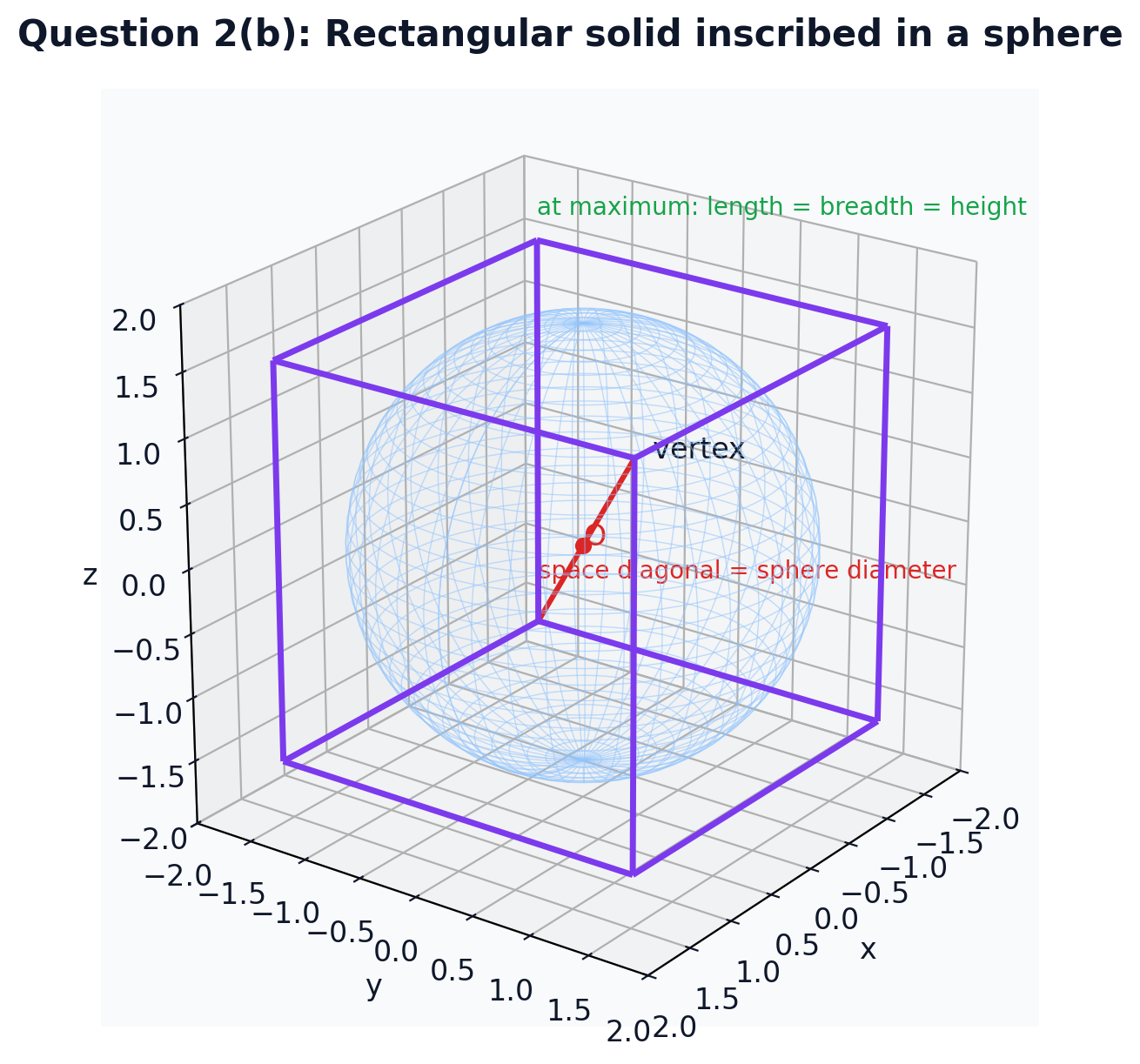
Using Lagrange multiplier, show that the rectangular solid of maximum volume inscribed in a sphere is a cube.

2Diagram

Question 2(b): Maximum-volume rectangular solid inscribed in a sphere
2020 IFoS Maths Optional Paper I Solutions diagram showing a rectangular solid inside a sphere, with half-edges, radius constraint, and maximum-volume cube interpretation.

3Concept Related to the Question

This question belongs to Maxima and Minima – Lagrange Multiplier. First identify the standard theorem or formula, then substitute the given data carefully.

4Detailed Solution

Let the rectangular solid have half-edges \(x,y,z\). Its volume is proportional to \(xyz\), and the sphere condition is \(x^2+y^2+z^2=r^2\). Maximize \(\log V=\log x+\\log y+\log z\) subject to the constraint. Lagrange multiplier equations give \(1/x=2\lambda x\), \(1/y=2\lambda y\), and \(1/z=2\lambda z\). Hence \(x^2=y^2=z^2\), and since lengths are positive, \(x=y=z\).

5Final Answer

The rectangular solid of maximum volume has equal edges; hence it is a cube.

Question 2(c)

Analytical Geometry – Direction Cosines

1Question

Prove that the angle between two straight lines whose direction cosines satisfy \(l+m+n=0\) and \(fmn+gnl+hlm=0\) is \(\pi/3\), if \(1/f+1/g+1/h=0\).

2Diagram

Full Solution Access

The Diagram section for this question is available in the full 2020 IFoS Maths Optional Paper I PYQ Solutions course.

Complete diagrams, concepts, detailed solutions and final answers for all questions are available in the full PYQ course.

3Concept Related to the Question

Full Solution Access

The Concept Related to the Question section for this question is available in the full 2020 IFoS Maths Optional Paper I PYQ Solutions course.

Complete diagrams, concepts, detailed solutions and final answers for all questions are available in the full PYQ course.

4Detailed Solution

Full Solution Access

The Detailed Solution section for this question is available in the full 2020 IFoS Maths Optional Paper I PYQ Solutions course.

Complete diagrams, concepts, detailed solutions and final answers for all questions are available in the full PYQ course.

5Final Answer

Full Solution Access

The Final Answer section for this question is available in the full 2020 IFoS Maths Optional Paper I PYQ Solutions course.

Complete diagrams, concepts, detailed solutions and final answers for all questions are available in the full PYQ course.

Question 3(a)

Analytical Geometry – Asymptotes

1Question

Find the asymptotes of \(x^3+3x^2y-4y^3-x+y+3=0\).

2Diagram

Full Solution Access

The Diagram section for this question is available in the full 2020 IFoS Maths Optional Paper I PYQ Solutions course.

Complete diagrams, concepts, detailed solutions and final answers for all questions are available in the full PYQ course.

3Concept Related to the Question

Full Solution Access

The Concept Related to the Question section for this question is available in the full 2020 IFoS Maths Optional Paper I PYQ Solutions course.

Complete diagrams, concepts, detailed solutions and final answers for all questions are available in the full PYQ course.

4Detailed Solution

Full Solution Access

The Detailed Solution section for this question is available in the full 2020 IFoS Maths Optional Paper I PYQ Solutions course.

Complete diagrams, concepts, detailed solutions and final answers for all questions are available in the full PYQ course.

5Final Answer

Full Solution Access

The Final Answer section for this question is available in the full 2020 IFoS Maths Optional Paper I PYQ Solutions course.

Complete diagrams, concepts, detailed solutions and final answers for all questions are available in the full PYQ course.

Question 3(b)

Linear Algebra – Similar Matrices

1Question

Define similar matrices. Prove symmetry of similarity, prove that similar matrices have the same eigenvalues, and give an example showing the converse need not hold.

2Diagram

Full Solution Access

The Diagram section for this question is available in the full 2020 IFoS Maths Optional Paper I PYQ Solutions course.

Complete diagrams, concepts, detailed solutions and final answers for all questions are available in the full PYQ course.

3Concept Related to the Question

Full Solution Access

The Concept Related to the Question section for this question is available in the full 2020 IFoS Maths Optional Paper I PYQ Solutions course.

Complete diagrams, concepts, detailed solutions and final answers for all questions are available in the full PYQ course.

4Detailed Solution

Full Solution Access

The Detailed Solution section for this question is available in the full 2020 IFoS Maths Optional Paper I PYQ Solutions course.

Complete diagrams, concepts, detailed solutions and final answers for all questions are available in the full PYQ course.

5Final Answer

Full Solution Access

The Final Answer section for this question is available in the full 2020 IFoS Maths Optional Paper I PYQ Solutions course.

Complete diagrams, concepts, detailed solutions and final answers for all questions are available in the full PYQ course.

Question 3(c)

Analytical Geometry – Locus

1Question

A point \(P\) moves on the fixed plane \(\frac{x}{a}+\frac{y}{b}+\frac{z}{c}=1\). The plane through \(P\) and perpendicular to \(OP\) meets the axes in \(A,B,C\) respectively. The planes through \(A,B,C\) parallel to the \(yz,zx\) and \(xy\) planes respectively intersect at \(Q\). Prove that the locus of \(Q\) is \(\frac1{x^2}+\frac1{y^2}+\frac1{z^2}=\frac1{ax}+\frac1{by}+\frac1{cz}\).

2Diagram

Full Solution Access

The Diagram section for this question is available in the full 2020 IFoS Maths Optional Paper I PYQ Solutions course.

Complete diagrams, concepts, detailed solutions and final answers for all questions are available in the full PYQ course.

3Concept Related to the Question

Full Solution Access

The Concept Related to the Question section for this question is available in the full 2020 IFoS Maths Optional Paper I PYQ Solutions course.

Complete diagrams, concepts, detailed solutions and final answers for all questions are available in the full PYQ course.

4Detailed Solution

Full Solution Access

The Detailed Solution section for this question is available in the full 2020 IFoS Maths Optional Paper I PYQ Solutions course.

Complete diagrams, concepts, detailed solutions and final answers for all questions are available in the full PYQ course.

5Final Answer

Full Solution Access

The Final Answer section for this question is available in the full 2020 IFoS Maths Optional Paper I PYQ Solutions course.

Complete diagrams, concepts, detailed solutions and final answers for all questions are available in the full PYQ course.

Question 4(a)

Analytical Geometry – Enveloping Cone

1Question

Let \(P\) be the vertex of the enveloping cone of \(x^2/a^2+y^2/b^2+z^2/c^2=1\). If its section by \(z=0\) is a rectangular hyperbola, find the locus of \(P\).

2Diagram

Full Solution Access

The Diagram section for this question is available in the full 2020 IFoS Maths Optional Paper I PYQ Solutions course.

Complete diagrams, concepts, detailed solutions and final answers for all questions are available in the full PYQ course.

3Concept Related to the Question

Full Solution Access

The Concept Related to the Question section for this question is available in the full 2020 IFoS Maths Optional Paper I PYQ Solutions course.

Complete diagrams, concepts, detailed solutions and final answers for all questions are available in the full PYQ course.

4Detailed Solution

Full Solution Access

The Detailed Solution section for this question is available in the full 2020 IFoS Maths Optional Paper I PYQ Solutions course.

Complete diagrams, concepts, detailed solutions and final answers for all questions are available in the full PYQ course.

5Final Answer

Full Solution Access

The Final Answer section for this question is available in the full 2020 IFoS Maths Optional Paper I PYQ Solutions course.

Complete diagrams, concepts, detailed solutions and final answers for all questions are available in the full PYQ course.

Question 4(b)(i)

Cayley-Hamilton Theorem

1Question

Verify Cayley-Hamilton theorem for \(A=\begin{pmatrix}1&4\\2&3\end{pmatrix}\), find \(A^{-1}\), and express \(A^5-4A^4-7A^3+11A^2-A-10I\) as a linear polynomial in \(A\).

2Diagram

Full Solution Access

The Diagram section for this question is available in the full 2020 IFoS Maths Optional Paper I PYQ Solutions course.

Complete diagrams, concepts, detailed solutions and final answers for all questions are available in the full PYQ course.

3Concept Related to the Question

Full Solution Access

The Concept Related to the Question section for this question is available in the full 2020 IFoS Maths Optional Paper I PYQ Solutions course.

Complete diagrams, concepts, detailed solutions and final answers for all questions are available in the full PYQ course.

4Detailed Solution

Full Solution Access

The Detailed Solution section for this question is available in the full 2020 IFoS Maths Optional Paper I PYQ Solutions course.

Complete diagrams, concepts, detailed solutions and final answers for all questions are available in the full PYQ course.

5Final Answer

Full Solution Access

The Final Answer section for this question is available in the full 2020 IFoS Maths Optional Paper I PYQ Solutions course.

Complete diagrams, concepts, detailed solutions and final answers for all questions are available in the full PYQ course.

Question 4(b)(ii)

Linear Combination of Vectors

1Question

Express the vector \((1,2,5)\) as a linear combination of the vectors \((1,1,1)\), \((2,1,2)\) and \((3,2,3)\), if possible. Justify your answer.

2Diagram

Full Solution Access

The Diagram section for this question is available in the full 2020 IFoS Maths Optional Paper I PYQ Solutions course.

Complete diagrams, concepts, detailed solutions and final answers for all questions are available in the full PYQ course.

3Concept Related to the Question

Full Solution Access

The Concept Related to the Question section for this question is available in the full 2020 IFoS Maths Optional Paper I PYQ Solutions course.

Complete diagrams, concepts, detailed solutions and final answers for all questions are available in the full PYQ course.

4Detailed Solution

Full Solution Access

The Detailed Solution section for this question is available in the full 2020 IFoS Maths Optional Paper I PYQ Solutions course.

Complete diagrams, concepts, detailed solutions and final answers for all questions are available in the full PYQ course.

5Final Answer

Full Solution Access

The Final Answer section for this question is available in the full 2020 IFoS Maths Optional Paper I PYQ Solutions course.

Complete diagrams, concepts, detailed solutions and final answers for all questions are available in the full PYQ course.

Question 4(c)(i)

Limits

1Question

Evaluate \(\lim_{x\to1}(x-1)\tan\frac{\pi x}{2}\).

2Diagram

Full Solution Access

The Diagram section for this question is available in the full 2020 IFoS Maths Optional Paper I PYQ Solutions course.

Complete diagrams, concepts, detailed solutions and final answers for all questions are available in the full PYQ course.

3Concept Related to the Question

Full Solution Access

The Concept Related to the Question section for this question is available in the full 2020 IFoS Maths Optional Paper I PYQ Solutions course.

Complete diagrams, concepts, detailed solutions and final answers for all questions are available in the full PYQ course.

4Detailed Solution

Full Solution Access

The Detailed Solution section for this question is available in the full 2020 IFoS Maths Optional Paper I PYQ Solutions course.

Complete diagrams, concepts, detailed solutions and final answers for all questions are available in the full PYQ course.

5Final Answer

Full Solution Access

The Final Answer section for this question is available in the full 2020 IFoS Maths Optional Paper I PYQ Solutions course.

Complete diagrams, concepts, detailed solutions and final answers for all questions are available in the full PYQ course.

Question 4(c)(ii)

Improper Integral

1Question

Evaluate \(\int_{-\infty}^{\infty}xe^{-x^2}\,dx\).

2Diagram

Full Solution Access

The Diagram section for this question is available in the full 2020 IFoS Maths Optional Paper I PYQ Solutions course.

Complete diagrams, concepts, detailed solutions and final answers for all questions are available in the full PYQ course.

3Concept Related to the Question

Full Solution Access

The Concept Related to the Question section for this question is available in the full 2020 IFoS Maths Optional Paper I PYQ Solutions course.

Complete diagrams, concepts, detailed solutions and final answers for all questions are available in the full PYQ course.

4Detailed Solution

Full Solution Access

The Detailed Solution section for this question is available in the full 2020 IFoS Maths Optional Paper I PYQ Solutions course.

Complete diagrams, concepts, detailed solutions and final answers for all questions are available in the full PYQ course.

5Final Answer

Full Solution Access

The Final Answer section for this question is available in the full 2020 IFoS Maths Optional Paper I PYQ Solutions course.

Complete diagrams, concepts, detailed solutions and final answers for all questions are available in the full PYQ course.

Question 5(a)

Ordinary Differential Equation

1Question

Solve \((2x^2+y)dx+(x^2y-x)dy=0\), with \(y(1)=2\).

2Diagram

Full Solution Access

The Diagram section for this question is available in the full 2020 IFoS Maths Optional Paper I PYQ Solutions course.

Complete diagrams, concepts, detailed solutions and final answers for all questions are available in the full PYQ course.

3Concept Related to the Question

Full Solution Access

The Concept Related to the Question section for this question is available in the full 2020 IFoS Maths Optional Paper I PYQ Solutions course.

Complete diagrams, concepts, detailed solutions and final answers for all questions are available in the full PYQ course.

4Detailed Solution

Full Solution Access

The Detailed Solution section for this question is available in the full 2020 IFoS Maths Optional Paper I PYQ Solutions course.

Complete diagrams, concepts, detailed solutions and final answers for all questions are available in the full PYQ course.

5Final Answer

Full Solution Access

The Final Answer section for this question is available in the full 2020 IFoS Maths Optional Paper I PYQ Solutions course.

Complete diagrams, concepts, detailed solutions and final answers for all questions are available in the full PYQ course.

Question 5(b)

Linear Differential Equation

1Question

Solve \(\frac{d^2y}{dx^2}-3\frac{dy}{dx}-4y=16x-12e^{2x}\).

2Diagram

Full Solution Access

The Diagram section for this question is available in the full 2020 IFoS Maths Optional Paper I PYQ Solutions course.

Complete diagrams, concepts, detailed solutions and final answers for all questions are available in the full PYQ course.

3Concept Related to the Question

Full Solution Access

The Concept Related to the Question section for this question is available in the full 2020 IFoS Maths Optional Paper I PYQ Solutions course.

Complete diagrams, concepts, detailed solutions and final answers for all questions are available in the full PYQ course.

4Detailed Solution

Full Solution Access

The Detailed Solution section for this question is available in the full 2020 IFoS Maths Optional Paper I PYQ Solutions course.

Complete diagrams, concepts, detailed solutions and final answers for all questions are available in the full PYQ course.

5Final Answer

Full Solution Access

The Final Answer section for this question is available in the full 2020 IFoS Maths Optional Paper I PYQ Solutions course.

Complete diagrams, concepts, detailed solutions and final answers for all questions are available in the full PYQ course.

Question 5(c)

Dynamics – Equiangular Spiral

1Question

If the radial and transverse velocities of a particle are proportional to each other, then prove that the path is an equiangular spiral. Further, if radial acceleration is proportional to transverse acceleration, then show that the velocity of the particle varies as some power of the radius vector.

2Diagram

Full Solution Access

The Diagram section for this question is available in the full 2020 IFoS Maths Optional Paper I PYQ Solutions course.

Complete diagrams, concepts, detailed solutions and final answers for all questions are available in the full PYQ course.

3Concept Related to the Question

Full Solution Access

The Concept Related to the Question section for this question is available in the full 2020 IFoS Maths Optional Paper I PYQ Solutions course.

Complete diagrams, concepts, detailed solutions and final answers for all questions are available in the full PYQ course.

4Detailed Solution

Full Solution Access

The Detailed Solution section for this question is available in the full 2020 IFoS Maths Optional Paper I PYQ Solutions course.

Complete diagrams, concepts, detailed solutions and final answers for all questions are available in the full PYQ course.

5Final Answer

Full Solution Access

The Final Answer section for this question is available in the full 2020 IFoS Maths Optional Paper I PYQ Solutions course.

Complete diagrams, concepts, detailed solutions and final answers for all questions are available in the full PYQ course.

Question 5(d)

Statics – Beam and Cylinder

1Question

A cylinder of radius \(r\), whose axis is fixed horizontally, touches a vertical wall along a generating line. A flat beam of length \(l\) and weight \(W\) rests with its extremities in contact with the wall and the cylinder, making an angle of \(45^\circ\) with the vertical. Prove that the reaction of the cylinder is \(\frac{W\sqrt5}{2}\) and the pressure on the wall is \(\frac W2\). Also, prove that the ratio of radius of the cylinder to the length of the beam is \(5+\sqrt5:4\sqrt2\).

2Diagram

Full Solution Access

The Diagram section for this question is available in the full 2020 IFoS Maths Optional Paper I PYQ Solutions course.

Complete diagrams, concepts, detailed solutions and final answers for all questions are available in the full PYQ course.

3Concept Related to the Question

Full Solution Access

The Concept Related to the Question section for this question is available in the full 2020 IFoS Maths Optional Paper I PYQ Solutions course.

Complete diagrams, concepts, detailed solutions and final answers for all questions are available in the full PYQ course.

4Detailed Solution

Full Solution Access

The Detailed Solution section for this question is available in the full 2020 IFoS Maths Optional Paper I PYQ Solutions course.

Complete diagrams, concepts, detailed solutions and final answers for all questions are available in the full PYQ course.

5Final Answer

Full Solution Access

The Final Answer section for this question is available in the full 2020 IFoS Maths Optional Paper I PYQ Solutions course.

Complete diagrams, concepts, detailed solutions and final answers for all questions are available in the full PYQ course.

Question 5(e)

Vector Analysis

1Question

Prove that for a vector \(\vec a\), \(\nabla(\vec a\cdot\vec r)=\vec a\), where \(\vec r=x\hat i+y\hat j+z\hat k,\ r=|\vec r|\). Is there any restriction on \(\vec a\)? Further, show that \(\vec a\cdot\nabla\left(\vec b\cdot\nabla\frac1r\right)=\frac{3(\vec a\cdot\vec r)(\vec b\cdot\vec r)}{r^5}-\frac{\vec a\cdot\vec b}{r^3}\). Give an example to verify the above.

2Diagram

Full Solution Access

The Diagram section for this question is available in the full 2020 IFoS Maths Optional Paper I PYQ Solutions course.

Complete diagrams, concepts, detailed solutions and final answers for all questions are available in the full PYQ course.

3Concept Related to the Question

Full Solution Access

The Concept Related to the Question section for this question is available in the full 2020 IFoS Maths Optional Paper I PYQ Solutions course.

Complete diagrams, concepts, detailed solutions and final answers for all questions are available in the full PYQ course.

4Detailed Solution

Full Solution Access

The Detailed Solution section for this question is available in the full 2020 IFoS Maths Optional Paper I PYQ Solutions course.

Complete diagrams, concepts, detailed solutions and final answers for all questions are available in the full PYQ course.

5Final Answer

Full Solution Access

The Final Answer section for this question is available in the full 2020 IFoS Maths Optional Paper I PYQ Solutions course.

Complete diagrams, concepts, detailed solutions and final answers for all questions are available in the full PYQ course.

Question 6(a)

ODE – Reduction of Order

1Question

Find one solution of the differential equation \((x^2+1)\frac{d^2y}{dx^2}-2x\frac{dy}{dx}+2y=0\) by inspection and using that solution determine the other linearly independent solution of the given equation. Obtain the general solution of the given differential equation.

2Diagram

Full Solution Access

The Diagram section for this question is available in the full 2020 IFoS Maths Optional Paper I PYQ Solutions course.

Complete diagrams, concepts, detailed solutions and final answers for all questions are available in the full PYQ course.

3Concept Related to the Question

Full Solution Access

The Concept Related to the Question section for this question is available in the full 2020 IFoS Maths Optional Paper I PYQ Solutions course.

Complete diagrams, concepts, detailed solutions and final answers for all questions are available in the full PYQ course.

4Detailed Solution

Full Solution Access

The Detailed Solution section for this question is available in the full 2020 IFoS Maths Optional Paper I PYQ Solutions course.

Complete diagrams, concepts, detailed solutions and final answers for all questions are available in the full PYQ course.

5Final Answer

Full Solution Access

The Final Answer section for this question is available in the full 2020 IFoS Maths Optional Paper I PYQ Solutions course.

Complete diagrams, concepts, detailed solutions and final answers for all questions are available in the full PYQ course.

Question 6(b)

Dynamics – Central Force

1Question

A particle of mass \(5\) units moves in a straight line towards a centre of force and the force varies inversely as the cube of distance. Starting from rest at the point \(A\) distant \(20\) units from centre of force \(O\), it reaches a point \(B\) distant \(b\) from \(O\). Find the time in reaching from \(A\) to \(B\) and the velocity at \(B\). When will the particle reach at the centre?

2Diagram

Full Solution Access

The Diagram section for this question is available in the full 2020 IFoS Maths Optional Paper I PYQ Solutions course.

Complete diagrams, concepts, detailed solutions and final answers for all questions are available in the full PYQ course.

3Concept Related to the Question

Full Solution Access

The Concept Related to the Question section for this question is available in the full 2020 IFoS Maths Optional Paper I PYQ Solutions course.

Complete diagrams, concepts, detailed solutions and final answers for all questions are available in the full PYQ course.

4Detailed Solution

Full Solution Access

The Detailed Solution section for this question is available in the full 2020 IFoS Maths Optional Paper I PYQ Solutions course.

Complete diagrams, concepts, detailed solutions and final answers for all questions are available in the full PYQ course.

5Final Answer

Full Solution Access

The Final Answer section for this question is available in the full 2020 IFoS Maths Optional Paper I PYQ Solutions course.

Complete diagrams, concepts, detailed solutions and final answers for all questions are available in the full PYQ course.

Question 6(c)

Differential Geometry – Curvature and Torsion

1Question

A tangent is drawn to a given curve at some point of contact. \(B\) is a point on the tangent at a distance \(5\) units from the point of contact. Show that the curvature of the locus of the point \(B\) is \(\frac{\left[25\kappa^2\tau^2(1+25\kappa^2)+\{\kappa+5\frac{d\kappa}{ds}+25\kappa^3\}^2\right]^{1/2}}{(1+25\kappa^2)^{3/2}}\). Find the curvature and torsion of the curve \(\vec r=t\hat i+t^2\hat j+t^3\hat k\).

2Diagram

Full Solution Access

The Diagram section for this question is available in the full 2020 IFoS Maths Optional Paper I PYQ Solutions course.

Complete diagrams, concepts, detailed solutions and final answers for all questions are available in the full PYQ course.

3Concept Related to the Question

Full Solution Access

The Concept Related to the Question section for this question is available in the full 2020 IFoS Maths Optional Paper I PYQ Solutions course.

Complete diagrams, concepts, detailed solutions and final answers for all questions are available in the full PYQ course.

4Detailed Solution

Full Solution Access

The Detailed Solution section for this question is available in the full 2020 IFoS Maths Optional Paper I PYQ Solutions course.

Complete diagrams, concepts, detailed solutions and final answers for all questions are available in the full PYQ course.

5Final Answer

Full Solution Access

The Final Answer section for this question is available in the full 2020 IFoS Maths Optional Paper I PYQ Solutions course.

Complete diagrams, concepts, detailed solutions and final answers for all questions are available in the full PYQ course.

Question 7(a)

Statics – Common Catenary

1Question

Derive intrinsic equation \(x=c\log(\sec\psi+\tan\psi)\) of the common catenary, where symbols have usual meanings. Prove that the length of an endless chain, which will hang over a circular pulley of radius \(a\) so as to be in contact with \(\frac23\) of the circumference of the pulley, is \(a\left\{\frac{4\pi}{3}+\frac{3}{\log(2+\sqrt3)}\right\}\).

2Diagram

Full Solution Access

The Diagram section for this question is available in the full 2020 IFoS Maths Optional Paper I PYQ Solutions course.

Complete diagrams, concepts, detailed solutions and final answers for all questions are available in the full PYQ course.

3Concept Related to the Question

Full Solution Access

The Concept Related to the Question section for this question is available in the full 2020 IFoS Maths Optional Paper I PYQ Solutions course.

Complete diagrams, concepts, detailed solutions and final answers for all questions are available in the full PYQ course.

4Detailed Solution

Full Solution Access

The Detailed Solution section for this question is available in the full 2020 IFoS Maths Optional Paper I PYQ Solutions course.

Complete diagrams, concepts, detailed solutions and final answers for all questions are available in the full PYQ course.

5Final Answer

Full Solution Access

The Final Answer section for this question is available in the full 2020 IFoS Maths Optional Paper I PYQ Solutions course.

Complete diagrams, concepts, detailed solutions and final answers for all questions are available in the full PYQ course.

Question 7(b)

Ordinary Differential Equation

1Question

Solve the differential equation \(x^2\frac{d^2y}{dx^2}+3x\frac{dy}{dx}+y=-\frac1{(1-x)^2}\).

2Diagram

Full Solution Access

The Diagram section for this question is available in the full 2020 IFoS Maths Optional Paper I PYQ Solutions course.

Complete diagrams, concepts, detailed solutions and final answers for all questions are available in the full PYQ course.

3Concept Related to the Question

Full Solution Access

The Concept Related to the Question section for this question is available in the full 2020 IFoS Maths Optional Paper I PYQ Solutions course.

Complete diagrams, concepts, detailed solutions and final answers for all questions are available in the full PYQ course.

4Detailed Solution

Full Solution Access

The Detailed Solution section for this question is available in the full 2020 IFoS Maths Optional Paper I PYQ Solutions course.

Complete diagrams, concepts, detailed solutions and final answers for all questions are available in the full PYQ course.

5Final Answer

Full Solution Access

The Final Answer section for this question is available in the full 2020 IFoS Maths Optional Paper I PYQ Solutions course.

Complete diagrams, concepts, detailed solutions and final answers for all questions are available in the full PYQ course.

Question 7(c)

Vector Analysis – Gauss Divergence Theorem

1Question

Given a portion of a circular disc of radius \(7\) units and of height \(1.5\) units such that \(x,y,z\ge0\). Verify Gauss Divergence Theorem for the vector field \(\vec f=(z,x,3y^2z)\) over the surface of the above mentioned circular disc.

2Diagram

Full Solution Access

The Diagram section for this question is available in the full 2020 IFoS Maths Optional Paper I PYQ Solutions course.

Complete diagrams, concepts, detailed solutions and final answers for all questions are available in the full PYQ course.

3Concept Related to the Question

Full Solution Access

The Concept Related to the Question section for this question is available in the full 2020 IFoS Maths Optional Paper I PYQ Solutions course.

Complete diagrams, concepts, detailed solutions and final answers for all questions are available in the full PYQ course.

4Detailed Solution

Full Solution Access

The Detailed Solution section for this question is available in the full 2020 IFoS Maths Optional Paper I PYQ Solutions course.

Complete diagrams, concepts, detailed solutions and final answers for all questions are available in the full PYQ course.

5Final Answer

Full Solution Access

The Final Answer section for this question is available in the full 2020 IFoS Maths Optional Paper I PYQ Solutions course.

Complete diagrams, concepts, detailed solutions and final answers for all questions are available in the full PYQ course.

Question 8(a)

Vector Analysis – Spherical Coordinates

1Question

Derive expression of \(\nabla f\) in terms of spherical coordinates. Prove that \(\nabla^2(fg)=f\nabla^2g+2\nabla f\cdot\nabla g+g\nabla^2f\) for any two vector point functions \(f(r,\theta,\phi)\) and \(g(r,\theta,\phi)\). Construct one example in three dimensions to verify this identity.

2Diagram

Full Solution Access

The Diagram section for this question is available in the full 2020 IFoS Maths Optional Paper I PYQ Solutions course.

Complete diagrams, concepts, detailed solutions and final answers for all questions are available in the full PYQ course.

3Concept Related to the Question

Full Solution Access

The Concept Related to the Question section for this question is available in the full 2020 IFoS Maths Optional Paper I PYQ Solutions course.

Complete diagrams, concepts, detailed solutions and final answers for all questions are available in the full PYQ course.

4Detailed Solution

Full Solution Access

The Detailed Solution section for this question is available in the full 2020 IFoS Maths Optional Paper I PYQ Solutions course.

Complete diagrams, concepts, detailed solutions and final answers for all questions are available in the full PYQ course.

5Final Answer

Full Solution Access

The Final Answer section for this question is available in the full 2020 IFoS Maths Optional Paper I PYQ Solutions course.

Complete diagrams, concepts, detailed solutions and final answers for all questions are available in the full PYQ course.

Question 8(b)

Clairaut Differential Equation

1Question

Reduce the differential equation \(xp^2-2yp+x+2y=0,\quad p=\frac{dy}{dx}\), to Clairaut's form and obtain its complete primitive. Also, determine a singular solution of the given differential equation.

2Diagram

Full Solution Access

The Diagram section for this question is available in the full 2020 IFoS Maths Optional Paper I PYQ Solutions course.

Complete diagrams, concepts, detailed solutions and final answers for all questions are available in the full PYQ course.

3Concept Related to the Question

Full Solution Access

The Concept Related to the Question section for this question is available in the full 2020 IFoS Maths Optional Paper I PYQ Solutions course.

Complete diagrams, concepts, detailed solutions and final answers for all questions are available in the full PYQ course.

4Detailed Solution

Full Solution Access

The Detailed Solution section for this question is available in the full 2020 IFoS Maths Optional Paper I PYQ Solutions course.

Complete diagrams, concepts, detailed solutions and final answers for all questions are available in the full PYQ course.

5Final Answer

Full Solution Access

The Final Answer section for this question is available in the full 2020 IFoS Maths Optional Paper I PYQ Solutions course.

Complete diagrams, concepts, detailed solutions and final answers for all questions are available in the full PYQ course.

Question 8(c)

Hydrostatics – Potential Energy

1Question

A sphere of radius \(a\), and having density half of that of water, is completely immersed at the bottom of a circular cylinder of radius \(b\), which is filled with water to depth \(d\). The sphere is set free and takes up its position of equilibrium. Show that the loss of potential energy this way is \(W\left(d-\frac{11}{8}a-\frac{a^3}{3b^2}\right)\), where \(W\) is the weight of the sphere.

2Diagram

Full Solution Access

The Diagram section for this question is available in the full 2020 IFoS Maths Optional Paper I PYQ Solutions course.

Complete diagrams, concepts, detailed solutions and final answers for all questions are available in the full PYQ course.

3Concept Related to the Question

Full Solution Access

The Concept Related to the Question section for this question is available in the full 2020 IFoS Maths Optional Paper I PYQ Solutions course.

Complete diagrams, concepts, detailed solutions and final answers for all questions are available in the full PYQ course.

4Detailed Solution

Full Solution Access

The Detailed Solution section for this question is available in the full 2020 IFoS Maths Optional Paper I PYQ Solutions course.

Complete diagrams, concepts, detailed solutions and final answers for all questions are available in the full PYQ course.

5Final Answer

Full Solution Access

The Final Answer section for this question is available in the full 2020 IFoS Maths Optional Paper I PYQ Solutions course.

Complete diagrams, concepts, detailed solutions and final answers for all questions are available in the full PYQ course.

2020 IFoS Maths Optional Paper I Solutions FAQs

Are these 2020 IFoS Maths Optional Paper I Solutions complete?

This public page gives one full sample solution for 2020 IFoS Maths Optional Paper I. Complete question-wise solutions for the full paper are available in the full PYQ course.

Which question is given as a free sample solution on this page?

Question 2(b) is given as the free sample solution on this 2020 IFoS Maths Optional Paper I Solutions page.

How should I use these 2020 IFoS Maths Optional Paper I Solutions for preparation?

Students should first solve the question independently, then compare their method with the solution format, diagram presentation, concept explanation, detailed solution, and final answer.

Do these solutions include diagrams and detailed solutions?

Yes. The complete PYQ course includes question-wise diagrams where needed, concept related to the question, detailed solutions, and final answers.

How can I get complete solutions for all questions in 2020 IFoS Maths Optional Paper I?

To get complete solutions for all questions, students can fill out the admission form. The Ramana Sri IAS admission team will guide students through WhatsApp, email, or call.

Scroll to Top