
UPSC Maths Optional Toughest Modules
UPSC Maths Optional Toughest Modules Course
Master the UPSC Maths Optional Toughest Modules Course with focused video lectures, concept clarity, PYQ practice, mock tests, formula revision, answer-writing discipline and expert guidance from Ramana Sri IAS.
UPSC Maths Optional Toughest Modules Course
UPSC Maths Optional video lectures are useful for students who have limited study time and need clear explanation of difficult concepts. In the UPSC Maths Optional Toughest Modules Course, students can revise hard areas in a structured way instead of studying randomly.
Accuracy and presentation are important parts of a good Maths Optional answer. This UPSC Maths Optional Toughest Modules Course helps students understand how to write solutions clearly, use correct formulas, avoid repeated mistakes and present answers step-by-step within the fixed answer space.
This UPSC Maths Optional Toughest Modules Course is designed for students who need special support in difficult areas such as Modern Algebra, Real Analysis, Dynamics and Statics, Mechanics and Fluid Dynamics.
The UPSC Maths Optional Toughest Modules Course is useful for aspirants who are comfortable with the basic syllabus but need extra support in difficult areas. Instead of revising randomly, students can use this course to strengthen concept clarity, practise module-wise PYQs, write tests, correct repeated mistakes and improve answer presentation in the most scoring but challenging parts of Mathematics Optional.
Core message:
Tough modules need focused concept clarity, theorem understanding, formula revision, repeated practice,
PYQ analysis, test writing and expert evaluation.
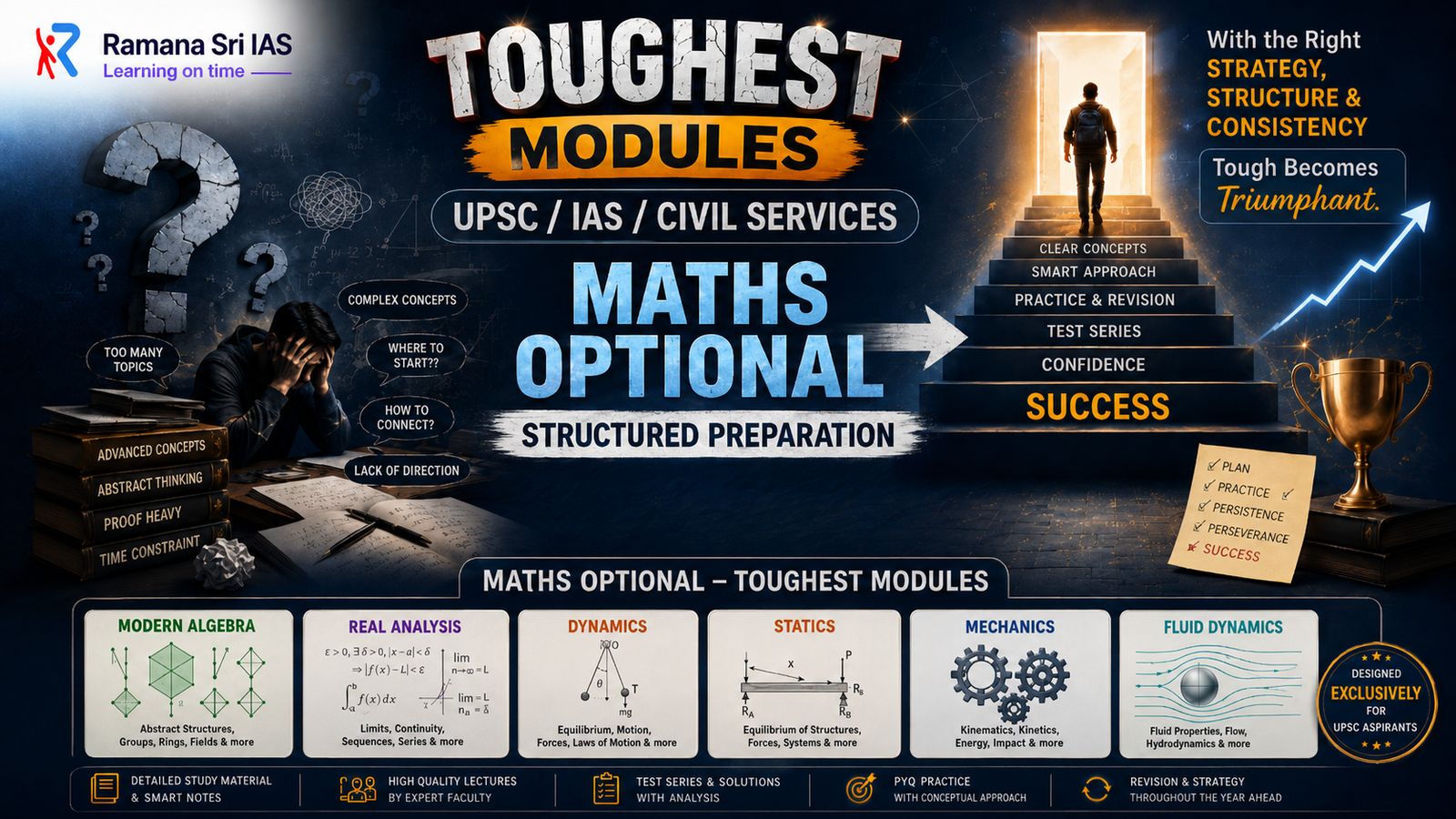
Why Toughest Modules Need Separate Preparation
Mathematics Optional is well-balanced between theorems and applications. Some modules require strong theory, while others demand fast problem-solving and accurate calculation. Students often lose marks because of weak proof writing, poor formula recall, calculation mistakes or unclear presentation.
The best way to prepare for tough modules is to read the syllabus, solve previous years’ question papers, practise mock tests and seek proper mentor guidance. Students should also learn how to apply correct formulas and write answers in a logical flow.
Theorem Clarity
Tough modules often need strong understanding of theorems, proofs and assumptions.
Formula Accuracy
Students must remember formulas correctly and apply them without mistakes.
Logical Flow
Step-by-step presentation is essential for scoring in Maths Optional.
Repeated Practice
Difficult modules become manageable only through regular PYQ and test practice.
Modern Algebra
Modern Algebra is one of the toughest areas for many UPSC Maths Optional students. It requires conceptual clarity, theorem understanding and the ability to write proofs correctly.
To prepare this module, students should read the syllabus carefully, solve previous years’ question papers and practise mock tests. It is also useful to get guidance from an expert mentor because many questions need a clear understanding of groups, rings, fields and proof-based methods.
Mathematics Optional is static and not linked with current affairs, which makes revision easier. However, the subject should be chosen after careful thought and followed with maximum effort from the beginning.
Core Challenge
Proof writing, abstract concepts and theorem applications.
Preparation Method
Read theory, write proofs, solve PYQs and revise standard results.
Common Mistake
Trying to memorise without understanding group and ring structures.
Scoring Tip
Write definitions, assumptions and proof steps clearly.
Real Analysis
Real Analysis is one of the most concept-heavy modules in UPSC Maths Optional. It requires a strong foundation in definitions, theorems, sequences, series, continuity, differentiability, integrability and proof-based reasoning.
Maths can be a high-scoring optional subject when students study the material thoroughly and practise it regularly. But before choosing it, students must understand both the benefits and challenges of the subject.
To prepare Real Analysis well, students should understand the syllabus, read standard books carefully, revise regularly, maintain a formula and theorem sheet, and practise multiple problems from previous year papers.
Core Challenge
Abstract theory, definitions, theorem proofs and rigorous writing.
Preparation Method
Revise definitions, understand proofs and practise previous year questions.
Common Mistake
Reading theory once and not revising it repeatedly.
Scoring Tip
Keep a theorem sheet handy and revise it before tests.
Dynamics and Statics
Dynamics and Statics can be scoring, but they require strong conceptual understanding and correct use of formulas. Students must understand the concept behind each question before applying equations.
The first step is to read the syllabus thoroughly. Students should practise mock tests and full-length papers from previous years to understand the type of questions asked in the exam and identify weak areas.
Video lectures can be helpful because they explain concepts, formulas and applications in a structured way. Students should take notes while watching lectures and maintain a separate formula sheet for quick revision.
Core Challenge
Understanding forces, equations, motion and equilibrium conditions.
Preparation Method
Practise examples, revise formulas and solve full-length PYQs.
Common Mistake
Applying formulas without understanding the physical situation.
Scoring Tip
Draw clean diagrams and write equations step-by-step.
Mechanics and Fluid Dynamics
Mechanics and Fluid Dynamics offer scoring opportunities when students understand the logic behind the problems. The questions are often method-based and can be solved systematically with the right preparation.
A good performance in Maths Optional can support a strong rank. Mathematics is a method-based optional subject, so students can improve their score through concept clarity, formula application, step-wise solution writing and regular practice.
Students should practise writing answers step-by-step and use previous years’ full-length question papers, video lectures and mentor feedback. Regular mock tests help assess preparation level and identify areas of improvement.
Core Challenge
Mathematical modelling, equations of motion and fluid flow concepts.
Preparation Method
Use diagrams, formulas, solved examples and repeated PYQ practice.
Common Mistake
Skipping diagrams and writing unclear solutions.
Scoring Tip
Present every step cleanly and revise standard derivations.
Video Lectures
How Video Lectures Help in UPSC Maths Optional Toughest Modules Course
UPSC Maths Optional toughest modules course video lectures are useful because they help students understand tough concepts and formulas in a structured manner. They save time and allow students to revise difficult lectures again.
Students should take notes while watching lectures, practise the examples immediately and revise formulas regularly. Video lectures become effective only when combined with writing practice and mock tests.
- Watch lectures topic-wise in proper sequence
- Take notes and maintain a formula sheet
- Solve PYQs after every completed topic
- Write mock tests in a fixed time frame
- Get answers evaluated by expert mentors
Preparation Rule
Do not only watch lectures. Practise after every topic.
Tough modules become easier when students combine concept learning, PYQ practice, test writing and mentor feedback.
Get GuidanceStep-by-Step Strategy for Toughest Modules
1
Read the UPSC Maths Optional syllabus and identify difficult modules clearly.
2
Study the theory, definitions, formulas and theorems from reliable class notes or standard books.
3
Watch video lectures for concept clarity and take proper notes during the lecture.
4
Solve previous year questions topic-wise after completing each module.
5
Write mock tests and full-length papers to improve speed and accuracy.
6
Revise mistakes, formulas, theorem statements and answer presentation regularly.
Common Mistakes in Tough Modules
Ignoring Theory
Students should not skip theorem statements, definitions and proof structure.
Weak Formula Revision
A separate formula sheet is important for quick revision before tests.
No PYQ Practice
PYQs help students understand actual UPSC difficulty and repeated patterns.
Poor Presentation
Accuracy and neat presentation are essential for scoring in Maths Optional.
Choosing Mathematics as an Optional Subject in UPSC
Choosing Mathematics as an optional subject in the UPSC exam is a good option for students who have a background in Mathematics or strong interest in the subject. However, it requires rigorous study, hard work and consistent practice.
Students should start preparation early by familiarising themselves with the syllabus, studying previous years’ question papers, writing mock tests and developing a logical flow in answers.
Since some Maths Optional questions require strong conceptual clarity and step-wise working, students must devote sufficient time to difficult modules and learn how to write clearly and concisely.
Why Choose Ramana Sri IAS for Toughest Modules?
Tough modules require more than normal reading. Students need concept explanation, structured examples, PYQ practice, doubt support, answer-writing guidance and regular test discussion.
Ramana Sri IAS helps students approach difficult Maths Optional modules in a systematic way. The focus is on making tough areas understandable, improving problem-solving skills and building confidence through guided practice.
Focused Module Guidance
Special attention is given to difficult and high-effort modules.
Concept-Based Teaching
Tough concepts are explained with logic, examples and applications.
PYQ and Test Practice
Students practise previous year questions and mock tests for exam readiness.
Answer Improvement
Guidance helps students improve accuracy, presentation and step-wise writing.
Related Resources
Continue Your UPSC Maths Optional Toughest Modules Preparation
Use Toughest Modules support with PYQ practice, test series, online coaching, self-study plans, demo videos, fee details and admission guidance.
Previous Year Questions
Practise UPSC Maths Optional PYQs for difficult modules
Maths Optional Test Series
Improve speed, accuracy and answer presentation
Online Coaching
Get structured guidance for difficult Maths Optional topics
Self-Study Course
Follow a structured self-study roadmap for Maths Optional
Self-Study 14 Test Series
Use final-stage sectional and full-paper practice before Mains
Self-Study 40 Test Series
Practise topic-wise tests for systematic Maths Optional revision
Demo Videos
Watch Ramana Sri IAS Maths Optional teaching style
Fee Structure
Compare course-wise fee details
Admission Form
Apply for coaching, test series or module support
Toughest Modules of UPSC Maths Optional FAQs
Which are the toughest modules in UPSC Maths Optional?
Modern Algebra, Real Analysis, Dynamics and Statics, Mechanics and Fluid Dynamics are commonly considered difficult by many students because they need theory clarity, formula application and regular practice.
Are video lectures useful for tough modules?
Yes. Video lectures help students understand complex topics, revise difficult areas and learn the correct approach to solving problems.
How should I prepare Modern Algebra?
Focus on definitions, theorems, proof writing, examples and previous year questions. Avoid memorising without understanding the structure of the topic.
Why is Real Analysis difficult?
Real Analysis is difficult because it is proof-based and concept-heavy. It requires repeated revision of definitions, theorem statements and problem types.
How can Ramana Sri IAS help in toughest modules?
Ramana Sri IAS provides concept-based teaching, PYQ practice, test support, answer-writing guidance and structured mentoring for difficult modules.
Master Toughest Modules
Prepare Difficult Maths Optional Modules with Ramana Sri IAS
Build concept clarity, practise PYQs, write mock tests, revise formulas and improve answer presentation with focused guidance.