UPSC Maths Optional FAQs
UPSC Maths Optional F.A.Q.s
Get clear answers to the most common questions about UPSC Maths Optional preparation, calculator rules, step marking, coaching, scaling, syllabus, scoring potential and preparation time.
UPSC Maths Optional FAQs
UPSC Maths Optional is one of the most scoring optional subjects for aspirants who have genuine interest, mathematical aptitude and discipline for regular practice. However, students usually have many doubts before choosing Mathematics as an optional subject.
This FAQ page answers common questions about preparation strategy, calculator permission, step marking, coaching requirement, scaling, syllabus, advantages, disadvantages and scoring potential of UPSC Maths Optional.
The goal is to help students make a clear decision and understand how to prepare Maths Optional in a structured, exam-oriented and practical manner.
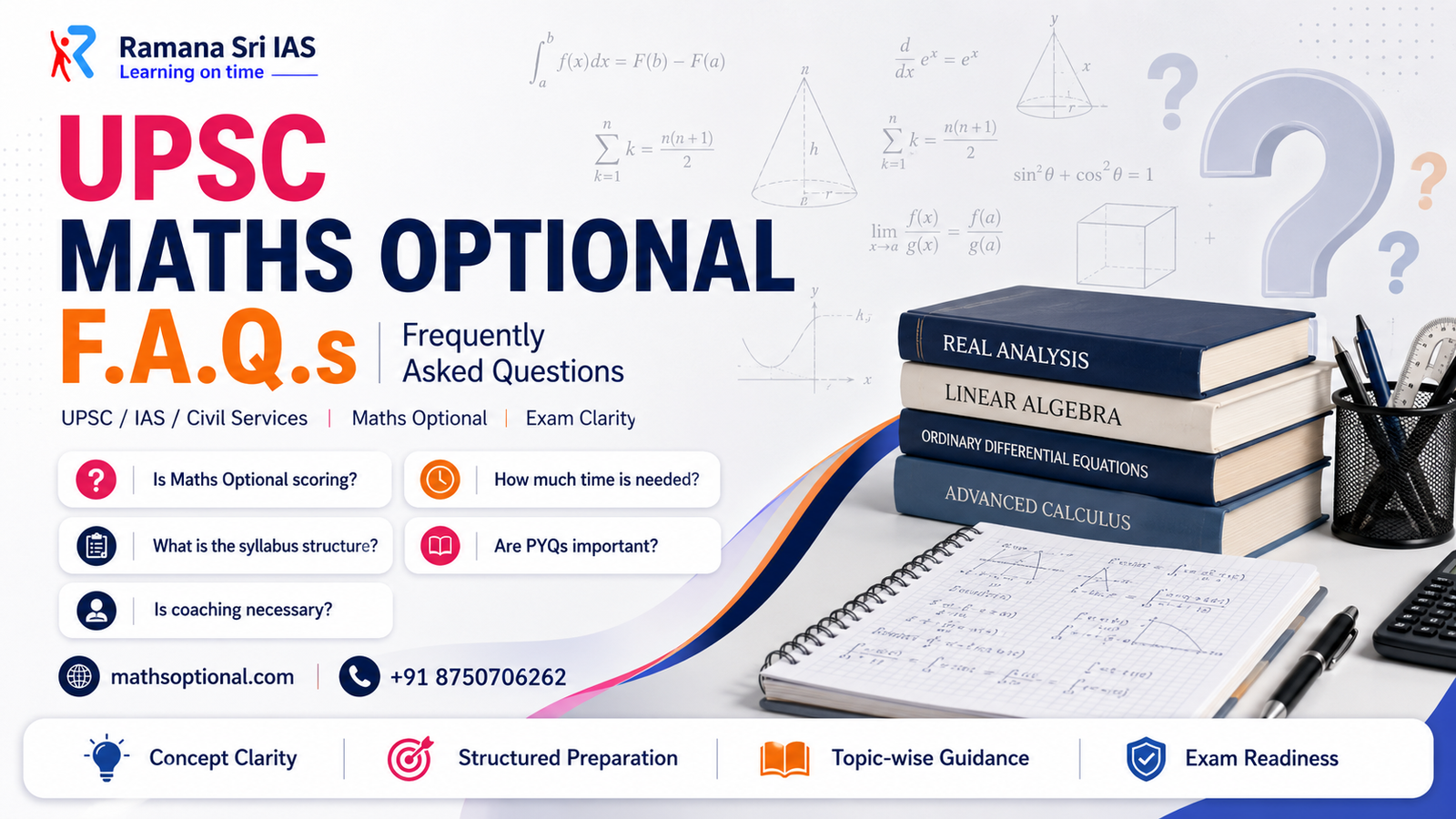
UPSC Maths Optional F.A.Q.s
How to prepare Maths Optional for UPSC?
For complete preparation of Maths Optional for UPSC, students should first understand the syllabus, divide Paper-1 and Paper-2 topic-wise, prepare proper notes, solve previous year questions, revise formulas, write mock tests and get answer-writing guidance. Students who need structured support can join Maths Optional coaching under Ramana Sri IAS guidance.
Does UPSC Maths allow optional calculator?
In UPSC Maths Optional, candidates should always follow the latest UPSC examination instructions printed in the official notification, admit card and question paper booklet. Generally, Maths Optional students prepare with a scientific non-programmable calculator, while programmable calculators and other electronic devices are not permitted. Candidates must verify the latest UPSC rules before the examination.
The purpose of the Maths Optional paper is not only calculation but also numerical analysis, problem-solving, logical reasoning and mathematical presentation. Therefore, students should practise calculations regularly and develop speed and accuracy even when using permitted tools.
Rough sheets or space provided in the examination can be used for intermediate steps, long calculations and solution planning. Students should not depend only on the calculator; they should also understand the mathematical method clearly.
Is there step marking in Maths Optional?
UPSC does not publicly disclose a detailed step-marking formula for Maths Optional. However, in Mathematics, the process of solving a problem is very important. Therefore, students should write answers step-by-step, show the method clearly and present solutions in a logical manner.
Even when the final answer is incorrect, a clear and correct approach may help the examiner understand the candidate’s mathematical reasoning. Candidates should write definitions, formulas, assumptions, diagrams and intermediate steps wherever required.
A clean step-by-step answer improves the chance of scoring better because the examiner can follow the thought process easily.
Can Maths be optional without coaching?
Maths Optional without coaching depends completely on the student’s level, background and discipline. A strong student with good mathematical foundation, enough time and proper resources may prepare through self-study.
However, for many students, preparing without coaching can take much longer because Maths Optional has a large syllabus and requires concept clarity, PYQ practice, mock tests and answer-writing improvement. If a student is preparing independently, they may need around two to three years depending on their level.
Coaching can reduce confusion, save time, provide direction and help students prepare in a more systematic manner.
What is scaling in Mathematics Optional?
Scaling in UPSC Mathematics Optional refers to a process used to maintain fairness and consistency in evaluation. Since different optional papers may vary in difficulty level, UPSC uses standard evaluation methods to ensure that candidates are assessed fairly.
The purpose of scaling is to balance difficulty variations and maintain a level playing field. It does not mean that students should worry unnecessarily about the subject. The best approach is to focus on strong preparation, accurate solutions, neat presentation and consistent mock test practice.
Students should prepare Mathematics Optional with the mindset that clear concepts, correct methods and disciplined practice are more important than worrying about scaling.
Does Mathematics have optional syllabus?
Yes. UPSC has a separate Mathematics Optional syllabus for the Civil Services Mains Examination. The syllabus covers topics from graduation-level Mathematics and includes both Paper-1 and Paper-2.
Important areas include Linear Algebra, Calculus, Analytical Geometry, Ordinary Differential Equations, Vector Analysis, Dynamics and Statics, Modern Algebra, Real Analysis, Complex Analysis, Linear Programming, Partial Differential Equations, Numerical Analysis, Computer Programming, Mechanics and Fluid Dynamics.
Students should read the official syllabus carefully before starting preparation and keep checking the syllabus while studying every topic.
Is Maths Optional in UPSC?
Yes. Mathematics is one of the optional subjects available in the UPSC Civil Services Mains Examination. Candidates with interest in Mathematics, logical reasoning and problem-solving can choose Maths Optional.
It is especially suitable for students from Mathematics, Science, Engineering, Statistics or technical backgrounds, provided they are ready to practise consistently.
What are the disadvantages of Maths Optional?
The main disadvantage of Maths Optional is that it requires regular practice, long syllabus coverage and strong conceptual clarity. It can become difficult for students who do not enjoy Mathematics or who are not ready to solve problems daily.
However, for students who have completed B.Sc., B.Tech. or have a strong mathematical foundation, there may not be a major disadvantage. With proper guidance and consistent practice, Maths Optional can become a high-scoring subject.
Who should take Maths Optional?
Any student with genuine interest in Mathematics can choose Maths Optional. A student should be comfortable with Mathematics from Class 11 and Class 12 onwards and should be ready to practise regularly.
Maths Optional is suitable for students who like logical problems, formulas, proofs, calculations and structured answers. Students should choose it only when they are confident that they can stay consistent throughout the preparation.
How many days will it take to complete Maths Optional?
Under proper guidance, it may take around seven months to complete the full UPSC Maths Optional syllabus. However, the exact time depends on the student’s background, daily study hours, mathematical foundation and revision discipline.
Students preparing with Ramana Sri IAS guidance can follow a structured plan to complete the syllabus, revise topics, solve PYQs and write mock tests within a realistic timeline.
What are the advantages of Maths Optional in UPSC?
Maths Optional can help students score high marks in UPSC Mains if they prepare properly. A good score in the optional subject can improve the overall rank and increase the chance of selection.
The syllabus is mostly static, answers are logical, marks can be more predictable, and there is less dependence on current affairs compared to many other optional subjects.
How can I prepare for Maths Optional in UPSC?
Start by reading the complete syllabus. Then divide the syllabus into Paper-1 and Paper-2 topics. Prepare notes, revise formulas, solve examples, practise previous year questions and write mock tests regularly.
Students can also use this website to understand the syllabus, courses, PYQs, test series, preparation strategy and admission process for UPSC Maths Optional.
Is Maths Optional scoring in UPSC?
Yes. Maths Optional can be a highly scoring optional subject in UPSC when students have strong concepts, regular practice, good answer presentation and proper time management.
The subject rewards accuracy, clarity and step-by-step solutions. Students who prepare seriously can use Maths Optional to improve their Mains score.
Main Areas Covered in These Maths Optional FAQs
Preparation Strategy
How to study syllabus, solve PYQs, revise formulas, write tests and prepare with discipline.
Exam Rules
Calculator, answer presentation, step-by-step writing and exam-hall related doubts.
Subject Selection
Who should take Maths Optional and what background is suitable for this subject.
Scoring Potential
Advantages, disadvantages, scaling and how Maths Optional can improve Mains marks.
How to Approach UPSC Maths Optional Preparation
1
Read the full UPSC Maths Optional syllabus and understand Paper-1 and Paper-2 topic-wise.
2
Start with strong concept building before directly solving difficult questions.
3
Maintain formula sheets and theorem notes for quick revision.
4
Solve previous year questions topic-wise after completing every module.
5
Write mock tests under time limits and improve answer presentation.
6
Revise weak topics repeatedly and take guidance wherever required.
Why Take Guidance for Maths Optional?
UPSC Maths Optional requires concept clarity, syllabus discipline, problem-solving ability and proper answer presentation. Without a clear plan, students may waste time on random preparation.
Ramana Sri IAS helps aspirants prepare Maths Optional with structured syllabus coverage, PYQ practice, test series, revision support and answer-writing guidance. Students can use coaching support to save time, improve accuracy and prepare in an exam-oriented manner.
Syllabus Coverage
Paper-1 and Paper-2 topics are covered in a structured manner.
PYQ Practice
Previous year questions help students understand actual UPSC expectations.
Test Series
Mock tests improve speed, accuracy and time management.
Answer Writing
Students learn step-by-step presentation for better scoring.
Related Resources
Continue Your UPSC Maths Optional Preparation
UPSC Maths Optional Syllabus
Check complete Paper-1 and Paper-2 syllabus
Previous Year Questions
Download and practise Maths Optional PYQs
Calculator in Maths Optional
Understand calculator-related guidance
Online Coaching
Join structured UPSC Maths Optional classes
Online Test Series
Practise mock tests and answer writing
Fee Structure
Check course-wise fee details
UPSC Maths Optional FAQs
Still Have Doubts About Maths Optional?
Fill the admission form or contact Ramana Sri IAS to get guidance on Maths Optional preparation, syllabus, test series, PYQs and course selection.