
UPSC Maths Optional Revision Course
Revision Maths Optional Course for UPSC, IAS, IFoS, CSE-Civil Service Exams
The Revision Maths Optional Course helps UPSC, IAS and IFoS aspirants revise the complete Maths Optional syllabus with theorem clarity, formula revision, PYQ practice, mock tests, answer-writing improvement and mentor guidance from Ramana Sri IAS.
This course also works as a Maths Optional crash course for students who want fast revision, important-module support, tough-topic clarity and exam-oriented practice before UPSC or IFoS Mains.
UPSC Maths Optional Coaching - How to Score Well in Maths with Revision
Choosing the right optional subject for UPSC is one of the most important decisions an aspirant makes. Maths is often considered a difficult optional, but with regular practice and proper revision, it can become one of the most scoring subjects.
Taking UPSC Maths Optional lectures and Revision Maths Optional Course is an excellent way to improve analytical ability, problem-solving skill and answer-writing confidence. Revision helps students remember formulas, understand theorems, avoid silly mistakes and write answers in a logical manner.
Revision Maths Optional Course is designed for students who have already studied the syllabus and now want to strengthen concepts, revise difficult areas, practise questions and improve test performance.
For Ramana Sri IAS students, the Revision Maths Optional Course and Maths Optional crash course serve the same practical purpose: quick syllabus strengthening, difficult-topic revision, previous year question practice, test support and final-stage answer-writing improvement.
Core message: Revision Maths Optional Course should include syllabus review, formula sheets, theorem practice, PYQs, mock tests, answer evaluation and repeated correction of weak areas.
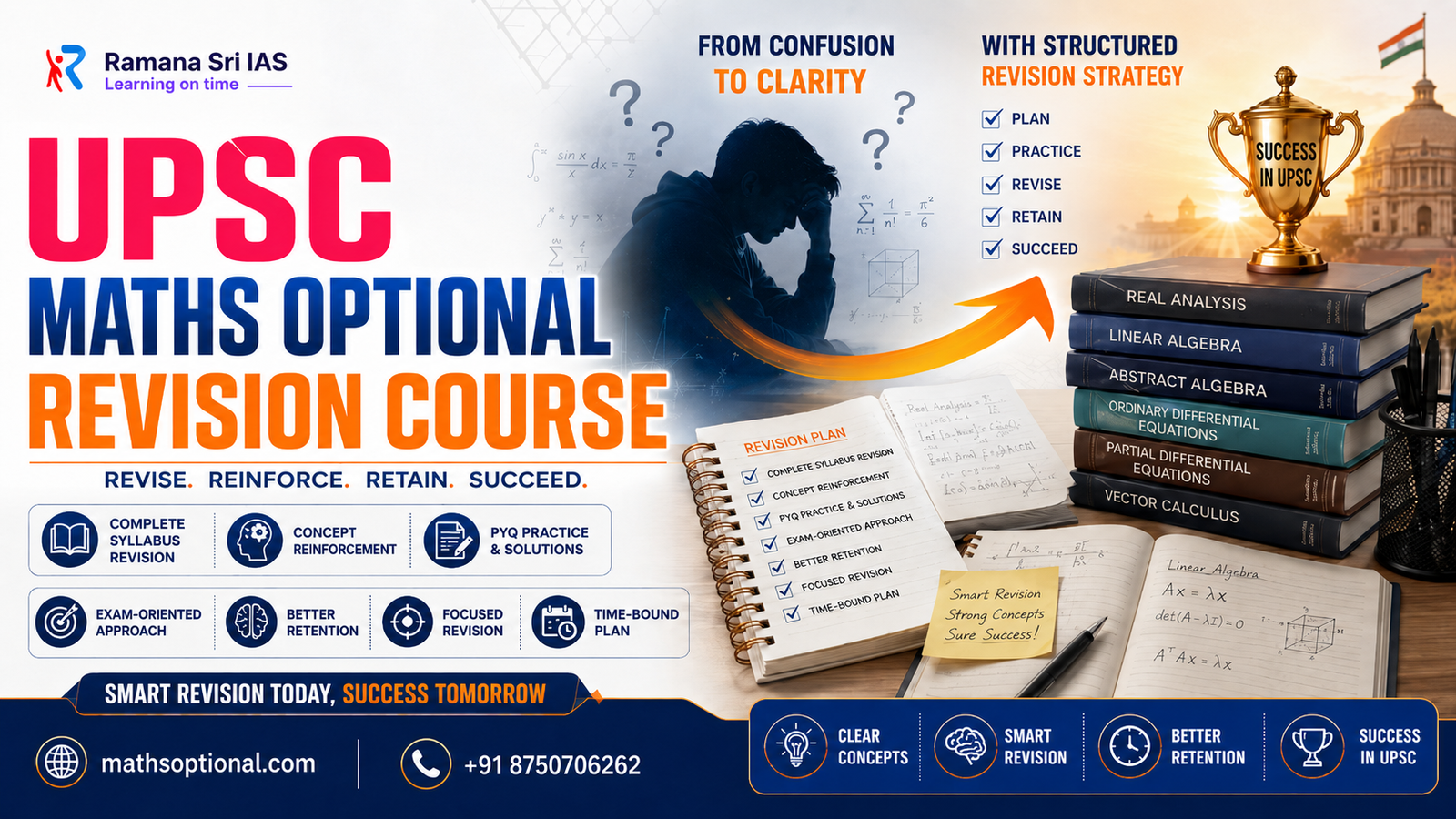
Course Highlights of Maths Optional Crash Course and Revision Course
Ramana Sri IAS provides Maths Optional crash course and revision course support for UPSC, IAS, IFoS and Civil Services aspirants who want focused preparation in a short and disciplined manner. The course helps students revise important modules, practise previous year questions and improve confidence before the examination.
The main aim is to help students move from passive revision to active problem solving. Students revise important concepts, apply standard methods, solve PYQs, write tests and improve answer presentation under mentor guidance.
Online Teaching Support
Students can revise important topics through structured online classroom guidance.
Study Materials
Notes and study materials help students revise important concepts faster.
PYQ Discussions
Previous year questions are discussed to understand UPSC pattern and method.
Test Practice
Tests help students improve speed, accuracy and final answer presentation.
Why Revision is Important for UPSC Maths Optional
Maths Optional requires a strong command over concepts, formulas, theorems and applications. Even if a student has completed the syllabus once, regular revision is necessary to retain the material and apply it correctly in the exam.
Revision also improves confidence. When students revise repeatedly, they become faster in solving questions, more accurate in calculations and more systematic in presentation.
Formula Retention
Repeated formula revision helps students avoid mistakes during problem solving.
Theorem Clarity
Revising theorem statements and proofs improves conceptual strength.
Speed Improvement
Regular revision makes standard methods faster and easier to recall.
Better Presentation
Revision helps students write answers in a logical and step-by-step manner.
Tough Modules Made Easier in Maths Optional Crash Course
Many students find modules like Modern Algebra, Real Analysis, Mechanics and Fluid Dynamics, Dynamics and Statics difficult during UPSC Maths Optional preparation. In the Maths Optional crash course and revision course, these areas are revised with concept clarity, standard methods, PYQ discussion and repeated problem-solving practice.
The course helps students understand how to approach difficult questions, how to select the right method and how to write answers within the given time frame. This is especially useful for students who have studied the syllabus but still feel low confidence in high-effort modules.
Modern Algebra
Group theory, ring theory and standard theorem-based questions are revised with PYQ focus.
Real Analysis
Limit, continuity, sequences, series and theorem-based areas are strengthened carefully.
Mechanics and Fluid Dynamics
Students revise important methods, equations and repeated UPSC problem types.
Dynamics and Statics
Standard problems are practised to improve accuracy and confidence.
Revision of UPSC Maths Optional Syllabus
Having an excellent score in Maths can help students improve their overall UPSC rank. But to score well, the syllabus must be revised thoroughly and practised through previous year questions.
Students should study the entire syllabus carefully, understand the concepts behind each topic and revise important formulas. The more the fundamentals are clear, the easier it becomes to apply them in problems.
The UPSC Mathematics Optional syllabus is well-balanced. It includes theorems, proofs and application-based problems. Students should also pay attention to question wording because careless reading can lead to avoidable mistakes.
Paper I Revision Areas
- Linear Algebra
- Calculus
- Analytical Geometry
- Ordinary Differential Equations
- Vector Analysis
- Dynamics and Statics
Paper II Revision Areas
- Modern Algebra
- Real Analysis
- Complex Analysis
- Linear Programming
- Partial Differential Equations
- Numerical Analysis
- Mechanics and Fluid Dynamics
Important Topics Covered in Maths Optional Crash Course
The Maths Optional crash course and revision course gives focused support for important Paper I and Paper II topics. Students are guided to revise high-value modules, practise standard questions and connect each topic with previous year question trends.
Main Focus Modules
- Abstract or Modern Algebra
- Real Analysis
- Calculus
- Linear Algebra
- Dynamics and Statics
- Mechanics and Fluid Dynamics
Additional Revision Support
- Ordinary Differential Equations
- Partial Differential Equations
- Analytical Geometry
- Linear Programming
- Numerical Analysis and Computer Programming
- Complex Analysis and Vector Analysis
Revision Method
How to Revise Maths Optional Effectively
Students should revise their work regularly so that important concepts are not forgotten. A proper schedule should be created with all important topics, formulas, theorems and weak areas clearly listed.
It is also useful to practise short answer steps, standard examples, theorem applications and previous year questions, because they help improve speed and accuracy. For Mains, the main focus should remain on full-length answer writing, proper method and clear final presentation.
- Create a revision timetable for the complete syllabus
- Maintain a formula and theorem notebook
- Revise confusing concepts repeatedly
- Practise previous year questions after revision
- Write timed answers and full-length mock tests
Revision Rule
Do not revise passively. Revise by solving questions.
Maths Optional revision becomes effective when students revise formulas and immediately apply them in PYQs and mock tests.
Join Revision CoursePYQ Practice and Time-Bound Problem Solving
A major goal of the Maths Optional crash course and revision course is to help students practise UPSC Maths Optional previous year questions within the exam time frame. PYQ discussion helps students understand repeated topics, question patterns, method selection and answer presentation.
Students should not only read solutions. They should solve questions, check the method, correct mistakes and practise again. This improves confidence in both Paper I and Paper II.
Question Pattern
PYQs help students understand how UPSC frames Maths Optional questions.
Method Selection
Students learn which method to apply in different types of problems.
Time Management
Timed PYQ practice improves speed during the actual Mains exam.
Answer Writing
Regular practice improves step-by-step presentation and final answer clarity.
Maths Optional Study Materials, Notes and Strategy Support
Study materials and notes are useful when they are connected with the UPSC Maths Optional syllabus and previous year questions. In the Revision Maths Optional Course, students get guidance on how to revise important formulas, theorems, standard examples and repeated PYQ areas.
Notes of other topics can also be used with strategy discussion so that students know what to revise deeply, what to practise repeatedly and how to avoid wasting time on less useful areas.
Formula Notes
Helps students revise important formulas quickly and repeatedly.
Theorem Notes
Important theorem statements and applications are revised carefully.
PYQ-Based Notes
Previous year question areas are connected with revision topics.
Strategy Discussion
Students learn how to cover weak areas with a practical revision plan.
Online Revision Maths Optional Course 2026 for UPSC, IAS, IFoS, CSE-Civil Service Exams
Maths is one of the most difficult subjects in the UPSC Mains Examination, but students who work hard can perform well if they understand theorems, practise applications and present answers logically.
Online revision courses are useful for students who cannot attend regular classes. These courses can include video lectures, study material, revision support and mock tests. They are helpful for students from different locations.
The syllabus for UPSC Maths Optional is well-balanced between theorems and applications. Students should understand the theory and be able to write it in a logical manner. Timed practice is also important because many questions require speed and accuracy.
Students searching for Maths Optional online crash course or Maths Optional online revision course can use this course for focused topic revision, PYQ practice, mock tests and final-stage guidance.
Video Revision
Students can revise difficult topics through structured video lectures.
Study Material
Notes and revision material help students revise faster.
Mock Tests
Timed tests help students check preparation quality.
Flexible Access
Online revision support is useful for students from any location.
Mock Tests in UPSC Maths Optional Revision
Many students believe that Maths is very difficult, but with diligent practice and proper revision, it becomes manageable. Mock tests and full-length papers from previous years help students understand the level of preparation.
Mock tests help students identify weak areas, improve answer-writing speed and learn how to manage the paper within the given time. Students should also take notes on topics they find difficult and write answers systematically.
Studying toppers’ answer scripts and getting feedback from mentors can improve answer presentation and reduce repeated mistakes.
The Maths Optional mock tests course and answer writing course support students who want to convert preparation into marks through timed practice, evaluation and correction.
Topic-wise Tests
Useful for checking concept clarity after each module.
Full-Length Papers
Helps students practise complete Paper I and Paper II under time limits.
Answer Evaluation
Mentor feedback helps improve accuracy and presentation.
Mistake Correction
Test analysis helps students correct repeated mistakes.
Mentorship for UPSC Maths Optional Revision
Mentorship is an important part of revision because a mentor helps students identify what to revise, how to revise and how to improve answer writing. A mentor can guide students through each topic and explain its relevance in the examination.
A good mentor also helps students find the right study methods, books and resources. Mentorship improves confidence, test-taking skills and the ability to write answers properly in the Civil Services Examination.
Students should respect the mentor’s time and follow the guidance sincerely. A revision plan becomes useful only when students apply the suggestions, write tests and correct mistakes consistently.
Study Strategy
A mentor helps students prepare a realistic revision plan.
Topic Priority
Students understand which areas need more attention.
Answer Feedback
Evaluation helps students improve presentation and method.
Confidence Building
Mentorship keeps students focused and motivated.
IFoS Maths Optional Crash Course and Revision Course Support
The Revision Maths Optional Course is also useful for IFoS Maths Optional aspirants because many Mathematics Optional topics overlap with UPSC CSE Maths Optional. Students preparing for IFoS can use this course for concept revision, PYQ practice, tough-module support and test-based preparation.
IFoS aspirants can especially benefit from additional practice in Paper I and Paper II modules, including Linear Algebra, Calculus, Analytical Geometry, ODE, Modern Algebra, Real Analysis, PDE, Numerical Analysis, Mechanics and Fluid Dynamics.
Current batch note: Batch timing, duration, test schedule and fee may change from time to time. Students should check the latest details through the admission form, WhatsApp guidance, call or fee structure page before joining.
Step-by-Step Revision Maths Optional Course Plan
A clear Revision Maths Optional Course plan saves valuable time in the final stage of Maths Optional preparation. Instead of revising all topics with equal time, students should know which areas need formula recall, which topics need theorem revision, which questions need repeated practice and which mistakes must be corrected before the exam. The revision course helps students follow this order with better discipline and exam-focused guidance.
1
Prepare a complete list of topics from Paper I and Paper II.
2
Revise formulas, theorem statements and standard methods topic-wise.
3
Solve previous year questions after revising each topic.
4
Write mock tests in a timed environment to improve speed and confidence.
5
Analyse mistakes and mark weak areas for second revision.
6
Revise toppers’ answer presentation style and improve your answer format.
Common Mistakes During Maths Optional Revision
Only Reading Notes
Revision should include question solving, not only reading formulas and notes.
No Timed Practice
Students should practise in a timed environment to improve exam speed.
Ignoring Weak Topics
Difficult topics should be revised repeatedly instead of being avoided.
No Answer Evaluation
Without evaluation, students may repeat the same mistakes in mock tests.
Why Choose Ramana Sri IAS Revision Course?
Ramana Sri IAS helps students revise UPSC Maths Optional in a structured and exam-oriented manner. The focus is on syllabus revision, formula clarity, theorem understanding, PYQ practice, mock tests and answer improvement.
Revision Maths Optional Course guidance helps students convert their preparation into marks. Students are guided to revise important topics, practise difficult questions and improve answer presentation before the final exam.
Many students complete the Maths Optional syllabus but still struggle during final revision of maths optional because they are not sure what to revise first, how to manage weak topics and how to convert preparation into marks. The Revision Maths Optional Course is designed for this stage, where students need a clear revision order, repeated PYQ practice, formula recall, theorem clarity and test-based correction.
This Revision Maths Optional Course is especially useful for aspirants who do not want to waste time revising randomly. Ramana Sri IAS guides students to revise Paper I and Paper II in a practical way, focus on high-effort areas, write answers within time limits and correct mistakes before the actual UPSC Mains examination. The aim is not only to complete revision, but to improve speed, accuracy and presentation.
Students who join the Revision Maths Optional Course get a more disciplined preparation path with mentor guidance, PYQ discussion, mock test practice and answer improvement support. If your syllabus is already completed but confidence is still missing, this course can help you move from passive revision to active exam-ready performance.
Students searching for UPSC Maths Optional crash course, Mathematics Optional crash course or Maths Optional final revision can use this same course as a focused preparation support system under Ramana Sri IAS guidance.
Structured Revision
Revision is planned topic-wise for Paper I and Paper II.
Formula and Theorem Focus
Important formulas and theorems are revised repeatedly.
PYQ and Test Practice
Students practise previous year questions and mock papers.
Mentor Feedback
Answer evaluation helps students correct mistakes and improve marks.
Need Crash Course Guidance?
Join Maths Optional Crash Course and Revision Course Support
Strengthen tough modules, revise important concepts, practise PYQs, write tests and improve your Maths Optional answer writing with focused guidance from Ramana Sri IAS.
Related Resources
Continue Your UPSC Maths Optional Revision Practice
Use the Revision Course along with PYQ practice, solved PYQs, IFoS extra practice, test series, demo videos, fee details and admission guidance.
UPSC Maths Optional PYQs Course
Revise through organised previous year question practice
UPSC Maths Optional PYQs
Practise UPSC Mathematics Optional previous year questions
IFoS Maths Optional PYQs
Use IFoS previous year questions for extra revision practice
UPSC Maths Optional PYQ Solutions
Check solved UPSC PYQs for method and answer presentation
IFoS Maths Optional PYQ Solutions
Study solved IFoS PYQs for stronger revision and practice
Maths Optional Test Series
Write tests to improve speed, accuracy and final performance
Demo Videos
Watch Ramana Sri IAS Maths Optional teaching style
Fee Structure
Compare revision course, PYQ course and test series fees
Admission Form
Apply for revision course, PYQ practice or test series support
UPSC Maths Optional Revision Course FAQs
Who should join the UPSC Maths Optional Revision Course?
Students who have completed the syllabus once and want structured revision, PYQ practice, mock tests and mentor feedback should join the revision course.
Why is revision important in Maths Optional?
Revision helps students remember formulas, theorems, methods and standard results. It also improves speed, accuracy and confidence.
Are mock tests necessary during revision?
Yes. Mock tests help students practise under exam conditions and identify mistakes before the final paper.
How should I revise Maths Optional?
Revise formulas and theorems topic-wise, solve PYQs, write mock tests, analyse mistakes and revise weak areas repeatedly.
How does mentorship help in revision?
Mentorship helps students prioritise topics, improve answer presentation, correct mistakes and stay focused.
Is the Revision Maths Optional Course same as Maths Optional crash course?
Yes. At Ramana Sri IAS, the Revision Maths Optional Course also works as a Maths Optional crash course for students who need fast revision, tough-module support, PYQ practice, mock tests and answer-writing improvement.
Which topics are covered in the Maths Optional crash course?
Important topics include Modern Algebra, Real Analysis, Calculus, Linear Algebra, Dynamics and Statics, Mechanics and Fluid Dynamics, ODE, PDE, Analytical Geometry, Complex Analysis, Vector Analysis, Linear Programming and Numerical Analysis.
Is this course useful for tough modules like Modern Algebra and Real Analysis?
Yes. The course gives special attention to difficult modules like Modern Algebra, Real Analysis, Mechanics and Fluid Dynamics through concept revision, PYQ discussion and repeated practice.
Is this course useful for IFoS Maths Optional also?
Yes. IFoS Maths Optional aspirants can also use this course for topic revision, PYQ practice, test support and important module guidance.
How can I check current batch timing, duration and fee?
Current batch timing, duration, test schedule and fee may change. Students should check the latest details through the admission form, WhatsApp guidance, call or fee structure page.
Need Revision or Crash Course Guidance?
Revise Maths Optional with Proper Guidance with Ramana Sri IAS
The Revision Maths Optional Course also works as a Maths Optional crash course for students who want fast syllabus revision, tough-module clarity, PYQ practice, mock tests, answer-writing support and final-stage guidance before UPSC or IFoS Mains.
Strengthen concepts, revise formulas, practise PYQs, write mock tests and improve your Maths Optional score with structured revision guidance.
Guidance support includes:
- Revision plan for Paper I and Paper II Maths Optional topics.
- Support for tough modules like Modern Algebra, Real Analysis, Mechanics and Fluid Dynamics.
- PYQ practice, mock tests, answer-writing guidance, batch details, fee and admission support.