
UPSC Maths Optional PYQ Papers
UPSC Maths Optional PYQs PDF Topic-wise Previous Year Questions
Prepare UPSC Maths Optional PYQs (Previous Year Questions) Papers from 2026 to 1992, topic-wise PYQ practice, exam-pattern understanding, time-management training and structured guidance from Ramana Sri IAS.
← Maths Optional PYQ Master HubRamana Sri IAS · Academic Resource Navigation
UPSC Maths Optional PYQ Hub
Use the complete UPSC PYQ system: full year-wise papers, module-wise practice, topic-wise resources, analysis, detailed solutions and test-series support.
Year-wise
Year-wise Question Papers
Download complete UPSC Mathematics Optional Paper I and Paper II question papers year by year.
Open resourceOn this pageModule-wise PYQs
Browse the existing module-wise PDFs and practise each major syllabus subject separately.
Open resourceTopic-wiseTopic-wise PYQs
Access deeper chapter-level and sub-topic-level PYQ classification when the dedicated resource is published.
Open resourceAnalysisPYQ Analysis
Filter questions and study module-wise marks, weightage, repeated areas and examination trends.
Open resourceSolutionsDetailed Solutions
Read structured solutions with the question, concept, diagram, detailed working and final answer.
Open resourcePracticePYQ Course / Test Series
Move from PYQ study to timed practice, answer presentation, evaluation and exam-oriented revision.
Open resourceUPSC Maths Optional Previous Year Question Papers | UPSC Maths Optional PYQs
We are providing all the UPSC Maths Optional Previous Year Question Papers, also known as UPSC Maths Optional PYQ Papers, in one place for serious aspirants preparing Mathematics Optional for the Civil Services Examination.
Preparing for UPSC Maths Optional becomes more effective when students solve UPSC Maths Optional PYQs i.e., UPSC Maths Optional previous year question papers regularly. PYQs help students understand the importance of repeated topics, question framing, difficulty level and expected answer presentation.
If you are considering taking UPSC Maths Optional for the Civil Services Examination, previous year question papers should become a regular part of your preparation. These papers help you understand the exam pattern, identify important topics, practise time management and improve speed and accuracy.
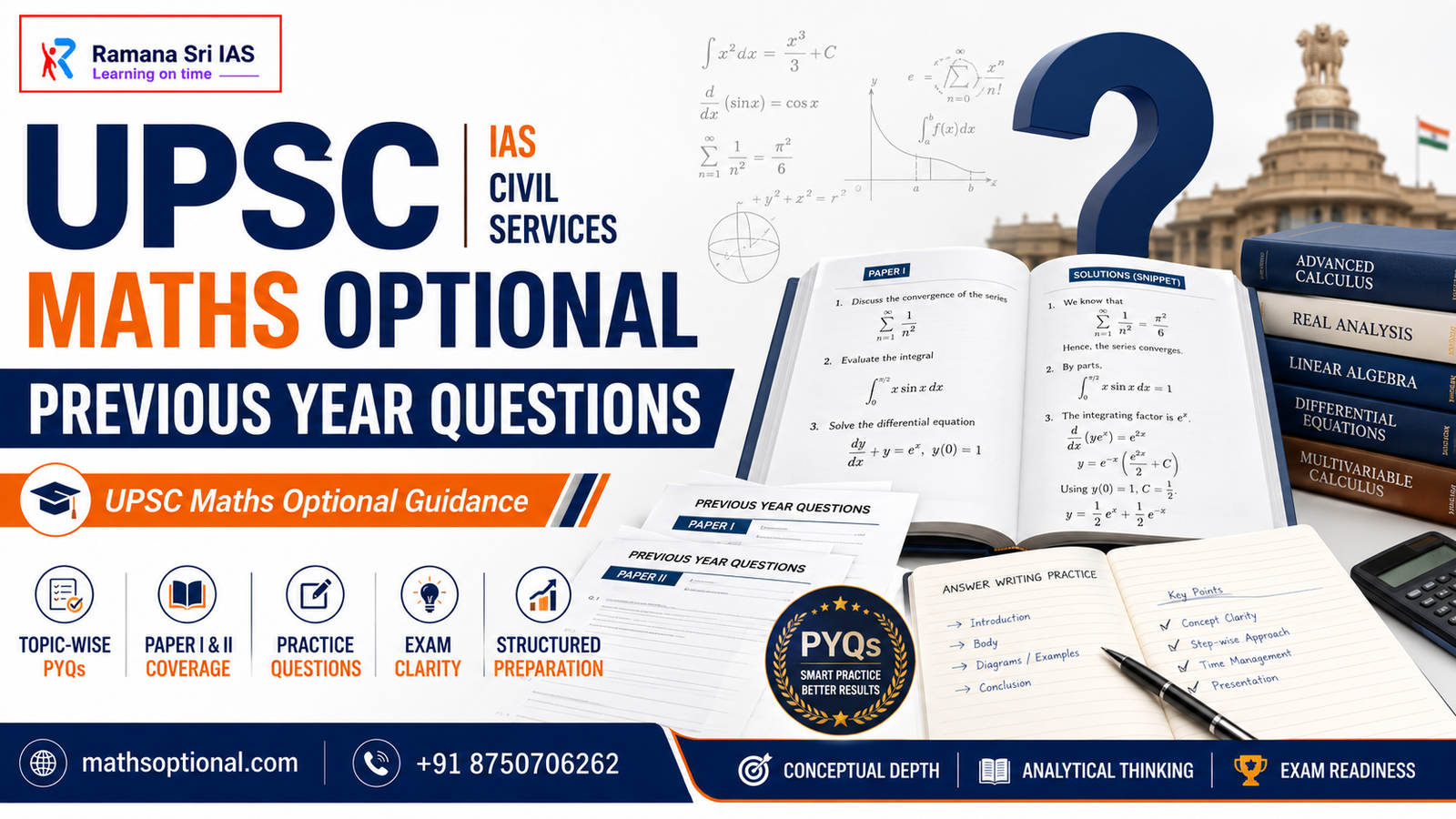
The Significance of UPSC Maths Optional Previous Year Question Papers
UPSC Maths Optional PYQs papers are an invaluable resource when it comes to preparing for any competitive examination, and the UPSC Maths Optional is no exception. They give students a practical understanding of the real exam and help them prepare with direction.
Familiarity with Exam Pattern
By solving UPSC Maths Optional PYQs papers, students understand the exam pattern, type of questions asked and distribution of marks etc.
Identifying Important Topics
PYQs help students identify topics that are frequently asked and should be prioritised during preparation.
Practising Time Management
UPSC Maths Optional questions can be lengthy, so solving regular intervals UPSC Maths Optional PYQs helps students manage time effectively.
Improving Speed and Accuracy
Regular practice improves mathematical speed, calculation accuracy and confidence in solving problems.
The Importance of UPSC Maths Optional PYQs Papers
Exam Difficulty Awareness
PYQs help students understand the level of difficulty and question types used in UPSC Mathematics Optional.
Recurring Topics
By solving PYQs, students can identify recurring topics and focus on the most important areas.
Question Framing
UPSC questions can be framed in tricky ways. PYQ practice helps students interpret questions correctly.
Confidence Building
Solving old papers builds confidence and prepares students for real exam conditions.
Tips for Solving UPSC Maths Optional Previous Year Question Papers
1
Start solving previous year question papers early in your preparation journey.
2
Create a schedule and dedicate fixed time slots for solving PYQ papers.
3
After every paper, analyse your performance and identify weak areas.
4
Seek guidance from mentors, teachers or fellow aspirants for difficult questions.
5
Practise regularly because repeated PYQ solving improves exam readiness.
6
Maintain a progress journal to track solved papers, mistakes and improvement areas.
UPSC Maths Optional PYQs Module-wise PDF Downloads
Download module-wise UPSC Mathematics Optional Previous Year Questions PDFs from 2025 to 1992. Each button is linked to its respective PDF file.
Linear Algebra
Previous year questions for UPSC Maths Optional Linear Algebra.
Download PDFCalculus
Previous year questions for UPSC Maths Optional Calculus.
Download PDFAnalytical Geometry
Previous year questions for UPSC Maths Optional Analytical Geometry.
Download PDFOrdinary Differential Equations
Previous year questions for UPSC Maths Optional Ordinary Differential Equations.
Download PDFVector Analysis
Previous year questions for UPSC Maths Optional Vector Analysis.
Download PDFDynamics & Statics
Previous year questions for UPSC Maths Optional Dynamics, Statics and Hydrostatics.
Download PDFModern Algebra
Previous year questions for UPSC Maths Optional Modern Algebra.
Download PDFReal Analysis
Previous year questions for UPSC Maths Optional Real Analysis.
Download PDFComplex Analysis
Previous year questions for UPSC Maths Optional Complex Analysis.
Download PDFLinear Programming
Previous year questions for UPSC Maths Optional Linear Programming.
Download PDFPartial Differential Equations
Previous year questions for UPSC Maths Optional Partial Differential Equations.
Download PDFNumerical Analysis & Computer Programming
Previous year questions for UPSC Maths Optional Numerical Analysis and Computer Programming.
Download PDFMechanics & Fluid Dynamics
Previous year questions for UPSC Maths Optional Mechanics and Fluid Dynamics.
Download PDF
All Modules ZIP
Download All Modules ZIP
Download UPSC Maths Optional PYQs of All Modules
Download all UPSC Maths Optional PYQ modules together in one ZIP file for complete offline practice.
How Ramana Sri IAS Helps You Use UPSC Maths Optional PYQs
Downloading UPSC Maths Optional PYQs is only the first step. Students must know how to connect each previous year question with the correct syllabus topic, revise the related theorem or formula, and practise the solution in a proper UPSC Mains answer-writing format.
Ramana Sri IAS helps aspirants use UPSC Maths Optional PYQs for topic-wise practice, repeated-topic analysis, concept revision, mock-test preparation, answer presentation and final revision. This prevents students from only collecting PDFs and helps them convert PYQ practice into real exam improvement.
After downloading the PYQ PDFs, students can move to PYQ solutions, test series, demo videos, fee details and admission guidance. Our Ramana Sri IAS admission team will guide you through WhatsApp, email, or call for the next preparation step.
How to Make the Most of UPSC Maths Optional PYQs Papers
Start with Basics
Before attempting PYQ papers, ensure that your fundamental mathematical concepts are clear.
Analyze Each Question
After solving a PYQ, analyse the concept, technique and method used in that question.
Practice Regularly
Set aside dedicated time every day to solve PYQ papers and different types of questions.
Time Yourself
Solve PYQs under time limits to simulate real exam conditions and improve efficiency.
Why Use UPSC Maths Optional PYQs Papers with Ramana Sri IAS Guidance?
Solving UPSC Maths Optional PYQ papers is an essential part of preparation strategy. It helps students gain confidence, enhance problem-solving skills and improve conceptual clarity.
With structured guidance, students can learn how to analyse questions, identify repeated patterns, improve answer presentation and avoid common mistakes. PYQ practice becomes more powerful when combined with concept revision, mock tests and mentor feedback.
Many students download UPSC Maths Optional PYQs but do not know how to use them in the right order. Ramana Sri IAS helps students connect each PYQ with the correct syllabus topic, revise the related formula or theorem, understand the solving method and practise answer presentation. This makes PYQ practice more systematic and more useful for final UPSC Mains preparation.
Topic-wise PYQ Mapping
Connect each syllabus topic with actual previous year questions.
Answer Presentation
Learn how to write mathematical solutions clearly and systematically.
Mock Test Support
Convert PYQ practice into full-length exam readiness.
Progress Tracking
Maintain a record of solved papers, weak areas and repeated mistakes.
Conclusion of UPSC Maths Optional Previous Year Question Papers
Solving previous year question papers is an essential part of UPSC Maths Optional preparation. It helps students understand the exam pattern and enhances problem-solving skills, time management and accuracy.
By following the right PYQ strategy and dedicating consistent effort, students can prepare strongly for UPSC Maths Optional and increase their chances of success in the Civil Services Examination.
Related Resources
Continue Your UPSC Maths Optional PYQ Preparation
Use UPSC Maths Optional PYQs with year-wise question papers, solved answers, syllabus, coaching support, test series, demo videos, student reviews, fee details and admission guidance.
UPSC Maths Optional Question Papers
Download year-wise Paper I and Paper II question papers
UPSC Maths Optional PYQ Solutions
Use guided solution support and answer presentation help
UPSC Maths Optional Syllabus
Check complete Paper I and Paper II syllabus
UPSC Maths Optional Coaching
Prepare with structured coaching support
Maths Optional Test Series
Improve speed, accuracy and answer presentation
Free Demo Videos
Watch teaching style before admission
Student Reviews
Read feedback and preparation experience
Fee Structure
Check course-wise fee details
Admission Form
Start your preparation with guidance
UPSC Maths Optional PYQs FAQs
Where can I download UPSC Maths Optional PYQs PDF?
You can download UPSC Maths Optional PYQs PDF topic-wise on this page. The PDFs cover important modules for Paper I and Paper II and help aspirants practise previous year questions systematically.
Are UPSC Maths Optional PYQs useful for preparation?
Yes. UPSC Maths Optional PYQs help students understand repeated topics, question patterns, difficulty level, answer-writing expectations, calculation speed and time management for the Mains examination.
Should I practise topic-wise PYQs or year-wise question papers?
Both are useful. Topic-wise PYQs help with concept mastery and revision, while year-wise question papers help students understand the real exam pattern and time-management requirements.
Where can I get UPSC Maths Optional PYQ solutions?
You can use the UPSC Maths Optional PYQ Solutions page, demo videos and Ramana Sri IAS guidance to practise previous year questions with proper methods and answer presentation.
How can Ramana Sri IAS help with UPSC Maths Optional PYQ preparation?
Ramana Sri IAS helps students connect PYQs with syllabus topics, revise formulas and theorems, practise step-by-step solutions, improve answer presentation, join test series and get admission guidance through WhatsApp, email, or call.
UPSC Maths Optional PYQ Papers
Start PYQ-Based Maths Optional Preparation with Ramana Sri IAS
Download module-wise PYQ papers, practise regularly, improve speed and prepare UPSC Maths Optional with structured guidance.