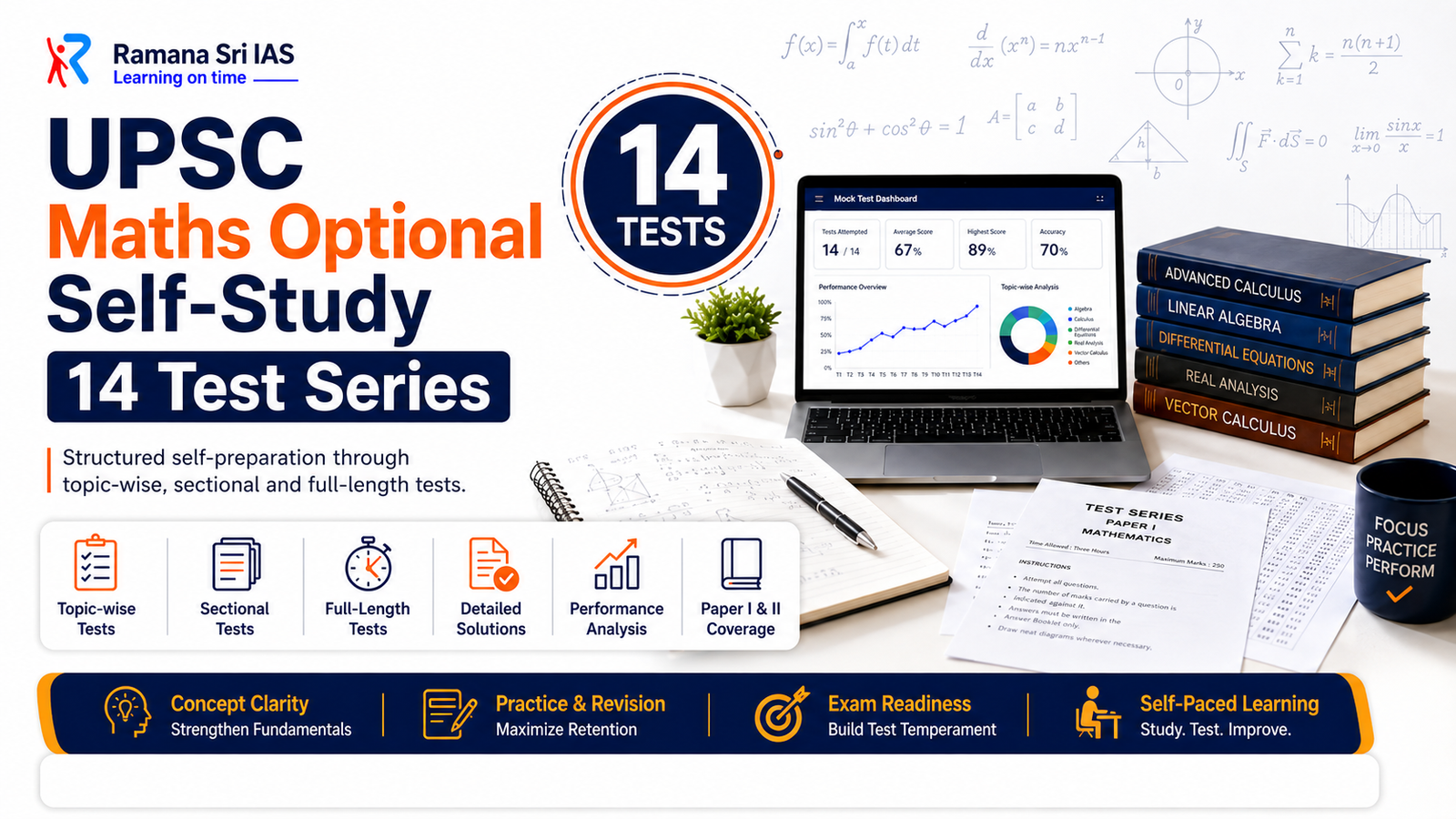
UPSC Maths Optional Self-Study 14 Test Series
A focused final-stage UPSC Maths Optional Self-Study 14 Test Series for aspirants who have already completed the syllabus and now want sectional revision, Paper-I practice, Paper-II practice and final grand practice before Mains.
Self-Study 14 Test Series for UPSC Maths Optional
The UPSC Maths Optional Self-Study 14 Test Series is designed for aspirants who have completed the major syllabus and want a compact, powerful and exam-focused practice plan before the final Mains examination.
This test series is not a beginner-level syllabus learning plan. It is mainly useful for students who need final revision, answer-writing practice, speed improvement, accuracy improvement and paper-wise exam readiness.
The structure begins with sectional tests from Paper-I and Paper-II, then moves towards complete Paper-I, complete Paper-II and repeated Paper-I & Paper-II final grand practice.
The UPSC Maths Optional Self-Study 14 Test Series is useful for aspirants who want a short, focused and result-oriented final practice plan. After completing the syllabus, many students need a disciplined method to revise Paper-I and Paper-II, improve answer presentation, reduce calculation mistakes and build confidence before Mains. This test series gives that structure through sectional tests, full-paper practice and final grand revision.
Ramana Sri IAS designed this UPSC Maths Optional Self-Study 14 Test Series is for students who do not want random revision in the final stage. Each test helps aspirants check their preparation level, identify weak areas, revise important formulas and practise under exam-like conditions. With proper analysis after every test, students can improve speed, accuracy, question selection and step-by-step solution writing for UPSC Maths Optional.
Who Should Use This 14 Test Series?
Students Who Completed Syllabus
Aspirants who already completed Paper-I and Paper-II can use this test series for final performance checking.
Repeat Aspirants
Repeat candidates can use these tests to identify old mistakes and improve accuracy before the next Mains.
Self-Study Students
Students preparing independently can follow this UPSC Maths Optional Self-Study 14 Test Series structure as a compact final practice roadmap.
High-Score Target Students
Serious aspirants targeting strong optional marks can improve speed, presentation and exam temperament.
UPSC Maths Optional Self-Study 14 Test Series Plan
This UPSC Maths Optional Self-Study 14 Test Series structure is prepared from the final-stage section and full-paper practice pattern of the larger self-study test structure. It is suitable for students who want a short and focused revision-based Maths Optional test series.
| New Test No. | Test Topic | Practice Type |
|---|---|---|
| Test-01 | Paper-I Section A | Sectional Practice |
| Test-02 | Paper-I Section B | Sectional Practice |
| Test-03 | Paper-II Section A | Sectional Practice |
| Test-04 | Paper-II Section B | Sectional Practice |
| Test-05 | Paper-I | Full Paper Practice |
| Test-06 | Paper-II | Full Paper Practice |
| Test-07 | Paper-I & Paper-II | Combined Practice |
| Test-08 | Paper-I & Paper-II | Combined Practice |
| Test-09 | Paper-I & Paper-II | Combined Practice |
| Test-10 | Paper-I & Paper-II | Final Grand Practice |
| Test-11 | Paper-I & Paper-II | Final Grand Practice |
| Test-12 | Paper-I & Paper-II | Final Grand Practice |
| Test-13 | Paper-I & Paper-II | Final Grand Practice |
| Test-14 | Paper-I & Paper-II | Final Grand Practice |
How the 14 Tests Are Arranged
Paper-I Section A, Paper-I Section B, Paper-II Section A and Paper-II Section B practice.
One complete Paper-I practice test and one complete Paper-II practice test.
Paper-I and Paper-II combined practice for overall optional preparation checking.
Final repeated Paper-I and Paper-II practice to build exam confidence before Mains.
What Students Will Gain from the 14 Test Series
Fast Final Revision
The 14-test structure helps students revise important Paper-I and Paper-II areas without following a very long test plan.
Better Time Management
Time-bound practice trains students to manage lengthy Maths Optional papers more effectively.
Improved Accuracy
Regular test writing reduces formula mistakes, calculation errors, method gaps and incomplete solutions.
Final Exam Confidence
Repeated Paper-I and Paper-II practice builds confidence before the final UPSC Mains examination.
Why the 14 Test Series Is Important for UPSC Maths Optional
Many UPSC Maths Optional aspirants complete the syllabus but still struggle in the final examination because they do not practise under proper exam conditions. Mathematics Optional is not only about knowing formulas and theorems. It also requires speed, accuracy, step-by-step presentation, proper use of diagrams, correct selection of questions and strong time management.
The UPSC Maths Optional Self-Study 14 Test Series helps students convert their completed syllabus into exam-ready performance. Through sectional tests, students revise important areas of Paper-I and Paper-II separately. Through full-paper tests, they learn how to manage three hours, attempt the right questions, avoid lengthy traps and maintain clean answer presentation.
This UPSC Maths Optional Self-Study 14 Test Series is especially useful in the last stage of preparation because it gives a disciplined structure to revision. Instead of revising randomly, students can write tests, analyse mistakes, revise weak areas and gradually improve confidence before UPSC Mains.
How to Use the 14 Test Series Effectively
Revise the relevant formulas, standard results, theorems and previous mistakes before writing each test.
Attempt every test in a serious exam-like environment with a fixed time limit.
During the test, focus on neat steps, correct logic, proper diagrams and final answer clarity.
After every test, analyse wrong answers, incomplete solutions, skipped questions and calculation mistakes.
Revise weak areas again before moving to the next test so that every test improves your preparation.
What Students Should Analyse After Every Test
Question Selection
Students should check whether they selected the right questions and avoided lengthy or doubtful questions in the first round.
Time Management
Students should analyse whether they completed the paper within time and how much time was lost on difficult questions.
Answer Presentation
Every solution should have proper heading, formula, substitution, calculation, conclusion and diagram wherever required.
Mistake Correction
The most important question after every test should be: “What exactly should I improve before the next test?”
Students should also check whether their answers are examiner-friendly. In Maths Optional, presentation matters a lot. A correct answer written in a confusing or incomplete manner may not get full marks. Therefore, every test should be followed by proper analysis and correction.
Best Time to Join This 14 Test Series
The UPSC Maths Optional Self-Study 14 Test Series is best for students who have already completed most of the syllabus. It is suitable during the final revision phase, especially when the student wants to move from topic learning to answer-writing practice.
Students who still have large parts of the syllabus pending should first complete the core topics. After that, they can use this test series for revision, speed improvement and final exam practice. Repeat aspirants can also use this 14-test structure to quickly identify weak areas and improve their previous attempt performance.
This test series is also suitable for self-study students who do not want a very long test plan but still need a structured, result-oriented practice schedule.
Common Mistakes Students Make in Maths Optional Test Practice
- Writing tests without proper revision and then feeling demotivated by low marks.
- Not analysing the paper after writing it and repeating the same mistakes again and again.
- Ignoring calculation errors, incomplete proofs, missing steps and wrong question selection.
- Spending too much time on one difficult question and leaving easier scoring questions.
- Checking only marks instead of checking concept clarity, presentation quality and time management.
In UPSC Maths Optional, smart question selection is very important. Students should first attempt questions they can solve confidently, then move to medium questions and finally attempt difficult questions if time permits.
Answer Writing Strategy for UPSC Maths Optional
Write Step-by-Step
Students should avoid jumping directly to the final answer without showing the method and logical flow.
Use Correct Formulas
Important formulas, theorems, assumptions and standard results should be written clearly wherever required.
Draw Proper Diagrams
In topics like Analytical Geometry, Mechanics, Fluid Dynamics and Vector Analysis, neat diagrams can improve answer quality.
Avoid Overwriting
The answer should be complete but not unnecessarily lengthy. A clean, logical and readable answer is better.
90-Day Revision Plan with 14 Test Series
Students can complete the UPSC Maths Optional Self-Study 14 Test Series in around 90 days if they follow a disciplined and balanced revision plan. This 90-day schedule is especially useful for students who want enough time for concept revision, formula revision, test writing, answer analysis and correction of weak areas before UPSC Mains.
Revise Linear Algebra, Calculus, Analytical Geometry, ODE, Vector Analysis, Statics and Dynamics. Focus on formulas, standard results, solved examples and PYQ patterns.
Revise important theorems, repeated problem types and lengthy calculation-based questions. Write sectional tests and analyse mistakes carefully.
Focus on Modern Algebra, Real Analysis, Complex Analysis and Linear Programming. Revise definitions, theorems, proofs and standard examples.
Revise PDE, Numerical Analysis, Computer Programming, Mechanics and Fluid Dynamics. Practise diagrams, standard methods and numerical accuracy.
Start full-length Paper-I and Paper-II tests within the actual time limit. Analyse question selection, time management, skipped questions and presentation.
Focus on formula revision, grand tests, mistake correction and confidence building. Avoid too many new topics and strengthen already prepared areas.
| Revision Phase | Days | Main Focus | Test Series Use |
|---|---|---|---|
| Phase 1 | Day 1–15 | Paper-I basic revision | Initial sectional tests |
| Phase 2 | Day 16–30 | Paper-I weak areas and PYQ patterns | More sectional practice |
| Phase 3 | Day 31–45 | Paper-II abstract topics | Sectional tests for Algebra, Analysis and Complex |
| Phase 4 | Day 46–60 | Paper-II applied topics | Sectional tests for PDE, Numerical, Mechanics and Fluid |
| Phase 5 | Day 61–75 | Full Paper-I and Paper-II practice | Full-length test practice |
| Phase 6 | Day 76–90 | Final revision and mistake correction | Grand tests and final improvement |
A practical 90-day method is: revise the topic first, write the test, analyse the answer sheet, correct mistakes, revise weak areas again and then move to the next test. This cycle helps students improve accuracy, speed, presentation and exam temperament. If followed seriously, the 14 Test Series can become a complete 90-day revision and performance-improvement plan for UPSC Maths Optional.
Final Checklist Before Writing Each Test
- Revise important formulas, standard examples, previous year question patterns and your mistake notebook.
- Keep all required stationery ready and sit for the test with a serious Mains-like mindset.
- Carefully read all questions before starting and choose questions wisely.
- Avoid spending too much time on one difficult problem.
- After the test, mark doubtful answers, skipped questions and time-consuming areas.
- Revise weak topics before moving to the next test.
Why Choose Ramana Sri IAS for Maths Optional Test Practice
Ramana Sri IAS focuses on structured Mathematics Optional preparation with strong attention to concepts, formulas, diagrams, answer-writing methods and exam-oriented practice. The purpose of the 14 Test Series is not only to give question papers but also to help students practise in a disciplined and result-oriented manner.
Students preparing for UPSC Maths Optional need a clear path from syllabus completion to final Mains performance. This test series helps bridge that gap through sectional practice, full-paper writing and final revision.
For serious aspirants, the 14 Test Series can become a compact but powerful tool to improve speed, accuracy, confidence and answer presentation before UPSC Mains.
Continue Your Maths Optional Preparation
Use this 14 Test Series together with syllabus, PYQs, study materials, demo videos and complete Maths Optional guidance.
UPSC Maths Optional Self-Study 14 Test Series FAQs
Who should join the 14 Test Series?
This test series is suitable for students who have completed the UPSC Maths Optional syllabus and want final-stage sectional and full-paper practice.
Is the 14 Test Series suitable for beginners?
It is not mainly for beginners. Beginners should first complete the syllabus and then use this test series for revision and exam-level practice.
Does this test series cover both Paper-I and Paper-II?
Yes. It includes Paper-I sectional practice, Paper-II sectional practice, full Paper-I, full Paper-II and combined Paper-I & Paper-II final grand practice.
How is this different from the 40 Test Series or 62 Test Series?
The 40 and 62 Test Series are more detailed and topic-wise. The 14 Test Series is shorter and mainly focused on final-stage revision and grand practice.
How should I write these 14 tests?
Write each test in a fixed time limit, check your mistakes, revise weak topics and use the final tests as full Mains-level exam simulation.
Join Ramana Sri IAS 14 Test Series for UPSC Maths Optional
Practise sectional tests, full papers and final grand practice through the UPSC Maths Optional Self-Study 14 Test Series to improve speed, accuracy, confidence and answer presentation before UPSC Mains.