UPSC Maths Optional Books
UPSC Maths Optional Books, Sample Study Materials, Notes
Explore UPSC Maths Optional books, sample study materials, notes, practice tests, study guides, video tutorials and module-wise sample PDFs for structured Mathematics Optional preparation.
Books for Maths Optional UPSC | UPSC Maths Optional Books, Sample Study Materials, Notes
Welcome to our collection of UPSC Maths Optional books, sample study materials and notes. Whether you are preparing for the UPSC Civil Services Examination or building your Mathematics Optional foundation, the right books and study resources can help you prepare with more clarity and confidence.
A good UPSC Maths Optional book should help students understand the syllabus, build concepts, learn standard methods and practise enough questions. Books are useful only when they are used with the UPSC syllabus, previous year questions, revision notes and regular answer-writing practice.
Ramana Sri IAS UPSC Maths Optional books and sample study materials were designed and developed by our team in 2023 for structured, module-wise preparation of Paper I and Paper II. These materials are prepared to support concept clarity, solved examples, standard methods, PYQ practice and exam-oriented revision.
Students can use practice tests to assess progress, comprehensive study guides to understand topics clearly, video tutorials to learn difficult concepts, flashcards to revise formulas and study communities to stay connected with fellow aspirants.
Ramana Sri IAS provides guidance for UPSC Maths Optional books, study materials, sample notes and problem-solving resources for topics like Linear Algebra, Calculus, Differential Equations, Vector Analysis, Complex Analysis, Linear Programming, Numerical Analysis, Analytical Geometry, Modern Algebra, Real Analysis, Dynamics, Statics, Mechanics and Fluid Dynamics.
UPSC Maths Optional Sample Study Materials
Practice Tests
Test your knowledge and assess your progress with practice tests. These tests help students identify weak areas and focus their study efforts.
Study Guides
Comprehensive study guides provide a clear and organized overview of important topics, key concepts and examples for effective preparation.
Video Tutorials
Video tutorials help students understand complex concepts in a simple and engaging way at their own pace.
Flashcards
Flashcards are useful for memorizing formulas, terms, concepts, definitions and frequently used results.
Study Communities
Study communities help students discuss doubts, share study tips and stay connected with fellow learners.
Previous Year Questions
PYQs help aspirants understand the actual UPSC Maths Optional exam pattern and repeatedly asked areas.
UPSC Maths Optional Books and Study Material Coverage
Ramana Sri IAS provides all books for UPSC Maths Optional and the UPSC Maths Optional book list for important modules including Linear Algebra, Matrices, Calculus, Differential Calculus, Integral Calculus, Ordinary Differential Equations, Partial Differential Equations, Vector Analysis, Complex Analysis, Linear Programming, Numerical Analysis, Computer Programming, Analytical Geometry, Modern Algebra, Real Analysis, Dynamics, Statics, Mechanics and Fluid Dynamics.
These Ramana Sri IAS materials are not random book links. They are institute-developed, exam-oriented resources designed in 2023 to help students study module-wise, revise systematically and connect concepts with previous year question patterns.
Many UPSC toppers follow important books for UPSC Maths Optional. Students may also refer to standard books such as Shanti Narayan and P.K. Mittal books, but some books may be difficult to understand without proper guidance. Therefore, students should choose resources according to their level and preparation need.
Mathematics Optional is a scoring optional subject among UPSC optional subjects when students prepare with correct books, clear concepts, regular practice and proper answer presentation.
Do Not Buy Too Many Books for UPSC Maths Optional
Many students collect too many books for UPSC Maths Optional and then struggle to finish the syllabus on time. This is not the right strategy. A better approach is to select one main resource for each module, study only the syllabus-relevant portions and practise previous year questions regularly.
UPSC Maths Optional has around 13 core modules from Linear Algebra to Mechanics and Fluid Dynamics. Instead of reading every book from the first page to the last page, students should first check the UPSC Maths Optional syllabus, identify the required concepts, solve topic-wise PYQs and revise the important methods again and again.
The UPSC Mathematics Optional syllabus has broadly remained unchanged since 2009. This gives students a clear advantage because previous year questions, standard books, topic-wise notes and module-wise practice can be used in a planned way for long-term preparation.
Standard books are useful, but they should be used with proper planning. Ramana Sri IAS study materials, class notes, solved examples, previous year questions, mock tests and revision sheets should work together as one preparation system.
UPSC Maths Optional Sample Books PDF Downloads
Download module-wise UPSC Maths Optional sample books and study material PDFs. Each book image and download button is linked to its respective PDF file.
Use these sample PDFs to understand the presentation style, module coverage, examples, solved methods and preparation approach before requesting complete materials or joining a structured course.
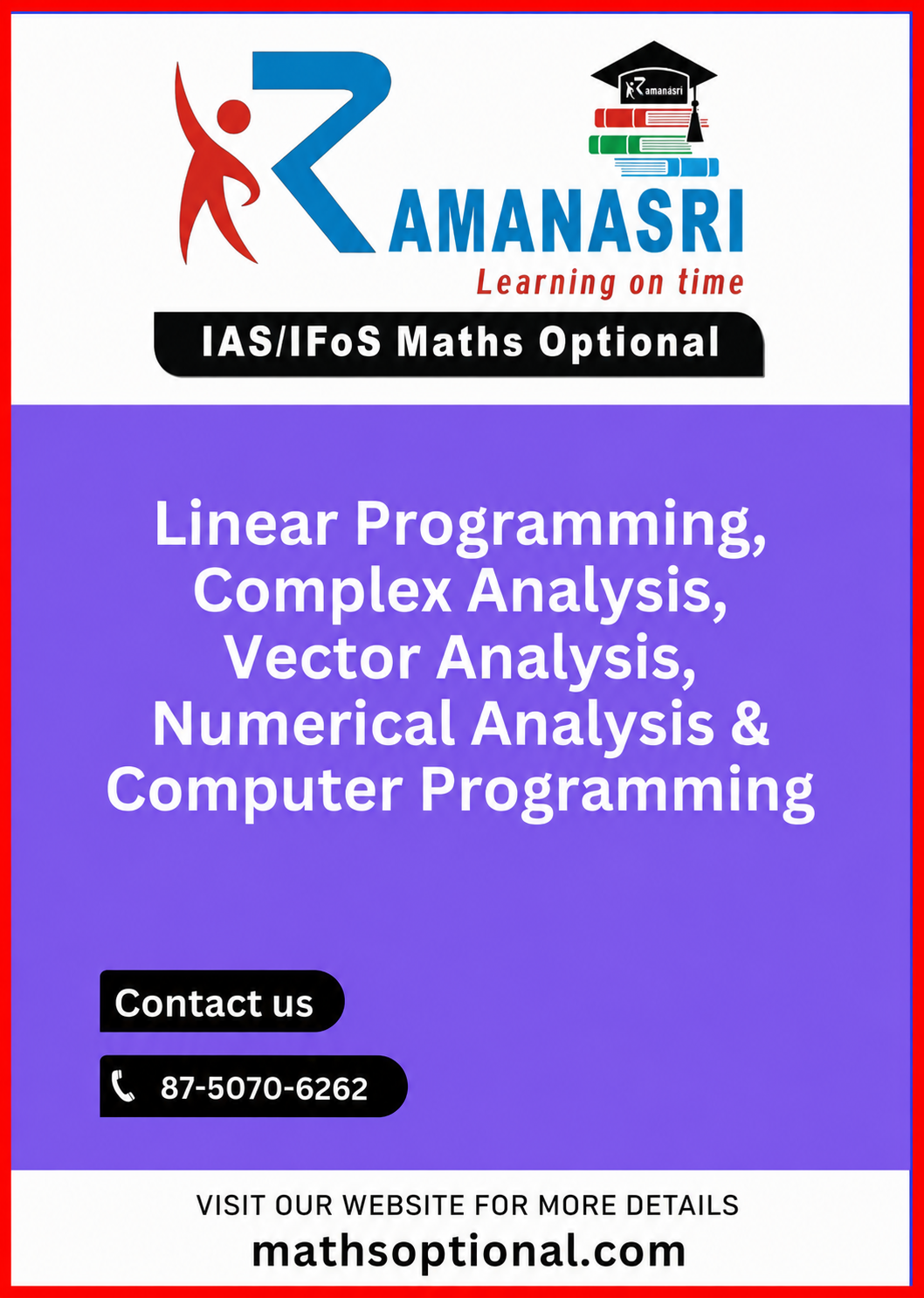 Sample Book 01
Linear Programming, Complex Analysis, Vector Analysis, Numerical Analysis & Computer Programming
Sample study material for important Paper-1 and Paper-2 analytical modules.
Download PDF Sample Book 02
Dynamics & Statics
Sample book for UPSC Maths Optional Dynamics and Statics preparation.
Download PDF Sample Book 03
Analytical Geometry
Sample book for UPSC Maths Optional Analytical Geometry and 3-D Geometry.
Download PDF Sample Book 04
Calculus & Real Analysis
Sample book for Differential Calculus, Integral Calculus and Real Analysis.
Download PDF Sample Book 05
Mechanics & Fluid Dynamics
Sample book for UPSC Maths Optional Mechanics and Fluid Dynamics.
Download PDF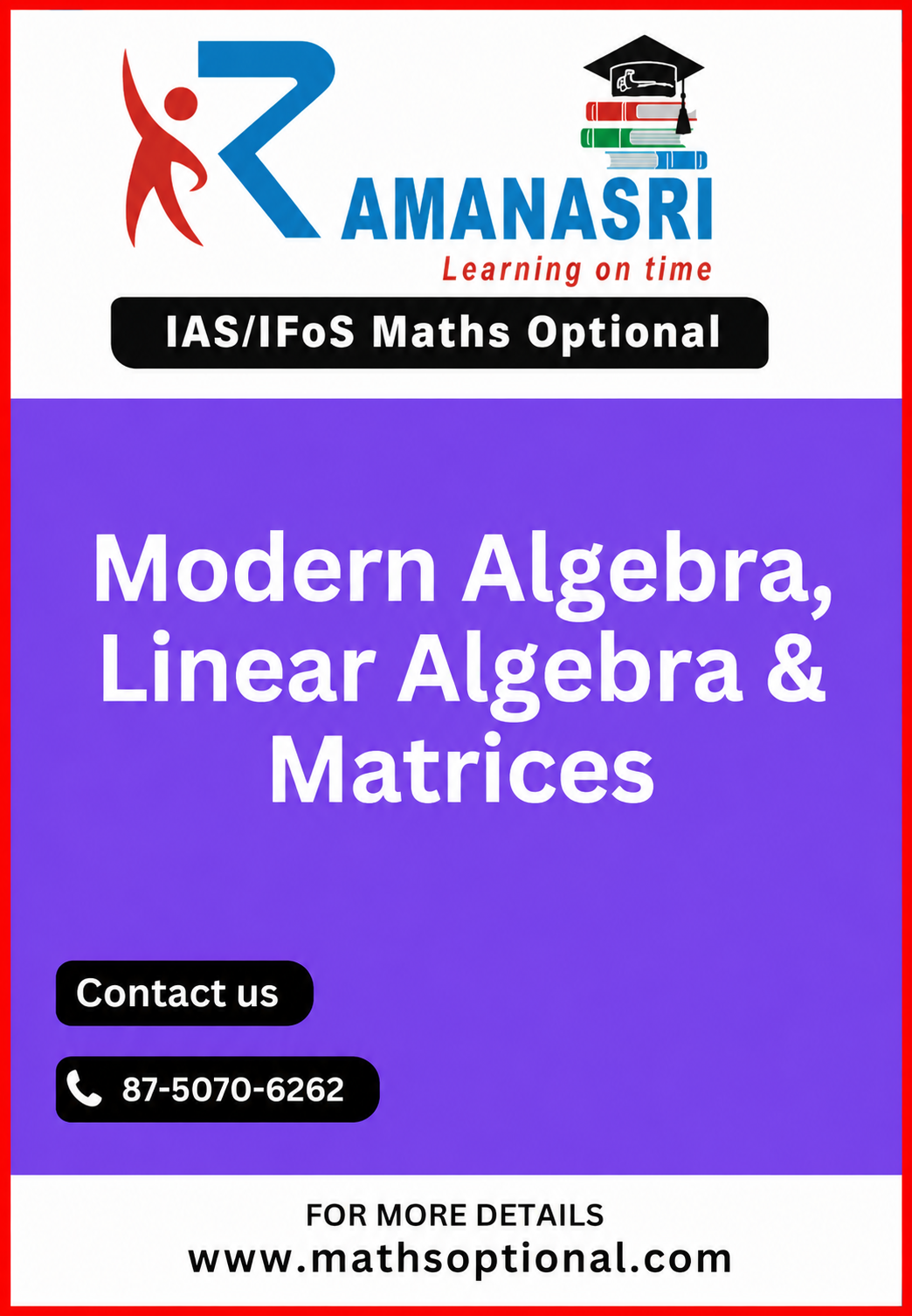 Sample Book 06
Modern Algebra, Linear Algebra & Matrices
Sample book for algebra, matrices, vector spaces and related topics.
Download PDF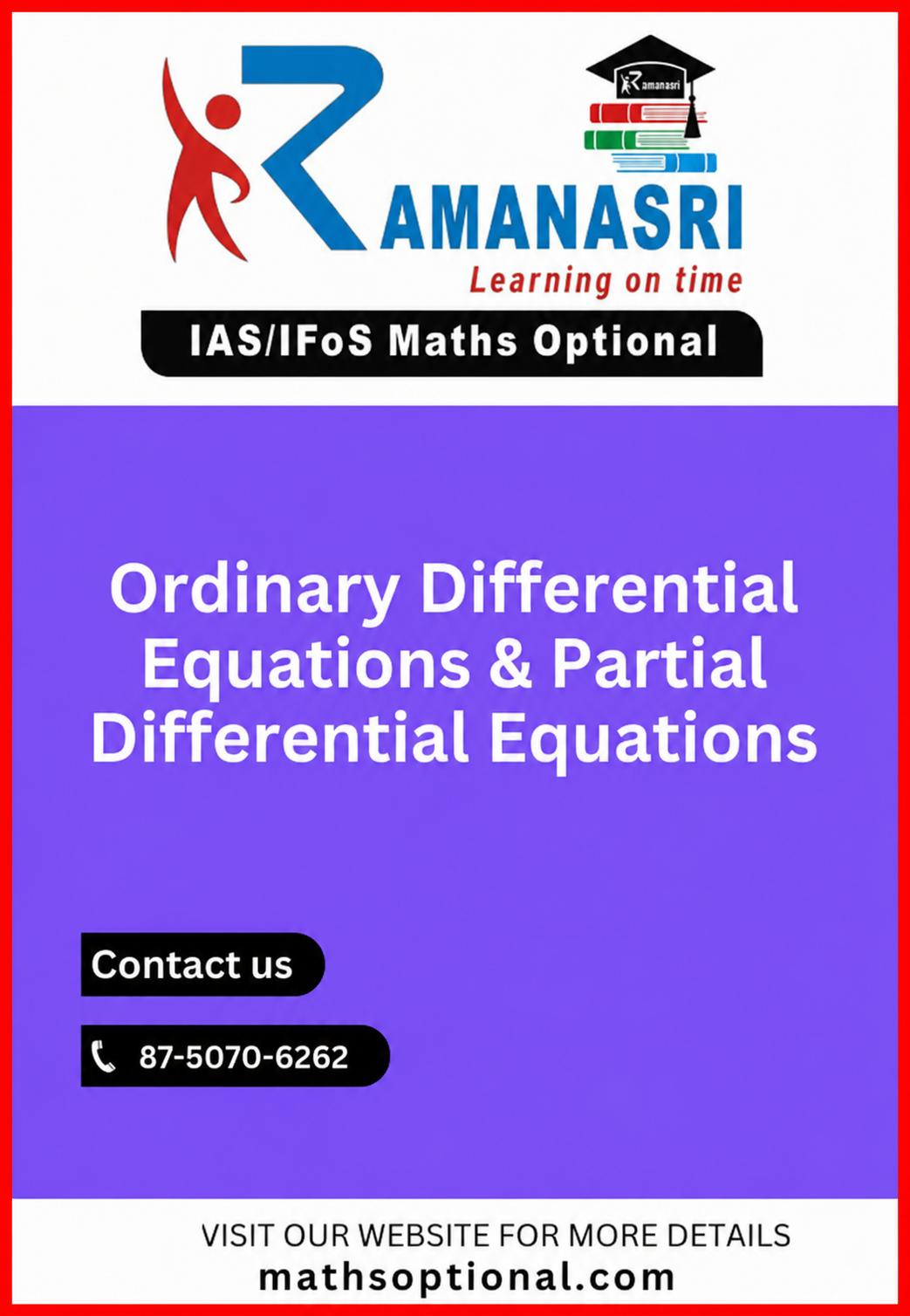 Sample Book 07
Ordinary Differential Equations & Partial Differential Equations
Sample book for ODE, PDE and differential equation-based UPSC Maths Optional preparation.
Download PDF
Need Complete Materials?
Ask on WhatsAppGet Complete UPSC Maths Optional Books, Notes and Study Materials
For complete UPSC Maths Optional books PDFs, sample materials, notes and guidance, contact Ramana Sri IAS through WhatsApp or fill the admission form.
Complete materials are guided module-wise so that students can connect books, notes, PYQs, tests and revision without collecting too many separate resources.
With regular study, proper planning and guidance, students can use our study materials to complete the Maths Optional syllabus in a structured way. A serious student who studies consistently for 2 to 3 hours daily can make steady progress and complete the syllabus within a practical preparation timeline.
Students can request IAS Mathematics Books and Maths Optional study material online or by visiting the Ramana Sri IAS office in Delhi. For complete material details, sample PDFs, course guidance and admission support, students can contact our team through WhatsApp or the admission form.
The Ultimate Guide to UPSC Mathematics Optional Books
The UPSC Civil Services Examination is one of the most prestigious and competitive examinations in India. Mathematics is chosen by many aspirants as an optional subject because of its logical, analytical and problem-solving nature.
The UPSC Maths Optional syllabus is divided into two papers and includes topics such as Algebra, Calculus, Linear Programming, Differential Equations, Real Analysis, Complex Analysis, Mechanics and Fluid Dynamics. The right books can help students understand these topics deeply and practise sufficiently.
Since the UPSC Mathematics Optional syllabus has broadly remained unchanged since 2009, students can use old PYQs, standard reference books and module-wise notes very effectively. The key is to match every resource with the official syllabus and avoid studying portions that are not relevant for the examination.
The choice of books should depend on the student’s background, comfort level, learning style and ability to understand difficult mathematical concepts independently. A beginner may need simple explanation-based books, while an advanced student may also use standard reference books and solved papers.
Importance of Selecting the Right Books
Concept Clarity
Good books explain complex mathematical ideas clearly and help students build a strong foundation.
Practice Problems
Mathematics requires regular problem-solving, so books with solved and unsolved examples are useful.
Author Credibility
Books written by established authors or educators can provide better structure and reliability.
Exam Relevance
UPSC Maths Optional books should be aligned with syllabus, PYQs and answer-writing requirements.
Recommended Book Areas for UPSC Maths Optional
Algebra
Algebra requires books that cover groups, rings, fields, vector spaces, matrices, eigenvalues and theorem-based problems.
Calculus
Calculus books should cover limits, continuity, differentiability, integration, maxima-minima and applications.
Geometry
Analytical Geometry requires books that explain 2-D and 3-D geometry, planes, spheres, cones and conicoids clearly.
Real Analysis
Real Analysis books should build understanding of sequences, series, continuity, compactness, integration and proofs.
Complex Analysis
Complex Analysis requires books that cover analytic functions, Cauchy theorem, Laurent series and residue theorem.
Mechanics
Mechanics and Fluid Dynamics need books with clear derivations, formula use and application-based problem-solving.
Important Standard Books for UPSC Maths Optional
Different toppers and topper blogs have recommended different combinations of standard books for UPSC Maths Optional. Students often refer to strategies associated with Revu Mutyal Raj, Prakash Raj Purohit, Kashish Mittal, Nitish K, Bhavesh Misra, Kanishk Kataria and others while searching for Maths Optional book guidance.
These books should be treated as reference books, not as a compulsory shopping list. Students should choose limited resources, match them with the syllabus and use Ramana Sri IAS notes, PYQs and test practice for exam-oriented preparation.
Linear Algebra and Matrices
Linear Algebra by A.R. Vasistha and Matrices by A.R. Vasistha are commonly used references for vector spaces, matrices and eigenvalue-related topics.
Calculus
Differential Calculus by A.R. Vasistha and Dr. S.K. Sharma, and Advanced Integral Calculus by Dr. D.C. Agarwal are useful references for calculus topics.
Analytical Geometry
Solid Geometry by P.N. Chatterjee is a commonly referred book for 3-D geometry, planes, lines, spheres, cones and conicoids.
ODE and PDE
Ordinary and Partial Differential Equations by M.D. Raisinghania is widely used for differential equation topics, but students should study only syllabus-relevant chapters.
Vector Analysis
Vector Calculus by A.R. Vasistha and J.N. Sharma, and Vector Calculus by Shanti Narayan are useful references for vector analysis.
Dynamics and Statics
Krishna Series books on Dynamics and Statics can be used for mechanics-related Paper I topics along with class notes and PYQs.
Modern Algebra
Modern Algebra by Vasistha, A Course in Abstract Algebra by Khanna and Bhambri, and I.N. Herstein are common references for algebra.
Real and Complex Analysis
Elements of Real Analysis by M.D. Raisinghania, Functions of a Complex Variable by J.N. Sharma and Schaum’s Complex Analysis can be used as references.
LP, Numerical Analysis and Fluid Dynamics
Operations Research by Kanti Swarup, P.K. Gupta and Man Mohan, S.D. Sharma, Sastry, V. Rajaraman and M.D. Raisinghania are common references for these areas.
Previous Year Question Papers and Solved Books
Practicing previous year question papers is one of the most important parts of UPSC Maths Optional preparation. PYQs help students understand the exam pattern, repeated topics, question difficulty and expected answer format.
Solved books and previous year papers allow candidates to compare methods, check mistakes and improve their ability to write step-by-step solutions. Students should practise papers under time limits and review every solution carefully.
A good study plan should combine theory books, solved examples, previous year papers, mock tests and revision notes for best results.
Special Guidance for M.D. Raisinghania ODE and PDE Book
For Ordinary Differential Equations and Partial Differential Equations, students should not read every chapter blindly. The better method is to match M.D. Raisinghania’s book with the UPSC Mathematics Optional syllabus and focus on the portions required for Paper I and Paper II.
In the 2013 edition, Elementary Differential Equations can be used for ODE preparation in Paper I Section B, while the Partial Differential Equations part can be used for PDE preparation in Paper II Section B. Some chapters and advanced special-function portions are not required for UPSC syllabus-focused preparation.
For Laplace transforms and boundary value problems, students may need to refer to the advanced differential equations portions by the same author or use class notes and guided material. The main aim should be syllabus coverage, PYQ practice and clarity of standard methods, not completion of every page of the book.
Online Resources and PDFs for UPSC Maths Optional
Online resources and PDFs have made UPSC Maths Optional preparation more accessible. Students can use digital study materials, e-books, PDFs, video lectures and online doubt support to improve preparation flexibility.
Digital study materials are useful because students can revise from multiple devices, access notes quickly and study at their own pace. However, online resources should be used carefully and should be aligned with the UPSC Maths Optional syllabus.
Testimonials from Toppers: Their Recommended Books
Many successful candidates recommend using standard books, solved examples and previous year question papers as the foundation of Mathematics Optional preparation. Toppers usually focus on conceptual clarity, repeated practice and answer presentation.
Instead of collecting too many books, students should select a limited number of reliable resources and revise them multiple times. Standard books, class notes, PYQs and mock tests should work together as one complete preparation system.
Various toppers and topper blogs have mentioned books used by candidates such as Revu Mutyal Raj, Prakash Raj Purohit, Kashish Mittal, Nitish K, Bhavesh Misra, Kanishk Kataria and others. These references are useful for understanding different preparation approaches, but students should not copy every book list blindly.
The practical strategy is to keep limited books, follow syllabus-relevant portions, solve topic-wise PYQs and revise the same resources multiple times. Ramana Sri IAS books and notes can help students keep this preparation more structured and exam-oriented.
Tips for Effective Study Using UPSC Maths Optional Books
1
Create a proper study plan based on the UPSC Maths Optional syllabus.
2
Use books to build concepts before attempting difficult questions.
3
Maintain formula sheets, theorem notes and short revision notes.
4
Solve examples, unsolved problems and previous year question papers regularly.
5
Revise difficult topics repeatedly instead of changing books again and again.
6
Write mock tests and improve answer presentation under time limits.
How to Use IAS Maths Optional Notes Effectively
IAS Maths Optional notes are useful only when students use them with regular problem-solving, formula revision, theorem practice, PYQs and mock tests. Mathematics Optional is not a reading-only subject. Students should revise concepts and then apply them repeatedly through solved examples and previous year questions.
UPSC Mathematics Optional has two papers of 250 marks each, making a total of 500 marks. A good preparation plan should cover both Paper I and Paper II topics with proper notes, formula sheets, proof practice, PYQ solving and time-bound tests.
More Problem-Solving Practice
Students should spend more time solving problems than only reading notes. Regular practice improves speed, accuracy and confidence.
Formula Sheet Revision
Maintain a separate formula sheet for quick revision of important formulas, theorems, definitions and standard results.
Proofs and Theorems
Paper II includes proof-based areas, so students should practise important theorem proofs from the basics.
Sample Notes Guidance
For sample IAS Maths Optional notes, students can email Ramana Sri IAS with the subject line: IAS Maths Optional Notes.
PYQ-Based Notes Revision
Students should connect notes with previous year questions so they can understand repeated topics, standard methods and UPSC answer expectations.
Mock Test Practice
Notes become more useful when students write sectional and full-length tests to improve time management, presentation and calculation accuracy.
A serious student can complete the Maths Optional syllabus in a structured way by studying regularly, revising notes, solving PYQs and writing tests under proper guidance.
Making Your UPSC Maths Optional Book Choices
Choosing the right study materials is critical for success in UPSC Maths Optional. Every student has a different level of mathematical strength, so books should be selected according to individual needs, learning style and preparation stage.
The right combination of books, notes, previous year papers, sample PDFs, mock tests and guidance can make UPSC Maths Optional preparation more focused and effective.
With a structured approach, consistent practice and proper material selection, students can build confidence and prepare strongly for UPSC Maths Optional.
Related Resources
Continue Your UPSC Maths Optional Preparation
UPSC Maths Optional Syllabus
Check complete Paper-1 and Paper-2 syllabus
Previous Year Questions
Download and practise Maths Optional PYQs
Online Coaching
Join structured UPSC Maths Optional classes
Online Test Series
Practise mock tests and answer writing
Demo Videos
Watch teaching style before admission
Fee Structure
Check course-wise fee details
UPSC Maths Optional Books FAQs
Which books are best for UPSC Maths Optional?
The best books are those that cover the syllabus clearly, provide solved examples, include enough practice problems and support PYQ-based preparation.
Are sample study materials useful for UPSC Maths Optional?
Yes. Sample study materials help students understand teaching style, topic coverage and preparation quality before using full course material.
Should I use multiple books for every topic?
It is better to use limited reliable books and revise them properly instead of collecting too many resources.
Are PYQs necessary with books?
Yes. Books build concepts, but PYQs show how UPSC asks questions and how answers should be written.
Can I prepare Maths Optional only from PDFs?
PDFs can support preparation, but students also need proper concept clarity, practice, revision, mock tests and answer-writing guidance.
Were Ramana Sri IAS Maths Optional books designed by the institute?
Yes. Ramana Sri IAS UPSC Maths Optional books and sample study materials were designed and developed by our team in 2023 for structured, module-wise preparation of Paper I and Paper II.
Should I buy all topper-recommended Maths Optional books?
No. Topper-recommended books are useful as references, but students should not buy every book blindly. It is better to use limited module-wise resources, revise them properly and practise PYQs regularly.
Is the UPSC Mathematics Optional syllabus unchanged since 2009?
The UPSC Mathematics Optional syllabus has broadly remained unchanged since 2009, so old PYQs, standard books and module-wise notes remain useful when they are matched with the latest official UPSC syllabus.
Need UPSC Maths Optional Books Guidance?
Use the Right Books, Notes and Study Materials
Ramana Sri IAS UPSC Maths Optional books and sample study materials were designed and developed by our team in 2023 for structured, module-wise preparation. We also guide students on how to use standard topper-recommended books, PYQs, notes and test practice without collecting too many resources.
Books and material guidance includes:
- Ramana Sri IAS module-wise books, notes and sample study materials.
- Guidance on standard books recommended in topper strategies and blogs.
- PYQ practice, revision planning, fee details and admission support.