Ramana Sri IAS - 2023 UPSC Maths Optional Paper II Solutions
2023 UPSC Maths Optional Paper II Solutions
Ramana Sri IAS provides complete and updated solutions for the 2023 UPSC Maths Optional Paper II. Aspirants preparing for the UPSC Mains Examination with Mathematics as their optional subject should solve all these questions carefully at least 5 to 10 times before the mains examination.
Ramana Sri IAS presents complete solutions for UPSC/IAS/CSE-Civil Service Examination 2023 Mathematics Optional Paper II. Each answer follows the same format: Question, Diagram where needed, Concept Related to the Question, Detailed Solution, and Final Answer.
About 2023 UPSC Maths Optional Paper II Solutions
These 2023 UPSC Maths Optional Paper II Solutions are prepared by Ramana Sri IAS for aspirants who want question-wise clarity before the UPSC Mains examination. This public page gives one full sample solution, while the complete paper-wise solutions are available in the full PYQ course.
Students can use these 2023 UPSC Maths Optional Paper II Solutions to understand the expected answer-writing method, diagram presentation, concept application, and final-answer format used by Ramana Sri IAS.
These 2023 UPSC Maths Optional Paper II Solutions are useful for revision, answer-writing practice, and understanding the step-by-step method expected in the UPSC Mathematics optional paper.
Sample Full Solution
We are giving one question from 2023 UPSC Maths Optional Paper II Solutions as a free sample solution below:
Question 1(e). This free sample includes all five sections:
Question, Diagram,
Concept Related to the Question,
Detailed Solution, and Final Answer. Complete 2023 UPSC Maths Optional Paper II Solutions for all questions are available in the full PYQ course. To purchase the full solution,
please fill out the admission form first. Our Ramana Sri IAS admission team will guide you through WhatsApp, email, or call.
2023 UPSC Maths Optional Paper II Solutions: Table of Contents
Test the convergence of the series \(\displaystyle \sum_{n=1}^{\infty}\frac{1\cdot3\cdot5\cdots(2n-1)}{2\cdot4\cdot6\cdots(2n)}\cdot\frac{x^{2n+1}}{2n+1}\), \(x>0\).
2Diagram
Full Solution Access
The Diagram section for this question is available in the full 2023 UPSC Maths Optional Paper II PYQ Solutions course.
Complete diagrams, concepts, detailed solutions and final answers for all questions are available in the full PYQ course.
State the sufficient conditions for a function \(f(z)=f(x+iy)=u(x,y)+iv(x,y)\) to be analytic in its domain. Hence, show that \(f(z)=\log z\) is analytic in its domain and find \(\frac{df}{dz}\).
2Diagram
Full Solution Access
The Diagram section for this question is available in the full 2023 UPSC Maths Optional Paper II PYQ Solutions course.
Complete diagrams, concepts, detailed solutions and final answers for all questions are available in the full PYQ course.
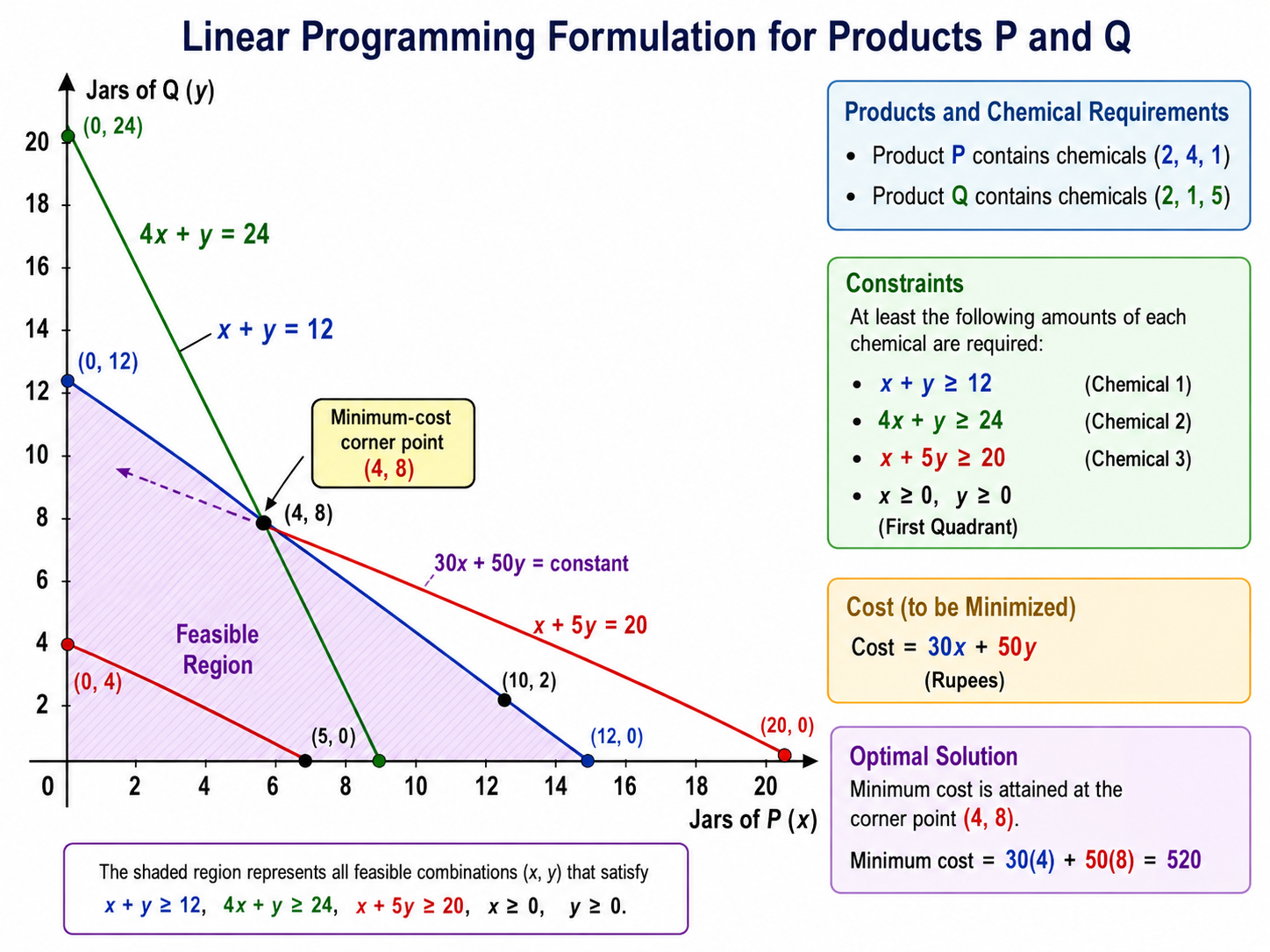
A person requires \(24\), \(24\) and \(20\) units of chemicals \(A\), \(B\) and \(C\) respectively for his garden. Product \(P\) contains \(2\), \(4\) and \(1\) units of chemicals \(A\), \(B\) and \(C\) respectively per jar and product \(Q\) contains \(2\), \(1\) and \(5\) units of chemicals \(A\), \(B\) and \(C\) respectively per jar. If a jar of \(P\) costs ₹\(30\) and a jar of \(Q\) costs ₹\(50\), then how many jars of each should be purchased in order to minimize the cost and meet the requirements?
2Diagram
Question 1(e): Linear programming formulation for products P and Q
3Concept Related to the Question
Let the number of jars of products \(P\) and \(Q\) be the decision variables. The cost is minimized subject to chemical requirement inequalities.
4Detailed Solution
Let \(x\) be the number of jars of \(P\) and \(y\) be the number of jars of \(Q\). Since negative jars cannot be purchased, \(x\geq0\) and \(y\geq0\).
The chemical requirements give \(2x+2y\geq24\), \(4x+y\geq24\), and \(x+5y\geq20\). The cost function is \(Z=30x+50y\).
Thus we minimize \(Z=30x+50y\), subject to \(x+y\geq12\), \(4x+y\geq24\), \(x+5y\geq20\), and \(x,y\geq0\).
The feasible corner points relevant for the minimum are obtained by solving boundary pairs. From \(x+y=12\) and \(4x+y=24\), we get \(x=4\), \(y=8\), and the cost is \(30(4)+50(8)=520\).
From \(x+y=12\) and \(x+5y=20\), we get \(x=10\), \(y=2\), and the cost is \(30(10)+50(2)=400\).
The remaining intersection of \(4x+y=24\) and \(x+5y=20\) is not feasible because it does not satisfy \(x+y\geq12\). Therefore the minimum cost occurs at \(x=10\), \(y=2\).
5Final Answer
The person should purchase \(10\) jars of \(P\) and \(2\) jars of \(Q\). The minimum cost is ₹\(400\).
Question 2(a)
Subgroup of order p
1Question
Prove that a non-commutative group of order \(2p\), where \(p\) is an odd prime, must have a subgroup of order \(p\).
2Diagram
Full Solution Access
The Diagram section for this question is available in the full 2023 UPSC Maths Optional Paper II PYQ Solutions course.
Complete diagrams, concepts, detailed solutions and final answers for all questions are available in the full PYQ course.
Prove that \(x^2+1\) is an irreducible polynomial in \(\mathbb Z_3[x]\). Further show that the quotient ring \(\frac{\mathbb Z_3[x]}{(x^2+1)}\) is a field of \(9\) elements.
2Diagram
Full Solution Access
The Diagram section for this question is available in the full 2023 UPSC Maths Optional Paper II PYQ Solutions course.
Complete diagrams, concepts, detailed solutions and final answers for all questions are available in the full PYQ course.
Prove that \(u(x,y)=e^x(x\cos y-y\sin y)\) is harmonic. Find its conjugate harmonic function \(v(x,y)\) and express the corresponding analytic function \(f(z)\) in terms of \(z\).
2Diagram
Full Solution Access
The Diagram section for this question is available in the full 2023 UPSC Maths Optional Paper II PYQ Solutions course.
Complete diagrams, concepts, detailed solutions and final answers for all questions are available in the full PYQ course.
Prove that the oscillation of a real-valued bounded function \(f\) defined on \([a,b]\) is the supremum of the set \(\{\,\lvert f(x_1)-f(x_2)\rvert:x_1,x_2\in[a,b]\\,\}\).
2Diagram
Full Solution Access
The Diagram section for this question is available in the full 2023 UPSC Maths Optional Paper II PYQ Solutions course.
Complete diagrams, concepts, detailed solutions and final answers for all questions are available in the full PYQ course.
A department head has \(5\) subordinates and \(5\) jobs to be performed. The time in hours that each subordinate will take to perform each job is given in the matrix below :
Subordinates
Jobs
A
B
C
D
E
I
4
9
4
12
4
II
15
11
20
5
8
III
17
7
15
12
18
IV
9
13
11
9
14
V
6
11
12
9
14
How should the jobs be assigned, one to each subordinate, so as to minimize the total time? Also, obtain the total minimum time to perform all the jobs if the subordinate \(IV\) cannot be assigned job \(C\).
2Diagram
Full Solution Access
The Diagram section for this question is available in the full 2023 UPSC Maths Optional Paper II PYQ Solutions course.
Complete diagrams, concepts, detailed solutions and final answers for all questions are available in the full PYQ course.
Given \(\frac{dy}{dx}=\frac{y^2-x}{y^2+x}\) with initial condition \(y=1\) at \(x=0\). Find the value of \(y\) for \(x=0.4\) by Euler’s method, correct to \(4\) decimal places, taking step length \(h=0.1\).
2Diagram
Full Solution Access
The Diagram section for this question is available in the full 2023 UPSC Maths Optional Paper II PYQ Solutions course.
Complete diagrams, concepts, detailed solutions and final answers for all questions are available in the full PYQ course.
Evaluate, using the binary arithmetic, the following numbers in their given system: (i) \((634.235)_8-(132.223)_8\), (ii) \((7AB.432)_{16}-(5CA.D61)_{16}\).
2Diagram
Full Solution Access
The Diagram section for this question is available in the full 2023 UPSC Maths Optional Paper II PYQ Solutions course.
Complete diagrams, concepts, detailed solutions and final answers for all questions are available in the full PYQ course.
A planet of mass \(m\) revolving around the sun of mass \(M\). The kinetic energy \(T\) and the potential energy \(V\) of the planet are given by \(T=\frac12m(\dot r^2+r^2\dot\theta^2)\) and \(V=GMm(\frac1{2a}-\frac1r)\), where \((r,\theta)\) are the polar coordinates of the planet at time \(t\), \(G\) is the gravitational constant and \(2a\) is the major axis of the ellipse, the path of the planet. Find the Hamiltonian and Hamilton equations of the planet’s motion.
2Diagram
Full Solution Access
The Diagram section for this question is available in the full 2023 UPSC Maths Optional Paper II PYQ Solutions course.
Complete diagrams, concepts, detailed solutions and final answers for all questions are available in the full PYQ course.
In a fluid motion, there is a source of strength \(2m\) placed at \(z=2\) and two sinks of strength \(m\) are placed at \(z=2+i\) and \(z=2-i\). Find the streamlines.
2Diagram
Full Solution Access
The Diagram section for this question is available in the full 2023 UPSC Maths Optional Paper II PYQ Solutions course.
Complete diagrams, concepts, detailed solutions and final answers for all questions are available in the full PYQ course.
Find the surface passing through the two lines \(z=x=0\) and \(z-1=x-y=0\), and satisfying the partial differential equation \(\frac{\partial^2 z}{\partial x^2}-4\frac{\partial^2 z}{\partial x\partial y}+4\frac{\partial^2 z}{\partial y^2}=0\).
2Diagram
Full Solution Access
The Diagram section for this question is available in the full 2023 UPSC Maths Optional Paper II PYQ Solutions course.
Complete diagrams, concepts, detailed solutions and final answers for all questions are available in the full PYQ course.
Solve the system of linear equations \(7x_1-x_2+2x_3=11\), \(2x_1+8x_2-x_3=9\), \(x_1-2x_2+9x_3=7\), correct up to \(4\) significant figures by the Gauss-Seidel iterative method. Take initially guessed solution as \(x_1=x_2=x_3=0\).
2Diagram
Full Solution Access
The Diagram section for this question is available in the full 2023 UPSC Maths Optional Paper II PYQ Solutions course.
Complete diagrams, concepts, detailed solutions and final answers for all questions are available in the full PYQ course.
A mechanical system with \(2\) degrees of freedom has the Lagrangian \(L=\frac12m(\dot x^2+\dot y^2)-\frac12m(\nu_1^2x^2+\nu_2^2y^2)+kxy\), where \(m,\nu_1,\nu_2,k\) are constants. Find parameter \(\theta\) so that under the transformation \(x=q_1\cos\theta-q_2\sin\theta\), \(y=q_1\sin\theta+q_2\cos\theta\), the Lagrangian in terms of \(q_1,q_2\) will not contain product term \(q_1q_2\). Find the Lagrange’s equations w.r.t. \(q_1\) and \(q_2\) independent of parameter \(\theta\).
2Diagram
Full Solution Access
The Diagram section for this question is available in the full 2023 UPSC Maths Optional Paper II PYQ Solutions course.
Complete diagrams, concepts, detailed solutions and final answers for all questions are available in the full PYQ course.
Express the Boolean function \(f(x,y,z)=x+\bar{(x\cdot\bar y+x\cdot\bar z)}+z\) in disjunctive normal form (DNF) and construct the truth table for the function.
2Diagram
Full Solution Access
The Diagram section for this question is available in the full 2023 UPSC Maths Optional Paper II PYQ Solutions course.
Complete diagrams, concepts, detailed solutions and final answers for all questions are available in the full PYQ course.
A perfectly rough ball is at rest within a hollow cylindrical roller. The roller is drawn along a level path with uniform velocity \(V\). Let \(a\) and \(b\) be the radii of the ball and the roller respectively. If \(V^2>\frac{27}{7}g(b-a)\), then show that the ball will roll completely round the inside of the roller.
2Diagram
Full Solution Access
The Diagram section for this question is available in the full 2023 UPSC Maths Optional Paper II PYQ Solutions course.
Complete diagrams, concepts, detailed solutions and final answers for all questions are available in the full PYQ course.
Determine under what conditions the velocity field \(u=c(x^2-y^2)\), \(v=-2cxy\), \(w=0\) is a solution to the Navier-Stokes momentum equations. Assuming that the conditions are met, determine the resulting pressure distribution, when \(z\) is up and the external body forces are \(B_x=0=B_y,\ B_z=-g\).
2Diagram
Full Solution Access
The Diagram section for this question is available in the full 2023 UPSC Maths Optional Paper II PYQ Solutions course.
Complete diagrams, concepts, detailed solutions and final answers for all questions are available in the full PYQ course.
Are these 2023 UPSC Maths Optional Paper II Solutions complete?
This public page gives one full sample solution for 2023 UPSC Maths Optional Paper II. Complete question-wise solutions for the full paper are available in the full PYQ course by Ramana Sri IAS.
Which question is given as a free sample solution on this page?
The free sample solution on this page is Question 1(e). It includes Question, Diagram, Concept Related to the Question, Detailed Solution, and Final Answer.
How should I use these 2023 UPSC Maths Optional Paper II Solutions for preparation?
Use these solutions for revision, answer-writing practice, diagram presentation, concept application, and checking the final-answer format expected in the UPSC Mathematics optional paper.
Do these solutions include diagrams and detailed solutions?
Yes. The complete PYQ course includes question-wise diagrams, concepts, detailed solutions, and final answers wherever required.
How can I get complete solutions for all questions in 2023 UPSC Maths Optional Paper II?
To get complete solutions for all questions, fill out the admission form. The Ramana Sri IAS admission team will guide you through WhatsApp, email, or call.
Prepare UPSC Maths Optional with Ramana Sri IAS
Learn concepts, diagrams, previous year questions, answer-writing, and test-series strategy in a clean step-by-step format.