
UPSC Maths Optional Lectures
How to Crack IAS with Best UPSC Maths Optional Lectures of RAMANA SRI IAS
Prepare UPSC Maths Optional with concept-focused lectures, formula clarity, step-by-step answer writing, previous year questions, mock tests, revision support and expert guidance from RAMANA SRI IAS.
UPSC Maths Optional Lectures
How to crack IAS with best UPSC Maths Optional Lectures of RAMANA SRI IAS. To crack IAS with Maths Optional, students must understand that Mathematics is one of the scoring optional subjects in the UPSC exam, provided they prepare well and practise questions regularly.
The key to success in this subject is understanding formulas and concepts, and presenting answers step-by-step. It is also important to study previous years question papers and analyse the pattern of questions asked in the examination.
To succeed in Maths Optional, students must have passion for the subject. It is a difficult subject to master and requires a lot of practice, but with proper guidance and disciplined preparation, it can become a strong scoring optional.
Core message:
UPSC Maths Optional lectures are useful when they help students build concepts, understand formulas,
practise questions, avoid mistakes and write answers in a logical step-by-step manner.
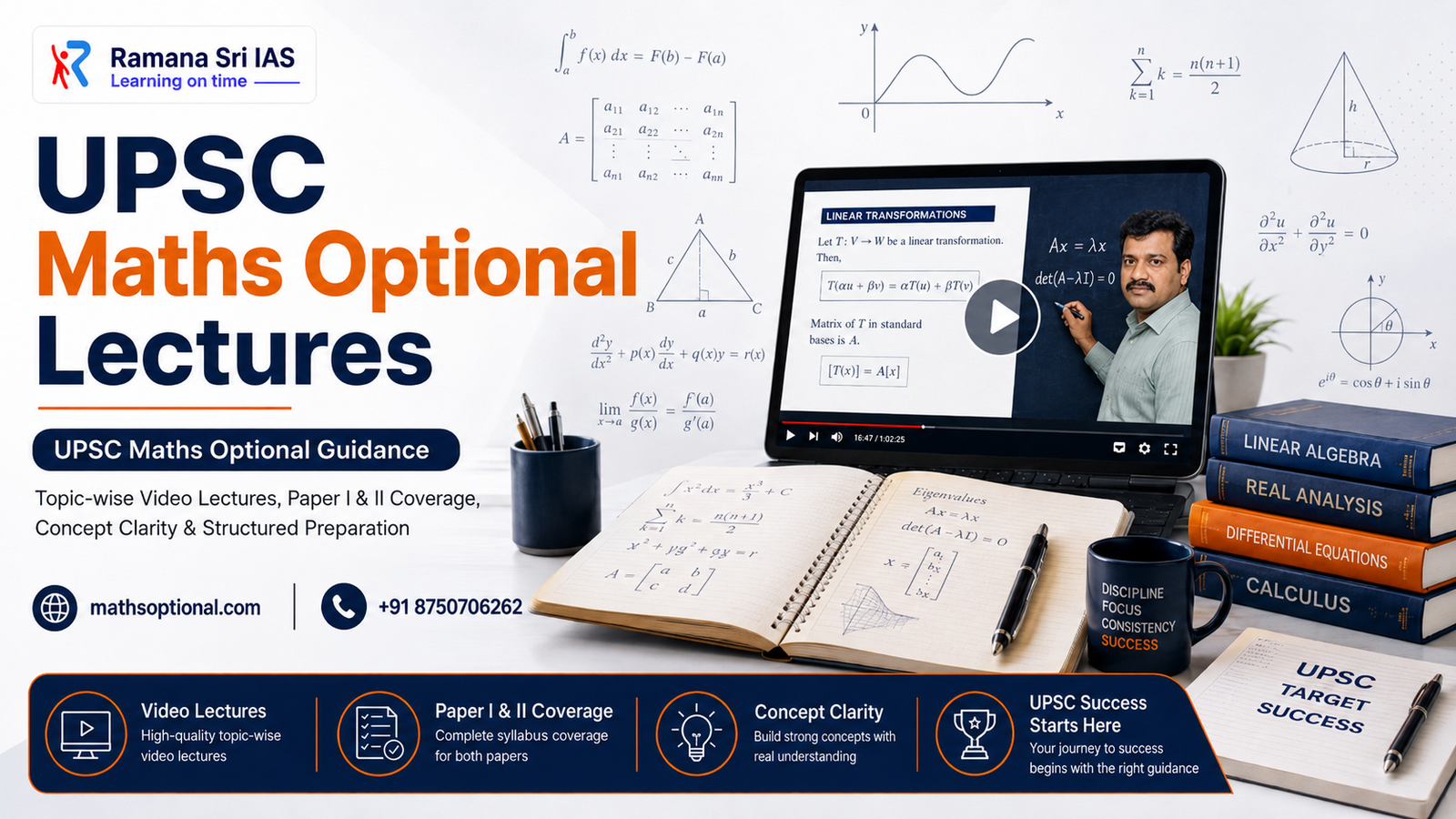
UPSC Maths Optional Lectures | It is a Scoring Optional Subject
Serious IAS aspirants who want to score well in the exam must prepare their optional subject with full focus. Although Mathematics is not as popular as humanities subjects, it has many advantages and can be a scoring subject for students who prepare properly.
The main advantage of Maths Optional is that it is a logic-based subject. It does not depend heavily on current affairs or opinion-based writing. However, the preparation time can be more than many other subjects because students must solve problems, understand theorems and apply concepts accurately.
Students preparing for the UPSC Maths Optional exam should know the syllabus and practise previous years exam papers. This helps identify difficult topics and understand what type of questions UPSC asks.
Logic-Based Subject
Maths Optional rewards logical thinking, clear formulas and correct application of concepts.
Scoring Potential
With strong preparation, Maths Optional can help students improve their overall UPSC rank.
Less Opinion-Based
Unlike many humanities subjects, Mathematics has more objective and method-based answers.
Needs Practice
Students must solve enough problems to improve speed, accuracy and exam confidence.
High Score Strategy
How to Score High in UPSC Maths Optional Lectures
To score high in UPSC Maths Optional, students should follow a strict study plan. They should allocate fixed time for revision and practise through previous years full-length papers and mock tests.
Problem-solving practice is essential because it improves speed and accuracy. Students should also take feedback from mentors and study answer scripts to understand how answers should be presented systematically.
- Understand the full UPSC Maths Optional syllabus
- Revise formulas, theorems and standard results regularly
- Practise previous year full-length papers
- Write mock tests under time limits
- Take mentor feedback to improve answer presentation
Preparation Rule
Scoring comes from concept clarity plus repeated practice.
RAMANA SRI IAS lectures are designed to help students understand concepts, practise questions and improve answer-writing discipline.
Join Online CoachingUPSC Maths Optional Lectures | It is a Difficult Subject
Maths is one of the most difficult subjects to master for UPSC aspirants. It requires discipline, dedication and repeated practice to develop concepts properly. However, it is possible to crack this subject with proper guidance and consistent effort.
Students must first familiarize themselves with the syllabus and previous years question papers. They should also write as many mock tests as possible to identify the areas where they need improvement.
A logical answer presentation is important for scoring high marks. Students should not only solve the question but also present every step clearly, because UPSC Maths Optional rewards method, clarity and accuracy.
Needs Discipline
Students should prepare daily, revise regularly and follow a fixed timetable.
Needs Concept Depth
Each topic should be understood from basics to application level.
Needs Mock Tests
Mock tests help students identify weak areas and improve exam temperament.
Needs Calm Mindset
Staying calm during the exam helps students concentrate and avoid mistakes.
Prepare a Detailed Study Schedule
Students should prepare a detailed study schedule and stick to it. They should allocate enough time for each topic based on its weightage in the Mains examination.
A good strategy is to create a timeline and study daily, weekly and monthly. This helps students focus on important topics, monitor progress and complete revision on time.
1
Read the complete UPSC Maths Optional syllabus carefully.
2
Divide the syllabus into daily, weekly and monthly targets.
3
Give more time to high-weightage and difficult topics.
4
Practise PYQs after completing every topic.
5
Write mock tests regularly and analyse mistakes.
6
Revise formulas and methods before every test.
UPSC Maths Optional Lectures | It is a Well-Balanced Subject
For science graduates thinking about taking Mathematics as an optional subject, it is important to consider both the advantages and challenges. While it is a difficult subject, it also helps develop analytical skills and problem-solving abilities, which are useful in the Mains exam and interview.
The Maths Optional lectures help students understand concepts in an easy-to-understand way. Good lectures cover the syllabus, explain questions and answers, and guide students through the subject with examples.
Under RAMANA SRI IAS expert faculty guidance, students can understand complex questions more clearly and learn how to approach them step-by-step. Proper mentoring helps simplify difficult areas and improves confidence in problem-solving.
Analytical Skill
Mathematics builds analytical ability and sharpens logical thinking.
Problem Solving
Regular problem-solving helps students handle complex questions confidently.
Theory + Application
The syllabus includes both theorem-based and application-based questions.
Expert Guidance
RAMANA SRI IAS faculty guidance helps students simplify difficult topics.
Understand Paper I and Paper II Properly
The Mathematics Optional subject consists of two papers, each carrying 250 marks. Students should prepare a schedule based on topic weightage and revise the subject at regular intervals.
Paper I generally includes topics such as Linear Algebra, Calculus, Analytic Geometry, Ordinary Differential Equations and Statics. Paper II includes advanced topics such as Real Analysis and Partial Differential Equations.
Paper I Focus
Linear Algebra, Calculus, Analytic Geometry, Ordinary Differential Equations and Statics.
Paper II Focus
Real Analysis, Complex Analysis, Algebra, PDE, Numerical Analysis and Mechanics.
Marks Focus
Each paper carries 250 marks, so both papers require equal seriousness.
Revision Focus
Students should revise both papers regularly to maintain command over formulas and methods.
UPSC Maths Optional Lectures | It Requires a Lot of Practice
In the IAS exam, Maths is a subject that requires a lot of practice. It involves complex concepts and difficult formulas that are hard to understand without proper guidance. Students who want to score well should prepare early and follow a clear strategy.
Choosing the right optional subject is a crucial decision for UPSC aspirants. A high score in the optional subject can improve overall rank, but this is possible only when the aspirant has interest, discipline and dedication towards preparation.
Students should read relevant books, study previous year question papers and practise as much as possible. Unlike many other subjects, the scoring in Mathematics is not purely subjective and is based on correct method, objective facts and clear solutions.
Early Preparation
Students should begin preparation early because Maths Optional needs time.
Clear Strategy
A proper plan helps students cover syllabus, revise and write tests.
Regular Revision
Revision prevents formula loss and improves retention.
Full-Length Tests
Full-length tests improve timing, presentation and exam confidence.
How RAMANA SRI IAS UPSC Maths Optional Lectures Help
UPSC Maths Optional Lectures are useful because they help students understand difficult formulas, concepts and problem-solving methods in a structured way. Lectures can save time because students do not have to depend only on self-reading or scattered study material.
Good lectures also help students avoid confusion, understand the logical flow of questions and learn how to present answers properly. Students can watch lectures, revise concepts, practise questions and take mentor feedback for improvement.
Concept Explanation
Lectures explain formulas, theorems and methods clearly.
Question Approach
Students learn how to start and complete questions logically.
Answer Presentation
Lectures guide students on step-by-step answer writing.
Mentor Feedback
Feedback helps students correct mistakes and improve scoring ability.
Mistakes to Avoid in UPSC Maths Optional
Cramming Without Understanding
Students should avoid cramming and focus on building logical understanding of topics.
Ignoring PYQs
Previous year questions are essential for understanding UPSC pattern and difficulty level.
Poor Answer Presentation
Even correct answers can lose marks if steps, notation and logic are not clear.
No Revision Plan
Without regular revision, students may forget formulas and standard methods.
Best Way to Prepare with UPSC Maths Optional Lectures
The best way to prepare for UPSC Maths Optional Lectures is to do a lot of revision. Students should practise full-length papers and mock tests from previous years. They should also be systematic while writing answers.
It is helpful to study answer scripts, take feedback from mentors and avoid cramming. Students should focus on problem-solving, logical flow, concept clarity and repeated practice to improve their marks.
Revise Repeatedly
Revision helps students retain formulas, theorems and standard methods.
Practise Mock Tests
Mock tests improve speed, accuracy and exam temperament.
Use Mentor Feedback
Feedback helps students identify and correct weak areas.
Write Systematically
Systematic answer writing improves presentation and scoring potential.
Related Resources
Continue Your UPSC Maths Optional Preparation
Use lectures along with syllabus, PYQs, online coaching, test series and demo videos for complete preparation.
UPSC Maths Optional Syllabus
Check complete Paper I and Paper II syllabus
Previous Year Questions
Practise UPSC Maths Optional PYQs
Online Coaching
Join structured Maths Optional classes
Maths Optional Test Series
Improve speed, accuracy and presentation
Demo Videos
Watch teaching style before joining
Fee Structure
Check course-wise fee details
UPSC Maths Optional Lectures FAQs
Are UPSC Maths Optional lectures useful?
Yes. Lectures help students understand concepts, formulas, theorems, problem-solving methods and answer presentation in a structured way.
Is Maths Optional a scoring subject?
Yes. Maths Optional can be scoring when students prepare well, practise questions and write answers step-by-step with proper logic.
Is Maths Optional difficult?
Maths Optional is difficult because it needs concept depth and practice, but it becomes manageable with proper guidance, revision and mock tests.
How should I use Maths Optional lectures?
Watch lectures topic-wise, take notes, revise formulas, solve PYQs after each topic and write mock tests regularly.
Why choose RAMANA SRI IAS for Maths Optional lectures?
RAMANA SRI IAS provides structured guidance, concept explanation, PYQ practice, test support and mentoring for UPSC Maths Optional preparation.
Start UPSC Maths Optional Lectures
Prepare Maths Optional with RAMANA SRI IAS Lectures
Build concept clarity, solve PYQs, improve answer writing and prepare with structured guidance for UPSC Maths Optional.