Ramana Sri IAS • IFoS Mathematics Optional 2016 IFoS Maths Optional Paper II Solutions Ramana Sri IAS provides complete and updated solutions for the 2016 IFoS Maths Optional Paper II. Aspirants preparing for the IFoS Mains Examination with Mathematics as their optional subject should solve all these questions carefully before the mains examination.
Ramana Sri IAS presents complete solutions for Indian Forest Service Examination 2016 Mathematics Optional Paper II. Each answer follows the same format: Question, Diagram where needed, Concept Related to the Question, Detailed Solution, and Final Answer.
About 2016 IFoS Maths Optional Paper II Solutions These 2016 IFoS Maths Optional Paper II Solutions are prepared by Ramana Sri IAS for aspirants who want question-wise clarity before the IFoS Mains examination. This public page gives one full sample solution, while the complete paper-wise solutions are available in the full PYQ course.
Students can use these 2016 IFoS Maths Optional Paper II Solutions to understand the expected answer-writing method, diagram presentation, concept application, and final-answer format used by Ramana Sri IAS.
For the official examination source, students may also refer to the
UPSC previous year question papers page .
These 2016 IFoS Maths Optional Paper II Solutions are useful for revision, answer-writing practice, and understanding the step-by-step method expected in the IFoS Mathematics optional paper.
Sample Full Solution
We are giving one question as a free sample solution below:
Question 3(d) . This free sample includes all five sections:
Question , Diagram ,
Concept Related to the Question ,
Detailed Solution , and Final Answer .
Complete solutions for all questions are available in the full PYQ course. To purchase the full solutions,
please fill out the admission form first. Our Ramana Sri IAS admission team will guide you through WhatsApp, email, or call.
2016 IFoS Maths Optional Paper II Solutions: Table of Contents
Question 1(a) Group of Bijective Functions
1. Question
2. Diagram
3. Concept Related to the Question
4. Detailed Solution
5. Final Answer
1 QuestionProve that the set of all bijective functions from a non-empty set \(X\) onto itself is a group with respect to usual composition of functions.
2 Diagram
Full Solution Access The Diagram section for this question is available in the full 2016 IFoS Maths Optional Paper II PYQ Solutions course.
Complete diagrams, concepts, detailed solutions and final answers for all questions are available in the full PYQ course.
3 Concept Related to the Question
Full Solution Access The Concept Related to the Question section for this question is available in the full 2016 IFoS Maths Optional Paper II PYQ Solutions course.
Complete diagrams, concepts, detailed solutions and final answers for all questions are available in the full PYQ course.
4 Detailed Solution
Full Solution Access The Detailed Solution section for this question is available in the full 2016 IFoS Maths Optional Paper II PYQ Solutions course.
Complete diagrams, concepts, detailed solutions and final answers for all questions are available in the full PYQ course.
5 Final Answer
Full Solution Access The Final Answer section for this question is available in the full 2016 IFoS Maths Optional Paper II PYQ Solutions course.
Complete diagrams, concepts, detailed solutions and final answers for all questions are available in the full PYQ course.
Question 1(b) Uniform Convergence
1. Question
2. Diagram
3. Concept Related to the Question
4. Detailed Solution
5. Final Answer
1 QuestionExamine the uniform convergence of \(f_n(x)=\dfrac{\sin(nx+n)}{n}\), for \(x\in\mathbb R\), \(n=1,2,3,\ldots\).
2 Diagram
Full Solution Access The Diagram section for this question is available in the full 2016 IFoS Maths Optional Paper II PYQ Solutions course.
Complete diagrams, concepts, detailed solutions and final answers for all questions are available in the full PYQ course.
3 Concept Related to the Question
Full Solution Access The Concept Related to the Question section for this question is available in the full 2016 IFoS Maths Optional Paper II PYQ Solutions course.
Complete diagrams, concepts, detailed solutions and final answers for all questions are available in the full PYQ course.
4 Detailed Solution
Full Solution Access The Detailed Solution section for this question is available in the full 2016 IFoS Maths Optional Paper II PYQ Solutions course.
Complete diagrams, concepts, detailed solutions and final answers for all questions are available in the full PYQ course.
5 Final Answer
Full Solution Access The Final Answer section for this question is available in the full 2016 IFoS Maths Optional Paper II PYQ Solutions course.
Complete diagrams, concepts, detailed solutions and final answers for all questions are available in the full PYQ course.
Question 1(c) Maxima and Minima of Two-Variable Function
1. Question
2. Diagram
3. Concept Related to the Question
4. Detailed Solution
5. Final Answer
1 QuestionFind the maxima and minima of \(f(x,y)=x^3+y^3-3x-12y+20\).
2 Diagram
Full Solution Access The Diagram section for this question is available in the full 2016 IFoS Maths Optional Paper II PYQ Solutions course.
Complete diagrams, concepts, detailed solutions and final answers for all questions are available in the full PYQ course.
3 Concept Related to the Question
Full Solution Access The Concept Related to the Question section for this question is available in the full 2016 IFoS Maths Optional Paper II PYQ Solutions course.
Complete diagrams, concepts, detailed solutions and final answers for all questions are available in the full PYQ course.
4 Detailed Solution
Full Solution Access The Detailed Solution section for this question is available in the full 2016 IFoS Maths Optional Paper II PYQ Solutions course.
Complete diagrams, concepts, detailed solutions and final answers for all questions are available in the full PYQ course.
5 Final Answer
Full Solution Access The Final Answer section for this question is available in the full 2016 IFoS Maths Optional Paper II PYQ Solutions course.
Complete diagrams, concepts, detailed solutions and final answers for all questions are available in the full PYQ course.
Question 1(d) Analytic Function from Real Part
1. Question
2. Diagram
3. Concept Related to the Question
4. Detailed Solution
5. Final Answer
1 QuestionFind the analytic function whose real part is \(e^{-x}\{(x^2-y^2)\cos y+2xy\sin y\}\).
2 Diagram
Full Solution Access The Diagram section for this question is available in the full 2016 IFoS Maths Optional Paper II PYQ Solutions course.
Complete diagrams, concepts, detailed solutions and final answers for all questions are available in the full PYQ course.
3 Concept Related to the Question
Full Solution Access The Concept Related to the Question section for this question is available in the full 2016 IFoS Maths Optional Paper II PYQ Solutions course.
Complete diagrams, concepts, detailed solutions and final answers for all questions are available in the full PYQ course.
4 Detailed Solution
Full Solution Access The Detailed Solution section for this question is available in the full 2016 IFoS Maths Optional Paper II PYQ Solutions course.
Complete diagrams, concepts, detailed solutions and final answers for all questions are available in the full PYQ course.
5 Final Answer
Full Solution Access The Final Answer section for this question is available in the full 2016 IFoS Maths Optional Paper II PYQ Solutions course.
Complete diagrams, concepts, detailed solutions and final answers for all questions are available in the full PYQ course.
Question 1(e) Convexity of Feasible Region in LPP
1. Question
2. Diagram
3. Concept Related to the Question
4. Detailed Solution
5. Final Answer
1 QuestionProve that the set of all feasible solutions of a linear programming problem is a convex set.
2 Diagram
Full Solution Access The Diagram section for this question is available in the full 2016 IFoS Maths Optional Paper II PYQ Solutions course.
Complete diagrams, concepts, detailed solutions and final answers for all questions are available in the full PYQ course.
3 Concept Related to the Question
Full Solution Access The Concept Related to the Question section for this question is available in the full 2016 IFoS Maths Optional Paper II PYQ Solutions course.
Complete diagrams, concepts, detailed solutions and final answers for all questions are available in the full PYQ course.
4 Detailed Solution
Full Solution Access The Detailed Solution section for this question is available in the full 2016 IFoS Maths Optional Paper II PYQ Solutions course.
Complete diagrams, concepts, detailed solutions and final answers for all questions are available in the full PYQ course.
5 Final Answer
Full Solution Access The Final Answer section for this question is available in the full 2016 IFoS Maths Optional Paper II PYQ Solutions course.
Complete diagrams, concepts, detailed solutions and final answers for all questions are available in the full PYQ course.
Question 2(a) Non-Abelian Group of Order 6
1. Question
2. Diagram
3. Concept Related to the Question
4. Detailed Solution
5. Final Answer
1 QuestionShow that any non-abelian group of order \(6\) is isomorphic to the symmetric group \(S_3\).
2 Diagram
Full Solution Access The Diagram section for this question is available in the full 2016 IFoS Maths Optional Paper II PYQ Solutions course.
Complete diagrams, concepts, detailed solutions and final answers for all questions are available in the full PYQ course.
3 Concept Related to the Question
Full Solution Access The Concept Related to the Question section for this question is available in the full 2016 IFoS Maths Optional Paper II PYQ Solutions course.
Complete diagrams, concepts, detailed solutions and final answers for all questions are available in the full PYQ course.
4 Detailed Solution
Full Solution Access The Detailed Solution section for this question is available in the full 2016 IFoS Maths Optional Paper II PYQ Solutions course.
Complete diagrams, concepts, detailed solutions and final answers for all questions are available in the full PYQ course.
5 Final Answer
Full Solution Access The Final Answer section for this question is available in the full 2016 IFoS Maths Optional Paper II PYQ Solutions course.
Complete diagrams, concepts, detailed solutions and final answers for all questions are available in the full PYQ course.
Question 2(b) Group of Order pq
1. Question
2. Diagram
3. Concept Related to the Question
4. Detailed Solution
5. Final Answer
1 QuestionLet \(G\) be a group of order \(pq\), where \(p\) and \(q\) are primes such that \(p>q\) and \(q\nmid(p-1)\). Prove that \(G\) is cyclic.
2 Diagram
Full Solution Access The Diagram section for this question is available in the full 2016 IFoS Maths Optional Paper II PYQ Solutions course.
Complete diagrams, concepts, detailed solutions and final answers for all questions are available in the full PYQ course.
3 Concept Related to the Question
Full Solution Access The Concept Related to the Question section for this question is available in the full 2016 IFoS Maths Optional Paper II PYQ Solutions course.
Complete diagrams, concepts, detailed solutions and final answers for all questions are available in the full PYQ course.
4 Detailed Solution
Full Solution Access The Detailed Solution section for this question is available in the full 2016 IFoS Maths Optional Paper II PYQ Solutions course.
Complete diagrams, concepts, detailed solutions and final answers for all questions are available in the full PYQ course.
5 Final Answer
Full Solution Access The Final Answer section for this question is available in the full 2016 IFoS Maths Optional Paper II PYQ Solutions course.
Complete diagrams, concepts, detailed solutions and final answers for all questions are available in the full PYQ course.
Question 2(c) Gaussian-Type Integer Ring Example
1. Question
2. Diagram
3. Concept Related to the Question
4. Detailed Solution
5. Final Answer
1 QuestionIn the ring \(R=\{a+b\sqrt{-5}:a,b\in\mathbb Z\}\), show that \(\alpha=3\) and \(\beta=1+2\sqrt{-5}\) are relatively prime, but \(\alpha\gamma\) and \(\beta\gamma\) have no greatest common divisor in \(R\), where \(\gamma=7(1+2\sqrt{-5})\).
2 Diagram
Full Solution Access The Diagram section for this question is available in the full 2016 IFoS Maths Optional Paper II PYQ Solutions course.
Complete diagrams, concepts, detailed solutions and final answers for all questions are available in the full PYQ course.
3 Concept Related to the Question
Full Solution Access The Concept Related to the Question section for this question is available in the full 2016 IFoS Maths Optional Paper II PYQ Solutions course.
Complete diagrams, concepts, detailed solutions and final answers for all questions are available in the full PYQ course.
4 Detailed Solution
Full Solution Access The Detailed Solution section for this question is available in the full 2016 IFoS Maths Optional Paper II PYQ Solutions course.
Complete diagrams, concepts, detailed solutions and final answers for all questions are available in the full PYQ course.
5 Final Answer
Full Solution Access The Final Answer section for this question is available in the full 2016 IFoS Maths Optional Paper II PYQ Solutions course.
Complete diagrams, concepts, detailed solutions and final answers for all questions are available in the full PYQ course.
Question 3(a) Uniform Convergence on a Closed Interval
1. Question
2. Diagram
3. Concept Related to the Question
4. Detailed Solution
5. Final Answer
1 QuestionIf \(f_n(x)=\dfrac3{x+n}\), \(0\le x\le2\), state with reasons whether \(\{f_n\}\) converges uniformly on \([0,2]\).
2 Diagram
Full Solution Access The Diagram section for this question is available in the full 2016 IFoS Maths Optional Paper II PYQ Solutions course.
Complete diagrams, concepts, detailed solutions and final answers for all questions are available in the full PYQ course.
3 Concept Related to the Question
Full Solution Access The Concept Related to the Question section for this question is available in the full 2016 IFoS Maths Optional Paper II PYQ Solutions course.
Complete diagrams, concepts, detailed solutions and final answers for all questions are available in the full PYQ course.
4 Detailed Solution
Full Solution Access The Detailed Solution section for this question is available in the full 2016 IFoS Maths Optional Paper II PYQ Solutions course.
Complete diagrams, concepts, detailed solutions and final answers for all questions are available in the full PYQ course.
5 Final Answer
Full Solution Access The Final Answer section for this question is available in the full 2016 IFoS Maths Optional Paper II PYQ Solutions course.
Complete diagrams, concepts, detailed solutions and final answers for all questions are available in the full PYQ course.
Question 3(b) Continuity at the Origin
1. Question
2. Diagram
3. Concept Related to the Question
4. Detailed Solution
5. Final Answer
1 QuestionExamine the continuity at \((0,0)\) of \(f(x,y)=\dfrac{\sin^{-1}(x+2y)}{\tan^{-1}(2x+4y)}\) for \((x,y)\ne(0,0)\), and \(f(0,0)=\dfrac12\).
2 Diagram
Full Solution Access The Diagram section for this question is available in the full 2016 IFoS Maths Optional Paper II PYQ Solutions course.
Complete diagrams, concepts, detailed solutions and final answers for all questions are available in the full PYQ course.
3 Concept Related to the Question
Full Solution Access The Concept Related to the Question section for this question is available in the full 2016 IFoS Maths Optional Paper II PYQ Solutions course.
Complete diagrams, concepts, detailed solutions and final answers for all questions are available in the full PYQ course.
4 Detailed Solution
Full Solution Access The Detailed Solution section for this question is available in the full 2016 IFoS Maths Optional Paper II PYQ Solutions course.
Complete diagrams, concepts, detailed solutions and final answers for all questions are available in the full PYQ course.
5 Final Answer
Full Solution Access The Final Answer section for this question is available in the full 2016 IFoS Maths Optional Paper II PYQ Solutions course.
Complete diagrams, concepts, detailed solutions and final answers for all questions are available in the full PYQ course.
Question 3(c) Euler’s Homogeneous Function Theorem
1. Question
2. Diagram
3. Concept Related to the Question
4. Detailed Solution
5. Final Answer
1 QuestionIf \(u(x,y)=\cos^{-1}\left(\dfrac{x+y}{\sqrt{x}+\sqrt{y}}\right)\), \(0<x<1\), \(0<y<1\), then find the value of \(x\dfrac{\partial u}{\partial x}+y\dfrac{\partial u}{\partial y}\).
2 Diagram
Full Solution Access The Diagram section for this question is available in the full 2016 IFoS Maths Optional Paper II PYQ Solutions course.
Complete diagrams, concepts, detailed solutions and final answers for all questions are available in the full PYQ course.
3 Concept Related to the Question
Full Solution Access The Concept Related to the Question section for this question is available in the full 2016 IFoS Maths Optional Paper II PYQ Solutions course.
Complete diagrams, concepts, detailed solutions and final answers for all questions are available in the full PYQ course.
4 Detailed Solution
Full Solution Access The Detailed Solution section for this question is available in the full 2016 IFoS Maths Optional Paper II PYQ Solutions course.
Complete diagrams, concepts, detailed solutions and final answers for all questions are available in the full PYQ course.
5 Final Answer
Full Solution Access The Final Answer section for this question is available in the full 2016 IFoS Maths Optional Paper II PYQ Solutions course.
Complete diagrams, concepts, detailed solutions and final answers for all questions are available in the full PYQ course.
Question 3(d) Double Integral by Changing Order
1. Question
2. Diagram
3. Concept Related to the Question
4. Detailed Solution
5. Final Answer
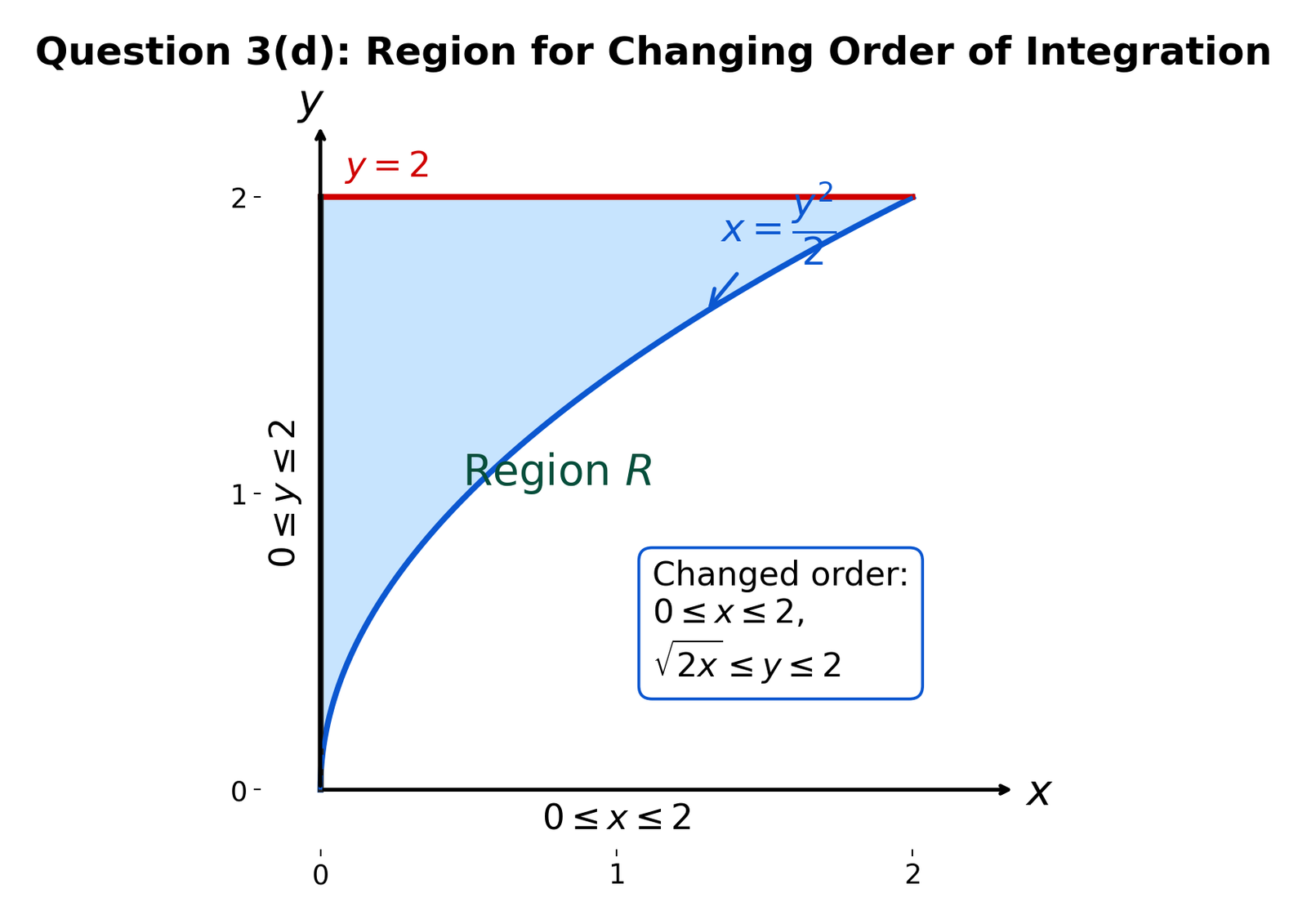
1 QuestionEvaluate \(\int_0^2\int_0^{y^2/2}\dfrac{y}{(x^2+y^2+1)^{1/2}}\,dx\,dy\).
2 DiagramQuestion 3(d): Region for changing the order of integration
3 Concept Related to the QuestionThe given region is \(0\le y\le2\), \(0\le x\le y^2/2\). Changing the order gives \(0\le x\le2\), \(\sqrt{2x}\le y\le2\).
4 Detailed SolutionChanging order, the integral becomes \(\int_0^2\int_{\sqrt{2x}}^2 \dfrac{y}{\sqrt{x^2+y^2+1}}\,dy\,dx\). The inner integral is \(\sqrt{x^2+y^2+1}\).
Thus the integral is \(\int_0^2\{\sqrt{x^2+5}-\sqrt{x^2+2x+1}\}\,dx\). Since \(x\ge0\), \(\sqrt{x^2+2x+1}=x+1\).
Therefore the integral equals \(\int_0^2\sqrt{x^2+5}\,dx-\int_0^2(x+1)dx\). Using \(\int\sqrt{x^2+a^2}dx=\dfrac x2\sqrt{x^2+a^2}+\dfrac{a^2}{2}\log(x+\sqrt{x^2+a^2})\), the value becomes \(\dfrac54\log5-1\).
5 Final AnswerThe value of the integral is \(\dfrac54\log5-1\).
Question 4(a) Improper Integral
1. Question
2. Diagram
3. Concept Related to the Question
4. Detailed Solution
5. Final Answer
1 QuestionEvaluate the integral \(\int_0^\infty \dfrac{dx}{\sqrt{x}(1+x)}\).
2 Diagram
Full Solution Access The Diagram section for this question is available in the full 2016 IFoS Maths Optional Paper II PYQ Solutions course.
Complete diagrams, concepts, detailed solutions and final answers for all questions are available in the full PYQ course.
3 Concept Related to the Question
Full Solution Access The Concept Related to the Question section for this question is available in the full 2016 IFoS Maths Optional Paper II PYQ Solutions course.
Complete diagrams, concepts, detailed solutions and final answers for all questions are available in the full PYQ course.
4 Detailed Solution
Full Solution Access The Detailed Solution section for this question is available in the full 2016 IFoS Maths Optional Paper II PYQ Solutions course.
Complete diagrams, concepts, detailed solutions and final answers for all questions are available in the full PYQ course.
5 Final Answer
Full Solution Access The Final Answer section for this question is available in the full 2016 IFoS Maths Optional Paper II PYQ Solutions course.
Complete diagrams, concepts, detailed solutions and final answers for all questions are available in the full PYQ course.
Question 4(b) Laurent Series
1. Question
2. Diagram
3. Concept Related to the Question
4. Detailed Solution
5. Final Answer
1 QuestionFind the Laurent series for \(f(z)=\dfrac1{1-z^2}\) with centre \(z=1\).
2 Diagram
Full Solution Access The Diagram section for this question is available in the full 2016 IFoS Maths Optional Paper II PYQ Solutions course.
Complete diagrams, concepts, detailed solutions and final answers for all questions are available in the full PYQ course.
3 Concept Related to the Question
Full Solution Access The Concept Related to the Question section for this question is available in the full 2016 IFoS Maths Optional Paper II PYQ Solutions course.
Complete diagrams, concepts, detailed solutions and final answers for all questions are available in the full PYQ course.
4 Detailed Solution
Full Solution Access The Detailed Solution section for this question is available in the full 2016 IFoS Maths Optional Paper II PYQ Solutions course.
Complete diagrams, concepts, detailed solutions and final answers for all questions are available in the full PYQ course.
5 Final Answer
Full Solution Access The Final Answer section for this question is available in the full 2016 IFoS Maths Optional Paper II PYQ Solutions course.
Complete diagrams, concepts, detailed solutions and final answers for all questions are available in the full PYQ course.
Question 4(c) Contour Integration Integral
1. Question
2. Diagram
3. Concept Related to the Question
4. Detailed Solution
5. Final Answer
1 QuestionEvaluate by contour integration \(\int_0^\pi\dfrac{d\theta}{(1+\frac12\cos\theta)^2}\).
2 Diagram
Full Solution Access The Diagram section for this question is available in the full 2016 IFoS Maths Optional Paper II PYQ Solutions course.
Complete diagrams, concepts, detailed solutions and final answers for all questions are available in the full PYQ course.
3 Concept Related to the Question
Full Solution Access The Concept Related to the Question section for this question is available in the full 2016 IFoS Maths Optional Paper II PYQ Solutions course.
Complete diagrams, concepts, detailed solutions and final answers for all questions are available in the full PYQ course.
4 Detailed Solution
Full Solution Access The Detailed Solution section for this question is available in the full 2016 IFoS Maths Optional Paper II PYQ Solutions course.
Complete diagrams, concepts, detailed solutions and final answers for all questions are available in the full PYQ course.
5 Final Answer
Full Solution Access The Final Answer section for this question is available in the full 2016 IFoS Maths Optional Paper II PYQ Solutions course.
Complete diagrams, concepts, detailed solutions and final answers for all questions are available in the full PYQ course.
Question 4(d) Transportation Problem: Profit Maximization
1. Question
2. Diagram
3. Concept Related to the Question
4. Detailed Solution
5. Final Answer
1 QuestionA company manufacturing air-coolers has two plants located at Bengaluru and Mumbai with a weekly capacity of \(200\) units and \(100\) units respectively. The company supplies air-coolers to its \(4\) showrooms situated at Mangalore, Bengaluru, Delhi and Goa which have a demand of \(75,100,100\) and \(25\) units respectively. Due to the differences in local taxes, showroom charges, transportation cost and others, the profits differ. The profits, in Rs., are shown in the following table:
From / To Mangalore Bengaluru Delhi Goa Bengaluru 90 90 100 100 Mumbai 50 70 130 85
Plan the production program so as to maximize the profit. The company may have its production capacity at both plants partially or wholly unused.
2 Diagram
Full Solution Access The Diagram section for this question is available in the full 2016 IFoS Maths Optional Paper II PYQ Solutions course.
Complete diagrams, concepts, detailed solutions and final answers for all questions are available in the full PYQ course.
3 Concept Related to the Question
Full Solution Access The Concept Related to the Question section for this question is available in the full 2016 IFoS Maths Optional Paper II PYQ Solutions course.
Complete diagrams, concepts, detailed solutions and final answers for all questions are available in the full PYQ course.
4 Detailed Solution
Full Solution Access The Detailed Solution section for this question is available in the full 2016 IFoS Maths Optional Paper II PYQ Solutions course.
Complete diagrams, concepts, detailed solutions and final answers for all questions are available in the full PYQ course.
5 Final Answer
Full Solution Access The Final Answer section for this question is available in the full 2016 IFoS Maths Optional Paper II PYQ Solutions course.
Complete diagrams, concepts, detailed solutions and final answers for all questions are available in the full PYQ course.
Question 5(a) Partial Differential Equation by Eliminating Arbitrary Function
1. Question
2. Diagram
3. Concept Related to the Question
4. Detailed Solution
5. Final Answer
1 QuestionObtain the partial differential equation governing \(\phi(u,v)=0\), where \(u=xyz\) and \(v=x+y+z\).
2 Diagram
Full Solution Access The Diagram section for this question is available in the full 2016 IFoS Maths Optional Paper II PYQ Solutions course.
Complete diagrams, concepts, detailed solutions and final answers for all questions are available in the full PYQ course.
3 Concept Related to the Question
Full Solution Access The Concept Related to the Question section for this question is available in the full 2016 IFoS Maths Optional Paper II PYQ Solutions course.
Complete diagrams, concepts, detailed solutions and final answers for all questions are available in the full PYQ course.
4 Detailed Solution
Full Solution Access The Detailed Solution section for this question is available in the full 2016 IFoS Maths Optional Paper II PYQ Solutions course.
Complete diagrams, concepts, detailed solutions and final answers for all questions are available in the full PYQ course.
5 Final Answer
Full Solution Access The Final Answer section for this question is available in the full 2016 IFoS Maths Optional Paper II PYQ Solutions course.
Complete diagrams, concepts, detailed solutions and final answers for all questions are available in the full PYQ course.
Question 5(b) Lagrange’s Linear PDE
1. Question
2. Diagram
3. Concept Related to the Question
4. Detailed Solution
5. Final Answer
1 QuestionFind the general solution of \(xy^2\dfrac{\partial z}{\partial x}+y^3\dfrac{\partial z}{\partial y}=zxy^2-4x^3\).
2 Diagram
Full Solution Access The Diagram section for this question is available in the full 2016 IFoS Maths Optional Paper II PYQ Solutions course.
Complete diagrams, concepts, detailed solutions and final answers for all questions are available in the full PYQ course.
3 Concept Related to the Question
Full Solution Access The Concept Related to the Question section for this question is available in the full 2016 IFoS Maths Optional Paper II PYQ Solutions course.
Complete diagrams, concepts, detailed solutions and final answers for all questions are available in the full PYQ course.
4 Detailed Solution
Full Solution Access The Detailed Solution section for this question is available in the full 2016 IFoS Maths Optional Paper II PYQ Solutions course.
Complete diagrams, concepts, detailed solutions and final answers for all questions are available in the full PYQ course.
5 Final Answer
Full Solution Access The Final Answer section for this question is available in the full 2016 IFoS Maths Optional Paper II PYQ Solutions course.
Complete diagrams, concepts, detailed solutions and final answers for all questions are available in the full PYQ course.
Question 5(c) Newton-Raphson Algorithm
1. Question
2. Diagram
3. Concept Related to the Question
4. Detailed Solution
5. Final Answer
1 QuestionDevelop an algorithm for Newton-Raphson method to solve \(\phi(x)=0\), starting with initial iterate \(x_0\). Let \(n\) be the number of iterations allowed, \(eps\) the prescribed relative error, and \(delta\) the prescribed lower bound for \(\phi^{\prime}(x)\).
2 Diagram
Full Solution Access The Diagram section for this question is available in the full 2016 IFoS Maths Optional Paper II PYQ Solutions course.
Complete diagrams, concepts, detailed solutions and final answers for all questions are available in the full PYQ course.
3 Concept Related to the Question
Full Solution Access The Concept Related to the Question section for this question is available in the full 2016 IFoS Maths Optional Paper II PYQ Solutions course.
Complete diagrams, concepts, detailed solutions and final answers for all questions are available in the full PYQ course.
4 Detailed Solution
Full Solution Access The Detailed Solution section for this question is available in the full 2016 IFoS Maths Optional Paper II PYQ Solutions course.
Complete diagrams, concepts, detailed solutions and final answers for all questions are available in the full PYQ course.
5 Final Answer
Full Solution Access The Final Answer section for this question is available in the full 2016 IFoS Maths Optional Paper II PYQ Solutions course.
Complete diagrams, concepts, detailed solutions and final answers for all questions are available in the full PYQ course.
Question 5(d) Lagrange Interpolation
1. Question
2. Diagram
3. Concept Related to the Question
4. Detailed Solution
5. Final Answer
1 QuestionApply Lagrange’s interpolation formula to find \(f(5)\) and \(f(6)\), given \(f(1)=2\), \(f(2)=4\), \(f(3)=8\), and \(f(7)=128\).
2 Diagram
Full Solution Access The Diagram section for this question is available in the full 2016 IFoS Maths Optional Paper II PYQ Solutions course.
Complete diagrams, concepts, detailed solutions and final answers for all questions are available in the full PYQ course.
3 Concept Related to the Question
Full Solution Access The Concept Related to the Question section for this question is available in the full 2016 IFoS Maths Optional Paper II PYQ Solutions course.
Complete diagrams, concepts, detailed solutions and final answers for all questions are available in the full PYQ course.
4 Detailed Solution
Full Solution Access The Detailed Solution section for this question is available in the full 2016 IFoS Maths Optional Paper II PYQ Solutions course.
Complete diagrams, concepts, detailed solutions and final answers for all questions are available in the full PYQ course.
5 Final Answer
Full Solution Access The Final Answer section for this question is available in the full 2016 IFoS Maths Optional Paper II PYQ Solutions course.
Complete diagrams, concepts, detailed solutions and final answers for all questions are available in the full PYQ course.
Question 5(e) Moment of Inertia of Ellipse
1. Question
2. Diagram
3. Concept Related to the Question
4. Detailed Solution
5. Final Answer
1 QuestionCalculate the moment of inertia of the ellipse \(\dfrac{x^2}{a^2}+\dfrac{y^2}{b^2}=1\), (i) relative to the \(x\)-axis, (ii) relative to the \(y\)-axis, and (iii) relative to the origin.
2 Diagram
Full Solution Access The Diagram section for this question is available in the full 2016 IFoS Maths Optional Paper II PYQ Solutions course.
Complete diagrams, concepts, detailed solutions and final answers for all questions are available in the full PYQ course.
3 Concept Related to the Question
Full Solution Access The Concept Related to the Question section for this question is available in the full 2016 IFoS Maths Optional Paper II PYQ Solutions course.
Complete diagrams, concepts, detailed solutions and final answers for all questions are available in the full PYQ course.
4 Detailed Solution
Full Solution Access The Detailed Solution section for this question is available in the full 2016 IFoS Maths Optional Paper II PYQ Solutions course.
Complete diagrams, concepts, detailed solutions and final answers for all questions are available in the full PYQ course.
5 Final Answer
Full Solution Access The Final Answer section for this question is available in the full 2016 IFoS Maths Optional Paper II PYQ Solutions course.
Complete diagrams, concepts, detailed solutions and final answers for all questions are available in the full PYQ course.
Question 6(a) Lagrange’s PDE
1. Question
2. Diagram
3. Concept Related to the Question
4. Detailed Solution
5. Final Answer
1 QuestionFind the general solution of \(x y^2 p+y^3 q=zxy^2-4x^3\), where \(p=\dfrac{\partial z}{\partial x}\) and \(q=\dfrac{\partial z}{\partial y}\).
2 Diagram
Full Solution Access The Diagram section for this question is available in the full 2016 IFoS Maths Optional Paper II PYQ Solutions course.
Complete diagrams, concepts, detailed solutions and final answers for all questions are available in the full PYQ course.
3 Concept Related to the Question
Full Solution Access The Concept Related to the Question section for this question is available in the full 2016 IFoS Maths Optional Paper II PYQ Solutions course.
Complete diagrams, concepts, detailed solutions and final answers for all questions are available in the full PYQ course.
4 Detailed Solution
Full Solution Access The Detailed Solution section for this question is available in the full 2016 IFoS Maths Optional Paper II PYQ Solutions course.
Complete diagrams, concepts, detailed solutions and final answers for all questions are available in the full PYQ course.
5 Final Answer
Full Solution Access The Final Answer section for this question is available in the full 2016 IFoS Maths Optional Paper II PYQ Solutions course.
Complete diagrams, concepts, detailed solutions and final answers for all questions are available in the full PYQ course.
Question 6(b) Particular Integral of PDE
1. Question
2. Diagram
3. Concept Related to the Question
4. Detailed Solution
5. Final Answer
1 QuestionFind the particular integral of \(\dfrac{\partial^2 z}{\partial x^2}-2\dfrac{\partial^2z}{\partial x\partial y}+\dfrac{\partial^2z}{\partial y^2}=2x\cos y\).
2 Diagram
Full Solution Access The Diagram section for this question is available in the full 2016 IFoS Maths Optional Paper II PYQ Solutions course.
Complete diagrams, concepts, detailed solutions and final answers for all questions are available in the full PYQ course.
3 Concept Related to the Question
Full Solution Access The Concept Related to the Question section for this question is available in the full 2016 IFoS Maths Optional Paper II PYQ Solutions course.
Complete diagrams, concepts, detailed solutions and final answers for all questions are available in the full PYQ course.
4 Detailed Solution
Full Solution Access The Detailed Solution section for this question is available in the full 2016 IFoS Maths Optional Paper II PYQ Solutions course.
Complete diagrams, concepts, detailed solutions and final answers for all questions are available in the full PYQ course.
5 Final Answer
Full Solution Access The Final Answer section for this question is available in the full 2016 IFoS Maths Optional Paper II PYQ Solutions course.
Complete diagrams, concepts, detailed solutions and final answers for all questions are available in the full PYQ course.
Question 6(c) Heat Equation in an Insulated Rod
1. Question
2. Diagram
3. Concept Related to the Question
4. Detailed Solution
5. Final Answer
1 QuestionA uniform rod of length \(L\), whose surface is thermally insulated, is initially at temperature \(\theta_0\). At time \(t=0\), one end is suddenly cooled to \(\theta=0\) and maintained at this temperature; the other end remains thermally insulated. Find the temperature distribution \(\theta(x,t)\).
2 Diagram
Full Solution Access The Diagram section for this question is available in the full 2016 IFoS Maths Optional Paper II PYQ Solutions course.
Complete diagrams, concepts, detailed solutions and final answers for all questions are available in the full PYQ course.
3 Concept Related to the Question
Full Solution Access The Concept Related to the Question section for this question is available in the full 2016 IFoS Maths Optional Paper II PYQ Solutions course.
Complete diagrams, concepts, detailed solutions and final answers for all questions are available in the full PYQ course.
4 Detailed Solution
Full Solution Access The Detailed Solution section for this question is available in the full 2016 IFoS Maths Optional Paper II PYQ Solutions course.
Complete diagrams, concepts, detailed solutions and final answers for all questions are available in the full PYQ course.
5 Final Answer
Full Solution Access The Final Answer section for this question is available in the full 2016 IFoS Maths Optional Paper II PYQ Solutions course.
Complete diagrams, concepts, detailed solutions and final answers for all questions are available in the full PYQ course.
Question 7(a) Simpson One-Third Rule
1. Question
2. Diagram
3. Concept Related to the Question
4. Detailed Solution
5. Final Answer
1 QuestionEvaluate \(\int_0^{0.6}\dfrac{dx}{\sqrt{1-x^2}}\) by Simpson’s \(\frac13\) rule using \(12\) equal subintervals.
2 Diagram
Full Solution Access The Diagram section for this question is available in the full 2016 IFoS Maths Optional Paper II PYQ Solutions course.
Complete diagrams, concepts, detailed solutions and final answers for all questions are available in the full PYQ course.
3 Concept Related to the Question
Full Solution Access The Concept Related to the Question section for this question is available in the full 2016 IFoS Maths Optional Paper II PYQ Solutions course.
Complete diagrams, concepts, detailed solutions and final answers for all questions are available in the full PYQ course.
4 Detailed Solution
Full Solution Access The Detailed Solution section for this question is available in the full 2016 IFoS Maths Optional Paper II PYQ Solutions course.
Complete diagrams, concepts, detailed solutions and final answers for all questions are available in the full PYQ course.
5 Final Answer
Full Solution Access The Final Answer section for this question is available in the full 2016 IFoS Maths Optional Paper II PYQ Solutions course.
Complete diagrams, concepts, detailed solutions and final answers for all questions are available in the full PYQ course.
Question 7(b) Newton-Raphson Cube Root
1. Question
2. Diagram
3. Concept Related to the Question
4. Detailed Solution
5. Final Answer
1 QuestionFind the cube root of \(10\) up to \(5\) significant figures by Newton-Raphson method.
2 Diagram
Full Solution Access The Diagram section for this question is available in the full 2016 IFoS Maths Optional Paper II PYQ Solutions course.
Complete diagrams, concepts, detailed solutions and final answers for all questions are available in the full PYQ course.
3 Concept Related to the Question
Full Solution Access The Concept Related to the Question section for this question is available in the full 2016 IFoS Maths Optional Paper II PYQ Solutions course.
Complete diagrams, concepts, detailed solutions and final answers for all questions are available in the full PYQ course.
4 Detailed Solution
Full Solution Access The Detailed Solution section for this question is available in the full 2016 IFoS Maths Optional Paper II PYQ Solutions course.
Complete diagrams, concepts, detailed solutions and final answers for all questions are available in the full PYQ course.
5 Final Answer
Full Solution Access The Final Answer section for this question is available in the full 2016 IFoS Maths Optional Paper II PYQ Solutions course.
Complete diagrams, concepts, detailed solutions and final answers for all questions are available in the full PYQ course.
Question 7(c) Fourth-Order Runge-Kutta Method
1. Question
2. Diagram
3. Concept Related to the Question
4. Detailed Solution
5. Final Answer
1 QuestionUse the classical fourth-order Runge-Kutta method with \(h=0.2\) to calculate a solution at \(x=0.4\) for \(\dfrac{dy}{dx}=x+y^2\), with \(y=1\) when \(x=0\).
2 Diagram
Full Solution Access The Diagram section for this question is available in the full 2016 IFoS Maths Optional Paper II PYQ Solutions course.
Complete diagrams, concepts, detailed solutions and final answers for all questions are available in the full PYQ course.
3 Concept Related to the Question
Full Solution Access The Concept Related to the Question section for this question is available in the full 2016 IFoS Maths Optional Paper II PYQ Solutions course.
Complete diagrams, concepts, detailed solutions and final answers for all questions are available in the full PYQ course.
4 Detailed Solution
Full Solution Access The Detailed Solution section for this question is available in the full 2016 IFoS Maths Optional Paper II PYQ Solutions course.
Complete diagrams, concepts, detailed solutions and final answers for all questions are available in the full PYQ course.
5 Final Answer
Full Solution Access The Final Answer section for this question is available in the full 2016 IFoS Maths Optional Paper II PYQ Solutions course.
Complete diagrams, concepts, detailed solutions and final answers for all questions are available in the full PYQ course.
Question 8(a) Moment of Inertia of a Solid Cone
1. Question
2. Diagram
3. Concept Related to the Question
4. Detailed Solution
5. Final Answer
1 QuestionFind the moment of inertia of a right solid cone of mass \(M\), height \(h\), and base radius \(a\), about its axis.
2 Diagram
Full Solution Access The Diagram section for this question is available in the full 2016 IFoS Maths Optional Paper II PYQ Solutions course.
Complete diagrams, concepts, detailed solutions and final answers for all questions are available in the full PYQ course.
3 Concept Related to the Question
Full Solution Access The Concept Related to the Question section for this question is available in the full 2016 IFoS Maths Optional Paper II PYQ Solutions course.
Complete diagrams, concepts, detailed solutions and final answers for all questions are available in the full PYQ course.
4 Detailed Solution
Full Solution Access The Detailed Solution section for this question is available in the full 2016 IFoS Maths Optional Paper II PYQ Solutions course.
Complete diagrams, concepts, detailed solutions and final answers for all questions are available in the full PYQ course.
5 Final Answer
Full Solution Access The Final Answer section for this question is available in the full 2016 IFoS Maths Optional Paper II PYQ Solutions course.
Complete diagrams, concepts, detailed solutions and final answers for all questions are available in the full PYQ course.
Question 8(b) Lagrange Equation for Bead on Cycloid
1. Question
2. Diagram
3. Concept Related to the Question
4. Detailed Solution
5. Final Answer
1 QuestionA bead slides on a wire in the shape of a cycloid described by the equations \(x=a(\theta-\sin\theta)\), \(y=a(1+\cos\theta)\), where \(0\le\theta\le2\pi\), and the friction between the bead and the wire is negligible. Deduce Lagrange’s equation of motion.
2 Diagram
Full Solution Access The Diagram section for this question is available in the full 2016 IFoS Maths Optional Paper II PYQ Solutions course.
Complete diagrams, concepts, detailed solutions and final answers for all questions are available in the full PYQ course.
3 Concept Related to the Question
Full Solution Access The Concept Related to the Question section for this question is available in the full 2016 IFoS Maths Optional Paper II PYQ Solutions course.
Complete diagrams, concepts, detailed solutions and final answers for all questions are available in the full PYQ course.
4 Detailed Solution
Full Solution Access The Detailed Solution section for this question is available in the full 2016 IFoS Maths Optional Paper II PYQ Solutions course.
Complete diagrams, concepts, detailed solutions and final answers for all questions are available in the full PYQ course.
5 Final Answer
Full Solution Access The Final Answer section for this question is available in the full 2016 IFoS Maths Optional Paper II PYQ Solutions course.
Complete diagrams, concepts, detailed solutions and final answers for all questions are available in the full PYQ course.
Question 8(c) Pressure on a Pulsating Sphere in Liquid
1. Question
2. Diagram
3. Concept Related to the Question
4. Detailed Solution
5. Final Answer
1 QuestionA sphere is at rest in an infinite mass of homogeneous liquid of density \(\rho\), the pressure at infinity being \(P\). If the radius \(R\) of the sphere varies in such a way that \(R=a+b\cos nt\), where \(b<a\), then find the pressure at the surface of the sphere at any time.
2 Diagram
Full Solution Access The Diagram section for this question is available in the full 2016 IFoS Maths Optional Paper II PYQ Solutions course.
Complete diagrams, concepts, detailed solutions and final answers for all questions are available in the full PYQ course.
3 Concept Related to the Question
Full Solution Access The Concept Related to the Question section for this question is available in the full 2016 IFoS Maths Optional Paper II PYQ Solutions course.
Complete diagrams, concepts, detailed solutions and final answers for all questions are available in the full PYQ course.
4 Detailed Solution
Full Solution Access The Detailed Solution section for this question is available in the full 2016 IFoS Maths Optional Paper II PYQ Solutions course.
Complete diagrams, concepts, detailed solutions and final answers for all questions are available in the full PYQ course.
5 Final Answer
Full Solution Access The Final Answer section for this question is available in the full 2016 IFoS Maths Optional Paper II PYQ Solutions course.
Complete diagrams, concepts, detailed solutions and final answers for all questions are available in the full PYQ course.
2016 IFoS Maths Optional Paper II Solutions FAQs
Are these 2016 IFoS Maths Optional Paper II Solutions complete? This public page gives one full sample solution. Complete question-wise solutions for the full 2016 IFoS Maths Optional Paper II are available in the full PYQ course.
Which question is given as a free sample solution on this page? Question 3(d) is given as the free sample solution on this page. It includes Question, Diagram, Concept Related to the Question, Detailed Solution, and Final Answer.
How should I use these 2016 IFoS Maths Optional Paper II Solutions for preparation? Use these solutions to understand the expected method of presentation, concept application, diagram usage, and final-answer writing style for IFoS Mathematics Optional.
Do these solutions include diagrams and detailed solutions? Yes. The full PYQ course includes diagrams where needed, concepts, detailed solutions, and final answers for all questions.
How can I get complete solutions for all questions in 2016 IFoS Maths Optional Paper II? To get complete solutions for all questions, please fill out the admission form first. Our Ramana Sri IAS admission team will guide you through WhatsApp, email, or call.