Ramana Sri IAS

Ramana Sri IAS Logo Ramana Sri IAS Admission Form
☰ Menu
Ramana Sri IAS - 2016 UPSC Maths Optional Paper II Solutions

2016 UPSC Maths Optional Paper II Solutions

Ramana Sri IAS provides complete and updated solutions for the 2016 UPSC Maths Optional Paper II. Aspirants preparing for the UPSC Mains Examination with Mathematics as their optional subject should solve all these questions carefully at least 5 to 10 times before the mains examination.

Ramana Sri IAS presents complete solutions for UPSC/IAS/CSE-Civil Service Examination 2016 Mathematics Optional Paper II. Each answer follows the same format: Question, Diagram where needed, Concept Related to the Question, Detailed Solution, and Final Answer.

About 2016 UPSC Maths Optional Paper II Solutions

These 2016 UPSC Maths Optional Paper II Solutions are prepared by Ramana Sri IAS for aspirants who want question-wise clarity before the UPSC Mains examination. This public page gives one full sample solution, while the complete paper-wise solutions are available in the full PYQ course.

Students can use these 2016 UPSC Maths Optional Paper II Solutions to understand the expected answer-writing method, diagram presentation, concept application, and final-answer format used by Ramana Sri IAS.

For the official examination source, students may also refer to the UPSC previous year question papers page.

These 2016 UPSC Maths Optional Paper II Solutions are useful for revision, answer-writing practice, and understanding the step-by-step method expected in the UPSC Mathematics optional paper.

Sample Full Solution

We are giving one question as a free sample solution below: Question 1(e). This free sample includes all five sections: Question, Diagram, Concept Related to the Question, Detailed Solution, and Final Answer. Complete solutions for all questions are available in the full PYQ course. To purchase the full solutions, please fill out the admission form first. Our Ramana Sri IAS admission team will guide you through WhatsApp, email, or call.

2016 UPSC Maths Optional Paper II Solutions: Table of Contents

Question 1(a)

Maximal ideals in polynomial rings

1Question

Let \(K\) be a field and \(K[X]\) be the ring of polynomials over \(K\) in a single variable \(X\). For a polynomial \(f\in K[X]\), let \((f)\) denote the ideal in \(K[X]\) generated by \(f\). Show that \((f)\) is a maximal ideal in \(K[X]\) if and only if \(f\) is an irreducible polynomial over \(K\).

2Diagram

Full Solution Access

The Diagram section for this question is available in the full 2016 UPSC Maths Optional Paper II PYQ Solutions course.

Complete diagrams, concepts, detailed solutions and final answers for all questions are available in the full PYQ course.

3Concept Related to the Question

Full Solution Access

The Concept Related to the Question section for this question is available in the full 2016 UPSC Maths Optional Paper II PYQ Solutions course.

Complete diagrams, concepts, detailed solutions and final answers for all questions are available in the full PYQ course.

4Detailed Solution

Full Solution Access

The Detailed Solution section for this question is available in the full 2016 UPSC Maths Optional Paper II PYQ Solutions course.

Complete diagrams, concepts, detailed solutions and final answers for all questions are available in the full PYQ course.

5Final Answer

Full Solution Access

The Final Answer section for this question is available in the full 2016 UPSC Maths Optional Paper II PYQ Solutions course.

Complete diagrams, concepts, detailed solutions and final answers for all questions are available in the full PYQ course.

Question 1(b)

Differentiable extension of a function

1Question

For the function \(f:(0,\infty)\to\mathbb{R}\) given by

\[ f(x)=x^2\sin\frac{1}{x},\qquad 0<x<\infty, \]

show that there is a differentiable function \(g:\mathbb{R}\to\mathbb{R}\) that extends \(f\).

2Diagram

Full Solution Access

The Diagram section for this question is available in the full 2016 UPSC Maths Optional Paper II PYQ Solutions course.

Complete diagrams, concepts, detailed solutions and final answers for all questions are available in the full PYQ course.

3Concept Related to the Question

Full Solution Access

The Concept Related to the Question section for this question is available in the full 2016 UPSC Maths Optional Paper II PYQ Solutions course.

Complete diagrams, concepts, detailed solutions and final answers for all questions are available in the full PYQ course.

4Detailed Solution

Full Solution Access

The Detailed Solution section for this question is available in the full 2016 UPSC Maths Optional Paper II PYQ Solutions course.

Complete diagrams, concepts, detailed solutions and final answers for all questions are available in the full PYQ course.

5Final Answer

Full Solution Access

The Final Answer section for this question is available in the full 2016 UPSC Maths Optional Paper II PYQ Solutions course.

Complete diagrams, concepts, detailed solutions and final answers for all questions are available in the full PYQ course.

Question 1(c)

Monotone sequences and common limit

1Question

Two sequences \(\{x_n\}\) and \(\{y_n\}\) are defined inductively by the following:

\[ x_1=\frac{1}{2},\qquad y_1=1\quad\text{and}\quad x_n=\sqrt{x_{n-1}y_{n-1}},\qquad n=2,3,4,\ldots \]
\[ \frac{1}{y_n}=\frac{1}{2}\left(\frac{1}{x_n}+\frac{1}{y_{n-1}}\right),\qquad n=2,3,4,\ldots \]

Prove that \(x_{n-1}<x_n<y_n<y_{n-1}\), \(n=2,3,4,\ldots\), and deduce that both the sequences converge to the same limit \(l\), where \(\frac{1}{2}<l<1\).

2Diagram

Full Solution Access

The Diagram section for this question is available in the full 2016 UPSC Maths Optional Paper II PYQ Solutions course.

Complete diagrams, concepts, detailed solutions and final answers for all questions are available in the full PYQ course.

3Concept Related to the Question

Full Solution Access

The Concept Related to the Question section for this question is available in the full 2016 UPSC Maths Optional Paper II PYQ Solutions course.

Complete diagrams, concepts, detailed solutions and final answers for all questions are available in the full PYQ course.

4Detailed Solution

Full Solution Access

The Detailed Solution section for this question is available in the full 2016 UPSC Maths Optional Paper II PYQ Solutions course.

Complete diagrams, concepts, detailed solutions and final answers for all questions are available in the full PYQ course.

5Final Answer

Full Solution Access

The Final Answer section for this question is available in the full 2016 UPSC Maths Optional Paper II PYQ Solutions course.

Complete diagrams, concepts, detailed solutions and final answers for all questions are available in the full PYQ course.

Question 1(d)

Harmonic conjugate and analytic function

1Question

Is \(v(x,y)=x^3-3xy^2+2y\) a harmonic function? Prove your claim. If yes, find its conjugate harmonic function \(u(x,y)\) and hence obtain the analytic function whose real and imaginary parts are \(u\) and \(v\) respectively.

2Diagram

Full Solution Access

The Diagram section for this question is available in the full 2016 UPSC Maths Optional Paper II PYQ Solutions course.

Complete diagrams, concepts, detailed solutions and final answers for all questions are available in the full PYQ course.

3Concept Related to the Question

Full Solution Access

The Concept Related to the Question section for this question is available in the full 2016 UPSC Maths Optional Paper II PYQ Solutions course.

Complete diagrams, concepts, detailed solutions and final answers for all questions are available in the full PYQ course.

4Detailed Solution

Full Solution Access

The Detailed Solution section for this question is available in the full 2016 UPSC Maths Optional Paper II PYQ Solutions course.

Complete diagrams, concepts, detailed solutions and final answers for all questions are available in the full PYQ course.

5Final Answer

Full Solution Access

The Final Answer section for this question is available in the full 2016 UPSC Maths Optional Paper II PYQ Solutions course.

Complete diagrams, concepts, detailed solutions and final answers for all questions are available in the full PYQ course.

Question 1(e)

Linear programming by graphical method

1Question

Find the maximum value of

\[ 5x+2y \]

with constraints \(x+2y\geq1\), \(2x+y\leq1\), \(x\geq0\) and \(y\geq0\) by graphical method.

2Diagram

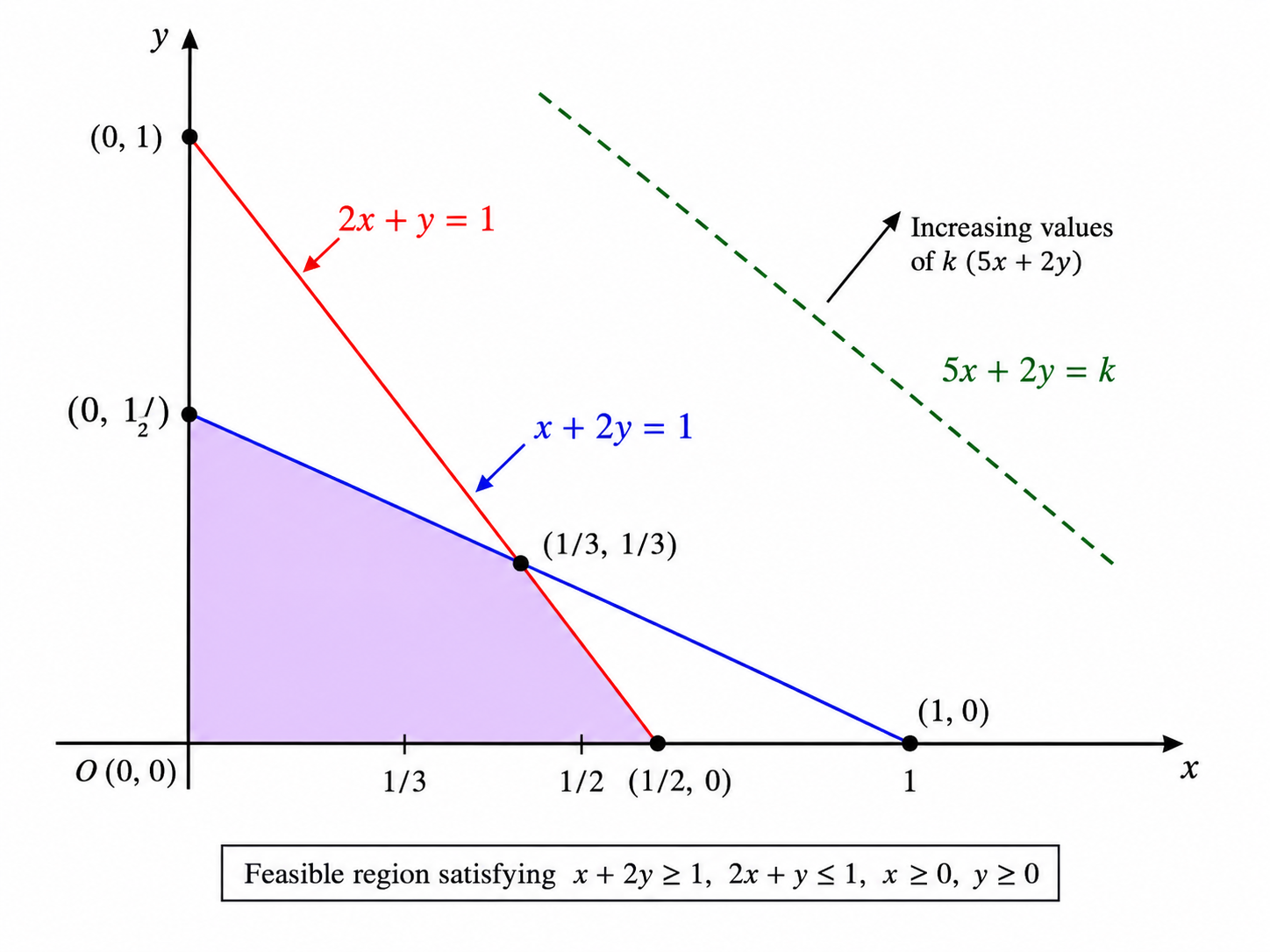
Question 1(e): Graphical method for linear programming
2016 UPSC Maths Optional Paper II Solutions - Question 1(e) graphical method for linear programming diagram showing feasible region, boundary lines and maximum point.

3Concept Related to the Question

In graphical linear programming, the maximum or minimum of a linear objective function over a polygonal feasible region occurs at a corner point of the feasible region.

4Detailed Solution

The feasible region lies in the first quadrant, below the line \(2x+y=1\), and above the line \(x+2y=1\). The corner points are found by intersecting the boundary lines. The points are \((0,\frac{1}{2})\), \((0,1)\), and the intersection of \(x+2y=1\) and \(2x+y=1\). Solving these two equations gives \(x=y=\frac{1}{3}\).

\[ \begin{array}{c|c} \text{Corner point} & 5x+2y\\ \hline (0,\frac{1}{2}) & 1\\ (0,1) & 2\\ (\frac{1}{3},\frac{1}{3}) & \frac{7}{3} \end{array} \]

The largest value is \(\frac{7}{3}\), attained at \((\frac{1}{3},\frac{1}{3})\).

5Final Answer

The maximum value of \(5x+2y\) is \(\frac{7}{3}\), attained at \(x=y=\frac{1}{3}\).

Question 2(a)

Conditional convergence of a series

1Question

Show that the series \(\displaystyle \sum_{n=1}^{\infty}\frac{(-1)^{n+1}}{n+1}\) is conditionally convergent. (If you use any theorem(s) to show it, then you must give a proof of that theorem(s).)

2Diagram

Full Solution Access

The Diagram section for this question is available in the full 2016 UPSC Maths Optional Paper II PYQ Solutions course.

Complete diagrams, concepts, detailed solutions and final answers for all questions are available in the full PYQ course.

3Concept Related to the Question

Full Solution Access

The Concept Related to the Question section for this question is available in the full 2016 UPSC Maths Optional Paper II PYQ Solutions course.

Complete diagrams, concepts, detailed solutions and final answers for all questions are available in the full PYQ course.

4Detailed Solution

Full Solution Access

The Detailed Solution section for this question is available in the full 2016 UPSC Maths Optional Paper II PYQ Solutions course.

Complete diagrams, concepts, detailed solutions and final answers for all questions are available in the full PYQ course.

5Final Answer

Full Solution Access

The Final Answer section for this question is available in the full 2016 UPSC Maths Optional Paper II PYQ Solutions course.

Complete diagrams, concepts, detailed solutions and final answers for all questions are available in the full PYQ course.

Question 2(b)

Generators of the additive group modulo a prime

1Question

Let \(p\) be a prime number and \(\mathbb{Z}_p\) denote the additive group of integers modulo \(p\). Show that every non-zero element of \(\mathbb{Z}_p\) generates \(\mathbb{Z}_p\).

2Diagram

Full Solution Access

The Diagram section for this question is available in the full 2016 UPSC Maths Optional Paper II PYQ Solutions course.

Complete diagrams, concepts, detailed solutions and final answers for all questions are available in the full PYQ course.

3Concept Related to the Question

Full Solution Access

The Concept Related to the Question section for this question is available in the full 2016 UPSC Maths Optional Paper II PYQ Solutions course.

Complete diagrams, concepts, detailed solutions and final answers for all questions are available in the full PYQ course.

4Detailed Solution

Full Solution Access

The Detailed Solution section for this question is available in the full 2016 UPSC Maths Optional Paper II PYQ Solutions course.

Complete diagrams, concepts, detailed solutions and final answers for all questions are available in the full PYQ course.

5Final Answer

Full Solution Access

The Final Answer section for this question is available in the full 2016 UPSC Maths Optional Paper II PYQ Solutions course.

Complete diagrams, concepts, detailed solutions and final answers for all questions are available in the full PYQ course.

Question 2(c)

Linear programming and uniqueness of optimum

1Question

Maximize

\[ z=2x_1+3x_2+6x_3 \]

subject to

\[ 2x_1+x_2+x_3\leq5,\qquad 3x_2+2x_3\leq6,\qquad x_1\geq0,\ x_2\geq0,\ x_3\geq0. \]

Is the optimal solution unique? Justify your answer.

2Diagram

Full Solution Access

The Diagram section for this question is available in the full 2016 UPSC Maths Optional Paper II PYQ Solutions course.

Complete diagrams, concepts, detailed solutions and final answers for all questions are available in the full PYQ course.

3Concept Related to the Question

Full Solution Access

The Concept Related to the Question section for this question is available in the full 2016 UPSC Maths Optional Paper II PYQ Solutions course.

Complete diagrams, concepts, detailed solutions and final answers for all questions are available in the full PYQ course.

4Detailed Solution

Full Solution Access

The Detailed Solution section for this question is available in the full 2016 UPSC Maths Optional Paper II PYQ Solutions course.

Complete diagrams, concepts, detailed solutions and final answers for all questions are available in the full PYQ course.

5Final Answer

Full Solution Access

The Final Answer section for this question is available in the full 2016 UPSC Maths Optional Paper II PYQ Solutions course.

Complete diagrams, concepts, detailed solutions and final answers for all questions are available in the full PYQ course.

Question 3(a)

Algebraic extensions and subfields

1Question

Let \(K\) be an extension of a field \(F\). Prove that the elements of \(K\), which are algebraic over \(F\), form a subfield of \(K\). Further, if \(F\subset K\subset L\) are fields, \(L\) is algebraic over \(K\) and \(K\) is algebraic over \(F\), then prove that \(L\) is algebraic over \(F\).

2Diagram

Full Solution Access

The Diagram section for this question is available in the full 2016 UPSC Maths Optional Paper II PYQ Solutions course.

Complete diagrams, concepts, detailed solutions and final answers for all questions are available in the full PYQ course.

3Concept Related to the Question

Full Solution Access

The Concept Related to the Question section for this question is available in the full 2016 UPSC Maths Optional Paper II PYQ Solutions course.

Complete diagrams, concepts, detailed solutions and final answers for all questions are available in the full PYQ course.

4Detailed Solution

Full Solution Access

The Detailed Solution section for this question is available in the full 2016 UPSC Maths Optional Paper II PYQ Solutions course.

Complete diagrams, concepts, detailed solutions and final answers for all questions are available in the full PYQ course.

5Final Answer

Full Solution Access

The Final Answer section for this question is available in the full 2016 UPSC Maths Optional Paper II PYQ Solutions course.

Complete diagrams, concepts, detailed solutions and final answers for all questions are available in the full PYQ course.

Question 3(b)

Relative extrema of a function of two variables

1Question

Find the relative maximum and minimum values of the function \(f(x,y)=x^4+y^4-2x^2+4xy-2y^2\).

2Diagram

Full Solution Access

The Diagram section for this question is available in the full 2016 UPSC Maths Optional Paper II PYQ Solutions course.

Complete diagrams, concepts, detailed solutions and final answers for all questions are available in the full PYQ course.

3Concept Related to the Question

Full Solution Access

The Concept Related to the Question section for this question is available in the full 2016 UPSC Maths Optional Paper II PYQ Solutions course.

Complete diagrams, concepts, detailed solutions and final answers for all questions are available in the full PYQ course.

4Detailed Solution

Full Solution Access

The Detailed Solution section for this question is available in the full 2016 UPSC Maths Optional Paper II PYQ Solutions course.

Complete diagrams, concepts, detailed solutions and final answers for all questions are available in the full PYQ course.

5Final Answer

Full Solution Access

The Final Answer section for this question is available in the full 2016 UPSC Maths Optional Paper II PYQ Solutions course.

Complete diagrams, concepts, detailed solutions and final answers for all questions are available in the full PYQ course.

Question 3(c)

Contour integral and residues

1Question

Let \(\gamma:[0,1]\to\mathbb{C}\) be the curve \(\gamma(t)=e^{2\pi it}\), \(0\leq t\leq1\). Find, giving justifications, the value of the contour integral \(\displaystyle \int_\gamma \frac{dz}{4z^2-1}\).

2Diagram

Full Solution Access

The Diagram section for this question is available in the full 2016 UPSC Maths Optional Paper II PYQ Solutions course.

Complete diagrams, concepts, detailed solutions and final answers for all questions are available in the full PYQ course.

3Concept Related to the Question

Full Solution Access

The Concept Related to the Question section for this question is available in the full 2016 UPSC Maths Optional Paper II PYQ Solutions course.

Complete diagrams, concepts, detailed solutions and final answers for all questions are available in the full PYQ course.

4Detailed Solution

Full Solution Access

The Detailed Solution section for this question is available in the full 2016 UPSC Maths Optional Paper II PYQ Solutions course.

Complete diagrams, concepts, detailed solutions and final answers for all questions are available in the full PYQ course.

5Final Answer

Full Solution Access

The Final Answer section for this question is available in the full 2016 UPSC Maths Optional Paper II PYQ Solutions course.

Complete diagrams, concepts, detailed solutions and final answers for all questions are available in the full PYQ course.

Question 4(a)

Algebraically closed fields

1Question

Show that every algebraically closed field is infinite.

2Diagram

Full Solution Access

The Diagram section for this question is available in the full 2016 UPSC Maths Optional Paper II PYQ Solutions course.

Complete diagrams, concepts, detailed solutions and final answers for all questions are available in the full PYQ course.

3Concept Related to the Question

Full Solution Access

The Concept Related to the Question section for this question is available in the full 2016 UPSC Maths Optional Paper II PYQ Solutions course.

Complete diagrams, concepts, detailed solutions and final answers for all questions are available in the full PYQ course.

4Detailed Solution

Full Solution Access

The Detailed Solution section for this question is available in the full 2016 UPSC Maths Optional Paper II PYQ Solutions course.

Complete diagrams, concepts, detailed solutions and final answers for all questions are available in the full PYQ course.

5Final Answer

Full Solution Access

The Final Answer section for this question is available in the full 2016 UPSC Maths Optional Paper II PYQ Solutions course.

Complete diagrams, concepts, detailed solutions and final answers for all questions are available in the full PYQ course.

Question 4(b)

Uniform continuity on the real line

1Question

Let \(f:\mathbb{R}\to\mathbb{R}\) be a continuous function such that \(\displaystyle \lim_{x\to+\infty}f(x)\) and \(\displaystyle \lim_{x\to-\infty}f(x)\) exist and are finite. Prove that \(f\) is uniformly continuous on \(\mathbb{R}\).

2Diagram

Full Solution Access

The Diagram section for this question is available in the full 2016 UPSC Maths Optional Paper II PYQ Solutions course.

Complete diagrams, concepts, detailed solutions and final answers for all questions are available in the full PYQ course.

3Concept Related to the Question

Full Solution Access

The Concept Related to the Question section for this question is available in the full 2016 UPSC Maths Optional Paper II PYQ Solutions course.

Complete diagrams, concepts, detailed solutions and final answers for all questions are available in the full PYQ course.

4Detailed Solution

Full Solution Access

The Detailed Solution section for this question is available in the full 2016 UPSC Maths Optional Paper II PYQ Solutions course.

Complete diagrams, concepts, detailed solutions and final answers for all questions are available in the full PYQ course.

5Final Answer

Full Solution Access

The Final Answer section for this question is available in the full 2016 UPSC Maths Optional Paper II PYQ Solutions course.

Complete diagrams, concepts, detailed solutions and final answers for all questions are available in the full PYQ course.

Question 4(c)

Analyticity of power series

1Question

Prove that every power series represents an analytic function inside its circle of convergence.

2Diagram

Full Solution Access

The Diagram section for this question is available in the full 2016 UPSC Maths Optional Paper II PYQ Solutions course.

Complete diagrams, concepts, detailed solutions and final answers for all questions are available in the full PYQ course.

3Concept Related to the Question

Full Solution Access

The Concept Related to the Question section for this question is available in the full 2016 UPSC Maths Optional Paper II PYQ Solutions course.

Complete diagrams, concepts, detailed solutions and final answers for all questions are available in the full PYQ course.

4Detailed Solution

Full Solution Access

The Detailed Solution section for this question is available in the full 2016 UPSC Maths Optional Paper II PYQ Solutions course.

Complete diagrams, concepts, detailed solutions and final answers for all questions are available in the full PYQ course.

5Final Answer

Full Solution Access

The Final Answer section for this question is available in the full 2016 UPSC Maths Optional Paper II PYQ Solutions course.

Complete diagrams, concepts, detailed solutions and final answers for all questions are available in the full PYQ course.

Question 5(a)

Orthogonal trajectories of spheres

1Question

Find the general equation of surfaces orthogonal to the family of spheres given by \(x^2+y^2+z^2=cz\).

2Diagram

Full Solution Access

The Diagram section for this question is available in the full 2016 UPSC Maths Optional Paper II PYQ Solutions course.

Complete diagrams, concepts, detailed solutions and final answers for all questions are available in the full PYQ course.

3Concept Related to the Question

Full Solution Access

The Concept Related to the Question section for this question is available in the full 2016 UPSC Maths Optional Paper II PYQ Solutions course.

Complete diagrams, concepts, detailed solutions and final answers for all questions are available in the full PYQ course.

4Detailed Solution

Full Solution Access

The Detailed Solution section for this question is available in the full 2016 UPSC Maths Optional Paper II PYQ Solutions course.

Complete diagrams, concepts, detailed solutions and final answers for all questions are available in the full PYQ course.

5Final Answer

Full Solution Access

The Final Answer section for this question is available in the full 2016 UPSC Maths Optional Paper II PYQ Solutions course.

Complete diagrams, concepts, detailed solutions and final answers for all questions are available in the full PYQ course.

Question 5(b)

Vorticity and circulation

1Question

Does a fluid with velocity

\[ \vec q=\left(z-\frac{2x}{r},\ 2y-3z-\frac{2y}{r},\ x-3y-\frac{2z}{r}\right) \]

possess vorticity, where \(\vec q=(u,v,w)\) is the velocity in the Cartesian frame, \(\vec r=(x,y,z)\) and \(r^2=x^2+y^2+z^2\)? What is the circulation in the circle \(x^2+y^2=9,\ z=0\)?

2Diagram

Full Solution Access

The Diagram section for this question is available in the full 2016 UPSC Maths Optional Paper II PYQ Solutions course.

Complete diagrams, concepts, detailed solutions and final answers for all questions are available in the full PYQ course.

3Concept Related to the Question

Full Solution Access

The Concept Related to the Question section for this question is available in the full 2016 UPSC Maths Optional Paper II PYQ Solutions course.

Complete diagrams, concepts, detailed solutions and final answers for all questions are available in the full PYQ course.

4Detailed Solution

Full Solution Access

The Detailed Solution section for this question is available in the full 2016 UPSC Maths Optional Paper II PYQ Solutions course.

Complete diagrams, concepts, detailed solutions and final answers for all questions are available in the full PYQ course.

5Final Answer

Full Solution Access

The Final Answer section for this question is available in the full 2016 UPSC Maths Optional Paper II PYQ Solutions course.

Complete diagrams, concepts, detailed solutions and final answers for all questions are available in the full PYQ course.

Question 5(c)

Hamilton characteristic function of a free particle

1Question

Consider a single free particle of mass \(m\), moving in space under no forces. If the particle starts from the origin at \(t=0\) and reaches the position \((x,y,z)\) at time \(\tau\), find the Hamilton's characteristic function \(S\) as a function of \(x,y,z,\tau\).

2Diagram

Full Solution Access

The Diagram section for this question is available in the full 2016 UPSC Maths Optional Paper II PYQ Solutions course.

Complete diagrams, concepts, detailed solutions and final answers for all questions are available in the full PYQ course.

3Concept Related to the Question

Full Solution Access

The Concept Related to the Question section for this question is available in the full 2016 UPSC Maths Optional Paper II PYQ Solutions course.

Complete diagrams, concepts, detailed solutions and final answers for all questions are available in the full PYQ course.

4Detailed Solution

Full Solution Access

The Detailed Solution section for this question is available in the full 2016 UPSC Maths Optional Paper II PYQ Solutions course.

Complete diagrams, concepts, detailed solutions and final answers for all questions are available in the full PYQ course.

5Final Answer

Full Solution Access

The Final Answer section for this question is available in the full 2016 UPSC Maths Optional Paper II PYQ Solutions course.

Complete diagrams, concepts, detailed solutions and final answers for all questions are available in the full PYQ course.

Question 5(d)

Decimal to binary and hexadecimal conversion

1Question

Convert the following decimal numbers to equivalent binary and hexadecimal numbers:

\[ \text{(i) }4096,\qquad \text{(ii) }0.4375,\qquad \text{(iii) }2048.0625. \]

2Diagram

Full Solution Access

The Diagram section for this question is available in the full 2016 UPSC Maths Optional Paper II PYQ Solutions course.

Complete diagrams, concepts, detailed solutions and final answers for all questions are available in the full PYQ course.

3Concept Related to the Question

Full Solution Access

The Concept Related to the Question section for this question is available in the full 2016 UPSC Maths Optional Paper II PYQ Solutions course.

Complete diagrams, concepts, detailed solutions and final answers for all questions are available in the full PYQ course.

4Detailed Solution

Full Solution Access

The Detailed Solution section for this question is available in the full 2016 UPSC Maths Optional Paper II PYQ Solutions course.

Complete diagrams, concepts, detailed solutions and final answers for all questions are available in the full PYQ course.

5Final Answer

Full Solution Access

The Final Answer section for this question is available in the full 2016 UPSC Maths Optional Paper II PYQ Solutions course.

Complete diagrams, concepts, detailed solutions and final answers for all questions are available in the full PYQ course.

Question 5(e)

Lagrange partial differential equation

1Question

Find the general integral of the partial differential equation \((y+zx)p-(x+yz)q=x^2-y^2\).

2Diagram

Full Solution Access

The Diagram section for this question is available in the full 2016 UPSC Maths Optional Paper II PYQ Solutions course.

Complete diagrams, concepts, detailed solutions and final answers for all questions are available in the full PYQ course.

3Concept Related to the Question

Full Solution Access

The Concept Related to the Question section for this question is available in the full 2016 UPSC Maths Optional Paper II PYQ Solutions course.

Complete diagrams, concepts, detailed solutions and final answers for all questions are available in the full PYQ course.

4Detailed Solution

Full Solution Access

The Detailed Solution section for this question is available in the full 2016 UPSC Maths Optional Paper II PYQ Solutions course.

Complete diagrams, concepts, detailed solutions and final answers for all questions are available in the full PYQ course.

5Final Answer

Full Solution Access

The Final Answer section for this question is available in the full 2016 UPSC Maths Optional Paper II PYQ Solutions course.

Complete diagrams, concepts, detailed solutions and final answers for all questions are available in the full PYQ course.

Question 6(a)

Characteristics of a first-order PDE

1Question

Determine the characteristics of the equation \(z=p^2-q^2\), and find the integral surface which passes through the parabola \(4z+x^2=0\), \(y=0\).

2Diagram

Full Solution Access

The Diagram section for this question is available in the full 2016 UPSC Maths Optional Paper II PYQ Solutions course.

Complete diagrams, concepts, detailed solutions and final answers for all questions are available in the full PYQ course.

3Concept Related to the Question

Full Solution Access

The Concept Related to the Question section for this question is available in the full 2016 UPSC Maths Optional Paper II PYQ Solutions course.

Complete diagrams, concepts, detailed solutions and final answers for all questions are available in the full PYQ course.

4Detailed Solution

Full Solution Access

The Detailed Solution section for this question is available in the full 2016 UPSC Maths Optional Paper II PYQ Solutions course.

Complete diagrams, concepts, detailed solutions and final answers for all questions are available in the full PYQ course.

5Final Answer

Full Solution Access

The Final Answer section for this question is available in the full 2016 UPSC Maths Optional Paper II PYQ Solutions course.

Complete diagrams, concepts, detailed solutions and final answers for all questions are available in the full PYQ course.

Question 6(b)

Velocity potential and streamlines

1Question

A simple source of strength \(m\) is fixed at the origin \(O\) in a uniform stream of incompressible fluid moving with velocity \(U\vec i\). Show that velocity potential \(\phi\) at any point \(P\) of the stream is \(\displaystyle \frac{m}{r}-Ur\cos\theta\), where \(OP=r\) and \(\theta\) is the angle which \(OP\) makes with the direction \(\vec i\). Find the differential equation of the streamlines and show that they lie on the surfaces \(Ur^2\sin^2\theta-2m\cos\theta=\text{constants}\).

2Diagram

Full Solution Access

The Diagram section for this question is available in the full 2016 UPSC Maths Optional Paper II PYQ Solutions course.

Complete diagrams, concepts, detailed solutions and final answers for all questions are available in the full PYQ course.

3Concept Related to the Question

Full Solution Access

The Concept Related to the Question section for this question is available in the full 2016 UPSC Maths Optional Paper II PYQ Solutions course.

Complete diagrams, concepts, detailed solutions and final answers for all questions are available in the full PYQ course.

4Detailed Solution

Full Solution Access

The Detailed Solution section for this question is available in the full 2016 UPSC Maths Optional Paper II PYQ Solutions course.

Complete diagrams, concepts, detailed solutions and final answers for all questions are available in the full PYQ course.

5Final Answer

Full Solution Access

The Final Answer section for this question is available in the full 2016 UPSC Maths Optional Paper II PYQ Solutions course.

Complete diagrams, concepts, detailed solutions and final answers for all questions are available in the full PYQ course.

Question 6(c)

Interpolation and error estimation

1Question

Let \(f(x)=e^{2x}\cos3x\), for \(x\in[0,1]\). Estimate the value of \(f(0.5)\) using Lagrange interpolating polynomial of degree \(3\) over the nodes \(x=0\), \(x=0.3\), \(x=0.6\) and \(x=1\). Also, compute the error bound over the interval \([0,1]\) and the actual error \(E(0.5)\).

2Diagram

Full Solution Access

The Diagram section for this question is available in the full 2016 UPSC Maths Optional Paper II PYQ Solutions course.

Complete diagrams, concepts, detailed solutions and final answers for all questions are available in the full PYQ course.

3Concept Related to the Question

Full Solution Access

The Concept Related to the Question section for this question is available in the full 2016 UPSC Maths Optional Paper II PYQ Solutions course.

Complete diagrams, concepts, detailed solutions and final answers for all questions are available in the full PYQ course.

4Detailed Solution

Full Solution Access

The Detailed Solution section for this question is available in the full 2016 UPSC Maths Optional Paper II PYQ Solutions course.

Complete diagrams, concepts, detailed solutions and final answers for all questions are available in the full PYQ course.

5Final Answer

Full Solution Access

The Final Answer section for this question is available in the full 2016 UPSC Maths Optional Paper II PYQ Solutions course.

Complete diagrams, concepts, detailed solutions and final answers for all questions are available in the full PYQ course.

Question 7(a)

Linear partial differential equation

1Question

Solve the partial differential equation \(\dfrac{\partial^3z}{\partial x^3}-2\dfrac{\partial^3z}{\partial x^2\partial y}-\dfrac{\partial^3z}{\partial x\partial y^2}+2\dfrac{\partial^3z}{\partial y^3}=e^{x+y}\).

2Diagram

Full Solution Access

The Diagram section for this question is available in the full 2016 UPSC Maths Optional Paper II PYQ Solutions course.

Complete diagrams, concepts, detailed solutions and final answers for all questions are available in the full PYQ course.

3Concept Related to the Question

Full Solution Access

The Concept Related to the Question section for this question is available in the full 2016 UPSC Maths Optional Paper II PYQ Solutions course.

Complete diagrams, concepts, detailed solutions and final answers for all questions are available in the full PYQ course.

4Detailed Solution

Full Solution Access

The Detailed Solution section for this question is available in the full 2016 UPSC Maths Optional Paper II PYQ Solutions course.

Complete diagrams, concepts, detailed solutions and final answers for all questions are available in the full PYQ course.

5Final Answer

Full Solution Access

The Final Answer section for this question is available in the full 2016 UPSC Maths Optional Paper II PYQ Solutions course.

Complete diagrams, concepts, detailed solutions and final answers for all questions are available in the full PYQ course.

Question 7(b)

Velocity field from a potential

1Question

The space between two concentric spherical shells of radii \(a,b\), \((a<b)\), is filled with a liquid of density \(\rho\). If the shells are set in motion, the inner one with velocity \(U\) in the \(x\)-direction and the outer one with velocity \(V\) in the \(y\)-direction, then show that the initial motion of the liquid is given by velocity potential

\[ \phi=\frac{\left\{a^3U\left(1+\frac{1}{2}b^3r^{-3}\right)x-b^3V\left(1+\frac{1}{2}a^3r^{-3}\right)y\right\}}{b^3-a^3}, \]

where \(r^2=x^2+y^2+z^2\), the coordinates being rectangular. Evaluate the velocity at any point of the liquid.

2Diagram

Full Solution Access

The Diagram section for this question is available in the full 2016 UPSC Maths Optional Paper II PYQ Solutions course.

Complete diagrams, concepts, detailed solutions and final answers for all questions are available in the full PYQ course.

3Concept Related to the Question

Full Solution Access

The Concept Related to the Question section for this question is available in the full 2016 UPSC Maths Optional Paper II PYQ Solutions course.

Complete diagrams, concepts, detailed solutions and final answers for all questions are available in the full PYQ course.

4Detailed Solution

Full Solution Access

The Detailed Solution section for this question is available in the full 2016 UPSC Maths Optional Paper II PYQ Solutions course.

Complete diagrams, concepts, detailed solutions and final answers for all questions are available in the full PYQ course.

5Final Answer

Full Solution Access

The Final Answer section for this question is available in the full 2016 UPSC Maths Optional Paper II PYQ Solutions course.

Complete diagrams, concepts, detailed solutions and final answers for all questions are available in the full PYQ course.

Question 7(c)

Two-point Gauss quadrature

1Question

For an integral \(\displaystyle \int_{-1}^{1}f(x)\,dx\), show that the two-point Gauss quadrature rule is given by

\[ \int_{-1}^{1}f(x)\,dx=f\left(\frac{1}{\sqrt3}\right)+f\left(-\frac{1}{\sqrt3}\right). \]

Using this rule, estimate \(\displaystyle \int_2^4 2xe^x\,dx\).

2Diagram

Full Solution Access

The Diagram section for this question is available in the full 2016 UPSC Maths Optional Paper II PYQ Solutions course.

Complete diagrams, concepts, detailed solutions and final answers for all questions are available in the full PYQ course.

3Concept Related to the Question

Full Solution Access

The Concept Related to the Question section for this question is available in the full 2016 UPSC Maths Optional Paper II PYQ Solutions course.

Complete diagrams, concepts, detailed solutions and final answers for all questions are available in the full PYQ course.

4Detailed Solution

Full Solution Access

The Detailed Solution section for this question is available in the full 2016 UPSC Maths Optional Paper II PYQ Solutions course.

Complete diagrams, concepts, detailed solutions and final answers for all questions are available in the full PYQ course.

5Final Answer

Full Solution Access

The Final Answer section for this question is available in the full 2016 UPSC Maths Optional Paper II PYQ Solutions course.

Complete diagrams, concepts, detailed solutions and final answers for all questions are available in the full PYQ course.

Question 8(a)

Heat equation in a finite bar

1Question

Find the temperature \(u(x,t)\) in a bar of silver of length \(10\) cm and constant cross-section of area \(1\text{ cm}^2\). Let density \(\rho=10\cdot6\text{ g/cm}^3\), thermal conductivity \(K=1\cdot04\text{ cal}/(\text{cm sec }{}^\circ\text{C})\) and specific heat \(\sigma=0\cdot056\text{ cal/g }{}^\circ\text{C}\). The bar is perfectly isolated laterally, with ends kept at \(0^\circ\text{C}\) and initial temperature \(f(x)=\sin(0\cdot1\pi x)^\circ\text{C}\). Note that \(u(x,t)\) follows the heat equation \(u_t=c^2u_{xx}\), where \(c^2=K/(\rho\sigma)\).

2Diagram

Full Solution Access

The Diagram section for this question is available in the full 2016 UPSC Maths Optional Paper II PYQ Solutions course.

Complete diagrams, concepts, detailed solutions and final answers for all questions are available in the full PYQ course.

3Concept Related to the Question

Full Solution Access

The Concept Related to the Question section for this question is available in the full 2016 UPSC Maths Optional Paper II PYQ Solutions course.

Complete diagrams, concepts, detailed solutions and final answers for all questions are available in the full PYQ course.

4Detailed Solution

Full Solution Access

The Detailed Solution section for this question is available in the full 2016 UPSC Maths Optional Paper II PYQ Solutions course.

Complete diagrams, concepts, detailed solutions and final answers for all questions are available in the full PYQ course.

5Final Answer

Full Solution Access

The Final Answer section for this question is available in the full 2016 UPSC Maths Optional Paper II PYQ Solutions course.

Complete diagrams, concepts, detailed solutions and final answers for all questions are available in the full PYQ course.

Question 8(b)

Lagrange equation for a rolling hoop

1Question

A hoop with radius \(r\) is rolling, without slipping, down an inclined plane of length \(l\) and with angle of inclination \(\phi\). Assign appropriate generalized coordinates to the system. Determine the constraints, if any. Write down the Lagrangian equations for the system. Hence or otherwise determine the velocity of the hoop at the bottom of the inclined plane.

2Diagram

Full Solution Access

The Diagram section for this question is available in the full 2016 UPSC Maths Optional Paper II PYQ Solutions course.

Complete diagrams, concepts, detailed solutions and final answers for all questions are available in the full PYQ course.

3Concept Related to the Question

Full Solution Access

The Concept Related to the Question section for this question is available in the full 2016 UPSC Maths Optional Paper II PYQ Solutions course.

Complete diagrams, concepts, detailed solutions and final answers for all questions are available in the full PYQ course.

4Detailed Solution

Full Solution Access

The Detailed Solution section for this question is available in the full 2016 UPSC Maths Optional Paper II PYQ Solutions course.

Complete diagrams, concepts, detailed solutions and final answers for all questions are available in the full PYQ course.

5Final Answer

Full Solution Access

The Final Answer section for this question is available in the full 2016 UPSC Maths Optional Paper II PYQ Solutions course.

Complete diagrams, concepts, detailed solutions and final answers for all questions are available in the full PYQ course.

Question 8(c)

Boolean simplification and logic gates

1Question

Let \(A,B,C\) be Boolean variables, \(\bar A\) denote complement of \(A\), \(A+B\) is an expression for \(A\) OR \(B\) and \(A\cdot B\) is an expression for \(A\) AND \(B\). Then simplify the following expression and draw a block diagram of the simplified expression, using AND and OR gates.

\[ A\cdot(A+B+C)\cdot(\bar A+B+C)\cdot(A+\bar B+C)\cdot(A+B+\bar C). \]

2Diagram

Full Solution Access

The Diagram section for this question is available in the full 2016 UPSC Maths Optional Paper II PYQ Solutions course.

Complete diagrams, concepts, detailed solutions and final answers for all questions are available in the full PYQ course.

3Concept Related to the Question

Full Solution Access

The Concept Related to the Question section for this question is available in the full 2016 UPSC Maths Optional Paper II PYQ Solutions course.

Complete diagrams, concepts, detailed solutions and final answers for all questions are available in the full PYQ course.

4Detailed Solution

Full Solution Access

The Detailed Solution section for this question is available in the full 2016 UPSC Maths Optional Paper II PYQ Solutions course.

Complete diagrams, concepts, detailed solutions and final answers for all questions are available in the full PYQ course.

5Final Answer

Full Solution Access

The Final Answer section for this question is available in the full 2016 UPSC Maths Optional Paper II PYQ Solutions course.

Complete diagrams, concepts, detailed solutions and final answers for all questions are available in the full PYQ course.

2016 UPSC Maths Optional Paper II Solutions FAQs

Are these 2016 UPSC Maths Optional Paper II Solutions complete?

This public page gives one complete sample solution. Complete solutions for all questions are available in the full PYQ course.

Which question is given as a free sample solution on this page?

Question 1(e) is given as the free sample solution on this page.

How should I use these 2016 UPSC Maths Optional Paper II Solutions for preparation?

Students should first read the question carefully, understand the concept, study the diagram where required, and then practise writing the detailed solution and final answer.

Do these solutions include diagrams and detailed solutions?

Yes. The full PYQ course includes diagrams where needed, concept explanation, detailed solution, and final answer for each question.

How can I get complete solutions for all questions in 2016 UPSC Maths Optional Paper II?

To get complete solutions for all questions, please fill out the admission form first. Our Ramana Sri IAS admission team will guide you through WhatsApp, email, or call.

Scroll to Top