Ramana Sri IAS - 2017 UPSC Maths Optional Paper I Solutions
2017 UPSC Maths Optional Paper I Solutions Ramana Sri IAS provides complete and updated solutions for the 2017 UPSC Maths Optional Paper I. Aspirants preparing for the UPSC Mains Examination with Mathematics as their optional subject should solve all these questions carefully at least 5 to 10 times before the mains examination.
Ramana Sri IAS presents complete solutions for UPSC/IAS/CSE-Civil Service Examination 2017 Mathematics Optional Paper I. Each answer follows the same format: Question, Diagram where needed, Concept Related to the Question, Detailed Solution, and Final Answer.
About 2017 UPSC Maths Optional Paper I Solutions These 2017 UPSC Maths Optional Paper I Solutions are prepared by Ramana Sri IAS for aspirants who want question-wise clarity before the UPSC Mains examination. This public page gives one full sample solution, while the complete paper-wise solutions are available in the full PYQ course.
Students can use these 2017 UPSC Maths Optional Paper I Solutions to understand the expected answer-writing method, diagram presentation, concept application, and final-answer format used by Ramana Sri IAS.
For the official examination source, students may also refer to the UPSC previous year question papers page .
These 2017 UPSC Maths Optional Paper I Solutions are useful for revision, answer-writing practice, and understanding the step-by-step method expected in the UPSC Mathematics optional paper.
Sample Full Solution
We are giving one question as a free sample solution below:
Question 1(c) . This free sample includes all five sections:
Question , Diagram ,
Concept Related to the Question ,
Detailed Solution , and Final Answer .
Complete solutions for all questions are available in the full PYQ course. To purchase the full solutions,
please fill out the admission form first. Our Ramana Sri IAS admission team will guide you through WhatsApp, email, or call.
2017 UPSC Maths Optional Paper I Solutions: Table of Contents
Question 1(a) Diagonalisation of a 2 by 2 matrix
1. Question
2. Diagram
3. Concept Related to the Question
4. Detailed Solution
5. Final Answer
1 QuestionLet \(A={\large \left[\begin{smallmatrix}2&2\\1&3\end{smallmatrix}\right]}\). Find a non-singular matrix \(P\) such that \(P^{-1}AP\) is a diagonal matrix.
2 Diagram
Full Solution Access The Diagram section for this question is available in the full 2017 UPSC Maths Optional Paper I PYQ Solutions course.
Complete diagrams, concepts, detailed solutions and final answers for all questions are available in the full PYQ course.
3 Concept Related to the Question
Full Solution Access The Concept Related to the Question section for this question is available in the full 2017 UPSC Maths Optional Paper I PYQ Solutions course.
Complete diagrams, concepts, detailed solutions and final answers for all questions are available in the full PYQ course.
4 Detailed Solution
Full Solution Access The Detailed Solution section for this question is available in the full 2017 UPSC Maths Optional Paper I PYQ Solutions course.
Complete diagrams, concepts, detailed solutions and final answers for all questions are available in the full PYQ course.
5 Final Answer
Full Solution Access The Final Answer section for this question is available in the full 2017 UPSC Maths Optional Paper I PYQ Solutions course.
Complete diagrams, concepts, detailed solutions and final answers for all questions are available in the full PYQ course.
Question 1(b) Characteristic polynomial of similar matrices
1. Question
2. Diagram
3. Concept Related to the Question
4. Detailed Solution
5. Final Answer
1 QuestionShow that similar matrices have the same characteristic polynomial.
2 Diagram
Full Solution Access The Diagram section for this question is available in the full 2017 UPSC Maths Optional Paper I PYQ Solutions course.
Complete diagrams, concepts, detailed solutions and final answers for all questions are available in the full PYQ course.
3 Concept Related to the Question
Full Solution Access The Concept Related to the Question section for this question is available in the full 2017 UPSC Maths Optional Paper I PYQ Solutions course.
Complete diagrams, concepts, detailed solutions and final answers for all questions are available in the full PYQ course.
4 Detailed Solution
Full Solution Access The Detailed Solution section for this question is available in the full 2017 UPSC Maths Optional Paper I PYQ Solutions course.
Complete diagrams, concepts, detailed solutions and final answers for all questions are available in the full PYQ course.
5 Final Answer
Full Solution Access The Final Answer section for this question is available in the full 2017 UPSC Maths Optional Paper I PYQ Solutions course.
Complete diagrams, concepts, detailed solutions and final answers for all questions are available in the full PYQ course.
Question 1(c) Double integral by change of variables
1. Question
2. Diagram
3. Concept Related to the Question
4. Detailed Solution
5. Final Answer
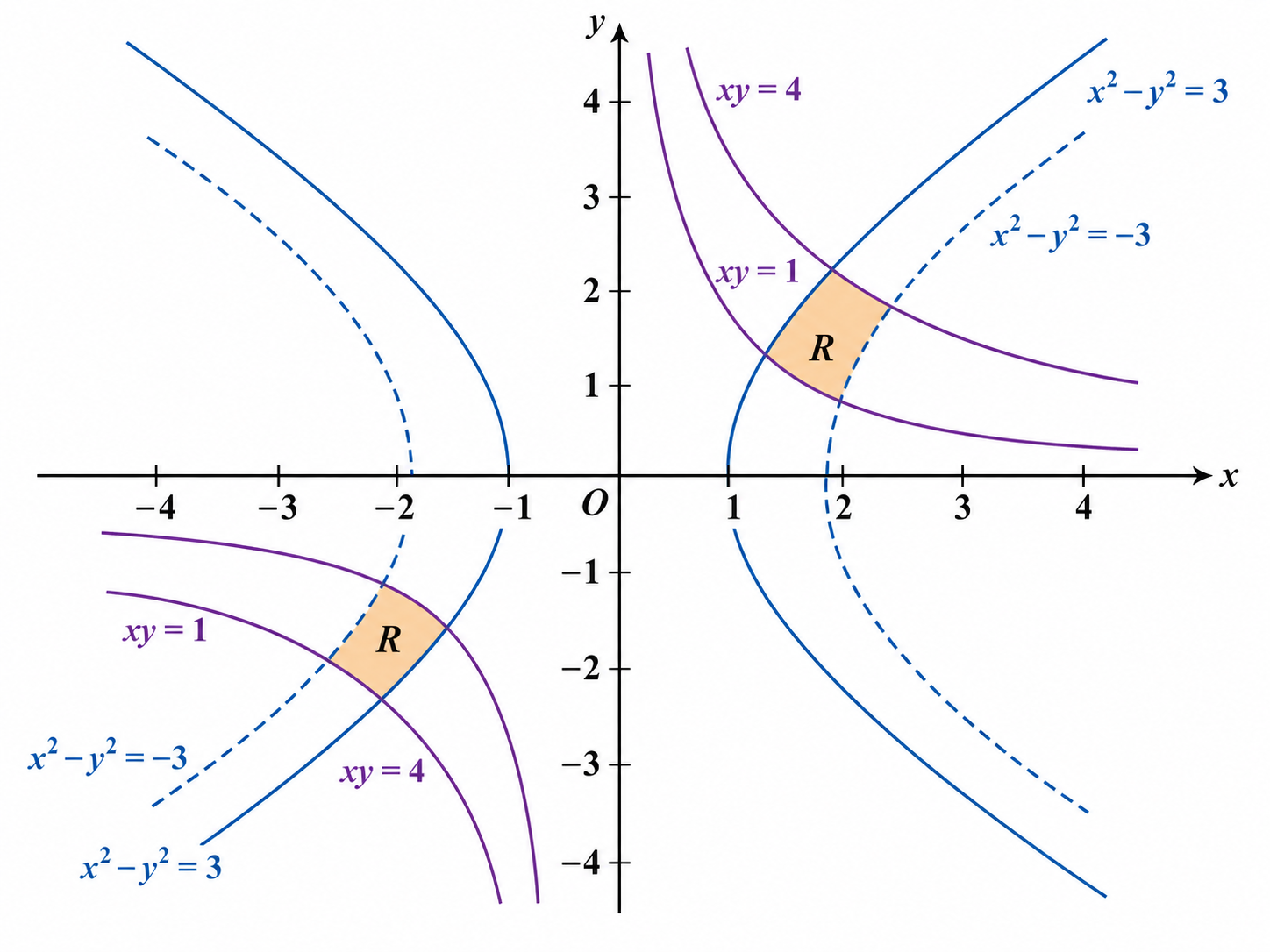
1 QuestionIntegrate the function \(f(x,y)=xy(x^2+y^2)\) over the domain \(R:\{-3\leq x^2-y^2\leq3,\;1\leq xy\leq4\}\).
2 DiagramQuestion 1(c): Region R given by -3 ≤ x² - y² ≤ 3 and 1 ≤ xy ≤ 4
3 Concept Related to the QuestionUse the change of variables \(u=x^2-y^2\) and \(v=xy\). The given region then becomes a rectangle in the \((u,v)\)-plane. We must also account for the two-to-one nature of the transformation in the region where \(xy>0\).
4 Detailed SolutionPut
\[u=x^2-y^2,\qquad v=xy.\]
The Jacobian is
\[\frac{\partial(u,v)}{\partial(x,y)}=(2x)(x)-(-2y)(y)=2(x^2+y^2).\]
Also,
\[u^2+4v^2=(x^2-y^2)^2+4x^2y^2=(x^2+y^2)^2.\]
Hence \(x^2+y^2=\sqrt{u^2+4v^2}\), and
\[dx\,dy=\frac{du\,dv}{2\sqrt{u^2+4v^2}}.\]
The condition \(1\leq xy\leq4\) implies \(xy>0\), so the points \((x,y)\) and \((-x,-y)\) give the same \((u,v)\). Thus the transformation is two-to-one on the given region. Therefore,
\[\iint_R xy(x^2+y^2)\,dx\,dy=2\int_{1}^{4}\int_{-3}^{3}v\sqrt{u^2+4v^2}\,\frac{du\,dv}{2\sqrt{u^2+4v^2}}.\]
After cancellation, this becomes
\[\int_{1}^{4}\int_{-3}^{3}v\,du\,dv=\int_{1}^{4}6v\,dv=3[v^2]_{1}^{4}=45.\]
5 Final AnswerThe required value of the integral is \(45\).
Question 1(d) Tangent plane to a conicoid
1. Question
2. Diagram
3. Concept Related to the Question
4. Detailed Solution
5. Final Answer
1 QuestionFind the equation of the tangent plane at point \((1,1,1)\) to the conicoid \(3x^2-y^2=2z\).
2 Diagram
Full Solution Access The Diagram section for this question is available in the full 2017 UPSC Maths Optional Paper I PYQ Solutions course.
Complete diagrams, concepts, detailed solutions and final answers for all questions are available in the full PYQ course.
3 Concept Related to the Question
Full Solution Access The Concept Related to the Question section for this question is available in the full 2017 UPSC Maths Optional Paper I PYQ Solutions course.
Complete diagrams, concepts, detailed solutions and final answers for all questions are available in the full PYQ course.
4 Detailed Solution
Full Solution Access The Detailed Solution section for this question is available in the full 2017 UPSC Maths Optional Paper I PYQ Solutions course.
Complete diagrams, concepts, detailed solutions and final answers for all questions are available in the full PYQ course.
5 Final Answer
Full Solution Access The Final Answer section for this question is available in the full 2017 UPSC Maths Optional Paper I PYQ Solutions course.
Complete diagrams, concepts, detailed solutions and final answers for all questions are available in the full PYQ course.
Question 1(e) Shortest distance between skew lines
1. Question
2. Diagram
3. Concept Related to the Question
4. Detailed Solution
5. Final Answer
1 QuestionFind the shortest distance between the skew lines :
\[\frac{x-3}{3}=\frac{8-y}{1}=\frac{z-3}{1}\]
and
\[\frac{x+3}{-3}=\frac{y+7}{2}=\frac{z-6}{4}.\]
2 Diagram
Full Solution Access The Diagram section for this question is available in the full 2017 UPSC Maths Optional Paper I PYQ Solutions course.
Complete diagrams, concepts, detailed solutions and final answers for all questions are available in the full PYQ course.
3 Concept Related to the Question
Full Solution Access The Concept Related to the Question section for this question is available in the full 2017 UPSC Maths Optional Paper I PYQ Solutions course.
Complete diagrams, concepts, detailed solutions and final answers for all questions are available in the full PYQ course.
4 Detailed Solution
Full Solution Access The Detailed Solution section for this question is available in the full 2017 UPSC Maths Optional Paper I PYQ Solutions course.
Complete diagrams, concepts, detailed solutions and final answers for all questions are available in the full PYQ course.
5 Final Answer
Full Solution Access The Final Answer section for this question is available in the full 2017 UPSC Maths Optional Paper I PYQ Solutions course.
Complete diagrams, concepts, detailed solutions and final answers for all questions are available in the full PYQ course.
Question 2(a) Volume under an elliptic paraboloid
1. Question
2. Diagram
3. Concept Related to the Question
4. Detailed Solution
5. Final Answer
1 QuestionFind the volume of the solid above the \(xy\)-plane and directly below the portion of the elliptic paraboloid \(x^2+\frac{y^2}{4}=z\) which is cut off by the plane \(z=9\).
2 Diagram
Full Solution Access The Diagram section for this question is available in the full 2017 UPSC Maths Optional Paper I PYQ Solutions course.
Complete diagrams, concepts, detailed solutions and final answers for all questions are available in the full PYQ course.
3 Concept Related to the Question
Full Solution Access The Concept Related to the Question section for this question is available in the full 2017 UPSC Maths Optional Paper I PYQ Solutions course.
Complete diagrams, concepts, detailed solutions and final answers for all questions are available in the full PYQ course.
4 Detailed Solution
Full Solution Access The Detailed Solution section for this question is available in the full 2017 UPSC Maths Optional Paper I PYQ Solutions course.
Complete diagrams, concepts, detailed solutions and final answers for all questions are available in the full PYQ course.
5 Final Answer
Full Solution Access The Final Answer section for this question is available in the full 2017 UPSC Maths Optional Paper I PYQ Solutions course.
Complete diagrams, concepts, detailed solutions and final answers for all questions are available in the full PYQ course.
Question 2(b) Locus of centre of a sphere through intercepts
1. Question
2. Diagram
3. Concept Related to the Question
4. Detailed Solution
5. Final Answer
1 QuestionA plane passes through a fixed point \((a,b,c)\) and cuts the axes at the points \(A,B,C\), respectively. Find the locus of the centre of the sphere which passes through the origin \(O\) and \(A,B,C\).
2 Diagram
Full Solution Access The Diagram section for this question is available in the full 2017 UPSC Maths Optional Paper I PYQ Solutions course.
Complete diagrams, concepts, detailed solutions and final answers for all questions are available in the full PYQ course.
3 Concept Related to the Question
Full Solution Access The Concept Related to the Question section for this question is available in the full 2017 UPSC Maths Optional Paper I PYQ Solutions course.
Complete diagrams, concepts, detailed solutions and final answers for all questions are available in the full PYQ course.
4 Detailed Solution
Full Solution Access The Detailed Solution section for this question is available in the full 2017 UPSC Maths Optional Paper I PYQ Solutions course.
Complete diagrams, concepts, detailed solutions and final answers for all questions are available in the full PYQ course.
5 Final Answer
Full Solution Access The Final Answer section for this question is available in the full 2017 UPSC Maths Optional Paper I PYQ Solutions course.
Complete diagrams, concepts, detailed solutions and final answers for all questions are available in the full PYQ course.
Question 2(c) Tangent plane to a sphere
1. Question
2. Diagram
3. Concept Related to the Question
4. Detailed Solution
5. Final Answer
1 QuestionShow that the plane \(2x-2y+z+12=0\) touches the sphere \(x^2+y^2+z^2-2x-4y+2z-3=0\). Find the point of contact.
2 Diagram
Full Solution Access The Diagram section for this question is available in the full 2017 UPSC Maths Optional Paper I PYQ Solutions course.
Complete diagrams, concepts, detailed solutions and final answers for all questions are available in the full PYQ course.
3 Concept Related to the Question
Full Solution Access The Concept Related to the Question section for this question is available in the full 2017 UPSC Maths Optional Paper I PYQ Solutions course.
Complete diagrams, concepts, detailed solutions and final answers for all questions are available in the full PYQ course.
4 Detailed Solution
Full Solution Access The Detailed Solution section for this question is available in the full 2017 UPSC Maths Optional Paper I PYQ Solutions course.
Complete diagrams, concepts, detailed solutions and final answers for all questions are available in the full PYQ course.
5 Final Answer
Full Solution Access The Final Answer section for this question is available in the full 2017 UPSC Maths Optional Paper I PYQ Solutions course.
Complete diagrams, concepts, detailed solutions and final answers for all questions are available in the full PYQ course.
Question 2(d) Dimensions of intersection of subspaces
1. Question
2. Diagram
3. Concept Related to the Question
4. Detailed Solution
5. Final Answer
1 QuestionSuppose \(U\) and \(W\) are distinct four dimensional subspaces of a vector space \(V\), where \(\dim V=6\). Find the possible dimensions of subspace \(U\cap W\).
2 Diagram
Full Solution Access The Diagram section for this question is available in the full 2017 UPSC Maths Optional Paper I PYQ Solutions course.
Complete diagrams, concepts, detailed solutions and final answers for all questions are available in the full PYQ course.
3 Concept Related to the Question
Full Solution Access The Concept Related to the Question section for this question is available in the full 2017 UPSC Maths Optional Paper I PYQ Solutions course.
Complete diagrams, concepts, detailed solutions and final answers for all questions are available in the full PYQ course.
4 Detailed Solution
Full Solution Access The Detailed Solution section for this question is available in the full 2017 UPSC Maths Optional Paper I PYQ Solutions course.
Complete diagrams, concepts, detailed solutions and final answers for all questions are available in the full PYQ course.
5 Final Answer
Full Solution Access The Final Answer section for this question is available in the full 2017 UPSC Maths Optional Paper I PYQ Solutions course.
Complete diagrams, concepts, detailed solutions and final answers for all questions are available in the full PYQ course.
Question 3(a) Image and kernel of a matrix mapping
1. Question
2. Diagram
3. Concept Related to the Question
4. Detailed Solution
5. Final Answer
1 QuestionConsider the matrix mapping \(A:\mathbb{R}^4\to\mathbb{R}^3\), where \(A={\large \left[\begin{smallmatrix}1&2&3&1\\1&3&5&-2\\3&8&13&-3\end{smallmatrix}\right]}\). Find a basis and dimension of the image \(A\) and those of the kernel \(A\).
2 Diagram
Full Solution Access The Diagram section for this question is available in the full 2017 UPSC Maths Optional Paper I PYQ Solutions course.
Complete diagrams, concepts, detailed solutions and final answers for all questions are available in the full PYQ course.
3 Concept Related to the Question
Full Solution Access The Concept Related to the Question section for this question is available in the full 2017 UPSC Maths Optional Paper I PYQ Solutions course.
Complete diagrams, concepts, detailed solutions and final answers for all questions are available in the full PYQ course.
4 Detailed Solution
Full Solution Access The Detailed Solution section for this question is available in the full 2017 UPSC Maths Optional Paper I PYQ Solutions course.
Complete diagrams, concepts, detailed solutions and final answers for all questions are available in the full PYQ course.
5 Final Answer
Full Solution Access The Final Answer section for this question is available in the full 2017 UPSC Maths Optional Paper I PYQ Solutions course.
Complete diagrams, concepts, detailed solutions and final answers for all questions are available in the full PYQ course.
Question 3(b) Linear independence of eigenvectors
1. Question
2. Diagram
3. Concept Related to the Question
4. Detailed Solution
5. Final Answer
1 QuestionProve that distinct non-zero eigenvectors of a matrix are linearly independent.
2 Diagram
Full Solution Access The Diagram section for this question is available in the full 2017 UPSC Maths Optional Paper I PYQ Solutions course.
Complete diagrams, concepts, detailed solutions and final answers for all questions are available in the full PYQ course.
3 Concept Related to the Question
Full Solution Access The Concept Related to the Question section for this question is available in the full 2017 UPSC Maths Optional Paper I PYQ Solutions course.
Complete diagrams, concepts, detailed solutions and final answers for all questions are available in the full PYQ course.
4 Detailed Solution
Full Solution Access The Detailed Solution section for this question is available in the full 2017 UPSC Maths Optional Paper I PYQ Solutions course.
Complete diagrams, concepts, detailed solutions and final answers for all questions are available in the full PYQ course.
5 Final Answer
Full Solution Access The Final Answer section for this question is available in the full 2017 UPSC Maths Optional Paper I PYQ Solutions course.
Complete diagrams, concepts, detailed solutions and final answers for all questions are available in the full PYQ course.
Question 3(c) Mixed partial derivatives at the origin
1. Question
2. Diagram
3. Concept Related to the Question
4. Detailed Solution
5. Final Answer
1 QuestionIf
\[f(x,y)=\begin{cases}\frac{xy(x^2-y^2)}{x^2+y^2}, & (x,y)\neq(0,0),\\[4pt]0, & (x,y)=(0,0),\end{cases}\]
calculate \(\frac{\partial^2 f}{\partial x\partial y}\) and \(\frac{\partial^2 f}{\partial y\partial x}\) at \((0,0)\).
2 Diagram
Full Solution Access The Diagram section for this question is available in the full 2017 UPSC Maths Optional Paper I PYQ Solutions course.
Complete diagrams, concepts, detailed solutions and final answers for all questions are available in the full PYQ course.
3 Concept Related to the Question
Full Solution Access The Concept Related to the Question section for this question is available in the full 2017 UPSC Maths Optional Paper I PYQ Solutions course.
Complete diagrams, concepts, detailed solutions and final answers for all questions are available in the full PYQ course.
4 Detailed Solution
Full Solution Access The Detailed Solution section for this question is available in the full 2017 UPSC Maths Optional Paper I PYQ Solutions course.
Complete diagrams, concepts, detailed solutions and final answers for all questions are available in the full PYQ course.
5 Final Answer
Full Solution Access The Final Answer section for this question is available in the full 2017 UPSC Maths Optional Paper I PYQ Solutions course.
Complete diagrams, concepts, detailed solutions and final answers for all questions are available in the full PYQ course.
Question 3(d) Director sphere of a central quadric
1. Question
2. Diagram
3. Concept Related to the Question
4. Detailed Solution
5. Final Answer
1 QuestionFind the locus of the point of intersection of three mutually perpendicular tangent planes to \(ax^2+by^2+cz^2=1\).
2 Diagram
Full Solution Access The Diagram section for this question is available in the full 2017 UPSC Maths Optional Paper I PYQ Solutions course.
Complete diagrams, concepts, detailed solutions and final answers for all questions are available in the full PYQ course.
3 Concept Related to the Question
Full Solution Access The Concept Related to the Question section for this question is available in the full 2017 UPSC Maths Optional Paper I PYQ Solutions course.
Complete diagrams, concepts, detailed solutions and final answers for all questions are available in the full PYQ course.
4 Detailed Solution
Full Solution Access The Detailed Solution section for this question is available in the full 2017 UPSC Maths Optional Paper I PYQ Solutions course.
Complete diagrams, concepts, detailed solutions and final answers for all questions are available in the full PYQ course.
5 Final Answer
Full Solution Access The Final Answer section for this question is available in the full 2017 UPSC Maths Optional Paper I PYQ Solutions course.
Complete diagrams, concepts, detailed solutions and final answers for all questions are available in the full PYQ course.
Question 4(a) Reduction of a conicoid to standard form
1. Question
2. Diagram
3. Concept Related to the Question
4. Detailed Solution
5. Final Answer
1 QuestionReduce the following equation to the standard form and hence determine the nature of the conicoid :
\[x^2+y^2+z^2-yz-zx-xy-3x-6y-9z+21=0.\]
2 Diagram
Full Solution Access The Diagram section for this question is available in the full 2017 UPSC Maths Optional Paper I PYQ Solutions course.
Complete diagrams, concepts, detailed solutions and final answers for all questions are available in the full PYQ course.
3 Concept Related to the Question
Full Solution Access The Concept Related to the Question section for this question is available in the full 2017 UPSC Maths Optional Paper I PYQ Solutions course.
Complete diagrams, concepts, detailed solutions and final answers for all questions are available in the full PYQ course.
4 Detailed Solution
Full Solution Access The Detailed Solution section for this question is available in the full 2017 UPSC Maths Optional Paper I PYQ Solutions course.
Complete diagrams, concepts, detailed solutions and final answers for all questions are available in the full PYQ course.
5 Final Answer
Full Solution Access The Final Answer section for this question is available in the full 2017 UPSC Maths Optional Paper I PYQ Solutions course.
Complete diagrams, concepts, detailed solutions and final answers for all questions are available in the full PYQ course.
Question 4(b) Consistency and uniqueness of a linear system
1. Question
2. Diagram
3. Concept Related to the Question
4. Detailed Solution
5. Final Answer
1 QuestionConsider the following system of equations in \(x,y,z\) :
\[x+2y+2z=1,\]
\[x+ay+3z=3,\]
\[x+11y+az=b.\]
(i) For which values of \(a\) does the system have a unique solution?
(ii) For which pair of values \((a,b)\) does the system have more than one solution?
2 Diagram
Full Solution Access The Diagram section for this question is available in the full 2017 UPSC Maths Optional Paper I PYQ Solutions course.
Complete diagrams, concepts, detailed solutions and final answers for all questions are available in the full PYQ course.
3 Concept Related to the Question
Full Solution Access The Concept Related to the Question section for this question is available in the full 2017 UPSC Maths Optional Paper I PYQ Solutions course.
Complete diagrams, concepts, detailed solutions and final answers for all questions are available in the full PYQ course.
4 Detailed Solution
Full Solution Access The Detailed Solution section for this question is available in the full 2017 UPSC Maths Optional Paper I PYQ Solutions course.
Complete diagrams, concepts, detailed solutions and final answers for all questions are available in the full PYQ course.
5 Final Answer
Full Solution Access The Final Answer section for this question is available in the full 2017 UPSC Maths Optional Paper I PYQ Solutions course.
Complete diagrams, concepts, detailed solutions and final answers for all questions are available in the full PYQ course.
Question 4(c) Existence of an improper integral
1. Question
2. Diagram
3. Concept Related to the Question
4. Detailed Solution
5. Final Answer
1 QuestionExamine if the improper integral \(\displaystyle \int_0^3\frac{2x\,dx}{(1-x^2)^{2/3}}\) exists.
2 Diagram
Full Solution Access The Diagram section for this question is available in the full 2017 UPSC Maths Optional Paper I PYQ Solutions course.
Complete diagrams, concepts, detailed solutions and final answers for all questions are available in the full PYQ course.
3 Concept Related to the Question
Full Solution Access The Concept Related to the Question section for this question is available in the full 2017 UPSC Maths Optional Paper I PYQ Solutions course.
Complete diagrams, concepts, detailed solutions and final answers for all questions are available in the full PYQ course.
4 Detailed Solution
Full Solution Access The Detailed Solution section for this question is available in the full 2017 UPSC Maths Optional Paper I PYQ Solutions course.
Complete diagrams, concepts, detailed solutions and final answers for all questions are available in the full PYQ course.
5 Final Answer
Full Solution Access The Final Answer section for this question is available in the full 2017 UPSC Maths Optional Paper I PYQ Solutions course.
Complete diagrams, concepts, detailed solutions and final answers for all questions are available in the full PYQ course.
Question 4(d) Bounds for an integral over the unit disc
1. Question
2. Diagram
3. Concept Related to the Question
4. Detailed Solution
5. Final Answer
1 QuestionProve that \(\frac{\pi}{3}\leq \iint_D \frac{dx\,dy}{\sqrt{x^2+(y-2)^2}}\leq\pi\), where \(D\) is the unit disc.
2 Diagram
Full Solution Access The Diagram section for this question is available in the full 2017 UPSC Maths Optional Paper I PYQ Solutions course.
Complete diagrams, concepts, detailed solutions and final answers for all questions are available in the full PYQ course.
3 Concept Related to the Question
Full Solution Access The Concept Related to the Question section for this question is available in the full 2017 UPSC Maths Optional Paper I PYQ Solutions course.
Complete diagrams, concepts, detailed solutions and final answers for all questions are available in the full PYQ course.
4 Detailed Solution
Full Solution Access The Detailed Solution section for this question is available in the full 2017 UPSC Maths Optional Paper I PYQ Solutions course.
Complete diagrams, concepts, detailed solutions and final answers for all questions are available in the full PYQ course.
5 Final Answer
Full Solution Access The Final Answer section for this question is available in the full 2017 UPSC Maths Optional Paper I PYQ Solutions course.
Complete diagrams, concepts, detailed solutions and final answers for all questions are available in the full PYQ course.
Question 5(a) Differential equation of all circles
1. Question
2. Diagram
3. Concept Related to the Question
4. Detailed Solution
5. Final Answer
1 QuestionFind the differential equation representing all the circles in the \(x\)-\(y\) plane.
2 Diagram
Full Solution Access The Diagram section for this question is available in the full 2017 UPSC Maths Optional Paper I PYQ Solutions course.
Complete diagrams, concepts, detailed solutions and final answers for all questions are available in the full PYQ course.
3 Concept Related to the Question
Full Solution Access The Concept Related to the Question section for this question is available in the full 2017 UPSC Maths Optional Paper I PYQ Solutions course.
Complete diagrams, concepts, detailed solutions and final answers for all questions are available in the full PYQ course.
4 Detailed Solution
Full Solution Access The Detailed Solution section for this question is available in the full 2017 UPSC Maths Optional Paper I PYQ Solutions course.
Complete diagrams, concepts, detailed solutions and final answers for all questions are available in the full PYQ course.
5 Final Answer
Full Solution Access The Final Answer section for this question is available in the full 2017 UPSC Maths Optional Paper I PYQ Solutions course.
Complete diagrams, concepts, detailed solutions and final answers for all questions are available in the full PYQ course.
Question 5(b) Orthogonal trajectories of streamlines
1. Question
2. Diagram
3. Concept Related to the Question
4. Detailed Solution
5. Final Answer
1 QuestionSuppose that the streamlines of the fluid flow are given by a family of curves \(xy=c\). Find the equipotential lines, that is, the orthogonal trajectories of the family of curves representing the streamlines.
2 Diagram
Full Solution Access The Diagram section for this question is available in the full 2017 UPSC Maths Optional Paper I PYQ Solutions course.
Complete diagrams, concepts, detailed solutions and final answers for all questions are available in the full PYQ course.
3 Concept Related to the Question
Full Solution Access The Concept Related to the Question section for this question is available in the full 2017 UPSC Maths Optional Paper I PYQ Solutions course.
Complete diagrams, concepts, detailed solutions and final answers for all questions are available in the full PYQ course.
4 Detailed Solution
Full Solution Access The Detailed Solution section for this question is available in the full 2017 UPSC Maths Optional Paper I PYQ Solutions course.
Complete diagrams, concepts, detailed solutions and final answers for all questions are available in the full PYQ course.
5 Final Answer
Full Solution Access The Final Answer section for this question is available in the full 2017 UPSC Maths Optional Paper I PYQ Solutions course.
Complete diagrams, concepts, detailed solutions and final answers for all questions are available in the full PYQ course.
Question 5(c) Motion on a cardioid using energy
1. Question
2. Diagram
3. Concept Related to the Question
4. Detailed Solution
5. Final Answer
1 QuestionA fixed wire is in the shape of the cardioid \(r=a(1+\cos\theta)\), the initial line being the downward vertical. A small ring of mass \(m\) can slide on the wire and is attached to the point \(r=0\) of the cardioid by an elastic string of natural length \(a\) and modulus of elasticity \(4mg\). The string is released from rest when the string is horizontal. Show by the laws of conservation of energy that
\[a\dot{\theta}^{2}(1+\cos\theta)-g\cos\theta(1-\cos\theta)=0,\]
\(g\) being the acceleration due to gravity.
2 Diagram
Full Solution Access The Diagram section for this question is available in the full 2017 UPSC Maths Optional Paper I PYQ Solutions course.
Complete diagrams, concepts, detailed solutions and final answers for all questions are available in the full PYQ course.
3 Concept Related to the Question
Full Solution Access The Concept Related to the Question section for this question is available in the full 2017 UPSC Maths Optional Paper I PYQ Solutions course.
Complete diagrams, concepts, detailed solutions and final answers for all questions are available in the full PYQ course.
4 Detailed Solution
Full Solution Access The Detailed Solution section for this question is available in the full 2017 UPSC Maths Optional Paper I PYQ Solutions course.
Complete diagrams, concepts, detailed solutions and final answers for all questions are available in the full PYQ course.
5 Final Answer
Full Solution Access The Final Answer section for this question is available in the full 2017 UPSC Maths Optional Paper I PYQ Solutions course.
Complete diagrams, concepts, detailed solutions and final answers for all questions are available in the full PYQ course.
Question 5(d) Irrotational vector field and divergence
1. Question
2. Diagram
3. Concept Related to the Question
4. Detailed Solution
5. Final Answer
1 QuestionFor what values of the constants \(a,b\) and \(c\) the vector \(\vec V=(x+y+az)\vec i+(bx+2y-z)\vec j+(-x+cy+2z)\vec k\) is irrotational? Find the divergence in cylindrical coordinates of this vector with these values.
2 Diagram
Full Solution Access The Diagram section for this question is available in the full 2017 UPSC Maths Optional Paper I PYQ Solutions course.
Complete diagrams, concepts, detailed solutions and final answers for all questions are available in the full PYQ course.
3 Concept Related to the Question
Full Solution Access The Concept Related to the Question section for this question is available in the full 2017 UPSC Maths Optional Paper I PYQ Solutions course.
Complete diagrams, concepts, detailed solutions and final answers for all questions are available in the full PYQ course.
4 Detailed Solution
Full Solution Access The Detailed Solution section for this question is available in the full 2017 UPSC Maths Optional Paper I PYQ Solutions course.
Complete diagrams, concepts, detailed solutions and final answers for all questions are available in the full PYQ course.
5 Final Answer
Full Solution Access The Final Answer section for this question is available in the full 2017 UPSC Maths Optional Paper I PYQ Solutions course.
Complete diagrams, concepts, detailed solutions and final answers for all questions are available in the full PYQ course.
Question 5(e) Components of acceleration
1. Question
2. Diagram
3. Concept Related to the Question
4. Detailed Solution
5. Final Answer
1 QuestionThe position vector of a moving point at time \(t\) is \(\vec r=\sin t\,\vec i+\cos2t\,\vec j+(t^2+2t)\vec k\). Find the components of acceleration \(\vec a\) in the directions parallel to the velocity vector \(\vec v\) and perpendicular to the plane of \(\vec r\) and \(\vec v\) at time \(t=0\).
2 Diagram
Full Solution Access The Diagram section for this question is available in the full 2017 UPSC Maths Optional Paper I PYQ Solutions course.
Complete diagrams, concepts, detailed solutions and final answers for all questions are available in the full PYQ course.
3 Concept Related to the Question
Full Solution Access The Concept Related to the Question section for this question is available in the full 2017 UPSC Maths Optional Paper I PYQ Solutions course.
Complete diagrams, concepts, detailed solutions and final answers for all questions are available in the full PYQ course.
4 Detailed Solution
Full Solution Access The Detailed Solution section for this question is available in the full 2017 UPSC Maths Optional Paper I PYQ Solutions course.
Complete diagrams, concepts, detailed solutions and final answers for all questions are available in the full PYQ course.
5 Final Answer
Full Solution Access The Final Answer section for this question is available in the full 2017 UPSC Maths Optional Paper I PYQ Solutions course.
Complete diagrams, concepts, detailed solutions and final answers for all questions are available in the full PYQ course.
Question 6(a)(i) Simultaneous linear differential equations
1. Question
2. Diagram
3. Concept Related to the Question
4. Detailed Solution
5. Final Answer
1 QuestionSolve the following simultaneous linear differential equations :
\[(D+1)y=z+e^x\quad\text{and}\quad (D+1)z=y+e^x,\]
where \(y\) and \(z\) are functions of independent variable \(x\) and \(D=\frac{d}{dx}\).
2 Diagram
Full Solution Access The Diagram section for this question is available in the full 2017 UPSC Maths Optional Paper I PYQ Solutions course.
Complete diagrams, concepts, detailed solutions and final answers for all questions are available in the full PYQ course.
3 Concept Related to the Question
Full Solution Access The Concept Related to the Question section for this question is available in the full 2017 UPSC Maths Optional Paper I PYQ Solutions course.
Complete diagrams, concepts, detailed solutions and final answers for all questions are available in the full PYQ course.
4 Detailed Solution
Full Solution Access The Detailed Solution section for this question is available in the full 2017 UPSC Maths Optional Paper I PYQ Solutions course.
Complete diagrams, concepts, detailed solutions and final answers for all questions are available in the full PYQ course.
5 Final Answer
Full Solution Access The Final Answer section for this question is available in the full 2017 UPSC Maths Optional Paper I PYQ Solutions course.
Complete diagrams, concepts, detailed solutions and final answers for all questions are available in the full PYQ course.
Question 6(a)(ii) Exponential growth of bacteria
1. Question
2. Diagram
3. Concept Related to the Question
4. Detailed Solution
5. Final Answer
1 QuestionIf the growth rate of the population of bacteria at any time \(t\) is proportional to the amount present at that time and population doubles in one week, then how much bacterias can be expected after \(4\) weeks?
2 Diagram
Full Solution Access The Diagram section for this question is available in the full 2017 UPSC Maths Optional Paper I PYQ Solutions course.
Complete diagrams, concepts, detailed solutions and final answers for all questions are available in the full PYQ course.
3 Concept Related to the Question
Full Solution Access The Concept Related to the Question section for this question is available in the full 2017 UPSC Maths Optional Paper I PYQ Solutions course.
Complete diagrams, concepts, detailed solutions and final answers for all questions are available in the full PYQ course.
4 Detailed Solution
Full Solution Access The Detailed Solution section for this question is available in the full 2017 UPSC Maths Optional Paper I PYQ Solutions course.
Complete diagrams, concepts, detailed solutions and final answers for all questions are available in the full PYQ course.
5 Final Answer
Full Solution Access The Final Answer section for this question is available in the full 2017 UPSC Maths Optional Paper I PYQ Solutions course.
Complete diagrams, concepts, detailed solutions and final answers for all questions are available in the full PYQ course.
Question 6(b)(i) Clairaut form by substitution
1. Question
2. Diagram
3. Concept Related to the Question
4. Detailed Solution
5. Final Answer
1 QuestionConsider the differential equation \(xy p^2-(x^2+y^2-1)p+xy=0\), where \(p=\frac{dy}{dx}\). Substituting \(u=x^2\) and \(v=y^2\), reduce the equation to Clairaut's form in terms of \(u,v\), and \(p'=\frac{dv}{du}\). Hence, or otherwise, solve the equation.
2 Diagram
Full Solution Access The Diagram section for this question is available in the full 2017 UPSC Maths Optional Paper I PYQ Solutions course.
Complete diagrams, concepts, detailed solutions and final answers for all questions are available in the full PYQ course.
3 Concept Related to the Question
Full Solution Access The Concept Related to the Question section for this question is available in the full 2017 UPSC Maths Optional Paper I PYQ Solutions course.
Complete diagrams, concepts, detailed solutions and final answers for all questions are available in the full PYQ course.
4 Detailed Solution
Full Solution Access The Detailed Solution section for this question is available in the full 2017 UPSC Maths Optional Paper I PYQ Solutions course.
Complete diagrams, concepts, detailed solutions and final answers for all questions are available in the full PYQ course.
5 Final Answer
Full Solution Access The Final Answer section for this question is available in the full 2017 UPSC Maths Optional Paper I PYQ Solutions course.
Complete diagrams, concepts, detailed solutions and final answers for all questions are available in the full PYQ course.
Question 6(b)(ii) Initial value differential equation
1. Question
2. Diagram
3. Concept Related to the Question
4. Detailed Solution
5. Final Answer
1 QuestionSolve the following initial value differential equations :
\[20y^{\prime\prime}+4y^\prime+y=0,\quad y(0)=3.2\quad\text{and}\quad y^\prime(0)=0.\]
2 Diagram
Full Solution Access The Diagram section for this question is available in the full 2017 UPSC Maths Optional Paper I PYQ Solutions course.
Complete diagrams, concepts, detailed solutions and final answers for all questions are available in the full PYQ course.
3 Concept Related to the Question
Full Solution Access The Concept Related to the Question section for this question is available in the full 2017 UPSC Maths Optional Paper I PYQ Solutions course.
Complete diagrams, concepts, detailed solutions and final answers for all questions are available in the full PYQ course.
4 Detailed Solution
Full Solution Access The Detailed Solution section for this question is available in the full 2017 UPSC Maths Optional Paper I PYQ Solutions course.
Complete diagrams, concepts, detailed solutions and final answers for all questions are available in the full PYQ course.
5 Final Answer
Full Solution Access The Final Answer section for this question is available in the full 2017 UPSC Maths Optional Paper I PYQ Solutions course.
Complete diagrams, concepts, detailed solutions and final answers for all questions are available in the full PYQ course.
Question 6(c) Equilibrium of a solid hemisphere on a rough plane
1. Question
2. Diagram
3. Concept Related to the Question
4. Detailed Solution
5. Final Answer
1 QuestionA uniform solid hemisphere rests on a rough plane inclined to the horizon at an angle \(\phi\), with its curved surface touching the plane. Find the greatest admissible value of \(\phi\) for equilibrium. If \(\phi\) is less than this value, is the equilibrium stable?
2 Diagram
Full Solution Access The Diagram section for this question is available in the full 2017 UPSC Maths Optional Paper I PYQ Solutions course.
Complete diagrams, concepts, detailed solutions and final answers for all questions are available in the full PYQ course.
3 Concept Related to the Question
Full Solution Access The Concept Related to the Question section for this question is available in the full 2017 UPSC Maths Optional Paper I PYQ Solutions course.
Complete diagrams, concepts, detailed solutions and final answers for all questions are available in the full PYQ course.
4 Detailed Solution
Full Solution Access The Detailed Solution section for this question is available in the full 2017 UPSC Maths Optional Paper I PYQ Solutions course.
Complete diagrams, concepts, detailed solutions and final answers for all questions are available in the full PYQ course.
5 Final Answer
Full Solution Access The Final Answer section for this question is available in the full 2017 UPSC Maths Optional Paper I PYQ Solutions course.
Complete diagrams, concepts, detailed solutions and final answers for all questions are available in the full PYQ course.
Question 7(a) Curvature vector of a helix and locus of foot of perpendicular
1. Question
2. Diagram
3. Concept Related to the Question
4. Detailed Solution
5. Final Answer
1 QuestionFind the curvature vector and its magnitude at any point \(\vec r=(\theta)\) of the curve \(\vec r=(a\cos\theta,a\sin\theta,a\theta)\). Show that the locus of the foot of the perpendicular from the origin to the tangent is a curve that completely lies on the hyperboloid \(x^2+y^2-z^2=a^2\).
2 Diagram
Full Solution Access The Diagram section for this question is available in the full 2017 UPSC Maths Optional Paper I PYQ Solutions course.
Complete diagrams, concepts, detailed solutions and final answers for all questions are available in the full PYQ course.
3 Concept Related to the Question
Full Solution Access The Concept Related to the Question section for this question is available in the full 2017 UPSC Maths Optional Paper I PYQ Solutions course.
Complete diagrams, concepts, detailed solutions and final answers for all questions are available in the full PYQ course.
4 Detailed Solution
Full Solution Access The Detailed Solution section for this question is available in the full 2017 UPSC Maths Optional Paper I PYQ Solutions course.
Complete diagrams, concepts, detailed solutions and final answers for all questions are available in the full PYQ course.
5 Final Answer
Full Solution Access The Final Answer section for this question is available in the full 2017 UPSC Maths Optional Paper I PYQ Solutions course.
Complete diagrams, concepts, detailed solutions and final answers for all questions are available in the full PYQ course.
Question 7(b)(i) Differential equation reducible by \(t=x^2\)
1. Question
2. Diagram
3. Concept Related to the Question
4. Detailed Solution
5. Final Answer
1 QuestionSolve the differential equation \(x\frac{d^2y}{dx^2}-\frac{dy}{dx}-4x^3y=8x^3\sin(x^2)\).
2 Diagram
Full Solution Access The Diagram section for this question is available in the full 2017 UPSC Maths Optional Paper I PYQ Solutions course.
Complete diagrams, concepts, detailed solutions and final answers for all questions are available in the full PYQ course.
3 Concept Related to the Question
Full Solution Access The Concept Related to the Question section for this question is available in the full 2017 UPSC Maths Optional Paper I PYQ Solutions course.
Complete diagrams, concepts, detailed solutions and final answers for all questions are available in the full PYQ course.
4 Detailed Solution
Full Solution Access The Detailed Solution section for this question is available in the full 2017 UPSC Maths Optional Paper I PYQ Solutions course.
Complete diagrams, concepts, detailed solutions and final answers for all questions are available in the full PYQ course.
5 Final Answer
Full Solution Access The Final Answer section for this question is available in the full 2017 UPSC Maths Optional Paper I PYQ Solutions course.
Complete diagrams, concepts, detailed solutions and final answers for all questions are available in the full PYQ course.
Question 7(b)(ii) Variation of parameters / undetermined coefficients
1. Question
2. Diagram
3. Concept Related to the Question
4. Detailed Solution
5. Final Answer
1 QuestionSolve the following differential equation using method of variation of parameters :
\[\frac{d^2y}{dx^2}-\frac{dy}{dx}-2y=44-76x-48x^2.\]
2 Diagram
Full Solution Access The Diagram section for this question is available in the full 2017 UPSC Maths Optional Paper I PYQ Solutions course.
Complete diagrams, concepts, detailed solutions and final answers for all questions are available in the full PYQ course.
3 Concept Related to the Question
Full Solution Access The Concept Related to the Question section for this question is available in the full 2017 UPSC Maths Optional Paper I PYQ Solutions course.
Complete diagrams, concepts, detailed solutions and final answers for all questions are available in the full PYQ course.
4 Detailed Solution
Full Solution Access The Detailed Solution section for this question is available in the full 2017 UPSC Maths Optional Paper I PYQ Solutions course.
Complete diagrams, concepts, detailed solutions and final answers for all questions are available in the full PYQ course.
5 Final Answer
Full Solution Access The Final Answer section for this question is available in the full 2017 UPSC Maths Optional Paper I PYQ Solutions course.
Complete diagrams, concepts, detailed solutions and final answers for all questions are available in the full PYQ course.
Question 7(c) Particle moving on a vertical circle
1. Question
2. Diagram
3. Concept Related to the Question
4. Detailed Solution
5. Final Answer
1 QuestionA particle is free to move on a smooth vertical circular wire of radius \(a\). At time \(t=0\), it is projected along the circle from its lowest point \(A\) with velocity just sufficient to carry it to the highest point \(B\). Find the time \(T\) at which the reaction between the particle and the wire is zero.
2 Diagram
Full Solution Access The Diagram section for this question is available in the full 2017 UPSC Maths Optional Paper I PYQ Solutions course.
Complete diagrams, concepts, detailed solutions and final answers for all questions are available in the full PYQ course.
3 Concept Related to the Question
Full Solution Access The Concept Related to the Question section for this question is available in the full 2017 UPSC Maths Optional Paper I PYQ Solutions course.
Complete diagrams, concepts, detailed solutions and final answers for all questions are available in the full PYQ course.
4 Detailed Solution
Full Solution Access The Detailed Solution section for this question is available in the full 2017 UPSC Maths Optional Paper I PYQ Solutions course.
Complete diagrams, concepts, detailed solutions and final answers for all questions are available in the full PYQ course.
5 Final Answer
Full Solution Access The Final Answer section for this question is available in the full 2017 UPSC Maths Optional Paper I PYQ Solutions course.
Complete diagrams, concepts, detailed solutions and final answers for all questions are available in the full PYQ course.
Question 8(a) Work done in lifting a spherical shot from water
1. Question
2. Diagram
3. Concept Related to the Question
4. Detailed Solution
5. Final Answer
1 QuestionA spherical shot of \(W\) gm weight and radius \(r\) cm lies at the bottom of cylindrical bucket of radius \(R\) cm. The bucket is filled with water up to a depth of \(h\) cm \((h>2r)\). Show that the minimum amount of work done in lifting the shot just clear of the water must be
\[\left[W\left(h-\frac{4r^3}{3R^2}\right)+W^\prime\left(r-h+\frac{2r^3}{3R^2}\right)\right]\text{ cm gm}.\]
\(W^\prime\) gm is the weight of water displaced by the shot.
2 Diagram
Full Solution Access The Diagram section for this question is available in the full 2017 UPSC Maths Optional Paper I PYQ Solutions course.
Complete diagrams, concepts, detailed solutions and final answers for all questions are available in the full PYQ course.
3 Concept Related to the Question
Full Solution Access The Concept Related to the Question section for this question is available in the full 2017 UPSC Maths Optional Paper I PYQ Solutions course.
Complete diagrams, concepts, detailed solutions and final answers for all questions are available in the full PYQ course.
4 Detailed Solution
Full Solution Access The Detailed Solution section for this question is available in the full 2017 UPSC Maths Optional Paper I PYQ Solutions course.
Complete diagrams, concepts, detailed solutions and final answers for all questions are available in the full PYQ course.
5 Final Answer
Full Solution Access The Final Answer section for this question is available in the full 2017 UPSC Maths Optional Paper I PYQ Solutions course.
Complete diagrams, concepts, detailed solutions and final answers for all questions are available in the full PYQ course.
Question 8(b) Initial value problem using convolution
1. Question
2. Diagram
3. Concept Related to the Question
4. Detailed Solution
5. Final Answer
1 QuestionSolve the following initial value problem using Laplace transform :
\[\frac{d^2y}{dx^2}+9y=r(x),\qquad y(0)=0,\qquad y^\prime(0)=4,\]
where
\[r(x)=\begin{cases}8\sin x, & \text{if }0<x<\pi,\\0, & \text{if }x\geq\pi.\end{cases}\]
2 Diagram
Full Solution Access The Diagram section for this question is available in the full 2017 UPSC Maths Optional Paper I PYQ Solutions course.
Complete diagrams, concepts, detailed solutions and final answers for all questions are available in the full PYQ course.
3 Concept Related to the Question
Full Solution Access The Concept Related to the Question section for this question is available in the full 2017 UPSC Maths Optional Paper I PYQ Solutions course.
Complete diagrams, concepts, detailed solutions and final answers for all questions are available in the full PYQ course.
4 Detailed Solution
Full Solution Access The Detailed Solution section for this question is available in the full 2017 UPSC Maths Optional Paper I PYQ Solutions course.
Complete diagrams, concepts, detailed solutions and final answers for all questions are available in the full PYQ course.
5 Final Answer
Full Solution Access The Final Answer section for this question is available in the full 2017 UPSC Maths Optional Paper I PYQ Solutions course.
Complete diagrams, concepts, detailed solutions and final answers for all questions are available in the full PYQ course.
Question 8(c)(i) Divergence theorem on a cylinder
1. Question
2. Diagram
3. Concept Related to the Question
4. Detailed Solution
5. Final Answer
1 QuestionEvaluate the integral :
\[\iint_S\vec F\cdot\vec n\,dS\]
where \(\vec F=3xy^2\vec i+(yx^2-y^3)\vec j+3xz^2\vec k\) and \(S\) is a surface of the cylinder \(y^2+z^2\leq4\), \(-3\leq x\leq3\), using divergence theorem.
2 Diagram
Full Solution Access The Diagram section for this question is available in the full 2017 UPSC Maths Optional Paper I PYQ Solutions course.
Complete diagrams, concepts, detailed solutions and final answers for all questions are available in the full PYQ course.
3 Concept Related to the Question
Full Solution Access The Concept Related to the Question section for this question is available in the full 2017 UPSC Maths Optional Paper I PYQ Solutions course.
Complete diagrams, concepts, detailed solutions and final answers for all questions are available in the full PYQ course.
4 Detailed Solution
Full Solution Access The Detailed Solution section for this question is available in the full 2017 UPSC Maths Optional Paper I PYQ Solutions course.
Complete diagrams, concepts, detailed solutions and final answers for all questions are available in the full PYQ course.
5 Final Answer
Full Solution Access The Final Answer section for this question is available in the full 2017 UPSC Maths Optional Paper I PYQ Solutions course.
Complete diagrams, concepts, detailed solutions and final answers for all questions are available in the full PYQ course.
Question 8(c)(ii) Green theorem in the plane
1. Question
2. Diagram
3. Concept Related to the Question
4. Detailed Solution
5. Final Answer
1 QuestionUsing Green's theorem, evaluate \(\oint_C \vec F(\vec r)\cdot d\vec r\) counterclockwise, where \(\vec F(\vec r)=(x^2+y^2)\vec i+(x^2-y^2)\vec j\), \(d\vec r=dx\vec i+dy\vec j\), and \(C\) is the boundary of the region \(R=\{(x,y):1\leq y\leq2-x^2\}\).
2 Diagram
Full Solution Access The Diagram section for this question is available in the full 2017 UPSC Maths Optional Paper I PYQ Solutions course.
Complete diagrams, concepts, detailed solutions and final answers for all questions are available in the full PYQ course.
3 Concept Related to the Question
Full Solution Access The Concept Related to the Question section for this question is available in the full 2017 UPSC Maths Optional Paper I PYQ Solutions course.
Complete diagrams, concepts, detailed solutions and final answers for all questions are available in the full PYQ course.
4 Detailed Solution
Full Solution Access The Detailed Solution section for this question is available in the full 2017 UPSC Maths Optional Paper I PYQ Solutions course.
Complete diagrams, concepts, detailed solutions and final answers for all questions are available in the full PYQ course.
5 Final Answer
Full Solution Access The Final Answer section for this question is available in the full 2017 UPSC Maths Optional Paper I PYQ Solutions course.
Complete diagrams, concepts, detailed solutions and final answers for all questions are available in the full PYQ course.
2017 UPSC Maths Optional Paper I Solutions FAQs
Are these 2017 UPSC Maths Optional Paper I Solutions complete? This public page provides one complete free sample solution. Complete paper-wise solutions for all questions are available in the full PYQ course.
Which question is given as a free sample solution on this page? Question 1(c) is given as the free sample solution. It includes the Question, Diagram, Concept Related to the Question, Detailed Solution, and Final Answer sections.
How should I use these 2017 UPSC Maths Optional Paper I Solutions for preparation? Use these solutions for revision, answer-writing practice, diagram presentation, and concept clarity before attempting the complete paper in timed conditions.
Do these solutions include diagrams and detailed explanations? Yes. The complete PYQ course includes diagrams where needed, concepts, detailed explanations, and final answers for all questions.
How can I get complete solutions for all questions in 2017 UPSC Maths Optional Paper I Solutions? Complete solutions are available in the full PYQ course. Please fill out the admission form first, and the Ramana Sri IAS admission team will guide you through WhatsApp, email, or call.