Ramana Sri IAS - 2019 IFoS Maths Optional Paper I Solutions
2019 IFoS Maths Optional Paper I Solutions
Ramana Sri IAS provides complete and updated solutions for the 2019 IFoS Maths Optional Paper I. Aspirants preparing for the IFoS Mains Examination with Mathematics as their optional subject should solve all these questions carefully before the mains examination.
Ramana Sri IAS presents complete solutions for Indian Forest Service Examination 2019 Mathematics Optional Paper I. Each answer follows the same format: Question, Diagram where needed, Concept Related to the Question, Detailed Solution, and Final Answer.
About 2019 IFoS Maths Optional Paper I Solutions
These 2019 IFoS Maths Optional Paper I Solutions are prepared by Ramana Sri IAS for aspirants who want question-wise clarity before the IFoS Mains examination. This public page gives one full sample solution, while the complete paper-wise solutions are available in the full PYQ course.
Students can use these 2019 IFoS Maths Optional Paper I Solutions to understand the expected answer-writing method, diagram presentation, concept application, and final-answer format used by Ramana Sri IAS.
These 2019 IFoS Maths Optional Paper I Solutions are useful for revision, answer-writing practice, and understanding the step-by-step method expected in the IFoS Mathematics optional paper.
Sample Full Solution
We are giving one question as a free sample solution below:
Question 1(c). This free sample includes all five sections:
Question, Diagram,
Concept Related to the Question,
Detailed Solution, and Final Answer.
Complete 2019 IFoS Maths Optional Paper I Solutions for all questions are available in the full PYQ course. To purchase the full solutions,
please fill out the admission form first. Our Ramana Sri IAS admission team will guide you through WhatsApp, email, or call.
2019 IFoS Maths Optional Paper I Solutions: Table of Contents
Let \(T:\mathbb R^3\to\mathbb R^3\) be a linear operator on \(\mathbb R^3\) defined by \(T(x,y,z)=(2y+z,x-4y,3x)\). Find the matrix of \(T\) in the basis \(\{(1,1,1),(1,1,0),(1,0,0)\}\).
2Diagram
Full Solution Access
The Diagram section for this question is available in the full 2019 IFoS Maths Optional Paper I PYQ Solutions course.
Complete diagrams, concepts, detailed solutions and final answers for all questions are available in the full PYQ course.
The eigenvalues of a real symmetric matrix \(A\) are \(-1,1\) and \(-2\). The corresponding eigenvectors are \(\frac{1}{\sqrt2}(-1,1,0)^T\), \((0,0,1)^T\) and \(\frac{1}{\sqrt2}(-1,-1,0)^T\), respectively. Find the matrix \(A^4\).
2Diagram
Full Solution Access
The Diagram section for this question is available in the full 2019 IFoS Maths Optional Paper I PYQ Solutions course.
Complete diagrams, concepts, detailed solutions and final answers for all questions are available in the full PYQ course.
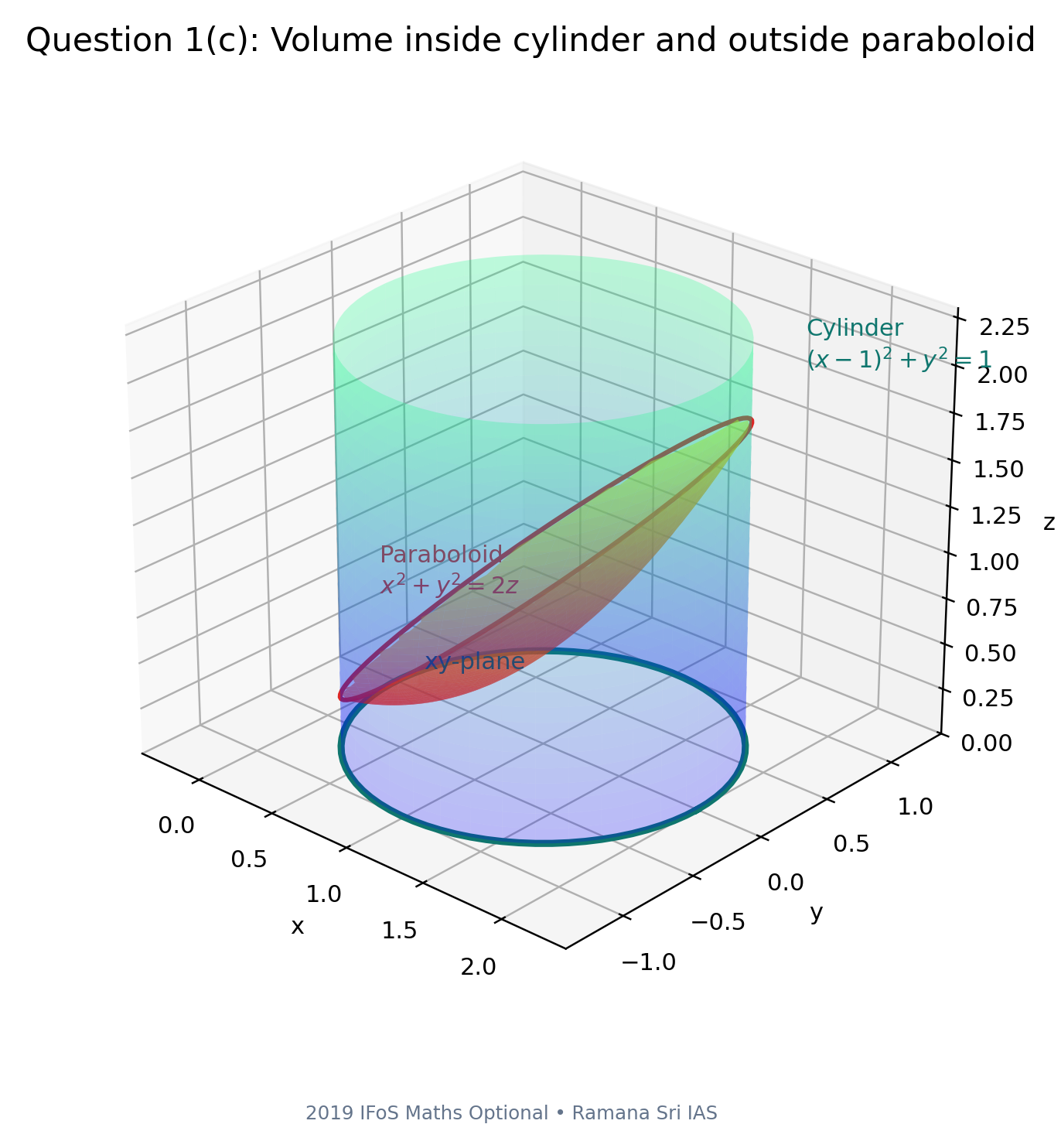
Find the volume lying inside the cylinder \(x^2+y^2-2x=0\) and outside the paraboloid \(x^2+y^2=2z\), while bounded by the \(xy\)-plane.
2Diagram
Question 1(c): Volume Inside Cylinder and Outside Paraboloid
3Concept Related to the Question
This question belongs to Multiple Integrals. The main idea is to write the given information in a standard mathematical form and then simplify it step by step.
4Detailed Solution
Use cylindrical coordinates \(x=r\cos\theta\), \(y=r\sin\theta\). The cylinder becomes \(r=2\cos\theta\), so \(-\frac\pi2\le\theta\le\frac\pi2\) and \(0\le r\le2\cos\theta\). The paraboloid gives \(z=\frac{r^2}{2}\). Since the lower boundary is \(z=0\), the required volume is \(\int_{-\pi/2}^{\pi/2}\int_0^{2\cos\theta}\frac{r^2}{2}r\,dr\,d\theta\). This becomes \(\frac18\int_{-\pi/2}^{\pi/2}16\cos^4\theta\,d\theta=2\cdot\frac{3\pi}{8}\).
5Final Answer
The required volume is \(\frac{3\pi}{4}\) cubic units.
Question 1(d)
Rolle Theorem
1Question
Justify by using Rolle’s theorem or mean value theorem that there is no number \(k\) for which the equation \(x^3-3x+k=0\) has two distinct solutions in the interval \([-1,1]\).
2Diagram
Full Solution Access
The Diagram section for this question is available in the full 2019 IFoS Maths Optional Paper I PYQ Solutions course.
Complete diagrams, concepts, detailed solutions and final answers for all questions are available in the full PYQ course.
If the coordinates of the points \(A\) and \(B\) are respectively \((b\cos\alpha,b\sin\alpha)\) and \((a\cos\beta,a\sin\beta)\), and if the line joining \(A\) and \(B\) is produced to the point \(M(x,y)\) so that \(AM:MB=b:a\), then show that \(x\cos\frac{\alpha+\beta}{2}+y\sin\frac{\alpha+\beta}{2}=0\).
2Diagram
Full Solution Access
The Diagram section for this question is available in the full 2019 IFoS Maths Optional Paper I PYQ Solutions course.
Complete diagrams, concepts, detailed solutions and final answers for all questions are available in the full PYQ course.
Given that one eigenvalue of \(A\) is \(4\) and one eigenvector that does not correspond to this eigenvalue \(4\) is \((1,1,0,0)^T\), find all the eigenvalues of \(A\) other than \(4\) and hence also find the real numbers \(p,q,r\) that satisfy the matrix equation \(A^4+pA^3+qA^2+rA=0\).
2Diagram
Full Solution Access
The Diagram section for this question is available in the full 2019 IFoS Maths Optional Paper I PYQ Solutions course.
Complete diagrams, concepts, detailed solutions and final answers for all questions are available in the full PYQ course.
A line makes angles \(\alpha,\beta,\gamma,\delta\) with the four diagonals of a cube. Show that \(\cos^2\alpha+\cos^2\beta+\cos^2\gamma+\cos^2\delta=\frac43\).
2Diagram
Full Solution Access
The Diagram section for this question is available in the full 2019 IFoS Maths Optional Paper I PYQ Solutions course.
Complete diagrams, concepts, detailed solutions and final answers for all questions are available in the full PYQ course.
Consider the vectors \(x_1=(1,2,1,-1)\), \(x_2=(2,4,1,1)\), \(x_3=(-1,-2,0,-2)\) and \(x_4=(3,6,2,0)\) in \(\mathbb R^4\). Justify that the linear span of the set \(\{x_1,x_2,x_3,x_4\}\) is a subspace of \(\mathbb R^4\) defined as \(\{(\xi_1,\xi_2,\xi_3,\xi_4)\in\mathbb R^4:2\xi_1-\xi_2=0,\;2\xi_1-3\xi_3-\xi_4=0\}\). Can this subspace be written as \(\{(\alpha,2\alpha,\beta,2\alpha-3\beta):\alpha,\beta\in\mathbb R\}\)? What is the dimension of this subspace?
2Diagram
Full Solution Access
The Diagram section for this question is available in the full 2019 IFoS Maths Optional Paper I PYQ Solutions course.
Complete diagrams, concepts, detailed solutions and final answers for all questions are available in the full PYQ course.
The dimensions of a rectangular box are linear functions of time—\(l(t),w(t)\) and \(h(t)\). If the length and width are increasing at the rate \(2\) cm/sec and the height is decreasing at the rate \(3\) cm/sec, find the rates at which the volume \(V\) and the surface area \(S\) are changing with respect to time. If \(l(0)=10\), \(w(0)=8\) and \(h(0)=20\), is \(V\) increasing or decreasing when \(t=5\) sec? What about \(S\), when \(t=5\) sec?
2Diagram
Full Solution Access
The Diagram section for this question is available in the full 2019 IFoS Maths Optional Paper I PYQ Solutions course.
Complete diagrams, concepts, detailed solutions and final answers for all questions are available in the full PYQ course.
Show that the shortest distance between the straight lines \(\frac{x-3}{3}=\frac{y-8}{-1}=\frac{z-3}{1}\) and \(\frac{x+3}{-3}=\frac{y+7}{2}=\frac{z-6}{4}\) is \(3\sqrt{30}\). Find also the equation of the line of shortest distance.
2Diagram
Full Solution Access
The Diagram section for this question is available in the full 2019 IFoS Maths Optional Paper I PYQ Solutions course.
Complete diagrams, concepts, detailed solutions and final answers for all questions are available in the full PYQ course.
to reduced echelon form and find the inverse of \(A\) and hence solve the system of linear equations \(AX=b\), where \(X=(x,y,z,u)^T\) and \(b=(2,1,0,4)^T\).
2Diagram
Full Solution Access
The Diagram section for this question is available in the full 2019 IFoS Maths Optional Paper I PYQ Solutions course.
Complete diagrams, concepts, detailed solutions and final answers for all questions are available in the full PYQ course.
Find the centroid of the solid generated by revolving the upper half of the cardioid \(r=a(1+\cos\theta)\) bounded by the line \(\theta=0\) about the initial line. Take the density of the solid as uniform.
2Diagram
Full Solution Access
The Diagram section for this question is available in the full 2019 IFoS Maths Optional Paper I PYQ Solutions course.
Complete diagrams, concepts, detailed solutions and final answers for all questions are available in the full PYQ course.
A variable plane is parallel to the plane \(\frac{x}{a}+\frac{y}{b}+\frac{z}{c}=0\) and meets the axes at the points \(A,B\) and \(C\). Prove that the circle \(ABC\) lies on the cone \(yz\left(\frac bc+\frac cb\right)+zx\left(\frac ca+\frac ac\right)+xy\left(\frac ab+\frac ba\right)=0\).
2Diagram
Full Solution Access
The Diagram section for this question is available in the full 2019 IFoS Maths Optional Paper I PYQ Solutions course.
Complete diagrams, concepts, detailed solutions and final answers for all questions are available in the full PYQ course.
A \(2\) metres rod has a weight of \(2\,N\) and has its centre of gravity at \(120\) cm from one end. At \(20\) cm, \(100\) cm and \(160\) cm from the same end are hung loads of \(3\,N\), \(7\,N\) and \(10\,N\) respectively. Find the point at which the rod must be supported if it is to remain horizontal.
2Diagram
Full Solution Access
The Diagram section for this question is available in the full 2019 IFoS Maths Optional Paper I PYQ Solutions course.
Complete diagrams, concepts, detailed solutions and final answers for all questions are available in the full PYQ course.
Let \(\vec r=\vec r(s)\) represent a space curve. Find \(\frac{d^3\vec r}{ds^3}\) in terms of \(\vec T,\vec N\) and \(\vec B\), where \(\vec T,\vec N\) and \(\vec B\) represent tangent, principal normal and binormal respectively. Compute \(\frac{d\vec r}{ds}\cdot\left(\frac{d^2\vec r}{ds^2}\times\frac{d^3\vec r}{ds^3}\right)\) in terms of radius of curvature and the torsion.
2Diagram
Full Solution Access
The Diagram section for this question is available in the full 2019 IFoS Maths Optional Paper I PYQ Solutions course.
Complete diagrams, concepts, detailed solutions and final answers for all questions are available in the full PYQ course.
Verify Stokes’ theorem for \(\vec V=(2x-y)\hat i-yz^2\hat j-y^2z\hat k\), where \(S\) is the upper half surface of the sphere \(x^2+y^2+z^2=1\) and \(C\) is its boundary.
2Diagram
Full Solution Access
The Diagram section for this question is available in the full 2019 IFoS Maths Optional Paper I PYQ Solutions course.
Complete diagrams, concepts, detailed solutions and final answers for all questions are available in the full PYQ course.
Find the general solution of the differential equation \(\ddot x+4x=\sin^2 2t\). Hence find the particular solution satisfying the conditions \(x\left(\frac\pi8\right)=0\) and \(\dot x\left(\frac\pi8\right)=0\).
2Diagram
Full Solution Access
The Diagram section for this question is available in the full 2019 IFoS Maths Optional Paper I PYQ Solutions course.
Complete diagrams, concepts, detailed solutions and final answers for all questions are available in the full PYQ course.
A vessel is in the shape of a hollow hemisphere surmounted by a cone held with the axis vertical and vertex uppermost. If it is filled with a liquid so as to submerge half the axis of the cone in the liquid and height of the cone be double the radius \((r)\) of its base, find the resultant downward thrust of the liquid on the vessel in terms of the radius of the hemisphere and density \((\rho)\) of the liquid.
2Diagram
Full Solution Access
The Diagram section for this question is available in the full 2019 IFoS Maths Optional Paper I PYQ Solutions course.
Complete diagrams, concepts, detailed solutions and final answers for all questions are available in the full PYQ course.
A shot projected with a velocity \(u\) can just reach a certain point on the horizontal plane through the point of projection. So in order to hit a mark \(h\) metres above the ground at the same point, if the shot is projected at the same elevation, find increase in the velocity of projection.
2Diagram
Full Solution Access
The Diagram section for this question is available in the full 2019 IFoS Maths Optional Paper I PYQ Solutions course.
Complete diagrams, concepts, detailed solutions and final answers for all questions are available in the full PYQ course.
Derive \(\nabla^2=\frac{\partial^2}{\partial x^2}+\frac{\partial^2}{\partial y^2}+\frac{\partial^2}{\partial z^2}\) in spherical coordinates and compute \(\nabla^2\left(\frac{x}{(x^2+y^2+z^2)^{3/2}}\right)\) in spherical coordinates.
2Diagram
Full Solution Access
The Diagram section for this question is available in the full 2019 IFoS Maths Optional Paper I PYQ Solutions course.
Complete diagrams, concepts, detailed solutions and final answers for all questions are available in the full PYQ course.
Are these 2019 IFoS Maths Optional Paper I Solutions complete?
This public page gives one full sample solution for 2019 IFoS Maths Optional Paper I Solutions. Complete question-wise solutions for the full paper are available in the full PYQ course by Ramana Sri IAS.
Which question is given as a free sample solution on this page?
The free sample solution on this page is Question 1(c). It includes Question, Diagram, Concept Related to the Question, Detailed Solution, and Final Answer.
How should I use these 2019 IFoS Maths Optional Paper I Solutions for preparation?
Use these solutions to practise answer-writing, revise concepts, understand diagram presentation, and improve step-by-step solution writing for the IFoS Mathematics optional paper.
Do these solutions include diagrams and detailed explanations?
Yes. The full PYQ course includes diagrams wherever needed, concept explanations, detailed solutions, and final answers in a structured format.
How can I get complete solutions for all questions in 2019 IFoS Maths Optional Paper I?
To get the complete solutions for all questions, please fill out the admission form first. Our Ramana Sri IAS admission team will guide you through WhatsApp, email, or call.
Prepare IFoS Maths Optional with Ramana Sri IAS
Learn concepts, diagrams, PYQs, answer-writing, and test-series strategy in a clean step-by-step format.