Ramana Sri IAS - 2019 IFoS Maths Optional Paper II Solutions 2019 IFoS Maths Optional Paper II Solutions Ramana Sri IAS provides complete and updated solutions for the 2019 IFoS Maths Optional Paper II. Aspirants preparing for the IFoS Mains Examination with Mathematics as their optional subject should solve all these questions carefully before the mains examination.
Ramana Sri IAS presents complete solutions for Indian Forest Service Examination 2019 Mathematics Optional Paper II. Each answer follows the same format: Question, Diagram where needed, Concept Related to the Question, Detailed Solution, and Final Answer.
About 2019 IFoS Maths Optional Paper II Solutions These 2019 IFoS Maths Optional Paper II Solutions are prepared by Ramana Sri IAS for aspirants who want question-wise clarity before the IFoS Mains examination. This public page gives one full sample solution, while the complete paper-wise solutions are available in the full PYQ course.
Students can use these 2019 IFoS Maths Optional Paper II Solutions to understand the expected answer-writing method, diagram presentation, concept application, and final-answer format used by Ramana Sri IAS.
For the official examination source, students may also refer to the UPSC previous year question papers page .
These 2019 IFoS Maths Optional Paper II Solutions are useful for revision, answer-writing practice, and understanding the step-by-step method expected in the IFoS Mathematics optional paper.
Sample Full Solution
We are giving one question as a free sample solution below:
Question 1(b) . This free sample includes all five sections:
Question , Diagram ,
Concept Related to the Question ,
Detailed Solution , and Final Answer .
Complete solutions for all questions are available in the full PYQ course. To purchase the full solutions,
please fill out the admission form first. Our Ramana Sri IAS admission team will guide you through WhatsApp, email, or call.
2019 IFoS Maths Optional Paper II Solutions: Table of Contents
Question 1(a) Ring Theory 1. Question 2. Diagram 3. Concept Related to the Question 4. Detailed Solution 5. Final Answer
1 QuestionLet \(R\) be an integral domain. Prove that the characteristic of \(R\) is \(0\) or a prime.
2 Diagram
Full Solution Access The Diagram section for this question is available in the full 2019 IFoS Maths Optional Paper II PYQ Solutions course.
Complete diagrams, concepts, detailed solutions and final answers for all questions are available in the full PYQ course.
3 Concept Related to the Question
Full Solution Access The Concept Related to the Question section for this question is available in the full 2019 IFoS Maths Optional Paper II PYQ Solutions course.
Complete diagrams, concepts, detailed solutions and final answers for all questions are available in the full PYQ course.
4 Detailed Solution
Full Solution Access The Detailed Solution section for this question is available in the full 2019 IFoS Maths Optional Paper II PYQ Solutions course.
Complete diagrams, concepts, detailed solutions and final answers for all questions are available in the full PYQ course.
5 Final Answer
Full Solution Access The Final Answer section for this question is available in the full 2019 IFoS Maths Optional Paper II PYQ Solutions course.
Complete diagrams, concepts, detailed solutions and final answers for all questions are available in the full PYQ course.
Question 1(b) Uniform Continuity 1. Question 2. Diagram 3. Concept Related to the Question 4. Detailed Solution 5. Final Answer
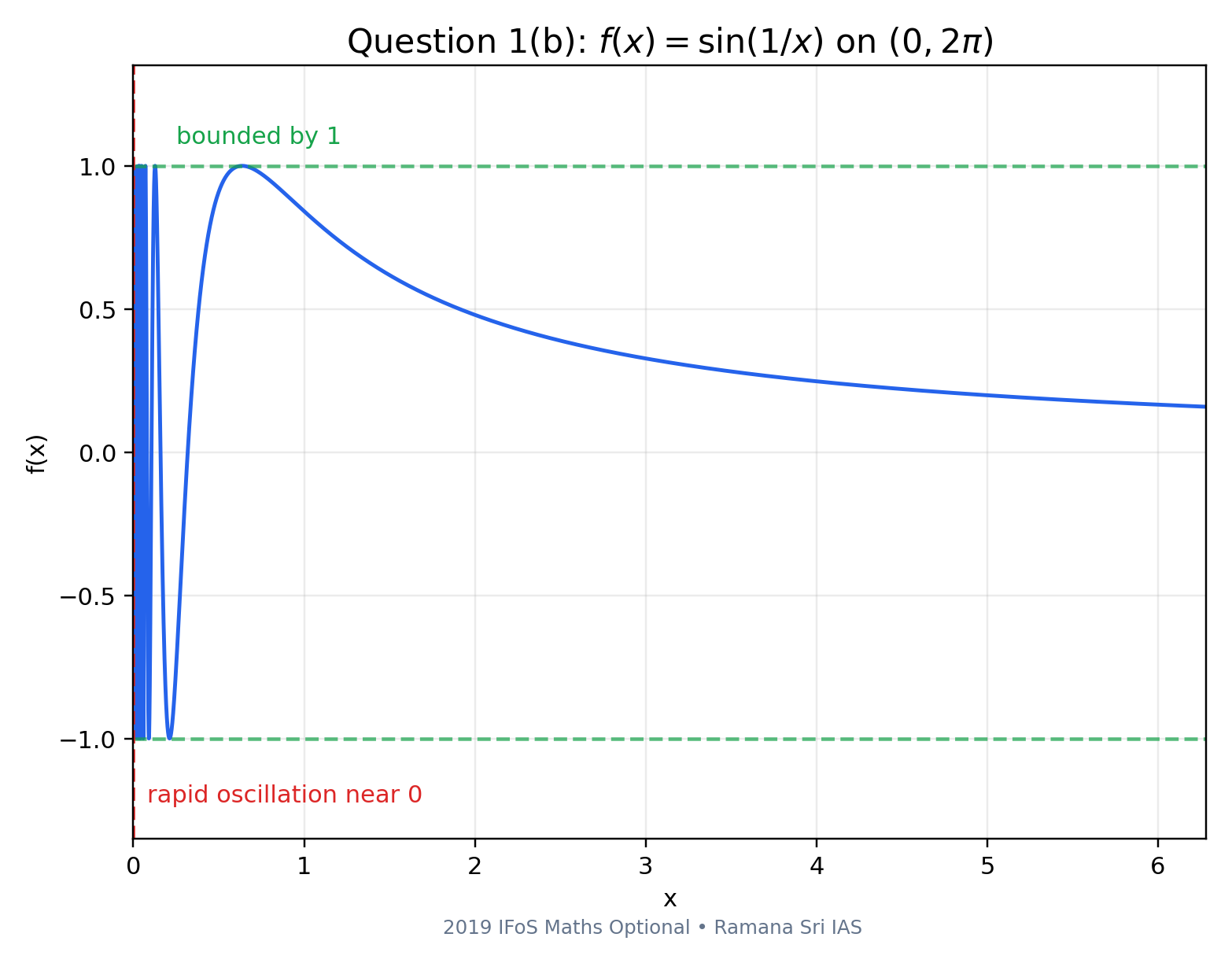
1 QuestionShow that \(f(x)=\sin(1/x)\) is continuous and bounded in \((0,2\pi)\) , but not uniformly continuous in \((0,2\pi)\) .
2 DiagramQuestion 1(b): Uniform Continuity
3 Concept Related to the QuestionThis question belongs to Uniform Continuity . The main idea is to write the given information in a standard mathematical form and then simplify it step by step.
4 Detailed SolutionFor every \(x>0\) , the function \(1/x\) is continuous and sine is continuous, so \(f\) is continuous. Also \(-1\le\sin(1/x)\le1\) , so it is bounded. To disprove uniform continuity, take \(x_n=1/(\frac\pi2+2\pi n)\) and \(y_n=1/(\frac{3\pi}{2}+2\pi n)\) . Then \(|x_n-y_n|\to0\) , but \(f(x_n)=1\) and \(f(y_n)=-1\) . The function values do not become close.
5 Final Answer\(f\) is continuous and bounded, but not uniformly continuous on \((0,2\pi)\) .
Question 1(c) Riemann Integrability 1. Question 2. Diagram 3. Concept Related to the Question 4. Detailed Solution 5. Final Answer
1 QuestionTest the Riemann integrability on \([0,1]\) of the function \(f\) defined by \(f(x)=0\) when \(x\) is rational and \(f(x)=1\) when \(x\) is irrational.
2 Diagram
Full Solution Access The Diagram section for this question is available in the full 2019 IFoS Maths Optional Paper II PYQ Solutions course.
Complete diagrams, concepts, detailed solutions and final answers for all questions are available in the full PYQ course.
3 Concept Related to the Question
Full Solution Access The Concept Related to the Question section for this question is available in the full 2019 IFoS Maths Optional Paper II PYQ Solutions course.
Complete diagrams, concepts, detailed solutions and final answers for all questions are available in the full PYQ course.
4 Detailed Solution
Full Solution Access The Detailed Solution section for this question is available in the full 2019 IFoS Maths Optional Paper II PYQ Solutions course.
Complete diagrams, concepts, detailed solutions and final answers for all questions are available in the full PYQ course.
5 Final Answer
Full Solution Access The Final Answer section for this question is available in the full 2019 IFoS Maths Optional Paper II PYQ Solutions course.
Complete diagrams, concepts, detailed solutions and final answers for all questions are available in the full PYQ course.
Question 1(d) Complex Integration 1. Question 2. Diagram 3. Concept Related to the Question 4. Detailed Solution 5. Final Answer
1 QuestionUsing Cauchy integral formula, evaluate \(\int_C\frac{dz}{(z^2+4)^2}\) , where \(C:|z-i|=2\) .
2 Diagram
Full Solution Access The Diagram section for this question is available in the full 2019 IFoS Maths Optional Paper II PYQ Solutions course.
Complete diagrams, concepts, detailed solutions and final answers for all questions are available in the full PYQ course.
3 Concept Related to the Question
Full Solution Access The Concept Related to the Question section for this question is available in the full 2019 IFoS Maths Optional Paper II PYQ Solutions course.
Complete diagrams, concepts, detailed solutions and final answers for all questions are available in the full PYQ course.
4 Detailed Solution
Full Solution Access The Detailed Solution section for this question is available in the full 2019 IFoS Maths Optional Paper II PYQ Solutions course.
Complete diagrams, concepts, detailed solutions and final answers for all questions are available in the full PYQ course.
5 Final Answer
Full Solution Access The Final Answer section for this question is available in the full 2019 IFoS Maths Optional Paper II PYQ Solutions course.
Complete diagrams, concepts, detailed solutions and final answers for all questions are available in the full PYQ course.
Question 1(e) Linear Programming 1. Question 2. Diagram 3. Concept Related to the Question 4. Detailed Solution 5. Final Answer
1 QuestionA firm manufactures two products \(A\) and \(B\) on which the profits earned per unit are ₹3 and ₹4 respectively. Each product is processed on two machines \(M_1\) and \(M_2\) . Product \(A\) requires one minute of processing time on \(M_1\) and two minutes on \(M_2\) , while product \(B\) requires one minute on \(M_1\) and one minute on \(M_2\) . Machine \(M_1\) is available for not more than 7 hours 30 minutes, while machine \(M_2\) is available for 10 hours during any working day. Find the number of units of products \(A\) and \(B\) to be manufactured to get maximum profit, using graphical method.
2 Diagram
Full Solution Access The Diagram section for this question is available in the full 2019 IFoS Maths Optional Paper II PYQ Solutions course.
Complete diagrams, concepts, detailed solutions and final answers for all questions are available in the full PYQ course.
3 Concept Related to the Question
Full Solution Access The Concept Related to the Question section for this question is available in the full 2019 IFoS Maths Optional Paper II PYQ Solutions course.
Complete diagrams, concepts, detailed solutions and final answers for all questions are available in the full PYQ course.
4 Detailed Solution
Full Solution Access The Detailed Solution section for this question is available in the full 2019 IFoS Maths Optional Paper II PYQ Solutions course.
Complete diagrams, concepts, detailed solutions and final answers for all questions are available in the full PYQ course.
5 Final Answer
Full Solution Access The Final Answer section for this question is available in the full 2019 IFoS Maths Optional Paper II PYQ Solutions course.
Complete diagrams, concepts, detailed solutions and final answers for all questions are available in the full PYQ course.
Question 2(a) Second Isomorphism Theorem 1. Question 2. Diagram 3. Concept Related to the Question 4. Detailed Solution 5. Final Answer
1 QuestionLet \(I\) and \(J\) be ideals in a ring \(R\) . Prove that \((I+J)/J\) is isomorphic to \(I/(I\cap J)\) .
2 Diagram
Full Solution Access The Diagram section for this question is available in the full 2019 IFoS Maths Optional Paper II PYQ Solutions course.
Complete diagrams, concepts, detailed solutions and final answers for all questions are available in the full PYQ course.
3 Concept Related to the Question
Full Solution Access The Concept Related to the Question section for this question is available in the full 2019 IFoS Maths Optional Paper II PYQ Solutions course.
Complete diagrams, concepts, detailed solutions and final answers for all questions are available in the full PYQ course.
4 Detailed Solution
Full Solution Access The Detailed Solution section for this question is available in the full 2019 IFoS Maths Optional Paper II PYQ Solutions course.
Complete diagrams, concepts, detailed solutions and final answers for all questions are available in the full PYQ course.
5 Final Answer
Full Solution Access The Final Answer section for this question is available in the full 2019 IFoS Maths Optional Paper II PYQ Solutions course.
Complete diagrams, concepts, detailed solutions and final answers for all questions are available in the full PYQ course.
Question 2(b) Improper Integral 1. Question 2. Diagram 3. Concept Related to the Question 4. Detailed Solution 5. Final Answer
1 QuestionShow that \(\int_0^{\pi/2}\log(\sin x)dx\) is convergent and evaluate it.
2 Diagram
Full Solution Access The Diagram section for this question is available in the full 2019 IFoS Maths Optional Paper II PYQ Solutions course.
Complete diagrams, concepts, detailed solutions and final answers for all questions are available in the full PYQ course.
3 Concept Related to the Question
Full Solution Access The Concept Related to the Question section for this question is available in the full 2019 IFoS Maths Optional Paper II PYQ Solutions course.
Complete diagrams, concepts, detailed solutions and final answers for all questions are available in the full PYQ course.
4 Detailed Solution
Full Solution Access The Detailed Solution section for this question is available in the full 2019 IFoS Maths Optional Paper II PYQ Solutions course.
Complete diagrams, concepts, detailed solutions and final answers for all questions are available in the full PYQ course.
5 Final Answer
Full Solution Access The Final Answer section for this question is available in the full 2019 IFoS Maths Optional Paper II PYQ Solutions course.
Complete diagrams, concepts, detailed solutions and final answers for all questions are available in the full PYQ course.
Question 2(c) Analytic Functions 1. Question 2. Diagram 3. Concept Related to the Question 4. Detailed Solution 5. Final Answer
1 QuestionIf \(f(z)\) is analytic in a domain \(D\) and \(|f(z)|\) is a non-zero constant in \(D\) , show that \(f(z)\) is constant in \(D\) .
2 Diagram
Full Solution Access The Diagram section for this question is available in the full 2019 IFoS Maths Optional Paper II PYQ Solutions course.
Complete diagrams, concepts, detailed solutions and final answers for all questions are available in the full PYQ course.
3 Concept Related to the Question
Full Solution Access The Concept Related to the Question section for this question is available in the full 2019 IFoS Maths Optional Paper II PYQ Solutions course.
Complete diagrams, concepts, detailed solutions and final answers for all questions are available in the full PYQ course.
4 Detailed Solution
Full Solution Access The Detailed Solution section for this question is available in the full 2019 IFoS Maths Optional Paper II PYQ Solutions course.
Complete diagrams, concepts, detailed solutions and final answers for all questions are available in the full PYQ course.
5 Final Answer
Full Solution Access The Final Answer section for this question is available in the full 2019 IFoS Maths Optional Paper II PYQ Solutions course.
Complete diagrams, concepts, detailed solutions and final answers for all questions are available in the full PYQ course.
Question 3(a) Group Theory 1. Question 2. Diagram 3. Concept Related to the Question 4. Detailed Solution 5. Final Answer
1 QuestionIf in a group \(G\) , \(a^5=e\) and \(aba^{-1}=b^2\) for some \(a,b\in G\) , find the order of \(b\) .
2 Diagram
Full Solution Access The Diagram section for this question is available in the full 2019 IFoS Maths Optional Paper II PYQ Solutions course.
Complete diagrams, concepts, detailed solutions and final answers for all questions are available in the full PYQ course.
3 Concept Related to the Question
Full Solution Access The Concept Related to the Question section for this question is available in the full 2019 IFoS Maths Optional Paper II PYQ Solutions course.
Complete diagrams, concepts, detailed solutions and final answers for all questions are available in the full PYQ course.
4 Detailed Solution
Full Solution Access The Detailed Solution section for this question is available in the full 2019 IFoS Maths Optional Paper II PYQ Solutions course.
Complete diagrams, concepts, detailed solutions and final answers for all questions are available in the full PYQ course.
5 Final Answer
Full Solution Access The Final Answer section for this question is available in the full 2019 IFoS Maths Optional Paper II PYQ Solutions course.
Complete diagrams, concepts, detailed solutions and final answers for all questions are available in the full PYQ course.
Question 3(b) Uniform Convergence 1. Question 2. Diagram 3. Concept Related to the Question 4. Detailed Solution 5. Final Answer
1 QuestionShow that the sequence \(\tan^{-1}(nx)\) , \(x\ge0\) , is uniformly convergent on any interval \([a,b]\) , \(a>0\) , but is only pointwise convergent on \([0,b]\) .
2 Diagram
Full Solution Access The Diagram section for this question is available in the full 2019 IFoS Maths Optional Paper II PYQ Solutions course.
Complete diagrams, concepts, detailed solutions and final answers for all questions are available in the full PYQ course.
3 Concept Related to the Question
Full Solution Access The Concept Related to the Question section for this question is available in the full 2019 IFoS Maths Optional Paper II PYQ Solutions course.
Complete diagrams, concepts, detailed solutions and final answers for all questions are available in the full PYQ course.
4 Detailed Solution
Full Solution Access The Detailed Solution section for this question is available in the full 2019 IFoS Maths Optional Paper II PYQ Solutions course.
Complete diagrams, concepts, detailed solutions and final answers for all questions are available in the full PYQ course.
5 Final Answer
Full Solution Access The Final Answer section for this question is available in the full 2019 IFoS Maths Optional Paper II PYQ Solutions course.
Complete diagrams, concepts, detailed solutions and final answers for all questions are available in the full PYQ course.
Question 3(c) Simplex Method 1. Question 2. Diagram 3. Concept Related to the Question 4. Detailed Solution 5. Final Answer
1 QuestionUse simplex method to maximize \(z=2x_1+5x_2\) subject to \(x_1+4x_2\le24\) , \(3x_1+x_2\le21\) , \(x_1+x_2\le9\) , and \(x_1,x_2\ge0\) .
2 Diagram
Full Solution Access The Diagram section for this question is available in the full 2019 IFoS Maths Optional Paper II PYQ Solutions course.
Complete diagrams, concepts, detailed solutions and final answers for all questions are available in the full PYQ course.
3 Concept Related to the Question
Full Solution Access The Concept Related to the Question section for this question is available in the full 2019 IFoS Maths Optional Paper II PYQ Solutions course.
Complete diagrams, concepts, detailed solutions and final answers for all questions are available in the full PYQ course.
4 Detailed Solution
Full Solution Access The Detailed Solution section for this question is available in the full 2019 IFoS Maths Optional Paper II PYQ Solutions course.
Complete diagrams, concepts, detailed solutions and final answers for all questions are available in the full PYQ course.
5 Final Answer
Full Solution Access The Final Answer section for this question is available in the full 2019 IFoS Maths Optional Paper II PYQ Solutions course.
Complete diagrams, concepts, detailed solutions and final answers for all questions are available in the full PYQ course.
Question 4(a) Alternating Group 1. Question 2. Diagram 3. Concept Related to the Question 4. Detailed Solution 5. Final Answer
1 QuestionShow that the smallest subgroup \(V\) of \(A_4\) containing \((1,2)(3,4)\) , \((1,3)(2,4)\) , and \((1,4)(2,3)\) is isomorphic to the Klein four-group.
2 Diagram
Full Solution Access The Diagram section for this question is available in the full 2019 IFoS Maths Optional Paper II PYQ Solutions course.
Complete diagrams, concepts, detailed solutions and final answers for all questions are available in the full PYQ course.
3 Concept Related to the Question
Full Solution Access The Concept Related to the Question section for this question is available in the full 2019 IFoS Maths Optional Paper II PYQ Solutions course.
Complete diagrams, concepts, detailed solutions and final answers for all questions are available in the full PYQ course.
4 Detailed Solution
Full Solution Access The Detailed Solution section for this question is available in the full 2019 IFoS Maths Optional Paper II PYQ Solutions course.
Complete diagrams, concepts, detailed solutions and final answers for all questions are available in the full PYQ course.
5 Final Answer
Full Solution Access The Final Answer section for this question is available in the full 2019 IFoS Maths Optional Paper II PYQ Solutions course.
Complete diagrams, concepts, detailed solutions and final answers for all questions are available in the full PYQ course.
Question 4(b) Laurent Series 1. Question 2. Diagram 3. Concept Related to the Question 4. Detailed Solution 5. Final Answer
1 QuestionClassify the singular point \(z=0\) of \(f(z)=\frac{e^z}{z+\sin z}\) and obtain the principal part of the Laurent expansion.
2 Diagram
Full Solution Access The Diagram section for this question is available in the full 2019 IFoS Maths Optional Paper II PYQ Solutions course.
Complete diagrams, concepts, detailed solutions and final answers for all questions are available in the full PYQ course.
3 Concept Related to the Question
Full Solution Access The Concept Related to the Question section for this question is available in the full 2019 IFoS Maths Optional Paper II PYQ Solutions course.
Complete diagrams, concepts, detailed solutions and final answers for all questions are available in the full PYQ course.
4 Detailed Solution
Full Solution Access The Detailed Solution section for this question is available in the full 2019 IFoS Maths Optional Paper II PYQ Solutions course.
Complete diagrams, concepts, detailed solutions and final answers for all questions are available in the full PYQ course.
5 Final Answer
Full Solution Access The Final Answer section for this question is available in the full 2019 IFoS Maths Optional Paper II PYQ Solutions course.
Complete diagrams, concepts, detailed solutions and final answers for all questions are available in the full PYQ course.
Question 4(c) Travelling Salesman Problem 1. Question 2. Diagram 3. Concept Related to the Question 4. Detailed Solution 5. Final Answer
1 QuestionA salesman wants to visit cities \(C_1,C_2,C_3\) and \(C_4\) . He does not want to visit any city twice before completing the tour of all the cities and wishes to return to his home city, the starting station. Cost of going from one city to another in rupees is given below. Find the least-cost route.
From / To \(C_1\) \(C_2\) \(C_3\) \(C_4\) \(C_1\) 0 30 80 50 \(C_2\) 40 0 140 30 \(C_3\) 40 50 0 20 \(C_4\) 70 80 130 0
2 Diagram
Full Solution Access The Diagram section for this question is available in the full 2019 IFoS Maths Optional Paper II PYQ Solutions course.
Complete diagrams, concepts, detailed solutions and final answers for all questions are available in the full PYQ course.
3 Concept Related to the Question
Full Solution Access The Concept Related to the Question section for this question is available in the full 2019 IFoS Maths Optional Paper II PYQ Solutions course.
Complete diagrams, concepts, detailed solutions and final answers for all questions are available in the full PYQ course.
4 Detailed Solution
Full Solution Access The Detailed Solution section for this question is available in the full 2019 IFoS Maths Optional Paper II PYQ Solutions course.
Complete diagrams, concepts, detailed solutions and final answers for all questions are available in the full PYQ course.
5 Final Answer
Full Solution Access The Final Answer section for this question is available in the full 2019 IFoS Maths Optional Paper II PYQ Solutions course.
Complete diagrams, concepts, detailed solutions and final answers for all questions are available in the full PYQ course.
Question 5(a) Partial Differential Equation 1. Question 2. Diagram 3. Concept Related to the Question 4. Detailed Solution 5. Final Answer
1 QuestionFind the solution of \(\frac{\partial^2 z}{\partial x^2}-\frac{\partial^2 z}{\partial y^2}=x-y\) .
2 Diagram
Full Solution Access The Diagram section for this question is available in the full 2019 IFoS Maths Optional Paper II PYQ Solutions course.
Complete diagrams, concepts, detailed solutions and final answers for all questions are available in the full PYQ course.
3 Concept Related to the Question
Full Solution Access The Concept Related to the Question section for this question is available in the full 2019 IFoS Maths Optional Paper II PYQ Solutions course.
Complete diagrams, concepts, detailed solutions and final answers for all questions are available in the full PYQ course.
4 Detailed Solution
Full Solution Access The Detailed Solution section for this question is available in the full 2019 IFoS Maths Optional Paper II PYQ Solutions course.
Complete diagrams, concepts, detailed solutions and final answers for all questions are available in the full PYQ course.
5 Final Answer
Full Solution Access The Final Answer section for this question is available in the full 2019 IFoS Maths Optional Paper II PYQ Solutions course.
Complete diagrams, concepts, detailed solutions and final answers for all questions are available in the full PYQ course.
Question 5(b) Newton Forward Interpolation 1. Question 2. Diagram 3. Concept Related to the Question 4. Detailed Solution 5. Final Answer
1 QuestionThe following table gives the values of \(y=f(x)\) for certain equidistant values of \(x\) . Find the value of \(f(x)\) when \(x=0.612\) using Newton's forward difference interpolation formula.
\(x\) 0.61 0.62 0.63 0.64 0.65 \(y=f(x)\) 1.840431 1.858928 1.877610 1.896481 1.915541
2 Diagram
Full Solution Access The Diagram section for this question is available in the full 2019 IFoS Maths Optional Paper II PYQ Solutions course.
Complete diagrams, concepts, detailed solutions and final answers for all questions are available in the full PYQ course.
3 Concept Related to the Question
Full Solution Access The Concept Related to the Question section for this question is available in the full 2019 IFoS Maths Optional Paper II PYQ Solutions course.
Complete diagrams, concepts, detailed solutions and final answers for all questions are available in the full PYQ course.
4 Detailed Solution
Full Solution Access The Detailed Solution section for this question is available in the full 2019 IFoS Maths Optional Paper II PYQ Solutions course.
Complete diagrams, concepts, detailed solutions and final answers for all questions are available in the full PYQ course.
5 Final Answer
Full Solution Access The Final Answer section for this question is available in the full 2019 IFoS Maths Optional Paper II PYQ Solutions course.
Complete diagrams, concepts, detailed solutions and final answers for all questions are available in the full PYQ course.
Question 5(c) Simpson Rule 1. Question 2. Diagram 3. Concept Related to the Question 4. Detailed Solution 5. Final Answer
1 QuestionFollowing values of \(x_i\) and the corresponding values of \(y_i\) are given. Find \(\int_0^3 y\,dx\) using Simpson's one-third rule.
\(x_i\) 0.0 0.5 1.0 1.5 2.0 2.5 3.0 \(y_i\) 0.0 0.75 1.0 0.75 0.0 -1.25 -3.0
2 Diagram
Full Solution Access The Diagram section for this question is available in the full 2019 IFoS Maths Optional Paper II PYQ Solutions course.
Complete diagrams, concepts, detailed solutions and final answers for all questions are available in the full PYQ course.
3 Concept Related to the Question
Full Solution Access The Concept Related to the Question section for this question is available in the full 2019 IFoS Maths Optional Paper II PYQ Solutions course.
Complete diagrams, concepts, detailed solutions and final answers for all questions are available in the full PYQ course.
4 Detailed Solution
Full Solution Access The Detailed Solution section for this question is available in the full 2019 IFoS Maths Optional Paper II PYQ Solutions course.
Complete diagrams, concepts, detailed solutions and final answers for all questions are available in the full PYQ course.
5 Final Answer
Full Solution Access The Final Answer section for this question is available in the full 2019 IFoS Maths Optional Paper II PYQ Solutions course.
Complete diagrams, concepts, detailed solutions and final answers for all questions are available in the full PYQ course.
Question 5(d) Irrotational Flow 1. Question 2. Diagram 3. Concept Related to the Question 4. Detailed Solution 5. Final Answer
1 QuestionFor the flow field given by \(\psi=a(x^2-y^2)\) , show that the flow is irrotational. Determine the velocity potential and show that streamlines and equipotential curves are orthogonal.
2 Diagram
Full Solution Access The Diagram section for this question is available in the full 2019 IFoS Maths Optional Paper II PYQ Solutions course.
Complete diagrams, concepts, detailed solutions and final answers for all questions are available in the full PYQ course.
3 Concept Related to the Question
Full Solution Access The Concept Related to the Question section for this question is available in the full 2019 IFoS Maths Optional Paper II PYQ Solutions course.
Complete diagrams, concepts, detailed solutions and final answers for all questions are available in the full PYQ course.
4 Detailed Solution
Full Solution Access The Detailed Solution section for this question is available in the full 2019 IFoS Maths Optional Paper II PYQ Solutions course.
Complete diagrams, concepts, detailed solutions and final answers for all questions are available in the full PYQ course.
5 Final Answer
Full Solution Access The Final Answer section for this question is available in the full 2019 IFoS Maths Optional Paper II PYQ Solutions course.
Complete diagrams, concepts, detailed solutions and final answers for all questions are available in the full PYQ course.
Question 5(e) Charpit Method 1. Question 2. Diagram 3. Concept Related to the Question 4. Detailed Solution 5. Final Answer
1 QuestionFind a complete integral of \(xp^2+yq^2=z\) , where \(p=\frac{\partial z}{\partial x}\) and \(q=\frac{\partial z}{\partial y}\) .
2 Diagram
Full Solution Access The Diagram section for this question is available in the full 2019 IFoS Maths Optional Paper II PYQ Solutions course.
Complete diagrams, concepts, detailed solutions and final answers for all questions are available in the full PYQ course.
3 Concept Related to the Question
Full Solution Access The Concept Related to the Question section for this question is available in the full 2019 IFoS Maths Optional Paper II PYQ Solutions course.
Complete diagrams, concepts, detailed solutions and final answers for all questions are available in the full PYQ course.
4 Detailed Solution
Full Solution Access The Detailed Solution section for this question is available in the full 2019 IFoS Maths Optional Paper II PYQ Solutions course.
Complete diagrams, concepts, detailed solutions and final answers for all questions are available in the full PYQ course.
5 Final Answer
Full Solution Access The Final Answer section for this question is available in the full 2019 IFoS Maths Optional Paper II PYQ Solutions course.
Complete diagrams, concepts, detailed solutions and final answers for all questions are available in the full PYQ course.
Question 6(a) Pfaffian Differential Equation 1. Question 2. Diagram 3. Concept Related to the Question 4. Detailed Solution 5. Final Answer
1 QuestionTest the integrability of \(z(z+y^2)dx+z(z+x^2)dy-xy(x+y)dz=0\) . If integrable, find its solution.
2 Diagram
Full Solution Access The Diagram section for this question is available in the full 2019 IFoS Maths Optional Paper II PYQ Solutions course.
Complete diagrams, concepts, detailed solutions and final answers for all questions are available in the full PYQ course.
3 Concept Related to the Question
Full Solution Access The Concept Related to the Question section for this question is available in the full 2019 IFoS Maths Optional Paper II PYQ Solutions course.
Complete diagrams, concepts, detailed solutions and final answers for all questions are available in the full PYQ course.
4 Detailed Solution
Full Solution Access The Detailed Solution section for this question is available in the full 2019 IFoS Maths Optional Paper II PYQ Solutions course.
Complete diagrams, concepts, detailed solutions and final answers for all questions are available in the full PYQ course.
5 Final Answer
Full Solution Access The Final Answer section for this question is available in the full 2019 IFoS Maths Optional Paper II PYQ Solutions course.
Complete diagrams, concepts, detailed solutions and final answers for all questions are available in the full PYQ course.
Question 6(b) Gauss-Jordan Elimination 1. Question 2. Diagram 3. Concept Related to the Question 4. Detailed Solution 5. Final Answer
1 QuestionSolve by Gauss-Jordan elimination: \(x_1+x_2+x_3=3\) , \(2x_1+3x_2+x_3=6\) , and \(x_1-x_2-x_3=-3\) .
2 Diagram
Full Solution Access The Diagram section for this question is available in the full 2019 IFoS Maths Optional Paper II PYQ Solutions course.
Complete diagrams, concepts, detailed solutions and final answers for all questions are available in the full PYQ course.
3 Concept Related to the Question
Full Solution Access The Concept Related to the Question section for this question is available in the full 2019 IFoS Maths Optional Paper II PYQ Solutions course.
Complete diagrams, concepts, detailed solutions and final answers for all questions are available in the full PYQ course.
4 Detailed Solution
Full Solution Access The Detailed Solution section for this question is available in the full 2019 IFoS Maths Optional Paper II PYQ Solutions course.
Complete diagrams, concepts, detailed solutions and final answers for all questions are available in the full PYQ course.
5 Final Answer
Full Solution Access The Final Answer section for this question is available in the full 2019 IFoS Maths Optional Paper II PYQ Solutions course.
Complete diagrams, concepts, detailed solutions and final answers for all questions are available in the full PYQ course.
Question 6(c) Lagrange Equations 1. Question 2. Diagram 3. Concept Related to the Question 4. Detailed Solution 5. Final Answer
1 QuestionFor a dynamical system, \(T=\frac12\{(1+2k)\dot\theta^2+2\dot\theta\dot\phi+\dot\phi^2\}\) and \(V=\frac{n^2}{2}\{(1+k)\theta^2+\phi^2\}\) , where \(\theta,\phi\) are coordinates and \(n,k\) are positive constants. Write down Lagrange's equations of motion and deduce that \((\ddot\theta-\ddot\phi)+n^2\left(\frac{1+k}{k}\right)(\theta-\phi)=0\) . Further show that if \(\theta=\phi\) , \(\dot\theta=\dot\phi\) at \(t=0\) , then \(\theta=\phi\) for all \(t\) .
2 Diagram
Full Solution Access The Diagram section for this question is available in the full 2019 IFoS Maths Optional Paper II PYQ Solutions course.
Complete diagrams, concepts, detailed solutions and final answers for all questions are available in the full PYQ course.
3 Concept Related to the Question
Full Solution Access The Concept Related to the Question section for this question is available in the full 2019 IFoS Maths Optional Paper II PYQ Solutions course.
Complete diagrams, concepts, detailed solutions and final answers for all questions are available in the full PYQ course.
4 Detailed Solution
Full Solution Access The Detailed Solution section for this question is available in the full 2019 IFoS Maths Optional Paper II PYQ Solutions course.
Complete diagrams, concepts, detailed solutions and final answers for all questions are available in the full PYQ course.
5 Final Answer
Full Solution Access The Final Answer section for this question is available in the full 2019 IFoS Maths Optional Paper II PYQ Solutions course.
Complete diagrams, concepts, detailed solutions and final answers for all questions are available in the full PYQ course.
Question 7(a) Runge-Kutta Method 1. Question 2. Diagram 3. Concept Related to the Question 4. Detailed Solution 5. Final Answer
1 QuestionGiven \(\frac{dy}{dx}=x^2+y^2\) , \(y(0)=1\) , find \(y(0.1)\) and \(y(0.2)\) by the fourth-order Runge-Kutta method.
2 Diagram
Full Solution Access The Diagram section for this question is available in the full 2019 IFoS Maths Optional Paper II PYQ Solutions course.
Complete diagrams, concepts, detailed solutions and final answers for all questions are available in the full PYQ course.
3 Concept Related to the Question
Full Solution Access The Concept Related to the Question section for this question is available in the full 2019 IFoS Maths Optional Paper II PYQ Solutions course.
Complete diagrams, concepts, detailed solutions and final answers for all questions are available in the full PYQ course.
4 Detailed Solution
Full Solution Access The Detailed Solution section for this question is available in the full 2019 IFoS Maths Optional Paper II PYQ Solutions course.
Complete diagrams, concepts, detailed solutions and final answers for all questions are available in the full PYQ course.
5 Final Answer
Full Solution Access The Final Answer section for this question is available in the full 2019 IFoS Maths Optional Paper II PYQ Solutions course.
Complete diagrams, concepts, detailed solutions and final answers for all questions are available in the full PYQ course.
Question 7(b) Hamiltonian Mechanics 1. Question 2. Diagram 3. Concept Related to the Question 4. Detailed Solution 5. Final Answer
1 QuestionFor a mass-spring system with mass \(m\) and stiffness \(k\) hanging from a fixed point, find the equation of motion using Hamiltonian method when displacement \(x\) is measured from the unstretched position.
2 Diagram
Full Solution Access The Diagram section for this question is available in the full 2019 IFoS Maths Optional Paper II PYQ Solutions course.
Complete diagrams, concepts, detailed solutions and final answers for all questions are available in the full PYQ course.
3 Concept Related to the Question
Full Solution Access The Concept Related to the Question section for this question is available in the full 2019 IFoS Maths Optional Paper II PYQ Solutions course.
Complete diagrams, concepts, detailed solutions and final answers for all questions are available in the full PYQ course.
4 Detailed Solution
Full Solution Access The Detailed Solution section for this question is available in the full 2019 IFoS Maths Optional Paper II PYQ Solutions course.
Complete diagrams, concepts, detailed solutions and final answers for all questions are available in the full PYQ course.
5 Final Answer
Full Solution Access The Final Answer section for this question is available in the full 2019 IFoS Maths Optional Paper II PYQ Solutions course.
Complete diagrams, concepts, detailed solutions and final answers for all questions are available in the full PYQ course.
Question 7(c) Orthogonal Trajectories on Cylinder 1. Question 2. Diagram 3. Concept Related to the Question 4. Detailed Solution 5. Final Answer
1 QuestionFind the equations of the system of curves on the cylinder \(2y=x^2\) orthogonal to its intersections with the hyperboloids \(xy=z+c\) .
2 Diagram
Full Solution Access The Diagram section for this question is available in the full 2019 IFoS Maths Optional Paper II PYQ Solutions course.
Complete diagrams, concepts, detailed solutions and final answers for all questions are available in the full PYQ course.
3 Concept Related to the Question
Full Solution Access The Concept Related to the Question section for this question is available in the full 2019 IFoS Maths Optional Paper II PYQ Solutions course.
Complete diagrams, concepts, detailed solutions and final answers for all questions are available in the full PYQ course.
4 Detailed Solution
Full Solution Access The Detailed Solution section for this question is available in the full 2019 IFoS Maths Optional Paper II PYQ Solutions course.
Complete diagrams, concepts, detailed solutions and final answers for all questions are available in the full PYQ course.
5 Final Answer
Full Solution Access The Final Answer section for this question is available in the full 2019 IFoS Maths Optional Paper II PYQ Solutions course.
Complete diagrams, concepts, detailed solutions and final answers for all questions are available in the full PYQ course.
Question 8(a) Viscous Flow 1. Question 2. Diagram 3. Concept Related to the Question 4. Detailed Solution 5. Final Answer
1 QuestionConsider that the region \(0\le z\le h\) between the planes \(z=0\) and \(z=h\) is filled with viscous incompressible fluid. The plane \(z=0\) is held at rest and the plane \(z=h\) moves with constant velocity \(V\hat{j}\) . When conditions are steady, assuming there is no slip between the fluid and either boundary, and neglecting body forces, show that the velocity profile between the plates is parabolic. Find the tangential stress at any point \(P(x,y,z)\) of the fluid and determine the drag per unit area on both the planes.
2 Diagram
Full Solution Access The Diagram section for this question is available in the full 2019 IFoS Maths Optional Paper II PYQ Solutions course.
Complete diagrams, concepts, detailed solutions and final answers for all questions are available in the full PYQ course.
3 Concept Related to the Question
Full Solution Access The Concept Related to the Question section for this question is available in the full 2019 IFoS Maths Optional Paper II PYQ Solutions course.
Complete diagrams, concepts, detailed solutions and final answers for all questions are available in the full PYQ course.
4 Detailed Solution
Full Solution Access The Detailed Solution section for this question is available in the full 2019 IFoS Maths Optional Paper II PYQ Solutions course.
Complete diagrams, concepts, detailed solutions and final answers for all questions are available in the full PYQ course.
5 Final Answer
Full Solution Access The Final Answer section for this question is available in the full 2019 IFoS Maths Optional Paper II PYQ Solutions course.
Complete diagrams, concepts, detailed solutions and final answers for all questions are available in the full PYQ course.
Question 8(b) Newton-Raphson Method 1. Question 2. Diagram 3. Concept Related to the Question 4. Detailed Solution 5. Final Answer
1 QuestionState the Newton-Raphson iteration formula and write a BASIC program to compute a root of \(\cos x-xe^x=0\) lying between \(0\) and \(1\) , using DEF functions for \(f(x)\) and \(f'(x)\) .
2 Diagram
Full Solution Access The Diagram section for this question is available in the full 2019 IFoS Maths Optional Paper II PYQ Solutions course.
Complete diagrams, concepts, detailed solutions and final answers for all questions are available in the full PYQ course.
3 Concept Related to the Question
Full Solution Access The Concept Related to the Question section for this question is available in the full 2019 IFoS Maths Optional Paper II PYQ Solutions course.
Complete diagrams, concepts, detailed solutions and final answers for all questions are available in the full PYQ course.
4 Detailed Solution
Full Solution Access The Detailed Solution section for this question is available in the full 2019 IFoS Maths Optional Paper II PYQ Solutions course.
Complete diagrams, concepts, detailed solutions and final answers for all questions are available in the full PYQ course.
5 Final Answer
Full Solution Access The Final Answer section for this question is available in the full 2019 IFoS Maths Optional Paper II PYQ Solutions course.
Complete diagrams, concepts, detailed solutions and final answers for all questions are available in the full PYQ course.
Question 8(c) Gauss Quadrature 1. Question 2. Diagram 3. Concept Related to the Question 4. Detailed Solution 5. Final Answer
1 QuestionUse Gauss quadrature formula of point six to evaluate \(\int_0^1\frac{dx}{1+x^2}\) , given
\(x_1=-0.23861919,\quad w_1=0.46791393\) , \(x_2=-0.66120939,\quad w_2=0.36076157\) , \(x_3=-0.93246951,\quad w_3=0.17132449\) , and \(x_4=-x_1,\ x_5=-x_2,\ x_6=-x_3,\ w_4=w_1,\ w_5=w_2,\ w_6=w_3\) .
2 Diagram
Full Solution Access The Diagram section for this question is available in the full 2019 IFoS Maths Optional Paper II PYQ Solutions course.
Complete diagrams, concepts, detailed solutions and final answers for all questions are available in the full PYQ course.
3 Concept Related to the Question
Full Solution Access The Concept Related to the Question section for this question is available in the full 2019 IFoS Maths Optional Paper II PYQ Solutions course.
Complete diagrams, concepts, detailed solutions and final answers for all questions are available in the full PYQ course.
4 Detailed Solution
Full Solution Access The Detailed Solution section for this question is available in the full 2019 IFoS Maths Optional Paper II PYQ Solutions course.
Complete diagrams, concepts, detailed solutions and final answers for all questions are available in the full PYQ course.
5 Final Answer
Full Solution Access The Final Answer section for this question is available in the full 2019 IFoS Maths Optional Paper II PYQ Solutions course.
Complete diagrams, concepts, detailed solutions and final answers for all questions are available in the full PYQ course.
2019 IFoS Maths Optional Paper II Solutions FAQs Are these 2019 IFoS Maths Optional Paper II Solutions complete? This public page gives one complete free sample solution. Complete solutions for all questions in 2019 IFoS Maths Optional Paper II Solutions are available in the full PYQ course.
Which question is given as a free sample solution on this page? The free sample solution on this page is Question 1(b). It includes Question, Diagram, Concept Related to the Question, Detailed Solution, and Final Answer.
How should I use these 2019 IFoS Maths Optional Paper II Solutions for preparation? First solve the question yourself, then compare your method with the step-by-step solution. Revise the concept, diagram, and final-answer format before moving to the next question.
Do these solutions include diagrams and detailed explanations? Yes. Wherever a diagram is needed, the solution format includes a diagram section along with concept explanation, detailed solution, and final answer.
How can I get complete solutions for all questions in 2019 IFoS Maths Optional Paper II Solutions? Complete solutions for all questions are available in the full PYQ course. Please fill out the admission form first, and our Ramana Sri IAS admission team will guide you through WhatsApp, email, or call.