Ramana Sri IAS

Ramana Sri IAS Logo Ramana Sri IAS Admission Form
☰ Menu
Ramana Sri IAS - 2019 UPSC Maths Optional Paper I Solutions

2019 UPSC Maths Optional Paper I Solutions

Ramana Sri IAS provides complete and updated solutions for the 2019 UPSC Maths Optional Paper I Solutions. Aspirants preparing for the UPSC Mains Examination with Mathematics as their optional subject should solve all these questions carefully at least 5 to 10 times before the mains examination.

Ramana Sri IAS presents complete solutions for UPSC/IAS/CSE-Civil Service Examination 2019 Mathematics Optional Paper I. Each answer follows the same format: Question, Diagram where needed, Concept Related to the Question, Detailed Solution, and Final Answer.

About 2019 UPSC Maths Optional Paper I Solutions

These 2019 UPSC Maths Optional Paper I Solutions are prepared by Ramana Sri IAS for aspirants who want question-wise clarity before the UPSC Mains examination. This public page gives one full sample solution, while the complete paper-wise solutions are available in the full PYQ course.

Students can use these 2019 UPSC Maths Optional Paper I Solutions to understand the expected answer-writing method, diagram presentation, concept application, and final-answer format used by Ramana Sri IAS.

For the official examination source, students may also refer to the UPSC previous year question papers page.

These 2019 UPSC Maths Optional Paper I Solutions are useful for revision, answer-writing practice, and understanding the step-by-step method expected in the UPSC Mathematics optional paper.

Sample Full Solution

We are giving one question from 2019 UPSC Maths Optional Paper I Solutions as a free sample solution below: Question 1(e). This free sample includes all five sections: Question, Diagram, Concept Related to the Question, Detailed Solution, and Final Answer. Complete 2019 UPSC Maths Optional Paper I Solutions for all questions are available in the full PYQ course. To purchase the full solution, please fill out the admission form first. Our Ramana Sri IAS admission team will guide you through WhatsApp, email, or call.

2019 UPSC Maths Optional Paper I Solutions: Table of Contents

Question 1(a)

Continuity and removable value

1Question

Let \(f:[0,\dfrac{\pi}{2}]\to R\) be a continuous function such that \(f(x)=\dfrac{\cos^2 x}{4x^2-\pi^2}\), \(0<x<\dfrac{\pi}{2}\). Find the value of \(f\left(\dfrac{\pi}{2}\right)\).

2Diagram

Full Solution Access

The Diagram section for this question is available in the full 2019 UPSC Maths Optional Paper I PYQ Solutions course.

Complete diagrams, concepts, detailed solutions and final answers for all questions are available in the full PYQ course.

3Concept Related to the Question

Full Solution Access

The Concept Related to the Question section for this question is available in the full 2019 UPSC Maths Optional Paper I PYQ Solutions course.

Complete diagrams, concepts, detailed solutions and final answers for all questions are available in the full PYQ course.

4Detailed Solution

Full Solution Access

The Detailed Solution section for this question is available in the full 2019 UPSC Maths Optional Paper I PYQ Solutions course.

Complete diagrams, concepts, detailed solutions and final answers for all questions are available in the full PYQ course.

5Final Answer

Full Solution Access

The Final Answer section for this question is available in the full 2019 UPSC Maths Optional Paper I PYQ Solutions course.

Complete diagrams, concepts, detailed solutions and final answers for all questions are available in the full PYQ course.

Question 1(b)

Continuity of section functions

1Question

Let \(f:D(\subset R^2)\to R\) be a function and \((a,b)\in D\). If \(f(x,y)\) is continuous at \((a,b)\), then show that the functions \(f(x,b)\) and \(f(a,y)\) are continuous at \(x=a\) and at \(y=b\) respectively.

2Diagram

Full Solution Access

The Diagram section for this question is available in the full 2019 UPSC Maths Optional Paper I PYQ Solutions course.

Complete diagrams, concepts, detailed solutions and final answers for all questions are available in the full PYQ course.

3Concept Related to the Question

Full Solution Access

The Concept Related to the Question section for this question is available in the full 2019 UPSC Maths Optional Paper I PYQ Solutions course.

Complete diagrams, concepts, detailed solutions and final answers for all questions are available in the full PYQ course.

4Detailed Solution

Full Solution Access

The Detailed Solution section for this question is available in the full 2019 UPSC Maths Optional Paper I PYQ Solutions course.

Complete diagrams, concepts, detailed solutions and final answers for all questions are available in the full PYQ course.

5Final Answer

Full Solution Access

The Final Answer section for this question is available in the full 2019 UPSC Maths Optional Paper I PYQ Solutions course.

Complete diagrams, concepts, detailed solutions and final answers for all questions are available in the full PYQ course.

Question 1(c)

Matrix of a linear map and rank

1Question

Let \(T:R^2\to R^2\) be a linear map such that \(T(2,1)=(5,7)\) and \(T(1,2)=(3,3)\). If \(A\) is the matrix corresponding to \(T\) with respect to the standard bases \(e_1,e_2\), then find \(\operatorname{Rank}(A)\).

2Diagram

Full Solution Access

The Diagram section for this question is available in the full 2019 UPSC Maths Optional Paper I PYQ Solutions course.

Complete diagrams, concepts, detailed solutions and final answers for all questions are available in the full PYQ course.

3Concept Related to the Question

Full Solution Access

The Concept Related to the Question section for this question is available in the full 2019 UPSC Maths Optional Paper I PYQ Solutions course.

Complete diagrams, concepts, detailed solutions and final answers for all questions are available in the full PYQ course.

4Detailed Solution

Full Solution Access

The Detailed Solution section for this question is available in the full 2019 UPSC Maths Optional Paper I PYQ Solutions course.

Complete diagrams, concepts, detailed solutions and final answers for all questions are available in the full PYQ course.

5Final Answer

Full Solution Access

The Final Answer section for this question is available in the full 2019 UPSC Maths Optional Paper I PYQ Solutions course.

Complete diagrams, concepts, detailed solutions and final answers for all questions are available in the full PYQ course.

Question 1(d)

Matrix product and linear equations

1Question

If \(A=\left[\begin{smallmatrix}1&2&1\\ 1&-4&1\\ 3&0&-3\end{smallmatrix}\right]\) and \(B=\left[\begin{smallmatrix}2&1&1\\ 1&-1&0\\ 2&1&-1\end{smallmatrix}\right]\), then show that \(AB=6I_3\). Use this result to solve the following system of equations: \(2x+y+z=5,\ x-y=0,\ 2x+y-z=1\).

2Diagram

Full Solution Access

The Diagram section for this question is available in the full 2019 UPSC Maths Optional Paper I PYQ Solutions course.

Complete diagrams, concepts, detailed solutions and final answers for all questions are available in the full PYQ course.

3Concept Related to the Question

Full Solution Access

The Concept Related to the Question section for this question is available in the full 2019 UPSC Maths Optional Paper I PYQ Solutions course.

Complete diagrams, concepts, detailed solutions and final answers for all questions are available in the full PYQ course.

4Detailed Solution

Full Solution Access

The Detailed Solution section for this question is available in the full 2019 UPSC Maths Optional Paper I PYQ Solutions course.

Complete diagrams, concepts, detailed solutions and final answers for all questions are available in the full PYQ course.

5Final Answer

Full Solution Access

The Final Answer section for this question is available in the full 2019 UPSC Maths Optional Paper I PYQ Solutions course.

Complete diagrams, concepts, detailed solutions and final answers for all questions are available in the full PYQ course.

Question 1(e)

Intersection of lines and plane

1Question

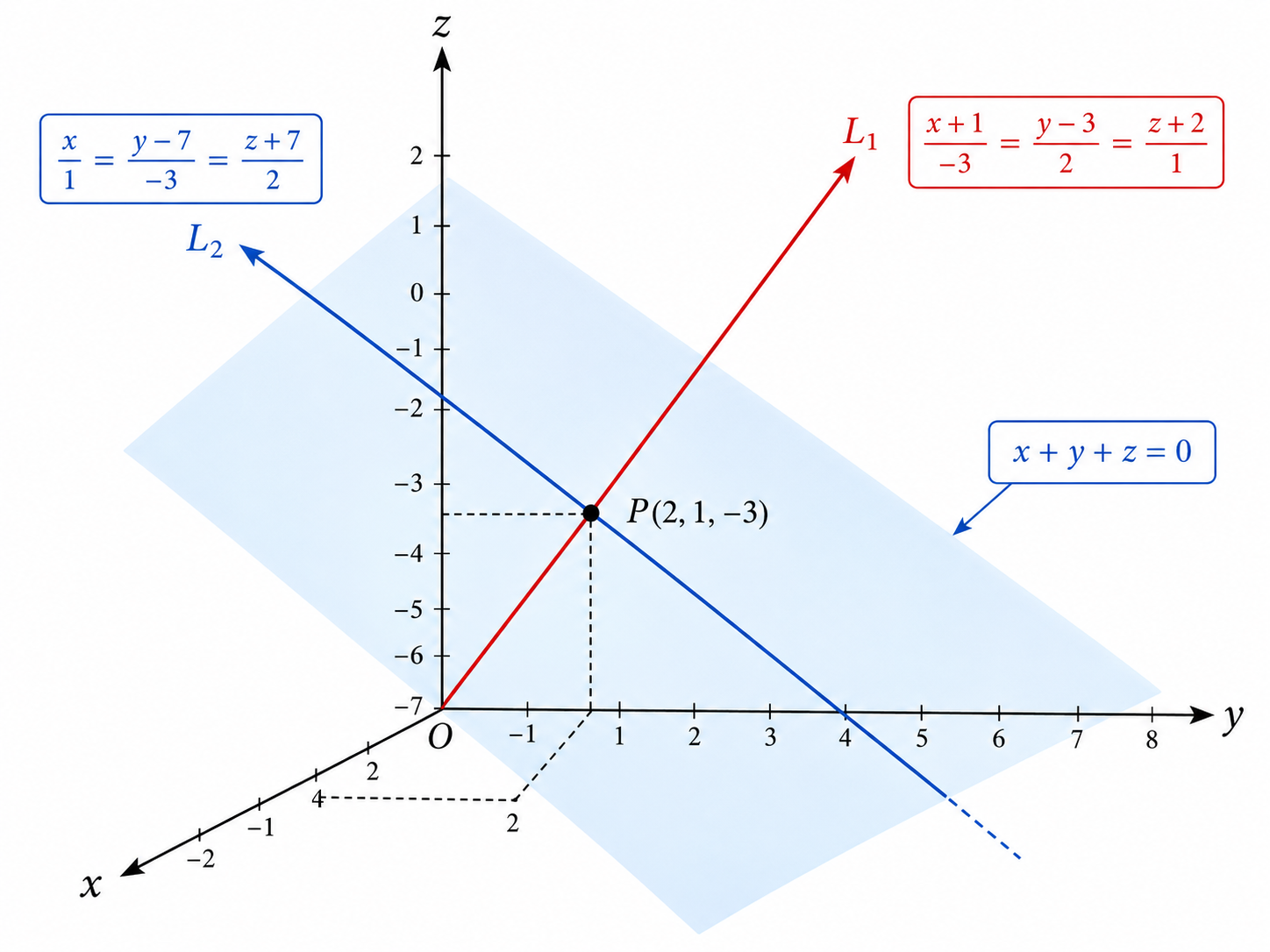
Show that the lines \(\dfrac{x+1}{-3}=\dfrac{y-3}{2}=\dfrac{z+2}{1}\) and \(\dfrac{x}{1}=\dfrac{y-7}{-3}=\dfrac{z+7}{2}\) intersect. Find the coordinates of the point of intersection and the equation of the plane containing them.

2Diagram

Question 1(e): Intersecting lines and containing plane
2019 UPSC Maths Optional Paper I Solutions diagram showing two intersecting three-dimensional straight lines meeting at point P and the plane x plus y plus z equals zero containing both lines.

3Concept Related to the Question

To check whether two lines intersect, write both lines in parametric form and solve for their parameters. If a common point exists, the lines intersect.

The plane containing two intersecting lines is found by using the common point and the two direction vectors of the lines.

4Detailed Solution

For the first line, put

\[\dfrac{x+1}{-3}=\dfrac{y-3}{2}=\dfrac{z+2}{1}=r.\]

Then

\[x=-1-3r,\qquad y=3+2r,\qquad z=-2+r.\]

For the second line, put

\[\dfrac{x}{1}=\dfrac{y-7}{-3}=\dfrac{z+7}{2}=s.\]

Then

\[x=s,\qquad y=7-3s,\qquad z=-7+2s.\]

At the point of intersection, the corresponding coordinates must be equal. Hence

\[-1-3r=s,\qquad 3+2r=7-3s,\qquad -2+r=-7+2s.\]

Solving these equations gives

\[r=-1,\qquad s=2.\]

Substituting \(r=-1\) in the first line gives the common point

\[(x,y,z)=(2,1,-3).\]

Therefore the two lines intersect at \((2,1,-3)\).

The direction ratios of the two lines are

\[\vec d_1=(-3,2,1),\qquad \vec d_2=(1,-3,2).\]

A normal vector to the required plane is obtained from their cross product:

\[\vec n=\vec d_1\times\vec d_2=(7,7,7).\]

Thus the required plane through \((2,1,-3)\) is

\[7(x-2)+7(y-1)+7(z+3)=0.\]

Dividing by \(7\),

\[x+y+z=0.\]

5Final Answer

The point of intersection is

\[(2,1,-3),\]

and the plane containing the two lines is

\[x+y+z=0.\]

Question 2(a)

Differentiability of absolute value function

1Question

Is \(f(x)=|\cos x|+|\sin x|\) differentiable at \(x=\dfrac{\pi}{2}\)? If yes, then find its derivative at \(x=\dfrac{\pi}{2}\). If no, then give a proof of it.

2Diagram

Full Solution Access

The Diagram section for this question is available in the full 2019 UPSC Maths Optional Paper I PYQ Solutions course.

Complete diagrams, concepts, detailed solutions and final answers for all questions are available in the full PYQ course.

3Concept Related to the Question

Full Solution Access

The Concept Related to the Question section for this question is available in the full 2019 UPSC Maths Optional Paper I PYQ Solutions course.

Complete diagrams, concepts, detailed solutions and final answers for all questions are available in the full PYQ course.

4Detailed Solution

Full Solution Access

The Detailed Solution section for this question is available in the full 2019 UPSC Maths Optional Paper I PYQ Solutions course.

Complete diagrams, concepts, detailed solutions and final answers for all questions are available in the full PYQ course.

5Final Answer

Full Solution Access

The Final Answer section for this question is available in the full 2019 UPSC Maths Optional Paper I PYQ Solutions course.

Complete diagrams, concepts, detailed solutions and final answers for all questions are available in the full PYQ course.

Question 2(b)

Orthogonal matrices

1Question

Let \(A\) and \(B\) be two orthogonal matrices of same order and \(\det A+\det B=0\). Show that \(A+B\) is a singular matrix.

2Diagram

Full Solution Access

The Diagram section for this question is available in the full 2019 UPSC Maths Optional Paper I PYQ Solutions course.

Complete diagrams, concepts, detailed solutions and final answers for all questions are available in the full PYQ course.

3Concept Related to the Question

Full Solution Access

The Concept Related to the Question section for this question is available in the full 2019 UPSC Maths Optional Paper I PYQ Solutions course.

Complete diagrams, concepts, detailed solutions and final answers for all questions are available in the full PYQ course.

4Detailed Solution

Full Solution Access

The Detailed Solution section for this question is available in the full 2019 UPSC Maths Optional Paper I PYQ Solutions course.

Complete diagrams, concepts, detailed solutions and final answers for all questions are available in the full PYQ course.

5Final Answer

Full Solution Access

The Final Answer section for this question is available in the full 2019 UPSC Maths Optional Paper I PYQ Solutions course.

Complete diagrams, concepts, detailed solutions and final answers for all questions are available in the full PYQ course.

Question 2(c)(i)

Circumcircle in 3D

1Question

The plane \(x+2y+3z=12\) cuts the axes of coordinates in \(A,B,C\). Find the equations of the circle circumscribing the triangle \(ABC\).

2Diagram

Full Solution Access

The Diagram section for this question is available in the full 2019 UPSC Maths Optional Paper I PYQ Solutions course.

Complete diagrams, concepts, detailed solutions and final answers for all questions are available in the full PYQ course.

3Concept Related to the Question

Full Solution Access

The Concept Related to the Question section for this question is available in the full 2019 UPSC Maths Optional Paper I PYQ Solutions course.

Complete diagrams, concepts, detailed solutions and final answers for all questions are available in the full PYQ course.

4Detailed Solution

Full Solution Access

The Detailed Solution section for this question is available in the full 2019 UPSC Maths Optional Paper I PYQ Solutions course.

Complete diagrams, concepts, detailed solutions and final answers for all questions are available in the full PYQ course.

5Final Answer

Full Solution Access

The Final Answer section for this question is available in the full 2019 UPSC Maths Optional Paper I PYQ Solutions course.

Complete diagrams, concepts, detailed solutions and final answers for all questions are available in the full PYQ course.

Question 2(c)(ii)

Enveloping cone and rectangular hyperbola

1Question

Prove that the plane \(z=0\) cuts the enveloping cone of the sphere \(x^2+y^2+z^2=11\) which has the vertex at \((2,4,1)\), in a rectangular hyperbola.

2Diagram

Full Solution Access

The Diagram section for this question is available in the full 2019 UPSC Maths Optional Paper I PYQ Solutions course.

Complete diagrams, concepts, detailed solutions and final answers for all questions are available in the full PYQ course.

3Concept Related to the Question

Full Solution Access

The Concept Related to the Question section for this question is available in the full 2019 UPSC Maths Optional Paper I PYQ Solutions course.

Complete diagrams, concepts, detailed solutions and final answers for all questions are available in the full PYQ course.

4Detailed Solution

Full Solution Access

The Detailed Solution section for this question is available in the full 2019 UPSC Maths Optional Paper I PYQ Solutions course.

Complete diagrams, concepts, detailed solutions and final answers for all questions are available in the full PYQ course.

5Final Answer

Full Solution Access

The Final Answer section for this question is available in the full 2019 UPSC Maths Optional Paper I PYQ Solutions course.

Complete diagrams, concepts, detailed solutions and final answers for all questions are available in the full PYQ course.

Question 3(a)

Maximum and minimum

1Question

Find the maximum and the minimum value of the function \(f(x)=2x^3-9x^2+12x+6\) on the interval \([2,3]\).

2Diagram

Full Solution Access

The Diagram section for this question is available in the full 2019 UPSC Maths Optional Paper I PYQ Solutions course.

Complete diagrams, concepts, detailed solutions and final answers for all questions are available in the full PYQ course.

3Concept Related to the Question

Full Solution Access

The Concept Related to the Question section for this question is available in the full 2019 UPSC Maths Optional Paper I PYQ Solutions course.

Complete diagrams, concepts, detailed solutions and final answers for all questions are available in the full PYQ course.

4Detailed Solution

Full Solution Access

The Detailed Solution section for this question is available in the full 2019 UPSC Maths Optional Paper I PYQ Solutions course.

Complete diagrams, concepts, detailed solutions and final answers for all questions are available in the full PYQ course.

5Final Answer

Full Solution Access

The Final Answer section for this question is available in the full 2019 UPSC Maths Optional Paper I PYQ Solutions course.

Complete diagrams, concepts, detailed solutions and final answers for all questions are available in the full PYQ course.

Question 3(b)

Normals to paraboloid

1Question

Prove that, in general, three normals can be drawn from a given point to the paraboloid \(x^2+y^2=2az\), but if the point lies on the surface \(27a(x^2+y^2)+8(a-z)^3=0\), then two of the three normals coincide.

2Diagram

Full Solution Access

The Diagram section for this question is available in the full 2019 UPSC Maths Optional Paper I PYQ Solutions course.

Complete diagrams, concepts, detailed solutions and final answers for all questions are available in the full PYQ course.

3Concept Related to the Question

Full Solution Access

The Concept Related to the Question section for this question is available in the full 2019 UPSC Maths Optional Paper I PYQ Solutions course.

Complete diagrams, concepts, detailed solutions and final answers for all questions are available in the full PYQ course.

4Detailed Solution

Full Solution Access

The Detailed Solution section for this question is available in the full 2019 UPSC Maths Optional Paper I PYQ Solutions course.

Complete diagrams, concepts, detailed solutions and final answers for all questions are available in the full PYQ course.

5Final Answer

Full Solution Access

The Final Answer section for this question is available in the full 2019 UPSC Maths Optional Paper I PYQ Solutions course.

Complete diagrams, concepts, detailed solutions and final answers for all questions are available in the full PYQ course.

Question 3(c)

Rank and nullity

1Question

Let \(A={\large \left(\begin{smallmatrix}5&7&2&1\\1&1&-8&1\\2&3&5&0\\3&4&-3&1\end{smallmatrix}\right)}\). (i) Find the rank of matrix \(A\). (ii) Find the dimension of the subspace \(V=\{(x_1,x_2,x_3,x_4)\in R^4\mid A{\large \left(\begin{smallmatrix}x_1\\x_2\\x_3\\x_4\end{smallmatrix}\right)}=0\}\).

2Diagram

Full Solution Access

The Diagram section for this question is available in the full 2019 UPSC Maths Optional Paper I PYQ Solutions course.

Complete diagrams, concepts, detailed solutions and final answers for all questions are available in the full PYQ course.

3Concept Related to the Question

Full Solution Access

The Concept Related to the Question section for this question is available in the full 2019 UPSC Maths Optional Paper I PYQ Solutions course.

Complete diagrams, concepts, detailed solutions and final answers for all questions are available in the full PYQ course.

4Detailed Solution

Full Solution Access

The Detailed Solution section for this question is available in the full 2019 UPSC Maths Optional Paper I PYQ Solutions course.

Complete diagrams, concepts, detailed solutions and final answers for all questions are available in the full PYQ course.

5Final Answer

Full Solution Access

The Final Answer section for this question is available in the full 2019 UPSC Maths Optional Paper I PYQ Solutions course.

Complete diagrams, concepts, detailed solutions and final answers for all questions are available in the full PYQ course.

Question 4(a)

Cayley-Hamilton theorem

1Question

State the Cayley-Hamilton theorem. Use this theorem to find \(A^{100}\), where \(A=\left[\begin{smallmatrix}1&0&0\\ 1&0&1\\ 0&1&0\end{smallmatrix}\right]\).

2Diagram

Full Solution Access

The Diagram section for this question is available in the full 2019 UPSC Maths Optional Paper I PYQ Solutions course.

Complete diagrams, concepts, detailed solutions and final answers for all questions are available in the full PYQ course.

3Concept Related to the Question

Full Solution Access

The Concept Related to the Question section for this question is available in the full 2019 UPSC Maths Optional Paper I PYQ Solutions course.

Complete diagrams, concepts, detailed solutions and final answers for all questions are available in the full PYQ course.

4Detailed Solution

Full Solution Access

The Detailed Solution section for this question is available in the full 2019 UPSC Maths Optional Paper I PYQ Solutions course.

Complete diagrams, concepts, detailed solutions and final answers for all questions are available in the full PYQ course.

5Final Answer

Full Solution Access

The Final Answer section for this question is available in the full 2019 UPSC Maths Optional Paper I PYQ Solutions course.

Complete diagrams, concepts, detailed solutions and final answers for all questions are available in the full PYQ course.

Question 4(b)

Normal chord of ellipsoid

1Question

Find the length of the normal chord through a point \(P\) of the ellipsoid \(\dfrac{x^2}{a^2}+\dfrac{y^2}{b^2}+\dfrac{z^2}{c^2}=1\) and prove that if it is equal to \(4PG_3\), where \(G_3\) is the point where the normal chord through \(P\) meets the \(xy\)-plane, then \(P\) lies on the cone \(\dfrac{x^2}{a^6}(2c^2-a^2)+\dfrac{y^2}{b^6}(2c^2-b^2)+\dfrac{z^2}{c^4}=0\).

2Diagram

Full Solution Access

The Diagram section for this question is available in the full 2019 UPSC Maths Optional Paper I PYQ Solutions course.

Complete diagrams, concepts, detailed solutions and final answers for all questions are available in the full PYQ course.

3Concept Related to the Question

Full Solution Access

The Concept Related to the Question section for this question is available in the full 2019 UPSC Maths Optional Paper I PYQ Solutions course.

Complete diagrams, concepts, detailed solutions and final answers for all questions are available in the full PYQ course.

4Detailed Solution

Full Solution Access

The Detailed Solution section for this question is available in the full 2019 UPSC Maths Optional Paper I PYQ Solutions course.

Complete diagrams, concepts, detailed solutions and final answers for all questions are available in the full PYQ course.

5Final Answer

Full Solution Access

The Final Answer section for this question is available in the full 2019 UPSC Maths Optional Paper I PYQ Solutions course.

Complete diagrams, concepts, detailed solutions and final answers for all questions are available in the full PYQ course.

Question 4(c)(i)

Homogeneous functions

1Question

If \(u=\sin^{-1}\sqrt{\dfrac{x^{\frac{1}{3}}+y^{\frac{1}{3}}}{x^{\frac{1}{2}}+y^{\frac{1}{2}}}}\), then show that \(\sin^2u\) is a homogeneous function of \(x\) and \(y\) of degree \(-\dfrac{1}{6}\). Hence show that \(x^2\dfrac{\partial^2u}{\partial x^2}+2xy\dfrac{\partial^2u}{\partial x\partial y}+y^2\dfrac{\partial^2u}{\partial y^2}=\dfrac{\tan u}{12}\left(\dfrac{13}{12}+\dfrac{\tan^2u}{12}\right)\).

2Diagram

Full Solution Access

The Diagram section for this question is available in the full 2019 UPSC Maths Optional Paper I PYQ Solutions course.

Complete diagrams, concepts, detailed solutions and final answers for all questions are available in the full PYQ course.

3Concept Related to the Question

Full Solution Access

The Concept Related to the Question section for this question is available in the full 2019 UPSC Maths Optional Paper I PYQ Solutions course.

Complete diagrams, concepts, detailed solutions and final answers for all questions are available in the full PYQ course.

4Detailed Solution

Full Solution Access

The Detailed Solution section for this question is available in the full 2019 UPSC Maths Optional Paper I PYQ Solutions course.

Complete diagrams, concepts, detailed solutions and final answers for all questions are available in the full PYQ course.

5Final Answer

Full Solution Access

The Final Answer section for this question is available in the full 2019 UPSC Maths Optional Paper I PYQ Solutions course.

Complete diagrams, concepts, detailed solutions and final answers for all questions are available in the full PYQ course.

Question 4(c)(ii)

Jacobian method

1Question

Using the Jacobian method show that if \(f'(x)=\dfrac{1}{1+x^2}\) and \(f(0)=0\), then \(f(x)+f(y)=f\left(\dfrac{x+y}{1-xy}\right)\).

2Diagram

Full Solution Access

The Diagram section for this question is available in the full 2019 UPSC Maths Optional Paper I PYQ Solutions course.

Complete diagrams, concepts, detailed solutions and final answers for all questions are available in the full PYQ course.

3Concept Related to the Question

Full Solution Access

The Concept Related to the Question section for this question is available in the full 2019 UPSC Maths Optional Paper I PYQ Solutions course.

Complete diagrams, concepts, detailed solutions and final answers for all questions are available in the full PYQ course.

4Detailed Solution

Full Solution Access

The Detailed Solution section for this question is available in the full 2019 UPSC Maths Optional Paper I PYQ Solutions course.

Complete diagrams, concepts, detailed solutions and final answers for all questions are available in the full PYQ course.

5Final Answer

Full Solution Access

The Final Answer section for this question is available in the full 2019 UPSC Maths Optional Paper I PYQ Solutions course.

Complete diagrams, concepts, detailed solutions and final answers for all questions are available in the full PYQ course.

Question 5(a)

First order differential equation

1Question

Solve the differential equation \((2y\sin x+3y^4\sin x\cos x)dx-(4y^3\cos^2x+\cos x)dy=0\).

2Diagram

Full Solution Access

The Diagram section for this question is available in the full 2019 UPSC Maths Optional Paper I PYQ Solutions course.

Complete diagrams, concepts, detailed solutions and final answers for all questions are available in the full PYQ course.

3Concept Related to the Question

Full Solution Access

The Concept Related to the Question section for this question is available in the full 2019 UPSC Maths Optional Paper I PYQ Solutions course.

Complete diagrams, concepts, detailed solutions and final answers for all questions are available in the full PYQ course.

4Detailed Solution

Full Solution Access

The Detailed Solution section for this question is available in the full 2019 UPSC Maths Optional Paper I PYQ Solutions course.

Complete diagrams, concepts, detailed solutions and final answers for all questions are available in the full PYQ course.

5Final Answer

Full Solution Access

The Final Answer section for this question is available in the full 2019 UPSC Maths Optional Paper I PYQ Solutions course.

Complete diagrams, concepts, detailed solutions and final answers for all questions are available in the full PYQ course.

Question 5(b)

Linear differential equation

1Question

Determine the complete solution of the differential equation \(\dfrac{d^2y}{dx^2}-4\dfrac{dy}{dx}+4y=3x^2e^{2x}\sin2x\).

2Diagram

Full Solution Access

The Diagram section for this question is available in the full 2019 UPSC Maths Optional Paper I PYQ Solutions course.

Complete diagrams, concepts, detailed solutions and final answers for all questions are available in the full PYQ course.

3Concept Related to the Question

Full Solution Access

The Concept Related to the Question section for this question is available in the full 2019 UPSC Maths Optional Paper I PYQ Solutions course.

Complete diagrams, concepts, detailed solutions and final answers for all questions are available in the full PYQ course.

4Detailed Solution

Full Solution Access

The Detailed Solution section for this question is available in the full 2019 UPSC Maths Optional Paper I PYQ Solutions course.

Complete diagrams, concepts, detailed solutions and final answers for all questions are available in the full PYQ course.

5Final Answer

Full Solution Access

The Final Answer section for this question is available in the full 2019 UPSC Maths Optional Paper I PYQ Solutions course.

Complete diagrams, concepts, detailed solutions and final answers for all questions are available in the full PYQ course.

Question 5(c)

Rod equilibrium with friction

1Question

One end of a heavy uniform rod \(AB\) can slide along a rough horizontal rod \(AC\), to which it is attached by a ring. \(B\) and \(C\) are joined by a string. When the rod is on the point of sliding, then \(AC^2-AB^2=BC^2\). If \(\theta\) is the angle between \(AB\) and the horizontal line, then prove that the coefficient of friction is \(\dfrac{\cot\theta}{2+\cot^2\theta}\).

2Diagram

Full Solution Access

The Diagram section for this question is available in the full 2019 UPSC Maths Optional Paper I PYQ Solutions course.

Complete diagrams, concepts, detailed solutions and final answers for all questions are available in the full PYQ course.

3Concept Related to the Question

Full Solution Access

The Concept Related to the Question section for this question is available in the full 2019 UPSC Maths Optional Paper I PYQ Solutions course.

Complete diagrams, concepts, detailed solutions and final answers for all questions are available in the full PYQ course.

4Detailed Solution

Full Solution Access

The Detailed Solution section for this question is available in the full 2019 UPSC Maths Optional Paper I PYQ Solutions course.

Complete diagrams, concepts, detailed solutions and final answers for all questions are available in the full PYQ course.

5Final Answer

Full Solution Access

The Final Answer section for this question is available in the full 2019 UPSC Maths Optional Paper I PYQ Solutions course.

Complete diagrams, concepts, detailed solutions and final answers for all questions are available in the full PYQ course.

Question 5(d)

Work under inverse-square force

1Question

The force of attraction of a particle by the earth is inversely proportional to the square of its distance from the earth's centre. A particle, whose weight on the surface of the earth is \(W\), falls to the surface of the earth from a height \(3h\) above it. Show that the magnitude of work done by the earth's attraction force is \(\dfrac{3}{4}hW\), where \(h\) is the radius of the earth.

2Diagram

Full Solution Access

The Diagram section for this question is available in the full 2019 UPSC Maths Optional Paper I PYQ Solutions course.

Complete diagrams, concepts, detailed solutions and final answers for all questions are available in the full PYQ course.

3Concept Related to the Question

Full Solution Access

The Concept Related to the Question section for this question is available in the full 2019 UPSC Maths Optional Paper I PYQ Solutions course.

Complete diagrams, concepts, detailed solutions and final answers for all questions are available in the full PYQ course.

4Detailed Solution

Full Solution Access

The Detailed Solution section for this question is available in the full 2019 UPSC Maths Optional Paper I PYQ Solutions course.

Complete diagrams, concepts, detailed solutions and final answers for all questions are available in the full PYQ course.

5Final Answer

Full Solution Access

The Final Answer section for this question is available in the full 2019 UPSC Maths Optional Paper I PYQ Solutions course.

Complete diagrams, concepts, detailed solutions and final answers for all questions are available in the full PYQ course.

Question 5(e)

Directional derivative

1Question

Find the directional derivative of the function \(xy^2+yz^2+zx^2\) along the tangent to the curve \(x=t,\ y=t^2,\ z=t^3\) at the point \((1,1,1)\).

2Diagram

Full Solution Access

The Diagram section for this question is available in the full 2019 UPSC Maths Optional Paper I PYQ Solutions course.

Complete diagrams, concepts, detailed solutions and final answers for all questions are available in the full PYQ course.

3Concept Related to the Question

Full Solution Access

The Concept Related to the Question section for this question is available in the full 2019 UPSC Maths Optional Paper I PYQ Solutions course.

Complete diagrams, concepts, detailed solutions and final answers for all questions are available in the full PYQ course.

4Detailed Solution

Full Solution Access

The Detailed Solution section for this question is available in the full 2019 UPSC Maths Optional Paper I PYQ Solutions course.

Complete diagrams, concepts, detailed solutions and final answers for all questions are available in the full PYQ course.

5Final Answer

Full Solution Access

The Final Answer section for this question is available in the full 2019 UPSC Maths Optional Paper I PYQ Solutions course.

Complete diagrams, concepts, detailed solutions and final answers for all questions are available in the full PYQ course.

Question 6(a)

Stable equilibrium

1Question

A body consists of a cone and underlying hemisphere. The base of the cone and the top of the hemisphere have same radius \(a\). The whole body rests on a rough horizontal table with hemisphere in contact with the table. Show that the greatest height of the cone, so that the equilibrium may be stable, is \(\sqrt3a\).

2Diagram

Full Solution Access

The Diagram section for this question is available in the full 2019 UPSC Maths Optional Paper I PYQ Solutions course.

Complete diagrams, concepts, detailed solutions and final answers for all questions are available in the full PYQ course.

3Concept Related to the Question

Full Solution Access

The Concept Related to the Question section for this question is available in the full 2019 UPSC Maths Optional Paper I PYQ Solutions course.

Complete diagrams, concepts, detailed solutions and final answers for all questions are available in the full PYQ course.

4Detailed Solution

Full Solution Access

The Detailed Solution section for this question is available in the full 2019 UPSC Maths Optional Paper I PYQ Solutions course.

Complete diagrams, concepts, detailed solutions and final answers for all questions are available in the full PYQ course.

5Final Answer

Full Solution Access

The Final Answer section for this question is available in the full 2019 UPSC Maths Optional Paper I PYQ Solutions course.

Complete diagrams, concepts, detailed solutions and final answers for all questions are available in the full PYQ course.

Question 6(b)

Green theorem circulation

1Question

Find the circulation of \(\vec F\) round the curve \(C\), where \(\vec F=(2x+y^2)\vec i+(3y-4x)\vec j\) and \(C\) is the curve \(y=x^2\) from \((0,0)\) to \((1,1)\) and the curve \(y^2=x\) from \((1,1)\) to \((0,0)\).

2Diagram

Full Solution Access

The Diagram section for this question is available in the full 2019 UPSC Maths Optional Paper I PYQ Solutions course.

Complete diagrams, concepts, detailed solutions and final answers for all questions are available in the full PYQ course.

3Concept Related to the Question

Full Solution Access

The Concept Related to the Question section for this question is available in the full 2019 UPSC Maths Optional Paper I PYQ Solutions course.

Complete diagrams, concepts, detailed solutions and final answers for all questions are available in the full PYQ course.

4Detailed Solution

Full Solution Access

The Detailed Solution section for this question is available in the full 2019 UPSC Maths Optional Paper I PYQ Solutions course.

Complete diagrams, concepts, detailed solutions and final answers for all questions are available in the full PYQ course.

5Final Answer

Full Solution Access

The Final Answer section for this question is available in the full 2019 UPSC Maths Optional Paper I PYQ Solutions course.

Complete diagrams, concepts, detailed solutions and final answers for all questions are available in the full PYQ course.

Question 6(c)(i)

Second order differential equation

1Question

Solve the differential equation \(\dfrac{d^2y}{dx^2}+(3\sin x-\cot x)\dfrac{dy}{dx}+2y\sin^2x=e^{-\cos x}\sin^2x\).

2Diagram

Full Solution Access

The Diagram section for this question is available in the full 2019 UPSC Maths Optional Paper I PYQ Solutions course.

Complete diagrams, concepts, detailed solutions and final answers for all questions are available in the full PYQ course.

3Concept Related to the Question

Full Solution Access

The Concept Related to the Question section for this question is available in the full 2019 UPSC Maths Optional Paper I PYQ Solutions course.

Complete diagrams, concepts, detailed solutions and final answers for all questions are available in the full PYQ course.

4Detailed Solution

Full Solution Access

The Detailed Solution section for this question is available in the full 2019 UPSC Maths Optional Paper I PYQ Solutions course.

Complete diagrams, concepts, detailed solutions and final answers for all questions are available in the full PYQ course.

5Final Answer

Full Solution Access

The Final Answer section for this question is available in the full 2019 UPSC Maths Optional Paper I PYQ Solutions course.

Complete diagrams, concepts, detailed solutions and final answers for all questions are available in the full PYQ course.

Question 6(c)(ii)

Laplace transforms

1Question

Find the Laplace transforms of \(t^{-\frac{1}{2}}\) and \(t^{\frac{1}{2}}\). Prove that the Laplace transform of \(t^{n+\dfrac{1}{2}}\), where \(n\in N\), is \(\dfrac{\Gamma\left(n+1+\dfrac{1}{2}\right)}{s^{n+1+\dfrac{1}{2}}}\).

2Diagram

Full Solution Access

The Diagram section for this question is available in the full 2019 UPSC Maths Optional Paper I PYQ Solutions course.

Complete diagrams, concepts, detailed solutions and final answers for all questions are available in the full PYQ course.

3Concept Related to the Question

Full Solution Access

The Concept Related to the Question section for this question is available in the full 2019 UPSC Maths Optional Paper I PYQ Solutions course.

Complete diagrams, concepts, detailed solutions and final answers for all questions are available in the full PYQ course.

4Detailed Solution

Full Solution Access

The Detailed Solution section for this question is available in the full 2019 UPSC Maths Optional Paper I PYQ Solutions course.

Complete diagrams, concepts, detailed solutions and final answers for all questions are available in the full PYQ course.

5Final Answer

Full Solution Access

The Final Answer section for this question is available in the full 2019 UPSC Maths Optional Paper I PYQ Solutions course.

Complete diagrams, concepts, detailed solutions and final answers for all questions are available in the full PYQ course.

Question 7(a)

Cauchy-Euler equation

1Question

Find the linearly independent solutions of the corresponding homogeneous differential equation of the equation \(x^2y''-2xy'+2y=x^3\sin x\) and then find the general solution of the given equation by the method of variation of parameters.

2Diagram

Full Solution Access

The Diagram section for this question is available in the full 2019 UPSC Maths Optional Paper I PYQ Solutions course.

Complete diagrams, concepts, detailed solutions and final answers for all questions are available in the full PYQ course.

3Concept Related to the Question

Full Solution Access

The Concept Related to the Question section for this question is available in the full 2019 UPSC Maths Optional Paper I PYQ Solutions course.

Complete diagrams, concepts, detailed solutions and final answers for all questions are available in the full PYQ course.

4Detailed Solution

Full Solution Access

The Detailed Solution section for this question is available in the full 2019 UPSC Maths Optional Paper I PYQ Solutions course.

Complete diagrams, concepts, detailed solutions and final answers for all questions are available in the full PYQ course.

5Final Answer

Full Solution Access

The Final Answer section for this question is available in the full 2019 UPSC Maths Optional Paper I PYQ Solutions course.

Complete diagrams, concepts, detailed solutions and final answers for all questions are available in the full PYQ course.

Question 7(b)

Curvature and torsion of helix

1Question

Find the radius of curvature and radius of torsion of the helix \(x=a\cos u,\ y=a\sin u,\ z=au\tan\alpha\).

2Diagram

Full Solution Access

The Diagram section for this question is available in the full 2019 UPSC Maths Optional Paper I PYQ Solutions course.

Complete diagrams, concepts, detailed solutions and final answers for all questions are available in the full PYQ course.

3Concept Related to the Question

Full Solution Access

The Concept Related to the Question section for this question is available in the full 2019 UPSC Maths Optional Paper I PYQ Solutions course.

Complete diagrams, concepts, detailed solutions and final answers for all questions are available in the full PYQ course.

4Detailed Solution

Full Solution Access

The Detailed Solution section for this question is available in the full 2019 UPSC Maths Optional Paper I PYQ Solutions course.

Complete diagrams, concepts, detailed solutions and final answers for all questions are available in the full PYQ course.

5Final Answer

Full Solution Access

The Final Answer section for this question is available in the full 2019 UPSC Maths Optional Paper I PYQ Solutions course.

Complete diagrams, concepts, detailed solutions and final answers for all questions are available in the full PYQ course.

Question 7(c)

Periodic motion

1Question

A particle moving along the \(y\)-axis has an acceleration \(Fy\) towards the origin, where \(F\) is positive and even function of \(y\). The periodic time, when the particle vibrates between \(y=-a\) and \(y=a\), is \(T\). Show that \(\dfrac{2\pi}{\sqrt{F_1}}<T<\dfrac{2\pi}{\sqrt{F_2}}\), where \(F_1\) and \(F_2\) are the greatest and the least values of \(F\) within the range \([-a,a]\). Further, show that when a simple pendulum of length \(l\) oscillates through \(30^\circ\) on either side of the vertical line, \(T\) lies between \(2\pi\sqrt{\dfrac{l}{g}}\) and \(2\pi\sqrt{\dfrac{l}{g}}\sqrt{\dfrac{\pi}{3}}\).

2Diagram

Full Solution Access

The Diagram section for this question is available in the full 2019 UPSC Maths Optional Paper I PYQ Solutions course.

Complete diagrams, concepts, detailed solutions and final answers for all questions are available in the full PYQ course.

3Concept Related to the Question

Full Solution Access

The Concept Related to the Question section for this question is available in the full 2019 UPSC Maths Optional Paper I PYQ Solutions course.

Complete diagrams, concepts, detailed solutions and final answers for all questions are available in the full PYQ course.

4Detailed Solution

Full Solution Access

The Detailed Solution section for this question is available in the full 2019 UPSC Maths Optional Paper I PYQ Solutions course.

Complete diagrams, concepts, detailed solutions and final answers for all questions are available in the full PYQ course.

5Final Answer

Full Solution Access

The Final Answer section for this question is available in the full 2019 UPSC Maths Optional Paper I PYQ Solutions course.

Complete diagrams, concepts, detailed solutions and final answers for all questions are available in the full PYQ course.

Question 8(a)

Singular solution

1Question

Obtain the singular solution of the differential equation \(\left(\dfrac{dy}{dx}\right)^2\left(\dfrac{y}{x}\right)^2\cot^2\alpha-2\left(\dfrac{dy}{dx}\right)\left(\dfrac{y}{x}\right)+\left(\dfrac{y}{x}\right)^2cosec^2\alpha=1\). Also find the complete primitive of the given differential equation. Give the geometrical interpretations of the complete primitive and singular solution.

2Diagram

Full Solution Access

The Diagram section for this question is available in the full 2019 UPSC Maths Optional Paper I PYQ Solutions course.

Complete diagrams, concepts, detailed solutions and final answers for all questions are available in the full PYQ course.

3Concept Related to the Question

Full Solution Access

The Concept Related to the Question section for this question is available in the full 2019 UPSC Maths Optional Paper I PYQ Solutions course.

Complete diagrams, concepts, detailed solutions and final answers for all questions are available in the full PYQ course.

4Detailed Solution

Full Solution Access

The Detailed Solution section for this question is available in the full 2019 UPSC Maths Optional Paper I PYQ Solutions course.

Complete diagrams, concepts, detailed solutions and final answers for all questions are available in the full PYQ course.

5Final Answer

Full Solution Access

The Final Answer section for this question is available in the full 2019 UPSC Maths Optional Paper I PYQ Solutions course.

Complete diagrams, concepts, detailed solutions and final answers for all questions are available in the full PYQ course.

Question 8(b)

Central orbit

1Question

Prove that the path of a planet, which is moving so that its acceleration is always directed to a fixed point (star) and is equal to \(\dfrac{\mu}{(\text{distance})^2}\), is a conic section. Find the conditions under which the path becomes (i) ellipse, (ii) parabola and (iii) hyperbola.

2Diagram

Full Solution Access

The Diagram section for this question is available in the full 2019 UPSC Maths Optional Paper I PYQ Solutions course.

Complete diagrams, concepts, detailed solutions and final answers for all questions are available in the full PYQ course.

3Concept Related to the Question

Full Solution Access

The Concept Related to the Question section for this question is available in the full 2019 UPSC Maths Optional Paper I PYQ Solutions course.

Complete diagrams, concepts, detailed solutions and final answers for all questions are available in the full PYQ course.

4Detailed Solution

Full Solution Access

The Detailed Solution section for this question is available in the full 2019 UPSC Maths Optional Paper I PYQ Solutions course.

Complete diagrams, concepts, detailed solutions and final answers for all questions are available in the full PYQ course.

5Final Answer

Full Solution Access

The Final Answer section for this question is available in the full 2019 UPSC Maths Optional Paper I PYQ Solutions course.

Complete diagrams, concepts, detailed solutions and final answers for all questions are available in the full PYQ course.

Question 8(c)(i)

Gauss divergence theorem

1Question

State Gauss divergence theorem. Verify this theorem for \(\vec F=4x\vec i-y^2\vec j+z^2\vec k\), taken over the region bounded by \(x^2+y^2=4\), \(z=0\) and \(z=3\).

2Diagram

Full Solution Access

The Diagram section for this question is available in the full 2019 UPSC Maths Optional Paper I PYQ Solutions course.

Complete diagrams, concepts, detailed solutions and final answers for all questions are available in the full PYQ course.

3Concept Related to the Question

Full Solution Access

The Concept Related to the Question section for this question is available in the full 2019 UPSC Maths Optional Paper I PYQ Solutions course.

Complete diagrams, concepts, detailed solutions and final answers for all questions are available in the full PYQ course.

4Detailed Solution

Full Solution Access

The Detailed Solution section for this question is available in the full 2019 UPSC Maths Optional Paper I PYQ Solutions course.

Complete diagrams, concepts, detailed solutions and final answers for all questions are available in the full PYQ course.

5Final Answer

Full Solution Access

The Final Answer section for this question is available in the full 2019 UPSC Maths Optional Paper I PYQ Solutions course.

Complete diagrams, concepts, detailed solutions and final answers for all questions are available in the full PYQ course.

Question 8(c)(ii)

Stokes/Green theorem

1Question

Evaluate by Stokes' theorem \(\oint_C e^x\,dx+2y\,dy-dz\), where \(C\) is the curve \(x^2+y^2=4,\ z=2\).

2Diagram

Full Solution Access

The Diagram section for this question is available in the full 2019 UPSC Maths Optional Paper I PYQ Solutions course.

Complete diagrams, concepts, detailed solutions and final answers for all questions are available in the full PYQ course.

3Concept Related to the Question

Full Solution Access

The Concept Related to the Question section for this question is available in the full 2019 UPSC Maths Optional Paper I PYQ Solutions course.

Complete diagrams, concepts, detailed solutions and final answers for all questions are available in the full PYQ course.

4Detailed Solution

Full Solution Access

The Detailed Solution section for this question is available in the full 2019 UPSC Maths Optional Paper I PYQ Solutions course.

Complete diagrams, concepts, detailed solutions and final answers for all questions are available in the full PYQ course.

5Final Answer

Full Solution Access

The Final Answer section for this question is available in the full 2019 UPSC Maths Optional Paper I PYQ Solutions course.

Complete diagrams, concepts, detailed solutions and final answers for all questions are available in the full PYQ course.

2019 UPSC Maths Optional Paper I Solutions FAQs

Are these 2019 UPSC Maths Optional Paper I Solutions complete?

This public page gives one full sample solution from 2019 UPSC Maths Optional Paper I Solutions. Complete question-wise solutions for the full paper are available in the full PYQ course by Ramana Sri IAS.

Which question is given as a free sample solution on this page?

The free sample solution on this page is Question 1(e). It includes Question, Diagram, Concept Related to the Question, Detailed Solution, and Final Answer.

How should I use these 2019 UPSC Maths Optional Paper I Solutions for preparation?

Students should first solve the question independently, then compare their approach with the step-by-step solution, diagram, concept explanation, and final answer format.

Do these solutions include diagrams and detailed solutions?

Yes. The full PYQ course includes diagrams where needed, concept explanations, detailed solutions, and final answers for the questions in the paper.

How can I get complete solutions for all questions in 2019 UPSC Maths Optional Paper I Solutions?

To get complete solutions for all questions, fill out the admission form first. Our Ramana Sri IAS admission team will guide you through WhatsApp, email, or call.

Scroll to Top