Ramana Sri IAS

Ramana Sri IAS Logo Ramana Sri IAS Admission Form
☰ Menu
Ramana Sri IAS - 2019 UPSC Maths Optional Paper II Solutions

2019 UPSC Maths Optional Paper II Solutions

Ramana Sri IAS provides complete and updated solutions for the 2019 UPSC Maths Optional Paper II. Aspirants preparing for the UPSC Mains Examination with Mathematics as their optional subject should solve all these questions carefully at least 5 to 10 times before the mains examination.

Ramana Sri IAS presents complete solutions for UPSC/IAS/CSE-Civil Service Examination 2019 Mathematics Optional Paper II. Each answer follows the same format: Question, Diagram where needed, Concept Related to the Question, Detailed Solution, and Final Answer.

About 2019 UPSC Maths Optional Paper II Solutions

These 2019 UPSC Maths Optional Paper II Solutions are prepared by Ramana Sri IAS for aspirants who want question-wise clarity before the UPSC Mains examination. This public page gives one full sample solution, while the complete paper-wise solutions are available in the full PYQ course.

Students can use these 2019 UPSC Maths Optional Paper II Solutions to understand the expected answer-writing method, diagram presentation, concept application, and final-answer format used by Ramana Sri IAS.

For the official examination source, students may also refer to the UPSC previous year question papers page.

These 2019 UPSC Maths Optional Paper II Solutions are useful for revision, answer-writing practice, and understanding the step-by-step method expected in the UPSC Mathematics optional paper.

Sample Full Solution

We are giving one question as a free sample solution below: Question 1(e). This free sample includes all five sections: Question, Diagram, Concept Related to the Question, Detailed Solution, and Final Answer. Complete solutions for all questions are available in the full PYQ course. To purchase the full solutions, please fill out the admission form first. Our Ramana Sri IAS admission team will guide you through WhatsApp, email, or call.

2019 UPSC Maths Optional Paper II Solutions: Table of Contents

Question 1(a)

Index formula for finite groups

1Question

Let \(G\) be a finite group, \(H\) and \(K\) subgroups of \(G\) such that \(K\subset H\). Show that \((G:K)=(G:H)(H:K)\).

2Diagram

Full Solution Access

The Diagram section for this question is available in the full 2019 UPSC Maths Optional Paper II PYQ Solutions course.

Complete diagrams, concepts, detailed solutions and final answers for all questions are available in the full PYQ course.

3Concept Related to the Question

Full Solution Access

The Concept Related to the Question section for this question is available in the full 2019 UPSC Maths Optional Paper II PYQ Solutions course.

Complete diagrams, concepts, detailed solutions and final answers for all questions are available in the full PYQ course.

4Detailed Solution

Full Solution Access

The Detailed Solution section for this question is available in the full 2019 UPSC Maths Optional Paper II PYQ Solutions course.

Complete diagrams, concepts, detailed solutions and final answers for all questions are available in the full PYQ course.

5Final Answer

Full Solution Access

The Final Answer section for this question is available in the full 2019 UPSC Maths Optional Paper II PYQ Solutions course.

Complete diagrams, concepts, detailed solutions and final answers for all questions are available in the full PYQ course.

Question 1(b)

Continuity and differentiability at a point

1Question

Show that the function \(f(x,y)\), defined by \(f(x,y)=\dfrac{x^2-y^2}{x-y}\) for \((x,y)\ne(1,-1),(1,1)\), and \(f(x,y)=0\) for \((x,y)=(1,1),(1,-1)\), is continuous and differentiable at \((1,-1)\).

2Diagram

Full Solution Access

The Diagram section for this question is available in the full 2019 UPSC Maths Optional Paper II PYQ Solutions course.

Complete diagrams, concepts, detailed solutions and final answers for all questions are available in the full PYQ course.

3Concept Related to the Question

Full Solution Access

The Concept Related to the Question section for this question is available in the full 2019 UPSC Maths Optional Paper II PYQ Solutions course.

Complete diagrams, concepts, detailed solutions and final answers for all questions are available in the full PYQ course.

4Detailed Solution

Full Solution Access

The Detailed Solution section for this question is available in the full 2019 UPSC Maths Optional Paper II PYQ Solutions course.

Complete diagrams, concepts, detailed solutions and final answers for all questions are available in the full PYQ course.

5Final Answer

Full Solution Access

The Final Answer section for this question is available in the full 2019 UPSC Maths Optional Paper II PYQ Solutions course.

Complete diagrams, concepts, detailed solutions and final answers for all questions are available in the full PYQ course.

Question 1(c)

Evaluation of parameter integral

1Question

Evaluate \(\displaystyle\int_0^\infty\dfrac{\tan^{-1}(ax)}{x(1+x^2)}\,dx,\ a\gt0,\ a\ne1\).

2Diagram

Full Solution Access

The Diagram section for this question is available in the full 2019 UPSC Maths Optional Paper II PYQ Solutions course.

Complete diagrams, concepts, detailed solutions and final answers for all questions are available in the full PYQ course.

3Concept Related to the Question

Full Solution Access

The Concept Related to the Question section for this question is available in the full 2019 UPSC Maths Optional Paper II PYQ Solutions course.

Complete diagrams, concepts, detailed solutions and final answers for all questions are available in the full PYQ course.

4Detailed Solution

Full Solution Access

The Detailed Solution section for this question is available in the full 2019 UPSC Maths Optional Paper II PYQ Solutions course.

Complete diagrams, concepts, detailed solutions and final answers for all questions are available in the full PYQ course.

5Final Answer

Full Solution Access

The Final Answer section for this question is available in the full 2019 UPSC Maths Optional Paper II PYQ Solutions course.

Complete diagrams, concepts, detailed solutions and final answers for all questions are available in the full PYQ course.

Question 1(d)

Analytic function with restricted imaginary part

1Question

Suppose \(f(z)\) is analytic function on a domain \(D\) in \(\mathbb C\) and satisfies the equation \(\operatorname{Im}f(z)=(\operatorname{Re}f(z))^2,\ z\in D\). Show that \(f(z)\) is constant in \(D\).

2Diagram

Full Solution Access

The Diagram section for this question is available in the full 2019 UPSC Maths Optional Paper II PYQ Solutions course.

Complete diagrams, concepts, detailed solutions and final answers for all questions are available in the full PYQ course.

3Concept Related to the Question

Full Solution Access

The Concept Related to the Question section for this question is available in the full 2019 UPSC Maths Optional Paper II PYQ Solutions course.

Complete diagrams, concepts, detailed solutions and final answers for all questions are available in the full PYQ course.

4Detailed Solution

Full Solution Access

The Detailed Solution section for this question is available in the full 2019 UPSC Maths Optional Paper II PYQ Solutions course.

Complete diagrams, concepts, detailed solutions and final answers for all questions are available in the full PYQ course.

5Final Answer

Full Solution Access

The Final Answer section for this question is available in the full 2019 UPSC Maths Optional Paper II PYQ Solutions course.

Complete diagrams, concepts, detailed solutions and final answers for all questions are available in the full PYQ course.

Question 1(e)

Graphical linear programming

1Question

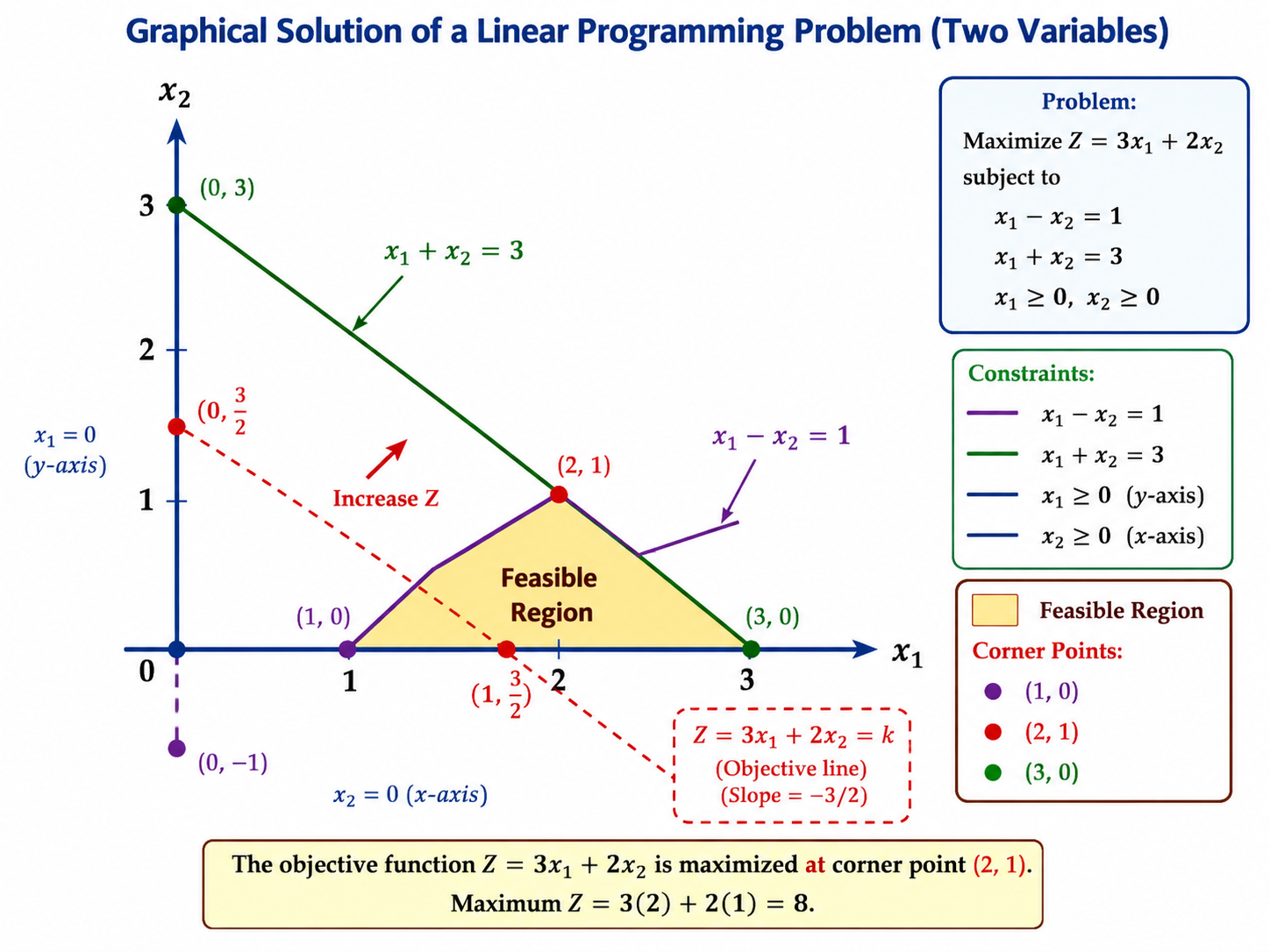
Use graphical method to solve the linear programming problem. Maximize \(Z=3x_1+2x_2\) subject to \(x_1-x_2\ge1\), \(x_1+x_3\ge3\), and \(x_1,x_2,x_3\ge0\).

2Diagram

Question 1(e): Graphical solution of linear programming problem
2019 UPSC Maths Optional Paper II Solutions diagram for Question 1(e), showing the coordinate axes, constraint lines, feasible region and corner points used in the graphical solution of the linear programming problem.

3Concept Related to the Question

A graphical LPP is solved by plotting the half-planes and checking whether the objective function has a finite maximum on the feasible region.

4Detailed Solution

The constraints are

\[x_1-x_2\ge1,\qquad x_1+x_2\ge3,\qquad x_1,x_2\ge0.\]

The feasible region lies in the first quadrant, above or on the line \(x_1+x_2=3\), and on the side \(x_1-x_2\ge1\). This region is unbounded in the positive \(x_1\)-direction.

Now take points of the form \((x_1,x_2)=(t,0)\). For every \(t\ge3\), all constraints are satisfied. At such points,

\[Z=3t+2\cdot0=3t.\]

As \(t\to\infty\), \(Z\to\infty\). Hence the objective function is not bounded above.

5Final Answer

The feasible region is unbounded and the problem has no finite maximum value.

Question 2(a)

Homomorphism between finite groups of coprime orders

1Question

If \(G\) and \(H\) are finite groups whose orders are relatively prime, then prove that there is only one homomorphism from \(G\) to \(H\), the trivial one.

2Diagram

Full Solution Access

The Diagram section for this question is available in the full 2019 UPSC Maths Optional Paper II PYQ Solutions course.

Complete diagrams, concepts, detailed solutions and final answers for all questions are available in the full PYQ course.

3Concept Related to the Question

Full Solution Access

The Concept Related to the Question section for this question is available in the full 2019 UPSC Maths Optional Paper II PYQ Solutions course.

Complete diagrams, concepts, detailed solutions and final answers for all questions are available in the full PYQ course.

4Detailed Solution

Full Solution Access

The Detailed Solution section for this question is available in the full 2019 UPSC Maths Optional Paper II PYQ Solutions course.

Complete diagrams, concepts, detailed solutions and final answers for all questions are available in the full PYQ course.

5Final Answer

Full Solution Access

The Final Answer section for this question is available in the full 2019 UPSC Maths Optional Paper II PYQ Solutions course.

Complete diagrams, concepts, detailed solutions and final answers for all questions are available in the full PYQ course.

Question 2(b)

Quotient groups of cyclic group

1Question

Write down all quotient groups of the group \(Z_{12}\).

2Diagram

Full Solution Access

The Diagram section for this question is available in the full 2019 UPSC Maths Optional Paper II PYQ Solutions course.

Complete diagrams, concepts, detailed solutions and final answers for all questions are available in the full PYQ course.

3Concept Related to the Question

Full Solution Access

The Concept Related to the Question section for this question is available in the full 2019 UPSC Maths Optional Paper II PYQ Solutions course.

Complete diagrams, concepts, detailed solutions and final answers for all questions are available in the full PYQ course.

4Detailed Solution

Full Solution Access

The Detailed Solution section for this question is available in the full 2019 UPSC Maths Optional Paper II PYQ Solutions course.

Complete diagrams, concepts, detailed solutions and final answers for all questions are available in the full PYQ course.

5Final Answer

Full Solution Access

The Final Answer section for this question is available in the full 2019 UPSC Maths Optional Paper II PYQ Solutions course.

Complete diagrams, concepts, detailed solutions and final answers for all questions are available in the full PYQ course.

Question 2(c)

Approximation using differentials

1Question

Using differentials, find an approximate value of \(f(4.1,4.9)\) where \(f(x,y)=(x^3+x^2y)^{1/2}\).

2Diagram

Full Solution Access

The Diagram section for this question is available in the full 2019 UPSC Maths Optional Paper II PYQ Solutions course.

Complete diagrams, concepts, detailed solutions and final answers for all questions are available in the full PYQ course.

3Concept Related to the Question

Full Solution Access

The Concept Related to the Question section for this question is available in the full 2019 UPSC Maths Optional Paper II PYQ Solutions course.

Complete diagrams, concepts, detailed solutions and final answers for all questions are available in the full PYQ course.

4Detailed Solution

Full Solution Access

The Detailed Solution section for this question is available in the full 2019 UPSC Maths Optional Paper II PYQ Solutions course.

Complete diagrams, concepts, detailed solutions and final answers for all questions are available in the full PYQ course.

5Final Answer

Full Solution Access

The Final Answer section for this question is available in the full 2019 UPSC Maths Optional Paper II PYQ Solutions course.

Complete diagrams, concepts, detailed solutions and final answers for all questions are available in the full PYQ course.

Question 2(d)

Poles and residue formula

1Question

Show that an isolated singular point \(z_0\) of a function \(f(z)\) is a pole of order \(m\) if and only if \(f(z)\) can be written in the form \(f(z)=\dfrac{\phi(z)}{(z-z_0)^m}\), where \(\phi(z)\) is analytic and non zero at \(z_0\). Moreover, \(\operatorname{Res}_{z=z_0}f(z)=\dfrac{\phi^{(m-1)}(z_0)}{(m-1)!}\) if \(m\ge1\).

2Diagram

Full Solution Access

The Diagram section for this question is available in the full 2019 UPSC Maths Optional Paper II PYQ Solutions course.

Complete diagrams, concepts, detailed solutions and final answers for all questions are available in the full PYQ course.

3Concept Related to the Question

Full Solution Access

The Concept Related to the Question section for this question is available in the full 2019 UPSC Maths Optional Paper II PYQ Solutions course.

Complete diagrams, concepts, detailed solutions and final answers for all questions are available in the full PYQ course.

4Detailed Solution

Full Solution Access

The Detailed Solution section for this question is available in the full 2019 UPSC Maths Optional Paper II PYQ Solutions course.

Complete diagrams, concepts, detailed solutions and final answers for all questions are available in the full PYQ course.

5Final Answer

Full Solution Access

The Final Answer section for this question is available in the full 2019 UPSC Maths Optional Paper II PYQ Solutions course.

Complete diagrams, concepts, detailed solutions and final answers for all questions are available in the full PYQ course.

Question 3(a)

Uniform convergence test

1Question

Discuss the uniform convergence of \(f_n(x)=\dfrac{nx}{1+n^2x^2}\), \(\forall x\in R(-\infty,\infty)\), \(n=1,2,3,\ldots\).

2Diagram

Full Solution Access

The Diagram section for this question is available in the full 2019 UPSC Maths Optional Paper II PYQ Solutions course.

Complete diagrams, concepts, detailed solutions and final answers for all questions are available in the full PYQ course.

3Concept Related to the Question

Full Solution Access

The Concept Related to the Question section for this question is available in the full 2019 UPSC Maths Optional Paper II PYQ Solutions course.

Complete diagrams, concepts, detailed solutions and final answers for all questions are available in the full PYQ course.

4Detailed Solution

Full Solution Access

The Detailed Solution section for this question is available in the full 2019 UPSC Maths Optional Paper II PYQ Solutions course.

Complete diagrams, concepts, detailed solutions and final answers for all questions are available in the full PYQ course.

5Final Answer

Full Solution Access

The Final Answer section for this question is available in the full 2019 UPSC Maths Optional Paper II PYQ Solutions course.

Complete diagrams, concepts, detailed solutions and final answers for all questions are available in the full PYQ course.

Question 3(b)

Simplex method and alternate optima

1Question

Solve the linear programming problem using Simplex method. Minimize \(Z=x_1+2x_2-3x_3-2x_4\) subject to \(x_1+2x_2-3x_3+x_4=4\), \(x_1+2x_2+x_3+2x_4=4\), and \(x_1,x_2,x_3,x_4\ge0\).

2Diagram

Full Solution Access

The Diagram section for this question is available in the full 2019 UPSC Maths Optional Paper II PYQ Solutions course.

Complete diagrams, concepts, detailed solutions and final answers for all questions are available in the full PYQ course.

3Concept Related to the Question

Full Solution Access

The Concept Related to the Question section for this question is available in the full 2019 UPSC Maths Optional Paper II PYQ Solutions course.

Complete diagrams, concepts, detailed solutions and final answers for all questions are available in the full PYQ course.

4Detailed Solution

Full Solution Access

The Detailed Solution section for this question is available in the full 2019 UPSC Maths Optional Paper II PYQ Solutions course.

Complete diagrams, concepts, detailed solutions and final answers for all questions are available in the full PYQ course.

5Final Answer

Full Solution Access

The Final Answer section for this question is available in the full 2019 UPSC Maths Optional Paper II PYQ Solutions course.

Complete diagrams, concepts, detailed solutions and final answers for all questions are available in the full PYQ course.

Question 3(c)

Complex line integral along a parabola

1Question

Evaluate the integral \(\displaystyle\int_C\operatorname{Re}(z^2)\,dz\) from \(0\) to \(2+4i\) along the curve \(C\) where \(C\) is a parabola \(y=x^2\).

2Diagram

Full Solution Access

The Diagram section for this question is available in the full 2019 UPSC Maths Optional Paper II PYQ Solutions course.

Complete diagrams, concepts, detailed solutions and final answers for all questions are available in the full PYQ course.

3Concept Related to the Question

Full Solution Access

The Concept Related to the Question section for this question is available in the full 2019 UPSC Maths Optional Paper II PYQ Solutions course.

Complete diagrams, concepts, detailed solutions and final answers for all questions are available in the full PYQ course.

4Detailed Solution

Full Solution Access

The Detailed Solution section for this question is available in the full 2019 UPSC Maths Optional Paper II PYQ Solutions course.

Complete diagrams, concepts, detailed solutions and final answers for all questions are available in the full PYQ course.

5Final Answer

Full Solution Access

The Final Answer section for this question is available in the full 2019 UPSC Maths Optional Paper II PYQ Solutions course.

Complete diagrams, concepts, detailed solutions and final answers for all questions are available in the full PYQ course.

Question 3(d)

Irreducible element and field quotient

1Question

Let \(a\) be an irreducible element of the Euclidean ring \(R\), then prove that \(R/(a)\) is a field.

2Diagram

Full Solution Access

The Diagram section for this question is available in the full 2019 UPSC Maths Optional Paper II PYQ Solutions course.

Complete diagrams, concepts, detailed solutions and final answers for all questions are available in the full PYQ course.

3Concept Related to the Question

Full Solution Access

The Concept Related to the Question section for this question is available in the full 2019 UPSC Maths Optional Paper II PYQ Solutions course.

Complete diagrams, concepts, detailed solutions and final answers for all questions are available in the full PYQ course.

4Detailed Solution

Full Solution Access

The Detailed Solution section for this question is available in the full 2019 UPSC Maths Optional Paper II PYQ Solutions course.

Complete diagrams, concepts, detailed solutions and final answers for all questions are available in the full PYQ course.

5Final Answer

Full Solution Access

The Final Answer section for this question is available in the full 2019 UPSC Maths Optional Paper II PYQ Solutions course.

Complete diagrams, concepts, detailed solutions and final answers for all questions are available in the full PYQ course.

Question 4(a)

Maximum under a sphere constraint

1Question

Find the maximum value of \(f(x,y,z)=x^2y^2z^2\) subject to the subsidiary condition \(x^2+y^2+z^2=c^2\), \((x,y,z\gt0)\).

2Diagram

Full Solution Access

The Diagram section for this question is available in the full 2019 UPSC Maths Optional Paper II PYQ Solutions course.

Complete diagrams, concepts, detailed solutions and final answers for all questions are available in the full PYQ course.

3Concept Related to the Question

Full Solution Access

The Concept Related to the Question section for this question is available in the full 2019 UPSC Maths Optional Paper II PYQ Solutions course.

Complete diagrams, concepts, detailed solutions and final answers for all questions are available in the full PYQ course.

4Detailed Solution

Full Solution Access

The Detailed Solution section for this question is available in the full 2019 UPSC Maths Optional Paper II PYQ Solutions course.

Complete diagrams, concepts, detailed solutions and final answers for all questions are available in the full PYQ course.

5Final Answer

Full Solution Access

The Final Answer section for this question is available in the full 2019 UPSC Maths Optional Paper II PYQ Solutions course.

Complete diagrams, concepts, detailed solutions and final answers for all questions are available in the full PYQ course.

Question 4(b)

Laurent expansion near zero

1Question

Obtain the first three terms of the Laurent series expansion of the function \(f(z)=\dfrac{1}{e^z-1}\) about the point \(z=0\) valid in the region \(0\lt|z|\lt2\pi\).

2Diagram

Full Solution Access

The Diagram section for this question is available in the full 2019 UPSC Maths Optional Paper II PYQ Solutions course.

Complete diagrams, concepts, detailed solutions and final answers for all questions are available in the full PYQ course.

3Concept Related to the Question

Full Solution Access

The Concept Related to the Question section for this question is available in the full 2019 UPSC Maths Optional Paper II PYQ Solutions course.

Complete diagrams, concepts, detailed solutions and final answers for all questions are available in the full PYQ course.

4Detailed Solution

Full Solution Access

The Detailed Solution section for this question is available in the full 2019 UPSC Maths Optional Paper II PYQ Solutions course.

Complete diagrams, concepts, detailed solutions and final answers for all questions are available in the full PYQ course.

5Final Answer

Full Solution Access

The Final Answer section for this question is available in the full 2019 UPSC Maths Optional Paper II PYQ Solutions course.

Complete diagrams, concepts, detailed solutions and final answers for all questions are available in the full PYQ course.

Question 4(c)

Improper integral convergence

1Question

Discuss the convergence of \(\displaystyle\int_1^2\dfrac{\sqrt{x}}{\ln x}\,dx\).

2Diagram

Full Solution Access

The Diagram section for this question is available in the full 2019 UPSC Maths Optional Paper II PYQ Solutions course.

Complete diagrams, concepts, detailed solutions and final answers for all questions are available in the full PYQ course.

3Concept Related to the Question

Full Solution Access

The Concept Related to the Question section for this question is available in the full 2019 UPSC Maths Optional Paper II PYQ Solutions course.

Complete diagrams, concepts, detailed solutions and final answers for all questions are available in the full PYQ course.

4Detailed Solution

Full Solution Access

The Detailed Solution section for this question is available in the full 2019 UPSC Maths Optional Paper II PYQ Solutions course.

Complete diagrams, concepts, detailed solutions and final answers for all questions are available in the full PYQ course.

5Final Answer

Full Solution Access

The Final Answer section for this question is available in the full 2019 UPSC Maths Optional Paper II PYQ Solutions course.

Complete diagrams, concepts, detailed solutions and final answers for all questions are available in the full PYQ course.

Question 4(d)

Dual check for non-optimality in LPP

1Question

Consider the following LPP, Maximize \(Z=2x_1+4x_2+4x_3-3x_4\) subject to \(x_1+x_2+x_3=4\), \(x_1+4x_2+x_4=8\), and \(x_1,x_2,x_3,x_4\ge0\). Use the dual problem to verify that the basic solution \((x_1,x_2)\) is not optimal.

2Diagram

Full Solution Access

The Diagram section for this question is available in the full 2019 UPSC Maths Optional Paper II PYQ Solutions course.

Complete diagrams, concepts, detailed solutions and final answers for all questions are available in the full PYQ course.

3Concept Related to the Question

Full Solution Access

The Concept Related to the Question section for this question is available in the full 2019 UPSC Maths Optional Paper II PYQ Solutions course.

Complete diagrams, concepts, detailed solutions and final answers for all questions are available in the full PYQ course.

4Detailed Solution

Full Solution Access

The Detailed Solution section for this question is available in the full 2019 UPSC Maths Optional Paper II PYQ Solutions course.

Complete diagrams, concepts, detailed solutions and final answers for all questions are available in the full PYQ course.

5Final Answer

Full Solution Access

The Final Answer section for this question is available in the full 2019 UPSC Maths Optional Paper II PYQ Solutions course.

Complete diagrams, concepts, detailed solutions and final answers for all questions are available in the full PYQ course.

Question 5(a)

Partial differential equation of a family of surfaces

1Question

Form a partial differential equation of the family of surfaces given by the following expression: \(\psi(x^2+y^2+2z^2,\ y^2-2zx)=0\).

2Diagram

Full Solution Access

The Diagram section for this question is available in the full 2019 UPSC Maths Optional Paper II PYQ Solutions course.

Complete diagrams, concepts, detailed solutions and final answers for all questions are available in the full PYQ course.

3Concept Related to the Question

Full Solution Access

The Concept Related to the Question section for this question is available in the full 2019 UPSC Maths Optional Paper II PYQ Solutions course.

Complete diagrams, concepts, detailed solutions and final answers for all questions are available in the full PYQ course.

4Detailed Solution

Full Solution Access

The Detailed Solution section for this question is available in the full 2019 UPSC Maths Optional Paper II PYQ Solutions course.

Complete diagrams, concepts, detailed solutions and final answers for all questions are available in the full PYQ course.

5Final Answer

Full Solution Access

The Final Answer section for this question is available in the full 2019 UPSC Maths Optional Paper II PYQ Solutions course.

Complete diagrams, concepts, detailed solutions and final answers for all questions are available in the full PYQ course.

Question 5(b)

Newton-Raphson method

1Question

Apply Newton-Raphson method, to find a real root of transcendental equation \(x\log_{10}x=1.2\), correct to three decimal places.

2Diagram

Full Solution Access

The Diagram section for this question is available in the full 2019 UPSC Maths Optional Paper II PYQ Solutions course.

Complete diagrams, concepts, detailed solutions and final answers for all questions are available in the full PYQ course.

3Concept Related to the Question

Full Solution Access

The Concept Related to the Question section for this question is available in the full 2019 UPSC Maths Optional Paper II PYQ Solutions course.

Complete diagrams, concepts, detailed solutions and final answers for all questions are available in the full PYQ course.

4Detailed Solution

Full Solution Access

The Detailed Solution section for this question is available in the full 2019 UPSC Maths Optional Paper II PYQ Solutions course.

Complete diagrams, concepts, detailed solutions and final answers for all questions are available in the full PYQ course.

5Final Answer

Full Solution Access

The Final Answer section for this question is available in the full 2019 UPSC Maths Optional Paper II PYQ Solutions course.

Complete diagrams, concepts, detailed solutions and final answers for all questions are available in the full PYQ course.

Question 5(c)

Conical motion of a rod

1Question

A uniform rod \(OA\), of length \(2a\), free to turn about its end \(O\), revolves with angular velocity \(\omega\) about the vertical \(OZ\) through \(O\), and is inclined at a constant angle \(\alpha\) to \(OZ\); find the value of \(\alpha\).

2Diagram

Full Solution Access

The Diagram section for this question is available in the full 2019 UPSC Maths Optional Paper II PYQ Solutions course.

Complete diagrams, concepts, detailed solutions and final answers for all questions are available in the full PYQ course.

3Concept Related to the Question

Full Solution Access

The Concept Related to the Question section for this question is available in the full 2019 UPSC Maths Optional Paper II PYQ Solutions course.

Complete diagrams, concepts, detailed solutions and final answers for all questions are available in the full PYQ course.

4Detailed Solution

Full Solution Access

The Detailed Solution section for this question is available in the full 2019 UPSC Maths Optional Paper II PYQ Solutions course.

Complete diagrams, concepts, detailed solutions and final answers for all questions are available in the full PYQ course.

5Final Answer

Full Solution Access

The Final Answer section for this question is available in the full 2019 UPSC Maths Optional Paper II PYQ Solutions course.

Complete diagrams, concepts, detailed solutions and final answers for all questions are available in the full PYQ course.

Question 5(d)

Fourth-order Runge-Kutta method

1Question

Using Runge-Kutta method of fourth order, solve \(\dfrac{dy}{dx}=\dfrac{y^2-x^2}{y^2+x^2}\) with \(y(0)=1\) at \(x=0.2\). Use four decimal places for calculation and step length \(0.2\).

2Diagram

Full Solution Access

The Diagram section for this question is available in the full 2019 UPSC Maths Optional Paper II PYQ Solutions course.

Complete diagrams, concepts, detailed solutions and final answers for all questions are available in the full PYQ course.

3Concept Related to the Question

Full Solution Access

The Concept Related to the Question section for this question is available in the full 2019 UPSC Maths Optional Paper II PYQ Solutions course.

Complete diagrams, concepts, detailed solutions and final answers for all questions are available in the full PYQ course.

4Detailed Solution

Full Solution Access

The Detailed Solution section for this question is available in the full 2019 UPSC Maths Optional Paper II PYQ Solutions course.

Complete diagrams, concepts, detailed solutions and final answers for all questions are available in the full PYQ course.

5Final Answer

Full Solution Access

The Final Answer section for this question is available in the full 2019 UPSC Maths Optional Paper II PYQ Solutions course.

Complete diagrams, concepts, detailed solutions and final answers for all questions are available in the full PYQ course.

Question 5(e)

Trapezoidal rule algorithm

1Question

Draw a flow chart and write a basic algorithm (in FORTRAN/C/C++) for evaluating \(y=\displaystyle\int_0^6\dfrac{dx}{1+x^2}\) using Trapezoidal rule.

2Diagram

Full Solution Access

The Diagram section for this question is available in the full 2019 UPSC Maths Optional Paper II PYQ Solutions course.

Complete diagrams, concepts, detailed solutions and final answers for all questions are available in the full PYQ course.

3Concept Related to the Question

Full Solution Access

The Concept Related to the Question section for this question is available in the full 2019 UPSC Maths Optional Paper II PYQ Solutions course.

Complete diagrams, concepts, detailed solutions and final answers for all questions are available in the full PYQ course.

4Detailed Solution

Full Solution Access

The Detailed Solution section for this question is available in the full 2019 UPSC Maths Optional Paper II PYQ Solutions course.

Complete diagrams, concepts, detailed solutions and final answers for all questions are available in the full PYQ course.

5Final Answer

Full Solution Access

The Final Answer section for this question is available in the full 2019 UPSC Maths Optional Paper II PYQ Solutions course.

Complete diagrams, concepts, detailed solutions and final answers for all questions are available in the full PYQ course.

Question 6(a)

First-order quasilinear PDE

1Question

Solve the first order quasilinear partial differential equation by the method of characteristics: \(x\dfrac{\partial u}{\partial x}+(u-x-y)\dfrac{\partial u}{\partial y}=x+2y\) in \(x\gt0\), \(-\infty\lt y\lt\infty\) with \(u=1+y\) on \(x=1\).

2Diagram

Full Solution Access

The Diagram section for this question is available in the full 2019 UPSC Maths Optional Paper II PYQ Solutions course.

Complete diagrams, concepts, detailed solutions and final answers for all questions are available in the full PYQ course.

3Concept Related to the Question

Full Solution Access

The Concept Related to the Question section for this question is available in the full 2019 UPSC Maths Optional Paper II PYQ Solutions course.

Complete diagrams, concepts, detailed solutions and final answers for all questions are available in the full PYQ course.

4Detailed Solution

Full Solution Access

The Detailed Solution section for this question is available in the full 2019 UPSC Maths Optional Paper II PYQ Solutions course.

Complete diagrams, concepts, detailed solutions and final answers for all questions are available in the full PYQ course.

5Final Answer

Full Solution Access

The Final Answer section for this question is available in the full 2019 UPSC Maths Optional Paper II PYQ Solutions course.

Complete diagrams, concepts, detailed solutions and final answers for all questions are available in the full PYQ course.

Question 6(b)

Number system conversion

1Question

Find the equivalent numbers given in a specified number to the system mentioned against them: (i) Integer \(524\) in binary system. (ii) \(1010101110101.10110111\) to octal system. (iii) decimal number \(5280\) to hexadecimal system. (iv) Find the unknown number \((1101.101)_8\to(?)10\).

2Diagram

Full Solution Access

The Diagram section for this question is available in the full 2019 UPSC Maths Optional Paper II PYQ Solutions course.

Complete diagrams, concepts, detailed solutions and final answers for all questions are available in the full PYQ course.

3Concept Related to the Question

Full Solution Access

The Concept Related to the Question section for this question is available in the full 2019 UPSC Maths Optional Paper II PYQ Solutions course.

Complete diagrams, concepts, detailed solutions and final answers for all questions are available in the full PYQ course.

4Detailed Solution

Full Solution Access

The Detailed Solution section for this question is available in the full 2019 UPSC Maths Optional Paper II PYQ Solutions course.

Complete diagrams, concepts, detailed solutions and final answers for all questions are available in the full PYQ course.

5Final Answer

Full Solution Access

The Final Answer section for this question is available in the full 2019 UPSC Maths Optional Paper II PYQ Solutions course.

Complete diagrams, concepts, detailed solutions and final answers for all questions are available in the full PYQ course.

Question 6(c)

Rolling cylinder as circular pendulum

1Question

A circular cylinder of radius \(a\) and radius of gyration \(k\) rolls without slipping inside a fixed hollow cylinder of radius \(b\). Show that the plane through axes moves in a circular pendulum of length \((b-a)\left(1+\dfrac{k^2}{a^2}\right)\).

2Diagram

Full Solution Access

The Diagram section for this question is available in the full 2019 UPSC Maths Optional Paper II PYQ Solutions course.

Complete diagrams, concepts, detailed solutions and final answers for all questions are available in the full PYQ course.

3Concept Related to the Question

Full Solution Access

The Concept Related to the Question section for this question is available in the full 2019 UPSC Maths Optional Paper II PYQ Solutions course.

Complete diagrams, concepts, detailed solutions and final answers for all questions are available in the full PYQ course.

4Detailed Solution

Full Solution Access

The Detailed Solution section for this question is available in the full 2019 UPSC Maths Optional Paper II PYQ Solutions course.

Complete diagrams, concepts, detailed solutions and final answers for all questions are available in the full PYQ course.

5Final Answer

Full Solution Access

The Final Answer section for this question is available in the full 2019 UPSC Maths Optional Paper II PYQ Solutions course.

Complete diagrams, concepts, detailed solutions and final answers for all questions are available in the full PYQ course.

Question 7(a)

Hamiltonian equation for rolling sphere

1Question

Using Hamilton's equation, find the acceleration for a sphere rolling down a rough inclined plane, if \(x\) be the distance of the point of contact of the sphere from a fixed point on the plane.

2Diagram

Full Solution Access

The Diagram section for this question is available in the full 2019 UPSC Maths Optional Paper II PYQ Solutions course.

Complete diagrams, concepts, detailed solutions and final answers for all questions are available in the full PYQ course.

3Concept Related to the Question

Full Solution Access

The Concept Related to the Question section for this question is available in the full 2019 UPSC Maths Optional Paper II PYQ Solutions course.

Complete diagrams, concepts, detailed solutions and final answers for all questions are available in the full PYQ course.

4Detailed Solution

Full Solution Access

The Detailed Solution section for this question is available in the full 2019 UPSC Maths Optional Paper II PYQ Solutions course.

Complete diagrams, concepts, detailed solutions and final answers for all questions are available in the full PYQ course.

5Final Answer

Full Solution Access

The Final Answer section for this question is available in the full 2019 UPSC Maths Optional Paper II PYQ Solutions course.

Complete diagrams, concepts, detailed solutions and final answers for all questions are available in the full PYQ course.

Question 7(b)

Gauss-Seidel iteration

1Question

Apply Gauss-Seidel iteration method to solve the following system of equations: \(2x+y-2z=17\), \(3x+20y-z=-18\), \(2x-3y+20z=25\), correct to three decimal places.

2Diagram

Full Solution Access

The Diagram section for this question is available in the full 2019 UPSC Maths Optional Paper II PYQ Solutions course.

Complete diagrams, concepts, detailed solutions and final answers for all questions are available in the full PYQ course.

3Concept Related to the Question

Full Solution Access

The Concept Related to the Question section for this question is available in the full 2019 UPSC Maths Optional Paper II PYQ Solutions course.

Complete diagrams, concepts, detailed solutions and final answers for all questions are available in the full PYQ course.

4Detailed Solution

Full Solution Access

The Detailed Solution section for this question is available in the full 2019 UPSC Maths Optional Paper II PYQ Solutions course.

Complete diagrams, concepts, detailed solutions and final answers for all questions are available in the full PYQ course.

5Final Answer

Full Solution Access

The Final Answer section for this question is available in the full 2019 UPSC Maths Optional Paper II PYQ Solutions course.

Complete diagrams, concepts, detailed solutions and final answers for all questions are available in the full PYQ course.

Question 7(c)

Canonical form of a second-order PDE

1Question

Reduce the following second order partial differential equation to canonical form and find the general solution: \(\dfrac{\partial^2u}{\partial x^2}-2x\dfrac{\partial^2u}{\partial x\partial y}+x^2\dfrac{\partial^2u}{\partial y^2}=\dfrac{\partial u}{\partial y}+12x\).

2Diagram

Full Solution Access

The Diagram section for this question is available in the full 2019 UPSC Maths Optional Paper II PYQ Solutions course.

Complete diagrams, concepts, detailed solutions and final answers for all questions are available in the full PYQ course.

3Concept Related to the Question

Full Solution Access

The Concept Related to the Question section for this question is available in the full 2019 UPSC Maths Optional Paper II PYQ Solutions course.

Complete diagrams, concepts, detailed solutions and final answers for all questions are available in the full PYQ course.

4Detailed Solution

Full Solution Access

The Detailed Solution section for this question is available in the full 2019 UPSC Maths Optional Paper II PYQ Solutions course.

Complete diagrams, concepts, detailed solutions and final answers for all questions are available in the full PYQ course.

5Final Answer

Full Solution Access

The Final Answer section for this question is available in the full 2019 UPSC Maths Optional Paper II PYQ Solutions course.

Complete diagrams, concepts, detailed solutions and final answers for all questions are available in the full PYQ course.

Question 8(a)

Boolean simplification

1Question

Given the Boolean expression \(X=AB+ABC+\bar A\bar B\bar C+\bar AC\). (i) Draw the logical diagram for the expression. (ii) Minimize the expression. (iii) Draw the logical diagram for the reduced expression.

2Diagram

Full Solution Access

The Diagram section for this question is available in the full 2019 UPSC Maths Optional Paper II PYQ Solutions course.

Complete diagrams, concepts, detailed solutions and final answers for all questions are available in the full PYQ course.

3Concept Related to the Question

Full Solution Access

The Concept Related to the Question section for this question is available in the full 2019 UPSC Maths Optional Paper II PYQ Solutions course.

Complete diagrams, concepts, detailed solutions and final answers for all questions are available in the full PYQ course.

4Detailed Solution

Full Solution Access

The Detailed Solution section for this question is available in the full 2019 UPSC Maths Optional Paper II PYQ Solutions course.

Complete diagrams, concepts, detailed solutions and final answers for all questions are available in the full PYQ course.

5Final Answer

Full Solution Access

The Final Answer section for this question is available in the full 2019 UPSC Maths Optional Paper II PYQ Solutions course.

Complete diagrams, concepts, detailed solutions and final answers for all questions are available in the full PYQ course.

Question 8(b)

Pressure on pulsating sphere in fluid

1Question

A sphere of radius \(R\), whose centre is at rest, vibrates radially in an infinite incompressible fluid of density \(\rho\), which is at rest at infinity. If the pressure at infinity is \(\Pi\), so that the pressure at the surface of the sphere at time \(t\) is \(\Pi+\dfrac{1}{2}\rho\left\{\dfrac{d^2R^2}{dt^2}+\left(\dfrac{dR}{dt}\right)^2\right\}\).

2Diagram

Full Solution Access

The Diagram section for this question is available in the full 2019 UPSC Maths Optional Paper II PYQ Solutions course.

Complete diagrams, concepts, detailed solutions and final answers for all questions are available in the full PYQ course.

3Concept Related to the Question

Full Solution Access

The Concept Related to the Question section for this question is available in the full 2019 UPSC Maths Optional Paper II PYQ Solutions course.

Complete diagrams, concepts, detailed solutions and final answers for all questions are available in the full PYQ course.

4Detailed Solution

Full Solution Access

The Detailed Solution section for this question is available in the full 2019 UPSC Maths Optional Paper II PYQ Solutions course.

Complete diagrams, concepts, detailed solutions and final answers for all questions are available in the full PYQ course.

5Final Answer

Full Solution Access

The Final Answer section for this question is available in the full 2019 UPSC Maths Optional Paper II PYQ Solutions course.

Complete diagrams, concepts, detailed solutions and final answers for all questions are available in the full PYQ course.

Question 8(c)

Two sources and a sink in fluid flow

1Question

Two sources, each of strength \(m\), are placed at the points \((-a,0)\), \((a,0)\) and a sink of strength \(2m\) at origin. Show that the stream lines are the curves \((x^2+y^2)^2=a^2(x^2-y^2+\lambda xy)\), where \(\lambda\) is a variable parameter. Show also that the fluid speed at any point is \(\dfrac{2ma^2}{r_1r_2r_3}\), where \(r_1,r_2\) and \(r_3\) are the distances of the points from the sources and the sink, respectively.

2Diagram

Full Solution Access

The Diagram section for this question is available in the full 2019 UPSC Maths Optional Paper II PYQ Solutions course.

Complete diagrams, concepts, detailed solutions and final answers for all questions are available in the full PYQ course.

3Concept Related to the Question

Full Solution Access

The Concept Related to the Question section for this question is available in the full 2019 UPSC Maths Optional Paper II PYQ Solutions course.

Complete diagrams, concepts, detailed solutions and final answers for all questions are available in the full PYQ course.

4Detailed Solution

Full Solution Access

The Detailed Solution section for this question is available in the full 2019 UPSC Maths Optional Paper II PYQ Solutions course.

Complete diagrams, concepts, detailed solutions and final answers for all questions are available in the full PYQ course.

5Final Answer

Full Solution Access

The Final Answer section for this question is available in the full 2019 UPSC Maths Optional Paper II PYQ Solutions course.

Complete diagrams, concepts, detailed solutions and final answers for all questions are available in the full PYQ course.

2019 UPSC Maths Optional Paper II Solutions FAQs

Are these 2019 UPSC Maths Optional Paper II Solutions complete?

This public page gives one full sample solution for 2019 UPSC Maths Optional Paper II Solutions. Complete question-wise solutions for the full paper are available in the full PYQ course by Ramana Sri IAS.

Which question is given as a free sample solution on this page?

Question 1(e) is given as the free sample solution on this page. It includes Question, Diagram, Concept Related to the Question, Detailed Solution, and Final Answer.

How should I use these 2019 UPSC Maths Optional Paper II Solutions for preparation?

Use these solutions for revision, answer-writing practice, concept clarity, and checking the step-by-step presentation expected in the UPSC Mathematics optional paper.

Do these solutions include diagrams and detailed explanations?

Yes. The free sample solution shows the complete format used by Ramana Sri IAS, including diagram support where needed, concept explanation, detailed solution, and final answer.

How can I get complete solutions for all questions in 2019 UPSC Maths Optional Paper II Solutions?

Complete solutions for all questions are available in the full PYQ course. To purchase the full solution, please fill out the admission form first. Our Ramana Sri IAS admission team will guide you through WhatsApp, email, or call.

Scroll to Top