Ramana Sri IAS

Ramana Sri IAS - 2020 UPSC Maths Optional Paper I Solutions

2020 UPSC Maths Optional Paper I Solutions

Ramana Sri IAS provides complete and updated solutions for the 2020 UPSC Maths Optional Paper I. Aspirants preparing for the UPSC Mains Examination with Mathematics as their optional subject should solve all these questions carefully at least 5 to 10 times before the mains examination.

Ramana Sri IAS presents complete solutions for UPSC/IAS/CSE-Civil Service Examination 2020 Mathematics Optional Paper I. Each answer follows the same format: Question, Diagram where needed, Concept Related to the Question, Detailed Solution, and Final Answer.

About 2020 UPSC Maths Optional Paper I Solutions

These 2020 UPSC Maths Optional Paper I Solutions are prepared by Ramana Sri IAS for aspirants who want question-wise clarity before the UPSC Mains examination. This public page gives one full sample solution, while the complete paper-wise solutions are available in the full PYQ course.

Students can use these 2020 UPSC Maths Optional Paper I Solutions to understand the expected answer-writing method, diagram presentation, concept application, and final-answer format used by Ramana Sri IAS.

For the official examination source, students may also refer to the UPSC previous year question papers page.

These 2020 UPSC Maths Optional Paper I Solutions are useful for revision, answer-writing practice, and understanding the step-by-step method expected in the UPSC Mathematics optional paper.

Sample Full Solution

We are giving one question from 2020 UPSC Maths Optional Paper I Solutions as a free sample solution below: Question 1(d). This free sample includes all five sections: Question, Diagram, Concept Related to the Question, Detailed Solution, and Final Answer. Complete 2020 UPSC Maths Optional Paper I Solutions for all questions are available in the full PYQ course. To purchase the full solution, please fill out the admission form first. Our Ramana Sri IAS admission team will guide you through WhatsApp, email, or call.

2020 UPSC Maths Optional Paper I Solutions: Table of Contents

Question 1(a)

Vector space of magic squares

1Question

Consider the set \(V\) of all \(n\times n\) real magic squares. Show that \(V\) is a vector space over \(R\). Give examples of two distinct \(2\times2\) magic squares.

2Diagram

Full Solution Access

The Diagram section for this question is available in the full 2020 UPSC Maths Optional Paper I PYQ Solutions course.

Complete diagrams, concepts, detailed solutions and final answers for all questions are available in the full PYQ course.

3Concept Related to the Question

Full Solution Access

The Concept Related to the Question section for this question is available in the full 2020 UPSC Maths Optional Paper I PYQ Solutions course.

Complete diagrams, concepts, detailed solutions and final answers for all questions are available in the full PYQ course.

4Detailed Solution

Full Solution Access

The Detailed Solution section for this question is available in the full 2020 UPSC Maths Optional Paper I PYQ Solutions course.

Complete diagrams, concepts, detailed solutions and final answers for all questions are available in the full PYQ course.

5Final Answer

Full Solution Access

The Final Answer section for this question is available in the full 2020 UPSC Maths Optional Paper I PYQ Solutions course.

Complete diagrams, concepts, detailed solutions and final answers for all questions are available in the full PYQ course.

Question 1(b)

Rank and nullity of a matrix transformation

1Question

Let \(M_2(R)\) be the vector space of all \(2\times2\) real matrices. Let \(B=\left[\begin{smallmatrix}1&-1\\-4&4\end{smallmatrix}\right]\). Suppose \(T:M_2(R)\to M_2(R)\) is a linear transformation defined by \(T(A)=BA\). Find the rank and nullity of \(T\). Find a matrix \(A\) which maps to the null matrix.

2Diagram

Full Solution Access

The Diagram section for this question is available in the full 2020 UPSC Maths Optional Paper I PYQ Solutions course.

Complete diagrams, concepts, detailed solutions and final answers for all questions are available in the full PYQ course.

3Concept Related to the Question

Full Solution Access

The Concept Related to the Question section for this question is available in the full 2020 UPSC Maths Optional Paper I PYQ Solutions course.

Complete diagrams, concepts, detailed solutions and final answers for all questions are available in the full PYQ course.

4Detailed Solution

Full Solution Access

The Detailed Solution section for this question is available in the full 2020 UPSC Maths Optional Paper I PYQ Solutions course.

Complete diagrams, concepts, detailed solutions and final answers for all questions are available in the full PYQ course.

5Final Answer

Full Solution Access

The Final Answer section for this question is available in the full 2020 UPSC Maths Optional Paper I PYQ Solutions course.

Complete diagrams, concepts, detailed solutions and final answers for all questions are available in the full PYQ course.

Question 1(c)

Indeterminate limit

1Question

Evaluate \(\displaystyle \lim_{x\to\pi/4}(\tan x)^{\tan 2x}\).

2Diagram

Full Solution Access

The Diagram section for this question is available in the full 2020 UPSC Maths Optional Paper I PYQ Solutions course.

Complete diagrams, concepts, detailed solutions and final answers for all questions are available in the full PYQ course.

3Concept Related to the Question

Full Solution Access

The Concept Related to the Question section for this question is available in the full 2020 UPSC Maths Optional Paper I PYQ Solutions course.

Complete diagrams, concepts, detailed solutions and final answers for all questions are available in the full PYQ course.

4Detailed Solution

Full Solution Access

The Detailed Solution section for this question is available in the full 2020 UPSC Maths Optional Paper I PYQ Solutions course.

Complete diagrams, concepts, detailed solutions and final answers for all questions are available in the full PYQ course.

5Final Answer

Full Solution Access

The Final Answer section for this question is available in the full 2020 UPSC Maths Optional Paper I PYQ Solutions course.

Complete diagrams, concepts, detailed solutions and final answers for all questions are available in the full PYQ course.

Question 1(d)

Asymptotes of a curve

1Question

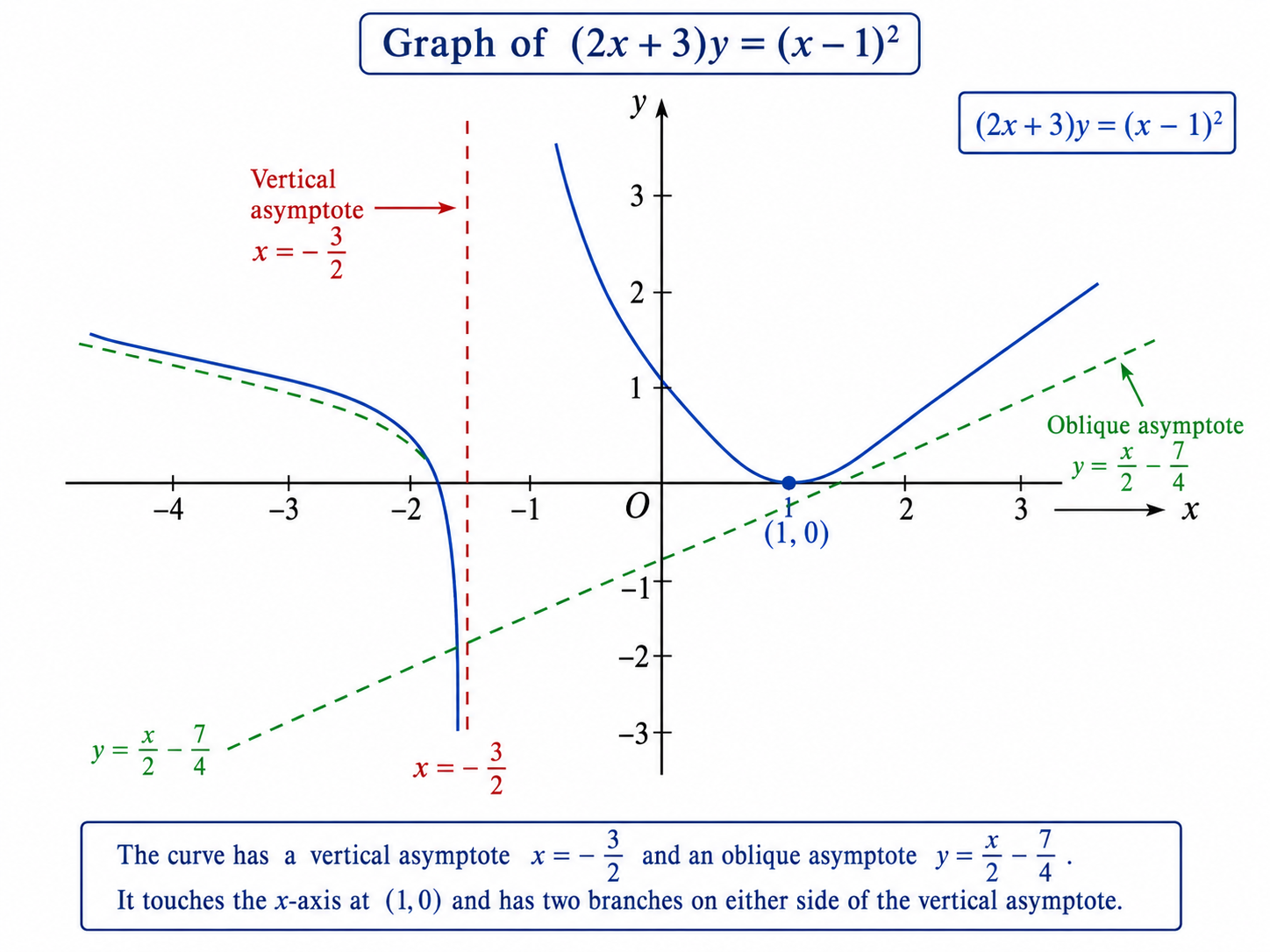
Find all the asymptotes of the curve \((2x+3)y=(x-1)^2\).

2Diagram

Question 1(d): Curve and its asymptotes
2020 UPSC Maths Optional Paper I Solutions diagram showing the curve two x plus three times y equals x minus one squared with its vertical asymptote and oblique asymptote clearly marked.

3Concept Related to the Question

Write the curve in the form \(y=\frac{(x-1)^2}{2x+3}\). Vertical asymptotes come from the denominator, and the oblique asymptote comes from polynomial division.

4Detailed Solution

The equation can be written as

\[y=\frac{x^2-2x+1}{2x+3}.\]

Since the denominator is zero at \(x=-\frac32\), and the numerator is not zero there, we get the vertical asymptote

\[x=-\frac32.\]

For the oblique asymptote, divide \(x^2-2x+1\) by \(2x+3\):

\[\frac{x^2-2x+1}{2x+3}=\frac{x}{2}-\frac74+\frac{25}{4(2x+3)}.\]

As \(x\to\pm\infty\), the last term tends to zero. Hence the oblique asymptote is

\[y=\frac{x}{2}-\frac74.\]

5Final Answer

The asymptotes are \(x=-\frac32\) and \(y=\frac{x}{2}-\frac74\).

Question 1(e)

Tangent plane to an ellipsoid through a line

1Question

Find the equations of the tangent plane to the ellipsoid \(2x^2+6y^2+3z^2=27\) which passes through the line \(x-y-z=0=x-y+2z-9\).

2Diagram

Full Solution Access

The Diagram section for this question is available in the full 2020 UPSC Maths Optional Paper I PYQ Solutions course.

Complete diagrams, concepts, detailed solutions and final answers for all questions are available in the full PYQ course.

3Concept Related to the Question

Full Solution Access

The Concept Related to the Question section for this question is available in the full 2020 UPSC Maths Optional Paper I PYQ Solutions course.

Complete diagrams, concepts, detailed solutions and final answers for all questions are available in the full PYQ course.

4Detailed Solution

Full Solution Access

The Detailed Solution section for this question is available in the full 2020 UPSC Maths Optional Paper I PYQ Solutions course.

Complete diagrams, concepts, detailed solutions and final answers for all questions are available in the full PYQ course.

5Final Answer

Full Solution Access

The Final Answer section for this question is available in the full 2020 UPSC Maths Optional Paper I PYQ Solutions course.

Complete diagrams, concepts, detailed solutions and final answers for all questions are available in the full PYQ course.

Question 2(a)

Integration using inverse tangent identity

1Question

Evaluate \(\displaystyle \int_0^1 \tan^{-1}\left(1-\dfrac{1}{x}\right)dx\).

2Diagram

Full Solution Access

The Diagram section for this question is available in the full 2020 UPSC Maths Optional Paper I PYQ Solutions course.

Complete diagrams, concepts, detailed solutions and final answers for all questions are available in the full PYQ course.

3Concept Related to the Question

Full Solution Access

The Concept Related to the Question section for this question is available in the full 2020 UPSC Maths Optional Paper I PYQ Solutions course.

Complete diagrams, concepts, detailed solutions and final answers for all questions are available in the full PYQ course.

4Detailed Solution

Full Solution Access

The Detailed Solution section for this question is available in the full 2020 UPSC Maths Optional Paper I PYQ Solutions course.

Complete diagrams, concepts, detailed solutions and final answers for all questions are available in the full PYQ course.

5Final Answer

Full Solution Access

The Final Answer section for this question is available in the full 2020 UPSC Maths Optional Paper I PYQ Solutions course.

Complete diagrams, concepts, detailed solutions and final answers for all questions are available in the full PYQ course.

Question 2(b)

Householder matrix

1Question

Define an \(n\times n\) matrix as \(A=I-2uu^T\), where \(u\) is a unit column vector.

(i) Examine if \(A\) is symmetric.

(ii) Examine if \(A\) is orthogonal.

(iii) Show that \(\operatorname{trace}(A)=n-2\).

(iv) Find \(A_{3\times3}\), when \(u=\left[\begin{smallmatrix}\dfrac{1}{3}\\\dfrac{2}{3}\\\dfrac{2}{3}\end{smallmatrix}\right]\).

2Diagram

Full Solution Access

The Diagram section for this question is available in the full 2020 UPSC Maths Optional Paper I PYQ Solutions course.

Complete diagrams, concepts, detailed solutions and final answers for all questions are available in the full PYQ course.

3Concept Related to the Question

Full Solution Access

The Concept Related to the Question section for this question is available in the full 2020 UPSC Maths Optional Paper I PYQ Solutions course.

Complete diagrams, concepts, detailed solutions and final answers for all questions are available in the full PYQ course.

4Detailed Solution

Full Solution Access

The Detailed Solution section for this question is available in the full 2020 UPSC Maths Optional Paper I PYQ Solutions course.

Complete diagrams, concepts, detailed solutions and final answers for all questions are available in the full PYQ course.

5Final Answer

Full Solution Access

The Final Answer section for this question is available in the full 2020 UPSC Maths Optional Paper I PYQ Solutions course.

Complete diagrams, concepts, detailed solutions and final answers for all questions are available in the full PYQ course.

Question 2(c)

Cylinder with given generators

1Question

Find the equation of the cylinder whose generators are parallel to the line \(\dfrac{x}{1}=\dfrac{y}{-2}=\dfrac{z}{3}\) and whose guiding curve is \(x^2+y^2=4,\ z=2\).

2Diagram

Full Solution Access

The Diagram section for this question is available in the full 2020 UPSC Maths Optional Paper I PYQ Solutions course.

Complete diagrams, concepts, detailed solutions and final answers for all questions are available in the full PYQ course.

3Concept Related to the Question

Full Solution Access

The Concept Related to the Question section for this question is available in the full 2020 UPSC Maths Optional Paper I PYQ Solutions course.

Complete diagrams, concepts, detailed solutions and final answers for all questions are available in the full PYQ course.

4Detailed Solution

Full Solution Access

The Detailed Solution section for this question is available in the full 2020 UPSC Maths Optional Paper I PYQ Solutions course.

Complete diagrams, concepts, detailed solutions and final answers for all questions are available in the full PYQ course.

5Final Answer

Full Solution Access

The Final Answer section for this question is available in the full 2020 UPSC Maths Optional Paper I PYQ Solutions course.

Complete diagrams, concepts, detailed solutions and final answers for all questions are available in the full PYQ course.

Question 3(a)

Critical points and zeros

1Question

Consider the function \(f(x)=\displaystyle\int_0^x(t^2-5t+4)(t^2-5t+6)dt\).

(i) Find the critical points of the function \(f(x)\).

(ii) Find the points at which local minimum occurs.

(iii) Find the points at which local maximum occurs.

(iv) Find the number of zeros of the function \(f(x)\) in \([0,5]\).

2Diagram

Full Solution Access

The Diagram section for this question is available in the full 2020 UPSC Maths Optional Paper I PYQ Solutions course.

Complete diagrams, concepts, detailed solutions and final answers for all questions are available in the full PYQ course.

3Concept Related to the Question

Full Solution Access

The Concept Related to the Question section for this question is available in the full 2020 UPSC Maths Optional Paper I PYQ Solutions course.

Complete diagrams, concepts, detailed solutions and final answers for all questions are available in the full PYQ course.

4Detailed Solution

Full Solution Access

The Detailed Solution section for this question is available in the full 2020 UPSC Maths Optional Paper I PYQ Solutions course.

Complete diagrams, concepts, detailed solutions and final answers for all questions are available in the full PYQ course.

5Final Answer

Full Solution Access

The Final Answer section for this question is available in the full 2020 UPSC Maths Optional Paper I PYQ Solutions course.

Complete diagrams, concepts, detailed solutions and final answers for all questions are available in the full PYQ course.

Question 3(b)

Null space of a function on \(F^3\)

1Question

Let \(F\) be a subfield of complex numbers and \(T:F^3\to F^3\) a function defined by \(T(x_1,x_2,x_3)=(x_1+x_2+3x_3,\ 2x_1-x_2,\ -3x_1+x_2-x_3)\). What are the condition on \(a,b,c\) such that \((a,b,c)\) be in the null space of \(T\)? Find the nullity of \(T\).

2Diagram

Full Solution Access

The Diagram section for this question is available in the full 2020 UPSC Maths Optional Paper I PYQ Solutions course.

Complete diagrams, concepts, detailed solutions and final answers for all questions are available in the full PYQ course.

3Concept Related to the Question

Full Solution Access

The Concept Related to the Question section for this question is available in the full 2020 UPSC Maths Optional Paper I PYQ Solutions course.

Complete diagrams, concepts, detailed solutions and final answers for all questions are available in the full PYQ course.

4Detailed Solution

Full Solution Access

The Detailed Solution section for this question is available in the full 2020 UPSC Maths Optional Paper I PYQ Solutions course.

Complete diagrams, concepts, detailed solutions and final answers for all questions are available in the full PYQ course.

5Final Answer

Full Solution Access

The Final Answer section for this question is available in the full 2020 UPSC Maths Optional Paper I PYQ Solutions course.

Complete diagrams, concepts, detailed solutions and final answers for all questions are available in the full PYQ course.

Question 3(c)

Mutually perpendicular generators of a cone

1Question

If the straight line \(\dfrac{x}{1}=\dfrac{y}{2}=\dfrac{z}{3}\) represents one of a set of three mutually perpendicular generators of the cone \(5yz-8zx-3xy=0\), then find the equations of the other two generators.

2Diagram

Full Solution Access

The Diagram section for this question is available in the full 2020 UPSC Maths Optional Paper I PYQ Solutions course.

Complete diagrams, concepts, detailed solutions and final answers for all questions are available in the full PYQ course.

3Concept Related to the Question

Full Solution Access

The Concept Related to the Question section for this question is available in the full 2020 UPSC Maths Optional Paper I PYQ Solutions course.

Complete diagrams, concepts, detailed solutions and final answers for all questions are available in the full PYQ course.

4Detailed Solution

Full Solution Access

The Detailed Solution section for this question is available in the full 2020 UPSC Maths Optional Paper I PYQ Solutions course.

Complete diagrams, concepts, detailed solutions and final answers for all questions are available in the full PYQ course.

5Final Answer

Full Solution Access

The Final Answer section for this question is available in the full 2020 UPSC Maths Optional Paper I PYQ Solutions course.

Complete diagrams, concepts, detailed solutions and final answers for all questions are available in the full PYQ course.

Question 4(a)

Matrix product, determinants and linear equations

1Question

Let \(A=\left[\begin{smallmatrix}1&0&2\\2&-1&3\\4&1&8\end{smallmatrix}\right]\) and \(B=\left[\begin{smallmatrix}-11&2&2\\-4&0&1\\6&-1&-1\end{smallmatrix}\right]\).

(i) Find \(AB\).

(ii) Find \(\det(A)\) and \(\det(B)\).

(iii) Solve the following system of linear equations: \(x+2z=3,\quad 2x-y+3z=3,\quad 4x+y+8z=14\).

2Diagram

Full Solution Access

The Diagram section for this question is available in the full 2020 UPSC Maths Optional Paper I PYQ Solutions course.

Complete diagrams, concepts, detailed solutions and final answers for all questions are available in the full PYQ course.

3Concept Related to the Question

Full Solution Access

The Concept Related to the Question section for this question is available in the full 2020 UPSC Maths Optional Paper I PYQ Solutions course.

Complete diagrams, concepts, detailed solutions and final answers for all questions are available in the full PYQ course.

4Detailed Solution

Full Solution Access

The Detailed Solution section for this question is available in the full 2020 UPSC Maths Optional Paper I PYQ Solutions course.

Complete diagrams, concepts, detailed solutions and final answers for all questions are available in the full PYQ course.

5Final Answer

Full Solution Access

The Final Answer section for this question is available in the full 2020 UPSC Maths Optional Paper I PYQ Solutions course.

Complete diagrams, concepts, detailed solutions and final answers for all questions are available in the full PYQ course.

Question 4(b)

Perpendicular generators of hyperbolic paraboloid

1Question

Find the locus of the point of intersection of the perpendicular generators of the hyperbolic paraboloid \(\dfrac{x^2}{a^2}-\dfrac{y^2}{b^2}=2z\).

2Diagram

Full Solution Access

The Diagram section for this question is available in the full 2020 UPSC Maths Optional Paper I PYQ Solutions course.

Complete diagrams, concepts, detailed solutions and final answers for all questions are available in the full PYQ course.

3Concept Related to the Question

Full Solution Access

The Concept Related to the Question section for this question is available in the full 2020 UPSC Maths Optional Paper I PYQ Solutions course.

Complete diagrams, concepts, detailed solutions and final answers for all questions are available in the full PYQ course.

4Detailed Solution

Full Solution Access

The Detailed Solution section for this question is available in the full 2020 UPSC Maths Optional Paper I PYQ Solutions course.

Complete diagrams, concepts, detailed solutions and final answers for all questions are available in the full PYQ course.

5Final Answer

Full Solution Access

The Final Answer section for this question is available in the full 2020 UPSC Maths Optional Paper I PYQ Solutions course.

Complete diagrams, concepts, detailed solutions and final answers for all questions are available in the full PYQ course.

Question 4(c)

Lagrange multiplier

1Question

Find an extreme value of the function \(u=x^2+y^2+z^2\), subject to the condition \(2x+3y+5z=30\), by using Lagrange's method of undetermined multiplier.

2Diagram

Full Solution Access

The Diagram section for this question is available in the full 2020 UPSC Maths Optional Paper I PYQ Solutions course.

Complete diagrams, concepts, detailed solutions and final answers for all questions are available in the full PYQ course.

3Concept Related to the Question

Full Solution Access

The Concept Related to the Question section for this question is available in the full 2020 UPSC Maths Optional Paper I PYQ Solutions course.

Complete diagrams, concepts, detailed solutions and final answers for all questions are available in the full PYQ course.

4Detailed Solution

Full Solution Access

The Detailed Solution section for this question is available in the full 2020 UPSC Maths Optional Paper I PYQ Solutions course.

Complete diagrams, concepts, detailed solutions and final answers for all questions are available in the full PYQ course.

5Final Answer

Full Solution Access

The Final Answer section for this question is available in the full 2020 UPSC Maths Optional Paper I PYQ Solutions course.

Complete diagrams, concepts, detailed solutions and final answers for all questions are available in the full PYQ course.

Question 5(a)

Homogeneous differential equation

1Question

Solve the following differential equation: \(x\cos\left(\dfrac{y}{x}\right)(y\,dx+x\,dy)=y\sin\left(\dfrac{y}{x}\right)(x\,dy-y\,dx)\).

2Diagram

Full Solution Access

The Diagram section for this question is available in the full 2020 UPSC Maths Optional Paper I PYQ Solutions course.

Complete diagrams, concepts, detailed solutions and final answers for all questions are available in the full PYQ course.

3Concept Related to the Question

Full Solution Access

The Concept Related to the Question section for this question is available in the full 2020 UPSC Maths Optional Paper I PYQ Solutions course.

Complete diagrams, concepts, detailed solutions and final answers for all questions are available in the full PYQ course.

4Detailed Solution

Full Solution Access

The Detailed Solution section for this question is available in the full 2020 UPSC Maths Optional Paper I PYQ Solutions course.

Complete diagrams, concepts, detailed solutions and final answers for all questions are available in the full PYQ course.

5Final Answer

Full Solution Access

The Final Answer section for this question is available in the full 2020 UPSC Maths Optional Paper I PYQ Solutions course.

Complete diagrams, concepts, detailed solutions and final answers for all questions are available in the full PYQ course.

Question 5(b)

Orthogonal trajectories

1Question

Find the orthogonal trajectories of the family of circles passing through the points \((0,2)\) and \((0,-2)\).

2Diagram

Full Solution Access

The Diagram section for this question is available in the full 2020 UPSC Maths Optional Paper I PYQ Solutions course.

Complete diagrams, concepts, detailed solutions and final answers for all questions are available in the full PYQ course.

3Concept Related to the Question

Full Solution Access

The Concept Related to the Question section for this question is available in the full 2020 UPSC Maths Optional Paper I PYQ Solutions course.

Complete diagrams, concepts, detailed solutions and final answers for all questions are available in the full PYQ course.

4Detailed Solution

Full Solution Access

The Detailed Solution section for this question is available in the full 2020 UPSC Maths Optional Paper I PYQ Solutions course.

Complete diagrams, concepts, detailed solutions and final answers for all questions are available in the full PYQ course.

5Final Answer

Full Solution Access

The Final Answer section for this question is available in the full 2020 UPSC Maths Optional Paper I PYQ Solutions course.

Complete diagrams, concepts, detailed solutions and final answers for all questions are available in the full PYQ course.

Question 5(c)

Irrotational vector field and potential

1Question

For what values of \(a,b,c\) is the vector field \(\vec V=(-4x-3y+az)\vec i+(bx+3y+5z)\vec j+(4x+cy+3z)\vec k\) irrotational? Hence, express \(\vec V\) as the gradient of a scalar function \(\phi\). Find \(\phi\).

2Diagram

Full Solution Access

The Diagram section for this question is available in the full 2020 UPSC Maths Optional Paper I PYQ Solutions course.

Complete diagrams, concepts, detailed solutions and final answers for all questions are available in the full PYQ course.

3Concept Related to the Question

Full Solution Access

The Concept Related to the Question section for this question is available in the full 2020 UPSC Maths Optional Paper I PYQ Solutions course.

Complete diagrams, concepts, detailed solutions and final answers for all questions are available in the full PYQ course.

4Detailed Solution

Full Solution Access

The Detailed Solution section for this question is available in the full 2020 UPSC Maths Optional Paper I PYQ Solutions course.

Complete diagrams, concepts, detailed solutions and final answers for all questions are available in the full PYQ course.

5Final Answer

Full Solution Access

The Final Answer section for this question is available in the full 2020 UPSC Maths Optional Paper I PYQ Solutions course.

Complete diagrams, concepts, detailed solutions and final answers for all questions are available in the full PYQ course.

Question 5(d)

Equilibrium of a rod

1Question

A uniform rod, in vertical position, can turn freely about one of its end and is pulled aside from the vertical by a horizontal force acting at the other end of the rod and equal to half its weight. At what inclination to the vertical will the rod rest?

2Diagram

Full Solution Access

The Diagram section for this question is available in the full 2020 UPSC Maths Optional Paper I PYQ Solutions course.

Complete diagrams, concepts, detailed solutions and final answers for all questions are available in the full PYQ course.

3Concept Related to the Question

Full Solution Access

The Concept Related to the Question section for this question is available in the full 2020 UPSC Maths Optional Paper I PYQ Solutions course.

Complete diagrams, concepts, detailed solutions and final answers for all questions are available in the full PYQ course.

4Detailed Solution

Full Solution Access

The Detailed Solution section for this question is available in the full 2020 UPSC Maths Optional Paper I PYQ Solutions course.

Complete diagrams, concepts, detailed solutions and final answers for all questions are available in the full PYQ course.

5Final Answer

Full Solution Access

The Final Answer section for this question is available in the full 2020 UPSC Maths Optional Paper I PYQ Solutions course.

Complete diagrams, concepts, detailed solutions and final answers for all questions are available in the full PYQ course.

Question 5(e)

Impulse and kinetic energy of a rigid rod system

1Question

A light rigid rod \(ABC\) has three particles each of mass \(m\) attached to it at \(A,\ B\) and \(C\). The rod is struck by a blow \(P\) at right angles to it at a point distant from \(A\) equal to \(BC\). Prove that the kinetic energy set up is \(\dfrac{1}{2}\dfrac{P^2}{m}\dfrac{a^2-ab+b^2}{a^2+ab+b^2}\), where \(AB=a\) and \(BC=b\).

2Diagram

Full Solution Access

The Diagram section for this question is available in the full 2020 UPSC Maths Optional Paper I PYQ Solutions course.

Complete diagrams, concepts, detailed solutions and final answers for all questions are available in the full PYQ course.

3Concept Related to the Question

Full Solution Access

The Concept Related to the Question section for this question is available in the full 2020 UPSC Maths Optional Paper I PYQ Solutions course.

Complete diagrams, concepts, detailed solutions and final answers for all questions are available in the full PYQ course.

4Detailed Solution

Full Solution Access

The Detailed Solution section for this question is available in the full 2020 UPSC Maths Optional Paper I PYQ Solutions course.

Complete diagrams, concepts, detailed solutions and final answers for all questions are available in the full PYQ course.

5Final Answer

Full Solution Access

The Final Answer section for this question is available in the full 2020 UPSC Maths Optional Paper I PYQ Solutions course.

Complete diagrams, concepts, detailed solutions and final answers for all questions are available in the full PYQ course.

Question 6(a)

Variation of parameters

1Question

Using the method of variation of parameters, solve the differential equation \(y''+(1-\cot x)y'-y\cot x=\sin^2x\) if \(y=e^{-x}\) is one solution of CF.

2Diagram

Full Solution Access

The Diagram section for this question is available in the full 2020 UPSC Maths Optional Paper I PYQ Solutions course.

Complete diagrams, concepts, detailed solutions and final answers for all questions are available in the full PYQ course.

3Concept Related to the Question

Full Solution Access

The Concept Related to the Question section for this question is available in the full 2020 UPSC Maths Optional Paper I PYQ Solutions course.

Complete diagrams, concepts, detailed solutions and final answers for all questions are available in the full PYQ course.

4Detailed Solution

Full Solution Access

The Detailed Solution section for this question is available in the full 2020 UPSC Maths Optional Paper I PYQ Solutions course.

Complete diagrams, concepts, detailed solutions and final answers for all questions are available in the full PYQ course.

5Final Answer

Full Solution Access

The Final Answer section for this question is available in the full 2020 UPSC Maths Optional Paper I PYQ Solutions course.

Complete diagrams, concepts, detailed solutions and final answers for all questions are available in the full PYQ course.

Question 6(b)

Line integral and path dependence

1Question

For the vector function \(\vec A\), where \(\vec A=(3x^2+6y)\vec i-14yz\vec j+20xz^2\vec k\), calculate \(\displaystyle\int_C \vec A\cdot d\vec r\) from \((0,0,0)\) to \((1,1,1)\) along the following paths:

(i) \(x=t,\ y=t^2,\ z=t^3\)

(ii) Straight lines joining \((0,0,0)\) to \((1,0,0)\), then to \((1,1,0)\) and then to \((1,1,1)\)

(iii) Straight line joining \((0,0,0)\) to \((1,1,1)\)

Is the result same in all the cases? Explain the reason.

2Diagram

Full Solution Access

The Diagram section for this question is available in the full 2020 UPSC Maths Optional Paper I PYQ Solutions course.

Complete diagrams, concepts, detailed solutions and final answers for all questions are available in the full PYQ course.

3Concept Related to the Question

Full Solution Access

The Concept Related to the Question section for this question is available in the full 2020 UPSC Maths Optional Paper I PYQ Solutions course.

Complete diagrams, concepts, detailed solutions and final answers for all questions are available in the full PYQ course.

4Detailed Solution

Full Solution Access

The Detailed Solution section for this question is available in the full 2020 UPSC Maths Optional Paper I PYQ Solutions course.

Complete diagrams, concepts, detailed solutions and final answers for all questions are available in the full PYQ course.

5Final Answer

Full Solution Access

The Final Answer section for this question is available in the full 2020 UPSC Maths Optional Paper I PYQ Solutions course.

Complete diagrams, concepts, detailed solutions and final answers for all questions are available in the full PYQ course.

Question 6(c)

Tilting of a beam on two supports

1Question

A beam \(AD\) rests on two supports \(B\) and \(C\), where \(AB=BC=CD\). It is found that the beam will tilt when a weight of \(p\) kg is hung from \(A\) or when a weight of \(q\) kg is hung from \(D\). Find the weight of the beam.

2Diagram

Full Solution Access

The Diagram section for this question is available in the full 2020 UPSC Maths Optional Paper I PYQ Solutions course.

Complete diagrams, concepts, detailed solutions and final answers for all questions are available in the full PYQ course.

3Concept Related to the Question

Full Solution Access

The Concept Related to the Question section for this question is available in the full 2020 UPSC Maths Optional Paper I PYQ Solutions course.

Complete diagrams, concepts, detailed solutions and final answers for all questions are available in the full PYQ course.

4Detailed Solution

Full Solution Access

The Detailed Solution section for this question is available in the full 2020 UPSC Maths Optional Paper I PYQ Solutions course.

Complete diagrams, concepts, detailed solutions and final answers for all questions are available in the full PYQ course.

5Final Answer

Full Solution Access

The Final Answer section for this question is available in the full 2020 UPSC Maths Optional Paper I PYQ Solutions course.

Complete diagrams, concepts, detailed solutions and final answers for all questions are available in the full PYQ course.

Question 7(a)

Stokes theorem

1Question

Verify Stokes' theorem for the vector field \(\vec F=xy\vec i+y\vec j+zx\vec k\) on the surface \(S\) which is the part of the cylinder \(z=1-x^2\) for \(0\le x\le1,\ -2\le y\le2\); is oriented upwards.

2Diagram

Full Solution Access

The Diagram section for this question is available in the full 2020 UPSC Maths Optional Paper I PYQ Solutions course.

Complete diagrams, concepts, detailed solutions and final answers for all questions are available in the full PYQ course.

3Concept Related to the Question

Full Solution Access

The Concept Related to the Question section for this question is available in the full 2020 UPSC Maths Optional Paper I PYQ Solutions course.

Complete diagrams, concepts, detailed solutions and final answers for all questions are available in the full PYQ course.

4Detailed Solution

Full Solution Access

The Detailed Solution section for this question is available in the full 2020 UPSC Maths Optional Paper I PYQ Solutions course.

Complete diagrams, concepts, detailed solutions and final answers for all questions are available in the full PYQ course.

5Final Answer

Full Solution Access

The Final Answer section for this question is available in the full 2020 UPSC Maths Optional Paper I PYQ Solutions course.

Complete diagrams, concepts, detailed solutions and final answers for all questions are available in the full PYQ course.

Question 7(b)

Laplace transform and uniqueness

1Question

Using Laplace transform, solve the initial value problem \(ty''+2ty'+2y=2;\ y(0)=1\) and \(y'(0)\) is arbitrary. Does this problem have a unique solution?

2Diagram

Full Solution Access

The Diagram section for this question is available in the full 2020 UPSC Maths Optional Paper I PYQ Solutions course.

Complete diagrams, concepts, detailed solutions and final answers for all questions are available in the full PYQ course.

3Concept Related to the Question

Full Solution Access

The Concept Related to the Question section for this question is available in the full 2020 UPSC Maths Optional Paper I PYQ Solutions course.

Complete diagrams, concepts, detailed solutions and final answers for all questions are available in the full PYQ course.

4Detailed Solution

Full Solution Access

The Detailed Solution section for this question is available in the full 2020 UPSC Maths Optional Paper I PYQ Solutions course.

Complete diagrams, concepts, detailed solutions and final answers for all questions are available in the full PYQ course.

5Final Answer

Full Solution Access

The Final Answer section for this question is available in the full 2020 UPSC Maths Optional Paper I PYQ Solutions course.

Complete diagrams, concepts, detailed solutions and final answers for all questions are available in the full PYQ course.

Question 7(c)(i)

Thrust in a light rod

1Question

A square framework formed of uniform heavy rods of equal weight \(W\) joined together, is hung up by one corner. A weight \(W\) is suspended from each of the lower corners, and the shape of the square is preserved by a light rod along the horizontal diagonal. Find the thrust of the light rod.

2Diagram

Full Solution Access

The Diagram section for this question is available in the full 2020 UPSC Maths Optional Paper I PYQ Solutions course.

Complete diagrams, concepts, detailed solutions and final answers for all questions are available in the full PYQ course.

3Concept Related to the Question

Full Solution Access

The Concept Related to the Question section for this question is available in the full 2020 UPSC Maths Optional Paper I PYQ Solutions course.

Complete diagrams, concepts, detailed solutions and final answers for all questions are available in the full PYQ course.

4Detailed Solution

Full Solution Access

The Detailed Solution section for this question is available in the full 2020 UPSC Maths Optional Paper I PYQ Solutions course.

Complete diagrams, concepts, detailed solutions and final answers for all questions are available in the full PYQ course.

5Final Answer

Full Solution Access

The Final Answer section for this question is available in the full 2020 UPSC Maths Optional Paper I PYQ Solutions course.

Complete diagrams, concepts, detailed solutions and final answers for all questions are available in the full PYQ course.

Question 7(c)(ii)

Least distance in central force motion

1Question

A particle starts at a great distance with velocity \(V\). Let \(p\) be the length of the perpendicular from the centre of a star on the tangent to the initial path of the particle. Show that the least distance of the particle from the centre of the star is \(\lambda\), where \(V^2\lambda=\sqrt{\mu^2+p^2V^4}-\mu\). Here \(\mu\) is a constant.

2Diagram

Full Solution Access

The Diagram section for this question is available in the full 2020 UPSC Maths Optional Paper I PYQ Solutions course.

Complete diagrams, concepts, detailed solutions and final answers for all questions are available in the full PYQ course.

3Concept Related to the Question

Full Solution Access

The Concept Related to the Question section for this question is available in the full 2020 UPSC Maths Optional Paper I PYQ Solutions course.

Complete diagrams, concepts, detailed solutions and final answers for all questions are available in the full PYQ course.

4Detailed Solution

Full Solution Access

The Detailed Solution section for this question is available in the full 2020 UPSC Maths Optional Paper I PYQ Solutions course.

Complete diagrams, concepts, detailed solutions and final answers for all questions are available in the full PYQ course.

5Final Answer

Full Solution Access

The Final Answer section for this question is available in the full 2020 UPSC Maths Optional Paper I PYQ Solutions course.

Complete diagrams, concepts, detailed solutions and final answers for all questions are available in the full PYQ course.

Question 8(a)(i)

Cauchy-Euler differential equation

1Question

Solve the following differential equation: \((x+1)^2y''-4(x+1)y'+6y=6(x+1)^2+\sin\log(x+1)\).

2Diagram

Full Solution Access

The Diagram section for this question is available in the full 2020 UPSC Maths Optional Paper I PYQ Solutions course.

Complete diagrams, concepts, detailed solutions and final answers for all questions are available in the full PYQ course.

3Concept Related to the Question

Full Solution Access

The Concept Related to the Question section for this question is available in the full 2020 UPSC Maths Optional Paper I PYQ Solutions course.

Complete diagrams, concepts, detailed solutions and final answers for all questions are available in the full PYQ course.

4Detailed Solution

Full Solution Access

The Detailed Solution section for this question is available in the full 2020 UPSC Maths Optional Paper I PYQ Solutions course.

Complete diagrams, concepts, detailed solutions and final answers for all questions are available in the full PYQ course.

5Final Answer

Full Solution Access

The Final Answer section for this question is available in the full 2020 UPSC Maths Optional Paper I PYQ Solutions course.

Complete diagrams, concepts, detailed solutions and final answers for all questions are available in the full PYQ course.

Question 8(a)(ii)

General and singular solution

1Question

Find the general and singular solutions of the differential equation \(9p^2(2-y)^2=4(3-y)\), where \(p=\dfrac{dy}{dx}\).

2Diagram

Full Solution Access

The Diagram section for this question is available in the full 2020 UPSC Maths Optional Paper I PYQ Solutions course.

Complete diagrams, concepts, detailed solutions and final answers for all questions are available in the full PYQ course.

3Concept Related to the Question

Full Solution Access

The Concept Related to the Question section for this question is available in the full 2020 UPSC Maths Optional Paper I PYQ Solutions course.

Complete diagrams, concepts, detailed solutions and final answers for all questions are available in the full PYQ course.

4Detailed Solution

Full Solution Access

The Detailed Solution section for this question is available in the full 2020 UPSC Maths Optional Paper I PYQ Solutions course.

Complete diagrams, concepts, detailed solutions and final answers for all questions are available in the full PYQ course.

5Final Answer

Full Solution Access

The Final Answer section for this question is available in the full 2020 UPSC Maths Optional Paper I PYQ Solutions course.

Complete diagrams, concepts, detailed solutions and final answers for all questions are available in the full PYQ course.

Question 8(b)

Surface integral using Stokes theorem

1Question

Evaluate the surface integral \(\displaystyle\iint_S \nabla\times\vec F\cdot\hat n\,dS\) for \(\vec F=y\vec i+(x-2xz)\vec j-xy\vec k\) and \(S\) is the surface of the sphere \(x^2+y^2+z^2=a^2\) above the \(xy\)-plane.

2Diagram

Full Solution Access

The Diagram section for this question is available in the full 2020 UPSC Maths Optional Paper I PYQ Solutions course.

Complete diagrams, concepts, detailed solutions and final answers for all questions are available in the full PYQ course.

3Concept Related to the Question

Full Solution Access

The Concept Related to the Question section for this question is available in the full 2020 UPSC Maths Optional Paper I PYQ Solutions course.

Complete diagrams, concepts, detailed solutions and final answers for all questions are available in the full PYQ course.

4Detailed Solution

Full Solution Access

The Detailed Solution section for this question is available in the full 2020 UPSC Maths Optional Paper I PYQ Solutions course.

Complete diagrams, concepts, detailed solutions and final answers for all questions are available in the full PYQ course.

5Final Answer

Full Solution Access

The Final Answer section for this question is available in the full 2020 UPSC Maths Optional Paper I PYQ Solutions course.

Complete diagrams, concepts, detailed solutions and final answers for all questions are available in the full PYQ course.

Question 8(c)

Acceleration of a railway truck

1Question

A four-wheeled railway truck has a total mass \(M\), the mass and radius of gyration of each pair of wheels and axle are \(m\) and \(k\), respectively, and the radius of each wheel is \(r\). Prove that if the truck is propelled along a level track by a force \(P\), the acceleration is \(\dfrac{P}{M+\dfrac{2mk^2}{r^2}}\), and find the horizontal force exerted on each axle by the truck. The axle friction and wind resistance are to be neglected.

2Diagram

Full Solution Access

The Diagram section for this question is available in the full 2020 UPSC Maths Optional Paper I PYQ Solutions course.

Complete diagrams, concepts, detailed solutions and final answers for all questions are available in the full PYQ course.

3Concept Related to the Question

Full Solution Access

The Concept Related to the Question section for this question is available in the full 2020 UPSC Maths Optional Paper I PYQ Solutions course.

Complete diagrams, concepts, detailed solutions and final answers for all questions are available in the full PYQ course.

4Detailed Solution

Full Solution Access

The Detailed Solution section for this question is available in the full 2020 UPSC Maths Optional Paper I PYQ Solutions course.

Complete diagrams, concepts, detailed solutions and final answers for all questions are available in the full PYQ course.

5Final Answer

Full Solution Access

The Final Answer section for this question is available in the full 2020 UPSC Maths Optional Paper I PYQ Solutions course.

Complete diagrams, concepts, detailed solutions and final answers for all questions are available in the full PYQ course.

2020 UPSC Maths Optional Paper I Solutions FAQs

Are these 2020 UPSC Maths Optional Paper I Solutions complete?

This public page gives one full sample solution for 2020 UPSC Maths Optional Paper I Solutions. Complete question-wise solutions for the full paper are available in the full PYQ course.

Which question is given as a free sample solution on this page?

Question 1(d) is given as the free sample solution on this 2020 UPSC Maths Optional Paper I Solutions page.

How should I use these 2020 UPSC Maths Optional Paper I Solutions for preparation?

Students should first solve the question independently, then compare their method with the solution format, diagram presentation, concept explanation, detailed solution, and final answer.

Do these solutions include diagrams and detailed solutions?

Yes. The complete PYQ course includes question-wise diagrams where needed, concept related to the question, detailed solutions, and final answers.

How can I get complete solutions for all questions in 2020 UPSC Maths Optional Paper I?

To get complete solutions for all questions, students can fill out the admission form. The Ramana Sri IAS admission team will guide students through WhatsApp, email, or call.

Scroll to Top