Ramana Sri IAS - 2020 UPSC Maths Optional Paper II Solutions
2020 UPSC Maths Optional Paper II Solutions
Ramana Sri IAS provides complete and updated solutions for the 2020 UPSC Maths Optional Paper II. Aspirants preparing for the UPSC Mains Examination with Mathematics as their optional subject should solve all these questions carefully at least 5 to 10 times before the mains examination.
Ramana Sri IAS presents complete solutions for UPSC/IAS/CSE-Civil Service Examination 2020 Mathematics Optional Paper II. Each answer follows the same format: Question, Diagram where needed, Concept Related to the Question, Detailed Solution, and Final Answer.
About 2020 UPSC Maths Optional Paper II Solutions
These 2020 UPSC Maths Optional Paper II Solutions are prepared by Ramana Sri IAS for aspirants who want question-wise clarity before the UPSC Mains examination. This public page gives one full sample solution, while the complete paper-wise solutions are available in the full PYQ course.
Students can use these 2020 UPSC Maths Optional Paper II Solutions to understand the expected answer-writing method, diagram presentation, concept application, and final-answer format used by Ramana Sri IAS.
These 2020 UPSC Maths Optional Paper II Solutions are useful for revision, answer-writing practice, and understanding the step-by-step method expected in the UPSC Mathematics optional paper.
Sample Full Solution
We are giving one question from 2020 UPSC Maths Optional Paper II Solutions as a free sample solution below:
Question 1(d). This free sample includes all five sections:
Question, Diagram,
Concept Related to the Question,
Detailed Solution, and Final Answer.
Complete 2020 UPSC Maths Optional Paper II Solutions for all questions are available in the full PYQ course.
To purchase the full solution, please fill out the admission form first.
Our Ramana Sri IAS admission team will guide you through WhatsApp, email, or call.
2020 UPSC Maths Optional Paper II Solutions: Table of Contents
Let \(S_3\) and \(Z_3\) be permutation group on \(3\) symbols and group of residue classes module \(3\) respectively. Show that there is no homomorphism of \(S_3\) in \(Z_3\) except the trivial homomorphism.
2Diagram
Full Solution Access
The Diagram section for this question is available in the full 2020 UPSC Maths Optional Paper II PYQ Solutions course.
Complete diagrams, concepts, detailed solutions and final answers for all questions are available in the full PYQ course.
Let \(R\) be a principal ideal domain. Show that every ideal of a quotient ring of \(R\) is principal ideal and \(R/P\) is a principal ideal domain for a prime ideal \(P\) of \(R\).
2Diagram
Full Solution Access
The Diagram section for this question is available in the full 2020 UPSC Maths Optional Paper II PYQ Solutions course.
Complete diagrams, concepts, detailed solutions and final answers for all questions are available in the full PYQ course.
Prove that the sequence \((a_n)\) satisfying the condition \(\lvert a_{n+1}-a_n\rvert<\alpha\lvert a_n-a_{n-1}\rvert\), \(0<\alpha<1\) for all natural numbers \(n\geq2\), is Cauchy sequence.
2Diagram
Full Solution Access
The Diagram section for this question is available in the full 2020 UPSC Maths Optional Paper II PYQ Solutions course.
Complete diagrams, concepts, detailed solutions and final answers for all questions are available in the full PYQ course.
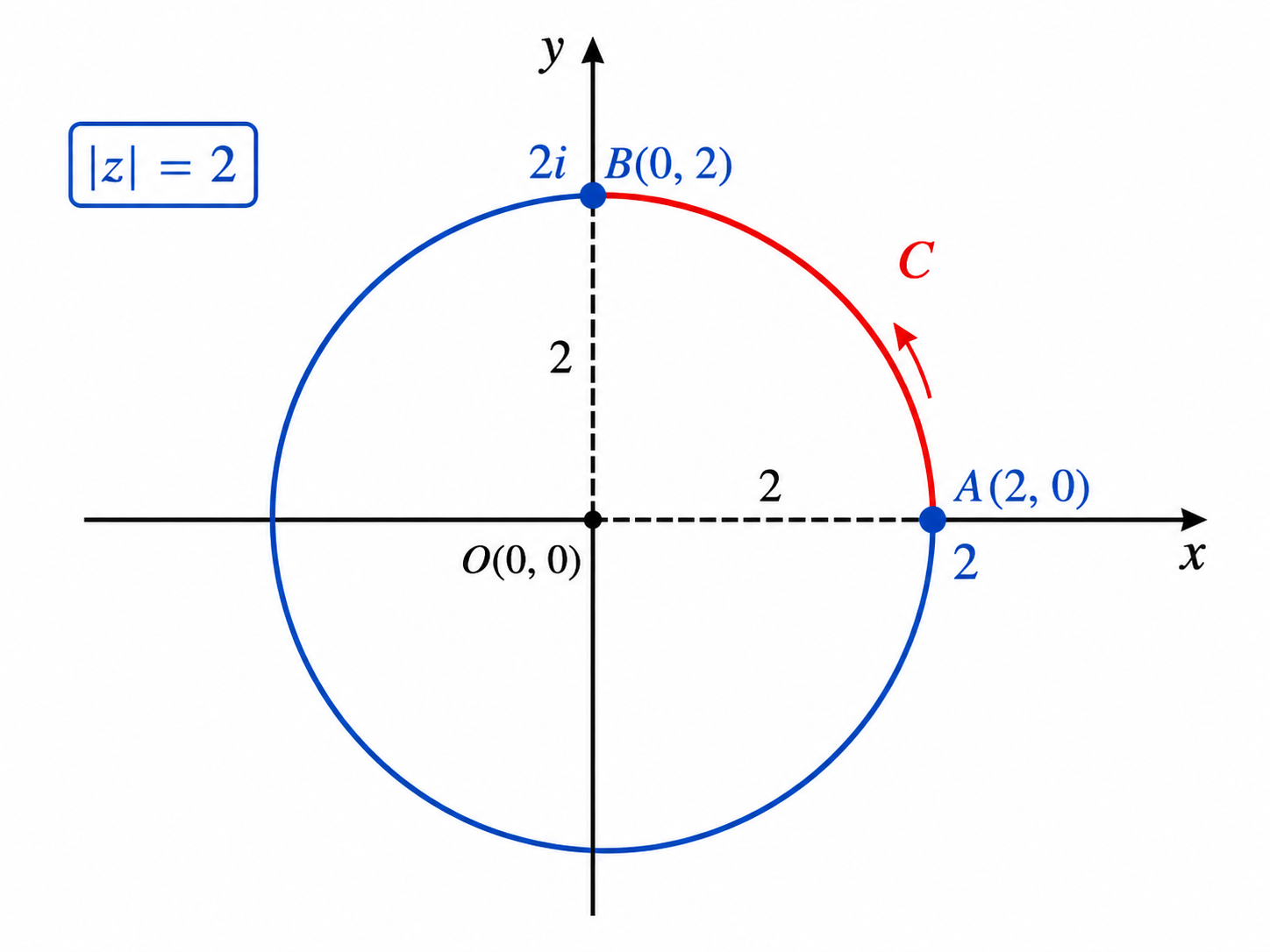
Evaluate the integral \(\int_C (z^2+3z)\,dz\) counterclockwise from \((2,0)\) to \((0,2)\) along the curve \(C\), where \(C\) is the circle \(\lvert z\rvert=2\).
2Diagram
Question 1(d): Complex line integral on the circle |z| = 2
3Concept Related to the Question
Since \(z^2+3z\) is an entire function, its integral between two points is independent of the path. We can use an antiderivative.
4Detailed Solution
The initial point is \(z=2\), and the final point is \(z=2i\). An antiderivative of \(z^2+3z\) is
The value of the integral is \(\displaystyle -\frac{44+8i}{3}\).
Question 1(e)
Cutting-stock linear programming model
1Question
UPSC maintenance section has purchased sufficient number of curtain cloth pieces to meet the curtain requirement of its building. The length of each piece is \(17\) feet. The requirement according to curtain length is as follows:
Curtain length (in feet)
Number required
\(5\)
\(700\)
\(9\)
\(400\)
\(7\)
\(300\)
The width of all curtains is same as that of available pieces. Form a linear programming problem in standard form that decides the number of pieces cut in different ways so that the total trim loss is minimum. Also give a basic feasible solution to it.
2Diagram
Full Solution Access
The Diagram section for this question is available in the full 2020 UPSC Maths Optional Paper II PYQ Solutions course.
Complete diagrams, concepts, detailed solutions and final answers for all questions are available in the full PYQ course.
Let \(R\) be a finite field of characteristic \(p(>0)\). Show that the mapping \(f:R\to R\) defined by \(f(a)=a^p\), \(\forall a\in R\) is an isomorphism.
2Diagram
Full Solution Access
The Diagram section for this question is available in the full 2020 UPSC Maths Optional Paper II PYQ Solutions course.
Complete diagrams, concepts, detailed solutions and final answers for all questions are available in the full PYQ course.
If \(u=\tan^{-1}\dfrac{x^3+y^3}{x-y}\), \(x\neq y\), then show that \(x^2\dfrac{\partial^2u}{\partial x^2}+2xy\dfrac{\partial^2u}{\partial x\partial y}+y^2\dfrac{\partial^2u}{\partial y^2}=(1-4\sin^2u)\sin 2u\).
2Diagram
Full Solution Access
The Diagram section for this question is available in the full 2020 UPSC Maths Optional Paper II PYQ Solutions course.
Complete diagrams, concepts, detailed solutions and final answers for all questions are available in the full PYQ course.
Find the initial basic feasible solution of the following transportation problem by Vogel’s approximation method and use it to find the optimal solution and the transportation cost of the problem.
Sources / Destinations
\(D_1\)
\(D_2\)
\(D_3\)
\(D_4\)
Availability
\(S_1\)
10
0
20
11
15
\(S_2\)
12
8
9
20
25
\(S_3\)
0
14
16
18
10
Demand
5
20
15
10
2Diagram
Full Solution Access
The Diagram section for this question is available in the full 2020 UPSC Maths Optional Paper II PYQ Solutions course.
Complete diagrams, concepts, detailed solutions and final answers for all questions are available in the full PYQ course.
Form a partial differential equation by eliminating the arbitrary functions \(f(x)\) and \(g(y)\) from \(z=yf(x)+xg(y)\) and specify its nature (elliptic, hyperbolic or parabolic) in the region \(x>0\), \(y>0\).
2Diagram
Full Solution Access
The Diagram section for this question is available in the full 2020 UPSC Maths Optional Paper II PYQ Solutions course.
Complete diagrams, concepts, detailed solutions and final answers for all questions are available in the full PYQ course.
Show that the equation : \(f(x)=\cos\dfrac{\pi(x+1)}{8}+0.148x-0.9062=0\) has one root in the interval \((-1,0)\) and one in \((0,1)\). Calculate the negative root correct to four decimal places using Newton-Raphson method.
2Diagram
Full Solution Access
The Diagram section for this question is available in the full 2020 UPSC Maths Optional Paper II PYQ Solutions course.
Complete diagrams, concepts, detailed solutions and final answers for all questions are available in the full PYQ course.
Let \(g(w,x,y,z)=(w+x+y)(x+\bar y+z)(w+\bar y)\) be a Boolean function. Obtain the conjunctive normal form for \(g(w,x,y,z)\). Also express \(g(w,x,y,z)\) as a product of maxterms.
2Diagram
Full Solution Access
The Diagram section for this question is available in the full 2020 UPSC Maths Optional Paper II PYQ Solutions course.
Complete diagrams, concepts, detailed solutions and final answers for all questions are available in the full PYQ course.
Prove that the moment of inertia of a triangular lamina \(ABC\) about any axis through \(A\) in its plane is \(\dfrac{M}{6}(\beta^2+\beta\gamma+\gamma^2)\), where \(M\) is the mass of the lamina and \(\beta\), \(\gamma\) are respectively the length of perpendiculars from \(B\) and \(C\) on the axis.
2Diagram
Full Solution Access
The Diagram section for this question is available in the full 2020 UPSC Maths Optional Paper II PYQ Solutions course.
Complete diagrams, concepts, detailed solutions and final answers for all questions are available in the full PYQ course.
set up the Gauss-Seidel iterative scheme and iterate three times starting with the initial vector \(X^{(0)}=0\). Also find the exact solutions and compare with the iterated solutions.
2Diagram
Full Solution Access
The Diagram section for this question is available in the full 2020 UPSC Maths Optional Paper II PYQ Solutions course.
Complete diagrams, concepts, detailed solutions and final answers for all questions are available in the full PYQ course.
By writing down the Hamiltonian, find the equations of motion of a particle of mass \(m\) constrained to move on the surface of a cylinder defined by \(x^2+y^2=R^2\), \(R\) is a constant. The particle is subject to a force directed towards the origin and proportional to the distance \(r\) of the particle from the origin given by \(\vec F=-k\vec r\), \(k\) is a constant.
2Diagram
Full Solution Access
The Diagram section for this question is available in the full 2020 UPSC Maths Optional Paper II PYQ Solutions course.
Complete diagrams, concepts, detailed solutions and final answers for all questions are available in the full PYQ course.
which is exact for polynomials of highest possible degree. Then use the formula to evaluate \(\displaystyle\int_0^1\dfrac{dx}{\sqrt{x-x^3}}\) (correct up to three decimal places).
2Diagram
Full Solution Access
The Diagram section for this question is available in the full 2020 UPSC Maths Optional Paper II PYQ Solutions course.
Complete diagrams, concepts, detailed solutions and final answers for all questions are available in the full PYQ course.
One end of a tightly stretched flexible thin string of length \(l\) is fixed at the origin and the other at \(x=l\). It is plucked at \(x=\dfrac{l}{3}\) so that it assumes initially the shape of a triangle of height \(h\) in the \(x-y\) plane. Find the displacement \(y\) at any distance \(x\) and at any time \(t\) after the string is released from rest. Take \(\dfrac{\text{horizontal tension}}{\text{mass per unit length}}=c^2\).
2Diagram
Full Solution Access
The Diagram section for this question is available in the full 2020 UPSC Maths Optional Paper II PYQ Solutions course.
Complete diagrams, concepts, detailed solutions and final answers for all questions are available in the full PYQ course.
Write the three point Lagrangian interpolating polynomial relative to the points \(x_0\), \(x_0+\varepsilon\) and \(x_1\). Then by taking the limit \(\varepsilon\to0\), establish the relation
where \(E(x)=\dfrac{1}{6}(x-x_0)^2(x-x_1)f^{\prime\prime\prime}(\xi)\) is the error function and \(\min(x_0,x_0+\varepsilon,x_1)<\xi<\max(x_0,x_0+\varepsilon,x_1)\).
2Diagram
Full Solution Access
The Diagram section for this question is available in the full 2020 UPSC Maths Optional Paper II PYQ Solutions course.
Complete diagrams, concepts, detailed solutions and final answers for all questions are available in the full PYQ course.
Two sources of strength \(\dfrac{m}{2}\) are placed at the points \((\pm a,0)\). Show that at any point on the circle \(x^2+y^2=a^2\), the velocity is parallel to the \(y\)-axis and is inversely proportional to \(y\).
2Diagram
Full Solution Access
The Diagram section for this question is available in the full 2020 UPSC Maths Optional Paper II PYQ Solutions course.
Complete diagrams, concepts, detailed solutions and final answers for all questions are available in the full PYQ course.
Are these 2020 UPSC Maths Optional Paper II Solutions complete?
This public page gives one full sample solution for 2020 UPSC Maths Optional Paper II Solutions. Complete question-wise solutions for the full paper are available in the full PYQ course.
Which question is given as a free sample solution on this page?
Question 1(d) is given as the free sample solution on this 2020 UPSC Maths Optional Paper II Solutions page.
How should I use these 2020 UPSC Maths Optional Paper II Solutions for preparation?
Students should first solve the question independently, then compare their method with the solution format, diagram presentation, concept explanation, detailed solution, and final answer.
Do these solutions include diagrams and detailed solutions?
Yes. The complete PYQ course includes question-wise diagrams where needed, concept related to the question, detailed solutions, and final answers.
How can I get complete solutions for all questions in 2020 UPSC Maths Optional Paper II?
To get complete solutions for all questions, students can fill out the admission form. The Ramana Sri IAS admission team will guide students through WhatsApp, email, or call.
Prepare UPSC Maths Optional with Ramana Sri IAS
Learn concepts, diagrams, previous year questions, answer-writing, and test-series strategy in a clean step-by-step format.