Ramana Sri IAS - 2021 UPSC Maths Optional Paper I Solutions
2021 UPSC Maths Optional Paper I Solutions
Ramana Sri IAS provides complete and updated solutions for the 2021 UPSC Maths Optional Paper I. Aspirants preparing for the UPSC Mains Examination with Mathematics as their optional subject should solve all these questions carefully at least 5 to 10 times before the mains examination.
Ramana Sri IAS presents complete solutions for UPSC/IAS/CSE-Civil Service Examination 2021 Mathematics Optional Paper I. Each answer follows the same format: Question, Diagram where needed, Concept Related to the Question, Detailed Solution, and Final Answer.
About 2021 UPSC Maths Optional Paper I Solutions
These 2021 UPSC Maths Optional Paper I Solutions are prepared by Ramana Sri IAS for aspirants who want question-wise clarity before the UPSC Mains examination. This public page gives one full sample solution, while the complete paper-wise solutions are available in the full PYQ course.
Students can use these 2021 UPSC Maths Optional Paper I Solutions to understand the expected answer-writing method, diagram presentation, concept application, and final-answer format used by Ramana Sri IAS.
These 2021 UPSC Maths Optional Paper I Solutions are useful for revision, answer-writing practice, and understanding the step-by-step method expected in the UPSC Mathematics optional paper.
Sample Full Solution
We are giving one question from 2021 UPSC Maths Optional Paper I Solutions as a free sample solution below:
Question 1(d). This free sample includes all five sections:
Question, Diagram,
Concept Related to the Question,
Detailed Solution, and Final Answer.
Complete 2021 UPSC Maths Optional Paper I Solutions for all questions are available in the full PYQ course.
To purchase the full solution, please fill out the admission form first.
Our Ramana Sri IAS admission team will guide you through WhatsApp, email, or call.
2021 UPSC Maths Optional Paper I Solutions: Table of Contents
Find the matrix associated with the linear operator on \(V_3(R)\) defined by \(T(a,b,c)=(a+b,a-b,2c)\) with respect to the ordered basis \(B=\{(0,1,1),(1,0,1),(1,1,0)\}\).
2Diagram
Full Solution Access
The Diagram section for this question is available in the full 2021 UPSC Maths Optional Paper I PYQ Solutions course.
Complete diagrams, concepts, detailed solutions and final answers for all questions are available in the full PYQ course.
Given \(\Delta(x)=\det{\large \left(\begin{smallmatrix}f(x+\alpha)&f(x+2\alpha)&f(x+3\alpha)\\f(\alpha)&f(2\alpha)&f(3\alpha)\\f\prime(\alpha)&f\prime(2\alpha)&f\prime(3\alpha)\end{smallmatrix}\right)}\), where \(f\) is a real valued differentiable function and \(\alpha\) is a constant. Find \(\displaystyle \lim_{x\to0}\frac{\Delta(x)}{x}\).
2Diagram
Full Solution Access
The Diagram section for this question is available in the full 2021 UPSC Maths Optional Paper I PYQ Solutions course.
Complete diagrams, concepts, detailed solutions and final answers for all questions are available in the full PYQ course.
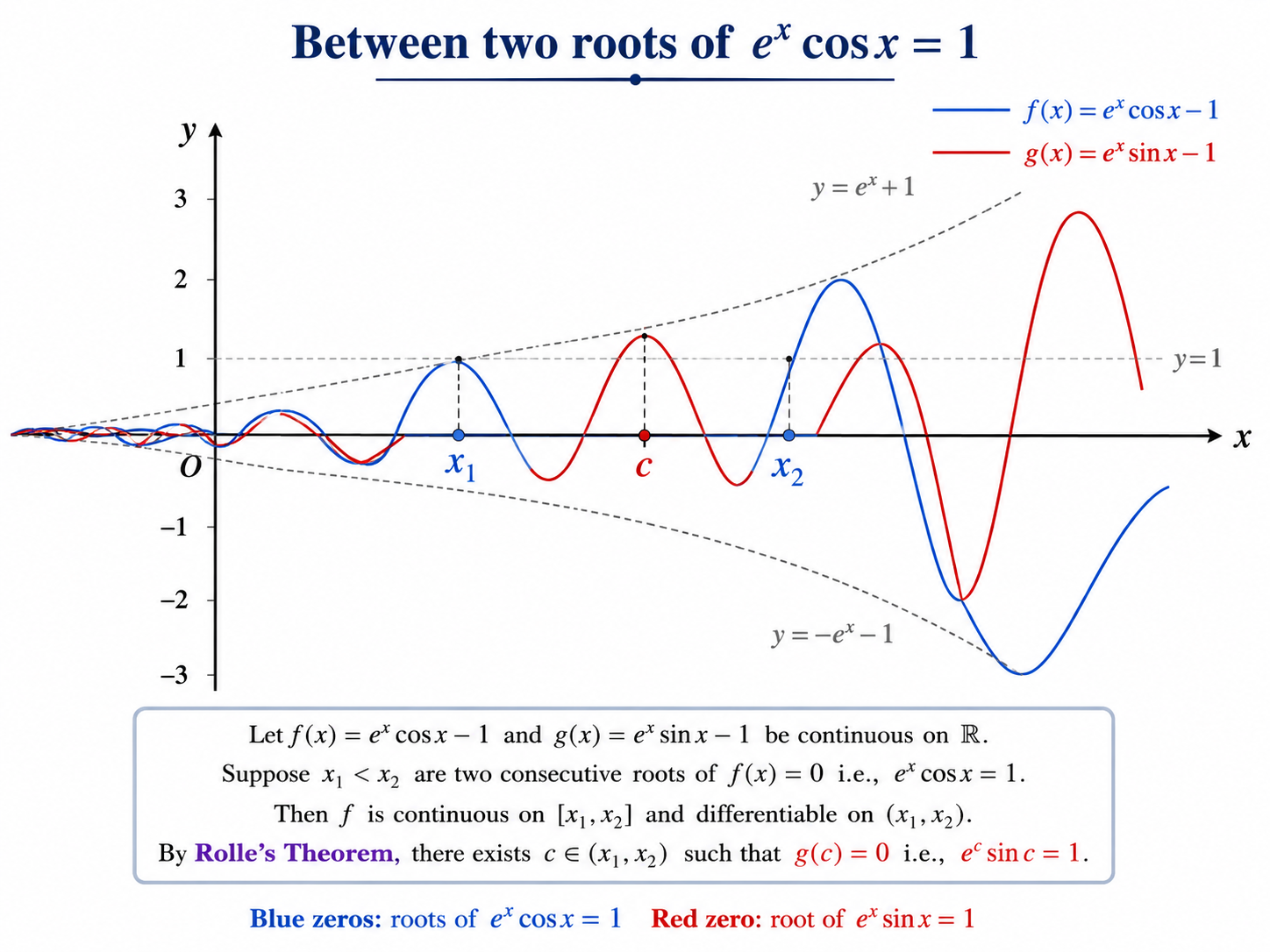
Show that between any two roots of \(e^x\cos x=1\), there exists at least one root of \(e^x\sin x-1=0\).
2Diagram
Question 1(d): Rolle theorem between roots of e^x cos x = 1
3Concept Related to the Question
The result is based on Rolle’s theorem and the relation between the derivatives of \(e^x\cos x\) and \(e^x\sin x\).
4Detailed Solution
Let \(a\) and \(b\), \(a
\[F(x)=e^x\cos x-1.\]
Then \(F(a)=F(b)=0\). By Rolle’s theorem, there is a point \(c\in(a,b)\) such that
\[F\prime(c)=0.\]
Now
\[F\prime(x)=e^x(\cos x-\sin x).\]
So at \(x=c\), \(\cos c=\sin c\). Between two successive intersections of \(e^x\cos x\) with the horizontal line \(1\), the function \(e^x\sin x\) changes from one side of \(1\) to the other. Therefore, by the intermediate value theorem, there is at least one point \(\xi\in(a,b)\) such that
\[e^\xi\sin\xi-1=0.\]
5Final Answer
Hence between any two roots of \(e^x\cos x=1\), there is at least one root of \(e^x\sin x-1=0\).
Question 1(e)
Cylinder with given generators
1Question
Find the equation of the cylinder whose generators are parallel to the line \(x=-\frac{y}{2}=\frac{z}{3}\) and whose guiding curve is \(x^2+2y^2=1,\ z=0\).
2Diagram
Full Solution Access
The Diagram section for this question is available in the full 2021 UPSC Maths Optional Paper I PYQ Solutions course.
Complete diagrams, concepts, detailed solutions and final answers for all questions are available in the full PYQ course.
Show that the planes, which cut the cone \(ax^2+by^2+cz^2=0\) in perpendicular generators, touch the cone \(\frac{x^2}{b+c}+\frac{y^2}{c+a}+\frac{z^2}{a+b}=0\).
2Diagram
Full Solution Access
The Diagram section for this question is available in the full 2021 UPSC Maths Optional Paper I PYQ Solutions course.
Complete diagrams, concepts, detailed solutions and final answers for all questions are available in the full PYQ course.
A sphere of constant radius \(r\) passes through the origin \(O\) and cuts the axes at the points \(A\), \(B\) and \(C\). Find the locus of the foot of the perpendicular drawn from \(O\) to the plane \(ABC\).
2Diagram
Full Solution Access
The Diagram section for this question is available in the full 2021 UPSC Maths Optional Paper I PYQ Solutions course.
Complete diagrams, concepts, detailed solutions and final answers for all questions are available in the full PYQ course.
For two square matrices \(A\) and \(B\) of order \(2\), show that \(\operatorname{trace}(AB)=\operatorname{trace}(BA)\). Hence show that \(AB-BA\neq I_2\), where \(I_2\) is an identity matrix of order \(2\).
2Diagram
Full Solution Access
The Diagram section for this question is available in the full 2021 UPSC Maths Optional Paper I PYQ Solutions course.
Complete diagrams, concepts, detailed solutions and final answers for all questions are available in the full PYQ course.
Reduce the following matrix to a row-reduced echelon form and hence also find its rank: \(A={\large \left[\begin{smallmatrix}1&3&2&4&1\\0&0&2&2&0\\2&6&2&6&2\\3&9&1&10&6\end{smallmatrix}\right]}\).
2Diagram
Full Solution Access
The Diagram section for this question is available in the full 2021 UPSC Maths Optional Paper I PYQ Solutions course.
Complete diagrams, concepts, detailed solutions and final answers for all questions are available in the full PYQ course.
Find the eigen values and the corresponding eigen vectors of the matrix \(A={\large \left(\begin{smallmatrix}0&-i\\i&0\end{smallmatrix}\right)}\), over the complex-number field.
2Diagram
Full Solution Access
The Diagram section for this question is available in the full 2021 UPSC Maths Optional Paper I PYQ Solutions course.
Complete diagrams, concepts, detailed solutions and final answers for all questions are available in the full PYQ course.
Find equation of the plane containing the lines \(\frac{x+1}{3}=\frac{y+3}{5}=\frac{z+5}{7}\), \(\frac{x-2}{1}=\frac{y-4}{3}=\frac{z-6}{5}\). Also find the point of intersection of the given lines.
2Diagram
Full Solution Access
The Diagram section for this question is available in the full 2021 UPSC Maths Optional Paper I PYQ Solutions course.
Complete diagrams, concepts, detailed solutions and final answers for all questions are available in the full PYQ course.
Two rods \(LM\) and \(MN\) are joined rigidly at the point \(M\) such that \((LM)^2+(MN)^2=(LN)^2\) and they are hanged freely in equilibrium from a fixed point \(L\). Let \(\omega\) be the weight per unit length of both the rods which are uniform. Determine the angle, which the rod \(LM\) makes with the vertical direction, in terms of lengths of the rods.
2Diagram
Full Solution Access
The Diagram section for this question is available in the full 2021 UPSC Maths Optional Paper I PYQ Solutions course.
Complete diagrams, concepts, detailed solutions and final answers for all questions are available in the full PYQ course.
If a planet, which revolves around the Sun in a circular orbit, is suddenly stopped in its orbit, then find the time in which it would fall into the Sun. Also, find the ratio of its falling time to the period of revolution of the planet.
2Diagram
Full Solution Access
The Diagram section for this question is available in the full 2021 UPSC Maths Optional Paper I PYQ Solutions course.
Complete diagrams, concepts, detailed solutions and final answers for all questions are available in the full PYQ course.
A heavy string, which is not of uniform density, is hung up from two points. Let \(T_1, T_2, T_3\) be the tensions at the intermediate points \(A,B,C\) of the catenary respectively where its inclinations to the horizontal are in arithmetic progression with common difference \(\beta\). Let \(\omega_1\) and \(\omega_2\) be the weights of the parts \(AB\) and \(BC\) of the string respectively. Prove that (i) Harmonic mean of \(T_1, T_2\) and \(T_3\) is \(\frac{3T_2}{1+2\cos\beta}\), (ii) \(\frac{T_1}{T_3}=\frac{\omega_1}{\omega_2}\).
2Diagram
Full Solution Access
The Diagram section for this question is available in the full 2021 UPSC Maths Optional Paper I PYQ Solutions course.
Complete diagrams, concepts, detailed solutions and final answers for all questions are available in the full PYQ course.
Verify Gauss divergence theorem for \(\vec F=2x^2y\hat i-y^2\hat j+4xz^2\hat k\) taken over the region in the first octant bounded by \(y^2+z^2=9\) and \(x=2\).
2Diagram
Full Solution Access
The Diagram section for this question is available in the full 2021 UPSC Maths Optional Paper I PYQ Solutions course.
Complete diagrams, concepts, detailed solutions and final answers for all questions are available in the full PYQ course.
A heavy particle hangs by an inextensible string of length \(a\) from a fixed point and is then projected horizontally with a velocity \(\sqrt{2gh}\). If \(\frac{5a}{2}>h>a\), then prove that the circular motion ceases when the particle has reached the height \(\frac13(a+2h)\) from the point of projection. Also, prove that the greatest height ever reached by the particle above the point of projection is \(\frac{(4a-h)(a+2h)^2}{27a^2}\).
2Diagram
Full Solution Access
The Diagram section for this question is available in the full 2021 UPSC Maths Optional Paper I PYQ Solutions course.
Complete diagrams, concepts, detailed solutions and final answers for all questions are available in the full PYQ course.
Find the orthogonal trajectories of the family of confocal conics \(\frac{x^2}{a^2+\lambda}+\frac{y^2}{b^2+\lambda}=1\), \(a>b>0\) are constants and \(\lambda\) is a parameter. Show that the given family of curves is self orthogonal.
2Diagram
Full Solution Access
The Diagram section for this question is available in the full 2021 UPSC Maths Optional Paper I PYQ Solutions course.
Complete diagrams, concepts, detailed solutions and final answers for all questions are available in the full PYQ course.
Find the general solution of \(x^2\frac{d^2y}{dx^2}-2x(1+x)\frac{dy}{dx}+2(1+x)y=0\). Hence, solve \(x^2\frac{d^2y}{dx^2}-2x(1+x)\frac{dy}{dx}+2(1+x)y=x^3\) by the method of variation of parameters.
2Diagram
Full Solution Access
The Diagram section for this question is available in the full 2021 UPSC Maths Optional Paper I PYQ Solutions course.
Complete diagrams, concepts, detailed solutions and final answers for all questions are available in the full PYQ course.
Describe the motion and path of a particle of mass \(m\) which is projected in a vertical plane through point of projection with velocity \(u\) in a direction making an angle \(\theta\) with the horizontal direction. Further, if particles are projected from that point in the same vertical plane with velocity \(4\sqrt g\), then determine the locus of vertices of their paths.
2Diagram
Full Solution Access
The Diagram section for this question is available in the full 2021 UPSC Maths Optional Paper I PYQ Solutions course.
Complete diagrams, concepts, detailed solutions and final answers for all questions are available in the full PYQ course.
Using Stoke’s theorem, evaluate \(\iint_S(\nabla\times\vec F)\cdot\hat n\,dS\), where \(\vec F=(x^2+y-4)\hat i+3xy\hat j+(2xy+z^2)\hat k\) and \(S\) is the surface of the paraboloid \(z=4-(x^2+y^2)\) above the \(xy\)-plane. Here, \(\hat n\) is the unit outward normal vector on \(S\).
2Diagram
Full Solution Access
The Diagram section for this question is available in the full 2021 UPSC Maths Optional Paper I PYQ Solutions course.
Complete diagrams, concepts, detailed solutions and final answers for all questions are available in the full PYQ course.
Are these 2021 UPSC Maths Optional Paper I Solutions complete?
This public page gives one full sample solution for 2021 UPSC Maths Optional Paper I Solutions. Complete question-wise solutions for the full paper are available in the full PYQ course.
Which question is given as a free sample solution on this page?
Question 1(d) is given as the free sample solution on this 2021 UPSC Maths Optional Paper I Solutions page.
How should I use these 2021 UPSC Maths Optional Paper I Solutions for preparation?
Students should first solve the question independently, then compare their method with the solution format, diagram presentation, concept explanation, detailed solution, and final answer.
Do these solutions include diagrams and detailed solutions?
Yes. The complete PYQ course includes question-wise diagrams where needed, concept related to the question, detailed solutions, and final answers.
How can I get complete solutions for all questions in 2021 UPSC Maths Optional Paper I?
To get complete solutions for all questions, students can fill out the admission form. The Ramana Sri IAS admission team will guide students through WhatsApp, email, or call.
Prepare UPSC Maths Optional with Ramana Sri IAS
Learn concepts, diagrams, previous year questions, answer-writing, and test-series strategy in a clean step-by-step format.