Ramana Sri IAS - 2022 UPSC Maths Optional Paper II Solutions
2022 UPSC Maths Optional Paper II Solutions Ramana Sri IAS provides complete and updated solutions for the 2022 UPSC Maths Optional Paper II. Aspirants preparing for the UPSC Mains Examination with Mathematics as their optional subject should solve all these questions carefully at least 5 to 10 times before the mains examination.
Ramana Sri IAS presents complete solutions for UPSC/IAS/CSE-Civil Service Examination 2022 Mathematics Optional Paper II. Each answer follows the same format: Question, Diagram where needed, Concept Related to the Question, Detailed Solution, and Final Answer.
About 2022 UPSC Maths Optional Paper II Solutions
These 2022 UPSC Maths Optional Paper II Solutions are prepared by Ramana Sri IAS for aspirants who want question-wise clarity before the UPSC Mains examination. This public page gives one full sample solution, while the complete paper-wise solutions are available in the full PYQ course.
Students can use these 2022 UPSC Maths Optional Paper II Solutions to understand the expected answer-writing method, diagram presentation, concept application, and final-answer format used by Ramana Sri IAS.
For the official examination source, students may also refer to the
UPSC previous year question papers page .
These 2022 UPSC Maths Optional Paper II Solutions are useful for revision, answer-writing practice, and understanding the step-by-step method expected in the UPSC Mathematics optional paper.
Sample Full Solution
We are giving one question from 2022 UPSC Maths Optional Paper II Solutions as a free sample solution below:
Question 1(b) . This free sample includes all five sections:
Question , Diagram ,
Concept Related to the Question ,
Detailed Solution , and Final Answer .
Complete 2022 UPSC Maths Optional Paper II Solutions for all questions are available in the full PYQ course.
To purchase the full solution, please fill out the admission form first.
Our Ramana Sri IAS admission team will guide you through WhatsApp, email, or call.
2022 UPSC Maths Optional Paper II Solutions: Table of Contents
Question 1(a) Group isomorphism
1. Question
2. Diagram
3. Concept Related to the Question
4. Detailed Solution
5. Final Answer
1 QuestionShow that the multiplicative group \(G=\{1,-1,i,-i\}\), where \(i=\sqrt{-1}\), is isomorphic to the group \(G'=(\{0,1,2,3\},+)\).
2 Diagram
Full Solution Access The Diagram section for this question is available in the full 2022 UPSC Maths Optional Paper II PYQ Solutions course.
Complete diagrams, concepts, detailed solutions and final answers for all questions are available in the full PYQ course.
3 Concept Related to the Question
Full Solution Access The Concept Related to the Question section for this question is available in the full 2022 UPSC Maths Optional Paper II PYQ Solutions course.
Complete diagrams, concepts, detailed solutions and final answers for all questions are available in the full PYQ course.
4 Detailed Solution
Full Solution Access The Detailed Solution section for this question is available in the full 2022 UPSC Maths Optional Paper II PYQ Solutions course.
Complete diagrams, concepts, detailed solutions and final answers for all questions are available in the full PYQ course.
5 Final Answer
Full Solution Access The Final Answer section for this question is available in the full 2022 UPSC Maths Optional Paper II PYQ Solutions course.
Complete diagrams, concepts, detailed solutions and final answers for all questions are available in the full PYQ course.
Question 1(b) Analytic function from real part
1. Question
2. Diagram
3. Concept Related to the Question
4. Detailed Solution
5. Final Answer
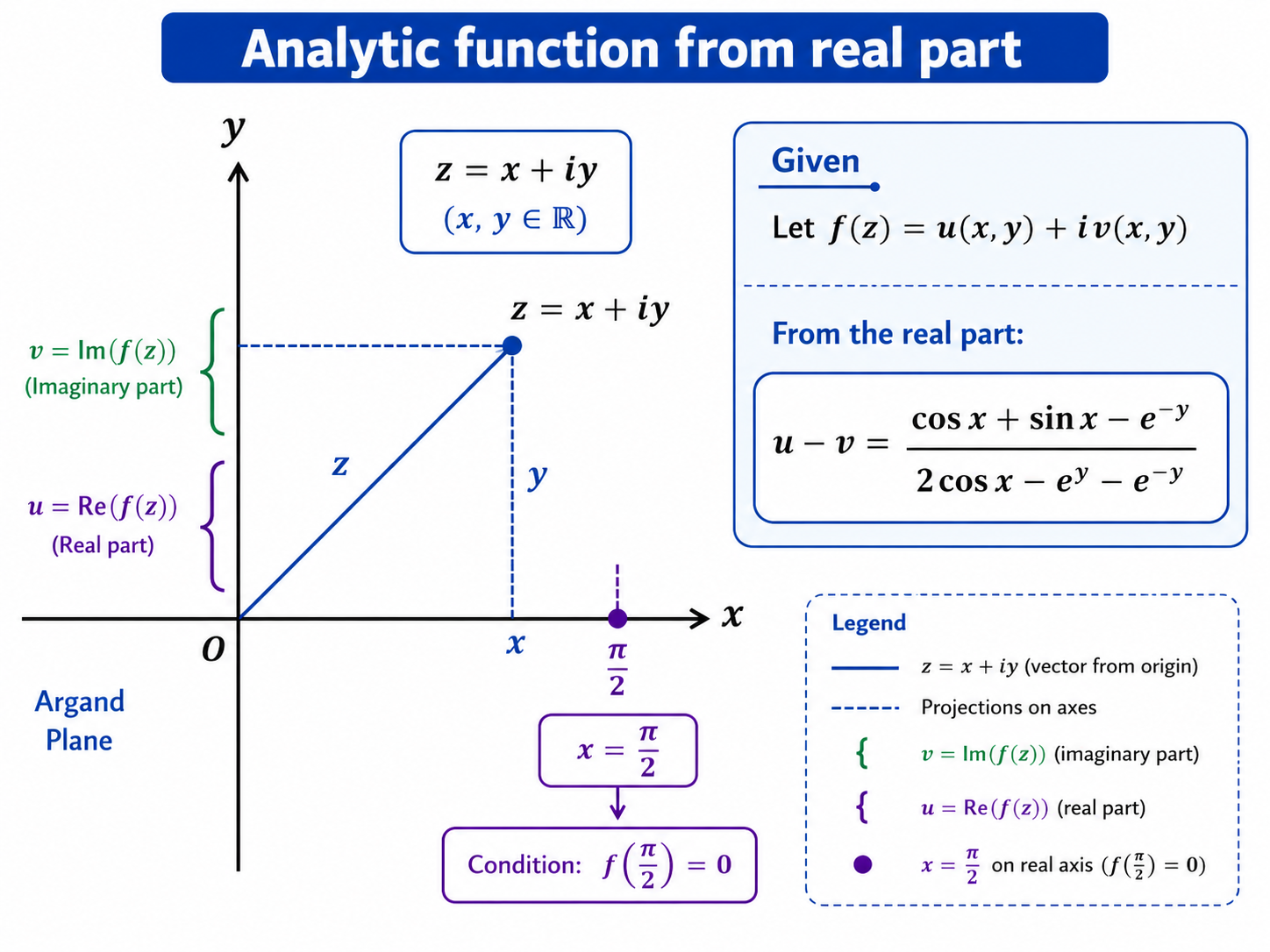
1 QuestionIf \(f(z)=u+iv\) is an analytic function of \(z\), and \(u-v=\frac{\cos x+\sin x-e^{-y}}{2\cos x-e^y-e^{-y}}\), then find \(f(z)\) subject to the condition \(f\left(\frac{\pi}{2}\right)=0\).
2 DiagramQuestion 1(b): Analytic function from real part
3 Concept Related to the QuestionSince \(u-v\) is the real part of \((1+i)f(z)\), first construct an analytic function having this real part.
4 Detailed SolutionLet
\[g(z)=(1+i)f(z).\]
Then
\[\operatorname{Re}g=u-v.\]
Now put
\[H(z)=\frac{1}{e^{-iz}-1}.\]
Writing \(z=x+iy\), direct simplification gives
\[\operatorname{Re}\{(-1+i)H(z)\}=\frac{\cos x+\sin x-e^{-y}}{2\cos x-e^y-e^{-y}}.\]
Therefore we may take
\[g(z)=\frac{-1+i}{e^{-iz}-1}+iC,\]
where \(C\) is a real constant. Hence
\[f(z)=\frac{g(z)}{1+i}=\frac{i}{e^{-iz}-1}+C_1,\]
where \(C_1\) is a complex constant. Using \(f(\pi/2)=0\),
\[0=\frac{i}{e^{-i\pi/2}-1}+C_1=\frac{i}{-i-1}+C_1.\]
Thus
\[C_1=\frac{1+i}{2}.\]
5 Final AnswerThe required analytic function is \(f(z)=\frac{i}{e^{-iz}-1}+\frac{1+i}{2}\).
Question 1(c) Improper integral convergence
1. Question
2. Diagram
3. Concept Related to the Question
4. Detailed Solution
5. Final Answer
1 QuestionTest the convergence of \(\displaystyle \int_0^\infty \frac{\cos x}{1+x^2}\,dx\).
2 Diagram
Full Solution Access The Diagram section for this question is available in the full 2022 UPSC Maths Optional Paper II PYQ Solutions course.
Complete diagrams, concepts, detailed solutions and final answers for all questions are available in the full PYQ course.
3 Concept Related to the Question
Full Solution Access The Concept Related to the Question section for this question is available in the full 2022 UPSC Maths Optional Paper II PYQ Solutions course.
Complete diagrams, concepts, detailed solutions and final answers for all questions are available in the full PYQ course.
4 Detailed Solution
Full Solution Access The Detailed Solution section for this question is available in the full 2022 UPSC Maths Optional Paper II PYQ Solutions course.
Complete diagrams, concepts, detailed solutions and final answers for all questions are available in the full PYQ course.
5 Final Answer
Full Solution Access The Final Answer section for this question is available in the full 2022 UPSC Maths Optional Paper II PYQ Solutions course.
Complete diagrams, concepts, detailed solutions and final answers for all questions are available in the full PYQ course.
Question 1(d) Laurent series expansion
1. Question
2. Diagram
3. Concept Related to the Question
4. Detailed Solution
5. Final Answer
1 QuestionExpand \(f(z)=\frac{1}{(z-1)^2(z-3)}\) in a Laurent series valid for the regions (i) \(0<\lvert z-1\rvert<2\), and (ii) \(0<\lvert z-3\rvert<2\).
2 Diagram
Full Solution Access The Diagram section for this question is available in the full 2022 UPSC Maths Optional Paper II PYQ Solutions course.
Complete diagrams, concepts, detailed solutions and final answers for all questions are available in the full PYQ course.
3 Concept Related to the Question
Full Solution Access The Concept Related to the Question section for this question is available in the full 2022 UPSC Maths Optional Paper II PYQ Solutions course.
Complete diagrams, concepts, detailed solutions and final answers for all questions are available in the full PYQ course.
4 Detailed Solution
Full Solution Access The Detailed Solution section for this question is available in the full 2022 UPSC Maths Optional Paper II PYQ Solutions course.
Complete diagrams, concepts, detailed solutions and final answers for all questions are available in the full PYQ course.
5 Final Answer
Full Solution Access The Final Answer section for this question is available in the full 2022 UPSC Maths Optional Paper II PYQ Solutions course.
Complete diagrams, concepts, detailed solutions and final answers for all questions are available in the full PYQ course.
Question 1(e) Two-phase LPP
1. Question
2. Diagram
3. Concept Related to the Question
4. Detailed Solution
5. Final Answer
1 QuestionUse two-phase method to solve the following linear programming problem :
\[
\text{Minimize } Z=x_1+x_2
\]
subject to
\[
2x_1+x_2\geq4,\qquad x_1+7x_2\geq7,\qquad x_1,x_2\geq0.
\]
2 Diagram
Full Solution Access The Diagram section for this question is available in the full 2022 UPSC Maths Optional Paper II PYQ Solutions course.
Complete diagrams, concepts, detailed solutions and final answers for all questions are available in the full PYQ course.
3 Concept Related to the Question
Full Solution Access The Concept Related to the Question section for this question is available in the full 2022 UPSC Maths Optional Paper II PYQ Solutions course.
Complete diagrams, concepts, detailed solutions and final answers for all questions are available in the full PYQ course.
4 Detailed Solution
Full Solution Access The Detailed Solution section for this question is available in the full 2022 UPSC Maths Optional Paper II PYQ Solutions course.
Complete diagrams, concepts, detailed solutions and final answers for all questions are available in the full PYQ course.
5 Final Answer
Full Solution Access The Final Answer section for this question is available in the full 2022 UPSC Maths Optional Paper II PYQ Solutions course.
Complete diagrams, concepts, detailed solutions and final answers for all questions are available in the full PYQ course.
Question 2(a) Riemann integrability
1. Question
2. Diagram
3. Concept Related to the Question
4. Detailed Solution
5. Final Answer
1 QuestionLet \(f(x)=x^2\) on \([0,k]\), \(k>0\). Show that \(f\) is Riemann integrable on the closed interval \([0,k]\), and \(\int_0^k f\,dx=\frac{k^3}{3}\).
2 Diagram
Full Solution Access The Diagram section for this question is available in the full 2022 UPSC Maths Optional Paper II PYQ Solutions course.
Complete diagrams, concepts, detailed solutions and final answers for all questions are available in the full PYQ course.
3 Concept Related to the Question
Full Solution Access The Concept Related to the Question section for this question is available in the full 2022 UPSC Maths Optional Paper II PYQ Solutions course.
Complete diagrams, concepts, detailed solutions and final answers for all questions are available in the full PYQ course.
4 Detailed Solution
Full Solution Access The Detailed Solution section for this question is available in the full 2022 UPSC Maths Optional Paper II PYQ Solutions course.
Complete diagrams, concepts, detailed solutions and final answers for all questions are available in the full PYQ course.
5 Final Answer
Full Solution Access The Final Answer section for this question is available in the full 2022 UPSC Maths Optional Paper II PYQ Solutions course.
Complete diagrams, concepts, detailed solutions and final answers for all questions are available in the full PYQ course.
Question 2(b) First isomorphism theorem
1. Question
2. Diagram
3. Concept Related to the Question
4. Detailed Solution
5. Final Answer
1 QuestionProve that every homomorphic image of a group \(G\) is isomorphic to some quotient group of \(G\).
2 Diagram
Full Solution Access The Diagram section for this question is available in the full 2022 UPSC Maths Optional Paper II PYQ Solutions course.
Complete diagrams, concepts, detailed solutions and final answers for all questions are available in the full PYQ course.
3 Concept Related to the Question
Full Solution Access The Concept Related to the Question section for this question is available in the full 2022 UPSC Maths Optional Paper II PYQ Solutions course.
Complete diagrams, concepts, detailed solutions and final answers for all questions are available in the full PYQ course.
4 Detailed Solution
Full Solution Access The Detailed Solution section for this question is available in the full 2022 UPSC Maths Optional Paper II PYQ Solutions course.
Complete diagrams, concepts, detailed solutions and final answers for all questions are available in the full PYQ course.
5 Final Answer
Full Solution Access The Final Answer section for this question is available in the full 2022 UPSC Maths Optional Paper II PYQ Solutions course.
Complete diagrams, concepts, detailed solutions and final answers for all questions are available in the full PYQ course.
Question 2(c) Residue integral
1. Question
2. Diagram
3. Concept Related to the Question
4. Detailed Solution
5. Final Answer
1 QuestionApply the calculus of residues to evaluate \(\displaystyle \int_{-\infty}^{\infty}\frac{\cos x\,dx}{(x^2+a^2)(x^2+b^2)},\ a>b>0.\)
2 Diagram
Full Solution Access The Diagram section for this question is available in the full 2022 UPSC Maths Optional Paper II PYQ Solutions course.
Complete diagrams, concepts, detailed solutions and final answers for all questions are available in the full PYQ course.
3 Concept Related to the Question
Full Solution Access The Concept Related to the Question section for this question is available in the full 2022 UPSC Maths Optional Paper II PYQ Solutions course.
Complete diagrams, concepts, detailed solutions and final answers for all questions are available in the full PYQ course.
4 Detailed Solution
Full Solution Access The Detailed Solution section for this question is available in the full 2022 UPSC Maths Optional Paper II PYQ Solutions course.
Complete diagrams, concepts, detailed solutions and final answers for all questions are available in the full PYQ course.
5 Final Answer
Full Solution Access The Final Answer section for this question is available in the full 2022 UPSC Maths Optional Paper II PYQ Solutions course.
Complete diagrams, concepts, detailed solutions and final answers for all questions are available in the full PYQ course.
Question 3(a) Contour integral by residue theorem
1. Question
2. Diagram
3. Concept Related to the Question
4. Detailed Solution
5. Final Answer
1 QuestionEvaluate \(\displaystyle \int_C \frac{z+4}{z^2+2z+5}\,dz\), where \(C\) is the circle with centre \(-1+i\) and radius \(2\).
2 Diagram
Full Solution Access The Diagram section for this question is available in the full 2022 UPSC Maths Optional Paper II PYQ Solutions course.
Complete diagrams, concepts, detailed solutions and final answers for all questions are available in the full PYQ course.
3 Concept Related to the Question
Full Solution Access The Concept Related to the Question section for this question is available in the full 2022 UPSC Maths Optional Paper II PYQ Solutions course.
Complete diagrams, concepts, detailed solutions and final answers for all questions are available in the full PYQ course.
4 Detailed Solution
Full Solution Access The Detailed Solution section for this question is available in the full 2022 UPSC Maths Optional Paper II PYQ Solutions course.
Complete diagrams, concepts, detailed solutions and final answers for all questions are available in the full PYQ course.
5 Final Answer
Full Solution Access The Final Answer section for this question is available in the full 2022 UPSC Maths Optional Paper II PYQ Solutions course.
Complete diagrams, concepts, detailed solutions and final answers for all questions are available in the full PYQ course.
Question 3(b) Stationary values on ellipsoid section
1. Question
2. Diagram
3. Concept Related to the Question
4. Detailed Solution
5. Final Answer
1 QuestionFind the maximum and minimum values of \(\frac{x^2}{a^4}+\frac{y^2}{b^4}+\frac{z^2}{c^4}\), when \(lx+my+nz=0\) and \(\frac{x^2}{a^2}+\frac{y^2}{b^2}+\frac{z^2}{c^2}=1\). Interpret the result geometrically.
2 Diagram
Full Solution Access The Diagram section for this question is available in the full 2022 UPSC Maths Optional Paper II PYQ Solutions course.
Complete diagrams, concepts, detailed solutions and final answers for all questions are available in the full PYQ course.
3 Concept Related to the Question
Full Solution Access The Concept Related to the Question section for this question is available in the full 2022 UPSC Maths Optional Paper II PYQ Solutions course.
Complete diagrams, concepts, detailed solutions and final answers for all questions are available in the full PYQ course.
4 Detailed Solution
Full Solution Access The Detailed Solution section for this question is available in the full 2022 UPSC Maths Optional Paper II PYQ Solutions course.
Complete diagrams, concepts, detailed solutions and final answers for all questions are available in the full PYQ course.
5 Final Answer
Full Solution Access The Final Answer section for this question is available in the full 2022 UPSC Maths Optional Paper II PYQ Solutions course.
Complete diagrams, concepts, detailed solutions and final answers for all questions are available in the full PYQ course.
Question 3(c) Simplex method and dual
1. Question
2. Diagram
3. Concept Related to the Question
4. Detailed Solution
5. Final Answer
1 QuestionSolve the following linear programming problem by the simplex method. Write its dual. Also, write the optimal solution of the dual from the optimal table of the given problem: Maximize \(Z=x_1+x_2+x_3\), subject to \(2x_1+x_2+x_3\leq2\), \(4x_1+2x_2+x_3\leq2\), and \(x_1,x_2,x_3\geq0\).
2 Diagram
Full Solution Access The Diagram section for this question is available in the full 2022 UPSC Maths Optional Paper II PYQ Solutions course.
Complete diagrams, concepts, detailed solutions and final answers for all questions are available in the full PYQ course.
3 Concept Related to the Question
Full Solution Access The Concept Related to the Question section for this question is available in the full 2022 UPSC Maths Optional Paper II PYQ Solutions course.
Complete diagrams, concepts, detailed solutions and final answers for all questions are available in the full PYQ course.
4 Detailed Solution
Full Solution Access The Detailed Solution section for this question is available in the full 2022 UPSC Maths Optional Paper II PYQ Solutions course.
Complete diagrams, concepts, detailed solutions and final answers for all questions are available in the full PYQ course.
5 Final Answer
Full Solution Access The Final Answer section for this question is available in the full 2022 UPSC Maths Optional Paper II PYQ Solutions course.
Complete diagrams, concepts, detailed solutions and final answers for all questions are available in the full PYQ course.
Question 4(a) Ideal and quotient ring
1. Question
2. Diagram
3. Concept Related to the Question
4. Detailed Solution
5. Final Answer
1 QuestionLet \(R\) be a field of all real numbers and \(S\), the field of all those polynomials \(f(x)\in R[x]\) such that \(f(0)=0=f(1)\). Prove that \(S\) is an ideal of \(R[x]\). Is the residue class ring \(R[x]/S\) an integral domain? Give justification for your answer.
2 Diagram
Full Solution Access The Diagram section for this question is available in the full 2022 UPSC Maths Optional Paper II PYQ Solutions course.
Complete diagrams, concepts, detailed solutions and final answers for all questions are available in the full PYQ course.
3 Concept Related to the Question
Full Solution Access The Concept Related to the Question section for this question is available in the full 2022 UPSC Maths Optional Paper II PYQ Solutions course.
Complete diagrams, concepts, detailed solutions and final answers for all questions are available in the full PYQ course.
4 Detailed Solution
Full Solution Access The Detailed Solution section for this question is available in the full 2022 UPSC Maths Optional Paper II PYQ Solutions course.
Complete diagrams, concepts, detailed solutions and final answers for all questions are available in the full PYQ course.
5 Final Answer
Full Solution Access The Final Answer section for this question is available in the full 2022 UPSC Maths Optional Paper II PYQ Solutions course.
Complete diagrams, concepts, detailed solutions and final answers for all questions are available in the full PYQ course.
Question 4(b) Series convergence
1. Question
2. Diagram
3. Concept Related to the Question
4. Detailed Solution
5. Final Answer
1 QuestionTest for convergence or divergence of the series \(\displaystyle x+\frac{2^2x^2}{2!}+\frac{3^3x^3}{3!}+\frac{4^4x^4}{4!}+\frac{5^5x^5}{5!}+\cdots\ (x>0)\).
2 Diagram
Full Solution Access The Diagram section for this question is available in the full 2022 UPSC Maths Optional Paper II PYQ Solutions course.
Complete diagrams, concepts, detailed solutions and final answers for all questions are available in the full PYQ course.
3 Concept Related to the Question
Full Solution Access The Concept Related to the Question section for this question is available in the full 2022 UPSC Maths Optional Paper II PYQ Solutions course.
Complete diagrams, concepts, detailed solutions and final answers for all questions are available in the full PYQ course.
4 Detailed Solution
Full Solution Access The Detailed Solution section for this question is available in the full 2022 UPSC Maths Optional Paper II PYQ Solutions course.
Complete diagrams, concepts, detailed solutions and final answers for all questions are available in the full PYQ course.
5 Final Answer
Full Solution Access The Final Answer section for this question is available in the full 2022 UPSC Maths Optional Paper II PYQ Solutions course.
Complete diagrams, concepts, detailed solutions and final answers for all questions are available in the full PYQ course.
Question 4(c) Transportation problem by VAM
1. Question
2. Diagram
3. Concept Related to the Question
4. Detailed Solution
5. Final Answer
1 QuestionFind the initial basic feasible solution of the following transportation problem by Vogel's approximation method and use it to find the optimal solution and the transportation cost of the problem :
Source A B C D Availability \(S_1\) 21 16 25 13 11 \(S_2\) 17 18 14 23 13 \(S_3\) 32 27 18 41 19 Requirement 6 10 12 15 43
2 Diagram
Full Solution Access The Diagram section for this question is available in the full 2022 UPSC Maths Optional Paper II PYQ Solutions course.
Complete diagrams, concepts, detailed solutions and final answers for all questions are available in the full PYQ course.
3 Concept Related to the Question
Full Solution Access The Concept Related to the Question section for this question is available in the full 2022 UPSC Maths Optional Paper II PYQ Solutions course.
Complete diagrams, concepts, detailed solutions and final answers for all questions are available in the full PYQ course.
4 Detailed Solution
Full Solution Access The Detailed Solution section for this question is available in the full 2022 UPSC Maths Optional Paper II PYQ Solutions course.
Complete diagrams, concepts, detailed solutions and final answers for all questions are available in the full PYQ course.
5 Final Answer
Full Solution Access The Final Answer section for this question is available in the full 2022 UPSC Maths Optional Paper II PYQ Solutions course.
Complete diagrams, concepts, detailed solutions and final answers for all questions are available in the full PYQ course.
Question 5(a) PDE of a cone
1. Question
2. Diagram
3. Concept Related to the Question
4. Detailed Solution
5. Final Answer
1 QuestionIt is given that the equation of any cone with vertex at \((a,b,c)\) is \(f\left(\frac{x-a}{z-c},\frac{y-b}{z-c}\right)=0\). Find the differential equation of the cone.
2 Diagram
Full Solution Access The Diagram section for this question is available in the full 2022 UPSC Maths Optional Paper II PYQ Solutions course.
Complete diagrams, concepts, detailed solutions and final answers for all questions are available in the full PYQ course.
3 Concept Related to the Question
Full Solution Access The Concept Related to the Question section for this question is available in the full 2022 UPSC Maths Optional Paper II PYQ Solutions course.
Complete diagrams, concepts, detailed solutions and final answers for all questions are available in the full PYQ course.
4 Detailed Solution
Full Solution Access The Detailed Solution section for this question is available in the full 2022 UPSC Maths Optional Paper II PYQ Solutions course.
Complete diagrams, concepts, detailed solutions and final answers for all questions are available in the full PYQ course.
5 Final Answer
Full Solution Access The Final Answer section for this question is available in the full 2022 UPSC Maths Optional Paper II PYQ Solutions course.
Complete diagrams, concepts, detailed solutions and final answers for all questions are available in the full PYQ course.
Question 5(b) Gauss elimination
1. Question
2. Diagram
3. Concept Related to the Question
4. Detailed Solution
5. Final Answer
1 QuestionSolve, by Gauss elimination method, the system of equations \(2x+4z=18\), \(x+3y+2z=13\), and \(3x+y+3z=14\).
2 Diagram
Full Solution Access The Diagram section for this question is available in the full 2022 UPSC Maths Optional Paper II PYQ Solutions course.
Complete diagrams, concepts, detailed solutions and final answers for all questions are available in the full PYQ course.
3 Concept Related to the Question
Full Solution Access The Concept Related to the Question section for this question is available in the full 2022 UPSC Maths Optional Paper II PYQ Solutions course.
Complete diagrams, concepts, detailed solutions and final answers for all questions are available in the full PYQ course.
4 Detailed Solution
Full Solution Access The Detailed Solution section for this question is available in the full 2022 UPSC Maths Optional Paper II PYQ Solutions course.
Complete diagrams, concepts, detailed solutions and final answers for all questions are available in the full PYQ course.
5 Final Answer
Full Solution Access The Final Answer section for this question is available in the full 2022 UPSC Maths Optional Paper II PYQ Solutions course.
Complete diagrams, concepts, detailed solutions and final answers for all questions are available in the full PYQ course.
Question 5(c) Number systems and Boolean maxterms
1. Question
2. Diagram
3. Concept Related to the Question
4. Detailed Solution
5. Final Answer
1 Question(i) Convert the number \((1093\cdot21875)_{10}\) into octal and the number \((1693\cdot0628)_{10}\) into hexadecimal systems.
(ii) Express the Boolean function \(F(x,y,z)=xy+x'z\) in a product of maxterms form.
2 Diagram
Full Solution Access The Diagram section for this question is available in the full 2022 UPSC Maths Optional Paper II PYQ Solutions course.
Complete diagrams, concepts, detailed solutions and final answers for all questions are available in the full PYQ course.
3 Concept Related to the Question
Full Solution Access The Concept Related to the Question section for this question is available in the full 2022 UPSC Maths Optional Paper II PYQ Solutions course.
Complete diagrams, concepts, detailed solutions and final answers for all questions are available in the full PYQ course.
4 Detailed Solution
Full Solution Access The Detailed Solution section for this question is available in the full 2022 UPSC Maths Optional Paper II PYQ Solutions course.
Complete diagrams, concepts, detailed solutions and final answers for all questions are available in the full PYQ course.
5 Final Answer
Full Solution Access The Final Answer section for this question is available in the full 2022 UPSC Maths Optional Paper II PYQ Solutions course.
Complete diagrams, concepts, detailed solutions and final answers for all questions are available in the full PYQ course.
Question 5(d) Central force motion
1. Question
2. Diagram
3. Concept Related to the Question
4. Detailed Solution
5. Final Answer
1 QuestionA particle at a distance \(r\) from the centre of force moves under the influence of the central force \(F=-\frac{k}{r^2}\), where \(k\) is a constant. Obtain the Lagrangian and derive the equations of motion.
2 Diagram
Full Solution Access The Diagram section for this question is available in the full 2022 UPSC Maths Optional Paper II PYQ Solutions course.
Complete diagrams, concepts, detailed solutions and final answers for all questions are available in the full PYQ course.
3 Concept Related to the Question
Full Solution Access The Concept Related to the Question section for this question is available in the full 2022 UPSC Maths Optional Paper II PYQ Solutions course.
Complete diagrams, concepts, detailed solutions and final answers for all questions are available in the full PYQ course.
4 Detailed Solution
Full Solution Access The Detailed Solution section for this question is available in the full 2022 UPSC Maths Optional Paper II PYQ Solutions course.
Complete diagrams, concepts, detailed solutions and final answers for all questions are available in the full PYQ course.
5 Final Answer
Full Solution Access The Final Answer section for this question is available in the full 2022 UPSC Maths Optional Paper II PYQ Solutions course.
Complete diagrams, concepts, detailed solutions and final answers for all questions are available in the full PYQ course.
Question 5(e) Velocity potential and streamlines
1. Question
2. Diagram
3. Concept Related to the Question
4. Detailed Solution
5. Final Answer
1 QuestionThe velocity components of an incompressible fluid in spherical polar coordinates \((r,\theta,\psi)\) are \((2Mr^{-3}\cos\theta,\ Mr^{-2}\sin\theta,\ 0)\), where \(M\) is a constant. Show that the velocity is of the potential kind. Find the velocity potential and the equations of the streamlines.
2 Diagram
Full Solution Access The Diagram section for this question is available in the full 2022 UPSC Maths Optional Paper II PYQ Solutions course.
Complete diagrams, concepts, detailed solutions and final answers for all questions are available in the full PYQ course.
3 Concept Related to the Question
Full Solution Access The Concept Related to the Question section for this question is available in the full 2022 UPSC Maths Optional Paper II PYQ Solutions course.
Complete diagrams, concepts, detailed solutions and final answers for all questions are available in the full PYQ course.
4 Detailed Solution
Full Solution Access The Detailed Solution section for this question is available in the full 2022 UPSC Maths Optional Paper II PYQ Solutions course.
Complete diagrams, concepts, detailed solutions and final answers for all questions are available in the full PYQ course.
5 Final Answer
Full Solution Access The Final Answer section for this question is available in the full 2022 UPSC Maths Optional Paper II PYQ Solutions course.
Complete diagrams, concepts, detailed solutions and final answers for all questions are available in the full PYQ course.
Question 6(a) Heat equation
1. Question
2. Diagram
3. Concept Related to the Question
4. Detailed Solution
5. Final Answer
1 QuestionSolve the heat equation \(\displaystyle \frac{\partial u}{\partial t}=\frac{\partial^2u}{\partial x^2}\), \(0<x<1\), \(t>0\), subject to the conditions
\[
u(0,t)=u(1,t)=0,\qquad u(x,0)=x(1-x),\quad 0\leq x\leq1.
\]
2 Diagram
Full Solution Access The Diagram section for this question is available in the full 2022 UPSC Maths Optional Paper II PYQ Solutions course.
Complete diagrams, concepts, detailed solutions and final answers for all questions are available in the full PYQ course.
3 Concept Related to the Question
Full Solution Access The Concept Related to the Question section for this question is available in the full 2022 UPSC Maths Optional Paper II PYQ Solutions course.
Complete diagrams, concepts, detailed solutions and final answers for all questions are available in the full PYQ course.
4 Detailed Solution
Full Solution Access The Detailed Solution section for this question is available in the full 2022 UPSC Maths Optional Paper II PYQ Solutions course.
Complete diagrams, concepts, detailed solutions and final answers for all questions are available in the full PYQ course.
5 Final Answer
Full Solution Access The Final Answer section for this question is available in the full 2022 UPSC Maths Optional Paper II PYQ Solutions course.
Complete diagrams, concepts, detailed solutions and final answers for all questions are available in the full PYQ course.
Question 6(b) Boolean circuit
1. Question
2. Diagram
3. Concept Related to the Question
4. Detailed Solution
5. Final Answer
1 QuestionFind a combinatorial circuit corresponding to the Boolean function \(f(x,y,z)=[x\cdot(\bar y+z)]+y\) and write the input/output table for the circuit.
2 Diagram
Full Solution Access The Diagram section for this question is available in the full 2022 UPSC Maths Optional Paper II PYQ Solutions course.
Complete diagrams, concepts, detailed solutions and final answers for all questions are available in the full PYQ course.
3 Concept Related to the Question
Full Solution Access The Concept Related to the Question section for this question is available in the full 2022 UPSC Maths Optional Paper II PYQ Solutions course.
Complete diagrams, concepts, detailed solutions and final answers for all questions are available in the full PYQ course.
4 Detailed Solution
Full Solution Access The Detailed Solution section for this question is available in the full 2022 UPSC Maths Optional Paper II PYQ Solutions course.
Complete diagrams, concepts, detailed solutions and final answers for all questions are available in the full PYQ course.
5 Final Answer
Full Solution Access The Final Answer section for this question is available in the full 2022 UPSC Maths Optional Paper II PYQ Solutions course.
Complete diagrams, concepts, detailed solutions and final answers for all questions are available in the full PYQ course.
Question 6(c) Moment of inertia of solid cone
1. Question
2. Diagram
3. Concept Related to the Question
4. Detailed Solution
5. Final Answer
1 QuestionFind the moment of inertia of a right circular solid cone about one of its slant sides (generator) in terms of its mass \(M\), height \(h\) and the radius of base \(a\).
2 Diagram
Full Solution Access The Diagram section for this question is available in the full 2022 UPSC Maths Optional Paper II PYQ Solutions course.
Complete diagrams, concepts, detailed solutions and final answers for all questions are available in the full PYQ course.
3 Concept Related to the Question
Full Solution Access The Concept Related to the Question section for this question is available in the full 2022 UPSC Maths Optional Paper II PYQ Solutions course.
Complete diagrams, concepts, detailed solutions and final answers for all questions are available in the full PYQ course.
4 Detailed Solution
Full Solution Access The Detailed Solution section for this question is available in the full 2022 UPSC Maths Optional Paper II PYQ Solutions course.
Complete diagrams, concepts, detailed solutions and final answers for all questions are available in the full PYQ course.
5 Final Answer
Full Solution Access The Final Answer section for this question is available in the full 2022 UPSC Maths Optional Paper II PYQ Solutions course.
Complete diagrams, concepts, detailed solutions and final answers for all questions are available in the full PYQ course.
Question 7(a) Linear PDE with constant coefficients
1. Question
2. Diagram
3. Concept Related to the Question
4. Detailed Solution
5. Final Answer
1 QuestionFind the general solution of the partial differential equation \((D^2+DD'-6D'^2)z=x^2\sin(x+y)\), where \(D=\frac{\partial}{\partial x}\) and \(D'=\frac{\partial}{\partial y}\).
2 Diagram
Full Solution Access The Diagram section for this question is available in the full 2022 UPSC Maths Optional Paper II PYQ Solutions course.
Complete diagrams, concepts, detailed solutions and final answers for all questions are available in the full PYQ course.
3 Concept Related to the Question
Full Solution Access The Concept Related to the Question section for this question is available in the full 2022 UPSC Maths Optional Paper II PYQ Solutions course.
Complete diagrams, concepts, detailed solutions and final answers for all questions are available in the full PYQ course.
4 Detailed Solution
Full Solution Access The Detailed Solution section for this question is available in the full 2022 UPSC Maths Optional Paper II PYQ Solutions course.
Complete diagrams, concepts, detailed solutions and final answers for all questions are available in the full PYQ course.
5 Final Answer
Full Solution Access The Final Answer section for this question is available in the full 2022 UPSC Maths Optional Paper II PYQ Solutions course.
Complete diagrams, concepts, detailed solutions and final answers for all questions are available in the full PYQ course.
Question 7(b) Simpson one-third rule
1. Question
2. Diagram
3. Concept Related to the Question
4. Detailed Solution
5. Final Answer
1 QuestionThe velocity of a train which starts from rest is given by the following table, the time being reckoned in minutes from the start and the velocity in km/hour :
\(t\) minutes 2 4 6 8 10 12 14 16 18 20 \(v\) km/hour 16 28.8 40 46.4 51.2 32 17.6 8 3.2 0
Using Simpson's \(\frac{1}{3}\)rd rule, estimate approximately in km the total distance run in \(20\) minutes.
2 Diagram
Full Solution Access The Diagram section for this question is available in the full 2022 UPSC Maths Optional Paper II PYQ Solutions course.
Complete diagrams, concepts, detailed solutions and final answers for all questions are available in the full PYQ course.
3 Concept Related to the Question
Full Solution Access The Concept Related to the Question section for this question is available in the full 2022 UPSC Maths Optional Paper II PYQ Solutions course.
Complete diagrams, concepts, detailed solutions and final answers for all questions are available in the full PYQ course.
4 Detailed Solution
Full Solution Access The Detailed Solution section for this question is available in the full 2022 UPSC Maths Optional Paper II PYQ Solutions course.
Complete diagrams, concepts, detailed solutions and final answers for all questions are available in the full PYQ course.
5 Final Answer
Full Solution Access The Final Answer section for this question is available in the full 2022 UPSC Maths Optional Paper II PYQ Solutions course.
Complete diagrams, concepts, detailed solutions and final answers for all questions are available in the full PYQ course.
Question 7(c) Point vortices and streamlines
1. Question
2. Diagram
3. Concept Related to the Question
4. Detailed Solution
5. Final Answer
1 QuestionTwo point vortices each of strength \(k\) are situated at \((\pm a,0)\) and a point vortex of strength \(-\frac{k}{2}\) is situated at the origin. Show that the fluid motion is stationary and also find the equations of streamlines. If the streamlines, which pass through the stagnation points, meet the \(x\)-axis at \((\pm b,0)\), then show that \(3\sqrt3(b^2-a^2)^2=16a^3b\).
2 Diagram
Full Solution Access The Diagram section for this question is available in the full 2022 UPSC Maths Optional Paper II PYQ Solutions course.
Complete diagrams, concepts, detailed solutions and final answers for all questions are available in the full PYQ course.
3 Concept Related to the Question
Full Solution Access The Concept Related to the Question section for this question is available in the full 2022 UPSC Maths Optional Paper II PYQ Solutions course.
Complete diagrams, concepts, detailed solutions and final answers for all questions are available in the full PYQ course.
4 Detailed Solution
Full Solution Access The Detailed Solution section for this question is available in the full 2022 UPSC Maths Optional Paper II PYQ Solutions course.
Complete diagrams, concepts, detailed solutions and final answers for all questions are available in the full PYQ course.
5 Final Answer
Full Solution Access The Final Answer section for this question is available in the full 2022 UPSC Maths Optional Paper II PYQ Solutions course.
Complete diagrams, concepts, detailed solutions and final answers for all questions are available in the full PYQ course.
Question 8(a) Canonical form of PDE
1. Question
2. Diagram
3. Concept Related to the Question
4. Detailed Solution
5. Final Answer
1 QuestionReduce the following partial differential equation to a canonical form and hence solve it: \(y u_{xx}+(x+y)u_{xy}+x u_{yy}=0\).
2 Diagram
Full Solution Access The Diagram section for this question is available in the full 2022 UPSC Maths Optional Paper II PYQ Solutions course.
Complete diagrams, concepts, detailed solutions and final answers for all questions are available in the full PYQ course.
3 Concept Related to the Question
Full Solution Access The Concept Related to the Question section for this question is available in the full 2022 UPSC Maths Optional Paper II PYQ Solutions course.
Complete diagrams, concepts, detailed solutions and final answers for all questions are available in the full PYQ course.
4 Detailed Solution
Full Solution Access The Detailed Solution section for this question is available in the full 2022 UPSC Maths Optional Paper II PYQ Solutions course.
Complete diagrams, concepts, detailed solutions and final answers for all questions are available in the full PYQ course.
5 Final Answer
Full Solution Access The Final Answer section for this question is available in the full 2022 UPSC Maths Optional Paper II PYQ Solutions course.
Complete diagrams, concepts, detailed solutions and final answers for all questions are available in the full PYQ course.
Question 8(b) Runge-Kutta fourth order method
1. Question
2. Diagram
3. Concept Related to the Question
4. Detailed Solution
5. Final Answer
1 QuestionUsing Runge-Kutta method of fourth order, solve the differential equation \(\frac{dy}{dx}=x+y^2\) with \(y(0)=1\), at \(x=0.2\). Use four decimal places for calculation and step length \(0.1\).
2 Diagram
Full Solution Access The Diagram section for this question is available in the full 2022 UPSC Maths Optional Paper II PYQ Solutions course.
Complete diagrams, concepts, detailed solutions and final answers for all questions are available in the full PYQ course.
3 Concept Related to the Question
Full Solution Access The Concept Related to the Question section for this question is available in the full 2022 UPSC Maths Optional Paper II PYQ Solutions course.
Complete diagrams, concepts, detailed solutions and final answers for all questions are available in the full PYQ course.
4 Detailed Solution
Full Solution Access The Detailed Solution section for this question is available in the full 2022 UPSC Maths Optional Paper II PYQ Solutions course.
Complete diagrams, concepts, detailed solutions and final answers for all questions are available in the full PYQ course.
5 Final Answer
Full Solution Access The Final Answer section for this question is available in the full 2022 UPSC Maths Optional Paper II PYQ Solutions course.
Complete diagrams, concepts, detailed solutions and final answers for all questions are available in the full PYQ course.
Question 8(c) Complex potential around circular cylinder
1. Question
2. Diagram
3. Concept Related to the Question
4. Detailed Solution
5. Final Answer
1 QuestionVerify that \(w=ik\log\{(z-ia)/(z+ia)\}\) is the complex potential of a steady flow of fluid about a circular cylinder, where the plane \(y=0\) is a rigid boundary. Find also the force exerted by the fluid on unit length of the cylinder.
2 Diagram
Full Solution Access The Diagram section for this question is available in the full 2022 UPSC Maths Optional Paper II PYQ Solutions course.
Complete diagrams, concepts, detailed solutions and final answers for all questions are available in the full PYQ course.
3 Concept Related to the Question
Full Solution Access The Concept Related to the Question section for this question is available in the full 2022 UPSC Maths Optional Paper II PYQ Solutions course.
Complete diagrams, concepts, detailed solutions and final answers for all questions are available in the full PYQ course.
4 Detailed Solution
Full Solution Access The Detailed Solution section for this question is available in the full 2022 UPSC Maths Optional Paper II PYQ Solutions course.
Complete diagrams, concepts, detailed solutions and final answers for all questions are available in the full PYQ course.
5 Final Answer
Full Solution Access The Final Answer section for this question is available in the full 2022 UPSC Maths Optional Paper II PYQ Solutions course.
Complete diagrams, concepts, detailed solutions and final answers for all questions are available in the full PYQ course.
2022 UPSC Maths Optional Paper II Solutions FAQs
Are these 2022 UPSC Maths Optional Paper II Solutions complete? This public page gives one full sample solution for 2022 UPSC Maths Optional Paper II Solutions. Complete question-wise solutions for the full paper are available in the full PYQ course.
Which question is given as a free sample solution on this page? Question 1(b) is given as the free sample solution on this 2022 UPSC Maths Optional Paper II Solutions page.
How should I use these 2022 UPSC Maths Optional Paper II Solutions for preparation? Students should first solve the question independently, then compare their method with the solution format, diagram presentation, concept explanation, detailed solution, and final answer.
Do these solutions include diagrams and detailed solutions? Yes. The complete PYQ course includes question-wise diagrams where needed, concept related to the question, detailed solutions, and final answers.
How can I get complete solutions for all questions in 2022 UPSC Maths Optional Paper II? To get complete solutions for all questions, students can fill out the admission form. The Ramana Sri IAS admission team will guide students through WhatsApp, email, or call.