Ramana Sri IAS - 2024 UPSC Maths Optional Paper I Solutions
2024 UPSC Maths Optional Paper I Solutions
Ramana Sri IAS provides complete and updated solutions for the 2024 UPSC Maths Optional Paper I. Aspirants preparing for the UPSC Mains Examination with Mathematics as their optional subject should solve all these questions carefully at least 5 to 10 times before the mains examination.
Ramana Sri IAS presents complete textbook-style solutions for UPSC/IAS/CSE-Civil Service Examination 2024 Mathematics Optional Paper I. Each answer follows the same format: Question, Diagram where needed, Concept Related to the Question, Detailed Solution, and Final Answer.
About 2024 UPSC Maths Optional Paper I Solutions
These 2024 UPSC Maths Optional Paper I Solutions are prepared by Ramana Sri IAS for aspirants who want question-wise clarity before the UPSC Mains examination. This public page gives one full sample solution, while the complete paper-wise solutions are available in the full PYQ course.
Students can use these 2024 UPSC Maths Optional Paper I Solutions to understand the expected answer-writing method, diagram presentation, concept application, and final-answer format used by Ramana Sri IAS.
These 2024 UPSC Maths Optional Paper I Solutions are useful for revision, answer-writing practice, and understanding the step-by-step method expected in the UPSC Mathematics optional paper.
Sample Full Solution
We are giving one question from 2024 UPSC Maths Optional Paper I Solutions as a free sample solution below:
Question 1(e). This free sample includes all five sections:
Question, Diagram,
Concept Related to the Question,
Detailed Solution, and Final Answer.
Complete 2024 UPSC Maths Optional Paper I Solutions for all questions are available in the full PYQ course.
To purchase the full solution, please fill out the admission form first.
Our Ramana Sri IAS admission team will guide you through WhatsApp, email, or call.
2024 UPSC Maths Optional Paper I Solutions: Table of Contents
Let \(H\) be a subspace of \(\mathbb R^4\) spanned by the vectors \(v_1=(1,-2,5,-3)\), \(v_2=(2,3,1,-4)\), \(v_3=(3,8,-3,-5)\). Then find a basis and dimension of \(H\), and extend the basis of \(H\) to a basis of \(\mathbb R^4\).
2Diagram
Full Solution Access
The Diagram section for this question is available in the full 2024 UPSC Maths Optional Paper I PYQ Solutions course.
Complete diagrams, concepts, detailed solutions and final answers for all questions are available in the full PYQ course.
Let \(T:\mathbb R^3\to\mathbb R^3\) be a linear operator and \(B=\{v_1,v_2,v_3\}\) be a basis of \(\mathbb R^3\) over \(\mathbb R\). Suppose that \(Tv_1=(1,1,0)\), \(Tv_2=(1,0,-1)\), \(Tv_3=(2,1,-1)\). Find a basis for the range space and null space of \(T\).
2Diagram
Full Solution Access
The Diagram section for this question is available in the full 2024 UPSC Maths Optional Paper I PYQ Solutions course.
Complete diagrams, concepts, detailed solutions and final answers for all questions are available in the full PYQ course.
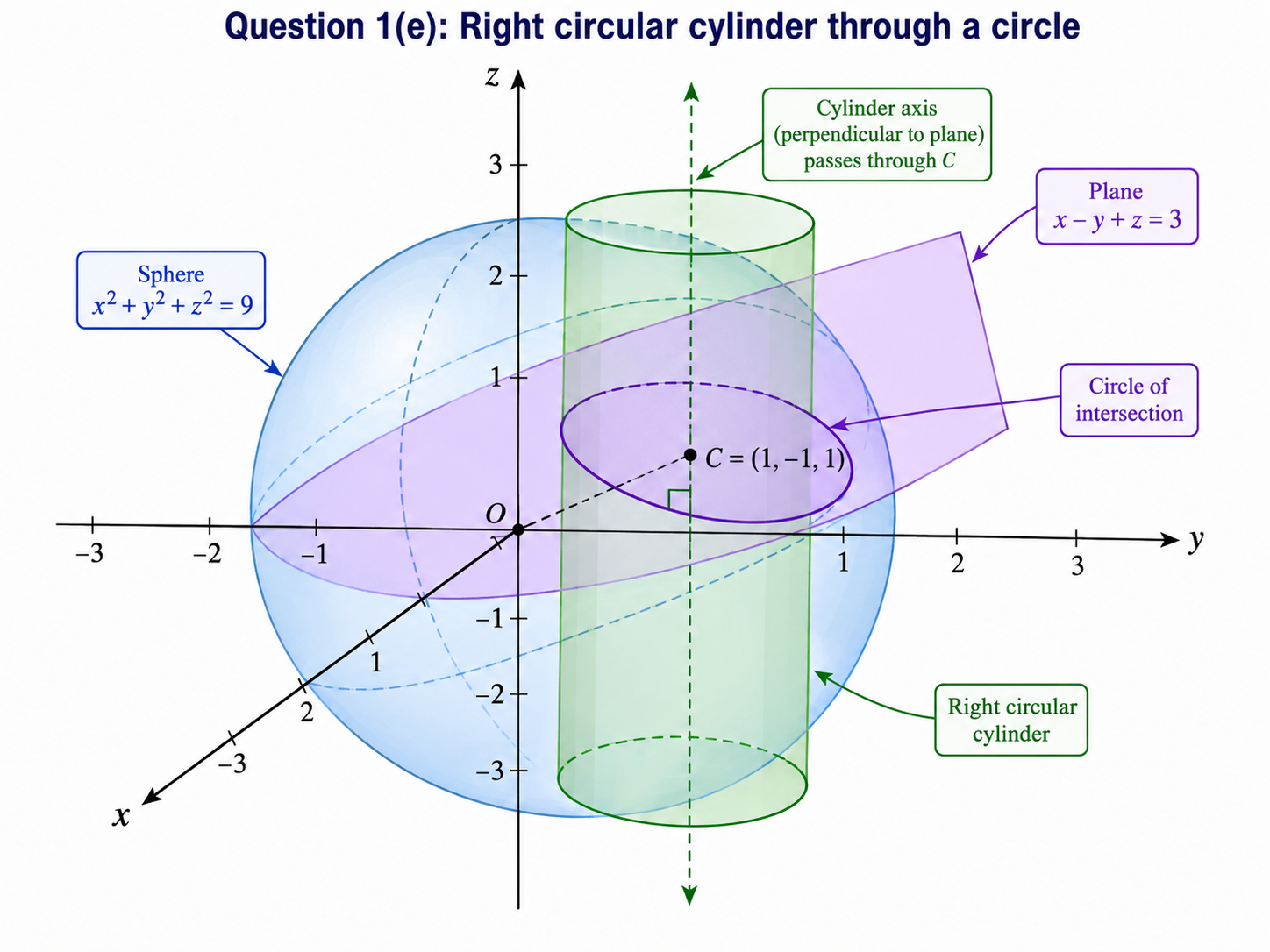
Find the equation of the right circular cylinder which passes through the circle \(x^2+y^2+z^2=9,\ x-y+z=3\).
2Diagram
Question 1(e): Right circular cylinder through a circle
3Concept Related to the Question
The circle is obtained by cutting a sphere by a plane. A right circular cylinder through this circle has its axis perpendicular to the plane and passing through the centre of the circle.
4Detailed Solution
The sphere has centre \(O=(0,0,0)\) and radius \(3\). The plane is
\[x-y+z=3.\]
The normal direction is \((1,-1,1)\). The foot of the perpendicular from the origin to the plane is
\[C=\frac{3}{1^2+(-1)^2+1^2}(1,-1,1)=(1,-1,1).\]
The distance of the plane from the origin is
\[\frac{3}{\sqrt3}=\sqrt3.\]
So the radius of the circle is
\[\sqrt{9-3}=\sqrt6.\]
The axis of the cylinder is the line through \(C=(1,-1,1)\) in the direction \((1,-1,1)\). Hence a point \((x,y,z)\) on the cylinder has distance \(\sqrt6\) from this axis:
The required cylinder is \((x-1)^2+(y+1)^2+(z-1)^2-\frac{(x-y+z-3)^2}{3}=6\).
Question 2(a)
Invertible linear operator
1Question
Consider a linear operator \(T\) on \(\mathbb R^3\) over \(\mathbb R\) defined by \(T(x,y,z)=(2x,4x-y,2x+3y-z)\). Is \(T\) invertible? If yes, justify your answer and find \(T^{-1}\).
2Diagram
Full Solution Access
The Diagram section for this question is available in the full 2024 UPSC Maths Optional Paper I PYQ Solutions course.
Complete diagrams, concepts, detailed solutions and final answers for all questions are available in the full PYQ course.
If \(u=\dfrac{x+y}{1-xy}\) and \(v=\tan^{-1}x+\tan^{-1}y\), then find \(\dfrac{\partial(u,v)}{\partial(x,y)}\). Are \(u\) and \(v\) functionally related? If yes, find the relationship.
2Diagram
Full Solution Access
The Diagram section for this question is available in the full 2024 UPSC Maths Optional Paper I PYQ Solutions course.
Complete diagrams, concepts, detailed solutions and final answers for all questions are available in the full PYQ course.
Let \(V=M_{2\times2}(\mathbb R)\) denote vector space over the field of real numbers. Find the matrix of the linear mapping \(\phi:V\to V\) given by \(\phi(v)={\large \left[\begin{smallmatrix}1&2\\3&-1\end{smallmatrix}\right]}v\) with respect to standard basis of \(M_{2\times2}(\mathbb R)\), and hence find the rank of \(\phi\). Is \(\phi\) invertible? Justify your answer.
2Diagram
Full Solution Access
The Diagram section for this question is available in the full 2024 UPSC Maths Optional Paper I PYQ Solutions course.
Complete diagrams, concepts, detailed solutions and final answers for all questions are available in the full PYQ course.
Let \(A={\large \left[\begin{smallmatrix}3&2&4\\2&0&2\\4&2&3\end{smallmatrix}\right]}\) be a \(3\times3\) matrix. Find the eigenvalues and the corresponding eigenvectors of \(A\). Hence find the eigenvalues and the corresponding eigenvectors of \(A^{-15}\), where \(A^{-15}=(A^{-1})^{15}\).
2Diagram
Full Solution Access
The Diagram section for this question is available in the full 2024 UPSC Maths Optional Paper I PYQ Solutions course.
Complete diagrams, concepts, detailed solutions and final answers for all questions are available in the full PYQ course.
Find the equation of the sphere which touches the plane \(3x+2y-z+2=0\) at the point \((1,-2,1)\) and cuts orthogonally the sphere \(x^2+y^2+z^2-4x+6y+4=0\).
2Diagram
Full Solution Access
The Diagram section for this question is available in the full 2024 UPSC Maths Optional Paper I PYQ Solutions course.
Complete diagrams, concepts, detailed solutions and final answers for all questions are available in the full PYQ course.
At any time \(t\) (in seconds), the coterminous edges of a variable parallelepiped are represented by the vectors \(\vec\alpha=t\hat i+(t+1)\hat j+(2t+1)\hat k\), \(\vec\beta=2t\hat i+(3t-1)\hat j+t\hat k\), and \(\vec\gamma=\hat i+3t\hat j+\hat k\). What is the rate of change of the vectorial area of the parallelogram whose coterminous edges are \(\vec\alpha\) and \(\vec\gamma\)? Also find the rate of change of the volume of the parallelepiped at \(t=1\) second.
2Diagram
Full Solution Access
The Diagram section for this question is available in the full 2024 UPSC Maths Optional Paper I PYQ Solutions course.
Complete diagrams, concepts, detailed solutions and final answers for all questions are available in the full PYQ course.
A solid hemisphere rests in equilibrium on a solid sphere of equal radius. Determine the stability of the equilibrium in the two situations—(i) when the curved surface and (ii) when the flat surface of the hemisphere rests on the sphere.
2Diagram
Full Solution Access
The Diagram section for this question is available in the full 2024 UPSC Maths Optional Paper I PYQ Solutions course.
Complete diagrams, concepts, detailed solutions and final answers for all questions are available in the full PYQ course.
Let \(C\) be a plane curve \(\vec r(t)=f(t)\hat i+g(t)\hat j\), where \(f\) and \(g\) have second-order derivatives. Show that the curvature at a point is given by \(\kappa=\dfrac{\lvert f'(t)g''(t)-g'(t)f''(t)\rvert}{\{[f'(t)]^2+[g'(t)]^2\}^{3/2}}\). What is the value of torsion \(\tau\) at any point of this curve?
2Diagram
Full Solution Access
The Diagram section for this question is available in the full 2024 UPSC Maths Optional Paper I PYQ Solutions course.
Complete diagrams, concepts, detailed solutions and final answers for all questions are available in the full PYQ course.
A regular tetrahedron, formed of six light rods each of length \(l\), rests on a smooth horizontal plane. A ring of weight \(W\) and radius \(r\) is supported by the slant sides. Using the principle of virtual work, find the stress in any of the horizontal sides.
2Diagram
Full Solution Access
The Diagram section for this question is available in the full 2024 UPSC Maths Optional Paper I PYQ Solutions course.
Complete diagrams, concepts, detailed solutions and final answers for all questions are available in the full PYQ course.
A particle executes simple harmonic motion such that in two of its positions, velocities are \(u\) and \(v\), and the two corresponding accelerations are \(f_1\) and \(f_2\). For what value(s) of \(k\), the distance between the two positions is \(k(v^2-u^2)\)? Show also that the amplitude of the motion is \(\dfrac{1}{f_2-f_1}\left[(u^2-v^2)(u^2f_2-v^2f_1)\right]^{1/2}\).
2Diagram
Full Solution Access
The Diagram section for this question is available in the full 2024 UPSC Maths Optional Paper I PYQ Solutions course.
Complete diagrams, concepts, detailed solutions and final answers for all questions are available in the full PYQ course.
State uniqueness theorem for the existence of unique solution of the initial value problem \(\dfrac{dy}{dx}=f(x,y),\ y(x_0)=y_0\) in the rectangular region \(R:\lvert x-x_0\rvert
2Diagram
Full Solution Access
The Diagram section for this question is available in the full 2024 UPSC Maths Optional Paper I PYQ Solutions course.
Complete diagrams, concepts, detailed solutions and final answers for all questions are available in the full PYQ course.
A heavy particle hanging vertically from a fixed point by a light inextensible string of length \(l\) starts to move with initial velocity \(u\) in a circle so as to make a complete revolution in a vertical plane. Show that the sum of tensions at the ends of any diameter is constant.
2Diagram
Full Solution Access
The Diagram section for this question is available in the full 2024 UPSC Maths Optional Paper I PYQ Solutions course.
Complete diagrams, concepts, detailed solutions and final answers for all questions are available in the full PYQ course.
State Stokes’ theorem and verify it for the vector field \(\vec F=xy\hat i+yz\hat j+zx\hat k\) over the surface \(S\), which is the upwardly oriented part of the cylinder \(z=1-x^2\), for \(0
2Diagram
Full Solution Access
The Diagram section for this question is available in the full 2024 UPSC Maths Optional Paper I PYQ Solutions course.
Complete diagrams, concepts, detailed solutions and final answers for all questions are available in the full PYQ course.
Using Laplace transform, solve the initial value problem \(y''+2y'+5y=\delta(t-2)\), \(y(0)=0\), \(y'(0)=0\), where \(\delta(t-2)\) denotes the Dirac delta function.
2Diagram
Full Solution Access
The Diagram section for this question is available in the full 2024 UPSC Maths Optional Paper I PYQ Solutions course.
Complete diagrams, concepts, detailed solutions and final answers for all questions are available in the full PYQ course.
Using Gauss divergence theorem, evaluate the integral \(\displaystyle \iint_S\left(y^2\hat i+xz^3\hat j+(z-1)^2\hat k\right)\cdot\hat n\,dS\) over the region bounded by the cylinder \(x^2+y^2=16\) and the planes \(z=1\) and \(z=5\).
2Diagram
Full Solution Access
The Diagram section for this question is available in the full 2024 UPSC Maths Optional Paper I PYQ Solutions course.
Complete diagrams, concepts, detailed solutions and final answers for all questions are available in the full PYQ course.
A particle moves with a central acceleration \(\mu\left(\frac3{r^3}+\frac{d^2}{r^5}\right)\), being projected from a distance \(d\) at an angle \(45^\circ\) with velocity equal to that in a circle at the same distance. Prove that the time it takes to reach the centre of force is \(\dfrac{d^2}{\sqrt{2\mu}}\left(2-\dfrac\pi2\right)\).
2Diagram
Full Solution Access
The Diagram section for this question is available in the full 2024 UPSC Maths Optional Paper I PYQ Solutions course.
Complete diagrams, concepts, detailed solutions and final answers for all questions are available in the full PYQ course.
Are these 2024 UPSC Maths Optional Paper I Solutions complete?
This public page gives one full sample solution for 2024 UPSC Maths Optional Paper I Solutions. Complete question-wise solutions for the full paper are available in the full PYQ course by Ramana Sri IAS.
Which question is given as a free sample solution on this page?
Question 1(e) is given as the free sample solution on this page. The sample includes all five sections: Question, Diagram, Concept Related to the Question, Detailed Solution, and Final Answer.
How should I use these 2024 UPSC Maths Optional Paper I Solutions for preparation?
Students should first solve the questions independently, then compare their approach with the solution method. These solutions are useful for revision, answer-writing practice, diagram presentation, and concept clarity before the UPSC Mains examination.
Do these solutions include diagrams and detailed explanations?
Yes. The full PYQ course follows a structured format wherever required: Question, Diagram, Concept Related to the Question, Detailed Solution, and Final Answer. This public page shows the format through one free sample solution.
How can I get complete solutions for all questions in 2024 UPSC Maths Optional Paper I Solutions?
To access complete solutions for all questions, please fill out the admission form first. Our Ramana Sri IAS admission team will guide you through WhatsApp, email, or call.
Prepare UPSC Maths Optional with Ramana Sri IAS
Learn concepts, diagrams, previous year questions, answer-writing, and test-series strategy in a clean step-by-step format.