
Ramana Sri IAS

Ramana Sri IAS - 2024 UPSC Maths Optional Paper II Solutions

2024 UPSC Maths Optional Paper II Solutions

Ramana Sri IAS provides complete and updated solutions for the 2024 UPSC Maths Optional Paper II. Aspirants preparing for the UPSC Mains Examination with Mathematics as their optional subject should solve all these questions carefully at least 5 to 10 times before the mains examination.

Ramana Sri IAS presents complete solutions for UPSC/IAS/CSE-Civil Service Examination 2024 Mathematics Optional Paper II. Each answer follows the same format: Question, Diagram where needed, Concept Related to the Question, Detailed Solution, and Final Answer.

About 2024 UPSC Maths Optional Paper II Solutions

These 2024 UPSC Maths Optional Paper II Solutions are prepared by Ramana Sri IAS for aspirants who want question-wise clarity before the UPSC Mains examination. This public page gives one full sample solution, while the complete paper-wise solutions are available in the full PYQ course.

Students can use these 2024 UPSC Maths Optional Paper II Solutions to understand the expected answer-writing method, diagram presentation, concept application, and final-answer format used by Ramana Sri IAS.

For the official examination source, students may also refer to the UPSC previous question papers page.

These 2024 UPSC Maths Optional Paper II Solutions are useful for revision, answer-writing practice, and understanding the step-by-step method expected in the UPSC Mathematics optional paper.

 Sample Full Solution

We are giving one question as a free sample solution below: Question 1(e). This free sample includes all five sections: Question, Diagram, Concept Related to the Question, Detailed Solution, and Final Answer. Complete solutions for all questions are available in the full PYQ course. To purchase the full solutions, please fill out the admission form first. Our Ramana Sri IAS admission team will guide you through WhatsApp, email, or call.

2024 UPSC Maths Optional Paper II Solutions: Table of Contents

Question 1(a)

Subgroups of prime order

1Question

Let \(G\) be a finite group of order \(mn\), where \(m\) and \(n\) are prime numbers with \(m>n\). Show that \(G\) has at most one subgroup of order \(m\).

2Diagram

Full Solution Access

The Diagram section for this question is available in the full 2024 UPSC Maths Optional Paper II PYQ Solutions course.

Complete diagrams, concepts, detailed solutions and final answers for all questions are available in the full PYQ course.

3Concept Related to the Question

Full Solution Access

The Concept Related to the Question section for this question is available in the full 2024 UPSC Maths Optional Paper II PYQ Solutions course.

Complete diagrams, concepts, detailed solutions and final answers for all questions are available in the full PYQ course.

4Detailed Solution

Full Solution Access

The Detailed Solution section for this question is available in the full 2024 UPSC Maths Optional Paper II PYQ Solutions course.

Complete diagrams, concepts, detailed solutions and final answers for all questions are available in the full PYQ course.

5Final Answer

Full Solution Access

The Final Answer section for this question is available in the full 2024 UPSC Maths Optional Paper II PYQ Solutions course.

Complete diagrams, concepts, detailed solutions and final answers for all questions are available in the full PYQ course.

Question 1(b)

Harmonic logarithm

1Question

If \(w=f(z)\) is an analytic function of \(z\), then show that \(\left(\frac{\partial^2}{\partial x^2}+\frac{\partial^2}{\partial y^2}\right)\log\lvert f'(z)\rvert=0\).

2Diagram

Full Solution Access

The Diagram section for this question is available in the full 2024 UPSC Maths Optional Paper II PYQ Solutions course.

Complete diagrams, concepts, detailed solutions and final answers for all questions are available in the full PYQ course.

3Concept Related to the Question

Full Solution Access

The Concept Related to the Question section for this question is available in the full 2024 UPSC Maths Optional Paper II PYQ Solutions course.

Complete diagrams, concepts, detailed solutions and final answers for all questions are available in the full PYQ course.

4Detailed Solution

Full Solution Access

The Detailed Solution section for this question is available in the full 2024 UPSC Maths Optional Paper II PYQ Solutions course.

Complete diagrams, concepts, detailed solutions and final answers for all questions are available in the full PYQ course.

5Final Answer

Full Solution Access

The Final Answer section for this question is available in the full 2024 UPSC Maths Optional Paper II PYQ Solutions course.

Complete diagrams, concepts, detailed solutions and final answers for all questions are available in the full PYQ course.

Question 1(c)

Improper integral

1Question

Test the convergence of \(\displaystyle \int_0^2\frac{\log x}{\sqrt{2-x}}\,dx\).

2Diagram

Full Solution Access

The Diagram section for this question is available in the full 2024 UPSC Maths Optional Paper II PYQ Solutions course.

Complete diagrams, concepts, detailed solutions and final answers for all questions are available in the full PYQ course.

3Concept Related to the Question

Full Solution Access

The Concept Related to the Question section for this question is available in the full 2024 UPSC Maths Optional Paper II PYQ Solutions course.

Complete diagrams, concepts, detailed solutions and final answers for all questions are available in the full PYQ course.

4Detailed Solution

Full Solution Access

The Detailed Solution section for this question is available in the full 2024 UPSC Maths Optional Paper II PYQ Solutions course.

Complete diagrams, concepts, detailed solutions and final answers for all questions are available in the full PYQ course.

5Final Answer

Full Solution Access

The Final Answer section for this question is available in the full 2024 UPSC Maths Optional Paper II PYQ Solutions course.

Complete diagrams, concepts, detailed solutions and final answers for all questions are available in the full PYQ course.

Question 1(d)

Cauchy-Riemann equations

1Question

If \(\phi\) and \(\psi\) are functions of \(x\) and \(y\) satisfying Laplace equation, then show that \(f(z)=p+iq\), \(i=\sqrt{-1}\), is an analytic function, where \(p=\frac{\partial\phi}{\partial y}-\frac{\partial\psi}{\partial x}\) and \(q=\frac{\partial\phi}{\partial x}+\frac{\partial\psi}{\partial y}\).

2Diagram

Full Solution Access

The Diagram section for this question is available in the full 2024 UPSC Maths Optional Paper II PYQ Solutions course.

Complete diagrams, concepts, detailed solutions and final answers for all questions are available in the full PYQ course.

3Concept Related to the Question

Full Solution Access

The Concept Related to the Question section for this question is available in the full 2024 UPSC Maths Optional Paper II PYQ Solutions course.

Complete diagrams, concepts, detailed solutions and final answers for all questions are available in the full PYQ course.

4Detailed Solution

Full Solution Access

The Detailed Solution section for this question is available in the full 2024 UPSC Maths Optional Paper II PYQ Solutions course.

Complete diagrams, concepts, detailed solutions and final answers for all questions are available in the full PYQ course.

5Final Answer

Full Solution Access

The Final Answer section for this question is available in the full 2024 UPSC Maths Optional Paper II PYQ Solutions course.

Complete diagrams, concepts, detailed solutions and final answers for all questions are available in the full PYQ course.

Question 1(e)

Two phase LPP

1Question

Use two phase method to solve the following linear programming problem:

Maximize \(z=x_1+2x_2\)

subject to \(x_1-x_2\geq3\)

\(2x_1+x_2\leq10\)

\(x_1,x_2\geq0\).

2Diagram

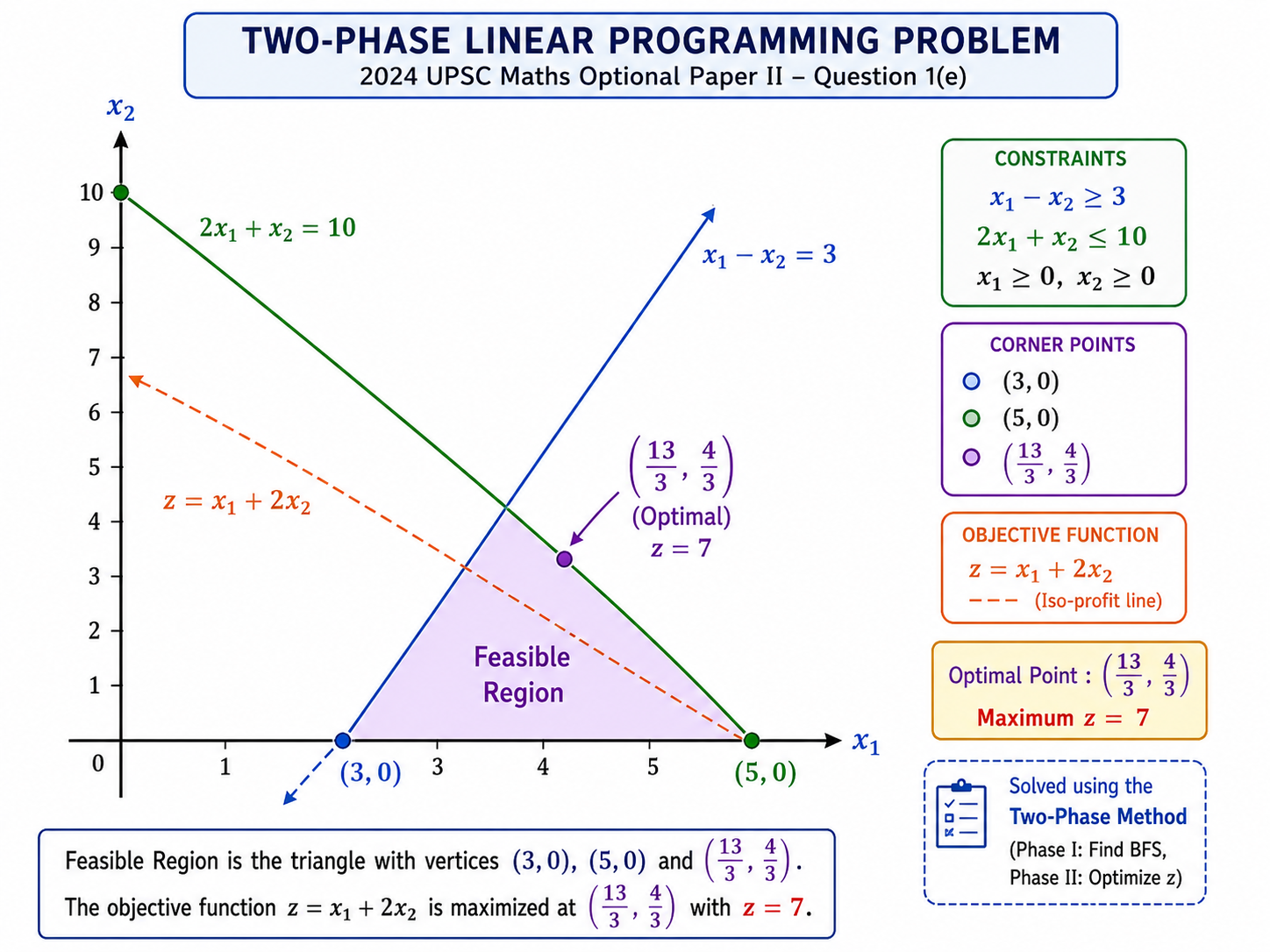
Question 1(e): Two-phase linear programming problem
2024 UPSC Maths Optional Paper II Solutions diagram showing the feasible region, constraints, objective function line, and optimal point for the two-phase linear programming problem.

3Concept Related to the Question

The first constraint is of type \(\geq\), so the two phase method first introduces a surplus variable and an artificial variable to get an initial basic feasible solution. After feasibility is obtained in Phase I, the original objective function is optimized in Phase II.

4Detailed Solution

The constraints are \(x_1-x_2\geq3\), \(2x_1+x_2\leq10\), and \(x_1,x_2\geq0\). In two phase form, the first constraint is written by subtracting a surplus variable and adding an artificial variable. Thus

\[x_1-x_2-s_1+a_1=3,\qquad 2x_1+x_2+s_2=10.\]

Phase I minimizes the artificial variable contribution. Since the system is feasible, Phase I ends with \(a_1=0\), and then Phase II optimizes the original objective \(z=x_1+2x_2\).

The feasible corner points are obtained from the boundary lines. From \(x_1-x_2=3\), we get \(x_2=x_1-3\). From \(2x_1+x_2=10\), we get \(x_2=10-2x_1\).

The intersection of these two boundary lines is found from \(x_1-3=10-2x_1\). Hence \(3x_1=13\), so \(x_1=\frac{13}{3}\) and \(x_2=\frac{4}{3}\).

The relevant corner points are \((3,0)\), \((5,0)\), and \(\left(\frac{13}{3},\frac{4}{3}\right)\). The objective values are

\[z(3,0)=3,\qquad z(5,0)=5,\qquad z\left(\frac{13}{3},\frac{4}{3}\right)=\frac{13}{3}+2\cdot\frac{4}{3}=7.\]

The largest value is therefore \(7\).

5Final Answer

The maximum value is \(z=7\), attained at \(x_1=\frac{13}{3}\), \(x_2=\frac{4}{3}\).

Question 2(a)

Cauchy convergence

1Question

Using Cauchy’s general principle of convergence, examine convergence of the sequence \(\langle f_n\rangle\), where \(f_n=1+\frac1{1!}+\frac1{2!}+\cdots+\frac1{n!}\).

2Diagram

Full Solution Access

The Diagram section for this question is available in the full 2024 UPSC Maths Optional Paper II PYQ Solutions course.

Complete diagrams, concepts, detailed solutions and final answers for all questions are available in the full PYQ course.

3Concept Related to the Question

Full Solution Access

The Concept Related to the Question section for this question is available in the full 2024 UPSC Maths Optional Paper II PYQ Solutions course.

Complete diagrams, concepts, detailed solutions and final answers for all questions are available in the full PYQ course.

4Detailed Solution

Full Solution Access

The Detailed Solution section for this question is available in the full 2024 UPSC Maths Optional Paper II PYQ Solutions course.

Complete diagrams, concepts, detailed solutions and final answers for all questions are available in the full PYQ course.

5Final Answer

Full Solution Access

The Final Answer section for this question is available in the full 2024 UPSC Maths Optional Paper II PYQ Solutions course.

Complete diagrams, concepts, detailed solutions and final answers for all questions are available in the full PYQ course.

Question 2(b)

Homomorphic images

1Question

Show that every homomorphic image of an abelian group is abelian, but converse is not necessarily true.

2Diagram

Full Solution Access

The Diagram section for this question is available in the full 2024 UPSC Maths Optional Paper II PYQ Solutions course.

Complete diagrams, concepts, detailed solutions and final answers for all questions are available in the full PYQ course.

3Concept Related to the Question

Full Solution Access

The Concept Related to the Question section for this question is available in the full 2024 UPSC Maths Optional Paper II PYQ Solutions course.

Complete diagrams, concepts, detailed solutions and final answers for all questions are available in the full PYQ course.

4Detailed Solution

Full Solution Access

The Detailed Solution section for this question is available in the full 2024 UPSC Maths Optional Paper II PYQ Solutions course.

Complete diagrams, concepts, detailed solutions and final answers for all questions are available in the full PYQ course.

5Final Answer

Full Solution Access

The Final Answer section for this question is available in the full 2024 UPSC Maths Optional Paper II PYQ Solutions course.

Complete diagrams, concepts, detailed solutions and final answers for all questions are available in the full PYQ course.

Question 2(c)

Analytic function from boundary values

1Question

Find the function which is analytic inside and on the circle \(C:z=e^{i\theta}\), \(0\leq\theta\leq2\pi\), and has the value \(\frac{(a^2-1)\cos\theta+i(a^2+1)\sin\theta}{a^4-2a^2\cos2\theta+1}\) on the circumference of \(C\), where \(a^2>1\).

2Diagram

Full Solution Access

The Diagram section for this question is available in the full 2024 UPSC Maths Optional Paper II PYQ Solutions course.

Complete diagrams, concepts, detailed solutions and final answers for all questions are available in the full PYQ course.

3Concept Related to the Question

Full Solution Access

The Concept Related to the Question section for this question is available in the full 2024 UPSC Maths Optional Paper II PYQ Solutions course.

Complete diagrams, concepts, detailed solutions and final answers for all questions are available in the full PYQ course.

4Detailed Solution

Full Solution Access

The Detailed Solution section for this question is available in the full 2024 UPSC Maths Optional Paper II PYQ Solutions course.

Complete diagrams, concepts, detailed solutions and final answers for all questions are available in the full PYQ course.

5Final Answer

Full Solution Access

The Final Answer section for this question is available in the full 2024 UPSC Maths Optional Paper II PYQ Solutions course.

Complete diagrams, concepts, detailed solutions and final answers for all questions are available in the full PYQ course.

Question 3(a)

Poles and residues

1Question

Locate the poles and their order for the function \(f(z)=\frac1{z(\sin\pi z)\left(z+\frac12\right)}\). Also, find the residue of \(f(z)\) at these poles.

2Diagram

Full Solution Access

The Diagram section for this question is available in the full 2024 UPSC Maths Optional Paper II PYQ Solutions course.

Complete diagrams, concepts, detailed solutions and final answers for all questions are available in the full PYQ course.

3Concept Related to the Question

Full Solution Access

The Concept Related to the Question section for this question is available in the full 2024 UPSC Maths Optional Paper II PYQ Solutions course.

Complete diagrams, concepts, detailed solutions and final answers for all questions are available in the full PYQ course.

4Detailed Solution

Full Solution Access

The Detailed Solution section for this question is available in the full 2024 UPSC Maths Optional Paper II PYQ Solutions course.

Complete diagrams, concepts, detailed solutions and final answers for all questions are available in the full PYQ course.

5Final Answer

Full Solution Access

The Final Answer section for this question is available in the full 2024 UPSC Maths Optional Paper II PYQ Solutions course.

Complete diagrams, concepts, detailed solutions and final answers for all questions are available in the full PYQ course.

Question 3(b)

Term-by-term differentiation

1Question

Consider the series \(\sum_{n=1}^{\infty}U_n(x)\), \(0\leq x\leq1\), the sum of whose first \(n\) terms is given by \(S_n(x)=\frac1{2n^2}\log(1+n^4x^2)\), \(x\in[0,1]\). Show that the given series can be differentiated term-by-term, though \(\sum_{n=1}^{\infty}U'_n(x)\) does not converge uniformly on \([0,1]\).

2Diagram

Full Solution Access

The Diagram section for this question is available in the full 2024 UPSC Maths Optional Paper II PYQ Solutions course.

Complete diagrams, concepts, detailed solutions and final answers for all questions are available in the full PYQ course.

3Concept Related to the Question

Full Solution Access

The Concept Related to the Question section for this question is available in the full 2024 UPSC Maths Optional Paper II PYQ Solutions course.

Complete diagrams, concepts, detailed solutions and final answers for all questions are available in the full PYQ course.

4Detailed Solution

Full Solution Access

The Detailed Solution section for this question is available in the full 2024 UPSC Maths Optional Paper II PYQ Solutions course.

Complete diagrams, concepts, detailed solutions and final answers for all questions are available in the full PYQ course.

5Final Answer

Full Solution Access

The Final Answer section for this question is available in the full 2024 UPSC Maths Optional Paper II PYQ Solutions course.

Complete diagrams, concepts, detailed solutions and final answers for all questions are available in the full PYQ course.

Question 3(c)

Duality principle

1Question

Using duality principle, solve the following linear programming problem:

Minimize \(z=4x_1+3x_2+x_3\)

subject to \(x_1+2x_2+4x_3\geq12\)

\(3x_1+2x_2+x_3\geq8\)

\(x_1,x_2,x_3\geq0\).

2Diagram

Full Solution Access

The Diagram section for this question is available in the full 2024 UPSC Maths Optional Paper II PYQ Solutions course.

Complete diagrams, concepts, detailed solutions and final answers for all questions are available in the full PYQ course.

3Concept Related to the Question

Full Solution Access

The Concept Related to the Question section for this question is available in the full 2024 UPSC Maths Optional Paper II PYQ Solutions course.

Complete diagrams, concepts, detailed solutions and final answers for all questions are available in the full PYQ course.

4Detailed Solution

Full Solution Access

The Detailed Solution section for this question is available in the full 2024 UPSC Maths Optional Paper II PYQ Solutions course.

Complete diagrams, concepts, detailed solutions and final answers for all questions are available in the full PYQ course.

5Final Answer

Full Solution Access

The Final Answer section for this question is available in the full 2024 UPSC Maths Optional Paper II PYQ Solutions course.

Complete diagrams, concepts, detailed solutions and final answers for all questions are available in the full PYQ course.

Question 4(a)

Prime ideal

1Question

Consider the polynomial ring \(Z[x]\) over the ring \(Z\) of integers. Let \(S\) be an ideal of \(Z[x]\) generated by \(x\). Show that \(S\) is prime but not a maximal ideal of \(Z[x]\).

2Diagram

Full Solution Access

The Diagram section for this question is available in the full 2024 UPSC Maths Optional Paper II PYQ Solutions course.

Complete diagrams, concepts, detailed solutions and final answers for all questions are available in the full PYQ course.

3Concept Related to the Question

Full Solution Access

The Concept Related to the Question section for this question is available in the full 2024 UPSC Maths Optional Paper II PYQ Solutions course.

Complete diagrams, concepts, detailed solutions and final answers for all questions are available in the full PYQ course.

4Detailed Solution

Full Solution Access

The Detailed Solution section for this question is available in the full 2024 UPSC Maths Optional Paper II PYQ Solutions course.

Complete diagrams, concepts, detailed solutions and final answers for all questions are available in the full PYQ course.

5Final Answer

Full Solution Access

The Final Answer section for this question is available in the full 2024 UPSC Maths Optional Paper II PYQ Solutions course.

Complete diagrams, concepts, detailed solutions and final answers for all questions are available in the full PYQ course.

Question 4(b)

Riemann integrability

1Question

Find the upper and lower Riemann integrals for the function \(f\) defined on \([0,1]\) as follows: \(f(x)=(1-x^2)^{1/2}\), if \(x\) is rational, and \(f(x)=1-x\), if \(x\) is irrational. Hence, show that \(f\) is not Riemann integrable on \([0,1]\).

2Diagram

Full Solution Access

The Diagram section for this question is available in the full 2024 UPSC Maths Optional Paper II PYQ Solutions course.

Complete diagrams, concepts, detailed solutions and final answers for all questions are available in the full PYQ course.

3Concept Related to the Question

Full Solution Access

The Concept Related to the Question section for this question is available in the full 2024 UPSC Maths Optional Paper II PYQ Solutions course.

Complete diagrams, concepts, detailed solutions and final answers for all questions are available in the full PYQ course.

4Detailed Solution

Full Solution Access

The Detailed Solution section for this question is available in the full 2024 UPSC Maths Optional Paper II PYQ Solutions course.

Complete diagrams, concepts, detailed solutions and final answers for all questions are available in the full PYQ course.

5Final Answer

Full Solution Access

The Final Answer section for this question is available in the full 2024 UPSC Maths Optional Paper II PYQ Solutions course.

Complete diagrams, concepts, detailed solutions and final answers for all questions are available in the full PYQ course.

Question 4(c)

Assignment problem

1Question

The personnel manager of a company wants to assign officers \(A\), \(B\) and \(C\) to the regional offices at Delhi, Mumbai, Kolkata and Chennai. The cost of relocation, in thousand Rupees, of the three officers at the four regional offices are given below:

OfficerDelhiMumbaiKolkataChennai
A16222420
B10322616
C10204630

Find the assignment which minimizes the total cost of relocation and also determine the minimum cost.

2Diagram

Full Solution Access

The Diagram section for this question is available in the full 2024 UPSC Maths Optional Paper II PYQ Solutions course.

Complete diagrams, concepts, detailed solutions and final answers for all questions are available in the full PYQ course.

3Concept Related to the Question

Full Solution Access

The Concept Related to the Question section for this question is available in the full 2024 UPSC Maths Optional Paper II PYQ Solutions course.

Complete diagrams, concepts, detailed solutions and final answers for all questions are available in the full PYQ course.

4Detailed Solution

Full Solution Access

The Detailed Solution section for this question is available in the full 2024 UPSC Maths Optional Paper II PYQ Solutions course.

Complete diagrams, concepts, detailed solutions and final answers for all questions are available in the full PYQ course.

5Final Answer

Full Solution Access

The Final Answer section for this question is available in the full 2024 UPSC Maths Optional Paper II PYQ Solutions course.

Complete diagrams, concepts, detailed solutions and final answers for all questions are available in the full PYQ course.

Question 5(a)

Wave equation verification

1Question

Show that \(f\) and \(g\) are arbitrary functions of their respective arguments, then \(u=f(x-kt+i\alpha y)+g(x-kt-i\alpha y)\) is a solution of \(\frac{\partial^2u}{\partial x^2}+\frac{\partial^2u}{\partial y^2}=\frac1{c^2}\frac{\partial^2u}{\partial t^2}\), where \(\alpha^2=1-\frac{k^2}{c^2}\).

2Diagram

Full Solution Access

The Diagram section for this question is available in the full 2024 UPSC Maths Optional Paper II PYQ Solutions course.

Complete diagrams, concepts, detailed solutions and final answers for all questions are available in the full PYQ course.

3Concept Related to the Question

Full Solution Access

The Concept Related to the Question section for this question is available in the full 2024 UPSC Maths Optional Paper II PYQ Solutions course.

Complete diagrams, concepts, detailed solutions and final answers for all questions are available in the full PYQ course.

4Detailed Solution

Full Solution Access

The Detailed Solution section for this question is available in the full 2024 UPSC Maths Optional Paper II PYQ Solutions course.

Complete diagrams, concepts, detailed solutions and final answers for all questions are available in the full PYQ course.

5Final Answer

Full Solution Access

The Final Answer section for this question is available in the full 2024 UPSC Maths Optional Paper II PYQ Solutions course.

Complete diagrams, concepts, detailed solutions and final answers for all questions are available in the full PYQ course.

Question 5(b)

Gauss-Jordan method

1Question

Solve the following system of linear equations by Gauss-Jordan method:

\(2x+3y-z=5\)

\(4x+4y-3z=3\)

\(2x-3y+2z=2\)

2Diagram

Full Solution Access

The Diagram section for this question is available in the full 2024 UPSC Maths Optional Paper II PYQ Solutions course.

Complete diagrams, concepts, detailed solutions and final answers for all questions are available in the full PYQ course.

3Concept Related to the Question

Full Solution Access

The Concept Related to the Question section for this question is available in the full 2024 UPSC Maths Optional Paper II PYQ Solutions course.

Complete diagrams, concepts, detailed solutions and final answers for all questions are available in the full PYQ course.

4Detailed Solution

Full Solution Access

The Detailed Solution section for this question is available in the full 2024 UPSC Maths Optional Paper II PYQ Solutions course.

Complete diagrams, concepts, detailed solutions and final answers for all questions are available in the full PYQ course.

5Final Answer

Full Solution Access

The Final Answer section for this question is available in the full 2024 UPSC Maths Optional Paper II PYQ Solutions course.

Complete diagrams, concepts, detailed solutions and final answers for all questions are available in the full PYQ course.

Question 5(c)(i)

Sign magnitude form

1Question

Determine the decimal equivalent in sign magnitude form of \((8D)_{16}\) and \((FF)_{16}\).

2Diagram

Full Solution Access

The Diagram section for this question is available in the full 2024 UPSC Maths Optional Paper II PYQ Solutions course.

Complete diagrams, concepts, detailed solutions and final answers for all questions are available in the full PYQ course.

3Concept Related to the Question

Full Solution Access

The Concept Related to the Question section for this question is available in the full 2024 UPSC Maths Optional Paper II PYQ Solutions course.

Complete diagrams, concepts, detailed solutions and final answers for all questions are available in the full PYQ course.

4Detailed Solution

Full Solution Access

The Detailed Solution section for this question is available in the full 2024 UPSC Maths Optional Paper II PYQ Solutions course.

Complete diagrams, concepts, detailed solutions and final answers for all questions are available in the full PYQ course.

5Final Answer

Full Solution Access

The Final Answer section for this question is available in the full 2024 UPSC Maths Optional Paper II PYQ Solutions course.

Complete diagrams, concepts, detailed solutions and final answers for all questions are available in the full PYQ course.

Question 5(c)(ii)

Hexadecimal conversion

1Question

Determine the decimal equivalent of \((9B2.1A)_{16}\).

2Diagram

Full Solution Access

The Diagram section for this question is available in the full 2024 UPSC Maths Optional Paper II PYQ Solutions course.

Complete diagrams, concepts, detailed solutions and final answers for all questions are available in the full PYQ course.

3Concept Related to the Question

Full Solution Access

The Concept Related to the Question section for this question is available in the full 2024 UPSC Maths Optional Paper II PYQ Solutions course.

Complete diagrams, concepts, detailed solutions and final answers for all questions are available in the full PYQ course.

4Detailed Solution

Full Solution Access

The Detailed Solution section for this question is available in the full 2024 UPSC Maths Optional Paper II PYQ Solutions course.

Complete diagrams, concepts, detailed solutions and final answers for all questions are available in the full PYQ course.

5Final Answer

Full Solution Access

The Final Answer section for this question is available in the full 2024 UPSC Maths Optional Paper II PYQ Solutions course.

Complete diagrams, concepts, detailed solutions and final answers for all questions are available in the full PYQ course.

Question 5(d)

Centre of mass

1Question

A rough uniform board of mass \(m\) and length \(2a\) rests on a smooth horizontal plane and a man of mass \(M\) walks on it from one end to the other. Find the distance covered by the board during this time.

2Diagram

Full Solution Access

The Diagram section for this question is available in the full 2024 UPSC Maths Optional Paper II PYQ Solutions course.

Complete diagrams, concepts, detailed solutions and final answers for all questions are available in the full PYQ course.

3Concept Related to the Question

Full Solution Access

The Concept Related to the Question section for this question is available in the full 2024 UPSC Maths Optional Paper II PYQ Solutions course.

Complete diagrams, concepts, detailed solutions and final answers for all questions are available in the full PYQ course.

4Detailed Solution

Full Solution Access

The Detailed Solution section for this question is available in the full 2024 UPSC Maths Optional Paper II PYQ Solutions course.

Complete diagrams, concepts, detailed solutions and final answers for all questions are available in the full PYQ course.

5Final Answer

Full Solution Access

The Final Answer section for this question is available in the full 2024 UPSC Maths Optional Paper II PYQ Solutions course.

Complete diagrams, concepts, detailed solutions and final answers for all questions are available in the full PYQ course.

Question 5(e)

Streamlines

1Question

The velocity potential \(\phi\) of a flow is given by \(\phi=\frac12(x^2+y^2-2z^2)\). Determine the streamlines.

2Diagram

Full Solution Access

The Diagram section for this question is available in the full 2024 UPSC Maths Optional Paper II PYQ Solutions course.

Complete diagrams, concepts, detailed solutions and final answers for all questions are available in the full PYQ course.

3Concept Related to the Question

Full Solution Access

The Concept Related to the Question section for this question is available in the full 2024 UPSC Maths Optional Paper II PYQ Solutions course.

Complete diagrams, concepts, detailed solutions and final answers for all questions are available in the full PYQ course.

4Detailed Solution

Full Solution Access

The Detailed Solution section for this question is available in the full 2024 UPSC Maths Optional Paper II PYQ Solutions course.

Complete diagrams, concepts, detailed solutions and final answers for all questions are available in the full PYQ course.

5Final Answer

Full Solution Access

The Final Answer section for this question is available in the full 2024 UPSC Maths Optional Paper II PYQ Solutions course.

Complete diagrams, concepts, detailed solutions and final answers for all questions are available in the full PYQ course.

Question 6(a)

Poisson integral

1Question

Show that the solution of the two-dimensional Laplace’s equation \(\frac{\partial^2\phi(x,y)}{\partial x^2}+\frac{\partial^2\phi(x,y)}{\partial y^2}=0\), \(x\in(-\infty,\infty)\), \(y\geq0\), subject to the boundary condition \(\phi(x,0)=f(x)\), \(x\in(-\infty,\infty)\), along with \(\phi(x,y)\to0\) for \(\lvert x\rvert\to\infty\) and \(y\to\infty\), can be written in the form \(\phi(x,y)=\frac y\pi\int_{-\infty}^{\infty}\frac{f(\xi)\,d\xi}{y^2+(x-\xi)^2}\).

2Diagram

Full Solution Access

The Diagram section for this question is available in the full 2024 UPSC Maths Optional Paper II PYQ Solutions course.

Complete diagrams, concepts, detailed solutions and final answers for all questions are available in the full PYQ course.

3Concept Related to the Question

Full Solution Access

The Concept Related to the Question section for this question is available in the full 2024 UPSC Maths Optional Paper II PYQ Solutions course.

Complete diagrams, concepts, detailed solutions and final answers for all questions are available in the full PYQ course.

4Detailed Solution

Full Solution Access

The Detailed Solution section for this question is available in the full 2024 UPSC Maths Optional Paper II PYQ Solutions course.

Complete diagrams, concepts, detailed solutions and final answers for all questions are available in the full PYQ course.

5Final Answer

Full Solution Access

The Final Answer section for this question is available in the full 2024 UPSC Maths Optional Paper II PYQ Solutions course.

Complete diagrams, concepts, detailed solutions and final answers for all questions are available in the full PYQ course.

Question 6(b)

Boolean circuit

1Question

Draw the logical circuit for the Boolean expression \(Y=AB\bar C+B\bar C+\bar AB\). Also, obtain the output \(Y\) (truth table) for the three input bit sequences:

\(A=1000111\), \(B=0011100\), \(C=11000100\).

2Diagram

Full Solution Access

The Diagram section for this question is available in the full 2024 UPSC Maths Optional Paper II PYQ Solutions course.

Complete diagrams, concepts, detailed solutions and final answers for all questions are available in the full PYQ course.

3Concept Related to the Question

Full Solution Access

The Concept Related to the Question section for this question is available in the full 2024 UPSC Maths Optional Paper II PYQ Solutions course.

Complete diagrams, concepts, detailed solutions and final answers for all questions are available in the full PYQ course.

4Detailed Solution

Full Solution Access

The Detailed Solution section for this question is available in the full 2024 UPSC Maths Optional Paper II PYQ Solutions course.

Complete diagrams, concepts, detailed solutions and final answers for all questions are available in the full PYQ course.

5Final Answer

Full Solution Access

The Final Answer section for this question is available in the full 2024 UPSC Maths Optional Paper II PYQ Solutions course.

Complete diagrams, concepts, detailed solutions and final answers for all questions are available in the full PYQ course.

Question 6(c)

Moment of inertia

1Question

Find the moment of inertia of a quadrant of an elliptic disk \(\frac{x^2}{a^2}+\frac{y^2}{b^2}=1\), of mass \(M\), about the line passing through its centre and perpendicular to its plane. Given that the density at any point is proportional to \(xy\).

2Diagram

Full Solution Access

The Diagram section for this question is available in the full 2024 UPSC Maths Optional Paper II PYQ Solutions course.

Complete diagrams, concepts, detailed solutions and final answers for all questions are available in the full PYQ course.

3Concept Related to the Question

Full Solution Access

The Concept Related to the Question section for this question is available in the full 2024 UPSC Maths Optional Paper II PYQ Solutions course.

Complete diagrams, concepts, detailed solutions and final answers for all questions are available in the full PYQ course.

4Detailed Solution

Full Solution Access

The Detailed Solution section for this question is available in the full 2024 UPSC Maths Optional Paper II PYQ Solutions course.

Complete diagrams, concepts, detailed solutions and final answers for all questions are available in the full PYQ course.

5Final Answer

Full Solution Access

The Final Answer section for this question is available in the full 2024 UPSC Maths Optional Paper II PYQ Solutions course.

Complete diagrams, concepts, detailed solutions and final answers for all questions are available in the full PYQ course.

Question 7(a)

Quasi-linear PDE

1Question

Find the integral surface of the following quasi-linear equation \((y-\phi)\frac{\partial\phi}{\partial x}+(\phi-x)\frac{\partial\phi}{\partial y}=x-y\), which passes through the curve \(\phi=0,\ xy=1\), and through the circle \(x+y+\phi=0,\ x^2+y^2+\phi^2=a^2\).

2Diagram

Full Solution Access

The Diagram section for this question is available in the full 2024 UPSC Maths Optional Paper II PYQ Solutions course.

Complete diagrams, concepts, detailed solutions and final answers for all questions are available in the full PYQ course.

3Concept Related to the Question

Full Solution Access

The Concept Related to the Question section for this question is available in the full 2024 UPSC Maths Optional Paper II PYQ Solutions course.

Complete diagrams, concepts, detailed solutions and final answers for all questions are available in the full PYQ course.

4Detailed Solution

Full Solution Access

The Detailed Solution section for this question is available in the full 2024 UPSC Maths Optional Paper II PYQ Solutions course.

Complete diagrams, concepts, detailed solutions and final answers for all questions are available in the full PYQ course.

5Final Answer

Full Solution Access

The Final Answer section for this question is available in the full 2024 UPSC Maths Optional Paper II PYQ Solutions course.

Complete diagrams, concepts, detailed solutions and final answers for all questions are available in the full PYQ course.

Question 7(b)

Numerical integration

1Question

Integrate \(f(x)=5x^3-3x^2+2x+1\) from \(x=-2\) to \(x=4\) using (i) Simpson’s \(\frac38\) rule with width \(h=1\), and (ii) Trapezoidal rule with width \(h=1\).

2Diagram

Full Solution Access

The Diagram section for this question is available in the full 2024 UPSC Maths Optional Paper II PYQ Solutions course.

Complete diagrams, concepts, detailed solutions and final answers for all questions are available in the full PYQ course.

3Concept Related to the Question

Full Solution Access

The Concept Related to the Question section for this question is available in the full 2024 UPSC Maths Optional Paper II PYQ Solutions course.

Complete diagrams, concepts, detailed solutions and final answers for all questions are available in the full PYQ course.

4Detailed Solution

Full Solution Access

The Detailed Solution section for this question is available in the full 2024 UPSC Maths Optional Paper II PYQ Solutions course.

Complete diagrams, concepts, detailed solutions and final answers for all questions are available in the full PYQ course.

5Final Answer

Full Solution Access

The Final Answer section for this question is available in the full 2024 UPSC Maths Optional Paper II PYQ Solutions course.

Complete diagrams, concepts, detailed solutions and final answers for all questions are available in the full PYQ course.

Question 7(c)

Pressure distribution

1Question

Let velocity field \(u(x,y)=\frac{B(x^2-y^2)}{(x^2+y^2)^2}\), \(v(x,y)=\frac{2Bxy}{(x^2+y^2)^2}\), \(w(x,y)=0\) satisfy the equations of motion for inviscid incompressible flow, where \(B\) is a constant. Determine the pressure associated with this velocity field.

2Diagram

Full Solution Access

The Diagram section for this question is available in the full 2024 UPSC Maths Optional Paper II PYQ Solutions course.

Complete diagrams, concepts, detailed solutions and final answers for all questions are available in the full PYQ course.

3Concept Related to the Question

Full Solution Access

The Concept Related to the Question section for this question is available in the full 2024 UPSC Maths Optional Paper II PYQ Solutions course.

Complete diagrams, concepts, detailed solutions and final answers for all questions are available in the full PYQ course.

4Detailed Solution

Full Solution Access

The Detailed Solution section for this question is available in the full 2024 UPSC Maths Optional Paper II PYQ Solutions course.

Complete diagrams, concepts, detailed solutions and final answers for all questions are available in the full PYQ course.

5Final Answer

Full Solution Access

The Final Answer section for this question is available in the full 2024 UPSC Maths Optional Paper II PYQ Solutions course.

Complete diagrams, concepts, detailed solutions and final answers for all questions are available in the full PYQ course.

Question 8(a)

Canonical PDE form

1Question

Solve the partial differential equation \(\frac{\partial}{\partial y}\left(\frac{\partial\phi}{\partial x}+\phi\right)+2x^2y\left(\frac{\partial\phi}{\partial x}+\phi\right)=0\) by transforming it to the canonical form.

2Diagram

Full Solution Access

The Diagram section for this question is available in the full 2024 UPSC Maths Optional Paper II PYQ Solutions course.

Complete diagrams, concepts, detailed solutions and final answers for all questions are available in the full PYQ course.

3Concept Related to the Question

Full Solution Access

The Concept Related to the Question section for this question is available in the full 2024 UPSC Maths Optional Paper II PYQ Solutions course.

Complete diagrams, concepts, detailed solutions and final answers for all questions are available in the full PYQ course.

4Detailed Solution

Full Solution Access

The Detailed Solution section for this question is available in the full 2024 UPSC Maths Optional Paper II PYQ Solutions course.

Complete diagrams, concepts, detailed solutions and final answers for all questions are available in the full PYQ course.

5Final Answer

Full Solution Access

The Final Answer section for this question is available in the full 2024 UPSC Maths Optional Paper II PYQ Solutions course.

Complete diagrams, concepts, detailed solutions and final answers for all questions are available in the full PYQ course.

Question 8(b)

Newton forward interpolation

1Question

Using Newton’s forward difference formula for interpolation, estimate the value of \(f(2\cdot5)\) from the following data:

\(x\)123456
\(f(x)\)0182764125

2Diagram

Full Solution Access

The Diagram section for this question is available in the full 2024 UPSC Maths Optional Paper II PYQ Solutions course.

Complete diagrams, concepts, detailed solutions and final answers for all questions are available in the full PYQ course.

3Concept Related to the Question

Full Solution Access

The Concept Related to the Question section for this question is available in the full 2024 UPSC Maths Optional Paper II PYQ Solutions course.

Complete diagrams, concepts, detailed solutions and final answers for all questions are available in the full PYQ course.

4Detailed Solution

Full Solution Access

The Detailed Solution section for this question is available in the full 2024 UPSC Maths Optional Paper II PYQ Solutions course.

Complete diagrams, concepts, detailed solutions and final answers for all questions are available in the full PYQ course.

5Final Answer

Full Solution Access

The Final Answer section for this question is available in the full 2024 UPSC Maths Optional Paper II PYQ Solutions course.

Complete diagrams, concepts, detailed solutions and final answers for all questions are available in the full PYQ course.

Question 8(c)

Vortex pair streamlines

1Question

Suppose an infinite liquid contains two parallel, equal and opposite rectilinear vortices at a distance \(2a\). Show that the streamlines relative to the vortices are given by the equation \(\log\frac{x^2+(y-a)^2}{x^2+(y+a)^2}+\frac ya=C\), where \(C\) is a constant, the origin is the middle point of the join, and the line joining the vortices is the axis of \(y\).

2Diagram

Full Solution Access

The Diagram section for this question is available in the full 2024 UPSC Maths Optional Paper II PYQ Solutions course.

Complete diagrams, concepts, detailed solutions and final answers for all questions are available in the full PYQ course.

3Concept Related to the Question

Full Solution Access

The Concept Related to the Question section for this question is available in the full 2024 UPSC Maths Optional Paper II PYQ Solutions course.

Complete diagrams, concepts, detailed solutions and final answers for all questions are available in the full PYQ course.

4Detailed Solution

Full Solution Access

The Detailed Solution section for this question is available in the full 2024 UPSC Maths Optional Paper II PYQ Solutions course.

Complete diagrams, concepts, detailed solutions and final answers for all questions are available in the full PYQ course.

5Final Answer

Full Solution Access

The Final Answer section for this question is available in the full 2024 UPSC Maths Optional Paper II PYQ Solutions course.

Complete diagrams, concepts, detailed solutions and final answers for all questions are available in the full PYQ course.

2024 UPSC Maths Optional Paper II Solutions FAQs

Are these 2024 UPSC Maths Optional Paper II Solutions complete?

This public page gives one full sample solution for 2024 UPSC Maths Optional Paper II Solutions. Complete question-wise solutions for the full paper are available in the full PYQ course by Ramana Sri IAS.

Which question is given as a free sample solution on this page?

Question 1(e) is given as the free sample solution on this page. The sample includes all five sections: Question, Diagram, Concept Related to the Question, Detailed Solution, and Final Answer.

How should I use these 2024 UPSC Maths Optional Paper II Solutions for preparation?

Students should first solve the questions independently, then compare their approach with the solution method. These solutions are useful for revision, answer-writing practice, diagram presentation, and concept clarity before the UPSC Mains examination.

Do these solutions include diagrams and detailed explanations?

Yes. The full PYQ course follows a structured format wherever required: Question, Diagram, Concept Related to the Question, Detailed Solution, and Final Answer. This public page shows the format through one free sample solution.

How can I get complete solutions for all questions in 2024 UPSC Maths Optional Paper II Solutions?

To access complete solutions for all questions, please fill out the admission form first. Our Ramana Sri IAS admission team will guide you through WhatsApp, email, or call.

Scroll to Top