Ramana Sri IAS

Ramana Sri IAS - 2025 UPSC Maths Optional Paper II Solutions

2025 UPSC Maths Optional Paper II Solutions

Ramana Sri IAS provides complete and updated solutions for the 2025 UPSC Maths Optional Paper II. Aspirants preparing for the UPSC Mains Examination with Mathematics as their optional subject should solve all these questions carefully at least 5 to 10 times before the mains examination.

Ramana Sri IAS presents complete solutions for UPSC/IAS/CSE-Civil Service Examination 2025 Mathematics Optional Paper II. Each answer follows the same format: Question, Diagram where needed, Concept Related to the Question, Detailed Solution, and Final Answer.

About 2025 UPSC Maths Optional Paper II Solutions

These 2025 UPSC Maths Optional Paper II Solutions are prepared by Ramana Sri IAS for aspirants who want question-wise clarity before the UPSC Mains examination. This public page gives one full sample solution, while the complete paper-wise solutions are available in the full PYQ course.

Students can use these 2025 UPSC Maths Optional Paper II Solutions to understand the expected answer-writing method, diagram presentation, concept application, and final-answer format used by Ramana Sri IAS.

For the official examination source, students may also refer to the UPSC previous question papers page.

These 2025 UPSC Maths Optional Paper II Solutions are useful for revision, answer-writing practice, and understanding the step-by-step method expected in the UPSC Mathematics optional paper.

Sample Full Solution

We are giving one question from 2025 UPSC Maths Optional Paper II Solutions as a free sample solution below: Question 1(d). This free sample includes all five sections: Question, Diagram, Concept Related to the Question, Detailed Solution, and Final Answer. Complete 2025 UPSC Maths Optional Paper II Solutions for all questions are available in the full PYQ course. To purchase the full solution, please fill out the admission form first. Our Ramana Sri IAS admission team will guide you through WhatsApp, email, or call.

2025 UPSC Maths Optional Paper II Solutions: Table of Contents

Question 1(a)

Subgroups and order

1Question

Let \(H\) and \(K\) be two subgroups of a group \(G\) such that \(o(H)>\sqrt{o(G)}\) and \(o(K)>\sqrt{o(G)}\). Show that \(H\cap K\neq(e)\), where \(e\) is the identity element. Here \(o(H)\), \(o(K)\) and \(o(G)\) denote the order of \(H\), \(K\) and \(G\) respectively.

2Diagram

Full Solution Access

The Diagram section for this question is available in the full 2025 UPSC Maths Optional Paper II PYQ Solutions course.

Complete diagrams, concepts, detailed solutions and final answers for all questions are available in the full PYQ course.

3Concept Related to the Question

Full Solution Access

The Concept Related to the Question section for this question is available in the full 2025 UPSC Maths Optional Paper II PYQ Solutions course.

Complete diagrams, concepts, detailed solutions and final answers for all questions are available in the full PYQ course.

4Detailed Solution

Full Solution Access

The Detailed Solution section for this question is available in the full 2025 UPSC Maths Optional Paper II PYQ Solutions course.

Complete diagrams, concepts, detailed solutions and final answers for all questions are available in the full PYQ course.

5Final Answer

Full Solution Access

The Final Answer section for this question is available in the full 2025 UPSC Maths Optional Paper II PYQ Solutions course.

Complete diagrams, concepts, detailed solutions and final answers for all questions are available in the full PYQ course.

Question 1(b)

Non-abelian group of order six

1Question

Let \(G=\{e,x,x^2,y,yx,yx^2\}\) be a non-Abelian group with \(o(x)=3\) and \(o(y)=2\). Show that \(xy=yx^2\) (where \(e\) is the identity element of \(G\) and \(o(x)\), \(o(y)\) denote the order of the elements \(x\), \(y\) respectively).

2Diagram

Full Solution Access

The Diagram section for this question is available in the full 2025 UPSC Maths Optional Paper II PYQ Solutions course.

Complete diagrams, concepts, detailed solutions and final answers for all questions are available in the full PYQ course.

3Concept Related to the Question

Full Solution Access

The Concept Related to the Question section for this question is available in the full 2025 UPSC Maths Optional Paper II PYQ Solutions course.

Complete diagrams, concepts, detailed solutions and final answers for all questions are available in the full PYQ course.

4Detailed Solution

Full Solution Access

The Detailed Solution section for this question is available in the full 2025 UPSC Maths Optional Paper II PYQ Solutions course.

Complete diagrams, concepts, detailed solutions and final answers for all questions are available in the full PYQ course.

5Final Answer

Full Solution Access

The Final Answer section for this question is available in the full 2025 UPSC Maths Optional Paper II PYQ Solutions course.

Complete diagrams, concepts, detailed solutions and final answers for all questions are available in the full PYQ course.

Question 1(c)

Alternating harmonic series

1Question

Examine whether the series \(\displaystyle \sum_{n=1}^{\infty}\frac{(-1)^{\,n-1}}{n}\) is absolutely or conditionally convergent.

2Diagram

Full Solution Access

The Diagram section for this question is available in the full 2025 UPSC Maths Optional Paper II PYQ Solutions course.

Complete diagrams, concepts, detailed solutions and final answers for all questions are available in the full PYQ course.

3Concept Related to the Question

Full Solution Access

The Concept Related to the Question section for this question is available in the full 2025 UPSC Maths Optional Paper II PYQ Solutions course.

Complete diagrams, concepts, detailed solutions and final answers for all questions are available in the full PYQ course.

4Detailed Solution

Full Solution Access

The Detailed Solution section for this question is available in the full 2025 UPSC Maths Optional Paper II PYQ Solutions course.

Complete diagrams, concepts, detailed solutions and final answers for all questions are available in the full PYQ course.

5Final Answer

Full Solution Access

The Final Answer section for this question is available in the full 2025 UPSC Maths Optional Paper II PYQ Solutions course.

Complete diagrams, concepts, detailed solutions and final answers for all questions are available in the full PYQ course.

Question 1(d)

Laurent series

1Question

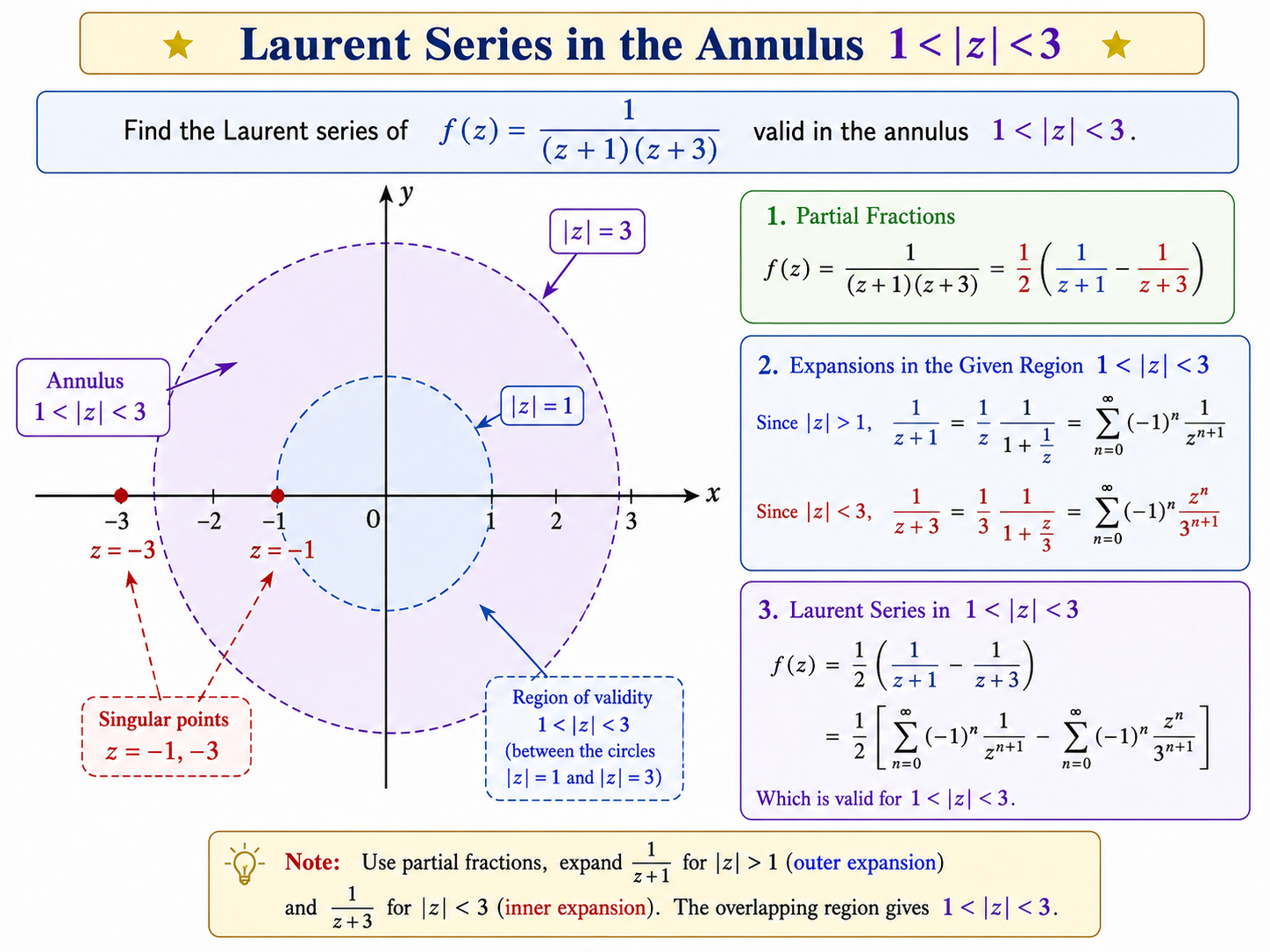
Expand \(f(z)=\dfrac1{(z+1)(z+3)}\) in a Laurent series valid for \(1<\lvert z\rvert<3\).

2Diagram

Question 1(d): Laurent series in the annulus
2025 UPSC Maths Optional Paper II Solutions diagram showing the annulus one less than modulus z less than three, singularities at z equals minus one and z equals minus three, and Laurent series expansion.

3Concept Related to the Question

Use partial fractions and geometric-series expansion in the annulus \(1<|z|<3\).

4Detailed Solution

We have \(\dfrac1{(z+1)(z+3)}=\dfrac12\left(\dfrac1{z+1}-\dfrac1{z+3}\right)\). For \(|z|>1\), \(\dfrac1{z+1}=\dfrac1z\dfrac1{1+1/z}=\sum_{n=0}^\infty(-1)^n z^{-n-1}\). For \(|z|<3\), \(\dfrac1{z+3}=\dfrac13\dfrac1{1+z/3}=\sum_{n=0}^\infty(-1)^n z^n/3^{n+1}\).

5Final Answer

The required Laurent series is \(\dfrac12\sum_{n=0}^\infty(-1)^n z^{-n-1}-\dfrac12\sum_{n=0}^\infty\dfrac{(-1)^n z^n}{3^{n+1}}\).

Question 1(e)

Basic solutions of linear equations

1Question

How many basic solutions are there for the following system equations?

\[2x_1-x_2+3x_3+x_4=6,\]
\[4x_1-2x_2-x_3+2x_4=10.\]

Find all of them. Further, find the number of basic solutions, which are feasible/non-feasible/non-degenerate.

2Diagram

Full Solution Access

The Diagram section for this question is available in the full 2025 UPSC Maths Optional Paper II PYQ Solutions course.

Complete diagrams, concepts, detailed solutions and final answers for all questions are available in the full PYQ course.

3Concept Related to the Question

Full Solution Access

The Concept Related to the Question section for this question is available in the full 2025 UPSC Maths Optional Paper II PYQ Solutions course.

Complete diagrams, concepts, detailed solutions and final answers for all questions are available in the full PYQ course.

4Detailed Solution

Full Solution Access

The Detailed Solution section for this question is available in the full 2025 UPSC Maths Optional Paper II PYQ Solutions course.

Complete diagrams, concepts, detailed solutions and final answers for all questions are available in the full PYQ course.

5Final Answer

Full Solution Access

The Final Answer section for this question is available in the full 2025 UPSC Maths Optional Paper II PYQ Solutions course.

Complete diagrams, concepts, detailed solutions and final answers for all questions are available in the full PYQ course.

Question 2(a)

Cauchy sequence

1Question

Define Cauchy sequence and prove that every convergent sequence of real number is a Cauchy sequence. What is the importance of Cauchy condition?

2Diagram

Full Solution Access

The Diagram section for this question is available in the full 2025 UPSC Maths Optional Paper II PYQ Solutions course.

Complete diagrams, concepts, detailed solutions and final answers for all questions are available in the full PYQ course.

3Concept Related to the Question

Full Solution Access

The Concept Related to the Question section for this question is available in the full 2025 UPSC Maths Optional Paper II PYQ Solutions course.

Complete diagrams, concepts, detailed solutions and final answers for all questions are available in the full PYQ course.

4Detailed Solution

Full Solution Access

The Detailed Solution section for this question is available in the full 2025 UPSC Maths Optional Paper II PYQ Solutions course.

Complete diagrams, concepts, detailed solutions and final answers for all questions are available in the full PYQ course.

5Final Answer

Full Solution Access

The Final Answer section for this question is available in the full 2025 UPSC Maths Optional Paper II PYQ Solutions course.

Complete diagrams, concepts, detailed solutions and final answers for all questions are available in the full PYQ course.

Question 2(b)

Irreducible element in Gaussian integers

1Question

Show that \(3\) is an irreducible element in the integral domain \(\mathbb Z[i]\).

2Diagram

Full Solution Access

The Diagram section for this question is available in the full 2025 UPSC Maths Optional Paper II PYQ Solutions course.

Complete diagrams, concepts, detailed solutions and final answers for all questions are available in the full PYQ course.

3Concept Related to the Question

Full Solution Access

The Concept Related to the Question section for this question is available in the full 2025 UPSC Maths Optional Paper II PYQ Solutions course.

Complete diagrams, concepts, detailed solutions and final answers for all questions are available in the full PYQ course.

4Detailed Solution

Full Solution Access

The Detailed Solution section for this question is available in the full 2025 UPSC Maths Optional Paper II PYQ Solutions course.

Complete diagrams, concepts, detailed solutions and final answers for all questions are available in the full PYQ course.

5Final Answer

Full Solution Access

The Final Answer section for this question is available in the full 2025 UPSC Maths Optional Paper II PYQ Solutions course.

Complete diagrams, concepts, detailed solutions and final answers for all questions are available in the full PYQ course.

Question 2(c)

Contour integration

1Question

Use the method of contour integration to prove that \(\displaystyle \int_{-\infty}^{\infty}\frac{x^2-x+2}{x^4+10x^2+9}\,dx=\frac{5\pi}{12}\).

2Diagram

Full Solution Access

The Diagram section for this question is available in the full 2025 UPSC Maths Optional Paper II PYQ Solutions course.

Complete diagrams, concepts, detailed solutions and final answers for all questions are available in the full PYQ course.

3Concept Related to the Question

Full Solution Access

The Concept Related to the Question section for this question is available in the full 2025 UPSC Maths Optional Paper II PYQ Solutions course.

Complete diagrams, concepts, detailed solutions and final answers for all questions are available in the full PYQ course.

4Detailed Solution

Full Solution Access

The Detailed Solution section for this question is available in the full 2025 UPSC Maths Optional Paper II PYQ Solutions course.

Complete diagrams, concepts, detailed solutions and final answers for all questions are available in the full PYQ course.

5Final Answer

Full Solution Access

The Final Answer section for this question is available in the full 2025 UPSC Maths Optional Paper II PYQ Solutions course.

Complete diagrams, concepts, detailed solutions and final answers for all questions are available in the full PYQ course.

Question 3(a)

Residue theorem

1Question

Evaluate the integral \(\displaystyle \oint_C\frac{e^z}{z^2(z+1)^3}\,dz\), where \(C:|z|=2\).

2Diagram

Full Solution Access

The Diagram section for this question is available in the full 2025 UPSC Maths Optional Paper II PYQ Solutions course.

Complete diagrams, concepts, detailed solutions and final answers for all questions are available in the full PYQ course.

3Concept Related to the Question

Full Solution Access

The Concept Related to the Question section for this question is available in the full 2025 UPSC Maths Optional Paper II PYQ Solutions course.

Complete diagrams, concepts, detailed solutions and final answers for all questions are available in the full PYQ course.

4Detailed Solution

Full Solution Access

The Detailed Solution section for this question is available in the full 2025 UPSC Maths Optional Paper II PYQ Solutions course.

Complete diagrams, concepts, detailed solutions and final answers for all questions are available in the full PYQ course.

5Final Answer

Full Solution Access

The Final Answer section for this question is available in the full 2025 UPSC Maths Optional Paper II PYQ Solutions course.

Complete diagrams, concepts, detailed solutions and final answers for all questions are available in the full PYQ course.

Question 3(b)

Maximum volume in ellipsoid

1Question

Show that the volume of the greatest rectangular parallelopiped that can be inscribed in the ellipsoid \(\displaystyle \frac{x^2}{a^2}+\frac{y^2}{b^2}+\frac{z^2}{c^2}=1\) is \(\displaystyle \frac{8abc}{3\sqrt3}\).

2Diagram

Full Solution Access

The Diagram section for this question is available in the full 2025 UPSC Maths Optional Paper II PYQ Solutions course.

Complete diagrams, concepts, detailed solutions and final answers for all questions are available in the full PYQ course.

3Concept Related to the Question

Full Solution Access

The Concept Related to the Question section for this question is available in the full 2025 UPSC Maths Optional Paper II PYQ Solutions course.

Complete diagrams, concepts, detailed solutions and final answers for all questions are available in the full PYQ course.

4Detailed Solution

Full Solution Access

The Detailed Solution section for this question is available in the full 2025 UPSC Maths Optional Paper II PYQ Solutions course.

Complete diagrams, concepts, detailed solutions and final answers for all questions are available in the full PYQ course.

5Final Answer

Full Solution Access

The Final Answer section for this question is available in the full 2025 UPSC Maths Optional Paper II PYQ Solutions course.

Complete diagrams, concepts, detailed solutions and final answers for all questions are available in the full PYQ course.

Question 3(c)

Duality in LPP

1Question

Apply the principle of duality to solve the following linear programming problem

\[\text{Maximize } Z=3x_1+4x_2\]

subject to the constraints

\[x_1-x_2\leq1,\]
\[x_1+x_2\geq4,\]
\[x_1-3x_2\leq3,\]
\[x_1,x_2\geq0.\]

2Diagram

Full Solution Access

The Diagram section for this question is available in the full 2025 UPSC Maths Optional Paper II PYQ Solutions course.

Complete diagrams, concepts, detailed solutions and final answers for all questions are available in the full PYQ course.

3Concept Related to the Question

Full Solution Access

The Concept Related to the Question section for this question is available in the full 2025 UPSC Maths Optional Paper II PYQ Solutions course.

Complete diagrams, concepts, detailed solutions and final answers for all questions are available in the full PYQ course.

4Detailed Solution

Full Solution Access

The Detailed Solution section for this question is available in the full 2025 UPSC Maths Optional Paper II PYQ Solutions course.

Complete diagrams, concepts, detailed solutions and final answers for all questions are available in the full PYQ course.

5Final Answer

Full Solution Access

The Final Answer section for this question is available in the full 2025 UPSC Maths Optional Paper II PYQ Solutions course.

Complete diagrams, concepts, detailed solutions and final answers for all questions are available in the full PYQ course.

Question 4(a)

Prime ideal in polynomial ring

1Question

Examine whether the mapping \(\phi:Z[x]\to Z\) defined by \(\phi(f(x))=f(0)\), for \(f(x)\in Z[x]\), is a homomorphism. Deduce that the ideal \((x)\) is a prime ideal in \(Z[x]\), but not a maximal ideal in \(Z[x]\).

2Diagram

Full Solution Access

The Diagram section for this question is available in the full 2025 UPSC Maths Optional Paper II PYQ Solutions course.

Complete diagrams, concepts, detailed solutions and final answers for all questions are available in the full PYQ course.

3Concept Related to the Question

Full Solution Access

The Concept Related to the Question section for this question is available in the full 2025 UPSC Maths Optional Paper II PYQ Solutions course.

Complete diagrams, concepts, detailed solutions and final answers for all questions are available in the full PYQ course.

4Detailed Solution

Full Solution Access

The Detailed Solution section for this question is available in the full 2025 UPSC Maths Optional Paper II PYQ Solutions course.

Complete diagrams, concepts, detailed solutions and final answers for all questions are available in the full PYQ course.

5Final Answer

Full Solution Access

The Final Answer section for this question is available in the full 2025 UPSC Maths Optional Paper II PYQ Solutions course.

Complete diagrams, concepts, detailed solutions and final answers for all questions are available in the full PYQ course.

Question 4(b)

Riemann integrability

1Question

Prove that every continuous function is Riemann integrable.

2Diagram

Full Solution Access

The Diagram section for this question is available in the full 2025 UPSC Maths Optional Paper II PYQ Solutions course.

Complete diagrams, concepts, detailed solutions and final answers for all questions are available in the full PYQ course.

3Concept Related to the Question

Full Solution Access

The Concept Related to the Question section for this question is available in the full 2025 UPSC Maths Optional Paper II PYQ Solutions course.

Complete diagrams, concepts, detailed solutions and final answers for all questions are available in the full PYQ course.

4Detailed Solution

Full Solution Access

The Detailed Solution section for this question is available in the full 2025 UPSC Maths Optional Paper II PYQ Solutions course.

Complete diagrams, concepts, detailed solutions and final answers for all questions are available in the full PYQ course.

5Final Answer

Full Solution Access

The Final Answer section for this question is available in the full 2025 UPSC Maths Optional Paper II PYQ Solutions course.

Complete diagrams, concepts, detailed solutions and final answers for all questions are available in the full PYQ course.

Question 4(c)

Transportation problem

1Question

The following table shows all the necessary information on the available supply to each warehouse, the requirement of each market and the unit transportation cost from each warehouse to each market:

Market \(I\)Market \(II\)Market \(III\)Market \(IV\)Supply
Warehouse \(A\)\(5\)\(2\)\(4\)\(3\)\(22\)
Warehouse \(B\)\(4\)\(8\)\(1\)\(6\)\(15\)
Warehouse \(C\)\(4\)\(6\)\(7\)\(5\)\(8\)
Requirement\(7\)\(12\)\(17\)\(9\)

The shipping clerk has worked out the following schedule from experience: \(12\) units from \(A\) to \(II\), \(1\) unit from \(A\) to \(III\), \(9\) units from \(A\) to \(IV\), \(15\) units from \(B\) to \(III\), \(7\) units from \(C\) to \(I\), and \(1\) unit from \(C\) to \(III\). Find the optimal schedule and minimum total shipping cost.

2Diagram

Full Solution Access

The Diagram section for this question is available in the full 2025 UPSC Maths Optional Paper II PYQ Solutions course.

Complete diagrams, concepts, detailed solutions and final answers for all questions are available in the full PYQ course.

3Concept Related to the Question

Full Solution Access

The Concept Related to the Question section for this question is available in the full 2025 UPSC Maths Optional Paper II PYQ Solutions course.

Complete diagrams, concepts, detailed solutions and final answers for all questions are available in the full PYQ course.

4Detailed Solution

Full Solution Access

The Detailed Solution section for this question is available in the full 2025 UPSC Maths Optional Paper II PYQ Solutions course.

Complete diagrams, concepts, detailed solutions and final answers for all questions are available in the full PYQ course.

5Final Answer

Full Solution Access

The Final Answer section for this question is available in the full 2025 UPSC Maths Optional Paper II PYQ Solutions course.

Complete diagrams, concepts, detailed solutions and final answers for all questions are available in the full PYQ course.

Question 5(a)

Linear PDE with constant coefficients

1Question

Find the solution of the equation \((D^2+DD'-2D'^2)z=y\sin x\), where \(D=\frac{\partial}{\partial x}\) and \(D'=\frac{\partial}{\partial y}\).

2Diagram

Full Solution Access

The Diagram section for this question is available in the full 2025 UPSC Maths Optional Paper II PYQ Solutions course.

Complete diagrams, concepts, detailed solutions and final answers for all questions are available in the full PYQ course.

3Concept Related to the Question

Full Solution Access

The Concept Related to the Question section for this question is available in the full 2025 UPSC Maths Optional Paper II PYQ Solutions course.

Complete diagrams, concepts, detailed solutions and final answers for all questions are available in the full PYQ course.

4Detailed Solution

Full Solution Access

The Detailed Solution section for this question is available in the full 2025 UPSC Maths Optional Paper II PYQ Solutions course.

Complete diagrams, concepts, detailed solutions and final answers for all questions are available in the full PYQ course.

5Final Answer

Full Solution Access

The Final Answer section for this question is available in the full 2025 UPSC Maths Optional Paper II PYQ Solutions course.

Complete diagrams, concepts, detailed solutions and final answers for all questions are available in the full PYQ course.

Question 5(b)

Gauss-Seidel method

1Question

Solve the following system of linear equations by Gauss-Seidel method:

\[10x-2y+z=9,\]
\[2x+20y-z=-44,\]
\[-2x+3y+10z=22.\]

2Diagram

Full Solution Access

The Diagram section for this question is available in the full 2025 UPSC Maths Optional Paper II PYQ Solutions course.

Complete diagrams, concepts, detailed solutions and final answers for all questions are available in the full PYQ course.

3Concept Related to the Question

Full Solution Access

The Concept Related to the Question section for this question is available in the full 2025 UPSC Maths Optional Paper II PYQ Solutions course.

Complete diagrams, concepts, detailed solutions and final answers for all questions are available in the full PYQ course.

4Detailed Solution

Full Solution Access

The Detailed Solution section for this question is available in the full 2025 UPSC Maths Optional Paper II PYQ Solutions course.

Complete diagrams, concepts, detailed solutions and final answers for all questions are available in the full PYQ course.

5Final Answer

Full Solution Access

The Final Answer section for this question is available in the full 2025 UPSC Maths Optional Paper II PYQ Solutions course.

Complete diagrams, concepts, detailed solutions and final answers for all questions are available in the full PYQ course.

Question 5(c)(i)

Number-system conversion

1Question

Convert the number \((3479)_{10}\) into binary system and the number \((7AE.9F)_{16}\) into decimal system.

2Diagram

Full Solution Access

The Diagram section for this question is available in the full 2025 UPSC Maths Optional Paper II PYQ Solutions course.

Complete diagrams, concepts, detailed solutions and final answers for all questions are available in the full PYQ course.

3Concept Related to the Question

Full Solution Access

The Concept Related to the Question section for this question is available in the full 2025 UPSC Maths Optional Paper II PYQ Solutions course.

Complete diagrams, concepts, detailed solutions and final answers for all questions are available in the full PYQ course.

4Detailed Solution

Full Solution Access

The Detailed Solution section for this question is available in the full 2025 UPSC Maths Optional Paper II PYQ Solutions course.

Complete diagrams, concepts, detailed solutions and final answers for all questions are available in the full PYQ course.

5Final Answer

Full Solution Access

The Final Answer section for this question is available in the full 2025 UPSC Maths Optional Paper II PYQ Solutions course.

Complete diagrams, concepts, detailed solutions and final answers for all questions are available in the full PYQ course.

Question 5(c)(ii)

Boolean truth table and DNF

1Question

Determine the truth table for the Boolean function \(F(x,y,z)=(x+y+z')(x'+y')\). Also derive the full disjunctive normal form of \(F(x,y,z)\) from the truth table.

2Diagram

Full Solution Access

The Diagram section for this question is available in the full 2025 UPSC Maths Optional Paper II PYQ Solutions course.

Complete diagrams, concepts, detailed solutions and final answers for all questions are available in the full PYQ course.

3Concept Related to the Question

Full Solution Access

The Concept Related to the Question section for this question is available in the full 2025 UPSC Maths Optional Paper II PYQ Solutions course.

Complete diagrams, concepts, detailed solutions and final answers for all questions are available in the full PYQ course.

4Detailed Solution

Full Solution Access

The Detailed Solution section for this question is available in the full 2025 UPSC Maths Optional Paper II PYQ Solutions course.

Complete diagrams, concepts, detailed solutions and final answers for all questions are available in the full PYQ course.

5Final Answer

Full Solution Access

The Final Answer section for this question is available in the full 2025 UPSC Maths Optional Paper II PYQ Solutions course.

Complete diagrams, concepts, detailed solutions and final answers for all questions are available in the full PYQ course.

Question 5(d)

Lagrangian of bead on cycloid

1Question

A bead of mass \(m\) slides on a frictionless wire in the shape of a cycloid given by \(x=a(\theta-\sin\theta)\), \(y=a(1+\cos\theta)\), \(0\leq\theta\leq2\pi\). Find the Lagrangian function. Hence show that the equation of motion can be written as \(\frac{d^2u}{dt^2}+\frac{g}{4a}u=0\), where \(u=\cos\left(\frac{\theta}{2}\right)\).

2Diagram

Full Solution Access

The Diagram section for this question is available in the full 2025 UPSC Maths Optional Paper II PYQ Solutions course.

Complete diagrams, concepts, detailed solutions and final answers for all questions are available in the full PYQ course.

3Concept Related to the Question

Full Solution Access

The Concept Related to the Question section for this question is available in the full 2025 UPSC Maths Optional Paper II PYQ Solutions course.

Complete diagrams, concepts, detailed solutions and final answers for all questions are available in the full PYQ course.

4Detailed Solution

Full Solution Access

The Detailed Solution section for this question is available in the full 2025 UPSC Maths Optional Paper II PYQ Solutions course.

Complete diagrams, concepts, detailed solutions and final answers for all questions are available in the full PYQ course.

5Final Answer

Full Solution Access

The Final Answer section for this question is available in the full 2025 UPSC Maths Optional Paper II PYQ Solutions course.

Complete diagrams, concepts, detailed solutions and final answers for all questions are available in the full PYQ course.

Question 5(e)

Source and sink in circular boundary

1Question

A source and a sink of equal strength are placed at points \(\left(\pm\frac a2,0\right)\) within a fixed circular boundary \(x^2+y^2=a^2\). Show that the streamlines are given by \(\left(r^2-\frac{a^2}{4}\right)(r^2-4a^2)-4a^2y^2=k y(r^2-a^2)\), where \(k\) is a constant and \(r^2=x^2+y^2\).

2Diagram

Full Solution Access

The Diagram section for this question is available in the full 2025 UPSC Maths Optional Paper II PYQ Solutions course.

Complete diagrams, concepts, detailed solutions and final answers for all questions are available in the full PYQ course.

3Concept Related to the Question

Full Solution Access

The Concept Related to the Question section for this question is available in the full 2025 UPSC Maths Optional Paper II PYQ Solutions course.

Complete diagrams, concepts, detailed solutions and final answers for all questions are available in the full PYQ course.

4Detailed Solution

Full Solution Access

The Detailed Solution section for this question is available in the full 2025 UPSC Maths Optional Paper II PYQ Solutions course.

Complete diagrams, concepts, detailed solutions and final answers for all questions are available in the full PYQ course.

5Final Answer

Full Solution Access

The Final Answer section for this question is available in the full 2025 UPSC Maths Optional Paper II PYQ Solutions course.

Complete diagrams, concepts, detailed solutions and final answers for all questions are available in the full PYQ course.

Question 6(a)

Laplace equation on a rectangle

1Question

Solve \(\frac{\partial^2u}{\partial x^2}+\frac{\partial^2u}{\partial y^2}=0\) for a rectangular plate subject to the boundary conditions \(u(0,y)=0\), \(u(a,y)=0\), \(u(x,0)=0\), and \(u(x,b)=f(x)\).

2Diagram

Full Solution Access

The Diagram section for this question is available in the full 2025 UPSC Maths Optional Paper II PYQ Solutions course.

Complete diagrams, concepts, detailed solutions and final answers for all questions are available in the full PYQ course.

3Concept Related to the Question

Full Solution Access

The Concept Related to the Question section for this question is available in the full 2025 UPSC Maths Optional Paper II PYQ Solutions course.

Complete diagrams, concepts, detailed solutions and final answers for all questions are available in the full PYQ course.

4Detailed Solution

Full Solution Access

The Detailed Solution section for this question is available in the full 2025 UPSC Maths Optional Paper II PYQ Solutions course.

Complete diagrams, concepts, detailed solutions and final answers for all questions are available in the full PYQ course.

5Final Answer

Full Solution Access

The Final Answer section for this question is available in the full 2025 UPSC Maths Optional Paper II PYQ Solutions course.

Complete diagrams, concepts, detailed solutions and final answers for all questions are available in the full PYQ course.

Question 6(b)

Boolean simplification and gate network

1Question

Simplify the Boolean function \(F(x,y,z)=xyz+x'yz+xy'z+xyz'\) and draw the corresponding GATE network.

2Diagram

Full Solution Access

The Diagram section for this question is available in the full 2025 UPSC Maths Optional Paper II PYQ Solutions course.

Complete diagrams, concepts, detailed solutions and final answers for all questions are available in the full PYQ course.

3Concept Related to the Question

Full Solution Access

The Concept Related to the Question section for this question is available in the full 2025 UPSC Maths Optional Paper II PYQ Solutions course.

Complete diagrams, concepts, detailed solutions and final answers for all questions are available in the full PYQ course.

4Detailed Solution

Full Solution Access

The Detailed Solution section for this question is available in the full 2025 UPSC Maths Optional Paper II PYQ Solutions course.

Complete diagrams, concepts, detailed solutions and final answers for all questions are available in the full PYQ course.

5Final Answer

Full Solution Access

The Final Answer section for this question is available in the full 2025 UPSC Maths Optional Paper II PYQ Solutions course.

Complete diagrams, concepts, detailed solutions and final answers for all questions are available in the full PYQ course.

Question 6(c)

Moment of inertia of a solid cylinder

1Question

Calculate the moment of inertia of a uniform solid cylinder of mass \(M\), radius \(R\) and length \(L\) with respect to a set of axes passing through the centre of the cylinder, where \(z\)-axis is the axis of the cylinder and \(\rho\) is the constant density at any point of the cylinder. Also find \(\frac LR\) for which the moment of inertia about \(x\)- or \(y\)-axis will be minimum for a given mass of the cylinder.

2Diagram

Full Solution Access

The Diagram section for this question is available in the full 2025 UPSC Maths Optional Paper II PYQ Solutions course.

Complete diagrams, concepts, detailed solutions and final answers for all questions are available in the full PYQ course.

3Concept Related to the Question

Full Solution Access

The Concept Related to the Question section for this question is available in the full 2025 UPSC Maths Optional Paper II PYQ Solutions course.

Complete diagrams, concepts, detailed solutions and final answers for all questions are available in the full PYQ course.

4Detailed Solution

Full Solution Access

The Detailed Solution section for this question is available in the full 2025 UPSC Maths Optional Paper II PYQ Solutions course.

Complete diagrams, concepts, detailed solutions and final answers for all questions are available in the full PYQ course.

5Final Answer

Full Solution Access

The Final Answer section for this question is available in the full 2025 UPSC Maths Optional Paper II PYQ Solutions course.

Complete diagrams, concepts, detailed solutions and final answers for all questions are available in the full PYQ course.

Question 7(a)

Complete integral of first-order PDE

1Question

Find the complete integral of \(z(p^2-q^2)=x-y;\ p=\frac{\partial z}{\partial x},\ q=\frac{\partial z}{\partial y}\).

2Diagram

Full Solution Access

The Diagram section for this question is available in the full 2025 UPSC Maths Optional Paper II PYQ Solutions course.

Complete diagrams, concepts, detailed solutions and final answers for all questions are available in the full PYQ course.

3Concept Related to the Question

Full Solution Access

The Concept Related to the Question section for this question is available in the full 2025 UPSC Maths Optional Paper II PYQ Solutions course.

Complete diagrams, concepts, detailed solutions and final answers for all questions are available in the full PYQ course.

4Detailed Solution

Full Solution Access

The Detailed Solution section for this question is available in the full 2025 UPSC Maths Optional Paper II PYQ Solutions course.

Complete diagrams, concepts, detailed solutions and final answers for all questions are available in the full PYQ course.

5Final Answer

Full Solution Access

The Final Answer section for this question is available in the full 2025 UPSC Maths Optional Paper II PYQ Solutions course.

Complete diagrams, concepts, detailed solutions and final answers for all questions are available in the full PYQ course.

Question 7(b)

Quadratic interpolation

1Question

Find the unique polynomial of degree \(2\) or less which fits the following data:

\(x\)\(0\)\(1\)\(3\)
\(f(x)\)\(1\)\(3\)\(55\)

Also obtain the bound on the truncation error.

2Diagram

Full Solution Access

The Diagram section for this question is available in the full 2025 UPSC Maths Optional Paper II PYQ Solutions course.

Complete diagrams, concepts, detailed solutions and final answers for all questions are available in the full PYQ course.

3Concept Related to the Question

Full Solution Access

The Concept Related to the Question section for this question is available in the full 2025 UPSC Maths Optional Paper II PYQ Solutions course.

Complete diagrams, concepts, detailed solutions and final answers for all questions are available in the full PYQ course.

4Detailed Solution

Full Solution Access

The Detailed Solution section for this question is available in the full 2025 UPSC Maths Optional Paper II PYQ Solutions course.

Complete diagrams, concepts, detailed solutions and final answers for all questions are available in the full PYQ course.

5Final Answer

Full Solution Access

The Final Answer section for this question is available in the full 2025 UPSC Maths Optional Paper II PYQ Solutions course.

Complete diagrams, concepts, detailed solutions and final answers for all questions are available in the full PYQ course.

Question 7(c)

Viscous incompressible steady flow

1Question

Show that for an incompressible steady flow with constant viscosity, the velocity components \(u(y)=\left(\frac Uh\right)y-\frac{hy}{2\mu}\frac{dp}{dx}\left(1-\frac yh\right)\), \(v=0=w\), with \(p=p(x)\), satisfy the equation of motion in the absence of body force. Given that \(U\), \(h\) and \(\frac{dp}{dx}\) are constants.

2Diagram

Full Solution Access

The Diagram section for this question is available in the full 2025 UPSC Maths Optional Paper II PYQ Solutions course.

Complete diagrams, concepts, detailed solutions and final answers for all questions are available in the full PYQ course.

3Concept Related to the Question

Full Solution Access

The Concept Related to the Question section for this question is available in the full 2025 UPSC Maths Optional Paper II PYQ Solutions course.

Complete diagrams, concepts, detailed solutions and final answers for all questions are available in the full PYQ course.

4Detailed Solution

Full Solution Access

The Detailed Solution section for this question is available in the full 2025 UPSC Maths Optional Paper II PYQ Solutions course.

Complete diagrams, concepts, detailed solutions and final answers for all questions are available in the full PYQ course.

5Final Answer

Full Solution Access

The Final Answer section for this question is available in the full 2025 UPSC Maths Optional Paper II PYQ Solutions course.

Complete diagrams, concepts, detailed solutions and final answers for all questions are available in the full PYQ course.

Question 8(a)

Characteristics of first-order PDE

1Question

Find the characteristics of the partial differential equation \(p^2+q^2=2;\ p=\frac{\partial z}{\partial x},\ q=\frac{\partial z}{\partial y}\), and determine the integral surface which passes through \(x=0,\ z=y\).

2Diagram

Full Solution Access

The Diagram section for this question is available in the full 2025 UPSC Maths Optional Paper II PYQ Solutions course.

Complete diagrams, concepts, detailed solutions and final answers for all questions are available in the full PYQ course.

3Concept Related to the Question

Full Solution Access

The Concept Related to the Question section for this question is available in the full 2025 UPSC Maths Optional Paper II PYQ Solutions course.

Complete diagrams, concepts, detailed solutions and final answers for all questions are available in the full PYQ course.

4Detailed Solution

Full Solution Access

The Detailed Solution section for this question is available in the full 2025 UPSC Maths Optional Paper II PYQ Solutions course.

Complete diagrams, concepts, detailed solutions and final answers for all questions are available in the full PYQ course.

5Final Answer

Full Solution Access

The Final Answer section for this question is available in the full 2025 UPSC Maths Optional Paper II PYQ Solutions course.

Complete diagrams, concepts, detailed solutions and final answers for all questions are available in the full PYQ course.

Question 8(b)

Corrected trapezoidal quadrature rule

1Question

Find the constant \(p\) and error term for the quadrature formula \(\displaystyle \int_{x_0}^{x_1}f(x)\,dx=\frac h2(f_0+f_1)+ph^2(f'_0-f'_1)\), where \(x_0+h=x_1\), \(f_0=f(x_0)\), \(f_1=f(x_1)\) and prime \((\, '\, )\) represents derivative with respect to \(x\). Hence deduce the composite rule for integrating \(\displaystyle \int_a^b f(x)\,dx\), \(a=x_0\lt x_1\lt\cdots\lt x_N=b\).

2Diagram

Full Solution Access

The Diagram section for this question is available in the full 2025 UPSC Maths Optional Paper II PYQ Solutions course.

Complete diagrams, concepts, detailed solutions and final answers for all questions are available in the full PYQ course.

3Concept Related to the Question

Full Solution Access

The Concept Related to the Question section for this question is available in the full 2025 UPSC Maths Optional Paper II PYQ Solutions course.

Complete diagrams, concepts, detailed solutions and final answers for all questions are available in the full PYQ course.

4Detailed Solution

Full Solution Access

The Detailed Solution section for this question is available in the full 2025 UPSC Maths Optional Paper II PYQ Solutions course.

Complete diagrams, concepts, detailed solutions and final answers for all questions are available in the full PYQ course.

5Final Answer

Full Solution Access

The Final Answer section for this question is available in the full 2025 UPSC Maths Optional Paper II PYQ Solutions course.

Complete diagrams, concepts, detailed solutions and final answers for all questions are available in the full PYQ course.

Question 8(c)(i)

Hamiltonian in spherical polar coordinates

1Question

A particle of mass \(m\) moves in a force field of potential \(V(r)=\dfrac{k\cos\theta}{r^2}\), \(k\) constant. Find the Hamiltonian and Hamilton’s equations in spherical polar coordinates \((r,\theta,\phi)\).

2Diagram

Full Solution Access

The Diagram section for this question is available in the full 2025 UPSC Maths Optional Paper II PYQ Solutions course.

Complete diagrams, concepts, detailed solutions and final answers for all questions are available in the full PYQ course.

3Concept Related to the Question

Full Solution Access

The Concept Related to the Question section for this question is available in the full 2025 UPSC Maths Optional Paper II PYQ Solutions course.

Complete diagrams, concepts, detailed solutions and final answers for all questions are available in the full PYQ course.

4Detailed Solution

Full Solution Access

The Detailed Solution section for this question is available in the full 2025 UPSC Maths Optional Paper II PYQ Solutions course.

Complete diagrams, concepts, detailed solutions and final answers for all questions are available in the full PYQ course.

5Final Answer

Full Solution Access

The Final Answer section for this question is available in the full 2025 UPSC Maths Optional Paper II PYQ Solutions course.

Complete diagrams, concepts, detailed solutions and final answers for all questions are available in the full PYQ course.

Question 8(c)(ii)

Hamiltonian from a coupled Lagrangian

1Question

Consider the Lagrangian \(L=m\dot x\dot y-m\omega_0^2xy\), where \(m\) and \(\omega_0\) are constants. Find the Hamiltonian and Hamilton’s equations of motion. Identify the system.

2Diagram

Full Solution Access

The Diagram section for this question is available in the full 2025 UPSC Maths Optional Paper II PYQ Solutions course.

Complete diagrams, concepts, detailed solutions and final answers for all questions are available in the full PYQ course.

3Concept Related to the Question

Full Solution Access

The Concept Related to the Question section for this question is available in the full 2025 UPSC Maths Optional Paper II PYQ Solutions course.

Complete diagrams, concepts, detailed solutions and final answers for all questions are available in the full PYQ course.

4Detailed Solution

Full Solution Access

The Detailed Solution section for this question is available in the full 2025 UPSC Maths Optional Paper II PYQ Solutions course.

Complete diagrams, concepts, detailed solutions and final answers for all questions are available in the full PYQ course.

5Final Answer

Full Solution Access

The Final Answer section for this question is available in the full 2025 UPSC Maths Optional Paper II PYQ Solutions course.

Complete diagrams, concepts, detailed solutions and final answers for all questions are available in the full PYQ course.

2025 UPSC Maths Optional Paper II Solutions FAQs

Are these 2025 UPSC Maths Optional Paper II Solutions complete?

This public page gives one full sample solution for 2025 UPSC Maths Optional Paper II Solutions. Complete question-wise solutions for the full paper are available in the full PYQ course by Ramana Sri IAS.

Which question is given as a free sample solution on this page?

Question 1(d) is given as the free sample solution on this page. The sample includes all five sections: Question, Diagram, Concept Related to the Question, Detailed Solution, and Final Answer.

How should I use these 2025 UPSC Maths Optional Paper II Solutions for preparation?

Students should first solve the questions independently, then compare their approach with the solution method. These solutions are useful for revision, answer-writing practice, diagram presentation, and concept clarity before the UPSC Mains examination.

Do these solutions include diagrams and detailed explanations?

Yes. The full PYQ course follows a structured format wherever required: Question, Diagram, Concept Related to the Question, Detailed Solution, and Final Answer. This public page shows the format through one free sample solution.

How can I get complete solutions for all questions in 2025 UPSC Maths Optional Paper II?

To access complete solutions for all questions, please fill out the admission form first. Our Ramana Sri IAS admission team will guide you through WhatsApp, email, or call.

Scroll to Top