Ramana Sri IAS - 2016 UPSC Maths Optional Paper I Solutions
2016 UPSC Maths Optional Paper I Solutions Ramana Sri IAS provides complete and updated solutions for the 2016 UPSC Maths Optional Paper I. Aspirants preparing for the UPSC Mains Examination with Mathematics as their optional subject should solve all these questions carefully at least 5 to 10 times before the mains examination.
Ramana Sri IAS presents complete solutions for UPSC/IAS/CSE-Civil Service Examination 2016 Mathematics Optional Paper I. Each answer follows the same format: Question, Diagram where needed, Concept Related to the Question, Detailed Solution, and Final Answer.
About 2016 UPSC Maths Optional Paper I Solutions
These 2016 UPSC Maths Optional Paper I Solutions are prepared by Ramana Sri IAS for aspirants who want question-wise clarity before the UPSC Mains examination. This public page gives one full sample solution, while the complete paper-wise solutions are available in the full PYQ course.
Students can use these 2016 UPSC Maths Optional Paper I Solutions to understand the expected answer-writing method, diagram presentation, concept application, and final-answer format used by Ramana Sri IAS.
For the official examination source, students may also refer to the
UPSC previous year question papers page .
These 2016 UPSC Maths Optional Paper I Solutions are useful for revision, answer-writing practice, and understanding the step-by-step method expected in the UPSC Mathematics optional paper.
Sample Full Solution
We are giving one question as a free sample solution below:
Question 1(d) . This free sample includes all five sections:
Question , Diagram ,
Concept Related to the Question ,
Detailed Solution , and Final Answer .
Complete solutions for all questions are available in the full PYQ course. To purchase the full solutions,
please fill out the admission form first. Our Ramana Sri IAS admission team will guide you through WhatsApp, email, or call.
2016 UPSC Maths Optional Paper I Solutions: Table of Contents
Question 1(a)(i) Inverse of a matrix by elementary row operations
1. Question
2. Diagram
3. Concept Related to the Question
4. Detailed Solution
5. Final Answer
1 Question Using elementary row operations, find the inverse of \(A={\large \left[\begin{smallmatrix}1&2&1\\1&3&2\\1&0&1\end{smallmatrix}\right]}\).
2 Diagram
Full Solution Access The Diagram section for this question is available in the full 2016 UPSC Maths Optional Paper I PYQ Solutions course.
Complete diagrams, concepts, detailed solutions and final answers for all questions are available in the full PYQ course.
3 Concept Related to the Question
Full Solution Access The Concept Related to the Question section for this question is available in the full 2016 UPSC Maths Optional Paper I PYQ Solutions course.
Complete diagrams, concepts, detailed solutions and final answers for all questions are available in the full PYQ course.
4 Detailed Solution
Full Solution Access The Detailed Solution section for this question is available in the full 2016 UPSC Maths Optional Paper I PYQ Solutions course.
Complete diagrams, concepts, detailed solutions and final answers for all questions are available in the full PYQ course.
5 Final Answer
Full Solution Access The Final Answer section for this question is available in the full 2016 UPSC Maths Optional Paper I PYQ Solutions course.
Complete diagrams, concepts, detailed solutions and final answers for all questions are available in the full PYQ course.
Question 1(a)(ii) Finding \(A^{14}+3A-2I\)
1. Question
2. Diagram
3. Concept Related to the Question
4. Detailed Solution
5. Final Answer
1 QuestionIf \(A={\large \left[\begin{smallmatrix}1&1&3\\5&2&6\\-2&-1&-3\end{smallmatrix}\right]}\), then find \(A^{14}+3A-2I\).
2 Diagram
Full Solution Access The Diagram section for this question is available in the full 2016 UPSC Maths Optional Paper I PYQ Solutions course.
Complete diagrams, concepts, detailed solutions and final answers for all questions are available in the full PYQ course.
3 Concept Related to the Question
Full Solution Access The Concept Related to the Question section for this question is available in the full 2016 UPSC Maths Optional Paper I PYQ Solutions course.
Complete diagrams, concepts, detailed solutions and final answers for all questions are available in the full PYQ course.
4 Detailed Solution
Full Solution Access The Detailed Solution section for this question is available in the full 2016 UPSC Maths Optional Paper I PYQ Solutions course.
Complete diagrams, concepts, detailed solutions and final answers for all questions are available in the full PYQ course.
5 Final Answer
Full Solution Access The Final Answer section for this question is available in the full 2016 UPSC Maths Optional Paper I PYQ Solutions course.
Complete diagrams, concepts, detailed solutions and final answers for all questions are available in the full PYQ course.
Question 1(b)(i) Condition for consistency of linear equations
1. Question
2. Diagram
3. Concept Related to the Question
4. Detailed Solution
5. Final Answer
1 QuestionUsing elementary row operations, find the condition that the linear equations \(x-2y+z=a\), \(2x+7y-3z=b\), \(3x+5y-2z=c\) have a solution.
2 Diagram
Full Solution Access The Diagram section for this question is available in the full 2016 UPSC Maths Optional Paper I PYQ Solutions course.
Complete diagrams, concepts, detailed solutions and final answers for all questions are available in the full PYQ course.
3 Concept Related to the Question
Full Solution Access The Concept Related to the Question section for this question is available in the full 2016 UPSC Maths Optional Paper I PYQ Solutions course.
Complete diagrams, concepts, detailed solutions and final answers for all questions are available in the full PYQ course.
4 Detailed Solution
Full Solution Access The Detailed Solution section for this question is available in the full 2016 UPSC Maths Optional Paper I PYQ Solutions course.
Complete diagrams, concepts, detailed solutions and final answers for all questions are available in the full PYQ course.
5 Final Answer
Full Solution Access The Final Answer section for this question is available in the full 2016 UPSC Maths Optional Paper I PYQ Solutions course.
Complete diagrams, concepts, detailed solutions and final answers for all questions are available in the full PYQ course.
Question 1(b)(ii) Dimensions of subspace intersection and sum
1. Question
2. Diagram
3. Concept Related to the Question
4. Detailed Solution
5. Final Answer
1 QuestionIf \(W_1=\{(x,y,z)\mid x+y-z=0\}\), \(W_2=\{(x,y,z)\mid 3x+y-2z=0\}\), and \(W_3=\{(x,y,z)\mid x-7y+3z=0\}\), then find \(\dim(W_1\cap W_2\cap W_3)\) and \(\dim(W_1+W_2)\).
2 Diagram
Full Solution Access The Diagram section for this question is available in the full 2016 UPSC Maths Optional Paper I PYQ Solutions course.
Complete diagrams, concepts, detailed solutions and final answers for all questions are available in the full PYQ course.
3 Concept Related to the Question
Full Solution Access The Concept Related to the Question section for this question is available in the full 2016 UPSC Maths Optional Paper I PYQ Solutions course.
Complete diagrams, concepts, detailed solutions and final answers for all questions are available in the full PYQ course.
4 Detailed Solution
Full Solution Access The Detailed Solution section for this question is available in the full 2016 UPSC Maths Optional Paper I PYQ Solutions course.
Complete diagrams, concepts, detailed solutions and final answers for all questions are available in the full PYQ course.
5 Final Answer
Full Solution Access The Final Answer section for this question is available in the full 2016 UPSC Maths Optional Paper I PYQ Solutions course.
Complete diagrams, concepts, detailed solutions and final answers for all questions are available in the full PYQ course.
Question 1(c) Evaluation of an improper integral
1. Question
2. Diagram
3. Concept Related to the Question
4. Detailed Solution
5. Final Answer
1 Question Evaluate \(I=\int_0^1 \sqrt[3]{x\log\left(\frac{1}{x}\right)}\,dx\).
2 Diagram
Full Solution Access The Diagram section for this question is available in the full 2016 UPSC Maths Optional Paper I PYQ Solutions course.
Complete diagrams, concepts, detailed solutions and final answers for all questions are available in the full PYQ course.
3 Concept Related to the Question
Full Solution Access The Concept Related to the Question section for this question is available in the full 2016 UPSC Maths Optional Paper I PYQ Solutions course.
Complete diagrams, concepts, detailed solutions and final answers for all questions are available in the full PYQ course.
4 Detailed Solution
Full Solution Access The Detailed Solution section for this question is available in the full 2016 UPSC Maths Optional Paper I PYQ Solutions course.
Complete diagrams, concepts, detailed solutions and final answers for all questions are available in the full PYQ course.
5 Final Answer
Full Solution Access The Final Answer section for this question is available in the full 2016 UPSC Maths Optional Paper I PYQ Solutions course.
Complete diagrams, concepts, detailed solutions and final answers for all questions are available in the full PYQ course.
Question 1(d) Sphere through a given circle
1. Question
2. Diagram
3. Concept Related to the Question
4. Detailed Solution
5. Final Answer
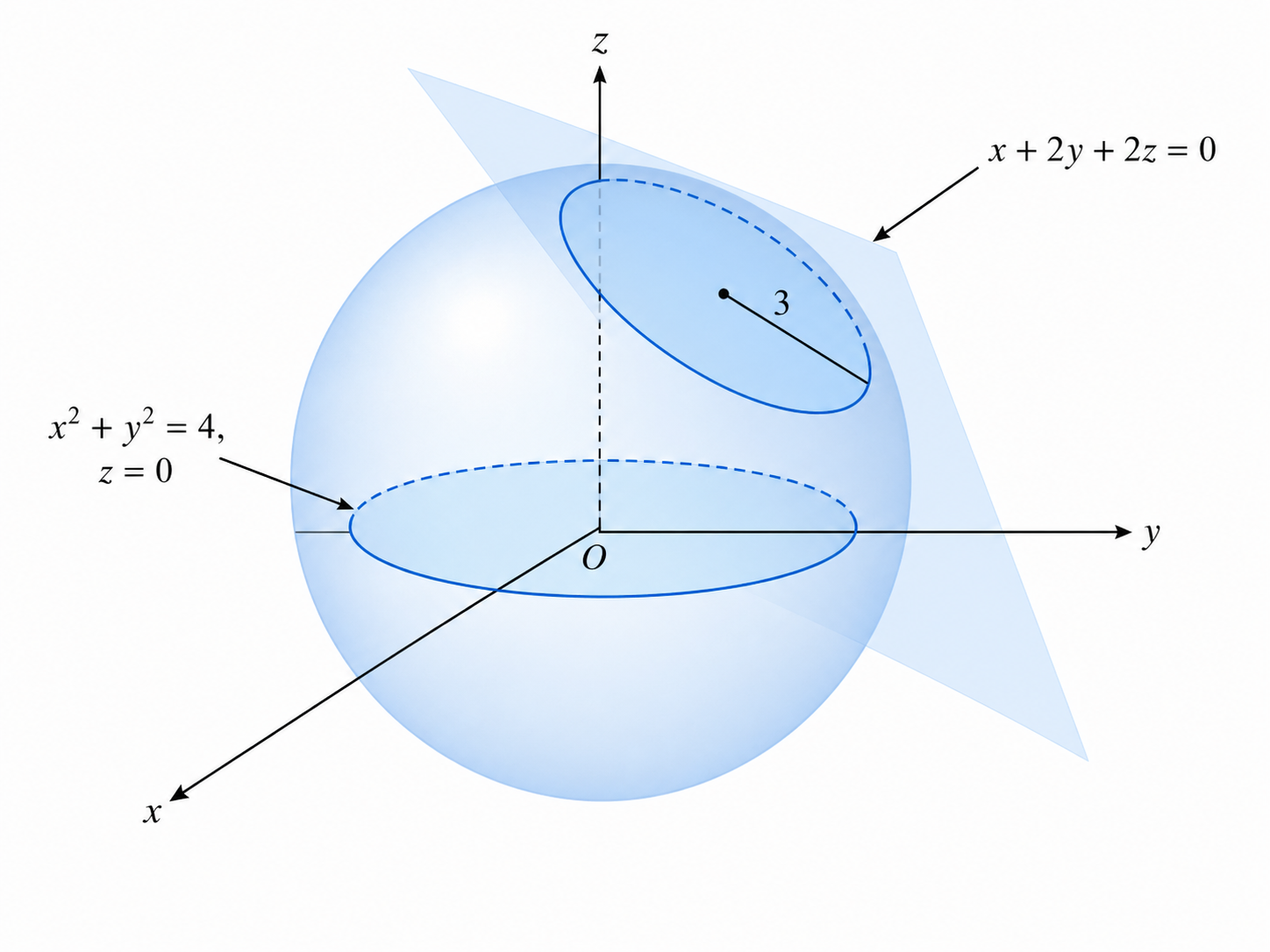
1 QuestionFind the equation of the sphere which passes through the circle \(x^2+y^2=4,\ z=0\) and is cut by the plane \(x+2y+2z=0\) in a circle of radius \(3\).
2 DiagramQuestion 1(d): Sphere cut by a plane
3 Concept Related to the QuestionA family of spheres passing through a fixed circle is obtained by combining the equation of the sphere through the circle with the equation of the plane of the circle. Then the radius of the circular section made by a plane is found from \(r^2=R^2-d^2\), where \(R\) is the sphere radius and \(d\) is the distance of the centre from the cutting plane.
4 Detailed SolutionThe circle is given by
\[
x^2+y^2=4,\qquad z=0.
\]
Every sphere passing through this circle can be written as
\[
x^2+y^2+z^2+\lambda z-4=0.
\]
This is because putting \(z=0\) gives \(x^2+y^2-4=0\), which is exactly the given circle. Now complete the square in \(z\):
\[
x^2+y^2+\left(z+\frac{\lambda}{2}\right)^2=4+\frac{\lambda^2}{4}.
\]
Hence the centre is \(C=(0,0,-\lambda/2)\), and
\[
R^2=4+\frac{\lambda^2}{4}.
\]
The distance of \(C\) from the plane \(x+2y+2z=0\) is
\[
d=\frac{|0+0+2(-\lambda/2)|}{\sqrt{1^2+2^2+2^2}}=\frac{|\lambda|}{3}.
\]
The plane cuts the sphere in a circle of radius \(3\). Therefore
\[
3^2=R^2-d^2=4+\frac{\lambda^2}{4}-\frac{\lambda^2}{9}.
\]
So
\[
9=4+\frac{5\lambda^2}{36}\quad\Rightarrow\quad \lambda^2=36.
\]
Thus \(\lambda=\pm6\).
5 Final AnswerThe required spheres are \(x^2+y^2+z^2+6z-4=0\) and \(x^2+y^2+z^2-6z-4=0\).
Question 1(e) Shortest distance between two lines
1. Question
2. Diagram
3. Concept Related to the Question
4. Detailed Solution
5. Final Answer
1 QuestionFind the shortest distance between the lines \(\frac{x-1}{2}=\frac{y-2}{4}=z-3\) and \(y-mx=z=0\). For what value of \(m\) will the two lines intersect?
2 Diagram
Full Solution Access The Diagram section for this question is available in the full 2016 UPSC Maths Optional Paper I PYQ Solutions course.
Complete diagrams, concepts, detailed solutions and final answers for all questions are available in the full PYQ course.
3 Concept Related to the Question
Full Solution Access The Concept Related to the Question section for this question is available in the full 2016 UPSC Maths Optional Paper I PYQ Solutions course.
Complete diagrams, concepts, detailed solutions and final answers for all questions are available in the full PYQ course.
4 Detailed Solution
Full Solution Access The Detailed Solution section for this question is available in the full 2016 UPSC Maths Optional Paper I PYQ Solutions course.
Complete diagrams, concepts, detailed solutions and final answers for all questions are available in the full PYQ course.
5 Final Answer
Full Solution Access The Final Answer section for this question is available in the full 2016 UPSC Maths Optional Paper I PYQ Solutions course.
Complete diagrams, concepts, detailed solutions and final answers for all questions are available in the full PYQ course.
Question 2(a)(i) Matrix representation and null space of a linear transformation
1. Question
2. Diagram
3. Concept Related to the Question
4. Detailed Solution
5. Final Answer
1 QuestionIf \(M_2(R)\) is space of real matrices of order \(2\times2\) and \(P_2(x)\) is the space of real polynomials of degree at most \(2\), then find the matrix representation of \(T:M_2(R)\to P_2(x)\), such that \(T\!\left({\large \left[\begin{smallmatrix}a&b\\c&d\end{smallmatrix}\right]}\right)=a+c+(a-d)x+(b+c)x^2\), with respect to the standard bases of \(M_2(R)\) and \(P_2(x)\). Further find the null space of \(T\).
2 Diagram
Full Solution Access The Diagram section for this question is available in the full 2016 UPSC Maths Optional Paper I PYQ Solutions course.
Complete diagrams, concepts, detailed solutions and final answers for all questions are available in the full PYQ course.
3 Concept Related to the Question
Full Solution Access The Concept Related to the Question section for this question is available in the full 2016 UPSC Maths Optional Paper I PYQ Solutions course.
Complete diagrams, concepts, detailed solutions and final answers for all questions are available in the full PYQ course.
4 Detailed Solution
Full Solution Access The Detailed Solution section for this question is available in the full 2016 UPSC Maths Optional Paper I PYQ Solutions course.
Complete diagrams, concepts, detailed solutions and final answers for all questions are available in the full PYQ course.
5 Final Answer
Full Solution Access The Final Answer section for this question is available in the full 2016 UPSC Maths Optional Paper I PYQ Solutions course.
Complete diagrams, concepts, detailed solutions and final answers for all questions are available in the full PYQ course.
Question 2(a)(ii) Matrix of a polynomial transformation
1. Question
2. Diagram
3. Concept Related to the Question
4. Detailed Solution
5. Final Answer
1 QuestionIf \(T:P_2(x)\to P_3(x)\) is such that \(T(f(x))=f(x)+5\int_0^x f(t)\,dt\), then choosing \(\{1,1+x,1-x^2\}\) and \(\{1,x,x^2,x^3\}\) as bases of \(P_2(x)\) and \(P_3(x)\) respectively, find the matrix of \(T\).
2 Diagram
Full Solution Access The Diagram section for this question is available in the full 2016 UPSC Maths Optional Paper I PYQ Solutions course.
Complete diagrams, concepts, detailed solutions and final answers for all questions are available in the full PYQ course.
3 Concept Related to the Question
Full Solution Access The Concept Related to the Question section for this question is available in the full 2016 UPSC Maths Optional Paper I PYQ Solutions course.
Complete diagrams, concepts, detailed solutions and final answers for all questions are available in the full PYQ course.
4 Detailed Solution
Full Solution Access The Detailed Solution section for this question is available in the full 2016 UPSC Maths Optional Paper I PYQ Solutions course.
Complete diagrams, concepts, detailed solutions and final answers for all questions are available in the full PYQ course.
5 Final Answer
Full Solution Access The Final Answer section for this question is available in the full 2016 UPSC Maths Optional Paper I PYQ Solutions course.
Complete diagrams, concepts, detailed solutions and final answers for all questions are available in the full PYQ course.
Question 2(b)(i) Eigenvalues and eigenvectors
1. Question
2. Diagram
3. Concept Related to the Question
4. Detailed Solution
5. Final Answer
1 QuestionIf \(A={\large \left[\begin{smallmatrix}1&1&0\\1&1&0\\0&0&1\end{smallmatrix}\right]}\), then find the eigenvalues and eigenvectors of \(A\).
2 Diagram
Full Solution Access The Diagram section for this question is available in the full 2016 UPSC Maths Optional Paper I PYQ Solutions course.
Complete diagrams, concepts, detailed solutions and final answers for all questions are available in the full PYQ course.
3 Concept Related to the Question
Full Solution Access The Concept Related to the Question section for this question is available in the full 2016 UPSC Maths Optional Paper I PYQ Solutions course.
Complete diagrams, concepts, detailed solutions and final answers for all questions are available in the full PYQ course.
4 Detailed Solution
Full Solution Access The Detailed Solution section for this question is available in the full 2016 UPSC Maths Optional Paper I PYQ Solutions course.
Complete diagrams, concepts, detailed solutions and final answers for all questions are available in the full PYQ course.
5 Final Answer
Full Solution Access The Final Answer section for this question is available in the full 2016 UPSC Maths Optional Paper I PYQ Solutions course.
Complete diagrams, concepts, detailed solutions and final answers for all questions are available in the full PYQ course.
Question 2(b)(ii) Eigenvalues of a Hermitian matrix are real
1. Question
2. Diagram
3. Concept Related to the Question
4. Detailed Solution
5. Final Answer
1 QuestionProve that eigenvalues of a Hermitian matrix are all real.
2 Diagram
Full Solution Access The Diagram section for this question is available in the full 2016 UPSC Maths Optional Paper I PYQ Solutions course.
Complete diagrams, concepts, detailed solutions and final answers for all questions are available in the full PYQ course.
3 Concept Related to the Question
Full Solution Access The Concept Related to the Question section for this question is available in the full 2016 UPSC Maths Optional Paper I PYQ Solutions course.
Complete diagrams, concepts, detailed solutions and final answers for all questions are available in the full PYQ course.
4 Detailed Solution
Full Solution Access The Detailed Solution section for this question is available in the full 2016 UPSC Maths Optional Paper I PYQ Solutions course.
Complete diagrams, concepts, detailed solutions and final answers for all questions are available in the full PYQ course.
5 Final Answer
Full Solution Access The Final Answer section for this question is available in the full 2016 UPSC Maths Optional Paper I PYQ Solutions course.
Complete diagrams, concepts, detailed solutions and final answers for all questions are available in the full PYQ course.
Question 2(c) Finding a linear transformation from its matrix representation
1. Question
2. Diagram
3. Concept Related to the Question
4. Detailed Solution
5. Final Answer
1 Question If \(A={\large \left[\begin{smallmatrix}1&-1&2\\-2&1&-1\\1&2&3\end{smallmatrix}\right]}\) is the matrix representation of a linear transformation \(T:P_2(x)\to P_2(x)\) with respect to the bases \(\{1-x,x(1-x),x(1+x)\}\) and \(\{1,1+x,1+x^2\}\), find \(T\).
2 Diagram
Full Solution Access The Diagram section for this question is available in the full 2016 UPSC Maths Optional Paper I PYQ Solutions course.
Complete diagrams, concepts, detailed solutions and final answers for all questions are available in the full PYQ course.
3 Concept Related to the Question
Full Solution Access The Concept Related to the Question section for this question is available in the full 2016 UPSC Maths Optional Paper I PYQ Solutions course.
Complete diagrams, concepts, detailed solutions and final answers for all questions are available in the full PYQ course.
4 Detailed Solution
Full Solution Access The Detailed Solution section for this question is available in the full 2016 UPSC Maths Optional Paper I PYQ Solutions course.
Complete diagrams, concepts, detailed solutions and final answers for all questions are available in the full PYQ course.
5 Final Answer
Full Solution Access The Final Answer section for this question is available in the full 2016 UPSC Maths Optional Paper I PYQ Solutions course.
Complete diagrams, concepts, detailed solutions and final answers for all questions are available in the full PYQ course.
Question 3(a) Maximum and minimum under two constraints
1. Question
2. Diagram
3. Concept Related to the Question
4. Detailed Solution
5. Final Answer
1 QuestionFind the maximum and minimum values of \(x^2+y^2+z^2\) subject to the conditions \(\frac{x^2}{4}+\frac{y^2}{5}+\frac{z^2}{25}=1\) and \(x+y-z=0\).
2 Diagram
Full Solution Access The Diagram section for this question is available in the full 2016 UPSC Maths Optional Paper I PYQ Solutions course.
Complete diagrams, concepts, detailed solutions and final answers for all questions are available in the full PYQ course.
3 Concept Related to the Question
Full Solution Access The Concept Related to the Question section for this question is available in the full 2016 UPSC Maths Optional Paper I PYQ Solutions course.
Complete diagrams, concepts, detailed solutions and final answers for all questions are available in the full PYQ course.
4 Detailed Solution
Full Solution Access The Detailed Solution section for this question is available in the full 2016 UPSC Maths Optional Paper I PYQ Solutions course.
Complete diagrams, concepts, detailed solutions and final answers for all questions are available in the full PYQ course.
5 Final Answer
Full Solution Access The Final Answer section for this question is available in the full 2016 UPSC Maths Optional Paper I PYQ Solutions course.
Complete diagrams, concepts, detailed solutions and final answers for all questions are available in the full PYQ course.
Question 3(b) Delta condition near the origin
1. Question
2. Diagram
3. Concept Related to the Question
4. Detailed Solution
5. Final Answer
1 QuestionLet
\[
f(x,y)=
\begin{array}{ll}
\dfrac{2x^4y-5x^2y^2+y^5}{(x^2+y^2)^2}, & (x,y)\ne(0,0),\\[6pt]
0, & (x,y)=(0,0).
\end{array}
\]
Find \(\delta>0\) such that \(|f(x,y)-f(0,0)|<.01\), whenever \(\sqrt{x^2+y^2}<\delta\).
2 Diagram
Full Solution Access The Diagram section for this question is available in the full 2016 UPSC Maths Optional Paper I PYQ Solutions course.
Complete diagrams, concepts, detailed solutions and final answers for all questions are available in the full PYQ course.
3 Concept Related to the Question
Full Solution Access The Concept Related to the Question section for this question is available in the full 2016 UPSC Maths Optional Paper I PYQ Solutions course.
Complete diagrams, concepts, detailed solutions and final answers for all questions are available in the full PYQ course.
4 Detailed Solution
Full Solution Access The Detailed Solution section for this question is available in the full 2016 UPSC Maths Optional Paper I PYQ Solutions course.
Complete diagrams, concepts, detailed solutions and final answers for all questions are available in the full PYQ course.
5 Final Answer
Full Solution Access The Final Answer section for this question is available in the full 2016 UPSC Maths Optional Paper I PYQ Solutions course.
Complete diagrams, concepts, detailed solutions and final answers for all questions are available in the full PYQ course.
Question 3(c) Surface area cut from a plane
1. Question
2. Diagram
3. Concept Related to the Question
4. Detailed Solution
5. Final Answer
1 Question Find the surface area of the plane \(x+2y+2z=12\) cut off by \(x=0\), \(y=0\), and \(x^2+y^2=16\).
2 Diagram
Full Solution Access The Diagram section for this question is available in the full 2016 UPSC Maths Optional Paper I PYQ Solutions course.
Complete diagrams, concepts, detailed solutions and final answers for all questions are available in the full PYQ course.
3 Concept Related to the Question
Full Solution Access The Concept Related to the Question section for this question is available in the full 2016 UPSC Maths Optional Paper I PYQ Solutions course.
Complete diagrams, concepts, detailed solutions and final answers for all questions are available in the full PYQ course.
4 Detailed Solution
Full Solution Access The Detailed Solution section for this question is available in the full 2016 UPSC Maths Optional Paper I PYQ Solutions course.
Complete diagrams, concepts, detailed solutions and final answers for all questions are available in the full PYQ course.
5 Final Answer
Full Solution Access The Final Answer section for this question is available in the full 2016 UPSC Maths Optional Paper I PYQ Solutions course.
Complete diagrams, concepts, detailed solutions and final answers for all questions are available in the full PYQ course.
Question 4(a) Surface generated by a moving line
1. Question
2. Diagram
3. Concept Related to the Question
4. Detailed Solution
5. Final Answer
1 QuestionFind the surface generated by a line which intersects the lines \(y=a=z\), \(x+3z=a=y+z\) and parallel to the plane \(x+y=0\).
2 Diagram
Full Solution Access The Diagram section for this question is available in the full 2016 UPSC Maths Optional Paper I PYQ Solutions course.
Complete diagrams, concepts, detailed solutions and final answers for all questions are available in the full PYQ course.
3 Concept Related to the Question
Full Solution Access The Concept Related to the Question section for this question is available in the full 2016 UPSC Maths Optional Paper I PYQ Solutions course.
Complete diagrams, concepts, detailed solutions and final answers for all questions are available in the full PYQ course.
4 Detailed Solution
Full Solution Access The Detailed Solution section for this question is available in the full 2016 UPSC Maths Optional Paper I PYQ Solutions course.
Complete diagrams, concepts, detailed solutions and final answers for all questions are available in the full PYQ course.
5 Final Answer
Full Solution Access The Final Answer section for this question is available in the full 2016 UPSC Maths Optional Paper I PYQ Solutions course.
Complete diagrams, concepts, detailed solutions and final answers for all questions are available in the full PYQ course.
Question 4(b) Mutually perpendicular generators of a cone
1. Question
2. Diagram
3. Concept Related to the Question
4. Detailed Solution
5. Final Answer
1 QuestionShow that the cone \(3yz-2zx-2xy=0\) has an infinite set of three mutually perpendicular generators. If \(\frac{x}{1}=\frac{y}{1}=\frac{z}{2}\) is a generator belonging to one such set, find the other two.
2 Diagram
Full Solution Access The Diagram section for this question is available in the full 2016 UPSC Maths Optional Paper I PYQ Solutions course.
Complete diagrams, concepts, detailed solutions and final answers for all questions are available in the full PYQ course.
3 Concept Related to the Question
Full Solution Access The Concept Related to the Question section for this question is available in the full 2016 UPSC Maths Optional Paper I PYQ Solutions course.
Complete diagrams, concepts, detailed solutions and final answers for all questions are available in the full PYQ course.
4 Detailed Solution
Full Solution Access The Detailed Solution section for this question is available in the full 2016 UPSC Maths Optional Paper I PYQ Solutions course.
Complete diagrams, concepts, detailed solutions and final answers for all questions are available in the full PYQ course.
5 Final Answer
Full Solution Access The Final Answer section for this question is available in the full 2016 UPSC Maths Optional Paper I PYQ Solutions course.
Complete diagrams, concepts, detailed solutions and final answers for all questions are available in the full PYQ course.
Question 4(c) Double integral over a rectangle
1. Question
2. Diagram
3. Concept Related to the Question
4. Detailed Solution
5. Final Answer
1 QuestionEvaluate \(\displaystyle \iint_R f(x,y)\,dx\,dy\) over the rectangle \(R=[0,1;0,1]\) where
\[
f(x,y)=
\begin{array}{ll}
x+y, & x^2\lt y\lt 2x^2,\\[4pt]
0, & \text{elsewhere.}
\end{array}
\]
2 Diagram
Full Solution Access The Diagram section for this question is available in the full 2016 UPSC Maths Optional Paper I PYQ Solutions course.
Complete diagrams, concepts, detailed solutions and final answers for all questions are available in the full PYQ course.
3 Concept Related to the Question
Full Solution Access The Concept Related to the Question section for this question is available in the full 2016 UPSC Maths Optional Paper I PYQ Solutions course.
Complete diagrams, concepts, detailed solutions and final answers for all questions are available in the full PYQ course.
4 Detailed Solution
Full Solution Access The Detailed Solution section for this question is available in the full 2016 UPSC Maths Optional Paper I PYQ Solutions course.
Complete diagrams, concepts, detailed solutions and final answers for all questions are available in the full PYQ course.
5 Final Answer
Full Solution Access The Final Answer section for this question is available in the full 2016 UPSC Maths Optional Paper I PYQ Solutions course.
Complete diagrams, concepts, detailed solutions and final answers for all questions are available in the full PYQ course.
Question 4(d) Locus of intersection of three mutually perpendicular tangent planes
1. Question
2. Diagram
3. Concept Related to the Question
4. Detailed Solution
5. Final Answer
1 Question Find the locus of the point of intersection of three mutually perpendicular tangent planes to the conicoid \(ax^2+by^2+cz^2=1\).
2 Diagram
Full Solution Access The Diagram section for this question is available in the full 2016 UPSC Maths Optional Paper I PYQ Solutions course.
Complete diagrams, concepts, detailed solutions and final answers for all questions are available in the full PYQ course.
3 Concept Related to the Question
Full Solution Access The Concept Related to the Question section for this question is available in the full 2016 UPSC Maths Optional Paper I PYQ Solutions course.
Complete diagrams, concepts, detailed solutions and final answers for all questions are available in the full PYQ course.
4 Detailed Solution
Full Solution Access The Detailed Solution section for this question is available in the full 2016 UPSC Maths Optional Paper I PYQ Solutions course.
Complete diagrams, concepts, detailed solutions and final answers for all questions are available in the full PYQ course.
5 Final Answer
Full Solution Access The Final Answer section for this question is available in the full 2016 UPSC Maths Optional Paper I PYQ Solutions course.
Complete diagrams, concepts, detailed solutions and final answers for all questions are available in the full PYQ course.
Question 5(a) Particular integral
1. Question
2. Diagram
3. Concept Related to the Question
4. Detailed Solution
5. Final Answer
1 Question Find a particular integral of \(\dfrac{d^2y}{dx^2}+y=e^{\dfrac{x}{2}}\sin\dfrac{\sqrt3x}{2}\).
2 Diagram
Full Solution Access The Diagram section for this question is available in the full 2016 UPSC Maths Optional Paper I PYQ Solutions course.
Complete diagrams, concepts, detailed solutions and final answers for all questions are available in the full PYQ course.
3 Concept Related to the Question
Full Solution Access The Concept Related to the Question section for this question is available in the full 2016 UPSC Maths Optional Paper I PYQ Solutions course.
Complete diagrams, concepts, detailed solutions and final answers for all questions are available in the full PYQ course.
4 Detailed Solution
Full Solution Access The Detailed Solution section for this question is available in the full 2016 UPSC Maths Optional Paper I PYQ Solutions course.
Complete diagrams, concepts, detailed solutions and final answers for all questions are available in the full PYQ course.
5 Final Answer
Full Solution Access The Final Answer section for this question is available in the full 2016 UPSC Maths Optional Paper I PYQ Solutions course.
Complete diagrams, concepts, detailed solutions and final answers for all questions are available in the full PYQ course.
Question 5(b) Triangle sides and medians
1. Question
2. Diagram
3. Concept Related to the Question
4. Detailed Solution
5. Final Answer
1 QuestionProve that the vectors \(\vec a=3\hat i+\hat j-2\hat k\), \(\vec b=-\hat i+3\hat j+4\hat k\), and \(\vec c=4\hat i-2\hat j-6\hat k\) can form the sides of a triangle. Find the lengths of the medians of the triangle.
2 Diagram
Full Solution Access The Diagram section for this question is available in the full 2016 UPSC Maths Optional Paper I PYQ Solutions course.
Complete diagrams, concepts, detailed solutions and final answers for all questions are available in the full PYQ course.
3 Concept Related to the Question
Full Solution Access The Concept Related to the Question section for this question is available in the full 2016 UPSC Maths Optional Paper I PYQ Solutions course.
Complete diagrams, concepts, detailed solutions and final answers for all questions are available in the full PYQ course.
4 Detailed Solution
Full Solution Access The Detailed Solution section for this question is available in the full 2016 UPSC Maths Optional Paper I PYQ Solutions course.
Complete diagrams, concepts, detailed solutions and final answers for all questions are available in the full PYQ course.
5 Final Answer
Full Solution Access The Final Answer section for this question is available in the full 2016 UPSC Maths Optional Paper I PYQ Solutions course.
Complete diagrams, concepts, detailed solutions and final answers for all questions are available in the full PYQ course.
Question 5(c) First-order differential equation
1. Question
2. Diagram
3. Concept Related to the Question
4. Detailed Solution
5. Final Answer
1 Question Solve \(\dfrac{dy}{dx}=\dfrac{1}{1+x^2}\left(e^{\tan^{-1}x}-y\right)\).
2 Diagram
Full Solution Access The Diagram section for this question is available in the full 2016 UPSC Maths Optional Paper I PYQ Solutions course.
Complete diagrams, concepts, detailed solutions and final answers for all questions are available in the full PYQ course.
3 Concept Related to the Question
Full Solution Access The Concept Related to the Question section for this question is available in the full 2016 UPSC Maths Optional Paper I PYQ Solutions course.
Complete diagrams, concepts, detailed solutions and final answers for all questions are available in the full PYQ course.
4 Detailed Solution
Full Solution Access The Detailed Solution section for this question is available in the full 2016 UPSC Maths Optional Paper I PYQ Solutions course.
Complete diagrams, concepts, detailed solutions and final answers for all questions are available in the full PYQ course.
5 Final Answer
Full Solution Access The Final Answer section for this question is available in the full 2016 UPSC Maths Optional Paper I PYQ Solutions course.
Complete diagrams, concepts, detailed solutions and final answers for all questions are available in the full PYQ course.
Question 5(d) Self-orthogonal family of parabolas
1. Question
2. Diagram
3. Concept Related to the Question
4. Detailed Solution
5. Final Answer
1 QuestionShow that the family of parabolas \(y^2=4cx+4c^2\) is self-orthogonal.
2 Diagram
Full Solution Access The Diagram section for this question is available in the full 2016 UPSC Maths Optional Paper I PYQ Solutions course.
Complete diagrams, concepts, detailed solutions and final answers for all questions are available in the full PYQ course.
3 Concept Related to the Question
Full Solution Access The Concept Related to the Question section for this question is available in the full 2016 UPSC Maths Optional Paper I PYQ Solutions course.
Complete diagrams, concepts, detailed solutions and final answers for all questions are available in the full PYQ course.
4 Detailed Solution
Full Solution Access The Detailed Solution section for this question is available in the full 2016 UPSC Maths Optional Paper I PYQ Solutions course.
Complete diagrams, concepts, detailed solutions and final answers for all questions are available in the full PYQ course.
5 Final Answer
Full Solution Access The Final Answer section for this question is available in the full 2016 UPSC Maths Optional Paper I PYQ Solutions course.
Complete diagrams, concepts, detailed solutions and final answers for all questions are available in the full PYQ course.
Question 5(e) Path under inverse-cube central acceleration
1. Question
2. Diagram
3. Concept Related to the Question
4. Detailed Solution
5. Final Answer
1 QuestionA particle moves with a central acceleration which varies inversely as the cube of the distance. If it is projected from an apse at a distance \(a\) from the origin with a velocity which is \(\sqrt2\) times the velocity for a circle of radius \(a\), then find the equation to the path.
2 Diagram
Full Solution Access The Diagram section for this question is available in the full 2016 UPSC Maths Optional Paper I PYQ Solutions course.
Complete diagrams, concepts, detailed solutions and final answers for all questions are available in the full PYQ course.
3 Concept Related to the Question
Full Solution Access The Concept Related to the Question section for this question is available in the full 2016 UPSC Maths Optional Paper I PYQ Solutions course.
Complete diagrams, concepts, detailed solutions and final answers for all questions are available in the full PYQ course.
4 Detailed Solution
Full Solution Access The Detailed Solution section for this question is available in the full 2016 UPSC Maths Optional Paper I PYQ Solutions course.
Complete diagrams, concepts, detailed solutions and final answers for all questions are available in the full PYQ course.
5 Final Answer
Full Solution Access The Final Answer section for this question is available in the full 2016 UPSC Maths Optional Paper I PYQ Solutions course.
Complete diagrams, concepts, detailed solutions and final answers for all questions are available in the full PYQ course.
Question 6(a) Solving a first-order differential equation
1. Question
2. Diagram
3. Concept Related to the Question
4. Detailed Solution
5. Final Answer
1 Question Solve \(\{y(1-x\tan x)+x^2\cos x\}\,dx-x\,dy=0\).
2 Diagram
Full Solution Access The Diagram section for this question is available in the full 2016 UPSC Maths Optional Paper I PYQ Solutions course.
Complete diagrams, concepts, detailed solutions and final answers for all questions are available in the full PYQ course.
3 Concept Related to the Question
Full Solution Access The Concept Related to the Question section for this question is available in the full 2016 UPSC Maths Optional Paper I PYQ Solutions course.
Complete diagrams, concepts, detailed solutions and final answers for all questions are available in the full PYQ course.
4 Detailed Solution
Full Solution Access The Detailed Solution section for this question is available in the full 2016 UPSC Maths Optional Paper I PYQ Solutions course.
Complete diagrams, concepts, detailed solutions and final answers for all questions are available in the full PYQ course.
5 Final Answer
Full Solution Access The Final Answer section for this question is available in the full 2016 UPSC Maths Optional Paper I PYQ Solutions course.
Complete diagrams, concepts, detailed solutions and final answers for all questions are available in the full PYQ course.
Question 6(b) Variation of parameters
1. Question
2. Diagram
3. Concept Related to the Question
4. Detailed Solution
5. Final Answer
1 QuestionUsing the method of variation of parameters, solve the differential equation \((D^2+2D+1)y=e^{-x}\log(x)\), \(\left[D=\frac{d}{dx}\right]\).
2 Diagram
Full Solution Access The Diagram section for this question is available in the full 2016 UPSC Maths Optional Paper I PYQ Solutions course.
Complete diagrams, concepts, detailed solutions and final answers for all questions are available in the full PYQ course.
3 Concept Related to the Question
Full Solution Access The Concept Related to the Question section for this question is available in the full 2016 UPSC Maths Optional Paper I PYQ Solutions course.
Complete diagrams, concepts, detailed solutions and final answers for all questions are available in the full PYQ course.
4 Detailed Solution
Full Solution Access The Detailed Solution section for this question is available in the full 2016 UPSC Maths Optional Paper I PYQ Solutions course.
Complete diagrams, concepts, detailed solutions and final answers for all questions are available in the full PYQ course.
5 Final Answer
Full Solution Access The Final Answer section for this question is available in the full 2016 UPSC Maths Optional Paper I PYQ Solutions course.
Complete diagrams, concepts, detailed solutions and final answers for all questions are available in the full PYQ course.
Question 6(c) Cauchy-Euler differential equation
1. Question
2. Diagram
3. Concept Related to the Question
4. Detailed Solution
5. Final Answer
1 Question Find the general solution of \(x^2\dfrac{d^3y}{dx^3}-4x\dfrac{d^2y}{dx^2}+6\dfrac{dy}{dx}=4\).
2 Diagram
Full Solution Access The Diagram section for this question is available in the full 2016 UPSC Maths Optional Paper I PYQ Solutions course.
Complete diagrams, concepts, detailed solutions and final answers for all questions are available in the full PYQ course.
3 Concept Related to the Question
Full Solution Access The Concept Related to the Question section for this question is available in the full 2016 UPSC Maths Optional Paper I PYQ Solutions course.
Complete diagrams, concepts, detailed solutions and final answers for all questions are available in the full PYQ course.
4 Detailed Solution
Full Solution Access The Detailed Solution section for this question is available in the full 2016 UPSC Maths Optional Paper I PYQ Solutions course.
Complete diagrams, concepts, detailed solutions and final answers for all questions are available in the full PYQ course.
5 Final Answer
Full Solution Access The Final Answer section for this question is available in the full 2016 UPSC Maths Optional Paper I PYQ Solutions course.
Complete diagrams, concepts, detailed solutions and final answers for all questions are available in the full PYQ course.
Question 6(d) Solution by Laplace transformation
1. Question
2. Diagram
3. Concept Related to the Question
4. Detailed Solution
5. Final Answer
1 Question Using Laplace transformation, solve \(y''-2y'-8y=0\), \(y(0)=3\), \(y'(0)=6\).
2 Diagram
Full Solution Access The Diagram section for this question is available in the full 2016 UPSC Maths Optional Paper I PYQ Solutions course.
Complete diagrams, concepts, detailed solutions and final answers for all questions are available in the full PYQ course.
3 Concept Related to the Question
Full Solution Access The Concept Related to the Question section for this question is available in the full 2016 UPSC Maths Optional Paper I PYQ Solutions course.
Complete diagrams, concepts, detailed solutions and final answers for all questions are available in the full PYQ course.
4 Detailed Solution
Full Solution Access The Detailed Solution section for this question is available in the full 2016 UPSC Maths Optional Paper I PYQ Solutions course.
Complete diagrams, concepts, detailed solutions and final answers for all questions are available in the full PYQ course.
5 Final Answer
Full Solution Access The Final Answer section for this question is available in the full 2016 UPSC Maths Optional Paper I PYQ Solutions course.
Complete diagrams, concepts, detailed solutions and final answers for all questions are available in the full PYQ course.
Question 7(a) Reaction at the hinge of a rod
1. Question
2. Diagram
3. Concept Related to the Question
4. Detailed Solution
5. Final Answer
1 QuestionA uniform rod \(AB\) of length \(2a\) movable about a hinge at \(A\) rests with other end against a smooth vertical wall. If \(\alpha\) is the inclination of the rod to the vertical, prove that the magnitude of reaction of the hinge is \(\frac{1}{2}W\sqrt{4+\tan^2\alpha}\), where \(W\) is the weight of the rod.
2 Diagram
Full Solution Access The Diagram section for this question is available in the full 2016 UPSC Maths Optional Paper I PYQ Solutions course.
Complete diagrams, concepts, detailed solutions and final answers for all questions are available in the full PYQ course.
3 Concept Related to the Question
Full Solution Access The Concept Related to the Question section for this question is available in the full 2016 UPSC Maths Optional Paper I PYQ Solutions course.
Complete diagrams, concepts, detailed solutions and final answers for all questions are available in the full PYQ course.
4 Detailed Solution
Full Solution Access The Detailed Solution section for this question is available in the full 2016 UPSC Maths Optional Paper I PYQ Solutions course.
Complete diagrams, concepts, detailed solutions and final answers for all questions are available in the full PYQ course.
5 Final Answer
Full Solution Access The Final Answer section for this question is available in the full 2016 UPSC Maths Optional Paper I PYQ Solutions course.
Complete diagrams, concepts, detailed solutions and final answers for all questions are available in the full PYQ course.
Question 7(b) Inclination of a light rod kept apart by strings
1. Question
2. Diagram
3. Concept Related to the Question
4. Detailed Solution
5. Final Answer
1 QuestionTwo weights \(P\) and \(Q\) are suspended from a fixed point \(O\) by strings \(OA\), \(OB\) and are kept apart by light rod \(AB\). If the strings \(OA\) and \(OB\) make angles \(\alpha\) and \(\beta\) with the rod \(AB\), show that the angle \(\theta\) which the rod makes with the vertical is given by
\[
\tan\theta=\dfrac{P+Q}{P\cot\alpha-Q\cot\beta}.
\]
2 Diagram
Full Solution Access The Diagram section for this question is available in the full 2016 UPSC Maths Optional Paper I PYQ Solutions course.
Complete diagrams, concepts, detailed solutions and final answers for all questions are available in the full PYQ course.
3 Concept Related to the Question
Full Solution Access The Concept Related to the Question section for this question is available in the full 2016 UPSC Maths Optional Paper I PYQ Solutions course.
Complete diagrams, concepts, detailed solutions and final answers for all questions are available in the full PYQ course.
4 Detailed Solution
Full Solution Access The Detailed Solution section for this question is available in the full 2016 UPSC Maths Optional Paper I PYQ Solutions course.
Complete diagrams, concepts, detailed solutions and final answers for all questions are available in the full PYQ course.
5 Final Answer
Full Solution Access The Final Answer section for this question is available in the full 2016 UPSC Maths Optional Paper I PYQ Solutions course.
Complete diagrams, concepts, detailed solutions and final answers for all questions are available in the full PYQ course.
Question 7(c) Tension in an endless string passing over square pegs
1. Question
2. Diagram
3. Concept Related to the Question
4. Detailed Solution
5. Final Answer
1 QuestionA square \(ABCD\), the length of whose sides is \(a\), is fixed in a vertical plane with two of its sides horizontal. An endless string of length \(l(>4a)\) passes over four pegs at the angles of the board and through a ring of weight \(W\) which is hanging vertically. Show that the tension of the string is \(\dfrac{W(l-3a)}{2\sqrt{l^2-6la+8a^2}}\).
2 Diagram
Full Solution Access The Diagram section for this question is available in the full 2016 UPSC Maths Optional Paper I PYQ Solutions course.
Complete diagrams, concepts, detailed solutions and final answers for all questions are available in the full PYQ course.
3 Concept Related to the Question
Full Solution Access The Concept Related to the Question section for this question is available in the full 2016 UPSC Maths Optional Paper I PYQ Solutions course.
Complete diagrams, concepts, detailed solutions and final answers for all questions are available in the full PYQ course.
4 Detailed Solution
Full Solution Access The Detailed Solution section for this question is available in the full 2016 UPSC Maths Optional Paper I PYQ Solutions course.
Complete diagrams, concepts, detailed solutions and final answers for all questions are available in the full PYQ course.
5 Final Answer
Full Solution Access The Final Answer section for this question is available in the full 2016 UPSC Maths Optional Paper I PYQ Solutions course.
Complete diagrams, concepts, detailed solutions and final answers for all questions are available in the full PYQ course.
Question 8(a) Finding a scalar function from its gradient
1. Question
2. Diagram
3. Concept Related to the Question
4. Detailed Solution
5. Final Answer
1 Question Find \(f(r)\) such that \(\nabla f=\dfrac{\vec r}{r^5}\) and \(f(1)=0\).
2 Diagram
Full Solution Access The Diagram section for this question is available in the full 2016 UPSC Maths Optional Paper I PYQ Solutions course.
Complete diagrams, concepts, detailed solutions and final answers for all questions are available in the full PYQ course.
3 Concept Related to the Question
Full Solution Access The Concept Related to the Question section for this question is available in the full 2016 UPSC Maths Optional Paper I PYQ Solutions course.
Complete diagrams, concepts, detailed solutions and final answers for all questions are available in the full PYQ course.
4 Detailed Solution
Full Solution Access The Detailed Solution section for this question is available in the full 2016 UPSC Maths Optional Paper I PYQ Solutions course.
Complete diagrams, concepts, detailed solutions and final answers for all questions are available in the full PYQ course.
5 Final Answer
Full Solution Access The Final Answer section for this question is available in the full 2016 UPSC Maths Optional Paper I PYQ Solutions course.
Complete diagrams, concepts, detailed solutions and final answers for all questions are available in the full PYQ course.
Question 8(b) Vector integral identity
1. Question
2. Diagram
3. Concept Related to the Question
4. Detailed Solution
5. Final Answer
1 Question Prove that \(\oint_C f\,d\vec r=\iint_S d\vec S\times\nabla f\).
2 Diagram
Full Solution Access The Diagram section for this question is available in the full 2016 UPSC Maths Optional Paper I PYQ Solutions course.
Complete diagrams, concepts, detailed solutions and final answers for all questions are available in the full PYQ course.
3 Concept Related to the Question
Full Solution Access The Concept Related to the Question section for this question is available in the full 2016 UPSC Maths Optional Paper I PYQ Solutions course.
Complete diagrams, concepts, detailed solutions and final answers for all questions are available in the full PYQ course.
4 Detailed Solution
Full Solution Access The Detailed Solution section for this question is available in the full 2016 UPSC Maths Optional Paper I PYQ Solutions course.
Complete diagrams, concepts, detailed solutions and final answers for all questions are available in the full PYQ course.
5 Final Answer
Full Solution Access The Final Answer section for this question is available in the full 2016 UPSC Maths Optional Paper I PYQ Solutions course.
Complete diagrams, concepts, detailed solutions and final answers for all questions are available in the full PYQ course.
Question 8(c) Time of arrival under variable acceleration
1. Question
2. Diagram
3. Concept Related to the Question
4. Detailed Solution
5. Final Answer
1 QuestionA particle moves in a straight line. Its acceleration is directed towards a fixed point \(O\) in the line and is always equal to \(\mu\left(\frac{a^5}{x^2}\right)^{\frac{1}{3}}\) when it is at a distance \(x\) from \(O\). It starts from rest at distance \(a\) from \(O\), then find the time, the particle will arrive at \(O\).
2 Diagram
Full Solution Access The Diagram section for this question is available in the full 2016 UPSC Maths Optional Paper I PYQ Solutions course.
Complete diagrams, concepts, detailed solutions and final answers for all questions are available in the full PYQ course.
3 Concept Related to the Question
Full Solution Access The Concept Related to the Question section for this question is available in the full 2016 UPSC Maths Optional Paper I PYQ Solutions course.
Complete diagrams, concepts, detailed solutions and final answers for all questions are available in the full PYQ course.
4 Detailed Solution
Full Solution Access The Detailed Solution section for this question is available in the full 2016 UPSC Maths Optional Paper I PYQ Solutions course.
Complete diagrams, concepts, detailed solutions and final answers for all questions are available in the full PYQ course.
5 Final Answer
Full Solution Access The Final Answer section for this question is available in the full 2016 UPSC Maths Optional Paper I PYQ Solutions course.
Complete diagrams, concepts, detailed solutions and final answers for all questions are available in the full PYQ course.
Question 8(d) Radius of curvature of a cardioid
1. Question
2. Diagram
3. Concept Related to the Question
4. Detailed Solution
5. Final Answer
1 QuestionFor the cardioid \(r=a(1+\cos\theta)\), show that the square of the radius of curvature at any point \((r,\theta)\) is proportional to \(r\). Also find the radius of curvature if \(\theta=0,\frac{\pi}{4},\frac{\pi}{2}\).
2 Diagram
Full Solution Access The Diagram section for this question is available in the full 2016 UPSC Maths Optional Paper I PYQ Solutions course.
Complete diagrams, concepts, detailed solutions and final answers for all questions are available in the full PYQ course.
3 Concept Related to the Question
Full Solution Access The Concept Related to the Question section for this question is available in the full 2016 UPSC Maths Optional Paper I PYQ Solutions course.
Complete diagrams, concepts, detailed solutions and final answers for all questions are available in the full PYQ course.
4 Detailed Solution
Full Solution Access The Detailed Solution section for this question is available in the full 2016 UPSC Maths Optional Paper I PYQ Solutions course.
Complete diagrams, concepts, detailed solutions and final answers for all questions are available in the full PYQ course.
5 Final Answer
Full Solution Access The Final Answer section for this question is available in the full 2016 UPSC Maths Optional Paper I PYQ Solutions course.
Complete diagrams, concepts, detailed solutions and final answers for all questions are available in the full PYQ course.
2016 UPSC Maths Optional Paper I Solutions FAQs
Are these 2016 UPSC Maths Optional Paper I Solutions complete? This public page gives one complete sample solution. Complete solutions for all questions are available in the full PYQ course.
Which question is given as a free sample solution on this page? Question 1(d) is given as the free sample solution on this page.
How should I use these 2016 UPSC Maths Optional Paper I Solutions for preparation? Students should first read the question carefully, understand the concept, study the diagram where required, and then practise writing the detailed solution and final answer.
Do these solutions include diagrams and detailed explanations? Yes. The full PYQ course includes diagrams where needed, concept explanation, detailed solution, and final answer for each question.
How can I get complete solutions for all questions in 2016 UPSC Maths Optional Paper I? To get complete solutions for all questions, please fill out the admission form first. Our Ramana Sri IAS admission team will guide you through WhatsApp, email, or call.