Ramana Sri IAS - 2017 UPSC Maths Optional Paper II Solutions
2017 UPSC Maths Optional Paper II Solutions Ramana Sri IAS provides complete and updated solutions for the 2017 UPSC Maths Optional Paper II. Aspirants preparing for the UPSC Mains Examination with Mathematics as their optional subject should solve all these questions carefully at least 5 to 10 times before the mains examination.
Ramana Sri IAS presents complete solutions for UPSC/IAS/CSE-Civil Service Examination 2017 Mathematics Optional Paper II. Each answer follows the same format: Question, Diagram where needed, Concept Related to the Question, Detailed Solution, and Final Answer.
About 2017 UPSC Maths Optional Paper II Solutions
These 2017 UPSC Maths Optional Paper II Solutions are prepared by Ramana Sri IAS for aspirants who want question-wise clarity before the UPSC Mains examination. This public page gives one full sample solution, while the complete paper-wise solutions are available in the full PYQ course.
Students can use these 2017 UPSC Maths Optional Paper II Solutions to understand the expected answer-writing method, diagram presentation, concept application, and final-answer format used by Ramana Sri IAS.
For the official examination source, students may also refer to the UPSC previous year question papers page .
These 2017 UPSC Maths Optional Paper II Solutions are useful for revision, answer-writing practice, and understanding the step-by-step method expected in the UPSC Mathematics optional paper.
Sample Full Solution
We are giving one question as a free sample solution below:
Question 1(e) . This free sample includes all five sections:
Question , Diagram ,
Concept Related to the Question ,
Detailed Solution , and Final Answer .
Complete solutions for all questions are available in the full PYQ course. To purchase the full solutions,
please fill out the admission form first. Our Ramana Sri IAS admission team will guide you through WhatsApp, email, or call.
2017 UPSC Maths Optional Paper II Solutions: Table of Contents
Question 1(a) Convergence of a recursive sequence
1. Question
2. Diagram
3. Concept Related to the Question
4. Detailed Solution
5. Final Answer
1 QuestionLet \(x_1=2\) and \(x_{n+1}=\sqrt{x_n+20}\), \(n=1,2,3,\ldots\). Show that sequence \(x_1,x_2,x_3,\ldots\) is convergent.
2 Diagram
Full Solution Access The Diagram section for this question is available in the full 2017 UPSC Maths Optional Paper II PYQ Solutions course.
Complete diagrams, concepts, detailed solutions and final answers for all questions are available in the full PYQ course.
3 Concept Related to the Question
Full Solution Access The Concept Related to the Question section for this question is available in the full 2017 UPSC Maths Optional Paper II PYQ Solutions course.
Complete diagrams, concepts, detailed solutions and final answers for all questions are available in the full PYQ course.
4 Detailed Solution
Full Solution Access The Detailed Solution section for this question is available in the full 2017 UPSC Maths Optional Paper II PYQ Solutions course.
Complete diagrams, concepts, detailed solutions and final answers for all questions are available in the full PYQ course.
5 Final Answer
Full Solution Access The Final Answer section for this question is available in the full 2017 UPSC Maths Optional Paper II PYQ Solutions course.
Complete diagrams, concepts, detailed solutions and final answers for all questions are available in the full PYQ course.
Question 1(b) Cayley theorem
1. Question
2. Diagram
3. Concept Related to the Question
4. Detailed Solution
5. Final Answer
1 QuestionLet \(G\) be a group of order \(n\). Show that \(G\) is isomorphic to a subgroup of the permutation group \(S_n\).
2 Diagram
Full Solution Access The Diagram section for this question is available in the full 2017 UPSC Maths Optional Paper II PYQ Solutions course.
Complete diagrams, concepts, detailed solutions and final answers for all questions are available in the full PYQ course.
3 Concept Related to the Question
Full Solution Access The Concept Related to the Question section for this question is available in the full 2017 UPSC Maths Optional Paper II PYQ Solutions course.
Complete diagrams, concepts, detailed solutions and final answers for all questions are available in the full PYQ course.
4 Detailed Solution
Full Solution Access The Detailed Solution section for this question is available in the full 2017 UPSC Maths Optional Paper II PYQ Solutions course.
Complete diagrams, concepts, detailed solutions and final answers for all questions are available in the full PYQ course.
5 Final Answer
Full Solution Access The Final Answer section for this question is available in the full 2017 UPSC Maths Optional Paper II PYQ Solutions course.
Complete diagrams, concepts, detailed solutions and final answers for all questions are available in the full PYQ course.
Question 1(c) Supremum and infimum
1. Question
2. Diagram
3. Concept Related to the Question
4. Detailed Solution
5. Final Answer
1 QuestionFind the supremum and the infimum of \(\dfrac{x}{\sin x}\) on the interval \(\left(0,\dfrac{\pi}{2}\right]\).
2 Diagram
Full Solution Access The Diagram section for this question is available in the full 2017 UPSC Maths Optional Paper II PYQ Solutions course.
Complete diagrams, concepts, detailed solutions and final answers for all questions are available in the full PYQ course.
3 Concept Related to the Question
Full Solution Access The Concept Related to the Question section for this question is available in the full 2017 UPSC Maths Optional Paper II PYQ Solutions course.
Complete diagrams, concepts, detailed solutions and final answers for all questions are available in the full PYQ course.
4 Detailed Solution
Full Solution Access The Detailed Solution section for this question is available in the full 2017 UPSC Maths Optional Paper II PYQ Solutions course.
Complete diagrams, concepts, detailed solutions and final answers for all questions are available in the full PYQ course.
5 Final Answer
Full Solution Access The Final Answer section for this question is available in the full 2017 UPSC Maths Optional Paper II PYQ Solutions course.
Complete diagrams, concepts, detailed solutions and final answers for all questions are available in the full PYQ course.
Question 1(d) Entire functions and removable singularity
1. Question
2. Diagram
3. Concept Related to the Question
4. Detailed Solution
5. Final Answer
1 QuestionDetermine all entire functions \(f(z)\) such that \(0\) is a removable singularity of \(f\left(\dfrac{1}{z}\right)\).
2 Diagram
Full Solution Access The Diagram section for this question is available in the full 2017 UPSC Maths Optional Paper II PYQ Solutions course.
Complete diagrams, concepts, detailed solutions and final answers for all questions are available in the full PYQ course.
3 Concept Related to the Question
Full Solution Access The Concept Related to the Question section for this question is available in the full 2017 UPSC Maths Optional Paper II PYQ Solutions course.
Complete diagrams, concepts, detailed solutions and final answers for all questions are available in the full PYQ course.
4 Detailed Solution
Full Solution Access The Detailed Solution section for this question is available in the full 2017 UPSC Maths Optional Paper II PYQ Solutions course.
Complete diagrams, concepts, detailed solutions and final answers for all questions are available in the full PYQ course.
5 Final Answer
Full Solution Access The Final Answer section for this question is available in the full 2017 UPSC Maths Optional Paper II PYQ Solutions course.
Complete diagrams, concepts, detailed solutions and final answers for all questions are available in the full PYQ course.
Question 1(e) Graphical linear programming
1. Question
2. Diagram
3. Concept Related to the Question
4. Detailed Solution
5. Final Answer
1 QuestionUsing graphical method, find the maximum value of
\[2x+y\]
subject to
\[4x+3y\leq12\]
\[4x+y\leq8\]
\[4x-y\leq8\]
\[x,y\geq0.\]
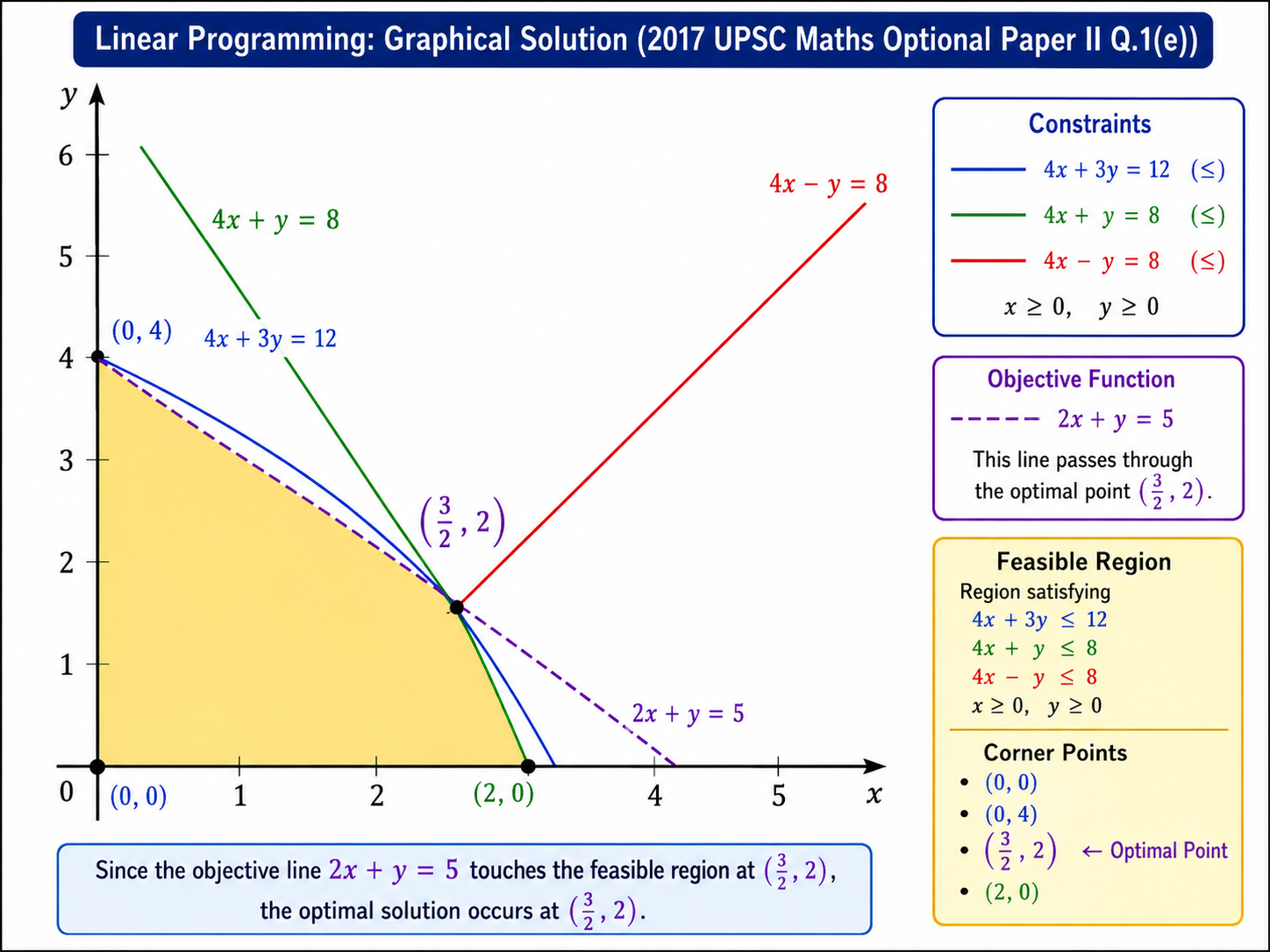
2 DiagramQuestion 1(e): Graphical method for linear programming
3 Concept Related to the QuestionIn graphical linear programming, each inequality represents a half-plane. Their common part is called the feasible region. A linear objective function reaches its maximum or minimum at a corner point of the feasible region.
4 Detailed SolutionWe have to maximize
\[Z=2x+y.\]
The constraints are
\[4x+3y\leq12,\qquad 4x+y\leq8,\qquad 4x-y\leq8,\qquad x\geq0,\quad y\geq0.\]
First find the corner points of the feasible region.
On the \(y\)-axis, put \(x=0\). The strongest restriction is \(3y\leq12\), so \(y\leq4\). Hence one corner point is \((0,4)\).
On the \(x\)-axis, put \(y=0\). The restrictions give \(4x\leq12\), \(4x\leq8\), and \(4x\leq8\). Hence \(x\leq2\), so one corner point is \((2,0)\).
The point of intersection of \(4x+3y=12\) and \(4x+y=8\) is found by subtracting the second equation from the first:
\[2y=4,\qquad y=2.\]
Substituting \(y=2\) in \(4x+y=8\),
\[4x+2=8,\qquad x=\frac32.\]
Thus another corner point is \(\left(\frac32,2\right)\). The origin \((0,0)\) is also a corner point.
Now evaluate \(Z=2x+y\) at all corner points.
Corner point Value of \(Z=2x+y\) \((0,0)\) \(0\) \((0,4)\) \(4\) \(\left(\frac32,2\right)\) \(2\cdot\frac32+2=5\) \((2,0)\) \(4\)
The largest value is \(5\).
5 Final AnswerThe maximum value of \(2x+y\) is \(5\), attained at \(x=\frac32\), \(y=2\).
Question 2(a) Differentiability of an integral with greatest-integer function
1. Question
2. Diagram
3. Concept Related to the Question
4. Detailed Solution
5. Final Answer
1 QuestionLet
\[f(t)=\int_0^t [x]\,dx,\]
where \([x]\) denote the largest integer less than or equal to \(x\).
(i) Determine all real numbers \(t\) at which \(f\) is differentiable.
(ii) Determine all real numbers \(t\) at which \(f\) is continuous but not differentiable.
2 Diagram
Full Solution Access The Diagram section for this question is available in the full 2017 UPSC Maths Optional Paper II PYQ Solutions course.
Complete diagrams, concepts, detailed solutions and final answers for all questions are available in the full PYQ course.
3 Concept Related to the Question
Full Solution Access The Concept Related to the Question section for this question is available in the full 2017 UPSC Maths Optional Paper II PYQ Solutions course.
Complete diagrams, concepts, detailed solutions and final answers for all questions are available in the full PYQ course.
4 Detailed Solution
Full Solution Access The Detailed Solution section for this question is available in the full 2017 UPSC Maths Optional Paper II PYQ Solutions course.
Complete diagrams, concepts, detailed solutions and final answers for all questions are available in the full PYQ course.
5 Final Answer
Full Solution Access The Final Answer section for this question is available in the full 2017 UPSC Maths Optional Paper II PYQ Solutions course.
Complete diagrams, concepts, detailed solutions and final answers for all questions are available in the full PYQ course.
Question 2(b) Contour integral evaluation
1. Question
2. Diagram
3. Concept Related to the Question
4. Detailed Solution
5. Final Answer
1 QuestionUsing contour integral method, prove that \(\displaystyle\int_0^\infty \frac{x\sin mx}{a^2+x^2}\,dx=\frac{\pi}{2}e^{-ma}\).
2 Diagram
Full Solution Access The Diagram section for this question is available in the full 2017 UPSC Maths Optional Paper II PYQ Solutions course.
Complete diagrams, concepts, detailed solutions and final answers for all questions are available in the full PYQ course.
3 Concept Related to the Question
Full Solution Access The Concept Related to the Question section for this question is available in the full 2017 UPSC Maths Optional Paper II PYQ Solutions course.
Complete diagrams, concepts, detailed solutions and final answers for all questions are available in the full PYQ course.
4 Detailed Solution
Full Solution Access The Detailed Solution section for this question is available in the full 2017 UPSC Maths Optional Paper II PYQ Solutions course.
Complete diagrams, concepts, detailed solutions and final answers for all questions are available in the full PYQ course.
5 Final Answer
Full Solution Access The Final Answer section for this question is available in the full 2017 UPSC Maths Optional Paper II PYQ Solutions course.
Complete diagrams, concepts, detailed solutions and final answers for all questions are available in the full PYQ course.
Question 2(c) Polynomial division algorithm
1. Question
2. Diagram
3. Concept Related to the Question
4. Detailed Solution
5. Final Answer
1 QuestionLet \(F\) be a field and \(F[X]\) denote the ring of polynomials over \(F\) in a single variable \(X\) and let \(f(X),g(X)\in F[X]\) with \(g(X)\neq0\). Show that there exist \(q(X),r(X)\in F[X]\) such that degree \(r(X)\lt\) degree \(g(X)\) and \(f(X)=q(X)\cdot g(X)+r(X)\).
2 Diagram
Full Solution Access The Diagram section for this question is available in the full 2017 UPSC Maths Optional Paper II PYQ Solutions course.
Complete diagrams, concepts, detailed solutions and final answers for all questions are available in the full PYQ course.
3 Concept Related to the Question
Full Solution Access The Concept Related to the Question section for this question is available in the full 2017 UPSC Maths Optional Paper II PYQ Solutions course.
Complete diagrams, concepts, detailed solutions and final answers for all questions are available in the full PYQ course.
4 Detailed Solution
Full Solution Access The Detailed Solution section for this question is available in the full 2017 UPSC Maths Optional Paper II PYQ Solutions course.
Complete diagrams, concepts, detailed solutions and final answers for all questions are available in the full PYQ course.
5 Final Answer
Full Solution Access The Final Answer section for this question is available in the full 2017 UPSC Maths Optional Paper II PYQ Solutions course.
Complete diagrams, concepts, detailed solutions and final answers for all questions are available in the full PYQ course.
Question 3(a) Isomorphism of cyclic groups
1. Question
2. Diagram
3. Concept Related to the Question
4. Detailed Solution
5. Final Answer
1 QuestionShow that the groups \(\mathbb Z_5\times\mathbb Z_7\) and \(\mathbb Z_{35}\) are isomorphic.
2 Diagram
Full Solution Access The Diagram section for this question is available in the full 2017 UPSC Maths Optional Paper II PYQ Solutions course.
Complete diagrams, concepts, detailed solutions and final answers for all questions are available in the full PYQ course.
3 Concept Related to the Question
Full Solution Access The Concept Related to the Question section for this question is available in the full 2017 UPSC Maths Optional Paper II PYQ Solutions course.
Complete diagrams, concepts, detailed solutions and final answers for all questions are available in the full PYQ course.
4 Detailed Solution
Full Solution Access The Detailed Solution section for this question is available in the full 2017 UPSC Maths Optional Paper II PYQ Solutions course.
Complete diagrams, concepts, detailed solutions and final answers for all questions are available in the full PYQ course.
5 Final Answer
Full Solution Access The Final Answer section for this question is available in the full 2017 UPSC Maths Optional Paper II PYQ Solutions course.
Complete diagrams, concepts, detailed solutions and final answers for all questions are available in the full PYQ course.
Question 3(b) Analytic functions and harmonic functions
1. Question
2. Diagram
3. Concept Related to the Question
4. Detailed Solution
5. Final Answer
1 QuestionLet \(f=u+iv\) be an analytic function on the unit disc \(D=\{z\in\mathbb C:|z|\lt1\}\). Show that \(\dfrac{\partial^2u}{\partial x^2}+\dfrac{\partial^2u}{\partial y^2}=0=\dfrac{\partial^2v}{\partial x^2}+\dfrac{\partial^2v}{\partial y^2}\) at all points of \(D\).
2 Diagram
Full Solution Access The Diagram section for this question is available in the full 2017 UPSC Maths Optional Paper II PYQ Solutions course.
Complete diagrams, concepts, detailed solutions and final answers for all questions are available in the full PYQ course.
3 Concept Related to the Question
Full Solution Access The Concept Related to the Question section for this question is available in the full 2017 UPSC Maths Optional Paper II PYQ Solutions course.
Complete diagrams, concepts, detailed solutions and final answers for all questions are available in the full PYQ course.
4 Detailed Solution
Full Solution Access The Detailed Solution section for this question is available in the full 2017 UPSC Maths Optional Paper II PYQ Solutions course.
Complete diagrams, concepts, detailed solutions and final answers for all questions are available in the full PYQ course.
5 Final Answer
Full Solution Access The Final Answer section for this question is available in the full 2017 UPSC Maths Optional Paper II PYQ Solutions course.
Complete diagrams, concepts, detailed solutions and final answers for all questions are available in the full PYQ course.
Question 3(c) Simplex method
1. Question
2. Diagram
3. Concept Related to the Question
4. Detailed Solution
5. Final Answer
1 QuestionSolve the following linear programming problem by simplex method :
Maximize
\[z=3x_1+5x_2+4x_3\]
subject to
\[2x_1+3x_2\leq8\]
\[2x_2+5x_3\leq10\]
\[3x_1+2x_2+4x_3\leq15\]
\[x_1,x_2,x_3\geq0.\]
2 Diagram
Full Solution Access The Diagram section for this question is available in the full 2017 UPSC Maths Optional Paper II PYQ Solutions course.
Complete diagrams, concepts, detailed solutions and final answers for all questions are available in the full PYQ course.
3 Concept Related to the Question
Full Solution Access The Concept Related to the Question section for this question is available in the full 2017 UPSC Maths Optional Paper II PYQ Solutions course.
Complete diagrams, concepts, detailed solutions and final answers for all questions are available in the full PYQ course.
4 Detailed Solution
Full Solution Access The Detailed Solution section for this question is available in the full 2017 UPSC Maths Optional Paper II PYQ Solutions course.
Complete diagrams, concepts, detailed solutions and final answers for all questions are available in the full PYQ course.
5 Final Answer
Full Solution Access The Final Answer section for this question is available in the full 2017 UPSC Maths Optional Paper II PYQ Solutions course.
Complete diagrams, concepts, detailed solutions and final answers for all questions are available in the full PYQ course.
Question 4(a) Zeros of derivatives of an entire function
1. Question
2. Diagram
3. Concept Related to the Question
4. Detailed Solution
5. Final Answer
1 QuestionFor a function \(f:\mathbb C\to\mathbb C\) and \(n\geq1\), let \(f^{(n)}\) denote the \(n^{\text{th}}\) derivative of \(f\), and \(f^{(0)}=f\). Let \(f\) be an entire function such that for some \(n\geq1\), \(f^{(n)}\left(\dfrac{1}{k}\right)=0\) for all \(k=1,2,3,\ldots\). Show that \(f\) is a polynomial.
2 Diagram
Full Solution Access The Diagram section for this question is available in the full 2017 UPSC Maths Optional Paper II PYQ Solutions course.
Complete diagrams, concepts, detailed solutions and final answers for all questions are available in the full PYQ course.
3 Concept Related to the Question
Full Solution Access The Concept Related to the Question section for this question is available in the full 2017 UPSC Maths Optional Paper II PYQ Solutions course.
Complete diagrams, concepts, detailed solutions and final answers for all questions are available in the full PYQ course.
4 Detailed Solution
Full Solution Access The Detailed Solution section for this question is available in the full 2017 UPSC Maths Optional Paper II PYQ Solutions course.
Complete diagrams, concepts, detailed solutions and final answers for all questions are available in the full PYQ course.
5 Final Answer
Full Solution Access The Final Answer section for this question is available in the full 2017 UPSC Maths Optional Paper II PYQ Solutions course.
Complete diagrams, concepts, detailed solutions and final answers for all questions are available in the full PYQ course.
Question 4(b) Vogel approximation method
1. Question
2. Diagram
3. Concept Related to the Question
4. Detailed Solution
5. Final Answer
1 QuestionFind the initial basic feasible solution of the following transportation problem using Vogel’s approximation method and find the cost.
Origins D1 D2 D3 D4 D5 Supply O1 4 7 0 3 6 14 O2 1 2 -3 3 8 9 O3 3 -1 4 0 5 17 Demand 8 3 8 13 8
2 Diagram
Full Solution Access The Diagram section for this question is available in the full 2017 UPSC Maths Optional Paper II PYQ Solutions course.
Complete diagrams, concepts, detailed solutions and final answers for all questions are available in the full PYQ course.
3 Concept Related to the Question
Full Solution Access The Concept Related to the Question section for this question is available in the full 2017 UPSC Maths Optional Paper II PYQ Solutions course.
Complete diagrams, concepts, detailed solutions and final answers for all questions are available in the full PYQ course.
4 Detailed Solution
Full Solution Access The Detailed Solution section for this question is available in the full 2017 UPSC Maths Optional Paper II PYQ Solutions course.
Complete diagrams, concepts, detailed solutions and final answers for all questions are available in the full PYQ course.
5 Final Answer
Full Solution Access The Final Answer section for this question is available in the full 2017 UPSC Maths Optional Paper II PYQ Solutions course.
Complete diagrams, concepts, detailed solutions and final answers for all questions are available in the full PYQ course.
Question 4(c) Riemann rearrangement theorem
1. Question
2. Diagram
3. Concept Related to the Question
4. Detailed Solution
5. Final Answer
1 QuestionLet \(\displaystyle\sum_{n=1}^{\infty}x_n\) be a conditionally convergent series of real numbers. Show that there is a rearrangement \(\displaystyle\sum_{n=1}^{\infty}x_{\pi(n)}\) of the series \(\displaystyle\sum_{n=1}^{\infty}x_n\) that converges to \(100\).
2 Diagram
Full Solution Access The Diagram section for this question is available in the full 2017 UPSC Maths Optional Paper II PYQ Solutions course.
Complete diagrams, concepts, detailed solutions and final answers for all questions are available in the full PYQ course.
3 Concept Related to the Question
Full Solution Access The Concept Related to the Question section for this question is available in the full 2017 UPSC Maths Optional Paper II PYQ Solutions course.
Complete diagrams, concepts, detailed solutions and final answers for all questions are available in the full PYQ course.
4 Detailed Solution
Full Solution Access The Detailed Solution section for this question is available in the full 2017 UPSC Maths Optional Paper II PYQ Solutions course.
Complete diagrams, concepts, detailed solutions and final answers for all questions are available in the full PYQ course.
5 Final Answer
Full Solution Access The Final Answer section for this question is available in the full 2017 UPSC Maths Optional Paper II PYQ Solutions course.
Complete diagrams, concepts, detailed solutions and final answers for all questions are available in the full PYQ course.
Question 5(a) Linear partial differential equation
1. Question
2. Diagram
3. Concept Related to the Question
4. Detailed Solution
5. Final Answer
1 QuestionSolve \((D^2-2DD'+D'^2)z=e^{x+2y}+x^3+\sin2x\), where \(D=\dfrac{\partial}{\partial x}\), \(D'=\dfrac{\partial}{\partial y}\), \(D^2=\dfrac{\partial^2}{\partial x^2}\), and \(D'^2=\dfrac{\partial^2}{\partial y^2}\).
2 Diagram
Full Solution Access The Diagram section for this question is available in the full 2017 UPSC Maths Optional Paper II PYQ Solutions course.
Complete diagrams, concepts, detailed solutions and final answers for all questions are available in the full PYQ course.
3 Concept Related to the Question
Full Solution Access The Concept Related to the Question section for this question is available in the full 2017 UPSC Maths Optional Paper II PYQ Solutions course.
Complete diagrams, concepts, detailed solutions and final answers for all questions are available in the full PYQ course.
4 Detailed Solution
Full Solution Access The Detailed Solution section for this question is available in the full 2017 UPSC Maths Optional Paper II PYQ Solutions course.
Complete diagrams, concepts, detailed solutions and final answers for all questions are available in the full PYQ course.
5 Final Answer
Full Solution Access The Final Answer section for this question is available in the full 2017 UPSC Maths Optional Paper II PYQ Solutions course.
Complete diagrams, concepts, detailed solutions and final answers for all questions are available in the full PYQ course.
Question 5(b) Gauss-Jordan inverse of a matrix
1. Question
2. Diagram
3. Concept Related to the Question
4. Detailed Solution
5. Final Answer
1 QuestionExplain the main steps of the Gauss-Jordan method and apply this method to find the inverse of the matrix \( {\large \left[\begin{smallmatrix}2&6&6\\2&8&6\\2&6&8\end{smallmatrix}\right]} \).
2 Diagram
Full Solution Access The Diagram section for this question is available in the full 2017 UPSC Maths Optional Paper II PYQ Solutions course.
Complete diagrams, concepts, detailed solutions and final answers for all questions are available in the full PYQ course.
3 Concept Related to the Question
Full Solution Access The Concept Related to the Question section for this question is available in the full 2017 UPSC Maths Optional Paper II PYQ Solutions course.
Complete diagrams, concepts, detailed solutions and final answers for all questions are available in the full PYQ course.
4 Detailed Solution
Full Solution Access The Detailed Solution section for this question is available in the full 2017 UPSC Maths Optional Paper II PYQ Solutions course.
Complete diagrams, concepts, detailed solutions and final answers for all questions are available in the full PYQ course.
5 Final Answer
Full Solution Access The Final Answer section for this question is available in the full 2017 UPSC Maths Optional Paper II PYQ Solutions course.
Complete diagrams, concepts, detailed solutions and final answers for all questions are available in the full PYQ course.
Question 5(c) Boolean simplification
1. Question
2. Diagram
3. Concept Related to the Question
4. Detailed Solution
5. Final Answer
1 QuestionWrite the Boolean expression \(z(y+z)(x+y+z)\) in its simplest form using Boolean postulate rules. Mention the rules used during simplification. Verify your result by constructing the truth table for the given expression and for its simplest form.
2 Diagram
Full Solution Access The Diagram section for this question is available in the full 2017 UPSC Maths Optional Paper II PYQ Solutions course.
Complete diagrams, concepts, detailed solutions and final answers for all questions are available in the full PYQ course.
3 Concept Related to the Question
Full Solution Access The Concept Related to the Question section for this question is available in the full 2017 UPSC Maths Optional Paper II PYQ Solutions course.
Complete diagrams, concepts, detailed solutions and final answers for all questions are available in the full PYQ course.
4 Detailed Solution
Full Solution Access The Detailed Solution section for this question is available in the full 2017 UPSC Maths Optional Paper II PYQ Solutions course.
Complete diagrams, concepts, detailed solutions and final answers for all questions are available in the full PYQ course.
5 Final Answer
Full Solution Access The Final Answer section for this question is available in the full 2017 UPSC Maths Optional Paper II PYQ Solutions course.
Complete diagrams, concepts, detailed solutions and final answers for all questions are available in the full PYQ course.
Question 5(d) Uniqueness for Poisson equation
1. Question
2. Diagram
3. Concept Related to the Question
4. Detailed Solution
5. Final Answer
1 QuestionLet \(\Gamma\) be a closed curve in \(xy\)-plane and let \(S\) denote the region bounded by the curve \(\Gamma\). Let \(\dfrac{\partial^2w}{\partial x^2}+\dfrac{\partial^2w}{\partial y^2}=f(x,y)\), \(\forall(x,y)\in S\). If \(f\) is prescribed at each point \((x,y)\) of \(S\) and \(w\) is prescribed on the boundary \(\Gamma\) of \(S\), then prove that any solution \(w=w(x,y)\), satisfying these conditions, is unique.
2 Diagram
Full Solution Access The Diagram section for this question is available in the full 2017 UPSC Maths Optional Paper II PYQ Solutions course.
Complete diagrams, concepts, detailed solutions and final answers for all questions are available in the full PYQ course.
3 Concept Related to the Question
Full Solution Access The Concept Related to the Question section for this question is available in the full 2017 UPSC Maths Optional Paper II PYQ Solutions course.
Complete diagrams, concepts, detailed solutions and final answers for all questions are available in the full PYQ course.
4 Detailed Solution
Full Solution Access The Detailed Solution section for this question is available in the full 2017 UPSC Maths Optional Paper II PYQ Solutions course.
Complete diagrams, concepts, detailed solutions and final answers for all questions are available in the full PYQ course.
5 Final Answer
Full Solution Access The Final Answer section for this question is available in the full 2017 UPSC Maths Optional Paper II PYQ Solutions course.
Complete diagrams, concepts, detailed solutions and final answers for all questions are available in the full PYQ course.
Question 5(e) Moment of inertia of elliptic area
1. Question
2. Diagram
3. Concept Related to the Question
4. Detailed Solution
5. Final Answer
1 QuestionShow that the moment of inertia of an elliptic area of mass \(M\) and semi-axis \(a\) and \(b\) about a semi-diameter of length \(r\) is \(\dfrac14 M\dfrac{a^2b^2}{r^2}\). Further, prove that the moment of inertia about a tangent is \(\dfrac{5M}{4}p^2\), where \(p\) is the perpendicular distance from the centre of the ellipse to the tangent.
2 Diagram
Full Solution Access The Diagram section for this question is available in the full 2017 UPSC Maths Optional Paper II PYQ Solutions course.
Complete diagrams, concepts, detailed solutions and final answers for all questions are available in the full PYQ course.
3 Concept Related to the Question
Full Solution Access The Concept Related to the Question section for this question is available in the full 2017 UPSC Maths Optional Paper II PYQ Solutions course.
Complete diagrams, concepts, detailed solutions and final answers for all questions are available in the full PYQ course.
4 Detailed Solution
Full Solution Access The Detailed Solution section for this question is available in the full 2017 UPSC Maths Optional Paper II PYQ Solutions course.
Complete diagrams, concepts, detailed solutions and final answers for all questions are available in the full PYQ course.
5 Final Answer
Full Solution Access The Final Answer section for this question is available in the full 2017 UPSC Maths Optional Paper II PYQ Solutions course.
Complete diagrams, concepts, detailed solutions and final answers for all questions are available in the full PYQ course.
Question 6(a) Complete integral of first-order PDE
1. Question
2. Diagram
3. Concept Related to the Question
4. Detailed Solution
5. Final Answer
1 QuestionFind complete integral of the partial differential equation
\[2(pq+yp+qx)+x^2+y^2=0.\]
2 Diagram
Full Solution Access The Diagram section for this question is available in the full 2017 UPSC Maths Optional Paper II PYQ Solutions course.
Complete diagrams, concepts, detailed solutions and final answers for all questions are available in the full PYQ course.
3 Concept Related to the Question
Full Solution Access The Concept Related to the Question section for this question is available in the full 2017 UPSC Maths Optional Paper II PYQ Solutions course.
Complete diagrams, concepts, detailed solutions and final answers for all questions are available in the full PYQ course.
4 Detailed Solution
Full Solution Access The Detailed Solution section for this question is available in the full 2017 UPSC Maths Optional Paper II PYQ Solutions course.
Complete diagrams, concepts, detailed solutions and final answers for all questions are available in the full PYQ course.
5 Final Answer
Full Solution Access The Final Answer section for this question is available in the full 2017 UPSC Maths Optional Paper II PYQ Solutions course.
Complete diagrams, concepts, detailed solutions and final answers for all questions are available in the full PYQ course.
Question 6(b) Lagrange interpolation formula
1. Question
2. Diagram
3. Concept Related to the Question
4. Detailed Solution
5. Final Answer
1 QuestionFor given equidistant values \(u_{-1},u_0,u_1\) and \(u_2\), a value is interpolated by Lagrange’s formula. Show that it may be written in the form
\[u_x=yu_0+xu_1+\frac{y(y^2-1)}{3!}\Delta^2u_{-1}+\frac{x(x^2-1)}{3!}\Delta^2u_0,\]
where \(x+y=1\).
2 Diagram
Full Solution Access The Diagram section for this question is available in the full 2017 UPSC Maths Optional Paper II PYQ Solutions course.
Complete diagrams, concepts, detailed solutions and final answers for all questions are available in the full PYQ course.
3 Concept Related to the Question
Full Solution Access The Concept Related to the Question section for this question is available in the full 2017 UPSC Maths Optional Paper II PYQ Solutions course.
Complete diagrams, concepts, detailed solutions and final answers for all questions are available in the full PYQ course.
4 Detailed Solution
Full Solution Access The Detailed Solution section for this question is available in the full 2017 UPSC Maths Optional Paper II PYQ Solutions course.
Complete diagrams, concepts, detailed solutions and final answers for all questions are available in the full PYQ course.
5 Final Answer
Full Solution Access The Final Answer section for this question is available in the full 2017 UPSC Maths Optional Paper II PYQ Solutions course.
Complete diagrams, concepts, detailed solutions and final answers for all questions are available in the full PYQ course.
Question 6(c) Kinetic energy and Lagrange equations
1. Question
2. Diagram
3. Concept Related to the Question
4. Detailed Solution
5. Final Answer
1 QuestionTwo uniform rods \(AB,AC\), each of mass \(m\) and length \(2a\), are smoothly hinged together at \(A\) and move on a horizontal plane. At time \(t\) the mass centre of the rods is at the point \((\xi,\eta)\) referred to fixed perpendicular axes \(Ox, Oy\) in the plane, and the rods make angles \(\theta\pm\phi\) with \(Ox\). Prove that the kinetic energy of the system is
\[m\left[\dot{\xi}^{\,2}+\dot{\eta}^{\,2}+\left(\frac13+\sin^2\phi\right)a^2\dot{\theta}^{\,2}+\left(\frac13+\cos^2\phi\right)a^2\dot{\phi}^{\,2}\right].\]
Also derive Lagrange’s equations of motion for the system if an external force with components \([X,Y]\) along the axes acts at \(A\).
2 Diagram
Full Solution Access The Diagram section for this question is available in the full 2017 UPSC Maths Optional Paper II PYQ Solutions course.
Complete diagrams, concepts, detailed solutions and final answers for all questions are available in the full PYQ course.
3 Concept Related to the Question
Full Solution Access The Concept Related to the Question section for this question is available in the full 2017 UPSC Maths Optional Paper II PYQ Solutions course.
Complete diagrams, concepts, detailed solutions and final answers for all questions are available in the full PYQ course.
4 Detailed Solution
Full Solution Access The Detailed Solution section for this question is available in the full 2017 UPSC Maths Optional Paper II PYQ Solutions course.
Complete diagrams, concepts, detailed solutions and final answers for all questions are available in the full PYQ course.
5 Final Answer
Full Solution Access The Final Answer section for this question is available in the full 2017 UPSC Maths Optional Paper II PYQ Solutions course.
Complete diagrams, concepts, detailed solutions and final answers for all questions are available in the full PYQ course.
Question 7(a) Canonical form of second-order PDE
1. Question
2. Diagram
3. Concept Related to the Question
4. Detailed Solution
5. Final Answer
1 QuestionReduce the equation
\[y^2\frac{\partial^2z}{\partial x^2}-2xy\frac{\partial^2z}{\partial x\partial y}+x^2\frac{\partial^2z}{\partial y^2}=\frac{y^2}{x}\frac{\partial z}{\partial x}+\frac{x^2}{y}\frac{\partial z}{\partial y}\]
to canonical form and hence solve it.
2 Diagram
Full Solution Access The Diagram section for this question is available in the full 2017 UPSC Maths Optional Paper II PYQ Solutions course.
Complete diagrams, concepts, detailed solutions and final answers for all questions are available in the full PYQ course.
3 Concept Related to the Question
Full Solution Access The Concept Related to the Question section for this question is available in the full 2017 UPSC Maths Optional Paper II PYQ Solutions course.
Complete diagrams, concepts, detailed solutions and final answers for all questions are available in the full PYQ course.
4 Detailed Solution
Full Solution Access The Detailed Solution section for this question is available in the full 2017 UPSC Maths Optional Paper II PYQ Solutions course.
Complete diagrams, concepts, detailed solutions and final answers for all questions are available in the full PYQ course.
5 Final Answer
Full Solution Access The Final Answer section for this question is available in the full 2017 UPSC Maths Optional Paper II PYQ Solutions course.
Complete diagrams, concepts, detailed solutions and final answers for all questions are available in the full PYQ course.
Question 7(b) Simpson's three-eighth rule
1. Question
2. Diagram
3. Concept Related to the Question
4. Detailed Solution
5. Final Answer
1 QuestionDerive the formula
\[\int_a^b y\,dx=\frac{3h}{8}\left[(y_0+y_n)+3(y_1+y_2+y_4+y_5+\cdots+y_{n-1})+2(y_3+y_6+\cdots+y_{n-3})\right].\]
Is there any restriction on \(n\)? State that condition. What is the error bound in the case of Simpson’s \(\frac38\) rule?
2 Diagram
Full Solution Access The Diagram section for this question is available in the full 2017 UPSC Maths Optional Paper II PYQ Solutions course.
Complete diagrams, concepts, detailed solutions and final answers for all questions are available in the full PYQ course.
3 Concept Related to the Question
Full Solution Access The Concept Related to the Question section for this question is available in the full 2017 UPSC Maths Optional Paper II PYQ Solutions course.
Complete diagrams, concepts, detailed solutions and final answers for all questions are available in the full PYQ course.
4 Detailed Solution
Full Solution Access The Detailed Solution section for this question is available in the full 2017 UPSC Maths Optional Paper II PYQ Solutions course.
Complete diagrams, concepts, detailed solutions and final answers for all questions are available in the full PYQ course.
5 Final Answer
Full Solution Access The Final Answer section for this question is available in the full 2017 UPSC Maths Optional Paper II PYQ Solutions course.
Complete diagrams, concepts, detailed solutions and final answers for all questions are available in the full PYQ course.
Question 7(c) Steady flow through a conical pipe
1. Question
2. Diagram
3. Concept Related to the Question
4. Detailed Solution
5. Final Answer
1 QuestionA stream is rushing from a boiler through a conical pipe, the diameters of the ends of which are \(D\) and \(d\). If \(V\) and \(v\) be the corresponding velocities of the stream and if the motion is assumed to be steady and diverging from the vertex of the cone, then prove that
\[\frac{v}{V}=\frac{D^2}{d^2}e^{(v^2-V^2)/2K},\]
where \(K\) is the pressure divided by the density and is constant.
2 Diagram
Full Solution Access The Diagram section for this question is available in the full 2017 UPSC Maths Optional Paper II PYQ Solutions course.
Complete diagrams, concepts, detailed solutions and final answers for all questions are available in the full PYQ course.
3 Concept Related to the Question
Full Solution Access The Concept Related to the Question section for this question is available in the full 2017 UPSC Maths Optional Paper II PYQ Solutions course.
Complete diagrams, concepts, detailed solutions and final answers for all questions are available in the full PYQ course.
4 Detailed Solution
Full Solution Access The Detailed Solution section for this question is available in the full 2017 UPSC Maths Optional Paper II PYQ Solutions course.
Complete diagrams, concepts, detailed solutions and final answers for all questions are available in the full PYQ course.
5 Final Answer
Full Solution Access The Final Answer section for this question is available in the full 2017 UPSC Maths Optional Paper II PYQ Solutions course.
Complete diagrams, concepts, detailed solutions and final answers for all questions are available in the full PYQ course.
Question 8(a) One-dimensional wave equation
1. Question
2. Diagram
3. Concept Related to the Question
4. Detailed Solution
5. Final Answer
1 QuestionGiven the one-dimensional wave equation
\[\frac{\partial^2y}{\partial t^2}=c^2\frac{\partial^2y}{\partial x^2},\qquad t\gt0,\]
where \(c^2=\dfrac{T}{m}\), \(T\) is the constant tension in the string and \(m\) is the mass per unit length of the string.
(i) Find the appropriate solution of the above wave equation.
(ii) Find also the solution under the conditions
\[y(0,t)=0,\qquad y(l,t)=0\quad\text{for all }t\]
and
\[\left[\frac{\partial y}{\partial t}\right]_{t=0}=0,\qquad y(x,0)=a\sin\frac{\pi x}{l},\qquad 0\lt x\lt l,\quad a\gt0.\]
2 Diagram
Full Solution Access The Diagram section for this question is available in the full 2017 UPSC Maths Optional Paper II PYQ Solutions course.
Complete diagrams, concepts, detailed solutions and final answers for all questions are available in the full PYQ course.
3 Concept Related to the Question
Full Solution Access The Concept Related to the Question section for this question is available in the full 2017 UPSC Maths Optional Paper II PYQ Solutions course.
Complete diagrams, concepts, detailed solutions and final answers for all questions are available in the full PYQ course.
4 Detailed Solution
Full Solution Access The Detailed Solution section for this question is available in the full 2017 UPSC Maths Optional Paper II PYQ Solutions course.
Complete diagrams, concepts, detailed solutions and final answers for all questions are available in the full PYQ course.
5 Final Answer
Full Solution Access The Final Answer section for this question is available in the full 2017 UPSC Maths Optional Paper II PYQ Solutions course.
Complete diagrams, concepts, detailed solutions and final answers for all questions are available in the full PYQ course.
Question 8(b) Newton-Raphson method flow chart and failures
1. Question
2. Diagram
3. Concept Related to the Question
4. Detailed Solution
5. Final Answer
1 QuestionWrite an algorithm in the form of a flow chart for Newton-Raphson method. Describe the cases of failure of this method.
2 Diagram
Full Solution Access The Diagram section for this question is available in the full 2017 UPSC Maths Optional Paper II PYQ Solutions course.
Complete diagrams, concepts, detailed solutions and final answers for all questions are available in the full PYQ course.
3 Concept Related to the Question
Full Solution Access The Concept Related to the Question section for this question is available in the full 2017 UPSC Maths Optional Paper II PYQ Solutions course.
Complete diagrams, concepts, detailed solutions and final answers for all questions are available in the full PYQ course.
4 Detailed Solution
Full Solution Access The Detailed Solution section for this question is available in the full 2017 UPSC Maths Optional Paper II PYQ Solutions course.
Complete diagrams, concepts, detailed solutions and final answers for all questions are available in the full PYQ course.
5 Final Answer
Full Solution Access The Final Answer section for this question is available in the full 2017 UPSC Maths Optional Paper II PYQ Solutions course.
Complete diagrams, concepts, detailed solutions and final answers for all questions are available in the full PYQ course.
Question 8(c) Velocity potential and streamlines
1. Question
2. Diagram
3. Concept Related to the Question
4. Detailed Solution
5. Final Answer
1 QuestionIf the velocity of an incompressible fluid at the point \((x,y,z)\) is given by \(\left(\dfrac{3xz}{r^5},\dfrac{3yz}{r^5},\dfrac{3z^2-r^2}{r^5}\right)\), \(r^2=x^2+y^2+z^2\), then prove that the liquid motion is possible and that the velocity potential is \(\dfrac{z}{r^3}\). Further, determine the streamlines.
2 Diagram
Full Solution Access The Diagram section for this question is available in the full 2017 UPSC Maths Optional Paper II PYQ Solutions course.
Complete diagrams, concepts, detailed solutions and final answers for all questions are available in the full PYQ course.
3 Concept Related to the Question
Full Solution Access The Concept Related to the Question section for this question is available in the full 2017 UPSC Maths Optional Paper II PYQ Solutions course.
Complete diagrams, concepts, detailed solutions and final answers for all questions are available in the full PYQ course.
4 Detailed Solution
Full Solution Access The Detailed Solution section for this question is available in the full 2017 UPSC Maths Optional Paper II PYQ Solutions course.
Complete diagrams, concepts, detailed solutions and final answers for all questions are available in the full PYQ course.
5 Final Answer
Full Solution Access The Final Answer section for this question is available in the full 2017 UPSC Maths Optional Paper II PYQ Solutions course.
Complete diagrams, concepts, detailed solutions and final answers for all questions are available in the full PYQ course.
2017 UPSC Maths Optional Paper II Solutions FAQs
Are these 2017 UPSC Maths Optional Paper II Solutions complete? This public page gives one complete sample solution. Complete solutions for all questions are available in the full PYQ course.
Which question is given as a free sample solution on this page? Question 1(e) is given as the free sample solution on this page.
How should I use these 2017 UPSC Maths Optional Paper II Solutions for preparation? Students should first read the question carefully, understand the concept, study the diagram where required, and then practise writing the detailed solution and final answer.
Do these solutions include diagrams and detailed solutions? Yes. The full PYQ course includes diagrams where needed, concept explanation, detailed solution, and final answer for each question.
How can I get complete solutions for all questions in 2017 UPSC Maths Optional Paper II? To get complete solutions for all questions, please fill out the admission form first. Our Ramana Sri IAS admission team will guide you through WhatsApp, email, or call.