Ramana Sri IAS - 2018 UPSC Maths Optional Paper I Solutions
2018 UPSC Maths Optional Paper I Solutions Ramana Sri IAS provides complete and updated solutions for the 2018 UPSC Maths Optional Paper I. Aspirants preparing for the UPSC Mains Examination with Mathematics as their optional subject should solve all these questions carefully at least 5 to 10 times before the mains examination.
Ramana Sri IAS presents complete solutions for UPSC/IAS/CSE-Civil Service Examination 2018 Mathematics Optional Paper I. Each answer follows the same format: Question, Diagram where needed, Concept Related to the Question, Detailed Solution, and Final Answer.
About 2018 UPSC Maths Optional Paper I Solutions These 2018 UPSC Maths Optional Paper I Solutions are prepared by Ramana Sri IAS for aspirants who want question-wise clarity before the UPSC Mains examination. This public page gives one full sample solution, while the complete paper-wise solutions are available in the full PYQ course.
Students can use these 2018 UPSC Maths Optional Paper I Solutions to understand the expected answer-writing method, diagram presentation, concept application, and final-answer format used by Ramana Sri IAS.
For the official examination source, students may also refer to the UPSC previous year question papers page .
These 2018 UPSC Maths Optional Paper I Solutions are useful for revision, answer-writing practice, and understanding the step-by-step method expected in the UPSC Mathematics optional paper.
Sample Full Solution
We are giving one question as a free sample solution below:
Question 1(e) . This free sample includes all five sections:
Question , Diagram ,
Concept Related to the Question ,
Detailed Solution , and Final Answer .
Complete solutions for all questions are available in the full PYQ course. To purchase the full solutions,
please fill out the admission form first. Our Ramana Sri IAS admission team will guide you through WhatsApp, email, or call.
2018 UPSC Maths Optional Paper I Solutions: Table of Contents
Question 1(a) Singular matrix by rank argument
1. Question
2. Diagram
3. Concept Related to the Question
4. Detailed Solution
5. Final Answer
1 QuestionLet \(A\) be a \(3\times2\) matrix and \(B\) a \(2\times3\) matrix. Show that \(C=A\cdot B\) is a singular matrix.
2 Diagram
Full Solution Access The Diagram section for this question is available in the full 2018 UPSC Maths Optional Paper I PYQ Solutions course.
Complete diagrams, concepts, detailed solutions and final answers for all questions are available in the full PYQ course.
3 Concept Related to the Question
Full Solution Access The Concept Related to the Question section for this question is available in the full 2018 UPSC Maths Optional Paper I PYQ Solutions course.
Complete diagrams, concepts, detailed solutions and final answers for all questions are available in the full PYQ course.
4 Detailed Solution
Full Solution Access The Detailed Solution section for this question is available in the full 2018 UPSC Maths Optional Paper I PYQ Solutions course.
Complete diagrams, concepts, detailed solutions and final answers for all questions are available in the full PYQ course.
5 Final Answer
Full Solution Access The Final Answer section for this question is available in the full 2018 UPSC Maths Optional Paper I PYQ Solutions course.
Complete diagrams, concepts, detailed solutions and final answers for all questions are available in the full PYQ course.
Question 1(b) Change of basis in \(\mathbb{R}^2\)
1. Question
2. Diagram
3. Concept Related to the Question
4. Detailed Solution
5. Final Answer
1 QuestionExpress basis vectors \(e_1=(1,0)\) and \(e_2=(0,1)\) as linear combinations of \(\alpha_1=(2,-1)\) and \(\alpha_2=(1,3)\).
2 Diagram
Full Solution Access The Diagram section for this question is available in the full 2018 UPSC Maths Optional Paper I PYQ Solutions course.
Complete diagrams, concepts, detailed solutions and final answers for all questions are available in the full PYQ course.
3 Concept Related to the Question
Full Solution Access The Concept Related to the Question section for this question is available in the full 2018 UPSC Maths Optional Paper I PYQ Solutions course.
Complete diagrams, concepts, detailed solutions and final answers for all questions are available in the full PYQ course.
4 Detailed Solution
Full Solution Access The Detailed Solution section for this question is available in the full 2018 UPSC Maths Optional Paper I PYQ Solutions course.
Complete diagrams, concepts, detailed solutions and final answers for all questions are available in the full PYQ course.
5 Final Answer
Full Solution Access The Final Answer section for this question is available in the full 2018 UPSC Maths Optional Paper I PYQ Solutions course.
Complete diagrams, concepts, detailed solutions and final answers for all questions are available in the full PYQ course.
Question 1(c) Limit involving tangent
1. Question
2. Diagram
3. Concept Related to the Question
4. Detailed Solution
5. Final Answer
1 QuestionDetermine if \(\displaystyle \lim_{z\to1}(1-z)\tan\frac{\pi z}{2}\) exists or not. If the limit exists, then find its value.
2 Diagram
Full Solution Access The Diagram section for this question is available in the full 2018 UPSC Maths Optional Paper I PYQ Solutions course.
Complete diagrams, concepts, detailed solutions and final answers for all questions are available in the full PYQ course.
3 Concept Related to the Question
Full Solution Access The Concept Related to the Question section for this question is available in the full 2018 UPSC Maths Optional Paper I PYQ Solutions course.
Complete diagrams, concepts, detailed solutions and final answers for all questions are available in the full PYQ course.
4 Detailed Solution
Full Solution Access The Detailed Solution section for this question is available in the full 2018 UPSC Maths Optional Paper I PYQ Solutions course.
Complete diagrams, concepts, detailed solutions and final answers for all questions are available in the full PYQ course.
5 Final Answer
Full Solution Access The Final Answer section for this question is available in the full 2018 UPSC Maths Optional Paper I PYQ Solutions course.
Complete diagrams, concepts, detailed solutions and final answers for all questions are available in the full PYQ course.
Question 1(d) Limit as a Riemann sum
1. Question
2. Diagram
3. Concept Related to the Question
4. Detailed Solution
5. Final Answer
1 QuestionFind \(\displaystyle \lim_{n\to\infty}\frac{1}{n^2}\sum_{r=0}^{n-1}\sqrt{n^2-r^2}\).
2 Diagram
Full Solution Access The Diagram section for this question is available in the full 2018 UPSC Maths Optional Paper I PYQ Solutions course.
Complete diagrams, concepts, detailed solutions and final answers for all questions are available in the full PYQ course.
3 Concept Related to the Question
Full Solution Access The Concept Related to the Question section for this question is available in the full 2018 UPSC Maths Optional Paper I PYQ Solutions course.
Complete diagrams, concepts, detailed solutions and final answers for all questions are available in the full PYQ course.
4 Detailed Solution
Full Solution Access The Detailed Solution section for this question is available in the full 2018 UPSC Maths Optional Paper I PYQ Solutions course.
Complete diagrams, concepts, detailed solutions and final answers for all questions are available in the full PYQ course.
5 Final Answer
Full Solution Access The Final Answer section for this question is available in the full 2018 UPSC Maths Optional Paper I PYQ Solutions course.
Complete diagrams, concepts, detailed solutions and final answers for all questions are available in the full PYQ course.
Question 1(e) Projection of a line on a plane
1. Question
2. Diagram
3. Concept Related to the Question
4. Detailed Solution
5. Final Answer
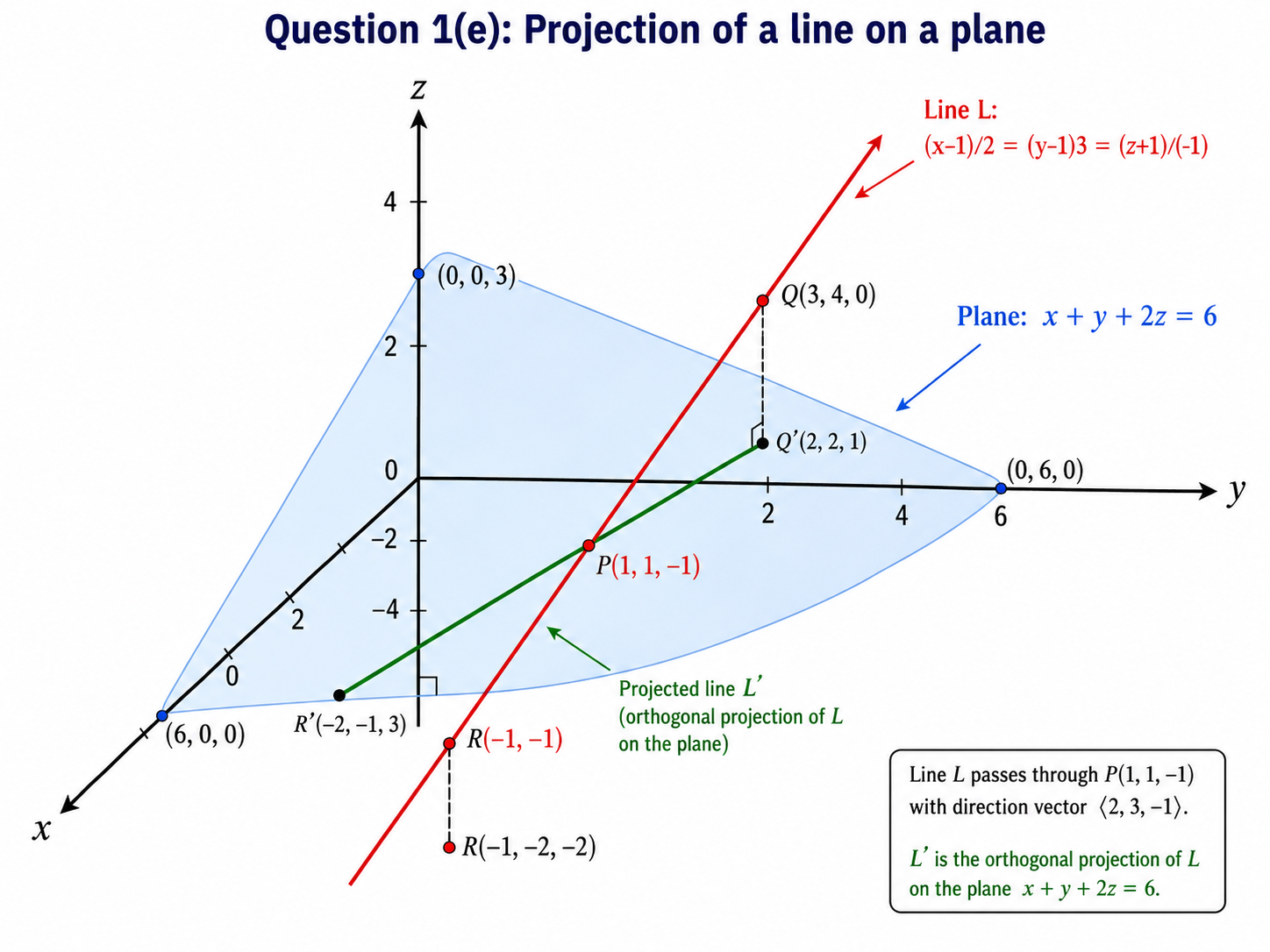
1 QuestionFind the projection of the straight line \(\frac{x-1}{2}=\frac{y-1}{3}=\frac{z+1}{-1}\) on the plane \(x+y+2z=6\).
2 DiagramQuestion 1(e): Projection of the line on the plane x + y + 2z = 6
3 Concept Related to the QuestionThe projection of a point on a plane can be obtained by moving it along the normal direction of the plane. This gives the projected point in coordinate form.
4 Detailed SolutionLet the parameter on the given line be \(t\). Then a general point on the line is
\[P(t)=(1+2t,\,1+3t,\,-1-t).\]
The normal direction of the plane \(x+y+2z=6\) is \((1,1,2)\). A point on the projected line is therefore of the form
\[Q(t)=P(t)+\lambda(1,1,2).\]
To make \(Q(t)\) lie on the plane, substitute into \(x+y+2z=6\). For \(P(t)\), we have
\[(1+2t)+(1+3t)+2(-1-t)=3t.\]
Hence \(3t+6\lambda=6\), so \(\lambda=1-\frac{t}{2}\). Therefore
\[Q(t)=\left(2+\frac{3t}{2},\,2+\frac{5t}{2},\,1-2t\right).\]
Putting \(s=\frac{t}{2}\), the projected line becomes
\[x=2+3s,\qquad y=2+5s,\qquad z=1-4s.\]
5 Final Answer\[\frac{x-2}{3}=\frac{y-2}{5}=\frac{z-1}{-4}.\]
Question 2(a) Similar matrices have same eigenvalues
1. Question
2. Diagram
3. Concept Related to the Question
4. Detailed Solution
5. Final Answer
1 QuestionShow that if \(A\) and \(B\) are similar \(n\times n\) matrices, then they have the same eigenvalues.
2 Diagram
Full Solution Access The Diagram section for this question is available in the full 2018 UPSC Maths Optional Paper I PYQ Solutions course.
Complete diagrams, concepts, detailed solutions and final answers for all questions are available in the full PYQ course.
3 Concept Related to the Question
Full Solution Access The Concept Related to the Question section for this question is available in the full 2018 UPSC Maths Optional Paper I PYQ Solutions course.
Complete diagrams, concepts, detailed solutions and final answers for all questions are available in the full PYQ course.
4 Detailed Solution
Full Solution Access The Detailed Solution section for this question is available in the full 2018 UPSC Maths Optional Paper I PYQ Solutions course.
Complete diagrams, concepts, detailed solutions and final answers for all questions are available in the full PYQ course.
5 Final Answer
Full Solution Access The Final Answer section for this question is available in the full 2018 UPSC Maths Optional Paper I PYQ Solutions course.
Complete diagrams, concepts, detailed solutions and final answers for all questions are available in the full PYQ course.
Question 2(b) Shortest distance from a point to a parabola
1. Question
2. Diagram
3. Concept Related to the Question
4. Detailed Solution
5. Final Answer
1 QuestionFind the shortest distance from the point \((1,0)\) to the parabola \(y^2=4x\).
2 Diagram
Full Solution Access The Diagram section for this question is available in the full 2018 UPSC Maths Optional Paper I PYQ Solutions course.
Complete diagrams, concepts, detailed solutions and final answers for all questions are available in the full PYQ course.
3 Concept Related to the Question
Full Solution Access The Concept Related to the Question section for this question is available in the full 2018 UPSC Maths Optional Paper I PYQ Solutions course.
Complete diagrams, concepts, detailed solutions and final answers for all questions are available in the full PYQ course.
4 Detailed Solution
Full Solution Access The Detailed Solution section for this question is available in the full 2018 UPSC Maths Optional Paper I PYQ Solutions course.
Complete diagrams, concepts, detailed solutions and final answers for all questions are available in the full PYQ course.
5 Final Answer
Full Solution Access The Final Answer section for this question is available in the full 2018 UPSC Maths Optional Paper I PYQ Solutions course.
Complete diagrams, concepts, detailed solutions and final answers for all questions are available in the full PYQ course.
Question 2(c) Volume of ellipsoid of revolution
1. Question
2. Diagram
3. Concept Related to the Question
4. Detailed Solution
5. Final Answer
1 QuestionThe ellipse \(\frac{x^2}{a^2}+\frac{y^2}{b^2}=1\) revolves about the \(x\)-axis. Find the volume of the solid of revolution.
2 Diagram
Full Solution Access The Diagram section for this question is available in the full 2018 UPSC Maths Optional Paper I PYQ Solutions course.
Complete diagrams, concepts, detailed solutions and final answers for all questions are available in the full PYQ course.
3 Concept Related to the Question
Full Solution Access The Concept Related to the Question section for this question is available in the full 2018 UPSC Maths Optional Paper I PYQ Solutions course.
Complete diagrams, concepts, detailed solutions and final answers for all questions are available in the full PYQ course.
4 Detailed Solution
Full Solution Access The Detailed Solution section for this question is available in the full 2018 UPSC Maths Optional Paper I PYQ Solutions course.
Complete diagrams, concepts, detailed solutions and final answers for all questions are available in the full PYQ course.
5 Final Answer
Full Solution Access The Final Answer section for this question is available in the full 2018 UPSC Maths Optional Paper I PYQ Solutions course.
Complete diagrams, concepts, detailed solutions and final answers for all questions are available in the full PYQ course.
Question 2(d) Shortest distance from an intersection line to the z-axis
1. Question
2. Diagram
3. Concept Related to the Question
4. Detailed Solution
5. Final Answer
1 QuestionFind the shortest distance between the lines \(a_1x+b_1y+c_1z+d_1=0\), \(a_2x+b_2y+c_2z+d_2=0\), and the \(z\)-axis.
2 Diagram
Full Solution Access The Diagram section for this question is available in the full 2018 UPSC Maths Optional Paper I PYQ Solutions course.
Complete diagrams, concepts, detailed solutions and final answers for all questions are available in the full PYQ course.
3 Concept Related to the Question
Full Solution Access The Concept Related to the Question section for this question is available in the full 2018 UPSC Maths Optional Paper I PYQ Solutions course.
Complete diagrams, concepts, detailed solutions and final answers for all questions are available in the full PYQ course.
4 Detailed Solution
Full Solution Access The Detailed Solution section for this question is available in the full 2018 UPSC Maths Optional Paper I PYQ Solutions course.
Complete diagrams, concepts, detailed solutions and final answers for all questions are available in the full PYQ course.
5 Final Answer
Full Solution Access The Final Answer section for this question is available in the full 2018 UPSC Maths Optional Paper I PYQ Solutions course.
Complete diagrams, concepts, detailed solutions and final answers for all questions are available in the full PYQ course.
Question 3(a) Consistency of a system of linear equations
1. Question
2. Diagram
3. Concept Related to the Question
4. Detailed Solution
5. Final Answer
1 QuestionFor the system of linear equations
\[x+3y-2z=-1\]
\[5y+3z=-8\]
\[x-2y-5z=7\]
determine which of the following statements are true and which are false:
(i) The system has no solution.
(ii) The system has a unique solution.
(iii) The system has infinitely many solutions.
2 Diagram
Full Solution Access The Diagram section for this question is available in the full 2018 UPSC Maths Optional Paper I PYQ Solutions course.
Complete diagrams, concepts, detailed solutions and final answers for all questions are available in the full PYQ course.
3 Concept Related to the Question
Full Solution Access The Concept Related to the Question section for this question is available in the full 2018 UPSC Maths Optional Paper I PYQ Solutions course.
Complete diagrams, concepts, detailed solutions and final answers for all questions are available in the full PYQ course.
4 Detailed Solution
Full Solution Access The Detailed Solution section for this question is available in the full 2018 UPSC Maths Optional Paper I PYQ Solutions course.
Complete diagrams, concepts, detailed solutions and final answers for all questions are available in the full PYQ course.
5 Final Answer
Full Solution Access The Final Answer section for this question is available in the full 2018 UPSC Maths Optional Paper I PYQ Solutions course.
Complete diagrams, concepts, detailed solutions and final answers for all questions are available in the full PYQ course.
Question 3(b) Existence of partial derivatives
1. Question
2. Diagram
3. Concept Related to the Question
4. Detailed Solution
5. Final Answer
1 QuestionLet
\[f(x,y)=\begin{cases}xy^2, & \text{if } y\gt0,\\-xy^2, & \text{if } y\leq0.\end{cases}\]
Determine which of \(\dfrac{\partial f}{\partial x}(0,1)\) and \(\dfrac{\partial f}{\partial y}(0,1)\) exists and which does not exist.
2 Diagram
Full Solution Access The Diagram section for this question is available in the full 2018 UPSC Maths Optional Paper I PYQ Solutions course.
Complete diagrams, concepts, detailed solutions and final answers for all questions are available in the full PYQ course.
3 Concept Related to the Question
Full Solution Access The Concept Related to the Question section for this question is available in the full 2018 UPSC Maths Optional Paper I PYQ Solutions course.
Complete diagrams, concepts, detailed solutions and final answers for all questions are available in the full PYQ course.
4 Detailed Solution
Full Solution Access The Detailed Solution section for this question is available in the full 2018 UPSC Maths Optional Paper I PYQ Solutions course.
Complete diagrams, concepts, detailed solutions and final answers for all questions are available in the full PYQ course.
5 Final Answer
Full Solution Access The Final Answer section for this question is available in the full 2018 UPSC Maths Optional Paper I PYQ Solutions course.
Complete diagrams, concepts, detailed solutions and final answers for all questions are available in the full PYQ course.
Question 3(c) Generating lines of a ruled surface
1. Question
2. Diagram
3. Concept Related to the Question
4. Detailed Solution
5. Final Answer
1 QuestionFind the equations to the generating lines of the paraboloid \((x+y+z)(2x+y-z)=6\) which pass through the point \((1,1,1)\).
2 Diagram
Full Solution Access The Diagram section for this question is available in the full 2018 UPSC Maths Optional Paper I PYQ Solutions course.
Complete diagrams, concepts, detailed solutions and final answers for all questions are available in the full PYQ course.
3 Concept Related to the Question
Full Solution Access The Concept Related to the Question section for this question is available in the full 2018 UPSC Maths Optional Paper I PYQ Solutions course.
Complete diagrams, concepts, detailed solutions and final answers for all questions are available in the full PYQ course.
4 Detailed Solution
Full Solution Access The Detailed Solution section for this question is available in the full 2018 UPSC Maths Optional Paper I PYQ Solutions course.
Complete diagrams, concepts, detailed solutions and final answers for all questions are available in the full PYQ course.
5 Final Answer
Full Solution Access The Final Answer section for this question is available in the full 2018 UPSC Maths Optional Paper I PYQ Solutions course.
Complete diagrams, concepts, detailed solutions and final answers for all questions are available in the full PYQ course.
Question 3(d) Sphere through four points
1. Question
2. Diagram
3. Concept Related to the Question
4. Detailed Solution
5. Final Answer
1 QuestionFind the equation of the sphere in \(xyz\)-plane passing through the points \((0,0,0)\), \((0,1,-1)\), \((-1,2,0)\) and \((1,2,3)\).
2 Diagram
Full Solution Access The Diagram section for this question is available in the full 2018 UPSC Maths Optional Paper I PYQ Solutions course.
Complete diagrams, concepts, detailed solutions and final answers for all questions are available in the full PYQ course.
3 Concept Related to the Question
Full Solution Access The Concept Related to the Question section for this question is available in the full 2018 UPSC Maths Optional Paper I PYQ Solutions course.
Complete diagrams, concepts, detailed solutions and final answers for all questions are available in the full PYQ course.
4 Detailed Solution
Full Solution Access The Detailed Solution section for this question is available in the full 2018 UPSC Maths Optional Paper I PYQ Solutions course.
Complete diagrams, concepts, detailed solutions and final answers for all questions are available in the full PYQ course.
5 Final Answer
Full Solution Access The Final Answer section for this question is available in the full 2018 UPSC Maths Optional Paper I PYQ Solutions course.
Complete diagrams, concepts, detailed solutions and final answers for all questions are available in the full PYQ course.
Question 4(a) Maximum and minimum on an interval
1. Question
2. Diagram
3. Concept Related to the Question
4. Detailed Solution
5. Final Answer
1 QuestionFind the maximum and the minimum values of \(x^4-5x^2+4\) on the interval \([2,3]\).
2 Diagram
Full Solution Access The Diagram section for this question is available in the full 2018 UPSC Maths Optional Paper I PYQ Solutions course.
Complete diagrams, concepts, detailed solutions and final answers for all questions are available in the full PYQ course.
3 Concept Related to the Question
Full Solution Access The Concept Related to the Question section for this question is available in the full 2018 UPSC Maths Optional Paper I PYQ Solutions course.
Complete diagrams, concepts, detailed solutions and final answers for all questions are available in the full PYQ course.
4 Detailed Solution
Full Solution Access The Detailed Solution section for this question is available in the full 2018 UPSC Maths Optional Paper I PYQ Solutions course.
Complete diagrams, concepts, detailed solutions and final answers for all questions are available in the full PYQ course.
5 Final Answer
Full Solution Access The Final Answer section for this question is available in the full 2018 UPSC Maths Optional Paper I PYQ Solutions course.
Complete diagrams, concepts, detailed solutions and final answers for all questions are available in the full PYQ course.
Question 4(b) Changing order of integration
1. Question
2. Diagram
3. Concept Related to the Question
4. Detailed Solution
5. Final Answer
1 QuestionEvaluate \(\displaystyle \int_0^a\int_x^a \frac{x}{x^2+y^2}\,dy\,dx\).
2 Diagram
Full Solution Access The Diagram section for this question is available in the full 2018 UPSC Maths Optional Paper I PYQ Solutions course.
Complete diagrams, concepts, detailed solutions and final answers for all questions are available in the full PYQ course.
3 Concept Related to the Question
Full Solution Access The Concept Related to the Question section for this question is available in the full 2018 UPSC Maths Optional Paper I PYQ Solutions course.
Complete diagrams, concepts, detailed solutions and final answers for all questions are available in the full PYQ course.
4 Detailed Solution
Full Solution Access The Detailed Solution section for this question is available in the full 2018 UPSC Maths Optional Paper I PYQ Solutions course.
Complete diagrams, concepts, detailed solutions and final answers for all questions are available in the full PYQ course.
5 Final Answer
Full Solution Access The Final Answer section for this question is available in the full 2018 UPSC Maths Optional Paper I PYQ Solutions course.
Complete diagrams, concepts, detailed solutions and final answers for all questions are available in the full PYQ course.
Question 4(c) Cone with given vertex and guiding curve
1. Question
2. Diagram
3. Concept Related to the Question
4. Detailed Solution
5. Final Answer
1 QuestionFind the equation of the cone with \((0,0,1)\) as the vertex and \(2x^2-y^2=4\), \(z=0\), as the guiding curve.
2 Diagram
Full Solution Access The Diagram section for this question is available in the full 2018 UPSC Maths Optional Paper I PYQ Solutions course.
Complete diagrams, concepts, detailed solutions and final answers for all questions are available in the full PYQ course.
3 Concept Related to the Question
Full Solution Access The Concept Related to the Question section for this question is available in the full 2018 UPSC Maths Optional Paper I PYQ Solutions course.
Complete diagrams, concepts, detailed solutions and final answers for all questions are available in the full PYQ course.
4 Detailed Solution
Full Solution Access The Detailed Solution section for this question is available in the full 2018 UPSC Maths Optional Paper I PYQ Solutions course.
Complete diagrams, concepts, detailed solutions and final answers for all questions are available in the full PYQ course.
5 Final Answer
Full Solution Access The Final Answer section for this question is available in the full 2018 UPSC Maths Optional Paper I PYQ Solutions course.
Complete diagrams, concepts, detailed solutions and final answers for all questions are available in the full PYQ course.
Question 4(d) Plane parallel to a given plane
1. Question
2. Diagram
3. Concept Related to the Question
4. Detailed Solution
5. Final Answer
1 QuestionFind the equation of the plane parallel to \(3x-y+3z=8\) and passing through \((1,1,1)\).
2 Diagram
Full Solution Access The Diagram section for this question is available in the full 2018 UPSC Maths Optional Paper I PYQ Solutions course.
Complete diagrams, concepts, detailed solutions and final answers for all questions are available in the full PYQ course.
3 Concept Related to the Question
Full Solution Access The Concept Related to the Question section for this question is available in the full 2018 UPSC Maths Optional Paper I PYQ Solutions course.
Complete diagrams, concepts, detailed solutions and final answers for all questions are available in the full PYQ course.
4 Detailed Solution
Full Solution Access The Detailed Solution section for this question is available in the full 2018 UPSC Maths Optional Paper I PYQ Solutions course.
Complete diagrams, concepts, detailed solutions and final answers for all questions are available in the full PYQ course.
5 Final Answer
Full Solution Access The Final Answer section for this question is available in the full 2018 UPSC Maths Optional Paper I PYQ Solutions course.
Complete diagrams, concepts, detailed solutions and final answers for all questions are available in the full PYQ course.
Question 5(a) Linear differential equation with constant coefficients
1. Question
2. Diagram
3. Concept Related to the Question
4. Detailed Solution
5. Final Answer
1 QuestionSolve \(y''-y=x^2e^{2x}\).
2 Diagram
Full Solution Access The Diagram section for this question is available in the full 2018 UPSC Maths Optional Paper I PYQ Solutions course.
Complete diagrams, concepts, detailed solutions and final answers for all questions are available in the full PYQ course.
3 Concept Related to the Question
Full Solution Access The Concept Related to the Question section for this question is available in the full 2018 UPSC Maths Optional Paper I PYQ Solutions course.
Complete diagrams, concepts, detailed solutions and final answers for all questions are available in the full PYQ course.
4 Detailed Solution
Full Solution Access The Detailed Solution section for this question is available in the full 2018 UPSC Maths Optional Paper I PYQ Solutions course.
Complete diagrams, concepts, detailed solutions and final answers for all questions are available in the full PYQ course.
5 Final Answer
Full Solution Access The Final Answer section for this question is available in the full 2018 UPSC Maths Optional Paper I PYQ Solutions course.
Complete diagrams, concepts, detailed solutions and final answers for all questions are available in the full PYQ course.
Question 5(b) Angle between tangent and a line
1. Question
2. Diagram
3. Concept Related to the Question
4. Detailed Solution
5. Final Answer
1 QuestionFind the angle between the tangent at a general point of the curve \(x=3t\), \(y=3t^2\), \(z=3t^3\), and the line \(y=z-x=0\).
2 Diagram
Full Solution Access The Diagram section for this question is available in the full 2018 UPSC Maths Optional Paper I PYQ Solutions course.
Complete diagrams, concepts, detailed solutions and final answers for all questions are available in the full PYQ course.
3 Concept Related to the Question
Full Solution Access The Concept Related to the Question section for this question is available in the full 2018 UPSC Maths Optional Paper I PYQ Solutions course.
Complete diagrams, concepts, detailed solutions and final answers for all questions are available in the full PYQ course.
4 Detailed Solution
Full Solution Access The Detailed Solution section for this question is available in the full 2018 UPSC Maths Optional Paper I PYQ Solutions course.
Complete diagrams, concepts, detailed solutions and final answers for all questions are available in the full PYQ course.
5 Final Answer
Full Solution Access The Final Answer section for this question is available in the full 2018 UPSC Maths Optional Paper I PYQ Solutions course.
Complete diagrams, concepts, detailed solutions and final answers for all questions are available in the full PYQ course.
Question 5(c) Higher order linear differential equation
1. Question
2. Diagram
3. Concept Related to the Question
4. Detailed Solution
5. Final Answer
1 QuestionSolve \(y'''-6y''+12y'-8y=12e^{2x}+27e^{-x}\).
2 Diagram
Full Solution Access The Diagram section for this question is available in the full 2018 UPSC Maths Optional Paper I PYQ Solutions course.
Complete diagrams, concepts, detailed solutions and final answers for all questions are available in the full PYQ course.
3 Concept Related to the Question
Full Solution Access The Concept Related to the Question section for this question is available in the full 2018 UPSC Maths Optional Paper I PYQ Solutions course.
Complete diagrams, concepts, detailed solutions and final answers for all questions are available in the full PYQ course.
4 Detailed Solution
Full Solution Access The Detailed Solution section for this question is available in the full 2018 UPSC Maths Optional Paper I PYQ Solutions course.
Complete diagrams, concepts, detailed solutions and final answers for all questions are available in the full PYQ course.
5 Final Answer
Full Solution Access The Final Answer section for this question is available in the full 2018 UPSC Maths Optional Paper I PYQ Solutions course.
Complete diagrams, concepts, detailed solutions and final answers for all questions are available in the full PYQ course.
Question 5(d) Laplace transform and inverse Laplace transform
1. Question
2. Diagram
3. Concept Related to the Question
4. Detailed Solution
5. Final Answer
1 Question(i) Find the Laplace transform of \(f(t)=\dfrac{1}{\sqrt t}\).
(ii) Find the inverse Laplace transform of \(\dfrac{5s^2+3s-16}{(s-1)(s-2)(s+3)}\).
2 Diagram
Full Solution Access The Diagram section for this question is available in the full 2018 UPSC Maths Optional Paper I PYQ Solutions course.
Complete diagrams, concepts, detailed solutions and final answers for all questions are available in the full PYQ course.
3 Concept Related to the Question
Full Solution Access The Concept Related to the Question section for this question is available in the full 2018 UPSC Maths Optional Paper I PYQ Solutions course.
Complete diagrams, concepts, detailed solutions and final answers for all questions are available in the full PYQ course.
4 Detailed Solution
Full Solution Access The Detailed Solution section for this question is available in the full 2018 UPSC Maths Optional Paper I PYQ Solutions course.
Complete diagrams, concepts, detailed solutions and final answers for all questions are available in the full PYQ course.
5 Final Answer
Full Solution Access The Final Answer section for this question is available in the full 2018 UPSC Maths Optional Paper I PYQ Solutions course.
Complete diagrams, concepts, detailed solutions and final answers for all questions are available in the full PYQ course.
Question 5(e) Projectile just clearing a wall
1. Question
2. Diagram
3. Concept Related to the Question
4. Detailed Solution
5. Final Answer
1 QuestionA particle projected from a given point on the ground just clears a wall of height \(h\) at a distance \(d\) from the point of projection. If the particle moves in a vertical plane and if the horizontal range is \(R\), find the elevation of the projection.
2 Diagram
Full Solution Access The Diagram section for this question is available in the full 2018 UPSC Maths Optional Paper I PYQ Solutions course.
Complete diagrams, concepts, detailed solutions and final answers for all questions are available in the full PYQ course.
3 Concept Related to the Question
Full Solution Access The Concept Related to the Question section for this question is available in the full 2018 UPSC Maths Optional Paper I PYQ Solutions course.
Complete diagrams, concepts, detailed solutions and final answers for all questions are available in the full PYQ course.
4 Detailed Solution
Full Solution Access The Detailed Solution section for this question is available in the full 2018 UPSC Maths Optional Paper I PYQ Solutions course.
Complete diagrams, concepts, detailed solutions and final answers for all questions are available in the full PYQ course.
5 Final Answer
Full Solution Access The Final Answer section for this question is available in the full 2018 UPSC Maths Optional Paper I PYQ Solutions course.
Complete diagrams, concepts, detailed solutions and final answers for all questions are available in the full PYQ course.
Question 6(a) First order differential equation
1. Question
2. Diagram
3. Concept Related to the Question
4. Detailed Solution
5. Final Answer
1 QuestionSolve
\[\left(\frac{dy}{dx}\right)^2y+2\frac{dy}{dx}x-y=0.\]
2 Diagram
Full Solution Access The Diagram section for this question is available in the full 2018 UPSC Maths Optional Paper I PYQ Solutions course.
Complete diagrams, concepts, detailed solutions and final answers for all questions are available in the full PYQ course.
3 Concept Related to the Question
Full Solution Access The Concept Related to the Question section for this question is available in the full 2018 UPSC Maths Optional Paper I PYQ Solutions course.
Complete diagrams, concepts, detailed solutions and final answers for all questions are available in the full PYQ course.
4 Detailed Solution
Full Solution Access The Detailed Solution section for this question is available in the full 2018 UPSC Maths Optional Paper I PYQ Solutions course.
Complete diagrams, concepts, detailed solutions and final answers for all questions are available in the full PYQ course.
5 Final Answer
Full Solution Access The Final Answer section for this question is available in the full 2018 UPSC Maths Optional Paper I PYQ Solutions course.
Complete diagrams, concepts, detailed solutions and final answers for all questions are available in the full PYQ course.
Question 6(b) Simple harmonic motion period
1. Question
2. Diagram
3. Concept Related to the Question
4. Detailed Solution
5. Final Answer
1 QuestionA particle moving with simple harmonic motion in a straight line has velocities \(v_1\) and \(v_2\) at distances \(x_1\) and \(x_2\), respectively, from the centre of its path. Find the period of the motion.
2 Diagram
Full Solution Access The Diagram section for this question is available in the full 2018 UPSC Maths Optional Paper I PYQ Solutions course.
Complete diagrams, concepts, detailed solutions and final answers for all questions are available in the full PYQ course.
3 Concept Related to the Question
Full Solution Access The Concept Related to the Question section for this question is available in the full 2018 UPSC Maths Optional Paper I PYQ Solutions course.
Complete diagrams, concepts, detailed solutions and final answers for all questions are available in the full PYQ course.
4 Detailed Solution
Full Solution Access The Detailed Solution section for this question is available in the full 2018 UPSC Maths Optional Paper I PYQ Solutions course.
Complete diagrams, concepts, detailed solutions and final answers for all questions are available in the full PYQ course.
5 Final Answer
Full Solution Access The Final Answer section for this question is available in the full 2018 UPSC Maths Optional Paper I PYQ Solutions course.
Complete diagrams, concepts, detailed solutions and final answers for all questions are available in the full PYQ course.
Question 6(c) Second order differential equation
1. Question
2. Diagram
3. Concept Related to the Question
4. Detailed Solution
5. Final Answer
1 QuestionSolve \(y''+16y=32\sec2x\).
2 Diagram
Full Solution Access The Diagram section for this question is available in the full 2018 UPSC Maths Optional Paper I PYQ Solutions course.
Complete diagrams, concepts, detailed solutions and final answers for all questions are available in the full PYQ course.
3 Concept Related to the Question
Full Solution Access The Concept Related to the Question section for this question is available in the full 2018 UPSC Maths Optional Paper I PYQ Solutions course.
Complete diagrams, concepts, detailed solutions and final answers for all questions are available in the full PYQ course.
4 Detailed Solution
Full Solution Access The Detailed Solution section for this question is available in the full 2018 UPSC Maths Optional Paper I PYQ Solutions course.
Complete diagrams, concepts, detailed solutions and final answers for all questions are available in the full PYQ course.
5 Final Answer
Full Solution Access The Final Answer section for this question is available in the full 2018 UPSC Maths Optional Paper I PYQ Solutions course.
Complete diagrams, concepts, detailed solutions and final answers for all questions are available in the full PYQ course.
Question 6(d) Gauss' divergence theorem
1. Question
2. Diagram
3. Concept Related to the Question
4. Detailed Solution
5. Final Answer
1 QuestionIf \(S\) is the surface of the sphere \(x^2+y^2+z^2=a^2\), then evaluate
\[\iint_S[(x+z)\,dy\,dz+(y+z)\,dz\,dx+(x+y)\,dx\,dy]\]
using Gauss' divergence theorem.
2 Diagram
Full Solution Access The Diagram section for this question is available in the full 2018 UPSC Maths Optional Paper I PYQ Solutions course.
Complete diagrams, concepts, detailed solutions and final answers for all questions are available in the full PYQ course.
3 Concept Related to the Question
Full Solution Access The Concept Related to the Question section for this question is available in the full 2018 UPSC Maths Optional Paper I PYQ Solutions course.
Complete diagrams, concepts, detailed solutions and final answers for all questions are available in the full PYQ course.
4 Detailed Solution
Full Solution Access The Detailed Solution section for this question is available in the full 2018 UPSC Maths Optional Paper I PYQ Solutions course.
Complete diagrams, concepts, detailed solutions and final answers for all questions are available in the full PYQ course.
5 Final Answer
Full Solution Access The Final Answer section for this question is available in the full 2018 UPSC Maths Optional Paper I PYQ Solutions course.
Complete diagrams, concepts, detailed solutions and final answers for all questions are available in the full PYQ course.
Question 7(a) Differential equation reducible by substitution
1. Question
2. Diagram
3. Concept Related to the Question
4. Detailed Solution
5. Final Answer
1 QuestionSolve \((1+x)^2y''+(1+x)y'+y=4\cos(\log(1+x))\).
2 Diagram
Full Solution Access The Diagram section for this question is available in the full 2018 UPSC Maths Optional Paper I PYQ Solutions course.
Complete diagrams, concepts, detailed solutions and final answers for all questions are available in the full PYQ course.
3 Concept Related to the Question
Full Solution Access The Concept Related to the Question section for this question is available in the full 2018 UPSC Maths Optional Paper I PYQ Solutions course.
Complete diagrams, concepts, detailed solutions and final answers for all questions are available in the full PYQ course.
4 Detailed Solution
Full Solution Access The Detailed Solution section for this question is available in the full 2018 UPSC Maths Optional Paper I PYQ Solutions course.
Complete diagrams, concepts, detailed solutions and final answers for all questions are available in the full PYQ course.
5 Final Answer
Full Solution Access The Final Answer section for this question is available in the full 2018 UPSC Maths Optional Paper I PYQ Solutions course.
Complete diagrams, concepts, detailed solutions and final answers for all questions are available in the full PYQ course.
Question 7(b) Curvature and torsion of a space curve
1. Question
2. Diagram
3. Concept Related to the Question
4. Detailed Solution
5. Final Answer
1 QuestionFind curvature and torsion of the curve
\[\vec r=a(t-\sin t)\vec i+a(1-\cos t)\vec j+bt\vec k.\]
2 Diagram
Full Solution Access The Diagram section for this question is available in the full 2018 UPSC Maths Optional Paper I PYQ Solutions course.
Complete diagrams, concepts, detailed solutions and final answers for all questions are available in the full PYQ course.
3 Concept Related to the Question
Full Solution Access The Concept Related to the Question section for this question is available in the full 2018 UPSC Maths Optional Paper I PYQ Solutions course.
Complete diagrams, concepts, detailed solutions and final answers for all questions are available in the full PYQ course.
4 Detailed Solution
Full Solution Access The Detailed Solution section for this question is available in the full 2018 UPSC Maths Optional Paper I PYQ Solutions course.
Complete diagrams, concepts, detailed solutions and final answers for all questions are available in the full PYQ course.
5 Final Answer
Full Solution Access The Final Answer section for this question is available in the full 2018 UPSC Maths Optional Paper I PYQ Solutions course.
Complete diagrams, concepts, detailed solutions and final answers for all questions are available in the full PYQ course.
Question 7(c) Initial value problem
1. Question
2. Diagram
3. Concept Related to the Question
4. Detailed Solution
5. Final Answer
1 QuestionSolve the initial value problem \(y''-5y'+4y=e^{2t}\), \(y(0)=\frac{19}{12}\), \(y'(0)=\frac{8}{3}\).
2 Diagram
Full Solution Access The Diagram section for this question is available in the full 2018 UPSC Maths Optional Paper I PYQ Solutions course.
Complete diagrams, concepts, detailed solutions and final answers for all questions are available in the full PYQ course.
3 Concept Related to the Question
Full Solution Access The Concept Related to the Question section for this question is available in the full 2018 UPSC Maths Optional Paper I PYQ Solutions course.
Complete diagrams, concepts, detailed solutions and final answers for all questions are available in the full PYQ course.
4 Detailed Solution
Full Solution Access The Detailed Solution section for this question is available in the full 2018 UPSC Maths Optional Paper I PYQ Solutions course.
Complete diagrams, concepts, detailed solutions and final answers for all questions are available in the full PYQ course.
5 Final Answer
Full Solution Access The Final Answer section for this question is available in the full 2018 UPSC Maths Optional Paper I PYQ Solutions course.
Complete diagrams, concepts, detailed solutions and final answers for all questions are available in the full PYQ course.
Question 7(d) Integrating factor and exact equation
1. Question
2. Diagram
3. Concept Related to the Question
4. Detailed Solution
5. Final Answer
1 QuestionFind \(\alpha\) and \(\beta\) such that \(x^\alpha y^\beta\) is an integrating factor of \((4y^2+3xy)dx-(3xy+2x^2)dy=0\), and solve the equation.
2 Diagram
Full Solution Access The Diagram section for this question is available in the full 2018 UPSC Maths Optional Paper I PYQ Solutions course.
Complete diagrams, concepts, detailed solutions and final answers for all questions are available in the full PYQ course.
3 Concept Related to the Question
Full Solution Access The Concept Related to the Question section for this question is available in the full 2018 UPSC Maths Optional Paper I PYQ Solutions course.
Complete diagrams, concepts, detailed solutions and final answers for all questions are available in the full PYQ course.
4 Detailed Solution
Full Solution Access The Detailed Solution section for this question is available in the full 2018 UPSC Maths Optional Paper I PYQ Solutions course.
Complete diagrams, concepts, detailed solutions and final answers for all questions are available in the full PYQ course.
5 Final Answer
Full Solution Access The Final Answer section for this question is available in the full 2018 UPSC Maths Optional Paper I PYQ Solutions course.
Complete diagrams, concepts, detailed solutions and final answers for all questions are available in the full PYQ course.
Question 8(a) Vector identity involving curl and divergence
1. Question
2. Diagram
3. Concept Related to the Question
4. Detailed Solution
5. Final Answer
1 QuestionLet \(\vec v=v_1\vec i+v_2\vec j+v_3\vec k\). Show that \(\operatorname{curl}(\operatorname{curl}\vec v)=\operatorname{grad}(\operatorname{div}\vec v)-\nabla^2\vec v\).
2 Diagram
Full Solution Access The Diagram section for this question is available in the full 2018 UPSC Maths Optional Paper I PYQ Solutions course.
Complete diagrams, concepts, detailed solutions and final answers for all questions are available in the full PYQ course.
3 Concept Related to the Question
Full Solution Access The Concept Related to the Question section for this question is available in the full 2018 UPSC Maths Optional Paper I PYQ Solutions course.
Complete diagrams, concepts, detailed solutions and final answers for all questions are available in the full PYQ course.
4 Detailed Solution
Full Solution Access The Detailed Solution section for this question is available in the full 2018 UPSC Maths Optional Paper I PYQ Solutions course.
Complete diagrams, concepts, detailed solutions and final answers for all questions are available in the full PYQ course.
5 Final Answer
Full Solution Access The Final Answer section for this question is available in the full 2018 UPSC Maths Optional Paper I PYQ Solutions course.
Complete diagrams, concepts, detailed solutions and final answers for all questions are available in the full PYQ course.
Question 8(b) Line integral using Stokes' theorem
1. Question
2. Diagram
3. Concept Related to the Question
4. Detailed Solution
5. Final Answer
1 QuestionEvaluate the line integral
\[\oint_C y^3\,dx+x^3\,dy+z^3\,dz\]
using Stokes' theorem. Here \(C\) is the intersection of the cylinder \(x^2+y^2=1\) and the plane \(x+y+z=1\). The orientation on \(C\) corresponds to counterclockwise motion in the \(xy\)-plane.
2 Diagram
Full Solution Access The Diagram section for this question is available in the full 2018 UPSC Maths Optional Paper I PYQ Solutions course.
Complete diagrams, concepts, detailed solutions and final answers for all questions are available in the full PYQ course.
3 Concept Related to the Question
Full Solution Access The Concept Related to the Question section for this question is available in the full 2018 UPSC Maths Optional Paper I PYQ Solutions course.
Complete diagrams, concepts, detailed solutions and final answers for all questions are available in the full PYQ course.
4 Detailed Solution
Full Solution Access The Detailed Solution section for this question is available in the full 2018 UPSC Maths Optional Paper I PYQ Solutions course.
Complete diagrams, concepts, detailed solutions and final answers for all questions are available in the full PYQ course.
5 Final Answer
Full Solution Access The Final Answer section for this question is available in the full 2018 UPSC Maths Optional Paper I PYQ Solutions course.
Complete diagrams, concepts, detailed solutions and final answers for all questions are available in the full PYQ course.
Question 8(c) Green's theorem over a bounded region
1. Question
2. Diagram
3. Concept Related to the Question
4. Detailed Solution
5. Final Answer
1 QuestionLet \(\vec F=xy^2\vec i+(y+x)\vec j\). Integrate \((\nabla\times\vec F)\cdot\vec k\) over the region in the first quadrant bounded by the curves \(y=x^2\) and \(y=x\) using Green's theorem.
2 Diagram
Full Solution Access The Diagram section for this question is available in the full 2018 UPSC Maths Optional Paper I PYQ Solutions course.
Complete diagrams, concepts, detailed solutions and final answers for all questions are available in the full PYQ course.
3 Concept Related to the Question
Full Solution Access The Concept Related to the Question section for this question is available in the full 2018 UPSC Maths Optional Paper I PYQ Solutions course.
Complete diagrams, concepts, detailed solutions and final answers for all questions are available in the full PYQ course.
4 Detailed Solution
Full Solution Access The Detailed Solution section for this question is available in the full 2018 UPSC Maths Optional Paper I PYQ Solutions course.
Complete diagrams, concepts, detailed solutions and final answers for all questions are available in the full PYQ course.
5 Final Answer
Full Solution Access The Final Answer section for this question is available in the full 2018 UPSC Maths Optional Paper I PYQ Solutions course.
Complete diagrams, concepts, detailed solutions and final answers for all questions are available in the full PYQ course.
Question 8(d) Exact differential equation
1. Question
2. Diagram
3. Concept Related to the Question
4. Detailed Solution
5. Final Answer
1 QuestionFind \(f(y)\) such that \((2xe^y+3y^2)dy+(3x^2+f(y))dx=0\) is exact, and hence solve it.
2 Diagram
Full Solution Access The Diagram section for this question is available in the full 2018 UPSC Maths Optional Paper I PYQ Solutions course.
Complete diagrams, concepts, detailed solutions and final answers for all questions are available in the full PYQ course.
3 Concept Related to the Question
Full Solution Access The Concept Related to the Question section for this question is available in the full 2018 UPSC Maths Optional Paper I PYQ Solutions course.
Complete diagrams, concepts, detailed solutions and final answers for all questions are available in the full PYQ course.
4 Detailed Solution
Full Solution Access The Detailed Solution section for this question is available in the full 2018 UPSC Maths Optional Paper I PYQ Solutions course.
Complete diagrams, concepts, detailed solutions and final answers for all questions are available in the full PYQ course.
5 Final Answer
Full Solution Access The Final Answer section for this question is available in the full 2018 UPSC Maths Optional Paper I PYQ Solutions course.
Complete diagrams, concepts, detailed solutions and final answers for all questions are available in the full PYQ course.
2018 UPSC Maths Optional Paper I Solutions FAQs
Are these 2018 UPSC Maths Optional Paper I Solutions complete? This public page gives one full sample solution for 2018 UPSC Maths Optional Paper I Solutions. Complete question-wise solutions for the full paper are available in the full PYQ course by Ramana Sri IAS.
Which question is given as a free sample solution on this page? Question 1(e) is given as the free sample solution on this page. It includes Question, Diagram, Concept Related to the Question, Detailed Solution, and Final Answer.
How should I use these 2018 UPSC Maths Optional Paper I Solutions for preparation? Use these solutions for revision, answer-writing practice, concept clarity, and checking the step-by-step presentation expected in the UPSC Mathematics optional paper.
Do these solutions include diagrams and detailed explanations? Yes. The free sample solution shows the complete format used by Ramana Sri IAS, including diagram support where needed, concept explanation, detailed solution, and final answer.
How can I get complete solutions for all questions in 2018 UPSC Maths Optional Paper I Solutions? Complete solutions for all questions are available in the full PYQ course. To purchase the full solution, please fill out the admission form first. Our Ramana Sri IAS admission team will guide you through WhatsApp, email, or call.