
Ramana Sri IAS

Ramana Sri IAS Logo Ramana Sri IAS Admission Form
☰ Menu
Ramana Sri IAS - 2018 UPSC Maths Optional Paper II Solutions

2018 UPSC Maths Optional Paper II Solutions

Ramana Sri IAS provides complete and updated solutions for the 2018 UPSC Maths Optional Paper II. Aspirants preparing for the UPSC Mains Examination with Mathematics as their optional subject should solve all these questions carefully at least 5 to 10 times before the mains examination.

Ramana Sri IAS presents complete solutions for UPSC/IAS/CSE-Civil Service Examination 2018 Mathematics Optional Paper II. Each answer follows the same format: Question, Diagram where needed, Concept Related to the Question, Detailed Solution, and Final Answer.

About 2018 UPSC Maths Optional Paper II Solutions

These 2018 UPSC Maths Optional Paper II Solutions are prepared by Ramana Sri IAS for aspirants who want question-wise clarity before the UPSC Mains examination. This public page gives one full sample solution, while the complete paper-wise solutions are available in the full PYQ course.

Students can use these 2018 UPSC Maths Optional Paper II Solutions to understand the expected answer-writing method, diagram presentation, concept application, and final-answer format used by Ramana Sri IAS.

For the official examination source, students may also refer to the UPSC previous year question papers page.

These 2018 UPSC Maths Optional Paper II Solutions are useful for revision, answer-writing practice, and understanding the step-by-step method expected in the UPSC Mathematics optional paper.

Sample Full Solution

We are giving one question as a free sample solution below: Question 1(e). This free sample includes all five sections: Question, Diagram, Concept Related to the Question, Detailed Solution, and Final Answer. Complete solutions for all questions are available in the full PYQ course. To purchase the full solutions, please fill out the admission form first. Our Ramana Sri IAS admission team will guide you through WhatsApp, email, or call.

2018 UPSC Maths Optional Paper II Solutions: Table of Contents

Question 1(a)

Units in polynomial rings

1Question

Let \(R\) be an integral domain with unit element. Show that any unit in \(R[x]\) is a unit in \(R\).

2Diagram

Full Solution Access

The Diagram section for this question is available in the full 2018 UPSC Maths Optional Paper II PYQ Solutions course.

Complete diagrams, concepts, detailed solutions and final answers for all questions are available in the full PYQ course.

3Concept Related to the Question

Full Solution Access

The Concept Related to the Question section for this question is available in the full 2018 UPSC Maths Optional Paper II PYQ Solutions course.

Complete diagrams, concepts, detailed solutions and final answers for all questions are available in the full PYQ course.

4Detailed Solution

Full Solution Access

The Detailed Solution section for this question is available in the full 2018 UPSC Maths Optional Paper II PYQ Solutions course.

Complete diagrams, concepts, detailed solutions and final answers for all questions are available in the full PYQ course.

5Final Answer

Full Solution Access

The Final Answer section for this question is available in the full 2018 UPSC Maths Optional Paper II PYQ Solutions course.

Complete diagrams, concepts, detailed solutions and final answers for all questions are available in the full PYQ course.

Question 1(b)

Integral inequality

1Question

Prove the inequality \(\frac{\pi^2}{9}\lt\int_{\pi/6}^{\pi/2}\frac{x}{\sin x}\,dx\lt\frac{2\pi^2}{9}\).

2Diagram

Full Solution Access

The Diagram section for this question is available in the full 2018 UPSC Maths Optional Paper II PYQ Solutions course.

Complete diagrams, concepts, detailed solutions and final answers for all questions are available in the full PYQ course.

3Concept Related to the Question

Full Solution Access

The Concept Related to the Question section for this question is available in the full 2018 UPSC Maths Optional Paper II PYQ Solutions course.

Complete diagrams, concepts, detailed solutions and final answers for all questions are available in the full PYQ course.

4Detailed Solution

Full Solution Access

The Detailed Solution section for this question is available in the full 2018 UPSC Maths Optional Paper II PYQ Solutions course.

Complete diagrams, concepts, detailed solutions and final answers for all questions are available in the full PYQ course.

5Final Answer

Full Solution Access

The Final Answer section for this question is available in the full 2018 UPSC Maths Optional Paper II PYQ Solutions course.

Complete diagrams, concepts, detailed solutions and final answers for all questions are available in the full PYQ course.

Question 1(c)

Harmonic conjugate and analytic function

1Question

Prove that the function \(u(x,y)=(x-1)^3-3xy^2+3y^2\) is harmonic and find its harmonic conjugate and the corresponding analytic function \(f(z)\) in terms of \(z\).

2Diagram

Full Solution Access

The Diagram section for this question is available in the full 2018 UPSC Maths Optional Paper II PYQ Solutions course.

Complete diagrams, concepts, detailed solutions and final answers for all questions are available in the full PYQ course.

3Concept Related to the Question

Full Solution Access

The Concept Related to the Question section for this question is available in the full 2018 UPSC Maths Optional Paper II PYQ Solutions course.

Complete diagrams, concepts, detailed solutions and final answers for all questions are available in the full PYQ course.

4Detailed Solution

Full Solution Access

The Detailed Solution section for this question is available in the full 2018 UPSC Maths Optional Paper II PYQ Solutions course.

Complete diagrams, concepts, detailed solutions and final answers for all questions are available in the full PYQ course.

5Final Answer

Full Solution Access

The Final Answer section for this question is available in the full 2018 UPSC Maths Optional Paper II PYQ Solutions course.

Complete diagrams, concepts, detailed solutions and final answers for all questions are available in the full PYQ course.

Question 1(d)

Series convergence

1Question

Find the range of \(p(>0)\) for which the series:

\[\frac{1}{(1+a)^p}+\frac{1}{(2+a)^p}+\frac{1}{(3+a)^p}+\cdots,\quad a\gt0,\]

is (i) absolutely convergent and (ii) conditionally convergent.

2Diagram

Full Solution Access

The Diagram section for this question is available in the full 2018 UPSC Maths Optional Paper II PYQ Solutions course.

Complete diagrams, concepts, detailed solutions and final answers for all questions are available in the full PYQ course.

3Concept Related to the Question

Full Solution Access

The Concept Related to the Question section for this question is available in the full 2018 UPSC Maths Optional Paper II PYQ Solutions course.

Complete diagrams, concepts, detailed solutions and final answers for all questions are available in the full PYQ course.

4Detailed Solution

Full Solution Access

The Detailed Solution section for this question is available in the full 2018 UPSC Maths Optional Paper II PYQ Solutions course.

Complete diagrams, concepts, detailed solutions and final answers for all questions are available in the full PYQ course.

5Final Answer

Full Solution Access

The Final Answer section for this question is available in the full 2018 UPSC Maths Optional Paper II PYQ Solutions course.

Complete diagrams, concepts, detailed solutions and final answers for all questions are available in the full PYQ course.

Question 1(e)

Linear programming formulation

1Question

An agricultural firm has 180 tons of nitrogen fertilizer, 250 tons of phosphate and 220 tons of potash. It will be able to sell a mixture of these substances in their respective ratio \(3:3:4\) at a profit of Rs. 1500 per ton and a mixture in the ratio \(2:4:2\) at a profit of Rs. 1200 per ton. Pose a linear programming problem to show how many tons of these two mixtures should be prepared to obtain the maximum profit.

2Diagram

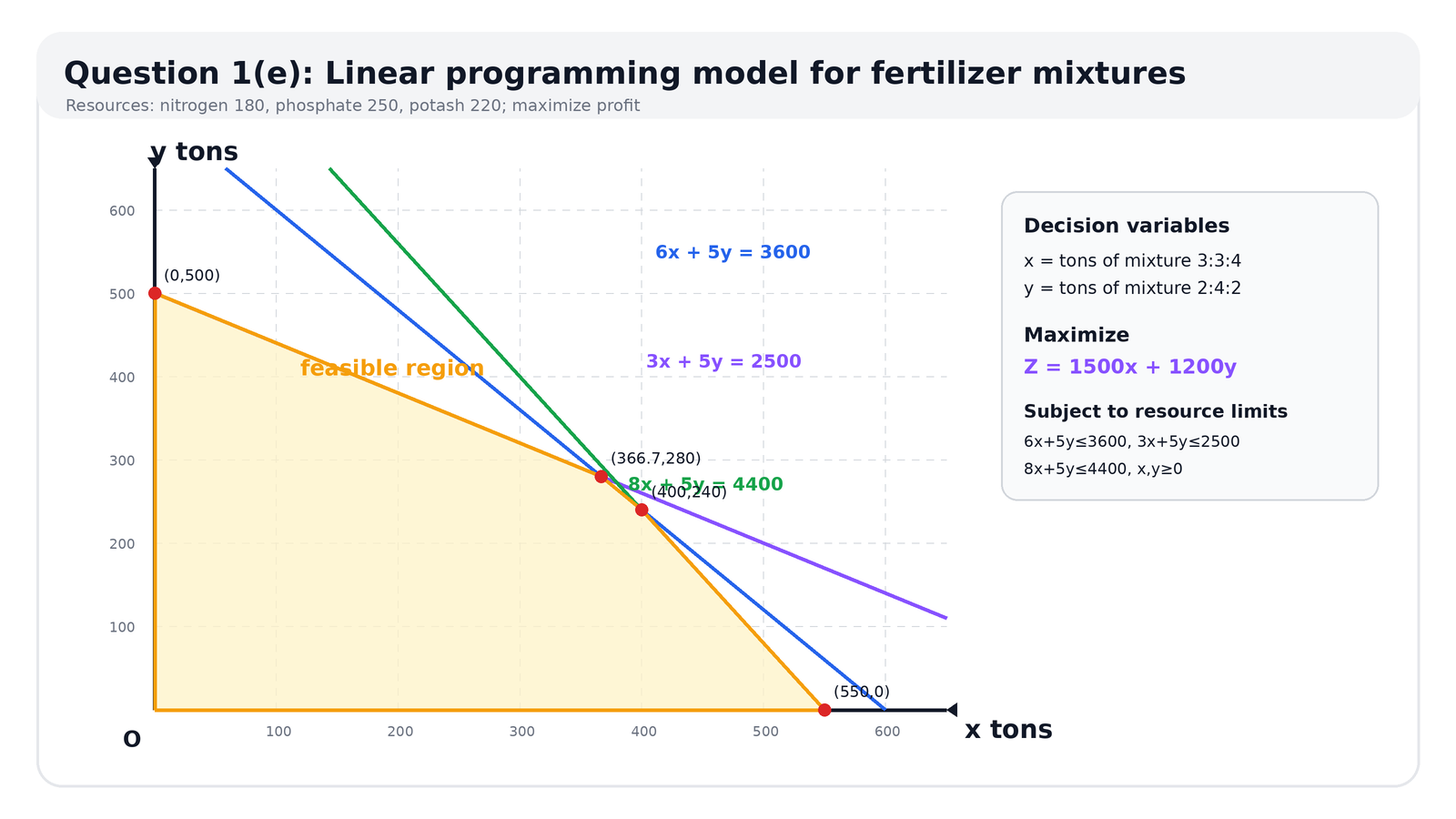
Question 1(e): Linear programming model for fertilizer mixtures
2018 UPSC Maths Optional Paper II Solutions diagram for Question 1(e), showing the linear programming model for fertilizer mixtures and resource constraints.

3Concept Related to the Question

This is a resource-allocation linear programming problem. We choose variables for the number of tons of each mixture, write resource constraints for nitrogen, phosphate and potash, and maximize total profit.

4Detailed Solution

Let \(x\) be the number of tons of the first mixture in the ratio \(3:3:4\), and let \(y\) be the number of tons of the second mixture in the ratio \(2:4:2\).

For the first mixture, the total ratio is \(3+3+4=10\). So one ton of the first mixture uses

\[\frac{3}{10}\text{ ton nitrogen},\quad \frac{3}{10}\text{ ton phosphate},\quad \frac{4}{10}\text{ ton potash}.\]

For the second mixture, the total ratio is \(2+4+2=8\). So one ton of the second mixture uses

\[\frac{2}{8}=\frac14\text{ ton nitrogen},\quad \frac{4}{8}=\frac12\text{ ton phosphate},\quad \frac{2}{8}=\frac14\text{ ton potash}.\]

The profit from \(x\) tons of the first mixture and \(y\) tons of the second mixture is

\[Z=1500x+1200y.\]

Using the available quantities of the three fertilizers, the constraints are

\[\frac{3}{10}x+\frac14y\leq180,\]
\[\frac{3}{10}x+\frac12y\leq250,\]
\[\frac{4}{10}x+\frac14y\leq220,\]
\[x\geq0,\qquad y\geq0.\]

Equivalently, after clearing fractions,

\[6x+5y\leq3600,\qquad 3x+5y\leq2500,\qquad 8x+5y\leq4400.\]

Checking the feasible corner points gives the maximum at the intersection of \(3x+5y=2500\) and \(8x+5y=4400\). Subtracting, we get \(5x=1900\), so \(x=380\). Then \(3(380)+5y=2500\), so \(5y=1360\), hence \(y=272\).

The maximum profit is

\[Z=1500(380)+1200(272)=570000+326400=896400.\]

5Final Answer

The firm should prepare \(380\) tons of the first mixture and \(272\) tons of the second mixture. The maximum profit is Rs. \(896400\).

Question 2(a)

Quotient group and unit circle

1Question

Show that the quotient group of \((R,+)\) modulo \(Z\) is isomorphic to the multiplicative group of complex numbers on the unit circle in the complex plane. Here \(R\) is the set of real numbers and \(Z\) is the set of integers.

2Diagram

Full Solution Access

The Diagram section for this question is available in the full 2018 UPSC Maths Optional Paper II PYQ Solutions course.

Complete diagrams, concepts, detailed solutions and final answers for all questions are available in the full PYQ course.

3Concept Related to the Question

Full Solution Access

The Concept Related to the Question section for this question is available in the full 2018 UPSC Maths Optional Paper II PYQ Solutions course.

Complete diagrams, concepts, detailed solutions and final answers for all questions are available in the full PYQ course.

4Detailed Solution

Full Solution Access

The Detailed Solution section for this question is available in the full 2018 UPSC Maths Optional Paper II PYQ Solutions course.

Complete diagrams, concepts, detailed solutions and final answers for all questions are available in the full PYQ course.

5Final Answer

Full Solution Access

The Final Answer section for this question is available in the full 2018 UPSC Maths Optional Paper II PYQ Solutions course.

Complete diagrams, concepts, detailed solutions and final answers for all questions are available in the full PYQ course.

Question 2(b)

Big M method linear programming

1Question

Solve the following linear programming problem by Big M-method and show that the problem has finite optimal solutions. Also find the value of the objective function:

\[\text{Minimize } z=3x_1+5x_2\]

subject to

\[x_1+2x_2\geq8,\]
\[3x_1+2x_2\geq12,\]
\[5x_1+6x_2\leq60,\]
\[x_1,x_2\geq0.\]

2Diagram

Full Solution Access

The Diagram section for this question is available in the full 2018 UPSC Maths Optional Paper II PYQ Solutions course.

Complete diagrams, concepts, detailed solutions and final answers for all questions are available in the full PYQ course.

3Concept Related to the Question

Full Solution Access

The Concept Related to the Question section for this question is available in the full 2018 UPSC Maths Optional Paper II PYQ Solutions course.

Complete diagrams, concepts, detailed solutions and final answers for all questions are available in the full PYQ course.

4Detailed Solution

Full Solution Access

The Detailed Solution section for this question is available in the full 2018 UPSC Maths Optional Paper II PYQ Solutions course.

Complete diagrams, concepts, detailed solutions and final answers for all questions are available in the full PYQ course.

5Final Answer

Full Solution Access

The Final Answer section for this question is available in the full 2018 UPSC Maths Optional Paper II PYQ Solutions course.

Complete diagrams, concepts, detailed solutions and final answers for all questions are available in the full PYQ course.

Question 2(c)

Convex functions and continuity

1Question

Show that if a function \(f\) defined on an open interval \((a,b)\) of \(R\) is convex, then \(f\) is continuous. Show, by example, if the condition of open interval is dropped, then the convex function need not be continuous.

2Diagram

Full Solution Access

The Diagram section for this question is available in the full 2018 UPSC Maths Optional Paper II PYQ Solutions course.

Complete diagrams, concepts, detailed solutions and final answers for all questions are available in the full PYQ course.

3Concept Related to the Question

Full Solution Access

The Concept Related to the Question section for this question is available in the full 2018 UPSC Maths Optional Paper II PYQ Solutions course.

Complete diagrams, concepts, detailed solutions and final answers for all questions are available in the full PYQ course.

4Detailed Solution

Full Solution Access

The Detailed Solution section for this question is available in the full 2018 UPSC Maths Optional Paper II PYQ Solutions course.

Complete diagrams, concepts, detailed solutions and final answers for all questions are available in the full PYQ course.

5Final Answer

Full Solution Access

The Final Answer section for this question is available in the full 2018 UPSC Maths Optional Paper II PYQ Solutions course.

Complete diagrams, concepts, detailed solutions and final answers for all questions are available in the full PYQ course.

Question 3(a)

Subgroups of multiplicative group of a finite field

1Question

Find all the proper subgroups of the multiplicative group of the field \((Z_{13},+_{13},\times_{13})\), where \(+_{13}\) and \(\times_{13}\) represent addition modulo 13 and multiplication modulo 13 respectively.

2Diagram

Full Solution Access

The Diagram section for this question is available in the full 2018 UPSC Maths Optional Paper II PYQ Solutions course.

Complete diagrams, concepts, detailed solutions and final answers for all questions are available in the full PYQ course.

3Concept Related to the Question

Full Solution Access

The Concept Related to the Question section for this question is available in the full 2018 UPSC Maths Optional Paper II PYQ Solutions course.

Complete diagrams, concepts, detailed solutions and final answers for all questions are available in the full PYQ course.

4Detailed Solution

Full Solution Access

The Detailed Solution section for this question is available in the full 2018 UPSC Maths Optional Paper II PYQ Solutions course.

Complete diagrams, concepts, detailed solutions and final answers for all questions are available in the full PYQ course.

5Final Answer

Full Solution Access

The Final Answer section for this question is available in the full 2018 UPSC Maths Optional Paper II PYQ Solutions course.

Complete diagrams, concepts, detailed solutions and final answers for all questions are available in the full PYQ course.

Question 3(b)

Residue theorem integral

1Question

Show by applying the residue theorem that \(\displaystyle \int_0^\infty\frac{dx}{(x^2+a^2)^2}=\frac{\pi}{4a^3}\), \(a\gt0\).

2Diagram

Full Solution Access

The Diagram section for this question is available in the full 2018 UPSC Maths Optional Paper II PYQ Solutions course.

Complete diagrams, concepts, detailed solutions and final answers for all questions are available in the full PYQ course.

3Concept Related to the Question

Full Solution Access

The Concept Related to the Question section for this question is available in the full 2018 UPSC Maths Optional Paper II PYQ Solutions course.

Complete diagrams, concepts, detailed solutions and final answers for all questions are available in the full PYQ course.

4Detailed Solution

Full Solution Access

The Detailed Solution section for this question is available in the full 2018 UPSC Maths Optional Paper II PYQ Solutions course.

Complete diagrams, concepts, detailed solutions and final answers for all questions are available in the full PYQ course.

5Final Answer

Full Solution Access

The Final Answer section for this question is available in the full 2018 UPSC Maths Optional Paper II PYQ Solutions course.

Complete diagrams, concepts, detailed solutions and final answers for all questions are available in the full PYQ course.

Question 3(c)

Basic solutions of linear equations

1Question

How many basic solutions are there in the following linearly independent set of equations? Find all of them.

\[2x_1-x_2+3x_3+x_4=6,\qquad 4x_1-2x_2-x_3+2x_4=10.\]

2Diagram

Full Solution Access

The Diagram section for this question is available in the full 2018 UPSC Maths Optional Paper II PYQ Solutions course.

Complete diagrams, concepts, detailed solutions and final answers for all questions are available in the full PYQ course.

3Concept Related to the Question

Full Solution Access

The Concept Related to the Question section for this question is available in the full 2018 UPSC Maths Optional Paper II PYQ Solutions course.

Complete diagrams, concepts, detailed solutions and final answers for all questions are available in the full PYQ course.

4Detailed Solution

Full Solution Access

The Detailed Solution section for this question is available in the full 2018 UPSC Maths Optional Paper II PYQ Solutions course.

Complete diagrams, concepts, detailed solutions and final answers for all questions are available in the full PYQ course.

5Final Answer

Full Solution Access

The Final Answer section for this question is available in the full 2018 UPSC Maths Optional Paper II PYQ Solutions course.

Complete diagrams, concepts, detailed solutions and final answers for all questions are available in the full PYQ course.

Question 4(a)

Additive and multiplicative functions on real numbers

1Question

Suppose \(R\) be the set of all real numbers and \(f:R\to R\) is a function such that the following equations hold for all \(x,y\in R\):

\[\text{(i) } f(x+y)=f(x)+f(y),\qquad \text{(ii) } f(xy)=f(x)f(y).\]

Show that \(\forall x\in R\) either \(f(x)=0\), or \(f(x)=x\).

2Diagram

Full Solution Access

The Diagram section for this question is available in the full 2018 UPSC Maths Optional Paper II PYQ Solutions course.

Complete diagrams, concepts, detailed solutions and final answers for all questions are available in the full PYQ course.

3Concept Related to the Question

Full Solution Access

The Concept Related to the Question section for this question is available in the full 2018 UPSC Maths Optional Paper II PYQ Solutions course.

Complete diagrams, concepts, detailed solutions and final answers for all questions are available in the full PYQ course.

4Detailed Solution

Full Solution Access

The Detailed Solution section for this question is available in the full 2018 UPSC Maths Optional Paper II PYQ Solutions course.

Complete diagrams, concepts, detailed solutions and final answers for all questions are available in the full PYQ course.

5Final Answer

Full Solution Access

The Final Answer section for this question is available in the full 2018 UPSC Maths Optional Paper II PYQ Solutions course.

Complete diagrams, concepts, detailed solutions and final answers for all questions are available in the full PYQ course.

Question 4(b)

Laurent series in annuli

1Question

Find the Laurent’s series which represent the function \(\frac{1}{(1+z^2)(z+2)}\) when (i) \(|z|\lt1\), (ii) \(1\lt |z|\lt2\), and (iii) \(|z|\gt2\).

2Diagram

Full Solution Access

The Diagram section for this question is available in the full 2018 UPSC Maths Optional Paper II PYQ Solutions course.

Complete diagrams, concepts, detailed solutions and final answers for all questions are available in the full PYQ course.

3Concept Related to the Question

Full Solution Access

The Concept Related to the Question section for this question is available in the full 2018 UPSC Maths Optional Paper II PYQ Solutions course.

Complete diagrams, concepts, detailed solutions and final answers for all questions are available in the full PYQ course.

4Detailed Solution

Full Solution Access

The Detailed Solution section for this question is available in the full 2018 UPSC Maths Optional Paper II PYQ Solutions course.

Complete diagrams, concepts, detailed solutions and final answers for all questions are available in the full PYQ course.

5Final Answer

Full Solution Access

The Final Answer section for this question is available in the full 2018 UPSC Maths Optional Paper II PYQ Solutions course.

Complete diagrams, concepts, detailed solutions and final answers for all questions are available in the full PYQ course.

Question 4(c)

Assignment problem

1Question

In a factory there are five operators \(O_1,O_2,O_3,O_4,O_5\) and five machines \(M_1,M_2,M_3,M_4,M_5\). The operating cost, when the \(O_i\) operator operates the \(M_j\) machine \((j=1,2,\ldots,5)\), is given in the following cost matrix:

Operator\(M_1\)\(M_2\)\(M_3\)\(M_4\)\(M_5\)
\(O_1\)2429183219
\(O_2\)1726342221
\(O_3\)2716281725
\(O_4\)2218283024
\(O_5\)2816312427

But there is a restriction that \(O_3\) cannot be allowed to operate the third machine \(M_3\) and \(O_2\) cannot be allowed to operate the fifth machine \(M_5\). The cost matrix is given above. Find the optimal assignment and the optimal assignment cost also.

2Diagram

Full Solution Access

The Diagram section for this question is available in the full 2018 UPSC Maths Optional Paper II PYQ Solutions course.

Complete diagrams, concepts, detailed solutions and final answers for all questions are available in the full PYQ course.

3Concept Related to the Question

Full Solution Access

The Concept Related to the Question section for this question is available in the full 2018 UPSC Maths Optional Paper II PYQ Solutions course.

Complete diagrams, concepts, detailed solutions and final answers for all questions are available in the full PYQ course.

4Detailed Solution

Full Solution Access

The Detailed Solution section for this question is available in the full 2018 UPSC Maths Optional Paper II PYQ Solutions course.

Complete diagrams, concepts, detailed solutions and final answers for all questions are available in the full PYQ course.

5Final Answer

Full Solution Access

The Final Answer section for this question is available in the full 2018 UPSC Maths Optional Paper II PYQ Solutions course.

Complete diagrams, concepts, detailed solutions and final answers for all questions are available in the full PYQ course.

Question 5(a)

PDE of tangent planes to an ellipsoid

1Question

Find the partial differential equation of the family of all tangent planes to the ellipsoid \(x^2+4y^2+4z^2=4\), which are not perpendicular to the \(xy\) plane.

2Diagram

Full Solution Access

The Diagram section for this question is available in the full 2018 UPSC Maths Optional Paper II PYQ Solutions course.

Complete diagrams, concepts, detailed solutions and final answers for all questions are available in the full PYQ course.

3Concept Related to the Question

Full Solution Access

The Concept Related to the Question section for this question is available in the full 2018 UPSC Maths Optional Paper II PYQ Solutions course.

Complete diagrams, concepts, detailed solutions and final answers for all questions are available in the full PYQ course.

4Detailed Solution

Full Solution Access

The Detailed Solution section for this question is available in the full 2018 UPSC Maths Optional Paper II PYQ Solutions course.

Complete diagrams, concepts, detailed solutions and final answers for all questions are available in the full PYQ course.

5Final Answer

Full Solution Access

The Final Answer section for this question is available in the full 2018 UPSC Maths Optional Paper II PYQ Solutions course.

Complete diagrams, concepts, detailed solutions and final answers for all questions are available in the full PYQ course.

Question 5(b)

Newton forward interpolation

1Question

Using Newton’s forward difference formula, find the lowest degree polynomial \(u_x\) when it is given that \(u_1=1\), \(u_2=9\), \(u_3=25\), \(u_4=55\), and \(u_5=105\).

2Diagram

Full Solution Access

The Diagram section for this question is available in the full 2018 UPSC Maths Optional Paper II PYQ Solutions course.

Complete diagrams, concepts, detailed solutions and final answers for all questions are available in the full PYQ course.

3Concept Related to the Question

Full Solution Access

The Concept Related to the Question section for this question is available in the full 2018 UPSC Maths Optional Paper II PYQ Solutions course.

Complete diagrams, concepts, detailed solutions and final answers for all questions are available in the full PYQ course.

4Detailed Solution

Full Solution Access

The Detailed Solution section for this question is available in the full 2018 UPSC Maths Optional Paper II PYQ Solutions course.

Complete diagrams, concepts, detailed solutions and final answers for all questions are available in the full PYQ course.

5Final Answer

Full Solution Access

The Final Answer section for this question is available in the full 2018 UPSC Maths Optional Paper II PYQ Solutions course.

Complete diagrams, concepts, detailed solutions and final answers for all questions are available in the full PYQ course.

Question 5(c)

Continuity equation and acceleration component

1Question

For an incompressible fluid flow, two components of velocity \((u,v,w)\) are given by \(u=x^2+2y^2+3z^2\), \(v=x^2y-y^2+zx\). Determine the third component \(w\) so that they satisfy the equation of continuity. Also, find the \(z\)-component of acceleration.

2Diagram

Full Solution Access

The Diagram section for this question is available in the full 2018 UPSC Maths Optional Paper II PYQ Solutions course.

Complete diagrams, concepts, detailed solutions and final answers for all questions are available in the full PYQ course.

3Concept Related to the Question

Full Solution Access

The Concept Related to the Question section for this question is available in the full 2018 UPSC Maths Optional Paper II PYQ Solutions course.

Complete diagrams, concepts, detailed solutions and final answers for all questions are available in the full PYQ course.

4Detailed Solution

Full Solution Access

The Detailed Solution section for this question is available in the full 2018 UPSC Maths Optional Paper II PYQ Solutions course.

Complete diagrams, concepts, detailed solutions and final answers for all questions are available in the full PYQ course.

5Final Answer

Full Solution Access

The Final Answer section for this question is available in the full 2018 UPSC Maths Optional Paper II PYQ Solutions course.

Complete diagrams, concepts, detailed solutions and final answers for all questions are available in the full PYQ course.

Question 5(d)

Simpson one-third rule

1Question

Starting from rest in the beginning, the speed (in Km/h) of a train at different times (in minutes) is given by the above table:

Time (Minutes)2468101214161820
Speed (Km/h)1018252932201152\(8\cdot5\)

Using Simpson’s \(\frac{1}{3}\) rule, find the approximate distance travelled (in Km) in 20 minutes from the beginning.

2Diagram

Full Solution Access

The Diagram section for this question is available in the full 2018 UPSC Maths Optional Paper II PYQ Solutions course.

Complete diagrams, concepts, detailed solutions and final answers for all questions are available in the full PYQ course.

3Concept Related to the Question

Full Solution Access

The Concept Related to the Question section for this question is available in the full 2018 UPSC Maths Optional Paper II PYQ Solutions course.

Complete diagrams, concepts, detailed solutions and final answers for all questions are available in the full PYQ course.

4Detailed Solution

Full Solution Access

The Detailed Solution section for this question is available in the full 2018 UPSC Maths Optional Paper II PYQ Solutions course.

Complete diagrams, concepts, detailed solutions and final answers for all questions are available in the full PYQ course.

5Final Answer

Full Solution Access

The Final Answer section for this question is available in the full 2018 UPSC Maths Optional Paper II PYQ Solutions course.

Complete diagrams, concepts, detailed solutions and final answers for all questions are available in the full PYQ course.

Question 5(e)

Bisection method algorithm

1Question

Write down the basic algorithm for solving the equation \(xe^x-1=0\) by bisection method, correct to 4 decimal places.

2Diagram

Full Solution Access

The Diagram section for this question is available in the full 2018 UPSC Maths Optional Paper II PYQ Solutions course.

Complete diagrams, concepts, detailed solutions and final answers for all questions are available in the full PYQ course.

3Concept Related to the Question

Full Solution Access

The Concept Related to the Question section for this question is available in the full 2018 UPSC Maths Optional Paper II PYQ Solutions course.

Complete diagrams, concepts, detailed solutions and final answers for all questions are available in the full PYQ course.

4Detailed Solution

Full Solution Access

The Detailed Solution section for this question is available in the full 2018 UPSC Maths Optional Paper II PYQ Solutions course.

Complete diagrams, concepts, detailed solutions and final answers for all questions are available in the full PYQ course.

5Final Answer

Full Solution Access

The Final Answer section for this question is available in the full 2018 UPSC Maths Optional Paper II PYQ Solutions course.

Complete diagrams, concepts, detailed solutions and final answers for all questions are available in the full PYQ course.

Question 6(a)

Lagrange partial differential equation

1Question

Find the general solution of the partial differential equation \((xy^3-2x^4)p+(2y^4-x^3y)q=9z(x^3-y^3)\), where \(p=\frac{\partial z}{\partial x}\), \(q=\frac{\partial z}{\partial y}\), and find its integral surface that passes through the curve \(x=t\), \(y=t^2\), \(z=1\).

2Diagram

Full Solution Access

The Diagram section for this question is available in the full 2018 UPSC Maths Optional Paper II PYQ Solutions course.

Complete diagrams, concepts, detailed solutions and final answers for all questions are available in the full PYQ course.

3Concept Related to the Question

Full Solution Access

The Concept Related to the Question section for this question is available in the full 2018 UPSC Maths Optional Paper II PYQ Solutions course.

Complete diagrams, concepts, detailed solutions and final answers for all questions are available in the full PYQ course.

4Detailed Solution

Full Solution Access

The Detailed Solution section for this question is available in the full 2018 UPSC Maths Optional Paper II PYQ Solutions course.

Complete diagrams, concepts, detailed solutions and final answers for all questions are available in the full PYQ course.

5Final Answer

Full Solution Access

The Final Answer section for this question is available in the full 2018 UPSC Maths Optional Paper II PYQ Solutions course.

Complete diagrams, concepts, detailed solutions and final answers for all questions are available in the full PYQ course.

Question 6(b)

Number system conversions

1Question

Find the equivalent of numbers given in a specified number system to the system mentioned against them.

(i) \((111011.101)_2\) to decimal system

(ii) \((1000111110000.00101100)_2\) to hexadecimal system

(iii) \((C4F2)_{16}\) to decimal system

(iv) \((418)_{10}\) to binary system

2Diagram

Full Solution Access

The Diagram section for this question is available in the full 2018 UPSC Maths Optional Paper II PYQ Solutions course.

Complete diagrams, concepts, detailed solutions and final answers for all questions are available in the full PYQ course.

3Concept Related to the Question

Full Solution Access

The Concept Related to the Question section for this question is available in the full 2018 UPSC Maths Optional Paper II PYQ Solutions course.

Complete diagrams, concepts, detailed solutions and final answers for all questions are available in the full PYQ course.

4Detailed Solution

Full Solution Access

The Detailed Solution section for this question is available in the full 2018 UPSC Maths Optional Paper II PYQ Solutions course.

Complete diagrams, concepts, detailed solutions and final answers for all questions are available in the full PYQ course.

5Final Answer

Full Solution Access

The Final Answer section for this question is available in the full 2018 UPSC Maths Optional Paper II PYQ Solutions course.

Complete diagrams, concepts, detailed solutions and final answers for all questions are available in the full PYQ course.

Question 6(c)

Lagrangian equations of motion

1Question

Suppose the Lagrangian of a mechanical system is given by \(L=\frac{1}{2}m(a\dot{x}^2+2b\dot{x}\dot{y}+c\dot{y}^2)-\frac{1}{2}k(ax^2+2bxy+cy^2)\), where \(a,b,c,m(>0)\), \(k(>0)\) are constants and \(b^2\ne ac\). Write down the Lagrangian equations of motion and identify the system.

2Diagram

Full Solution Access

The Diagram section for this question is available in the full 2018 UPSC Maths Optional Paper II PYQ Solutions course.

Complete diagrams, concepts, detailed solutions and final answers for all questions are available in the full PYQ course.

3Concept Related to the Question

Full Solution Access

The Concept Related to the Question section for this question is available in the full 2018 UPSC Maths Optional Paper II PYQ Solutions course.

Complete diagrams, concepts, detailed solutions and final answers for all questions are available in the full PYQ course.

4Detailed Solution

Full Solution Access

The Detailed Solution section for this question is available in the full 2018 UPSC Maths Optional Paper II PYQ Solutions course.

Complete diagrams, concepts, detailed solutions and final answers for all questions are available in the full PYQ course.

5Final Answer

Full Solution Access

The Final Answer section for this question is available in the full 2018 UPSC Maths Optional Paper II PYQ Solutions course.

Complete diagrams, concepts, detailed solutions and final answers for all questions are available in the full PYQ course.

Question 7(a)

Linear PDE with constant coefficients

1Question

Solve the partial differential equation \((2D^2-5DD'+2D'^2)z=5\sin(2x+y)+24(y-x)+e^{3x+4y}\), where \(D=\frac{\partial}{\partial x}\), \(D'=\frac{\partial}{\partial y}\).

2Diagram

Full Solution Access

The Diagram section for this question is available in the full 2018 UPSC Maths Optional Paper II PYQ Solutions course.

Complete diagrams, concepts, detailed solutions and final answers for all questions are available in the full PYQ course.

3Concept Related to the Question

Full Solution Access

The Concept Related to the Question section for this question is available in the full 2018 UPSC Maths Optional Paper II PYQ Solutions course.

Complete diagrams, concepts, detailed solutions and final answers for all questions are available in the full PYQ course.

4Detailed Solution

Full Solution Access

The Detailed Solution section for this question is available in the full 2018 UPSC Maths Optional Paper II PYQ Solutions course.

Complete diagrams, concepts, detailed solutions and final answers for all questions are available in the full PYQ course.

5Final Answer

Full Solution Access

The Final Answer section for this question is available in the full 2018 UPSC Maths Optional Paper II PYQ Solutions course.

Complete diagrams, concepts, detailed solutions and final answers for all questions are available in the full PYQ course.

Question 7(b)

Quadrature formula and error

1Question

Find the values of the constants \(a,b,c\) such that the quadrature formula \(\int_0^h f(x)\,dx=h\left[af(0)+bf\left(\frac{h}{3}\right)+cf(h)\right]\) is exact for polynomials of as high degree as possible, and hence find the order of the truncation error.

2Diagram

Full Solution Access

The Diagram section for this question is available in the full 2018 UPSC Maths Optional Paper II PYQ Solutions course.

Complete diagrams, concepts, detailed solutions and final answers for all questions are available in the full PYQ course.

3Concept Related to the Question

Full Solution Access

The Concept Related to the Question section for this question is available in the full 2018 UPSC Maths Optional Paper II PYQ Solutions course.

Complete diagrams, concepts, detailed solutions and final answers for all questions are available in the full PYQ course.

4Detailed Solution

Full Solution Access

The Detailed Solution section for this question is available in the full 2018 UPSC Maths Optional Paper II PYQ Solutions course.

Complete diagrams, concepts, detailed solutions and final answers for all questions are available in the full PYQ course.

5Final Answer

Full Solution Access

The Final Answer section for this question is available in the full 2018 UPSC Maths Optional Paper II PYQ Solutions course.

Complete diagrams, concepts, detailed solutions and final answers for all questions are available in the full PYQ course.

Question 7(c)

Hamiltonian equations

1Question

The Hamiltonian of a mechanical system is given by \(H=p_1q_1-aq_1^2+bq_2^2-p_2q_2\), where \(a,b\) are the constants. Solve the Hamiltonian equations and show that \(\frac{p_2-bq_2}{q_1}\) is constant.

2Diagram

Full Solution Access

The Diagram section for this question is available in the full 2018 UPSC Maths Optional Paper II PYQ Solutions course.

Complete diagrams, concepts, detailed solutions and final answers for all questions are available in the full PYQ course.

3Concept Related to the Question

Full Solution Access

The Concept Related to the Question section for this question is available in the full 2018 UPSC Maths Optional Paper II PYQ Solutions course.

Complete diagrams, concepts, detailed solutions and final answers for all questions are available in the full PYQ course.

4Detailed Solution

Full Solution Access

The Detailed Solution section for this question is available in the full 2018 UPSC Maths Optional Paper II PYQ Solutions course.

Complete diagrams, concepts, detailed solutions and final answers for all questions are available in the full PYQ course.

5Final Answer

Full Solution Access

The Final Answer section for this question is available in the full 2018 UPSC Maths Optional Paper II PYQ Solutions course.

Complete diagrams, concepts, detailed solutions and final answers for all questions are available in the full PYQ course.

Question 8(a)

Boolean algebra and minterms

1Question

Simplify the boolean expression \((a+b)(\bar b+c)+b(\bar a+\bar c)\) by using the laws of boolean algebra. From its truth table write it in minterm normal form.

2Diagram

Full Solution Access

The Diagram section for this question is available in the full 2018 UPSC Maths Optional Paper II PYQ Solutions course.

Complete diagrams, concepts, detailed solutions and final answers for all questions are available in the full PYQ course.

3Concept Related to the Question

Full Solution Access

The Concept Related to the Question section for this question is available in the full 2018 UPSC Maths Optional Paper II PYQ Solutions course.

Complete diagrams, concepts, detailed solutions and final answers for all questions are available in the full PYQ course.

4Detailed Solution

Full Solution Access

The Detailed Solution section for this question is available in the full 2018 UPSC Maths Optional Paper II PYQ Solutions course.

Complete diagrams, concepts, detailed solutions and final answers for all questions are available in the full PYQ course.

5Final Answer

Full Solution Access

The Final Answer section for this question is available in the full 2018 UPSC Maths Optional Paper II PYQ Solutions course.

Complete diagrams, concepts, detailed solutions and final answers for all questions are available in the full PYQ course.

Question 8(b)

Two-dimensional potential flow

1Question

For a two-dimensional potential flow, the velocity potential is given by \(\phi=x^2y-xy^2+\frac{1}{3}(x^3-y^3)\). Determine the velocity components along the directions \(x\) and \(y\). Also, determine the stream function \(\psi\) and check whether \(\phi\) represents a possible case of flow or not.

2Diagram

Full Solution Access

The Diagram section for this question is available in the full 2018 UPSC Maths Optional Paper II PYQ Solutions course.

Complete diagrams, concepts, detailed solutions and final answers for all questions are available in the full PYQ course.

3Concept Related to the Question

Full Solution Access

The Concept Related to the Question section for this question is available in the full 2018 UPSC Maths Optional Paper II PYQ Solutions course.

Complete diagrams, concepts, detailed solutions and final answers for all questions are available in the full PYQ course.

4Detailed Solution

Full Solution Access

The Detailed Solution section for this question is available in the full 2018 UPSC Maths Optional Paper II PYQ Solutions course.

Complete diagrams, concepts, detailed solutions and final answers for all questions are available in the full PYQ course.

5Final Answer

Full Solution Access

The Final Answer section for this question is available in the full 2018 UPSC Maths Optional Paper II PYQ Solutions course.

Complete diagrams, concepts, detailed solutions and final answers for all questions are available in the full PYQ course.

Question 8(c)

Temperature distribution in an annulus

1Question

A thin annulus occupies the region \(0\lt a\leq r\leq b\), \(0\leq\theta\leq2\pi\). The faces are insulated. Along the inner edge the temperature is maintained at \(0^\circ\), while along the outer edge the temperature is held at \(T=K\cos\frac{\theta}{2}\), where \(K\) is a constant. Determine the temperature distribution in the annulus.

2Diagram

Full Solution Access

The Diagram section for this question is available in the full 2018 UPSC Maths Optional Paper II PYQ Solutions course.

Complete diagrams, concepts, detailed solutions and final answers for all questions are available in the full PYQ course.

3Concept Related to the Question

Full Solution Access

The Concept Related to the Question section for this question is available in the full 2018 UPSC Maths Optional Paper II PYQ Solutions course.

Complete diagrams, concepts, detailed solutions and final answers for all questions are available in the full PYQ course.

4Detailed Solution

Full Solution Access

The Detailed Solution section for this question is available in the full 2018 UPSC Maths Optional Paper II PYQ Solutions course.

Complete diagrams, concepts, detailed solutions and final answers for all questions are available in the full PYQ course.

5Final Answer

Full Solution Access

The Final Answer section for this question is available in the full 2018 UPSC Maths Optional Paper II PYQ Solutions course.

Complete diagrams, concepts, detailed solutions and final answers for all questions are available in the full PYQ course.

2018 UPSC Maths Optional Paper II Solutions FAQs

Are these 2018 UPSC Maths Optional Paper II Solutions complete?

This public page gives one full sample solution. Complete solutions for all questions are available in the full PYQ course.

Which question is given as a free sample solution on this page?

Question 1(e) is given as the free sample full solution on this page, including Question, Diagram, Concept Related to the Question, Detailed Solution, and Final Answer.

How should I use these 2018 UPSC Maths Optional Paper II Solutions for preparation?

Use these solutions for revision, answer-writing practice, concept clarity, and understanding the expected step-by-step presentation for UPSC Mathematics optional answers.

Do these solutions include diagrams and detailed explanations?

Yes. The full PYQ course includes diagrams where needed, concept explanations, detailed solutions, and final answers for every question.

How can I get complete solutions for all questions in 2018 UPSC Maths Optional Paper II Solutions?

To access complete solutions for all questions, please fill out the admission form first. Our Ramana Sri IAS admission team will guide you through WhatsApp, email, or call.

Scroll to Top