Ramana Sri IAS

Ramana Sri IAS - 2023 UPSC Maths Optional Paper I Solutions

2023 UPSC Maths Optional Paper I Solutions

Ramana Sri IAS provides complete and updated solutions for the 2023 UPSC Maths Optional Paper I. Aspirants preparing for the UPSC Mains Examination with Mathematics as their optional subject should solve all these questions carefully at least 5 to 10 times before the mains examination.

Ramana Sri IAS presents complete solutions for UPSC/IAS/CSE-Civil Service Examination 2023 Mathematics Optional Paper I. Each answer follows the same format: Question, Diagram where needed, Concept Related to the Question, Detailed Solution, and Final Answer.

About 2023 UPSC Maths Optional Paper I Solutions

These 2023 UPSC Maths Optional Paper I Solutions are prepared by Ramana Sri IAS for aspirants who want question-wise clarity before the UPSC Mains examination. This public page gives one full sample solution, while the complete paper-wise solutions are available in the full PYQ course.

Students can use these 2023 UPSC Maths Optional Paper I Solutions to understand the expected answer-writing method, diagram presentation, concept application, and final-answer format used by Ramana Sri IAS.

For the official examination source, students may also refer to the UPSC previous year question papers page.

These 2023 UPSC Maths Optional Paper I Solutions are useful for revision, answer-writing practice, and understanding the step-by-step method expected in the UPSC Mathematics optional paper.

Sample Full Solution

We are giving one question from 2023 UPSC Maths Optional Paper I Solutions as a free sample solution below: Question 1(e). This free sample includes all five sections: Question, Diagram, Concept Related to the Question, Detailed Solution, and Final Answer. Complete 2023 UPSC Maths Optional Paper I Solutions for all questions are available in the full PYQ course. To purchase the full solution, please fill out the admission form first. Our Ramana Sri IAS admission team will guide you through WhatsApp, email, or call.

2023 UPSC Maths Optional Paper I Solutions: Table of Contents

Question 1(a)

Span of vectors in R4

1Question

Let \(V_1=(2,-1,3,2)\), \(V_2=(-1,1,1,-3)\) and \(V_3=(1,1,9,-5)\) be three vectors of the space \(\mathbb R^4\). Does \((3,-1,0,-1)\in \operatorname{span}\{V_1,V_2,V_3\}\)? Justify your answer.

2Diagram

Full Solution Access

The Diagram section for this question is available in the full 2023 UPSC Maths Optional Paper I PYQ Solutions course.

Complete diagrams, concepts, detailed solutions and final answers for all questions are available in the full PYQ course.

3Concept Related to the Question

Full Solution Access

The Concept Related to the Question section for this question is available in the full 2023 UPSC Maths Optional Paper I PYQ Solutions course.

Complete diagrams, concepts, detailed solutions and final answers for all questions are available in the full PYQ course.

4Detailed Solution

Full Solution Access

The Detailed Solution section for this question is available in the full 2023 UPSC Maths Optional Paper I PYQ Solutions course.

Complete diagrams, concepts, detailed solutions and final answers for all questions are available in the full PYQ course.

5Final Answer

Full Solution Access

The Final Answer section for this question is available in the full 2023 UPSC Maths Optional Paper I PYQ Solutions course.

Complete diagrams, concepts, detailed solutions and final answers for all questions are available in the full PYQ course.

Question 1(b)

Rank and nullity

1Question

Find the rank and nullity of the linear transformation : \(T:\mathbb R^3\to\mathbb R^3\) given by \(T(x,y,z)=(x+z,x+y+2z,2x+y+3z)\).

2Diagram

Full Solution Access

The Diagram section for this question is available in the full 2023 UPSC Maths Optional Paper I PYQ Solutions course.

Complete diagrams, concepts, detailed solutions and final answers for all questions are available in the full PYQ course.

3Concept Related to the Question

Full Solution Access

The Concept Related to the Question section for this question is available in the full 2023 UPSC Maths Optional Paper I PYQ Solutions course.

Complete diagrams, concepts, detailed solutions and final answers for all questions are available in the full PYQ course.

4Detailed Solution

Full Solution Access

The Detailed Solution section for this question is available in the full 2023 UPSC Maths Optional Paper I PYQ Solutions course.

Complete diagrams, concepts, detailed solutions and final answers for all questions are available in the full PYQ course.

5Final Answer

Full Solution Access

The Final Answer section for this question is available in the full 2023 UPSC Maths Optional Paper I PYQ Solutions course.

Complete diagrams, concepts, detailed solutions and final answers for all questions are available in the full PYQ course.

Question 1(c)

Limit using expansion

1Question

Find the values of \(p\) and \(q\) for which \(\displaystyle \lim_{x\to0}\frac{x(1+p\cos x)-q\sin x}{x^3}\) exist and equals \(1\).

2Diagram

Full Solution Access

The Diagram section for this question is available in the full 2023 UPSC Maths Optional Paper I PYQ Solutions course.

Complete diagrams, concepts, detailed solutions and final answers for all questions are available in the full PYQ course.

3Concept Related to the Question

Full Solution Access

The Concept Related to the Question section for this question is available in the full 2023 UPSC Maths Optional Paper I PYQ Solutions course.

Complete diagrams, concepts, detailed solutions and final answers for all questions are available in the full PYQ course.

4Detailed Solution

Full Solution Access

The Detailed Solution section for this question is available in the full 2023 UPSC Maths Optional Paper I PYQ Solutions course.

Complete diagrams, concepts, detailed solutions and final answers for all questions are available in the full PYQ course.

5Final Answer

Full Solution Access

The Final Answer section for this question is available in the full 2023 UPSC Maths Optional Paper I PYQ Solutions course.

Complete diagrams, concepts, detailed solutions and final answers for all questions are available in the full PYQ course.

Question 1(d)

Improper integral with logarithm

1Question

Examine the convergence of the integral \(\displaystyle \int_0^1\frac{\log x}{1+x}\,dx\).

2Diagram

Full Solution Access

The Diagram section for this question is available in the full 2023 UPSC Maths Optional Paper I PYQ Solutions course.

Complete diagrams, concepts, detailed solutions and final answers for all questions are available in the full PYQ course.

3Concept Related to the Question

Full Solution Access

The Concept Related to the Question section for this question is available in the full 2023 UPSC Maths Optional Paper I PYQ Solutions course.

Complete diagrams, concepts, detailed solutions and final answers for all questions are available in the full PYQ course.

4Detailed Solution

Full Solution Access

The Detailed Solution section for this question is available in the full 2023 UPSC Maths Optional Paper I PYQ Solutions course.

Complete diagrams, concepts, detailed solutions and final answers for all questions are available in the full PYQ course.

5Final Answer

Full Solution Access

The Final Answer section for this question is available in the full 2023 UPSC Maths Optional Paper I PYQ Solutions course.

Complete diagrams, concepts, detailed solutions and final answers for all questions are available in the full PYQ course.

Question 1(e)

Centroid locus of tetrahedron

1Question

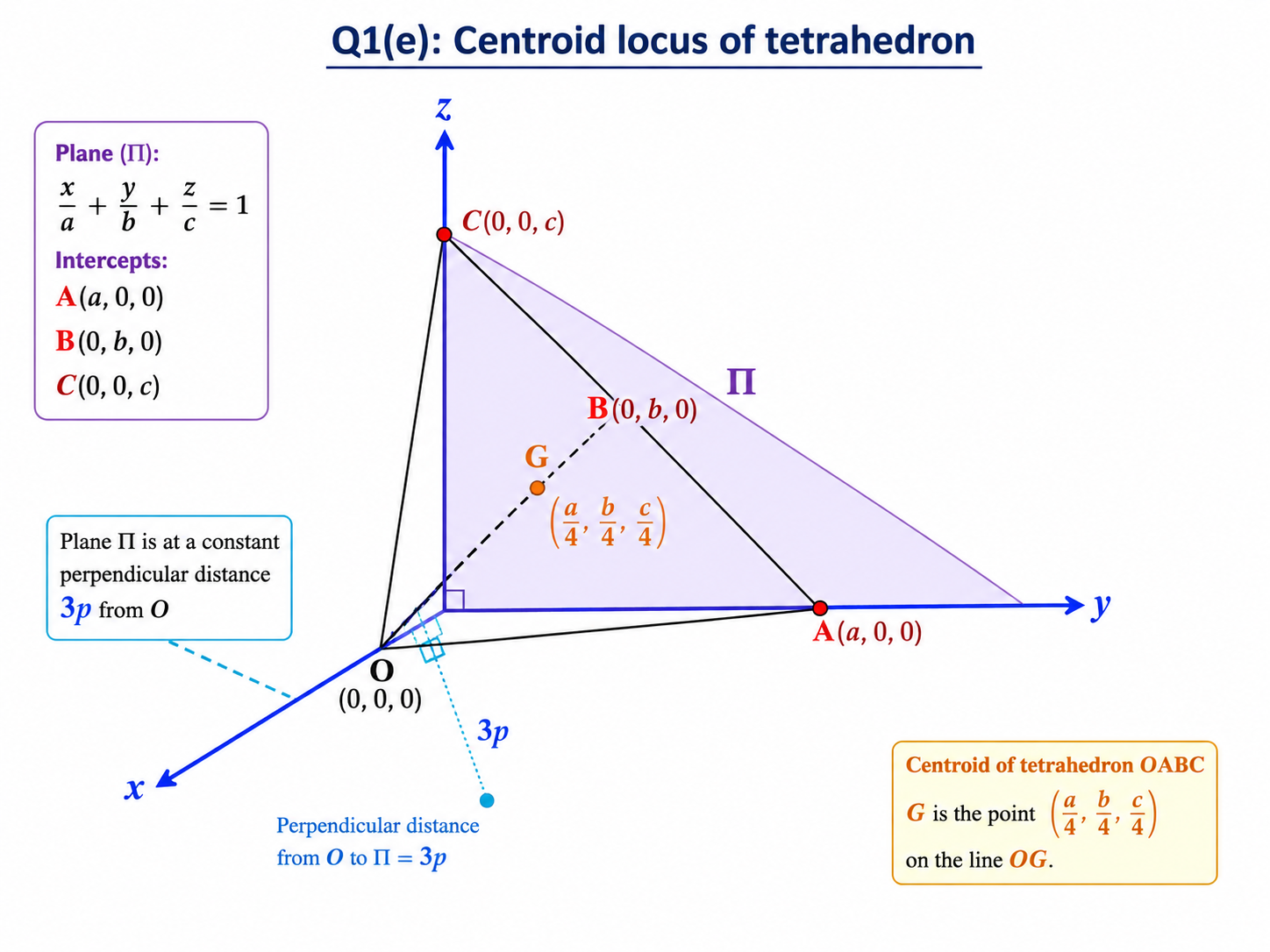
A variable plane which at a constant distance \(3p\) from the origin \(O\) cuts the axes in the points \(A\), \(B\), \(C\) respectively. Show that the locus of the centroid of the tetrahedron \(OABC\) is \(\displaystyle 9\left(\frac1{x^2}+\frac1{y^2}+\frac1{z^2}\right)=\frac{16}{p^2}\).

2Diagram

Question 1(e): Centroid locus of tetrahedron
2023 UPSC Maths Optional Paper I Solutions diagram showing the intercept plane cutting the coordinate axes at A, B and C, the tetrahedron OABC, the centroid G and the perpendicular distance 3p from the origin.

3Concept Related to the Question

Write the plane in intercept form. Then express the intercepts in terms of the centroid coordinates.

4Detailed Solution

Let the plane cut the axes at \((a,0,0)\), \((0,b,0)\), and \((0,0,c)\). Its equation is

\[\frac{X}{a}+\frac{Y}{b}+\frac{Z}{c}=1.\]

The distance of this plane from the origin is

\[\frac{1}{\sqrt{\frac1{a^2}+\frac1{b^2}+\frac1{c^2}}}=3p.\]

Therefore

\[\frac1{a^2}+\frac1{b^2}+\frac1{c^2}=\frac1{9p^2}.\]

The centroid of the tetrahedron \(OABC\) is

\[(x,y,z)=\left(\frac a4,\frac b4,\frac c4\right).\]

Hence \(a=4x\), \(b=4y\), and \(c=4z\). Substitute these values:

\[\frac1{16x^2}+\frac1{16y^2}+\frac1{16z^2}=\frac1{9p^2}.\]

Multiplying by \(16\),

\[\frac1{x^2}+\frac1{y^2}+\frac1{z^2}=\frac{16}{9p^2}.\]

Therefore

\[9\left(\frac1{x^2}+\frac1{y^2}+\frac1{z^2}\right)=\frac{16}{p^2}.\]

5Final Answer

The locus of the centroid is \(9\left(\frac1{x^2}+\frac1{y^2}+\frac1{z^2}\right)=\frac{16}{p^2}\).

Question 2(a)

Change of basis matrix

1Question

If the matrix of a linear transformation \(T:\mathbb R^3\to\mathbb R^3\) relative to the basis \(\{(1,0,0),(0,1,0),(0,0,1)\}\) is \(\begin{bmatrix}1&1&2\\-1&2&1\\0&1&3\end{bmatrix}\), then find the matrix of \(T\) relative to the basis \(\{(1,1,1),(0,1,1),(0,0,1)\}\).

2Diagram

Full Solution Access

The Diagram section for this question is available in the full 2023 UPSC Maths Optional Paper I PYQ Solutions course.

Complete diagrams, concepts, detailed solutions and final answers for all questions are available in the full PYQ course.

3Concept Related to the Question

Full Solution Access

The Concept Related to the Question section for this question is available in the full 2023 UPSC Maths Optional Paper I PYQ Solutions course.

Complete diagrams, concepts, detailed solutions and final answers for all questions are available in the full PYQ course.

4Detailed Solution

Full Solution Access

The Detailed Solution section for this question is available in the full 2023 UPSC Maths Optional Paper I PYQ Solutions course.

Complete diagrams, concepts, detailed solutions and final answers for all questions are available in the full PYQ course.

5Final Answer

Full Solution Access

The Final Answer section for this question is available in the full 2023 UPSC Maths Optional Paper I PYQ Solutions course.

Complete diagrams, concepts, detailed solutions and final answers for all questions are available in the full PYQ course.

Question 2(b)

Volume between paraboloids

1Question

Evaluate the triple integral which gives the volume of the solid enclosed between the two paraboloids \(Z=5(x^2+y^2)\) and \(Z=6-7x^2-y^2\).

2Diagram

Full Solution Access

The Diagram section for this question is available in the full 2023 UPSC Maths Optional Paper I PYQ Solutions course.

Complete diagrams, concepts, detailed solutions and final answers for all questions are available in the full PYQ course.

3Concept Related to the Question

Full Solution Access

The Concept Related to the Question section for this question is available in the full 2023 UPSC Maths Optional Paper I PYQ Solutions course.

Complete diagrams, concepts, detailed solutions and final answers for all questions are available in the full PYQ course.

4Detailed Solution

Full Solution Access

The Detailed Solution section for this question is available in the full 2023 UPSC Maths Optional Paper I PYQ Solutions course.

Complete diagrams, concepts, detailed solutions and final answers for all questions are available in the full PYQ course.

5Final Answer

Full Solution Access

The Final Answer section for this question is available in the full 2023 UPSC Maths Optional Paper I PYQ Solutions course.

Complete diagrams, concepts, detailed solutions and final answers for all questions are available in the full PYQ course.

Question 2(c)(i)

Elliptic paraboloid

1Question

Show that the equation \(2x^2+3y^2-8x+6y-12z+11=0\) represents an elliptic paraboloid. Also find its principal axis and principal planes.

2Diagram

Full Solution Access

The Diagram section for this question is available in the full 2023 UPSC Maths Optional Paper I PYQ Solutions course.

Complete diagrams, concepts, detailed solutions and final answers for all questions are available in the full PYQ course.

3Concept Related to the Question

Full Solution Access

The Concept Related to the Question section for this question is available in the full 2023 UPSC Maths Optional Paper I PYQ Solutions course.

Complete diagrams, concepts, detailed solutions and final answers for all questions are available in the full PYQ course.

4Detailed Solution

Full Solution Access

The Detailed Solution section for this question is available in the full 2023 UPSC Maths Optional Paper I PYQ Solutions course.

Complete diagrams, concepts, detailed solutions and final answers for all questions are available in the full PYQ course.

5Final Answer

Full Solution Access

The Final Answer section for this question is available in the full 2023 UPSC Maths Optional Paper I PYQ Solutions course.

Complete diagrams, concepts, detailed solutions and final answers for all questions are available in the full PYQ course.

Question 2(c)(ii)

Cone through circle of intercept plane

1Question

The plane \(\frac xa+\frac yb+\frac zc=1\) meets the coordinate axes in \(A\), \(B\), \(C\) respectively. Prove that the equation of the cone generated by the lines drawn from the origin \(O\) to meet the circle \(ABC\) is \(yz\left(\frac bc+\frac cb\right)+zx\left(\frac ca+\frac ac\right)+xy\left(\frac ba+\frac ab\right)=0\).

2Diagram

Full Solution Access

The Diagram section for this question is available in the full 2023 UPSC Maths Optional Paper I PYQ Solutions course.

Complete diagrams, concepts, detailed solutions and final answers for all questions are available in the full PYQ course.

3Concept Related to the Question

Full Solution Access

The Concept Related to the Question section for this question is available in the full 2023 UPSC Maths Optional Paper I PYQ Solutions course.

Complete diagrams, concepts, detailed solutions and final answers for all questions are available in the full PYQ course.

4Detailed Solution

Full Solution Access

The Detailed Solution section for this question is available in the full 2023 UPSC Maths Optional Paper I PYQ Solutions course.

Complete diagrams, concepts, detailed solutions and final answers for all questions are available in the full PYQ course.

5Final Answer

Full Solution Access

The Final Answer section for this question is available in the full 2023 UPSC Maths Optional Paper I PYQ Solutions course.

Complete diagrams, concepts, detailed solutions and final answers for all questions are available in the full PYQ course.

Question 3(a)

Cayley-Hamilton theorem

1Question

Let \(A={\large \left[\begin{smallmatrix}1&0&0\\1&0&1\\0&1&0\end{smallmatrix}\right]}\). (i) Verify the Cayley-Hamilton theorem for the matrix \(A\). (ii) Show that \(A^n=A^{n-2}+A^2-I\) for \(n\ge3\), where \(I\) is the identity matrix of order \(3\). Hence, find \(A^{40}\).

2Diagram

Full Solution Access

The Diagram section for this question is available in the full 2023 UPSC Maths Optional Paper I PYQ Solutions course.

Complete diagrams, concepts, detailed solutions and final answers for all questions are available in the full PYQ course.

3Concept Related to the Question

Full Solution Access

The Concept Related to the Question section for this question is available in the full 2023 UPSC Maths Optional Paper I PYQ Solutions course.

Complete diagrams, concepts, detailed solutions and final answers for all questions are available in the full PYQ course.

4Detailed Solution

Full Solution Access

The Detailed Solution section for this question is available in the full 2023 UPSC Maths Optional Paper I PYQ Solutions course.

Complete diagrams, concepts, detailed solutions and final answers for all questions are available in the full PYQ course.

5Final Answer

Full Solution Access

The Final Answer section for this question is available in the full 2023 UPSC Maths Optional Paper I PYQ Solutions course.

Complete diagrams, concepts, detailed solutions and final answers for all questions are available in the full PYQ course.

Question 3(b)

Extreme point test

1Question

Justify whether \((0,0)\) is an extreme point for the function \(f(x,y)=2x^4-3x^2y+y^2\).

2Diagram

Full Solution Access

The Diagram section for this question is available in the full 2023 UPSC Maths Optional Paper I PYQ Solutions course.

Complete diagrams, concepts, detailed solutions and final answers for all questions are available in the full PYQ course.

3Concept Related to the Question

Full Solution Access

The Concept Related to the Question section for this question is available in the full 2023 UPSC Maths Optional Paper I PYQ Solutions course.

Complete diagrams, concepts, detailed solutions and final answers for all questions are available in the full PYQ course.

4Detailed Solution

Full Solution Access

The Detailed Solution section for this question is available in the full 2023 UPSC Maths Optional Paper I PYQ Solutions course.

Complete diagrams, concepts, detailed solutions and final answers for all questions are available in the full PYQ course.

5Final Answer

Full Solution Access

The Final Answer section for this question is available in the full 2023 UPSC Maths Optional Paper I PYQ Solutions course.

Complete diagrams, concepts, detailed solutions and final answers for all questions are available in the full PYQ course.

Question 3(c)

Sphere through a circle

1Question

Find the equation of the sphere through the circle \(x^2+y^2+z^2-4x-6y+2z-16=0\), \(3x+y+3z-4=0\) in the following two cases: (i) the point \((1,0,-3)\) lies on the sphere, (ii) the given circle is a great circle of the sphere.

2Diagram

Full Solution Access

The Diagram section for this question is available in the full 2023 UPSC Maths Optional Paper I PYQ Solutions course.

Complete diagrams, concepts, detailed solutions and final answers for all questions are available in the full PYQ course.

3Concept Related to the Question

Full Solution Access

The Concept Related to the Question section for this question is available in the full 2023 UPSC Maths Optional Paper I PYQ Solutions course.

Complete diagrams, concepts, detailed solutions and final answers for all questions are available in the full PYQ course.

4Detailed Solution

Full Solution Access

The Detailed Solution section for this question is available in the full 2023 UPSC Maths Optional Paper I PYQ Solutions course.

Complete diagrams, concepts, detailed solutions and final answers for all questions are available in the full PYQ course.

5Final Answer

Full Solution Access

The Final Answer section for this question is available in the full 2023 UPSC Maths Optional Paper I PYQ Solutions course.

Complete diagrams, concepts, detailed solutions and final answers for all questions are available in the full PYQ course.

Question 4(a)

Rank by RREF

1Question

Find the rank of the matrix \(A=\begin{bmatrix}1&2&-1&0\\-1&3&0&-4\\2&1&3&-2\\1&1&1&-1\end{bmatrix}\) by reducing it to row-reduced echelon form.

2Diagram

Full Solution Access

The Diagram section for this question is available in the full 2023 UPSC Maths Optional Paper I PYQ Solutions course.

Complete diagrams, concepts, detailed solutions and final answers for all questions are available in the full PYQ course.

3Concept Related to the Question

Full Solution Access

The Concept Related to the Question section for this question is available in the full 2023 UPSC Maths Optional Paper I PYQ Solutions course.

Complete diagrams, concepts, detailed solutions and final answers for all questions are available in the full PYQ course.

4Detailed Solution

Full Solution Access

The Detailed Solution section for this question is available in the full 2023 UPSC Maths Optional Paper I PYQ Solutions course.

Complete diagrams, concepts, detailed solutions and final answers for all questions are available in the full PYQ course.

5Final Answer

Full Solution Access

The Final Answer section for this question is available in the full 2023 UPSC Maths Optional Paper I PYQ Solutions course.

Complete diagrams, concepts, detailed solutions and final answers for all questions are available in the full PYQ course.

Question 4(b)

Curve tracing

1Question

Trace the curve \(y^2(x^2-1)=2x-1\).

2Diagram

Full Solution Access

The Diagram section for this question is available in the full 2023 UPSC Maths Optional Paper I PYQ Solutions course.

Complete diagrams, concepts, detailed solutions and final answers for all questions are available in the full PYQ course.

3Concept Related to the Question

Full Solution Access

The Concept Related to the Question section for this question is available in the full 2023 UPSC Maths Optional Paper I PYQ Solutions course.

Complete diagrams, concepts, detailed solutions and final answers for all questions are available in the full PYQ course.

4Detailed Solution

Full Solution Access

The Detailed Solution section for this question is available in the full 2023 UPSC Maths Optional Paper I PYQ Solutions course.

Complete diagrams, concepts, detailed solutions and final answers for all questions are available in the full PYQ course.

5Final Answer

Full Solution Access

The Final Answer section for this question is available in the full 2023 UPSC Maths Optional Paper I PYQ Solutions course.

Complete diagrams, concepts, detailed solutions and final answers for all questions are available in the full PYQ course.

Question 4(c)

Locus of a transversal line

1Question

Prove that the locus of a line which meets the lines \(y=mx,\ z=c\), \(y=-mx,\ z=-c\) and the circle \(x^2+y^2=a^2,\ z=0\) is \(c^2m^2(cy-mzx)^2+c^2(yz-cmx)^2=a^2m^2(z^2-c^2)^2\).

2Diagram

Full Solution Access

The Diagram section for this question is available in the full 2023 UPSC Maths Optional Paper I PYQ Solutions course.

Complete diagrams, concepts, detailed solutions and final answers for all questions are available in the full PYQ course.

3Concept Related to the Question

Full Solution Access

The Concept Related to the Question section for this question is available in the full 2023 UPSC Maths Optional Paper I PYQ Solutions course.

Complete diagrams, concepts, detailed solutions and final answers for all questions are available in the full PYQ course.

4Detailed Solution

Full Solution Access

The Detailed Solution section for this question is available in the full 2023 UPSC Maths Optional Paper I PYQ Solutions course.

Complete diagrams, concepts, detailed solutions and final answers for all questions are available in the full PYQ course.

5Final Answer

Full Solution Access

The Final Answer section for this question is available in the full 2023 UPSC Maths Optional Paper I PYQ Solutions course.

Complete diagrams, concepts, detailed solutions and final answers for all questions are available in the full PYQ course.

Question 5(a)

Linear differential equation and error function

1Question

Obtain the solution of the initial-value problem \(\frac{dy}{dx}-2xy=2,\ y(0)=1\) in the form \(y=e^{x^2}\left[1+\sqrt\pi\,\operatorname{erf}(x)\right]\).

2Diagram

Full Solution Access

The Diagram section for this question is available in the full 2023 UPSC Maths Optional Paper I PYQ Solutions course.

Complete diagrams, concepts, detailed solutions and final answers for all questions are available in the full PYQ course.

3Concept Related to the Question

Full Solution Access

The Concept Related to the Question section for this question is available in the full 2023 UPSC Maths Optional Paper I PYQ Solutions course.

Complete diagrams, concepts, detailed solutions and final answers for all questions are available in the full PYQ course.

4Detailed Solution

Full Solution Access

The Detailed Solution section for this question is available in the full 2023 UPSC Maths Optional Paper I PYQ Solutions course.

Complete diagrams, concepts, detailed solutions and final answers for all questions are available in the full PYQ course.

5Final Answer

Full Solution Access

The Final Answer section for this question is available in the full 2023 UPSC Maths Optional Paper I PYQ Solutions course.

Complete diagrams, concepts, detailed solutions and final answers for all questions are available in the full PYQ course.

Question 5(b)

Laplace transform integral property

1Question

Given that \(L\{f(t);p\}=F(p)\). Show that \(\displaystyle \int_0^\infty\frac{f(t)}{t}\,dt=\int_0^\infty F(x)\,dx\). Hence evaluate the integral \(\displaystyle \int_0^\infty\frac{e^{-t}-e^{-3t}}{t}\,dt\).

2Diagram

Full Solution Access

The Diagram section for this question is available in the full 2023 UPSC Maths Optional Paper I PYQ Solutions course.

Complete diagrams, concepts, detailed solutions and final answers for all questions are available in the full PYQ course.

3Concept Related to the Question

Full Solution Access

The Concept Related to the Question section for this question is available in the full 2023 UPSC Maths Optional Paper I PYQ Solutions course.

Complete diagrams, concepts, detailed solutions and final answers for all questions are available in the full PYQ course.

4Detailed Solution

Full Solution Access

The Detailed Solution section for this question is available in the full 2023 UPSC Maths Optional Paper I PYQ Solutions course.

Complete diagrams, concepts, detailed solutions and final answers for all questions are available in the full PYQ course.

5Final Answer

Full Solution Access

The Final Answer section for this question is available in the full 2023 UPSC Maths Optional Paper I PYQ Solutions course.

Complete diagrams, concepts, detailed solutions and final answers for all questions are available in the full PYQ course.

Question 5(c)

Equilibrium of beam and cylinder

1Question

A cylinder of radius ‘\(a\)’ touches a vertical wall along a generating line. Axis of the cylinder is fixed horizontally. A uniform flat beam of length ‘\(l\)’ and weight ‘\(W\)’ rests with its extremities in contact with the wall and the cylinder, making an angle of \(45^\circ\) with the vertical. If frictional forces are neglected, then show that \(\displaystyle \frac al=\frac{\sqrt5+5}{4\sqrt2}\). Also, find the reactions of the cylinder and wall.

2Diagram

Full Solution Access

The Diagram section for this question is available in the full 2023 UPSC Maths Optional Paper I PYQ Solutions course.

Complete diagrams, concepts, detailed solutions and final answers for all questions are available in the full PYQ course.

3Concept Related to the Question

Full Solution Access

The Concept Related to the Question section for this question is available in the full 2023 UPSC Maths Optional Paper I PYQ Solutions course.

Complete diagrams, concepts, detailed solutions and final answers for all questions are available in the full PYQ course.

4Detailed Solution

Full Solution Access

The Detailed Solution section for this question is available in the full 2023 UPSC Maths Optional Paper I PYQ Solutions course.

Complete diagrams, concepts, detailed solutions and final answers for all questions are available in the full PYQ course.

5Final Answer

Full Solution Access

The Final Answer section for this question is available in the full 2023 UPSC Maths Optional Paper I PYQ Solutions course.

Complete diagrams, concepts, detailed solutions and final answers for all questions are available in the full PYQ course.

Question 5(d)

Simple harmonic motion

1Question

A particle is moving under Simple Harmonic Motion of period \(T\) about a centre \(O\). It passes through the point \(P\) with velocity \(v\) along the direction \(OP\) and \(OP=p\). Find the time that elapses before the particle returns to the point \(P\). What will be the value of \(p\) when the elapsed time is \(\frac T2\)?

2Diagram

Full Solution Access

The Diagram section for this question is available in the full 2023 UPSC Maths Optional Paper I PYQ Solutions course.

Complete diagrams, concepts, detailed solutions and final answers for all questions are available in the full PYQ course.

3Concept Related to the Question

Full Solution Access

The Concept Related to the Question section for this question is available in the full 2023 UPSC Maths Optional Paper I PYQ Solutions course.

Complete diagrams, concepts, detailed solutions and final answers for all questions are available in the full PYQ course.

4Detailed Solution

Full Solution Access

The Detailed Solution section for this question is available in the full 2023 UPSC Maths Optional Paper I PYQ Solutions course.

Complete diagrams, concepts, detailed solutions and final answers for all questions are available in the full PYQ course.

5Final Answer

Full Solution Access

The Final Answer section for this question is available in the full 2023 UPSC Maths Optional Paper I PYQ Solutions course.

Complete diagrams, concepts, detailed solutions and final answers for all questions are available in the full PYQ course.

Question 5(e)

Derivative of vector triple product

1Question

If \(\vec a=\sin\theta\,\hat i+\cos\theta\,\hat j+0\hat k\), \(\vec b=\cos\theta\,\hat i-\sin\theta\,\hat j-3\hat k\), and \(\vec c=2\hat i+3\hat j-3\hat k\), then find the values of the derivative of the vector function \(\vec a\times(\vec b\times\vec c)\) w.r.t. \(\theta\) at \(\theta=\frac\pi2\) and \(\theta=\pi\).

2Diagram

Full Solution Access

The Diagram section for this question is available in the full 2023 UPSC Maths Optional Paper I PYQ Solutions course.

Complete diagrams, concepts, detailed solutions and final answers for all questions are available in the full PYQ course.

3Concept Related to the Question

Full Solution Access

The Concept Related to the Question section for this question is available in the full 2023 UPSC Maths Optional Paper I PYQ Solutions course.

Complete diagrams, concepts, detailed solutions and final answers for all questions are available in the full PYQ course.

4Detailed Solution

Full Solution Access

The Detailed Solution section for this question is available in the full 2023 UPSC Maths Optional Paper I PYQ Solutions course.

Complete diagrams, concepts, detailed solutions and final answers for all questions are available in the full PYQ course.

5Final Answer

Full Solution Access

The Final Answer section for this question is available in the full 2023 UPSC Maths Optional Paper I PYQ Solutions course.

Complete diagrams, concepts, detailed solutions and final answers for all questions are available in the full PYQ course.

Question 6(a)

Linear differential equation with constant coefficients

1Question

Solve the differential equation : \(\frac{d^3y}{dx^3}-3\frac{d^2y}{dx^2}+4\frac{dy}{dx}-2y=e^x+\cos x\).

2Diagram

Full Solution Access

The Diagram section for this question is available in the full 2023 UPSC Maths Optional Paper I PYQ Solutions course.

Complete diagrams, concepts, detailed solutions and final answers for all questions are available in the full PYQ course.

3Concept Related to the Question

Full Solution Access

The Concept Related to the Question section for this question is available in the full 2023 UPSC Maths Optional Paper I PYQ Solutions course.

Complete diagrams, concepts, detailed solutions and final answers for all questions are available in the full PYQ course.

4Detailed Solution

Full Solution Access

The Detailed Solution section for this question is available in the full 2023 UPSC Maths Optional Paper I PYQ Solutions course.

Complete diagrams, concepts, detailed solutions and final answers for all questions are available in the full PYQ course.

5Final Answer

Full Solution Access

The Final Answer section for this question is available in the full 2023 UPSC Maths Optional Paper I PYQ Solutions course.

Complete diagrams, concepts, detailed solutions and final answers for all questions are available in the full PYQ course.

Question 6(b)

Projectile range from height

1Question

When a particle is projected from a point \(O_1\) on the sea level with a velocity \(v\) and angle of projection \(\theta\) with the horizon in a vertical plane, its horizontal range is \(R_1\). If it is further projected from a point \(O_2\), which is vertically above \(O_1\) at a height \(h\) in the same vertical plane, with the same velocity \(v\) and same angle \(\theta\) with the horizon, its horizontal range is \(R_2\). Prove that \(R_2>R_1\) and \((R_2-R_1):R_1\) is equal to \(\frac12\left\{\sqrt{1+\frac{2gh}{v^2\sin^2\theta}}-1\right\}:1\).

2Diagram

Full Solution Access

The Diagram section for this question is available in the full 2023 UPSC Maths Optional Paper I PYQ Solutions course.

Complete diagrams, concepts, detailed solutions and final answers for all questions are available in the full PYQ course.

3Concept Related to the Question

Full Solution Access

The Concept Related to the Question section for this question is available in the full 2023 UPSC Maths Optional Paper I PYQ Solutions course.

Complete diagrams, concepts, detailed solutions and final answers for all questions are available in the full PYQ course.

4Detailed Solution

Full Solution Access

The Detailed Solution section for this question is available in the full 2023 UPSC Maths Optional Paper I PYQ Solutions course.

Complete diagrams, concepts, detailed solutions and final answers for all questions are available in the full PYQ course.

5Final Answer

Full Solution Access

The Final Answer section for this question is available in the full 2023 UPSC Maths Optional Paper I PYQ Solutions course.

Complete diagrams, concepts, detailed solutions and final answers for all questions are available in the full PYQ course.

Question 6(c)

Gauss divergence theorem on hemisphere

1Question

Evaluate the integral \(\displaystyle \iint_S(3y^2z^2\hat i+4z^2x^2\hat j+zy^2\hat k)\cdot\hat n\,dS\), where \(S\) is the upper part of the surface \(4x^2+4y^2+4z^2=1\) above the plane \(z=0\) and bounded by the \(xy\)-plane. Hence, verify Gauss-Divergence theorem.

2Diagram

Full Solution Access

The Diagram section for this question is available in the full 2023 UPSC Maths Optional Paper I PYQ Solutions course.

Complete diagrams, concepts, detailed solutions and final answers for all questions are available in the full PYQ course.

3Concept Related to the Question

Full Solution Access

The Concept Related to the Question section for this question is available in the full 2023 UPSC Maths Optional Paper I PYQ Solutions course.

Complete diagrams, concepts, detailed solutions and final answers for all questions are available in the full PYQ course.

4Detailed Solution

Full Solution Access

The Detailed Solution section for this question is available in the full 2023 UPSC Maths Optional Paper I PYQ Solutions course.

Complete diagrams, concepts, detailed solutions and final answers for all questions are available in the full PYQ course.

5Final Answer

Full Solution Access

The Final Answer section for this question is available in the full 2023 UPSC Maths Optional Paper I PYQ Solutions course.

Complete diagrams, concepts, detailed solutions and final answers for all questions are available in the full PYQ course.

Question 7(a)(i)

Exact differential equation

1Question

Find the solution of the differential equation \(\displaystyle \frac{dy}{dx}=-\frac{2xy^3+2}{3x^2y^2+8e^{4y}}\).

2Diagram

Full Solution Access

The Diagram section for this question is available in the full 2023 UPSC Maths Optional Paper I PYQ Solutions course.

Complete diagrams, concepts, detailed solutions and final answers for all questions are available in the full PYQ course.

3Concept Related to the Question

Full Solution Access

The Concept Related to the Question section for this question is available in the full 2023 UPSC Maths Optional Paper I PYQ Solutions course.

Complete diagrams, concepts, detailed solutions and final answers for all questions are available in the full PYQ course.

4Detailed Solution

Full Solution Access

The Detailed Solution section for this question is available in the full 2023 UPSC Maths Optional Paper I PYQ Solutions course.

Complete diagrams, concepts, detailed solutions and final answers for all questions are available in the full PYQ course.

5Final Answer

Full Solution Access

The Final Answer section for this question is available in the full 2023 UPSC Maths Optional Paper I PYQ Solutions course.

Complete diagrams, concepts, detailed solutions and final answers for all questions are available in the full PYQ course.

Question 7(a)(ii)

Reduction to Clairaut form

1Question

Reduce the equation \(x^2p^2+y(2x+y)p+y^2=0\) to Clairaut’s form by the substitution \(y=u\) and \(xy=v\). Hence solve the equation and show that \(y+4x=0\) is a singular solution of the differential equation.

2Diagram

Full Solution Access

The Diagram section for this question is available in the full 2023 UPSC Maths Optional Paper I PYQ Solutions course.

Complete diagrams, concepts, detailed solutions and final answers for all questions are available in the full PYQ course.

3Concept Related to the Question

Full Solution Access

The Concept Related to the Question section for this question is available in the full 2023 UPSC Maths Optional Paper I PYQ Solutions course.

Complete diagrams, concepts, detailed solutions and final answers for all questions are available in the full PYQ course.

4Detailed Solution

Full Solution Access

The Detailed Solution section for this question is available in the full 2023 UPSC Maths Optional Paper I PYQ Solutions course.

Complete diagrams, concepts, detailed solutions and final answers for all questions are available in the full PYQ course.

5Final Answer

Full Solution Access

The Final Answer section for this question is available in the full 2023 UPSC Maths Optional Paper I PYQ Solutions course.

Complete diagrams, concepts, detailed solutions and final answers for all questions are available in the full PYQ course.

Question 7(b)

Hemisphere equilibrium

1Question

A solid hemisphere is supported by a string fixed to a point on its rim and to a point on a smooth vertical wall with which the curved surface is in contact. If \(\theta\) is the angle of inclination of the string with vertical and \(\phi\) is the angle of inclination of the plane base of the hemisphere to the vertical, then find the value of \((\tan\phi-\tan\theta)\).

2Diagram

Full Solution Access

The Diagram section for this question is available in the full 2023 UPSC Maths Optional Paper I PYQ Solutions course.

Complete diagrams, concepts, detailed solutions and final answers for all questions are available in the full PYQ course.

3Concept Related to the Question

Full Solution Access

The Concept Related to the Question section for this question is available in the full 2023 UPSC Maths Optional Paper I PYQ Solutions course.

Complete diagrams, concepts, detailed solutions and final answers for all questions are available in the full PYQ course.

4Detailed Solution

Full Solution Access

The Detailed Solution section for this question is available in the full 2023 UPSC Maths Optional Paper I PYQ Solutions course.

Complete diagrams, concepts, detailed solutions and final answers for all questions are available in the full PYQ course.

5Final Answer

Full Solution Access

The Final Answer section for this question is available in the full 2023 UPSC Maths Optional Paper I PYQ Solutions course.

Complete diagrams, concepts, detailed solutions and final answers for all questions are available in the full PYQ course.

Question 7(c)

Curvature and torsion of a helix

1Question

If the tangent to a curve makes a constant angle \(\theta\) with a fixed line, then prove that the ratio of radius of torsion to radius of curvature is proportional to \(\tan\theta\). Further prove that if this ratio is constant, then the tangent makes a constant angle with a fixed direction.

2Diagram

Full Solution Access

The Diagram section for this question is available in the full 2023 UPSC Maths Optional Paper I PYQ Solutions course.

Complete diagrams, concepts, detailed solutions and final answers for all questions are available in the full PYQ course.

3Concept Related to the Question

Full Solution Access

The Concept Related to the Question section for this question is available in the full 2023 UPSC Maths Optional Paper I PYQ Solutions course.

Complete diagrams, concepts, detailed solutions and final answers for all questions are available in the full PYQ course.

4Detailed Solution

Full Solution Access

The Detailed Solution section for this question is available in the full 2023 UPSC Maths Optional Paper I PYQ Solutions course.

Complete diagrams, concepts, detailed solutions and final answers for all questions are available in the full PYQ course.

5Final Answer

Full Solution Access

The Final Answer section for this question is available in the full 2023 UPSC Maths Optional Paper I PYQ Solutions course.

Complete diagrams, concepts, detailed solutions and final answers for all questions are available in the full PYQ course.

Question 8(a)

Laplace transform with general forcing

1Question

Solve the following initial value problem by using Laplace transform technique : \(\frac{d^2y}{dt^2}-4\frac{dy}{dt}+3y(t)=f(t)\), \(y(0)=1\), \(y'(0)=0\) and \(f(t)\) is a given function of \(t\).

2Diagram

Full Solution Access

The Diagram section for this question is available in the full 2023 UPSC Maths Optional Paper I PYQ Solutions course.

Complete diagrams, concepts, detailed solutions and final answers for all questions are available in the full PYQ course.

3Concept Related to the Question

Full Solution Access

The Concept Related to the Question section for this question is available in the full 2023 UPSC Maths Optional Paper I PYQ Solutions course.

Complete diagrams, concepts, detailed solutions and final answers for all questions are available in the full PYQ course.

4Detailed Solution

Full Solution Access

The Detailed Solution section for this question is available in the full 2023 UPSC Maths Optional Paper I PYQ Solutions course.

Complete diagrams, concepts, detailed solutions and final answers for all questions are available in the full PYQ course.

5Final Answer

Full Solution Access

The Final Answer section for this question is available in the full 2023 UPSC Maths Optional Paper I PYQ Solutions course.

Complete diagrams, concepts, detailed solutions and final answers for all questions are available in the full PYQ course.

Question 8(b)

Central orbit from an apse

1Question

A particle is projected from an apse at a distance \(\sqrt c\) from the centre of force with a velocity \(\sqrt{\frac{2\lambda}{3}c^3}\) and is moving with central acceleration \(\lambda(r^5-c^2r)\). Find the path of motion of this particle. Will that be the curve \(x^4+y^4=c^2\)?

2Diagram

Full Solution Access

The Diagram section for this question is available in the full 2023 UPSC Maths Optional Paper I PYQ Solutions course.

Complete diagrams, concepts, detailed solutions and final answers for all questions are available in the full PYQ course.

3Concept Related to the Question

Full Solution Access

The Concept Related to the Question section for this question is available in the full 2023 UPSC Maths Optional Paper I PYQ Solutions course.

Complete diagrams, concepts, detailed solutions and final answers for all questions are available in the full PYQ course.

4Detailed Solution

Full Solution Access

The Detailed Solution section for this question is available in the full 2023 UPSC Maths Optional Paper I PYQ Solutions course.

Complete diagrams, concepts, detailed solutions and final answers for all questions are available in the full PYQ course.

5Final Answer

Full Solution Access

The Final Answer section for this question is available in the full 2023 UPSC Maths Optional Paper I PYQ Solutions course.

Complete diagrams, concepts, detailed solutions and final answers for all questions are available in the full PYQ course.

Question 8(c)

Divergence product identity

1Question

For a scalar point function \(\phi\) and vector point function \(\vec f\), prove the identity \(\nabla\cdot(\phi\vec f)=\nabla\phi\cdot\vec f+\phi(\nabla\cdot\vec f)\). Also find the value of \(\nabla\cdot\left(\frac{f(r)}r\vec r\right)\) and then verify stated identity.

2Diagram

Full Solution Access

The Diagram section for this question is available in the full 2023 UPSC Maths Optional Paper I PYQ Solutions course.

Complete diagrams, concepts, detailed solutions and final answers for all questions are available in the full PYQ course.

3Concept Related to the Question

Full Solution Access

The Concept Related to the Question section for this question is available in the full 2023 UPSC Maths Optional Paper I PYQ Solutions course.

Complete diagrams, concepts, detailed solutions and final answers for all questions are available in the full PYQ course.

4Detailed Solution

Full Solution Access

The Detailed Solution section for this question is available in the full 2023 UPSC Maths Optional Paper I PYQ Solutions course.

Complete diagrams, concepts, detailed solutions and final answers for all questions are available in the full PYQ course.

5Final Answer

Full Solution Access

The Final Answer section for this question is available in the full 2023 UPSC Maths Optional Paper I PYQ Solutions course.

Complete diagrams, concepts, detailed solutions and final answers for all questions are available in the full PYQ course.

2023 UPSC Maths Optional Paper I Solutions FAQs

Are these 2023 UPSC Maths Optional Paper I Solutions complete?

This public page gives one full sample solution from 2023 UPSC Maths Optional Paper I Solutions. Complete question-wise solutions for the full paper are available in the full PYQ course.

Which question is given as a free sample solution on this page?

Question 1(e) is given as the free sample solution on this page. It includes the Question, Diagram, Concept Related to the Question, Detailed Solution, and Final Answer sections.

How should I use these 2023 UPSC Maths Optional Paper I Solutions for preparation?

Use these solutions for revision, answer-writing practice, concept clarity, diagram presentation, and final-answer formatting before the UPSC Mains Mathematics optional paper.

Do these solutions include diagrams and detailed solutions?

Yes. The full PYQ course includes diagrams where needed, concepts, detailed solutions, and final answers for the questions in 2023 UPSC Maths Optional Paper I Solutions.

How can I get complete solutions for all questions in 2023 UPSC Maths Optional Paper I?

To get complete solutions for all questions, fill out the admission form. The Ramana Sri IAS admission team will guide you through WhatsApp, email, or call.

Scroll to Top