Ramana Sri IAS

Ramana Sri IAS - 2025 UPSC Maths Optional Paper I Solutions

2025 UPSC Maths Optional Paper I Solutions

Ramana Sri IAS provides complete and updated solutions for the 2025 UPSC Maths Optional Paper I. Aspirants preparing for the UPSC Mains Examination with Mathematics as their optional subject should solve all these questions carefully at least 5 to 10 times before the mains examination.

Ramana Sri IAS presents complete solutions for UPSC/IAS/CSE-Civil Service Examination 2025 Mathematics Optional Paper I. Each answer follows the same format: Question, Diagram where needed, Concept Related to the Question, Detailed Solution, and Final Answer.

About 2025 UPSC Maths Optional Paper I Solutions

These 2025 UPSC Maths Optional Paper I Solutions are prepared by Ramana Sri IAS for aspirants who want question-wise clarity before the UPSC Mains examination. This public page gives one full sample solution, while the complete paper-wise solutions are available in the full PYQ course.

Students can use these 2025 UPSC Maths Optional Paper I Solutions to understand the expected answer-writing method, diagram presentation, concept application, and final-answer format used by Ramana Sri IAS.

For the official examination source, students may also refer to the UPSC previous year question papers page.

These 2025 UPSC Maths Optional Paper I Solutions are useful for revision, answer-writing practice, and understanding the step-by-step method expected in the UPSC Mathematics optional paper.

Sample Full Solution

We are giving one question from 2025 UPSC Maths Optional Paper I Solutions as a free sample solution below: Question 1(c). This free sample includes all five sections: Question, Diagram, Concept Related to the Question, Detailed Solution, and Final Answer. Complete 2025 UPSC Maths Optional Paper I Solutions for all questions are available in the full PYQ course. To purchase the full solution, please fill out the admission form first. Our Ramana Sri IAS admission team will guide you through WhatsApp, email, or call.

2025 UPSC Maths Optional Paper I Solutions: Table of Contents

Question 1(a)

Extension to a basis

1Question

Can the set \(\{(0,0,0,3),(1,1,0,0),(0,1,-1,0)\}\) be extended to form a basis of the vector space \(\mathbb R^4\)? Justify your answer.

2Diagram

Full Solution Access

The Diagram section for this question is available in the full 2025 UPSC Maths Optional Paper I PYQ Solutions course.

Complete diagrams, concepts, detailed solutions and final answers for all questions are available in the full PYQ course.

3Concept Related to the Question

Full Solution Access

The Concept Related to the Question section for this question is available in the full 2025 UPSC Maths Optional Paper I PYQ Solutions course.

Complete diagrams, concepts, detailed solutions and final answers for all questions are available in the full PYQ course.

4Detailed Solution

Full Solution Access

The Detailed Solution section for this question is available in the full 2025 UPSC Maths Optional Paper I PYQ Solutions course.

Complete diagrams, concepts, detailed solutions and final answers for all questions are available in the full PYQ course.

5Final Answer

Full Solution Access

The Final Answer section for this question is available in the full 2025 UPSC Maths Optional Paper I PYQ Solutions course.

Complete diagrams, concepts, detailed solutions and final answers for all questions are available in the full PYQ course.

Question 1(b)

Range, rank, kernel and nullity

1Question

Find the range, rank, kernel and nullity of the linear transformation \(T:\mathbb R^4\to\mathbb R^3\) given by \(T(x,y,z,w)=(x-w,y+z,z-w)\).

2Diagram

Full Solution Access

The Diagram section for this question is available in the full 2025 UPSC Maths Optional Paper I PYQ Solutions course.

Complete diagrams, concepts, detailed solutions and final answers for all questions are available in the full PYQ course.

3Concept Related to the Question

Full Solution Access

The Concept Related to the Question section for this question is available in the full 2025 UPSC Maths Optional Paper I PYQ Solutions course.

Complete diagrams, concepts, detailed solutions and final answers for all questions are available in the full PYQ course.

4Detailed Solution

Full Solution Access

The Detailed Solution section for this question is available in the full 2025 UPSC Maths Optional Paper I PYQ Solutions course.

Complete diagrams, concepts, detailed solutions and final answers for all questions are available in the full PYQ course.

5Final Answer

Full Solution Access

The Final Answer section for this question is available in the full 2025 UPSC Maths Optional Paper I PYQ Solutions course.

Complete diagrams, concepts, detailed solutions and final answers for all questions are available in the full PYQ course.

Question 1(c)

Maximum volume of an open box

1Question

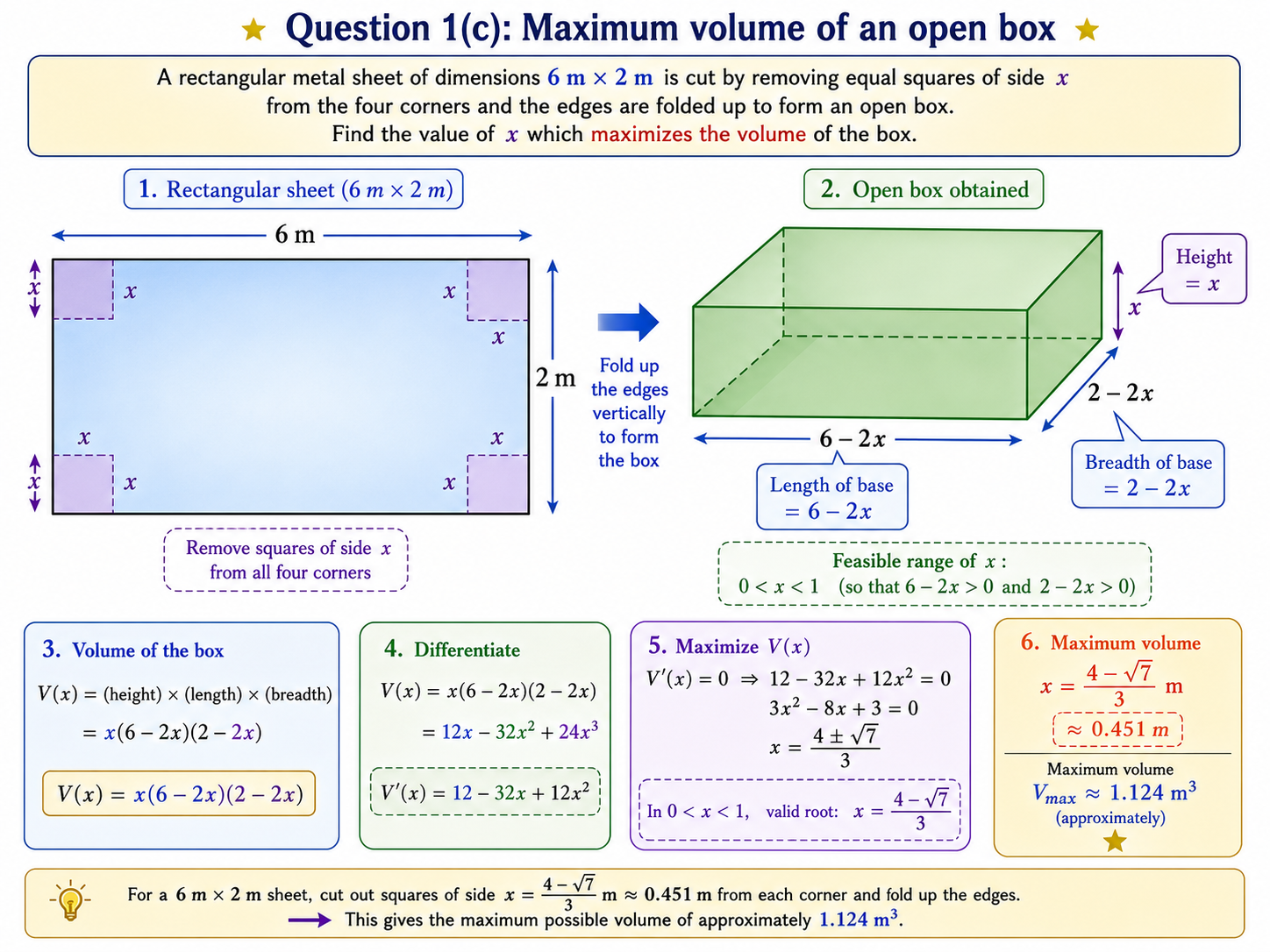
A rectangular sheet of metal of length \(6\) meters and width \(2\) meters is given. Four equal squares are removed from the four corners. The sides of this sheet are now folded up to form an open rectangular box. Find approximately the height of the box such that the volume of the box is maximum.

2Diagram

Question 1(c): Maximum volume of an open box
2025 UPSC Maths Optional Paper I Solutions diagram showing a rectangular sheet of size 6 m by 2 m, corner squares of side x removed, folded open box, and maximum-volume setup.

3Concept Related to the Question

The volume is expressed as a function of the cut-out square side.

4Detailed Solution

Let the side of each removed square be \(x\) metre. Then the height of the open box is \(x\), the length is \(6-2x\), and the width is \(2-2x\).

\[ V(x)=x(6-2x)(2-2x)=12x-16x^2+4x^3. \]

For maximum volume, differentiate with respect to \(x\):

\[ V'(x)=12-32x+12x^2. \]

Now \(V'(x)=0\) gives

\[ 12x^2-32x+12=0 \quad\Rightarrow\quad 3x^2-8x+3=0 \quad\Rightarrow\quad x=\frac{4\pm\sqrt7}{3}. \]

Since \(0<x<1\), the admissible value is \(x=\frac{4-\sqrt7}{3}\). Also, \(V''(x)=24x-32<0\) at this value, so the volume is maximum.

5Final Answer

The required height of the open box is \(\frac{4-\sqrt7}{3}\) metre, which is approximately \(0.451\) metre.

Question 1(d)

Functional equation

1Question

Given that \(f(x+y)=f(x)f(y)\) for all real \(x,y\), \(f(x)\neq0\) for any real \(x\) and \(f'(0)=2\). Show that for all real \(x\), \(f'(x)=2f(x)\). Hence find \(f(x)\).

2Diagram

Full Solution Access

The Diagram section for this question is available in the full 2025 UPSC Maths Optional Paper I PYQ Solutions course.

Complete diagrams, concepts, detailed solutions and final answers for all questions are available in the full PYQ course.

3Concept Related to the Question

Full Solution Access

The Concept Related to the Question section for this question is available in the full 2025 UPSC Maths Optional Paper I PYQ Solutions course.

Complete diagrams, concepts, detailed solutions and final answers for all questions are available in the full PYQ course.

4Detailed Solution

Full Solution Access

The Detailed Solution section for this question is available in the full 2025 UPSC Maths Optional Paper I PYQ Solutions course.

Complete diagrams, concepts, detailed solutions and final answers for all questions are available in the full PYQ course.

5Final Answer

Full Solution Access

The Final Answer section for this question is available in the full 2025 UPSC Maths Optional Paper I PYQ Solutions course.

Complete diagrams, concepts, detailed solutions and final answers for all questions are available in the full PYQ course.

Question 1(e)

Cone through a guiding curve

1Question

Find the equation of the cone whose vertex is the point \((1,1,0)\) and whose guiding curve is \(y=0,\ x^2+z^2=4\).

2Diagram

Full Solution Access

The Diagram section for this question is available in the full 2025 UPSC Maths Optional Paper I PYQ Solutions course.

Complete diagrams, concepts, detailed solutions and final answers for all questions are available in the full PYQ course.

3Concept Related to the Question

Full Solution Access

The Concept Related to the Question section for this question is available in the full 2025 UPSC Maths Optional Paper I PYQ Solutions course.

Complete diagrams, concepts, detailed solutions and final answers for all questions are available in the full PYQ course.

4Detailed Solution

Full Solution Access

The Detailed Solution section for this question is available in the full 2025 UPSC Maths Optional Paper I PYQ Solutions course.

Complete diagrams, concepts, detailed solutions and final answers for all questions are available in the full PYQ course.

5Final Answer

Full Solution Access

The Final Answer section for this question is available in the full 2025 UPSC Maths Optional Paper I PYQ Solutions course.

Complete diagrams, concepts, detailed solutions and final answers for all questions are available in the full PYQ course.

Question 2(a)

Linear transformation

1Question

Let \(T:\mathbb R^3\to\mathbb R^2\) be a linear transformation such that \(T(1,1,-1)=(1,0)\), \(T(4,1,1)=(0,1)\) and \(T(1,-1,2)=(1,1)\). Find \(T\).

2Diagram

Full Solution Access

The Diagram section for this question is available in the full 2025 UPSC Maths Optional Paper I PYQ Solutions course.

Complete diagrams, concepts, detailed solutions and final answers for all questions are available in the full PYQ course.

3Concept Related to the Question

Full Solution Access

The Concept Related to the Question section for this question is available in the full 2025 UPSC Maths Optional Paper I PYQ Solutions course.

Complete diagrams, concepts, detailed solutions and final answers for all questions are available in the full PYQ course.

4Detailed Solution

Full Solution Access

The Detailed Solution section for this question is available in the full 2025 UPSC Maths Optional Paper I PYQ Solutions course.

Complete diagrams, concepts, detailed solutions and final answers for all questions are available in the full PYQ course.

5Final Answer

Full Solution Access

The Final Answer section for this question is available in the full 2025 UPSC Maths Optional Paper I PYQ Solutions course.

Complete diagrams, concepts, detailed solutions and final answers for all questions are available in the full PYQ course.

Question 2(b)

Mean Value Theorem

1Question

Using Mean Value Theorem, prove that \(\dfrac{\pi}{6}+\dfrac{\sqrt3}{15}<\sin^{-1}\left(\dfrac35\right)<\dfrac{\pi}{6}+\dfrac18\).

2Diagram

Full Solution Access

The Diagram section for this question is available in the full 2025 UPSC Maths Optional Paper I PYQ Solutions course.

Complete diagrams, concepts, detailed solutions and final answers for all questions are available in the full PYQ course.

3Concept Related to the Question

Full Solution Access

The Concept Related to the Question section for this question is available in the full 2025 UPSC Maths Optional Paper I PYQ Solutions course.

Complete diagrams, concepts, detailed solutions and final answers for all questions are available in the full PYQ course.

4Detailed Solution

Full Solution Access

The Detailed Solution section for this question is available in the full 2025 UPSC Maths Optional Paper I PYQ Solutions course.

Complete diagrams, concepts, detailed solutions and final answers for all questions are available in the full PYQ course.

5Final Answer

Full Solution Access

The Final Answer section for this question is available in the full 2025 UPSC Maths Optional Paper I PYQ Solutions course.

Complete diagrams, concepts, detailed solutions and final answers for all questions are available in the full PYQ course.

Question 2(c)(i)

Cylinder with parallel generators

1Question

Find the equation of the cylinder whose generators are parallel to the line \(\dfrac{x}{1}=\dfrac{y}{2}=\dfrac{z}{3}\) and that passes through the curve \(x^2+y^2=16,\ z=0\).

2Diagram

Full Solution Access

The Diagram section for this question is available in the full 2025 UPSC Maths Optional Paper I PYQ Solutions course.

Complete diagrams, concepts, detailed solutions and final answers for all questions are available in the full PYQ course.

3Concept Related to the Question

Full Solution Access

The Concept Related to the Question section for this question is available in the full 2025 UPSC Maths Optional Paper I PYQ Solutions course.

Complete diagrams, concepts, detailed solutions and final answers for all questions are available in the full PYQ course.

4Detailed Solution

Full Solution Access

The Detailed Solution section for this question is available in the full 2025 UPSC Maths Optional Paper I PYQ Solutions course.

Complete diagrams, concepts, detailed solutions and final answers for all questions are available in the full PYQ course.

5Final Answer

Full Solution Access

The Final Answer section for this question is available in the full 2025 UPSC Maths Optional Paper I PYQ Solutions course.

Complete diagrams, concepts, detailed solutions and final answers for all questions are available in the full PYQ course.

Question 2(c)(ii)

Shortest distance between lines

1Question

Find the shortest distance between the straight lines \(\dfrac{x-3}{3}=\dfrac{y-8}{-1}=\dfrac{z-3}{1}\) and \(\dfrac{x+3}{-3}=\dfrac{y+7}{2}=\dfrac{z-6}{4}\).

2Diagram

Full Solution Access

The Diagram section for this question is available in the full 2025 UPSC Maths Optional Paper I PYQ Solutions course.

Complete diagrams, concepts, detailed solutions and final answers for all questions are available in the full PYQ course.

3Concept Related to the Question

Full Solution Access

The Concept Related to the Question section for this question is available in the full 2025 UPSC Maths Optional Paper I PYQ Solutions course.

Complete diagrams, concepts, detailed solutions and final answers for all questions are available in the full PYQ course.

4Detailed Solution

Full Solution Access

The Detailed Solution section for this question is available in the full 2025 UPSC Maths Optional Paper I PYQ Solutions course.

Complete diagrams, concepts, detailed solutions and final answers for all questions are available in the full PYQ course.

5Final Answer

Full Solution Access

The Final Answer section for this question is available in the full 2025 UPSC Maths Optional Paper I PYQ Solutions course.

Complete diagrams, concepts, detailed solutions and final answers for all questions are available in the full PYQ course.

Question 3(a)

Matrix echelon form

1Question

Reduce the following matrix to echelon form: \(A={\large \left[\begin{smallmatrix}2&-2&2&1\\-3&6&0&-1\\1&-7&10&2\end{smallmatrix}\right]}\).

2Diagram

Full Solution Access

The Diagram section for this question is available in the full 2025 UPSC Maths Optional Paper I PYQ Solutions course.

Complete diagrams, concepts, detailed solutions and final answers for all questions are available in the full PYQ course.

3Concept Related to the Question

Full Solution Access

The Concept Related to the Question section for this question is available in the full 2025 UPSC Maths Optional Paper I PYQ Solutions course.

Complete diagrams, concepts, detailed solutions and final answers for all questions are available in the full PYQ course.

4Detailed Solution

Full Solution Access

The Detailed Solution section for this question is available in the full 2025 UPSC Maths Optional Paper I PYQ Solutions course.

Complete diagrams, concepts, detailed solutions and final answers for all questions are available in the full PYQ course.

5Final Answer

Full Solution Access

The Final Answer section for this question is available in the full 2025 UPSC Maths Optional Paper I PYQ Solutions course.

Complete diagrams, concepts, detailed solutions and final answers for all questions are available in the full PYQ course.

Question 3(b)

Spheres through a circle

1Question

Find the equations of the spheres which pass through the circle \(x^2+y^2+z^2-2x+2y+4z-3=0,\ 2x+y+z=4\) and touch the plane \(3x+4y=14\).

2Diagram

Full Solution Access

The Diagram section for this question is available in the full 2025 UPSC Maths Optional Paper I PYQ Solutions course.

Complete diagrams, concepts, detailed solutions and final answers for all questions are available in the full PYQ course.

3Concept Related to the Question

Full Solution Access

The Concept Related to the Question section for this question is available in the full 2025 UPSC Maths Optional Paper I PYQ Solutions course.

Complete diagrams, concepts, detailed solutions and final answers for all questions are available in the full PYQ course.

4Detailed Solution

Full Solution Access

The Detailed Solution section for this question is available in the full 2025 UPSC Maths Optional Paper I PYQ Solutions course.

Complete diagrams, concepts, detailed solutions and final answers for all questions are available in the full PYQ course.

5Final Answer

Full Solution Access

The Final Answer section for this question is available in the full 2025 UPSC Maths Optional Paper I PYQ Solutions course.

Complete diagrams, concepts, detailed solutions and final answers for all questions are available in the full PYQ course.

Question 3(c)(i)

Double integral

1Question

Evaluate \(\displaystyle \iint_R y\,dx\,dy\), where \(R\) is the region bounded by \(y=x\) and \(y=4x-x^2\).

2Diagram

Full Solution Access

The Diagram section for this question is available in the full 2025 UPSC Maths Optional Paper I PYQ Solutions course.

Complete diagrams, concepts, detailed solutions and final answers for all questions are available in the full PYQ course.

3Concept Related to the Question

Full Solution Access

The Concept Related to the Question section for this question is available in the full 2025 UPSC Maths Optional Paper I PYQ Solutions course.

Complete diagrams, concepts, detailed solutions and final answers for all questions are available in the full PYQ course.

4Detailed Solution

Full Solution Access

The Detailed Solution section for this question is available in the full 2025 UPSC Maths Optional Paper I PYQ Solutions course.

Complete diagrams, concepts, detailed solutions and final answers for all questions are available in the full PYQ course.

5Final Answer

Full Solution Access

The Final Answer section for this question is available in the full 2025 UPSC Maths Optional Paper I PYQ Solutions course.

Complete diagrams, concepts, detailed solutions and final answers for all questions are available in the full PYQ course.

Question 3(c)(ii)

Partial derivative identities

1Question

If \(u(x,y)=xf\left(\dfrac yx\right)+g\left(\dfrac yx\right)\), where \(f\) and \(g\) are arbitrary functions, then show that

I. \(x\dfrac{\partial u}{\partial x}+y\dfrac{\partial u}{\partial y}=xf\left(\dfrac yx\right)\),

II. \(x^2\dfrac{\partial^2u}{\partial x^2}+2xy\dfrac{\partial^2u}{\partial x\partial y}+y^2\dfrac{\partial^2u}{\partial y^2}=0\).

2Diagram

Full Solution Access

The Diagram section for this question is available in the full 2025 UPSC Maths Optional Paper I PYQ Solutions course.

Complete diagrams, concepts, detailed solutions and final answers for all questions are available in the full PYQ course.

3Concept Related to the Question

Full Solution Access

The Concept Related to the Question section for this question is available in the full 2025 UPSC Maths Optional Paper I PYQ Solutions course.

Complete diagrams, concepts, detailed solutions and final answers for all questions are available in the full PYQ course.

4Detailed Solution

Full Solution Access

The Detailed Solution section for this question is available in the full 2025 UPSC Maths Optional Paper I PYQ Solutions course.

Complete diagrams, concepts, detailed solutions and final answers for all questions are available in the full PYQ course.

5Final Answer

Full Solution Access

The Final Answer section for this question is available in the full 2025 UPSC Maths Optional Paper I PYQ Solutions course.

Complete diagrams, concepts, detailed solutions and final answers for all questions are available in the full PYQ course.

Question 4(a)

Sphere and tangent plane

1Question

Show that there is no tangent plane to the sphere \(x^2+y^2+z^2-4x+2y-4z+4=0\) that can be passed through the straight line \(\dfrac{x+6}{2}=y+3=z+1\).

2Diagram

Full Solution Access

The Diagram section for this question is available in the full 2025 UPSC Maths Optional Paper I PYQ Solutions course.

Complete diagrams, concepts, detailed solutions and final answers for all questions are available in the full PYQ course.

3Concept Related to the Question

Full Solution Access

The Concept Related to the Question section for this question is available in the full 2025 UPSC Maths Optional Paper I PYQ Solutions course.

Complete diagrams, concepts, detailed solutions and final answers for all questions are available in the full PYQ course.

4Detailed Solution

Full Solution Access

The Detailed Solution section for this question is available in the full 2025 UPSC Maths Optional Paper I PYQ Solutions course.

Complete diagrams, concepts, detailed solutions and final answers for all questions are available in the full PYQ course.

5Final Answer

Full Solution Access

The Final Answer section for this question is available in the full 2025 UPSC Maths Optional Paper I PYQ Solutions course.

Complete diagrams, concepts, detailed solutions and final answers for all questions are available in the full PYQ course.

Question 4(b)

Mixed partial derivatives

1Question

If \(f(x,y)=xy\dfrac{x^2-y^2}{x^2+y^2}\) when \((x,y)\neq(0,0)\), and \(f(x,y)=0\) when \((x,y)=(0,0)\), then find \(f_{xy}(0,0)\) and \(f_{yx}(0,0)\).

2Diagram

Full Solution Access

The Diagram section for this question is available in the full 2025 UPSC Maths Optional Paper I PYQ Solutions course.

Complete diagrams, concepts, detailed solutions and final answers for all questions are available in the full PYQ course.

3Concept Related to the Question

Full Solution Access

The Concept Related to the Question section for this question is available in the full 2025 UPSC Maths Optional Paper I PYQ Solutions course.

Complete diagrams, concepts, detailed solutions and final answers for all questions are available in the full PYQ course.

4Detailed Solution

Full Solution Access

The Detailed Solution section for this question is available in the full 2025 UPSC Maths Optional Paper I PYQ Solutions course.

Complete diagrams, concepts, detailed solutions and final answers for all questions are available in the full PYQ course.

5Final Answer

Full Solution Access

The Final Answer section for this question is available in the full 2025 UPSC Maths Optional Paper I PYQ Solutions course.

Complete diagrams, concepts, detailed solutions and final answers for all questions are available in the full PYQ course.

Question 4(c)(i)

Eigenvalues and eigenvectors

1Question

Find the eigenvalues and the corresponding eigenvectors of the matrix \(A={\large \left[\begin{smallmatrix}1&2&0\\2&1&-6\\2&-2&3\end{smallmatrix}\right]}\).

2Diagram

Full Solution Access

The Diagram section for this question is available in the full 2025 UPSC Maths Optional Paper I PYQ Solutions course.

Complete diagrams, concepts, detailed solutions and final answers for all questions are available in the full PYQ course.

3Concept Related to the Question

Full Solution Access

The Concept Related to the Question section for this question is available in the full 2025 UPSC Maths Optional Paper I PYQ Solutions course.

Complete diagrams, concepts, detailed solutions and final answers for all questions are available in the full PYQ course.

4Detailed Solution

Full Solution Access

The Detailed Solution section for this question is available in the full 2025 UPSC Maths Optional Paper I PYQ Solutions course.

Complete diagrams, concepts, detailed solutions and final answers for all questions are available in the full PYQ course.

5Final Answer

Full Solution Access

The Final Answer section for this question is available in the full 2025 UPSC Maths Optional Paper I PYQ Solutions course.

Complete diagrams, concepts, detailed solutions and final answers for all questions are available in the full PYQ course.

Question 4(c)(ii)

Quotient vector space

1Question

Let \(P_n\) denote the vector space of all polynomials of degree \(\leq n\) over \(\mathbb R\). Verify that \(\dim\left(\dfrac{P_4}{P_2}\right)=\dim P_4-\dim P_2\).

2Diagram

Full Solution Access

The Diagram section for this question is available in the full 2025 UPSC Maths Optional Paper I PYQ Solutions course.

Complete diagrams, concepts, detailed solutions and final answers for all questions are available in the full PYQ course.

3Concept Related to the Question

Full Solution Access

The Concept Related to the Question section for this question is available in the full 2025 UPSC Maths Optional Paper I PYQ Solutions course.

Complete diagrams, concepts, detailed solutions and final answers for all questions are available in the full PYQ course.

4Detailed Solution

Full Solution Access

The Detailed Solution section for this question is available in the full 2025 UPSC Maths Optional Paper I PYQ Solutions course.

Complete diagrams, concepts, detailed solutions and final answers for all questions are available in the full PYQ course.

5Final Answer

Full Solution Access

The Final Answer section for this question is available in the full 2025 UPSC Maths Optional Paper I PYQ Solutions course.

Complete diagrams, concepts, detailed solutions and final answers for all questions are available in the full PYQ course.

Question 5(a)

First order differential equation

1Question

Solve \(\left(1-y^2+\dfrac{y^4}{x^2}\right)\left(\dfrac{dy}{dx}\right)^2-2\dfrac yx\dfrac{dy}{dx}+\dfrac{y^2}{x^2}=0\).

2Diagram

Full Solution Access

The Diagram section for this question is available in the full 2025 UPSC Maths Optional Paper I PYQ Solutions course.

Complete diagrams, concepts, detailed solutions and final answers for all questions are available in the full PYQ course.

3Concept Related to the Question

Full Solution Access

The Concept Related to the Question section for this question is available in the full 2025 UPSC Maths Optional Paper I PYQ Solutions course.

Complete diagrams, concepts, detailed solutions and final answers for all questions are available in the full PYQ course.

4Detailed Solution

Full Solution Access

The Detailed Solution section for this question is available in the full 2025 UPSC Maths Optional Paper I PYQ Solutions course.

Complete diagrams, concepts, detailed solutions and final answers for all questions are available in the full PYQ course.

5Final Answer

Full Solution Access

The Final Answer section for this question is available in the full 2025 UPSC Maths Optional Paper I PYQ Solutions course.

Complete diagrams, concepts, detailed solutions and final answers for all questions are available in the full PYQ course.

Question 5(b)

Differential equation of ellipses

1Question

Form the differential equation of all ellipses whose axes coincide with coordinate axes.

2Diagram

Full Solution Access

The Diagram section for this question is available in the full 2025 UPSC Maths Optional Paper I PYQ Solutions course.

Complete diagrams, concepts, detailed solutions and final answers for all questions are available in the full PYQ course.

3Concept Related to the Question

Full Solution Access

The Concept Related to the Question section for this question is available in the full 2025 UPSC Maths Optional Paper I PYQ Solutions course.

Complete diagrams, concepts, detailed solutions and final answers for all questions are available in the full PYQ course.

4Detailed Solution

Full Solution Access

The Detailed Solution section for this question is available in the full 2025 UPSC Maths Optional Paper I PYQ Solutions course.

Complete diagrams, concepts, detailed solutions and final answers for all questions are available in the full PYQ course.

5Final Answer

Full Solution Access

The Final Answer section for this question is available in the full 2025 UPSC Maths Optional Paper I PYQ Solutions course.

Complete diagrams, concepts, detailed solutions and final answers for all questions are available in the full PYQ course.

Question 5(c)

Kepler orbit time

1Question

Prove that the time taken by the Earth to travel over half of its orbit, which is separated by the minor axis and is remote from the Sun, when the Sun is at the focus of the elliptic orbit, is two days more than half of the year. The eccentricity of the orbit is taken as \(\dfrac1{60}\).

2Diagram

Full Solution Access

The Diagram section for this question is available in the full 2025 UPSC Maths Optional Paper I PYQ Solutions course.

Complete diagrams, concepts, detailed solutions and final answers for all questions are available in the full PYQ course.

3Concept Related to the Question

Full Solution Access

The Concept Related to the Question section for this question is available in the full 2025 UPSC Maths Optional Paper I PYQ Solutions course.

Complete diagrams, concepts, detailed solutions and final answers for all questions are available in the full PYQ course.

4Detailed Solution

Full Solution Access

The Detailed Solution section for this question is available in the full 2025 UPSC Maths Optional Paper I PYQ Solutions course.

Complete diagrams, concepts, detailed solutions and final answers for all questions are available in the full PYQ course.

5Final Answer

Full Solution Access

The Final Answer section for this question is available in the full 2025 UPSC Maths Optional Paper I PYQ Solutions course.

Complete diagrams, concepts, detailed solutions and final answers for all questions are available in the full PYQ course.

Question 5(d)

Catenary

1Question

Given that \(A\) and \(B\) are two points in the same horizontal line distant \(2a\) apart. \(AO\) and \(BO\) are two equal heavy strings tied together at \(O\) and carrying their weight at \(O\). If \(l\) is length of each string and \(d\) is depth of \(O\) below \(AB\), then show that the parameter \(c\) of this catenary, in which the strings hang, is given by \(l^2-d^2=2c^2\left[\cosh\left(\dfrac ac\right)-1\right]\).

2Diagram

Full Solution Access

The Diagram section for this question is available in the full 2025 UPSC Maths Optional Paper I PYQ Solutions course.

Complete diagrams, concepts, detailed solutions and final answers for all questions are available in the full PYQ course.

3Concept Related to the Question

Full Solution Access

The Concept Related to the Question section for this question is available in the full 2025 UPSC Maths Optional Paper I PYQ Solutions course.

Complete diagrams, concepts, detailed solutions and final answers for all questions are available in the full PYQ course.

4Detailed Solution

Full Solution Access

The Detailed Solution section for this question is available in the full 2025 UPSC Maths Optional Paper I PYQ Solutions course.

Complete diagrams, concepts, detailed solutions and final answers for all questions are available in the full PYQ course.

5Final Answer

Full Solution Access

The Final Answer section for this question is available in the full 2025 UPSC Maths Optional Paper I PYQ Solutions course.

Complete diagrams, concepts, detailed solutions and final answers for all questions are available in the full PYQ course.

Question 5(e)

Coplanar gradients

1Question

If \(u=x+y+z\), \(v=x^2+y^2+z^2\) and \(w=xy+yz+zx\), then show that \(\nabla u\), \(\nabla v\) and \(\nabla w\) are coplanar.

2Diagram

Full Solution Access

The Diagram section for this question is available in the full 2025 UPSC Maths Optional Paper I PYQ Solutions course.

Complete diagrams, concepts, detailed solutions and final answers for all questions are available in the full PYQ course.

3Concept Related to the Question

Full Solution Access

The Concept Related to the Question section for this question is available in the full 2025 UPSC Maths Optional Paper I PYQ Solutions course.

Complete diagrams, concepts, detailed solutions and final answers for all questions are available in the full PYQ course.

4Detailed Solution

Full Solution Access

The Detailed Solution section for this question is available in the full 2025 UPSC Maths Optional Paper I PYQ Solutions course.

Complete diagrams, concepts, detailed solutions and final answers for all questions are available in the full PYQ course.

5Final Answer

Full Solution Access

The Final Answer section for this question is available in the full 2025 UPSC Maths Optional Paper I PYQ Solutions course.

Complete diagrams, concepts, detailed solutions and final answers for all questions are available in the full PYQ course.

Question 6(a)

Laplace convolution theorem

1Question

If \(F(s)\) and \(G(s)\) are Laplace transforms of \(f(t)\) and \(g(t)\) respectively, then prove that \(\mathcal L\left\{\int_0^t f(x)g(t-x)\,dx\right\}=F(s)G(s)\). Using this result, solve the equation \(y(t)=t+\int_0^t y(x)\sin(t-x)\,dx\).

2Diagram

Full Solution Access

The Diagram section for this question is available in the full 2025 UPSC Maths Optional Paper I PYQ Solutions course.

Complete diagrams, concepts, detailed solutions and final answers for all questions are available in the full PYQ course.

3Concept Related to the Question

Full Solution Access

The Concept Related to the Question section for this question is available in the full 2025 UPSC Maths Optional Paper I PYQ Solutions course.

Complete diagrams, concepts, detailed solutions and final answers for all questions are available in the full PYQ course.

4Detailed Solution

Full Solution Access

The Detailed Solution section for this question is available in the full 2025 UPSC Maths Optional Paper I PYQ Solutions course.

Complete diagrams, concepts, detailed solutions and final answers for all questions are available in the full PYQ course.

5Final Answer

Full Solution Access

The Final Answer section for this question is available in the full 2025 UPSC Maths Optional Paper I PYQ Solutions course.

Complete diagrams, concepts, detailed solutions and final answers for all questions are available in the full PYQ course.

Question 6(b)

Elastic string motion

1Question

One end of an elastic string, having natural length \(a\), is fixed at some point \(O\) and a heavy particle is attached to the other end of the string. The string is drawn vertically downward till it is four times its natural length at the point \(C\) and then released. If the modulus of elasticity of the string is equal to the weight of the particle, then show that the particle will return to the same point \(C\) in the time \(\sqrt{\dfrac ag}\left(2\sqrt3+\dfrac{4\pi}{3}\right)\).

2Diagram

Full Solution Access

The Diagram section for this question is available in the full 2025 UPSC Maths Optional Paper I PYQ Solutions course.

Complete diagrams, concepts, detailed solutions and final answers for all questions are available in the full PYQ course.

3Concept Related to the Question

Full Solution Access

The Concept Related to the Question section for this question is available in the full 2025 UPSC Maths Optional Paper I PYQ Solutions course.

Complete diagrams, concepts, detailed solutions and final answers for all questions are available in the full PYQ course.

4Detailed Solution

Full Solution Access

The Detailed Solution section for this question is available in the full 2025 UPSC Maths Optional Paper I PYQ Solutions course.

Complete diagrams, concepts, detailed solutions and final answers for all questions are available in the full PYQ course.

5Final Answer

Full Solution Access

The Final Answer section for this question is available in the full 2025 UPSC Maths Optional Paper I PYQ Solutions course.

Complete diagrams, concepts, detailed solutions and final answers for all questions are available in the full PYQ course.

Question 6(c)(i)

Directional derivative

1Question

Find the absolute value of the directional derivative of \(\phi(x,y,z)=x^2y^2z\) at the point \((1,1,-1)\) in the direction of the tangent to the curve \(x=e^t,\ y=2\sin t+1,\ z=t-\cos t\), at \(t=0\).

2Diagram

Full Solution Access

The Diagram section for this question is available in the full 2025 UPSC Maths Optional Paper I PYQ Solutions course.

Complete diagrams, concepts, detailed solutions and final answers for all questions are available in the full PYQ course.

3Concept Related to the Question

Full Solution Access

The Concept Related to the Question section for this question is available in the full 2025 UPSC Maths Optional Paper I PYQ Solutions course.

Complete diagrams, concepts, detailed solutions and final answers for all questions are available in the full PYQ course.

4Detailed Solution

Full Solution Access

The Detailed Solution section for this question is available in the full 2025 UPSC Maths Optional Paper I PYQ Solutions course.

Complete diagrams, concepts, detailed solutions and final answers for all questions are available in the full PYQ course.

5Final Answer

Full Solution Access

The Final Answer section for this question is available in the full 2025 UPSC Maths Optional Paper I PYQ Solutions course.

Complete diagrams, concepts, detailed solutions and final answers for all questions are available in the full PYQ course.

Question 6(c)(ii)

Vector wave equations

1Question

If \(\nabla\cdot\vec E=0\), \(\nabla\cdot\vec H=0\), \(\nabla\times\vec E=-\dfrac{\partial\vec H}{\partial t}\) and \(\nabla\times\vec H=\dfrac{\partial\vec E}{\partial t}\), then show that \(\nabla^2\vec H=\dfrac{\partial^2\vec H}{\partial t^2}\) and \(\nabla^2\vec E=\dfrac{\partial^2\vec E}{\partial t^2}\).

2Diagram

Full Solution Access

The Diagram section for this question is available in the full 2025 UPSC Maths Optional Paper I PYQ Solutions course.

Complete diagrams, concepts, detailed solutions and final answers for all questions are available in the full PYQ course.

3Concept Related to the Question

Full Solution Access

The Concept Related to the Question section for this question is available in the full 2025 UPSC Maths Optional Paper I PYQ Solutions course.

Complete diagrams, concepts, detailed solutions and final answers for all questions are available in the full PYQ course.

4Detailed Solution

Full Solution Access

The Detailed Solution section for this question is available in the full 2025 UPSC Maths Optional Paper I PYQ Solutions course.

Complete diagrams, concepts, detailed solutions and final answers for all questions are available in the full PYQ course.

5Final Answer

Full Solution Access

The Final Answer section for this question is available in the full 2025 UPSC Maths Optional Paper I PYQ Solutions course.

Complete diagrams, concepts, detailed solutions and final answers for all questions are available in the full PYQ course.

Question 7(a)

Stable equilibrium of a sphere in a bowl

1Question

A solid sphere rests inside a fixed rough and hemispherical bowl of twice its radius. If a large amount of weight, whatsoever, is attached to the highest point of the sphere, then show that the equilibrium is stable.

2Diagram

Full Solution Access

The Diagram section for this question is available in the full 2025 UPSC Maths Optional Paper I PYQ Solutions course.

Complete diagrams, concepts, detailed solutions and final answers for all questions are available in the full PYQ course.

3Concept Related to the Question

Full Solution Access

The Concept Related to the Question section for this question is available in the full 2025 UPSC Maths Optional Paper I PYQ Solutions course.

Complete diagrams, concepts, detailed solutions and final answers for all questions are available in the full PYQ course.

4Detailed Solution

Full Solution Access

The Detailed Solution section for this question is available in the full 2025 UPSC Maths Optional Paper I PYQ Solutions course.

Complete diagrams, concepts, detailed solutions and final answers for all questions are available in the full PYQ course.

5Final Answer

Full Solution Access

The Final Answer section for this question is available in the full 2025 UPSC Maths Optional Paper I PYQ Solutions course.

Complete diagrams, concepts, detailed solutions and final answers for all questions are available in the full PYQ course.

Question 7(b)

Green theorem

1Question

Verify Green’s theorem in the plane for \(\displaystyle \oint_C\left[(xy+y^2)\,dx+x^2\,dy\right]\), where \(C\) is the boundary of the region bounded by the curves \(y=x\) and \(y=x^2\).

2Diagram

Full Solution Access

The Diagram section for this question is available in the full 2025 UPSC Maths Optional Paper I PYQ Solutions course.

Complete diagrams, concepts, detailed solutions and final answers for all questions are available in the full PYQ course.

3Concept Related to the Question

Full Solution Access

The Concept Related to the Question section for this question is available in the full 2025 UPSC Maths Optional Paper I PYQ Solutions course.

Complete diagrams, concepts, detailed solutions and final answers for all questions are available in the full PYQ course.

4Detailed Solution

Full Solution Access

The Detailed Solution section for this question is available in the full 2025 UPSC Maths Optional Paper I PYQ Solutions course.

Complete diagrams, concepts, detailed solutions and final answers for all questions are available in the full PYQ course.

5Final Answer

Full Solution Access

The Final Answer section for this question is available in the full 2025 UPSC Maths Optional Paper I PYQ Solutions course.

Complete diagrams, concepts, detailed solutions and final answers for all questions are available in the full PYQ course.

Question 7(c)(i)

General and singular solution

1Question

Find the general solution and singular solution of differential equation \(\left(1+\dfrac{dy}{dx}\right)^3=\dfrac{27}{8a}(x+y)\left(1-\dfrac{dy}{dx}\right)^3\).

2Diagram

Full Solution Access

The Diagram section for this question is available in the full 2025 UPSC Maths Optional Paper I PYQ Solutions course.

Complete diagrams, concepts, detailed solutions and final answers for all questions are available in the full PYQ course.

3Concept Related to the Question

Full Solution Access

The Concept Related to the Question section for this question is available in the full 2025 UPSC Maths Optional Paper I PYQ Solutions course.

Complete diagrams, concepts, detailed solutions and final answers for all questions are available in the full PYQ course.

4Detailed Solution

Full Solution Access

The Detailed Solution section for this question is available in the full 2025 UPSC Maths Optional Paper I PYQ Solutions course.

Complete diagrams, concepts, detailed solutions and final answers for all questions are available in the full PYQ course.

5Final Answer

Full Solution Access

The Final Answer section for this question is available in the full 2025 UPSC Maths Optional Paper I PYQ Solutions course.

Complete diagrams, concepts, detailed solutions and final answers for all questions are available in the full PYQ course.

Question 7(c)(ii)

Cauchy-Euler equation

1Question

Find the complete solution of \(x^3\dfrac{d^3y}{dx^3}+3x^2\dfrac{d^2y}{dx^2}+x\dfrac{dy}{dx}+y=x\log x\).

2Diagram

Full Solution Access

The Diagram section for this question is available in the full 2025 UPSC Maths Optional Paper I PYQ Solutions course.

Complete diagrams, concepts, detailed solutions and final answers for all questions are available in the full PYQ course.

3Concept Related to the Question

Full Solution Access

The Concept Related to the Question section for this question is available in the full 2025 UPSC Maths Optional Paper I PYQ Solutions course.

Complete diagrams, concepts, detailed solutions and final answers for all questions are available in the full PYQ course.

4Detailed Solution

Full Solution Access

The Detailed Solution section for this question is available in the full 2025 UPSC Maths Optional Paper I PYQ Solutions course.

Complete diagrams, concepts, detailed solutions and final answers for all questions are available in the full PYQ course.

5Final Answer

Full Solution Access

The Final Answer section for this question is available in the full 2025 UPSC Maths Optional Paper I PYQ Solutions course.

Complete diagrams, concepts, detailed solutions and final answers for all questions are available in the full PYQ course.

Question 8(a)

Variation of parameters

1Question

Solve the differential equation \((x+2)\dfrac{d^2y}{dx^2}-(2x+5)\dfrac{dy}{dx}+2y=(1+x)e^x\) by the method of variation of parameters.

2Diagram

Full Solution Access

The Diagram section for this question is available in the full 2025 UPSC Maths Optional Paper I PYQ Solutions course.

Complete diagrams, concepts, detailed solutions and final answers for all questions are available in the full PYQ course.

3Concept Related to the Question

Full Solution Access

The Concept Related to the Question section for this question is available in the full 2025 UPSC Maths Optional Paper I PYQ Solutions course.

Complete diagrams, concepts, detailed solutions and final answers for all questions are available in the full PYQ course.

4Detailed Solution

Full Solution Access

The Detailed Solution section for this question is available in the full 2025 UPSC Maths Optional Paper I PYQ Solutions course.

Complete diagrams, concepts, detailed solutions and final answers for all questions are available in the full PYQ course.

5Final Answer

Full Solution Access

The Final Answer section for this question is available in the full 2025 UPSC Maths Optional Paper I PYQ Solutions course.

Complete diagrams, concepts, detailed solutions and final answers for all questions are available in the full PYQ course.

Question 8(b)

Gauss divergence theorem

1Question

Verify Gauss’s divergence theorem for \(\vec F=[(x^2-yz)\hat i+(y^2-zx)\hat j+(z^2-xy)\hat k]\), taken over rectangular parallelopiped \(0\leq x\leq a,\ 0\leq y\leq b,\ 0\leq z\leq c\).

2Diagram

Full Solution Access

The Diagram section for this question is available in the full 2025 UPSC Maths Optional Paper I PYQ Solutions course.

Complete diagrams, concepts, detailed solutions and final answers for all questions are available in the full PYQ course.

3Concept Related to the Question

Full Solution Access

The Concept Related to the Question section for this question is available in the full 2025 UPSC Maths Optional Paper I PYQ Solutions course.

Complete diagrams, concepts, detailed solutions and final answers for all questions are available in the full PYQ course.

4Detailed Solution

Full Solution Access

The Detailed Solution section for this question is available in the full 2025 UPSC Maths Optional Paper I PYQ Solutions course.

Complete diagrams, concepts, detailed solutions and final answers for all questions are available in the full PYQ course.

5Final Answer

Full Solution Access

The Final Answer section for this question is available in the full 2025 UPSC Maths Optional Paper I PYQ Solutions course.

Complete diagrams, concepts, detailed solutions and final answers for all questions are available in the full PYQ course.

Question 8(c)

Particle in smooth vertical cylinder

1Question

A particle is projected inside a fixed smooth cylinder with circular cross-section in a vertical plane from the lowest point with initial horizontal velocity \(u\). Show that for

(i) \((u^2\leq 2ag)\); the particle oscillates about the mean position in the lower half,

(ii) \((u^2\geq 5ag)\); the particle executes complete circular motion, and

(iii) \((2ag<u^2<5ag)\); the particle will leave the curve in a tangential direction, making an angle \(\alpha\) with the horizontal such that \(\cos\alpha=\dfrac{u^2-2ag}{3ag}\).

2Diagram

Full Solution Access

The Diagram section for this question is available in the full 2025 UPSC Maths Optional Paper I PYQ Solutions course.

Complete diagrams, concepts, detailed solutions and final answers for all questions are available in the full PYQ course.

3Concept Related to the Question

Full Solution Access

The Concept Related to the Question section for this question is available in the full 2025 UPSC Maths Optional Paper I PYQ Solutions course.

Complete diagrams, concepts, detailed solutions and final answers for all questions are available in the full PYQ course.

4Detailed Solution

Full Solution Access

The Detailed Solution section for this question is available in the full 2025 UPSC Maths Optional Paper I PYQ Solutions course.

Complete diagrams, concepts, detailed solutions and final answers for all questions are available in the full PYQ course.

5Final Answer

Full Solution Access

The Final Answer section for this question is available in the full 2025 UPSC Maths Optional Paper I PYQ Solutions course.

Complete diagrams, concepts, detailed solutions and final answers for all questions are available in the full PYQ course.

2025 UPSC Maths Optional Paper I Solutions FAQs

Are these 2025 UPSC Maths Optional Paper I Solutions complete?

This public page gives one full sample solution for 2025 UPSC Maths Optional Paper I. Complete question-wise solutions for the full paper are available in the full PYQ course by Ramana Sri IAS.

Which question is given as a free sample solution on this page?

Question 1(c) is given as the free sample solution on this page. The sample includes all five sections: Question, Diagram, Concept Related to the Question, Detailed Solution, and Final Answer.

How should I use these 2025 UPSC Maths Optional Paper I Solutions for preparation?

Students should first solve the questions independently, then compare their approach with the solution method. These solutions are useful for revision, answer-writing practice, diagram presentation, and concept clarity before the UPSC Mains examination.

Do these solutions include diagrams and detailed explanations?

Yes. The full PYQ course follows a structured format wherever required: Question, Diagram, Concept Related to the Question, Detailed Solution, and Final Answer. This public page shows the format through one free sample solution.

How can I get complete solutions for all questions in 2025 UPSC Maths Optional Paper I?

To access complete solutions for all questions, please fill out the admission form first. Our Ramana Sri IAS admission team will guide you through WhatsApp, email, or call.

Scroll to Top