IFoS Mathematics Optional Syllabus
IFoS Maths Optional Syllabus 2026 in English
Complete IFoS Maths Optional Syllabus in English for Paper-1 and Paper-2 with topic-wise structure, preparation guidance, study strategy and exam-oriented support for serious aspirants.
The IFoS Maths Optional Syllabus 2026 gives students a clear topic-wise structure for Paper-1 and Paper-2 preparation. Aspirants should study the syllabus carefully before starting IFoS Mathematics Optional preparation because it helps them understand important modules, repeated areas, paper structure, scoring topics and the correct order of revision.
What should you do after reading the IFoS Maths Optional Syllabus?
Reading the syllabus is only the first step. To prepare Paper I and Paper II properly, students should connect each topic with previous year questions, solved examples, answer-writing practice and full-length test evaluation. Our Ramana Sri IAS admission team will guide you through WhatsApp, email, or call.
IFoS Maths Optional Syllabus
IFoS Maths Optional Syllabus in English can be one of the most scoring optional subjects in the IFoS Mains exam. This subject is well-suited for candidates who have a background in science and possess strong problem-solving skills. It is also a good choice for those who want to broaden their analytical skills.
The subject requires a lot of time and effort, but it can be very rewarding. If you are considering taking this subject, it is important to prepare thoroughly and focus on the topic-wise preparation tips.
In order to pass the IFoS Maths Optional, you should take advantage of all available resources. This includes study notes, online videos, and previous year exam papers. It is also a good idea to attend a coaching class. This will help you understand the course material better and improve your score.
Moreover, you should keep a notebook that contains all the formulas and theorems that you might need to solve questions. This will help you avoid silly mistakes and save a lot of time.
Preparation Focus:
Study notes, online videos, previous year papers, formula notebook, coaching guidance, mock tests and full-length practice are important for IFoS Maths Optional preparation.
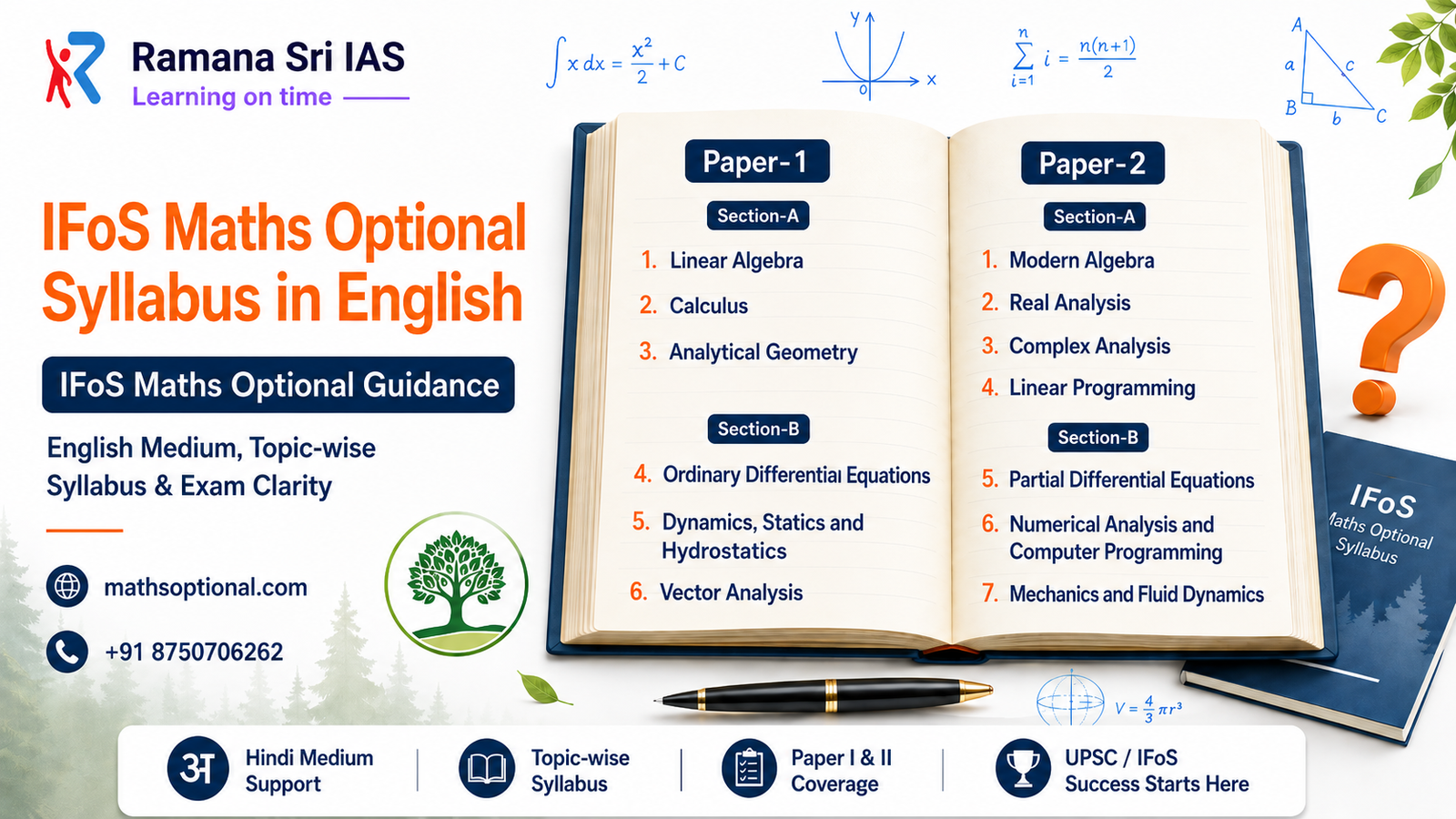
IFoS Maths Optional Syllabus and Preparation Approach
IFoS Maths Optional Syllabus is a challenging subject, but you can improve your chances of passing by preparing well. The best way to prepare is by systematically going through all the topics and practicing as many questions as possible. You should also try to write answers in a logical manner. This will help you score more marks and secure a high rank in the exam.
Besides practicing and studying, you should also try to take some mock tests and full-length exams from previous years. It is also important to make a schedule and stick to it. By following this plan, you will be able to cover the entire syllabus and improve your score in the exam. In addition, you should try to find out the best books for IFoS Maths Optional to study from.
Systematic Study
Go through all topics in a planned and structured manner.
Question Practice
Practice as many questions as possible to improve accuracy and confidence.
Logical Answers
Write answers in a logical manner to score more marks.
Mock Tests
Take mock tests and full-length exams from previous years.
The IFoS Mathematics Optional Syllabus
The IFoS Mathematics optional syllabus consists of two papers with 250 marks each. This is a great choice for science graduates, as it offers an opportunity to increase their score and get a top rank in the exam. It is also a useful subject to learn, as it develops analytical and problem-solving skills.
The IFoS Mathematics optional syllabus covers topics like calculus, linear algebra with matrices, ordinary differential equations, and Analytical Geometry. This subject is an excellent choice for those who wish to become a civil servant and develop their analytical and problem-solving skills. It is also one of the most popular subjects in the IAS and IFoS examinations.
It is also a good choice for candidates who are interested in working as an engineer or B.Sc Maths. This subject is also considered one of the most scoring options in the IAS, IFoS, and CSE-Civil Services Mains exams. Candidates should remember that this subject is not linked to current affairs, so it is not as difficult to pass as other subjects. Moreover, it is not as time-consuming as other subjects. In addition, it is easy to master if you are a science graduate and have a good understanding of the theory behind it.
Difference Between UPSC and IFoS Maths Optional Syllabus
IFoS Mathematics Optional Syllabus is almost the same as the UPSC Civil Services Mathematics Optional Syllabus. However, there are some small but important differences in Paper I and Paper II. IFoS aspirants should carefully note the extra topics added in the IFoS syllabus and the topics not required from the UPSC syllabus.
The core modules such as Linear Algebra, Calculus, Analytical Geometry, Ordinary Differential Equations, Vector Analysis, Modern Algebra, Real Analysis, Complex Analysis, Linear Programming, PDE, Numerical Analysis and Mechanics are largely similar. The main difference is in a few additional topics and removed topics.
| Module | IFoS Maths Optional Syllabus Difference |
|---|---|
| Linear Algebra | Orthogonal and unitary reduction of quadratic and Hermitian forms, positive definite quadratic forms are added. |
| Calculus | Centre of gravity is added. |
| Ordinary Differential Equations | Laplace transformations and related concepts are not included. |
| Dynamics and Statics | Hydrostatics is added. |
| Modern Algebra | Sylow groups, field extensions and finite fields are added. |
| Complex Analysis | Conformal mapping and bilinear transformations are added. |
| Linear Programming | Travelling salesman problem is added. |
| Partial Differential Equations | Pfaffian differential equations and Charpit's method of solution are added. |
| Numerical Analysis and Computer Programming | Developing simple programs in BASIC for problems involving techniques covered in numerical analysis is added. |
The remaining topics are more or less similar to the UPSC Mathematics Optional syllabus. Since there is usually a gap between the Civil Services Mains examination and the IFoS Mains examination, students can use that time to revise the extra IFoS-specific topics with proper planning and guidance.
Paper 1
IFoS Maths Optional Syllabus Paper 1
Paper-1 includes Linear Algebra, Calculus, Analytical Geometry, Ordinary Differential Equations, Dynamics, Statics, Hydrostatics and Vector Analysis.
Section-A
(1) Linear Algebra
Vector, space, linear dependence and independence, subspaces, bases, dimensions. Finite dimensional vector spaces. Matrices, Cayley-Hamilton theorem, Eigen values and Eigenvectors, matrix of linear transformation, row and column reduction, Echelon form, equivalence, congruence and similarity, reduction to canonical form, rank, orthogonal, symmetrical, skew symmetrical, unitary, Hermitian, skew-Hermitian forms their Eigen values. Orthogonal and unitary reduction of quadratic and Hermitian forms, positive definite quadratic forms.
(2) Calculus
Real numbers, limits, continuity, differentiability, mean-value theorems, Taylor’s theorem with remainders, indeterminate forms, maxima and minima, asymptotes. Functions of several variables: continuity, differentiability, partial derivatives, maxima and minima, Lagrange’s method of multipliers, Jacobian. Riemann’s definition of definite integrals, indefinite integrals, infinite and improper integrals, beta and gamma functions. Double and triple integrals (evaluation techniques only). Areas, surface and volumes, center of gravity.
(3) Analytical Geometry
Cartesian and polar coordinates in two and three dimensions, second degree equations in two and three dimensions, reduction to canonical forms, straight lines, shortest distance between two skew lines, plane, sphere, cone, cylinder, paraboloid, ellipsoid, hyperboloid of one and two sheets and their properties.
Section-B
(4) Ordinary Differential Equations
Formulation of differential equations, order and degree, equations of first order and first degree, integrating factor, equations of first order but not of first degree, Clairaut’s equation, singular solution. Higher order linear equations, with constant coefficients, complementary function and particular integral, general solution, Euler-Cauchy equation. Second order linear equations with variable coefficients, determination of complete solution when one solution is known, method of variation of parameters.
(5) Dynamics, Statics and Hydrostatics
(i) Dynamics: Degree of freedom and constraints, rectilinear motion, simple harmonic motion, motion in a plane, projectiles, constrained motion, work and energy, conservation of energy, motion under impulsive forces, Kepler’s laws, orbits under central forces, motion of varying mass, motion under resistance.
(ii) Statics: Equilibrium of a system of particles, work and potential energy, friction, common catenary, principle of virtual work, stability of equilibrium, equilibrium of forces in three dimensions.
(iii) Hydro Statics: Pressure of heavy fluids, equilibrium of fluids under given system of forces Bernoulli’s equation, centre of pressure, thrust on curved surfaces, equilibrium of floating bodies, stability of equilibrium, metacentre, pressure of gases.
(6) Vector Analysis
Scalar and vector fields, triple, products, differentiation of vector function of a scalar variable, gradient, divergence and curl in Cartesian, cylindrical and spherical coordinates and their physical interpretations. Higher order derivatives, vector identities and vector equations. Application to Geometry: Curves in space, curvature and torsion. Serret-Frenet’s formulae, Gauss and Stokes’ theorems, Green’s identities.
Paper 2
IFoS Maths Optional Syllabus Paper 2
Paper-2 includes Algebra, Real Analysis, Complex Analysis, Linear Programming, Partial Differential Equations, Numerical Analysis, Computer Programming, Mechanics and Fluid Dynamics.
Section-A
(1) Modern Algebra
Groups, subgroups, normal subgroups, homomorphism of groups quotient groups basic isomorphism theorems, Sylow’s group, permutation groups, Cayley theorem. Rings and ideals, principal ideal domains, unique factorization domains and Euclidean domains. Field extensions, finite fields.
(2) Real Analysis
Real number system, ordered sets, bounds, ordered field, real number system as an ordered field with least upper bound property, Cauchy sequence, completeness, Continuity and uniform continuity of functions, properties of continuous functions on compact sets. Riemann integral, improper integrals, absolute and conditional convergence of series of real and complex terms, rearrangement of series. Uniform convergence, continuity, differentiability and integrability for sequences and series of functions. Differentiation of functions of several variables, change in the order of partial derivatives, implicit function theorem, maxima and minima. Multiple integrals.
(3) Complex Analysis
Analytic function, Cauchy-Riemann equations, Cauchy’s theorem, Cauchy’s integral formula, power series, Taylor’s series, Laurent’s Series, Singularities, Cauchy’s residue theorem, contour integration. Conformal mapping, bilinear transformations.
(4) Linear Programming
Linear programming problems, basic solution, basic feasible solution and optimal solution, graphical method and Simplex method of solutions. Duality. Transportation and assignment problems. Travelling salesman problems.
Section-B
(5) Partial Differential Equations
Curves and surfaces in three dimensions, formulation of partial differential equations, solutions of equations of type dx/p=dy/q=dz/r; orthogonal trajectories, Pfaffian differential equations; partial differential equations of the first order, solution by Cauchy’s method of characteristics; Charpit’s method of solutions, linear partial differential equations of the second order with constant coefficients, equations of vibrating string, heat equation, Laplace equation.
(6) Numerical Analysis and Computer Programming
(i) Numerical methods: Solution of algebraic and transcendental equations of one variable by bisection, Regula-Falsi and Newton-Raphson methods, solution of system of linear equations by Gaussian elimination and Gauss-Jordan (direct) methods, Gauss-Seidel(iterative) method. Newton’s (Forward and backward) and Lagrange’s method of interpolation.
(ii) Numerical integration: Simpson’s one-third rule, trapezoidal rule, Gaussian quadrature formula.
(iii) Numerical solution of ordinary differential equations: Euler and Runge Kutta-methods.
(iv) Computer Programming: Storage of numbers in Computers, bits, bytes and words, binary system. arithmetic and logical operations on numbers. Bitwise operations. AND, OR, XOR, NOT, and shift/rotate operators. Octal and Hexadecimal Systems. Conversion to and from decimal Systems. Representation of unsigned integers, signed integers and reals, double precision reals and long integers. Algorithms and flow charts for solving numerical analysis problems. Developing simple programs in Basic for problems involving techniques covered in the numerical analysis.
(7) Mechanics and Fluid Dynamics
(i) Mechanics: Generalized coordinates, constraints, holonomic and non-holonomic, systems. D’Alembert’s principle and Lagrange’ equations, Hamilton equations, moment of inertia, motion of rigid bodies in two dimensions.
(ii) Fluid Dynamics: Equation of continuity, Euler’s equation of motion for in viscid flow, stream-lines, path of a particle, potential flow, two-dimensional and axisymmetric motion, sources and sinks, vortex motion, flow past a cylinder and a sphere, method of images. Navier-Stokes equation for a viscous fluid.
Why IFoS aspirants contact Ramana Sri IAS after reading the syllabus
IFoS aspirants usually need help in connecting the IFoS Maths Optional syllabus with PYQs, concept clarity, full-length test practice, answer presentation and revision planning. Ramana Sri IAS provides demo videos, PYQ guidance, test series and admission support so that students can move from syllabus reading to actual preparation.
How to Prepare IFoS Maths Optional Syllabus
The best way to prepare is by systematically going through all the topics and practicing as many questions as possible. You should also try to write answers in a logical manner, take mock tests, solve previous year papers and follow a clear study schedule.
Formula Notebook
Keep all formulas and theorems in one notebook for quick revision.
Topic-wise Practice
Practice questions after completing every topic.
PYQ Practice
Solve previous year exam papers to understand the actual question pattern.
Mock Tests
Take mock tests and full-length exams to improve time management.
How to continue after reading IFoS Maths Optional Syllabus?
IFoS Maths Optional PYQs
Start year-wise and topic-wise PYQ practice after completing syllabus reading.
IFoS Maths Optional PYQ Solutions
Check solved previous year questions and improve answer presentation.
IFoS Maths Optional Test Series
Improve speed, accuracy, answer writing and exam presentation.
Free Demo Videos
Watch teaching style, explanation depth and solution method.
Fee Structure
Check course-wise fee details and admission guidance.
IFoS Maths Optional Coaching
Join structured Paper I and Paper II preparation.
Fill Admission Form
Contact Ramana Sri IAS admission team for direct guidance.
Related Resources
Continue Your IFoS Maths Optional Preparation
After reading the IFoS Maths Optional syllabus, check coaching, Hindi syllabus, test series, PYQs, solved PYQs, self-study support, demo videos, fee details and admission guidance.
IFoS Maths Optional Coaching
Get structured guidance for IFoS Mathematics Optional preparation
IFoS Maths Optional Syllabus in Hindi
Read the IFoS Mathematics Optional syllabus in Hindi
IFoS Maths Optional Test Series
Practise sectional and full-length IFoS Maths Optional tests
IFoS Maths Optional PYQs
Practise IFoS Mathematics Optional previous year questions
IFoS Maths Optional PYQ Solutions
Check solved previous year questions for IFoS Maths Optional
Maths Optional Self-Study Course
Follow a structured self-study roadmap for Maths Optional preparation
Demo Videos
Watch Ramana Sri IAS Maths Optional teaching style
Fee Structure
Compare course-wise fee details
Admission Form
Apply for IFoS Maths Optional guidance
IFoS Mathematics Optional Syllabus PDF
IFoS Maths Optional Syllabus PDF download, IFoS Mathematics Optional Syllabus PDF, IFoS Maths Optional Syllabus PDF free download and IFoS Maths Optional syllabus in English resources can help students revise the complete Paper I and Paper II syllabus in one place.
Students can also check the Hindi syllabus, IFoS Maths Optional PYQs, solved PYQs and coaching guidance after downloading the syllabus PDF.
Common Mistakes to Avoid in IFoS Maths Optional Preparation
1. Reading without PYQs
Reading the syllabus without solving IFoS previous year questions topic-wise.
2. Ignoring presentation
Ignoring answer presentation, theorem statements and step-by-step solution writing.
3. No full-length tests
Completing theory but not writing full-length tests under time pressure.
4. Weak revision
Not revising formulas, standard results and repeated PYQ patterns regularly.
5. No Paper I/II plan
Starting preparation without a clear Paper I and Paper II completion plan.
IFoS Maths Optional Syllabus FAQs
What is the IFoS Maths Optional Syllabus 2026?
IFoS Maths Optional Syllabus 2026 includes Paper I and Paper II topics such as Linear Algebra, Calculus, Analytical Geometry, Ordinary Differential Equations, Dynamics, Statics, Hydrostatics, Vector Analysis, Modern Algebra, Real Analysis, Complex Analysis, Linear Programming, PDE, Numerical Analysis, Computer Programming, Mechanics and Fluid Dynamics.
Does IFoS Maths Optional have two papers?
Yes. IFoS Maths Optional has two papers. Paper I carries 250 marks and Paper II carries 250 marks, making a total of 500 optional marks.
How should I prepare after reading the IFoS Maths Optional syllabus?
After reading the syllabus, students should connect every topic with previous year questions, practise solved examples, revise formulas and theorems, write full-length tests and improve answer presentation.
Is IFoS Maths Optional scoring?
IFoS Maths Optional can be scoring for students who have strong concept clarity, regular practice, calculation accuracy and structured answer-writing skills.
Where can I download IFoS Maths Optional Syllabus PDF?
Students can download the IFoS Maths Optional Syllabus PDF from this syllabus page and use it for quick revision of Paper I and Paper II topics.
Need IFoS Maths Optional Guidance?
Prepare IFoS Maths Optional with Structured Guidance
Cover the full syllabus, strengthen concepts, solve previous year papers, write mock tests and improve your IFoS Maths Optional preparation with Ramana Sri IAS.