UPSC Maths Optional Topic-wise PYQs
UPSC Maths Optional Topic-wise PYQs
Practise UPSC Maths Optional topic-wise, chapter-wise and syllabus-wise previous year questions for Paper I and Paper II with syllabus-based preparation guidance.
UPSC Maths Optional Topic-wise Previous Year Questions
Topic-wise PYQs are different from module-wise PYQs. Module-wise PYQs are broad subject collections, while topic-wise PYQs go deeper into detailed chapters and repeated question areas.
This page is created for students who want to practise UPSC Maths Optional PYQs topic by topic, revise weak chapters and understand which concepts are repeatedly tested in Paper I and Paper II.
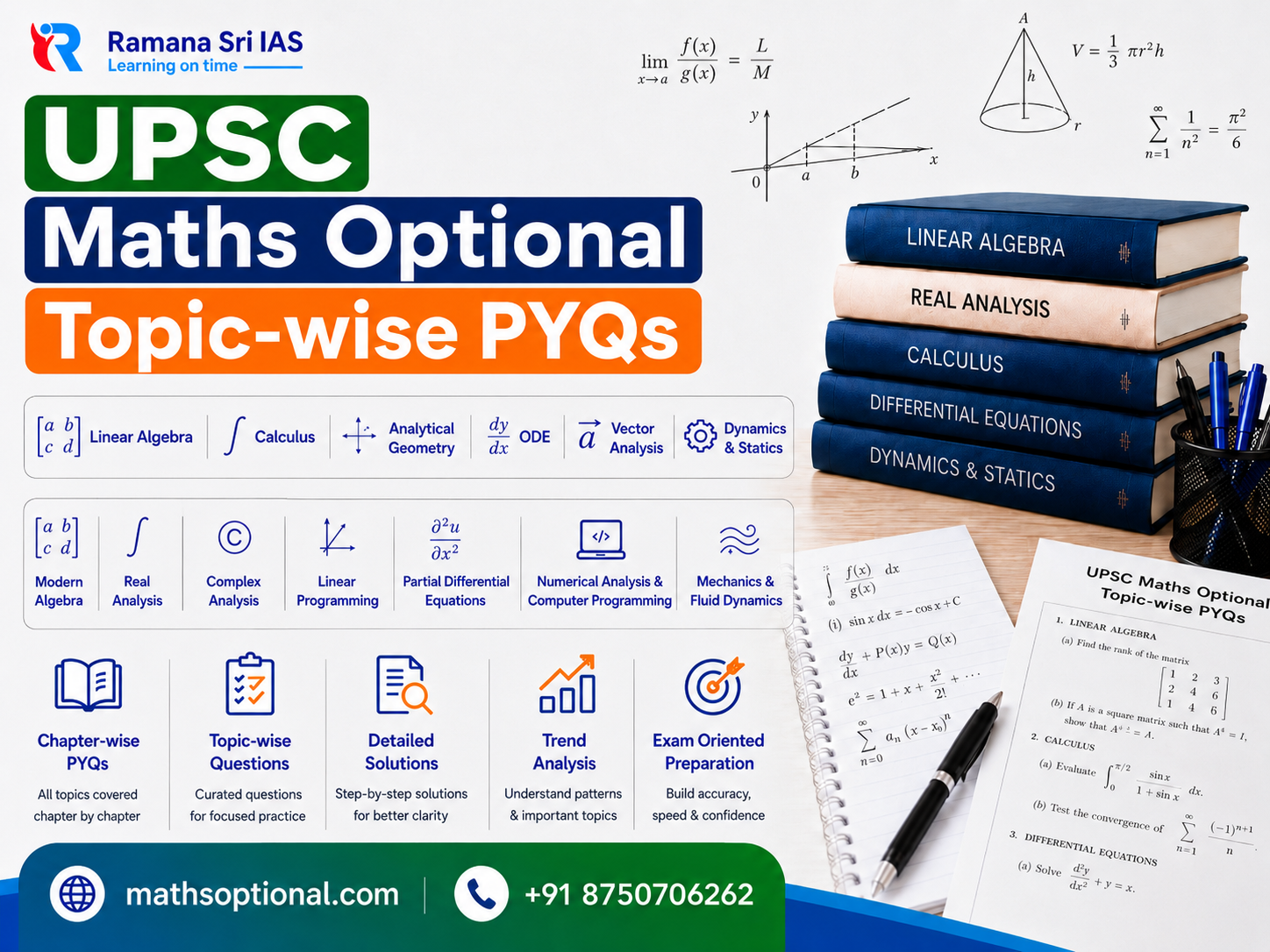
UPSC Maths Optional Topic-wise PYQs Based on Full Syllabus
UPSC Maths Optional topic-wise PYQs will be arranged according to the official Mathematics Optional syllabus. Instead of mixing all previous year questions together, students can practise questions topic by topic from Paper I and Paper II.
This page is useful for students who want to revise concepts, identify repeated areas, practise important PYQs and connect each question with the correct syllabus topic. For complete syllabus details, students can also refer to the UPSC Maths Optional Syllabus.
Linear Algebra Topics
Vector spaces, matrices, rank, linear transformations, eigenvalues, eigenvectors, characteristic polynomial and Cayley-Hamilton theorem.
Calculus Topics
Limits, continuity, differentiability, mean value theorems, Taylor’s theorem, maxima-minima, integrations, areas, surface and volumes.
Analytical Geometry Topics
Cartesian and polar coordinates, straight lines, planes, spheres, cones, cylinders, conicoids and reduction to canonical forms.
Ordinary Differential Equations Topics
First order equations, higher order linear equations, complementary function, particular integral, variation of parameters and Laplace transforms.
Dynamics Topics
Rectilinear motion, simple harmonic motion, motion in a plane, projectiles, constrained motion, work-energy and central forces.
Statics Topics
Equilibrium of forces, friction, catenary, virtual work, stability of equilibrium and equilibrium of forces in three dimensions.
Vector Analysis Topics
Gradient, divergence, curl, vector identities, line integrals, surface integrals, Green’s theorem, Gauss theorem and Stokes theorem.
Modern Algebra Topics
Groups, subgroups, cyclic groups, cosets, normal subgroups, quotient groups, homomorphisms, rings, ideals and fields.
Real Analysis Topics
Sequences, series, Cauchy sequence, continuity, uniform continuity, compactness, Riemann integration, improper integrals and uniform convergence.
Complex Analysis Topics
Analytic functions, Cauchy-Riemann equations, Cauchy’s theorem, Cauchy’s integral formula, Taylor series, Laurent series and residues.
Linear Programming Topics
Linear programming problems, basic feasible solution, graphical method, simplex method, duality, transportation problems and assignment problems.
Partial Differential Equations Topics
Formation of PDE, first order PDE, Lagrange’s method, Charpit’s method, second order PDE, vibrating string, heat equation and Laplace equation.
Numerical Analysis Topics
Bisection method, Regula-Falsi method, Newton-Raphson method, Gaussian elimination, interpolation, numerical integration and Runge-Kutta method.
Computer Programming Topics
Binary system, logical operations, Boolean algebra, computer memory, logic gates, truth tables, algorithms and flowcharts.
Mechanics Topics
Generalized coordinates, D’Alembert’s principle, Lagrange’s equations, Hamilton’s equations, moment of inertia and rigid body motion.
Fluid Dynamics Topics
Equation of continuity, Euler’s equation, streamlines, potential flow, sources, sinks, vortex motion and Navier-Stokes equation.
UPSC Topic-wise PYQs Page Is Being Built
Detailed topic-wise UPSC Maths Optional PYQ lists can be added gradually for each Paper I and Paper II chapter.
Students can use the available year-wise papers, module-wise PYQs and solutions until the full topic-wise index is updated.
Continue Your Maths Optional Preparation
Maths Optional PYQ Hub
Access all UPSC and IFoS PYQ resources from one central page.
UPSC Maths Optional Syllabus
Check complete Paper I and Paper II syllabus before practising PYQs.
IFoS Maths Optional Syllabus
Check IFoS Mathematics Optional syllabus and exam-oriented preparation areas.
UPSC PYQ Solutions
Use solved answers to understand method, notation and presentation.
IFoS PYQ Solutions
Use solved answers and guidance for IFoS Maths Optional PYQs.
Maths Optional Test Series
Improve speed, accuracy and answer-writing through test practice.
UPSC Maths Optional Topic-wise PYQs FAQs
What are UPSC Maths Optional topic-wise PYQs?
They are UPSC Maths Optional previous year questions arranged by detailed chapter or topic instead of only year-wise or module-wise order.
How are topic-wise PYQs different from module-wise PYQs?
Module-wise PYQs are broad subject collections, while topic-wise PYQs focus on specific chapters such as eigenvalues, residues, simplex method or PDE.
Should I practise topic-wise PYQs before year-wise papers?
Students can use topic-wise PYQs for chapter revision and later practise year-wise papers for full exam pattern and time management.
Will this page cover Paper I and Paper II?
Yes. The page can be expanded to include detailed topic-wise PYQs for both UPSC Maths Optional Paper I and Paper II.
Ramana Sri IAS Guidance
Start UPSC Topic-wise PYQ Practice with Ramana Sri IAS
Use topic-wise PYQs to strengthen weak chapters, revise repeated areas and improve answer-writing before full-length test practice.