
Ramana Sri IAS

Ramana Sri IAS Logo Ramana Sri IAS Admission Form
☰ Menu
UPSC Maths Optional Decision Guide

Is Maths Good Optional For UPSC?

Yes, Maths can be a good optional subject for UPSC, especially for students who have studied Mathematics in graduation, have genuine interest in the subject, and are ready for regular problem-solving practice, PYQ revision and mock tests.

500 Total Optional Marks
2 Maths Optional Papers
250 Marks Per Paper
Yes Good for Maths Background Students
PYQs Very Important for Preparation
Tests Needed for Speed and Accuracy
Formula Revision Sheet is Important
Guidance Useful Before Choosing Optional

Is Maths Good Optional For UPSC?

Yes, Maths is good optional for UPSC for students who have studied Mathematics in graduation and have genuine interest in the subject. It is a logical, method-based and scoring optional when the student builds concepts properly and practises regularly.

At the same time, Maths Optional should not be selected only because some toppers have scored high marks. A candidate needs patience, calculation accuracy, formula memory, step-by-step writing habit and the ability to solve questions repeatedly.

Maths only till Class 12th is usually not enough for UPSC Mathematics Optional. The UPSC Maths Optional syllabus requires graduation-level understanding of topics like Linear Algebra, Calculus, Analytical Geometry, Ordinary Differential Equations, Real Analysis, Complex Analysis, Modern Algebra, PDE, Numerical Analysis and Mechanics.

Teacher’s guidance: Choose Maths Optional only if you have studied Mathematics in graduation, have interest in solving problems, and are ready to practise with discipline. Students who are not interested in Mathematics may find it difficult to grasp concepts and apply them in the exam.
Is Maths good optional for UPSC preparation guidance by Ramana Sri IAS

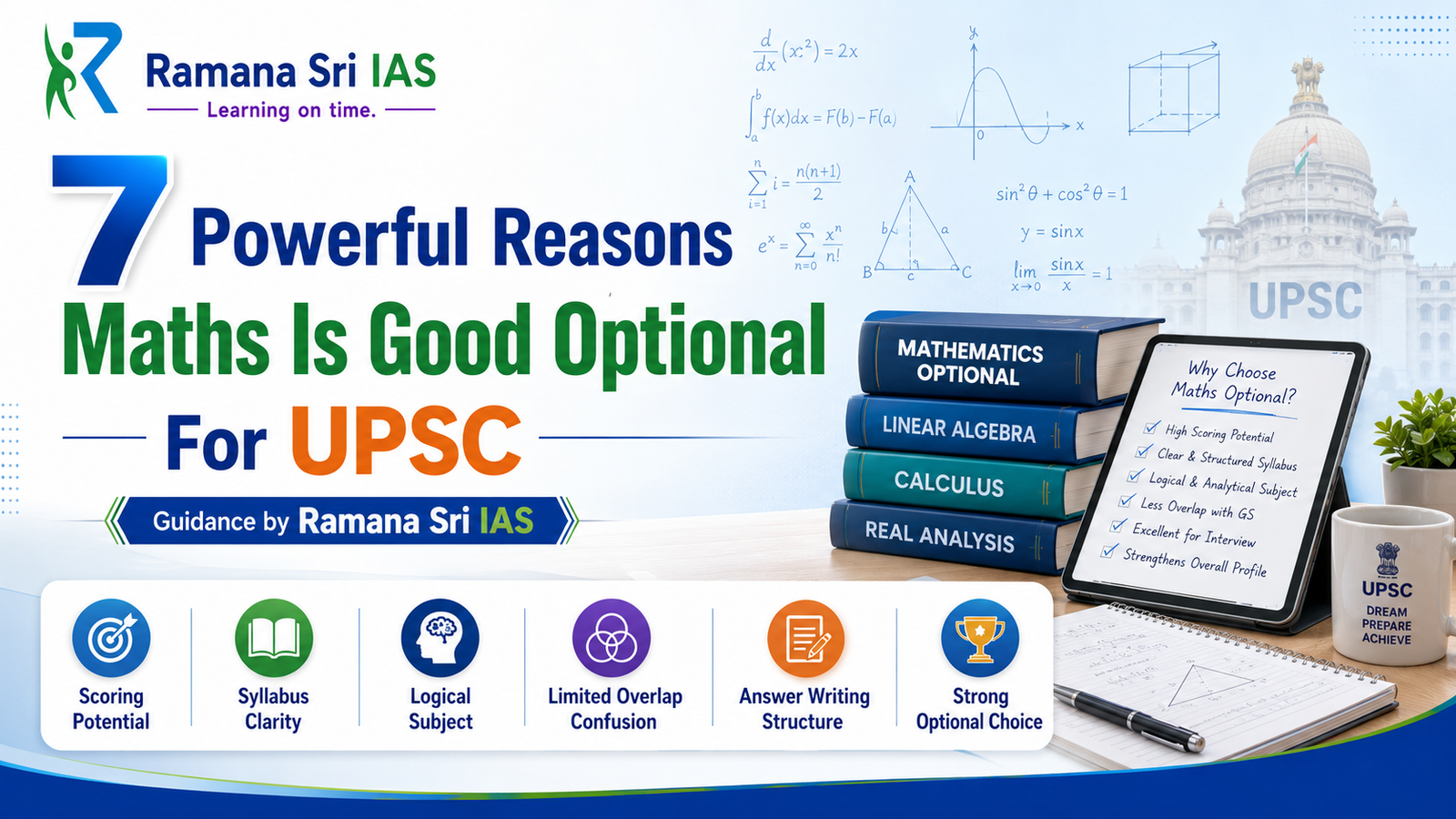
7 Powerful Reasons Maths Is Good Optional For UPSC

Maths Optional is not easy for everyone, but for the right candidate it can become a strong scoring subject. The main advantage is that the subject rewards clear concepts, correct methods, accurate calculation and neat step-wise presentation.

1. Scoring Potential

Mathematics can give strong marks because answers are evaluated mainly on correct method, calculation and final result.

2. Fixed Syllabus

The syllabus is defined. Students can divide Paper I and Paper II into topics and prepare with a clear plan.

3. Less Subjective

Maths answers are less opinion-based compared to many theory subjects. Correct logic and steps matter more.

4. PYQ Relevance

Previous year questions help students understand repeated models, standard methods and UPSC-level difficulty.

5. Step-wise Marks

Even when a final answer has some error, correct intermediate steps may help the student secure marks.

6. Analytical Skill

Mathematics improves logical thinking, calculation discipline and structured problem-solving ability.

7. Practice-Based Improvement

With repeated problem-solving, formula revision, mock tests and correction of mistakes, marks can improve steadily.

Best for Right Background

It is especially suitable for students from Mathematics, Engineering, Physics, Statistics or similar quantitative backgrounds.

Who Should Choose Maths Optional For UPSC?

Maths Optional is suitable only when the student has the right background and interest. It is not a subject to choose casually. The preparation requires continuous practice, concept clarity and confidence in calculation.

Good Choice

Students who studied Mathematics in graduation and enjoy solving problems can consider Maths Optional seriously.

Think Carefully

Students who studied Maths only till Class 12th should be very careful because UPSC Maths Optional needs graduation-level depth.

Avoid If No Interest

If a student does not like Mathematics, calculation or regular practice, this optional can become difficult.

Is Maths Better or Best Optional For UPSC?

Maths Optional can be better for students who are comfortable with formulas, proofs, calculations and structured problem-solving. It may not be the best optional for every candidate, but it can be one of the best choices for a student with strong mathematical preparation.

The syllabus may look large at first, but with proper planning it can be completed in a disciplined manner. Many questions are based on standard methods, previous patterns and concepts from standard books. This makes PYQ practice very important.

Students with strong preparation can score well because the subject is logical and method-based. But students with no background in Mathematics should avoid selecting it only because it is considered scoring.

Is Mathematics the Right Choice for the UPSC Optional - Ramana Sri IAS

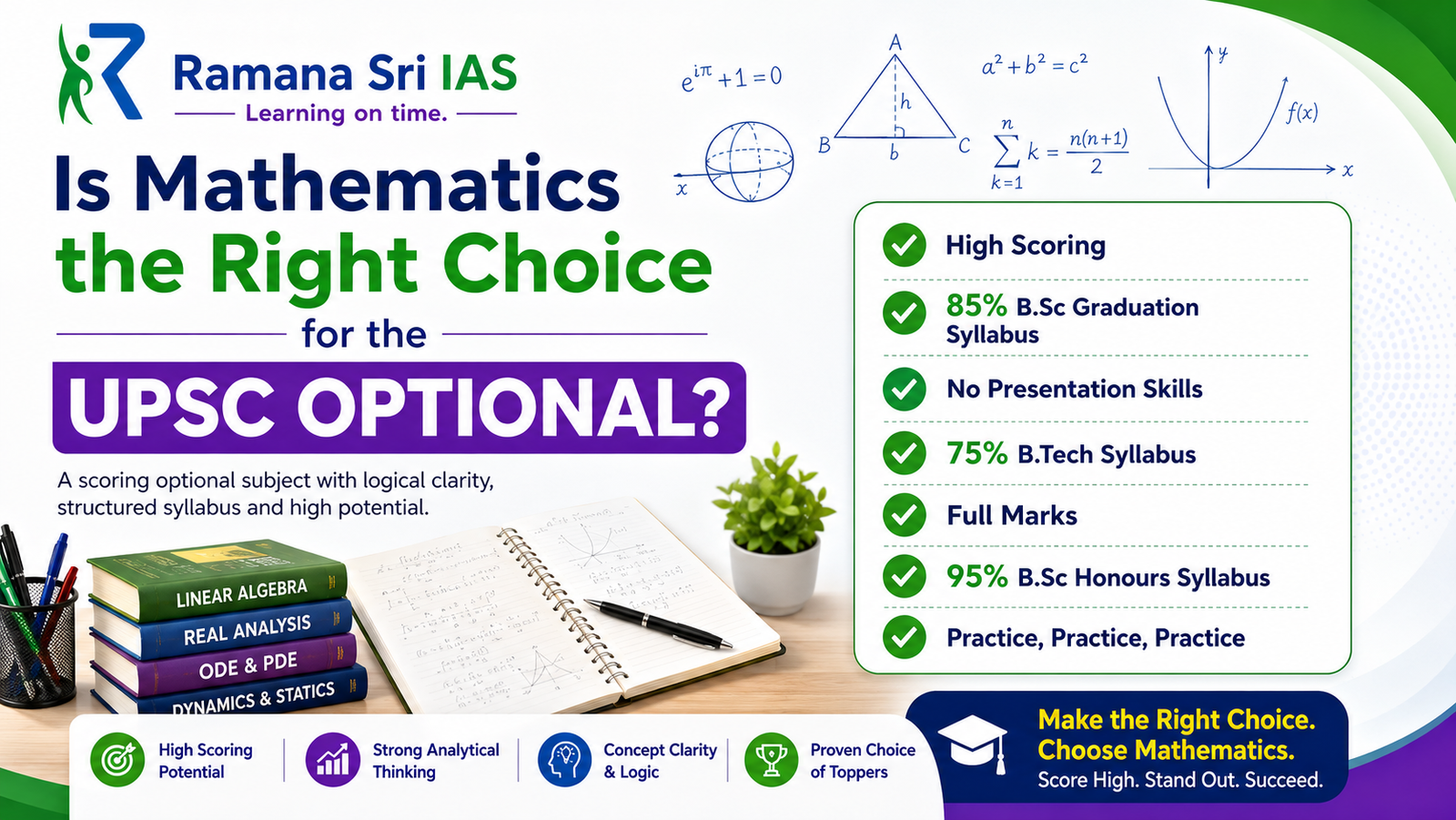
Is Mathematics the Right Choice for the UPSC Optional?

Mathematics can be the right optional subject for UPSC, IAS, CSE and IFoS aspirants when the student has genuine interest in the subject, a strong academic background and the discipline to practise regularly. It is a logical, objective and scoring optional, but it is not the right choice for every aspirant.

Students who have studied Mathematics in graduation, Engineering, Physics, Statistics or similar quantitative subjects may find many parts of the syllabus familiar. However, UPSC Mathematics Optional still needs a balanced study plan, regular problem-solving, PYQ practice, formula revision and mock-test writing.

Mathematics Optional rewards clear concepts, correct formulas, proper steps, accurate calculation and final answers. This makes it suitable for students who prefer objective and logical answers instead of opinion-based writing.

Scoring Subject

Mathematics can be scoring because answers are mainly evaluated through correct methods, steps, calculations and final results.

Well-Structured Syllabus

The syllabus is clearly divided into Paper I and Paper II topics, so students can prepare with a proper topic-wise plan.

Objective Nature

Maths Optional is less subjective compared to many theory optional subjects. Correct logic and step-by-step solutions matter more.

Needs Balanced Study Plan

Students should not only read theory. They must solve problems, revise formulas, practise PYQs and write mock tests regularly.

Useful for Quantitative Background

Students from B.Sc with Mathematics, B.tech/B.E any Engineering stream, Physics, Statistics and similar backgrounds may find this optional more suitable.

PYQ Practice Is Essential

Previous year questions help students understand repeated areas, question patterns, difficulty level and UPSC answer expectations.

Suitable for UPSC and IFoS

Mathematics Optional can support both UPSC CSE and IFoS aspirants because the subject rewards concept clarity, practice and accuracy.

Coaching Can Help

Coaching is useful when students need syllabus sequence, concept clarity, PYQ discussion, doubt support, test feedback and revision guidance.

Paper I includes important areas such as Linear Algebra, Calculus, Analytical Geometry, Ordinary Differential Equations, Vector Analysis, Dynamics and Statics. Paper II includes Modern Algebra, Real Analysis, Complex Analysis, Linear Programming, Partial Differential Equations, Numerical Analysis, Computer Programming, Mechanics and Fluid Dynamics.

So, Mathematics is the right choice for UPSC Optional when the student has interest, background, patience and regular practice discipline. It is not a casual optional, but for the right candidate it can become a strong scoring subject.

Ramana Sri IAS guidance: Before choosing Mathematics Optional, students should check their subject background, interest level, available preparation time, syllabus comfort and ability to practise consistently.

Important Topics in UPSC Maths Optional

UPSC Mathematics Optional includes topics from both pure and applied Mathematics. A student should understand the syllabus before deciding whether Maths Optional is good for them.

Paper I Focus Areas

Linear Algebra, Calculus, Analytical Geometry, Ordinary Differential Equations, Vector Analysis, Dynamics and Statics.

Paper II Focus Areas

Modern Algebra, Real Analysis, Complex Analysis, Linear Programming, Partial Differential Equations, Numerical Analysis, Computer Programming, Mechanics and Fluid Dynamics.

How to Prepare Maths Optional If You Choose It

If you decide to take Maths Optional, preparation should be systematic. Reading alone is not enough. Students need problem-solving practice, formula revision, PYQ analysis and full-length tests.

1

Understand the Syllabus: Read Paper I and Paper II syllabus properly and divide the topics into a monthly preparation plan.

2

Master Basic Concepts: Build clarity in definitions, formulas, theorems and standard methods before solving advanced questions.

3

Maintain a Formula Sheet: Keep a formula and theorem notebook for quick revision during practice and before tests.

4

Practise PYQs: Solve previous year questions topic-wise to understand repeated areas and UPSC question patterns.

5

Write Mock Tests: Take sectional and full-length tests to improve speed, accuracy, time management and answer presentation.

6

Analyse Mistakes: Correct calculation errors, missing steps, weak topics and presentation mistakes after every test.

Advantages and Challenges of Maths Optional

Advantages

Maths Optional is logical, scoring, less subjective, practice-based and useful for students with a strong mathematical background.

Challenges

The syllabus needs regular practice. Students must avoid calculation mistakes, revise formulas and write complete steps under time limits.

Important: Maths Optional is good only when the student can stay consistent. Without practice, even strong concepts may not convert into marks.

How Ramana Sri IAS Helps Maths Optional Students

Ramana Sri IAS helps students understand whether Maths Optional is suitable for them and then guides them with structured syllabus coverage, concept clarity, topic-wise PYQ practice, test series, formula revision and answer presentation improvement.

Students can watch demo videos, check the syllabus, understand fee details and contact the admission team for guidance before joining.

Resources Before Choosing Maths Optional

Use these resources to check syllabus, PYQs, demo videos, courses, reviews and preparation support before taking a final decision.

Is Maths Good Optional For UPSC FAQs

Is Maths good optional for UPSC?

Yes, Maths is good optional for UPSC for students who have studied Mathematics in graduation, have interest in problem-solving and can practise regularly.

Who should choose Maths Optional for UPSC?

Students with a graduation-level Mathematics background and genuine interest in the subject can choose Maths Optional. Maths only till Class 12th is usually not enough.

Is Maths Optional scoring in UPSC?

Yes. Maths Optional can be scoring because answers are method-based, logical and less subjective. However, scoring well requires accuracy, practice and step-wise presentation.

Can Maths Optional be completed in 6 months?

Students with a strong Mathematics background and regular study discipline may complete major syllabus coverage in around 6 months. Revision, PYQs and tests still need proper time.

Is Class 12 Maths enough for UPSC Maths Optional?

No. Class 12 Maths alone is usually not enough. UPSC Maths Optional needs graduation-level understanding of both Paper I and Paper II topics.

What are the main topics in UPSC Maths Optional?

Main topics include Linear Algebra, Calculus, Analytical Geometry, ODE, Vector Analysis, Dynamics, Statics, Modern Algebra, Real Analysis, Complex Analysis, Linear Programming, PDE, Numerical Analysis, Mechanics and Fluid Dynamics.

Should I take coaching for Maths Optional?

Coaching can help if you need structured syllabus coverage, concept clarity, PYQ practice, test feedback, revision support and guidance before the exam.

Need Maths Optional Guidance?

Decide Maths Optional with Proper Guidance

Maths Optional is good when your background, interest, syllabus comfort and practice discipline match the subject. After enquiry, our Ramana Sri IAS team will guide you about suitability, batch options, fee details, admission steps and preparation support.

Guidance support includes:
  • Suitability check based on your Mathematics background.
  • Syllabus planning, PYQ practice and mock test guidance.
  • Batch, fee, payment and admission guidance after enquiry.
Scroll to Top