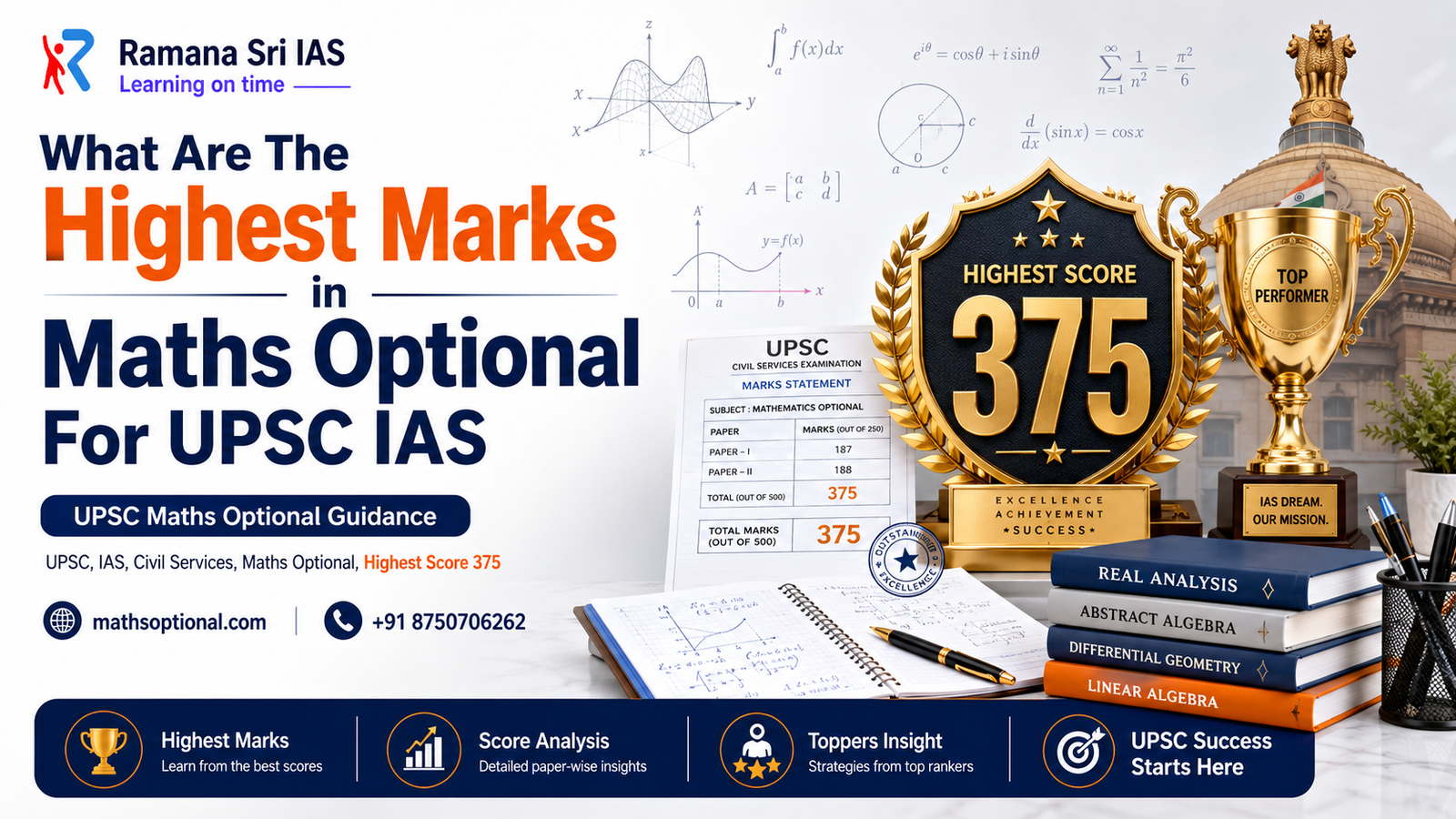
375
Reported High Score Out of 500
500
Total Optional Marks
2
Maths Optional Papers
250
Marks Per Optional Paper
300+
Strong score range
350+
Exceptional score range
PYQs
Very important for scoring
Tests
Needed for speed and accuracy
Direct AnswerHighest Marks in Maths Optional for UPSC
In the present UPSC optional marks structure, Mathematics Optional has two papers of 250 marks each, making a total of 500 marks. One of the most cited high-score examples in UPSC Mathematics Optional is 375 marks out of 500.
Students should understand this score as a high-score reference, not as a fixed target for every aspirant. The highest marks in any year can vary depending on paper difficulty, evaluation, candidate performance, accuracy and answer presentation.
Since there is no simple official all-time public list of only Mathematics Optional highest marks, it is better to understand the score range carefully. A score above 300 is generally strong, above 350 is exceptional, and around 375 out of 500 is regarded as an outstanding high-score example.
Important:
Do not choose Maths Optional only after seeing topper marks. Choose it only if you can build concepts, practise regularly, solve PYQs and write tests with discipline.
IntroductionHighest Marks in Maths Optional for UPSC
When it comes to choosing an optional subject for the UPSC IAS exam, Mathematics is often considered a challenging yet rewarding choice. With its logical reasoning and problem-solving nature, Mathematics has attracted many aspirants who have performed exceptionally well in this subject.
High marks in Maths Optional show that the subject can become a strong scoring area when candidates have conceptual clarity, strong practice, accurate calculation, proper answer presentation and effective time management.
Commonly cited high-score examples include 375 out of 500 in the present optional marks structure. Older references also mention scores like 424 out of 600 under earlier patterns. Students should understand these figures as high-score references and focus mainly on preparation quality.
Important:
Maths Optional can be scoring, but high marks come only through syllabus mastery, PYQ practice, mock tests, formula revision, logical presentation and consistent preparation.
UPSC IAS ExamHighest Marks in Maths Optional for UPSC | The UPSC IAS Exam
The Union Public Service Commission conducts the Civil Services Examination, commonly known as the UPSC IAS exam, to recruit candidates for prestigious positions in the Indian Administrative Service, Indian Foreign Service, Indian Police Service and other civil services.
The UPSC Civil Services Examination consists of three stages: the Preliminary Examination, the Mains Examination and the Interview. Mathematics Optional is part of the Mains Examination and contributes significantly to the final written score.
Prelims
Screening stage with objective-type papers.
Mains
Written examination where optional subject marks play an important role.
Interview
Personality test stage after clearing the Mains Examination.
Final Rank
Mains and Interview marks together decide final merit ranking.
Highest Marks in Maths Optional for UPSC | Choosing Mathematics as an Optional Subject
Mathematics is not a compulsory subject for the UPSC IAS exam, but it is a popular choice among candidates with a strong mathematical background or genuine interest in the subject.
Opting for Mathematics as an optional subject can give candidates an edge because it allows them to showcase analytical ability, logical reasoning and problem-solving skills. For students who enjoy objective, method-based preparation, Maths Optional can become a powerful scoring subject.
Logical Subject
Mathematics rewards logical steps, correct formulas and clear reasoning.
Scoring Potential
With correct preparation, Maths Optional can support a strong Mains score.
Less Opinion-Based
Answers are method-based and depend on accuracy, clarity and presentation.
Strong for Maths Background
Students from mathematics, science or engineering background may find it suitable.
Highest Marks in Maths Optional for UPSC | High Score References
Over the years, several candidates have achieved remarkable scores in Mathematics Optional for the UPSC IAS exam. However, the highest marks may vary from year to year depending on the difficulty level of the paper, evaluation pattern and overall performance of candidates.
While there is no simple single official all-time public list for Mathematics Optional highest marks, scores in the range of 300–350 out of 500 are generally considered excellent. A score around 375 out of 500 is regarded as exceptional.
In UPSC Civil Services Exam 2017, Anubhav Singh is widely cited for securing 375 marks out of 500 in Mathematics Optional. This shows that Maths Optional can produce very high marks when preparation is strong.
Kanishak Kataria, UPSC CSE 2018 All India Rank 1, chose Mathematics as his optional subject and scored an excellent 361 out of 500 marks. He secured 170 marks in Mathematics Optional Paper I and 191 marks in Mathematics Optional Paper II. His strong optional score played an important role in his final selection, as he achieved a total of 1121 marks out of 2025, including 179 marks in the Personality Test.
Revu Mutyala Raju, UPSC Civil Services Examination 2006 All India Rank 1, chose Mathematics as one of his optional subjects under the old UPSC pattern. He scored an excellent 424 marks out of 600 in Mathematics Optional, which is around 70.67%. Since the old pattern had optional subjects for 600 marks, his Mathematics score clearly shows the scoring potential of Mathematics Optional when prepared with strong conceptual clarity, regular practice and proper answer presentation.
High Score Example:
375 / 500 is one of the most cited high scores in UPSC Mathematics Optional. The number is important, but the preparation system behind it is more important.
Score UnderstandingHow to Understand Maths Optional Marks
Highest marks in maths optional for UPSC should be understood in ranges. A student may clear the exam with different optional scores depending on GS marks, essay marks and interview marks. Still, optional marks are very important because they can strongly affect the final written score.
250–300 / 500
Good Score: Solid syllabus coverage, regular practice and basic test writing.
300–350 / 500
Excellent Score: Strong concepts, PYQ command, accuracy and answer-writing discipline.
350+ / 500
Exceptional Score: Deep subject command, very high accuracy, strong speed and excellent presentation.
375 / 500
Outstanding High Score Example: Complete preparation, disciplined test practice and strong exam temperament.
Scoring clarity:
In Maths Optional, marks improve when the student reduces calculation errors, writes complete steps, manages time properly and presents final answers clearly.
Proof + GuidanceHow Ramana Sri IAS Helps Students Aim for High Marks
Highest marks in maths optional for UPSC require concept clarity, PYQ practice, full-length test writing, formula revision and clean answer presentation. Students can first watch demo videos, check fee details, read student reviews and then contact the Ramana Sri IAS admission team through WhatsApp, email, or call.
After enquiry, our Ramana Sri IAS admission team will guide you about batch options, fee details, payment steps and next follow-up clearly through WhatsApp, email, or call.
Why Maths Scores HighWhy Mathematics Optional Can Give High Marks
Mathematics Optional can give high marks because answers are based on correct methods, formulas, theorems, calculations and logical steps. If a student solves the problem correctly and presents it clearly, marks can be awarded more objectively than many opinion-based subjects.
Objective Nature
Maths answers are based on correct method, calculation and final result.
Step-wise Marks
Even if the final answer is wrong, correct intermediate steps may help secure marks.
Static Syllabus
Maths Optional is not heavily dependent on current affairs.
Repeatable Practice
Standard methods and repeated PYQ patterns help students improve with practice.
Fixed Syllabus
Maths Optional has a defined syllabus. Students can connect every topic with PYQs and prepare in a structured way.
PYQ Relevance
Previous year questions help students understand repeated areas, standard models and UPSC-level difficulty.
Important Topics for High Marks in Maths Optional
Candidates aiming for highest marks in maths optional for UPSC should master the full UPSC Maths Optional topic structure: Linear Algebra, Calculus, Analytical Geometry, Ordinary Differential Equations, Vector Analysis, Dynamics and Statics in Paper I; and Modern Algebra, Real Analysis, Complex Analysis, Linear Programming, Partial Differential Equations, Numerical Analysis, Computer Programming, Mechanics and Fluid Dynamics in Paper II.
Paper I Focus Areas
- Linear Algebra
- Calculus
- Analytical Geometry
- Ordinary Differential Equations
- Vector Analysis
- Dynamics
- Statics
Paper II Focus Areas
- Modern Algebra
- Real Analysis
- Complex Analysis
- Linear Programming
- Partial Differential Equations
- Numerical Analysis
- Computer Programming
- Mechanics
- Fluid Dynamics
Highest Marks in Maths Optional for UPSC | Tips for Scoring Well
To score well in Mathematics Optional, candidates need to combine syllabus understanding, standard books, previous year question practice, mock tests and revision. High marks are not achieved by reading alone; they require repeated problem-solving and accurate answer presentation.
1Understand the Syllabus: Familiarize yourself with the UPSC Mathematics Optional syllabus and identify key topics that carry more weightage.
2Practise Previous Years’ Question Papers: Solve PYQs to understand the exam pattern and the type of questions asked.
3Refer to Standard Textbooks: Study from recommended books that explain concepts in a complete and structured manner.
4Take Mock Tests: Regular tests help assess preparation level and identify areas that need improvement.
5Revise and Review: Allocate enough time for revision, formula review and correction of weak areas.
How to Aim for 300+ and 350+ in Maths Optional
A high score in Maths Optional requires more than syllabus completion. Students must develop speed, accuracy, concept clarity and presentation quality. Mock tests should be written under exam-like conditions, and every mistake should be analysed.
Complete Syllabus
Complete the syllabus with conceptual understanding and proper topic sequencing.
Formula Notebook
Maintain a formula and theorem notebook for fast revision before tests and exam.
Topic-wise PYQs
Solve topic-wise PYQs after every chapter to understand UPSC-level application.
Full-Length Tests
Write full-length tests within 3 hours to improve speed and selection of questions.
Mistake Analysis
Analyse calculation mistakes and presentation errors after every test.
Repeated Revision
Revise repeatedly before the final exam to improve recall and confidence.
Scoring Rule:
Accuracy and presentation decide the final score. Maths Optional is scoring only when the student avoids silly mistakes, writes steps clearly and manages time properly in the exam.
Common MistakesMistakes That Reduce Marks in Maths Optional
Ignoring PYQs
PYQs help students understand the actual UPSC pattern and repeated areas.
Weak Formula Revision
Forgetting formulas, standard results or theorems leads to avoidable errors.
Poor Time Management
Spending too much time on one question can reduce overall attempt quality.
Messy Presentation
Unclear steps, poor notation and careless diagrams can reduce marks.
Incomplete Steps
Directly writing the final answer without proper working can reduce marks even when the answer is correct.
Calculation Errors
Small mistakes in algebra, signs, limits, constants or substitutions can affect the full solution.
How Ramana Sri IAS Helps Students Improve Maths Optional Marks
Ramana Sri IAS helps UPSC Mathematics Optional students through structured syllabus coverage, topic-wise practice, PYQ discussion, answer-writing improvement, revision support and test-series guidance.
Students can get guidance based on their preparation stage. Some students need full syllabus classes, some need revision, some need only tough modules, and some need test series with feedback.
Before joining, students can watch demo videos, check fee details, read student reviews and then contact the admission team for proper course guidance.
Conclusion of Highest Marks in Maths Optional for UPSC
While there is no definitive single answer to the highest marks achieved in Mathematics Optional for the UPSC IAS exam, it is clear that candidates who excel in this subject can significantly improve their overall score.
By dedicating time and effort to master concepts, practising effectively, solving previous year papers, writing mock tests and revising properly, aspirants can aim for exceptional scores and increase their chances of success in the UPSC IAS exam.
Choosing Mathematics as an optional subject should be based on aptitude and interest. With the right approach, preparation and guidance, this challenging subject can become a rewarding choice.
Related ResourcesContinue Your UPSC Maths Optional Preparation
Use this high-score guidance with syllabus, PYQs, test series, coaching, demo videos, student reviews, books and study material.
FAQsHighest Marks in Maths Optional for UPSC FAQs
What are the highest marks in Maths Optional for UPSC?
One of the most cited high-score examples in UPSC Mathematics Optional is 375 marks out of 500. Scores above 300 are generally strong, and scores above 350 are considered exceptional.
Who scored 375 marks in Maths Optional?
Anubhav Singh is widely cited for securing 375 marks out of 500 in Mathematics Optional in UPSC Civil Services Examination 2017.
Is Maths Optional scoring in UPSC?
Yes. Maths Optional can be scoring because it is logical, method-based and less opinion-based than many other subjects. It rewards concept clarity, regular practice, PYQ command, accurate calculation and clean answer presentation.
Is 300 marks good in Maths Optional?
Yes. Around 300 marks out of 500 is generally considered a strong score in UPSC Mathematics Optional, especially when combined with good GS, Essay and Interview marks.
How can I score high in Maths Optional?
To score high, understand the syllabus, practise previous year questions, refer to standard books, take mock tests, revise formulas, correct mistakes and write answers step-by-step under time limits.
Should I choose Maths Optional only because of high marks?
No. Do not choose Maths Optional only because of high marks. Choose it only if you have interest in Mathematics, patience for regular practice and willingness to prepare the subject systematically.
Should I choose Maths Optional for UPSC?
Choose Maths Optional if you have aptitude, interest, discipline and willingness to practise regularly. It is rewarding but requires serious preparation.
Need High Score Guidance?Prepare Maths Optional with Ramana Sri IAS
Build concepts, practise PYQs, write mock tests, revise formulas and improve answer presentation with structured Maths Optional guidance. After enquiry, our Ramana Sri IAS admission team will guide you about batch options, fee details, payment steps and next follow-up clearly through WhatsApp, email, or call.
High-score preparation support includes:- Concept clarity with topic-wise PYQ mapping.
- Mock test practice for speed, accuracy and presentation.
- Batch, fee, payment and admission guidance after enquiry.