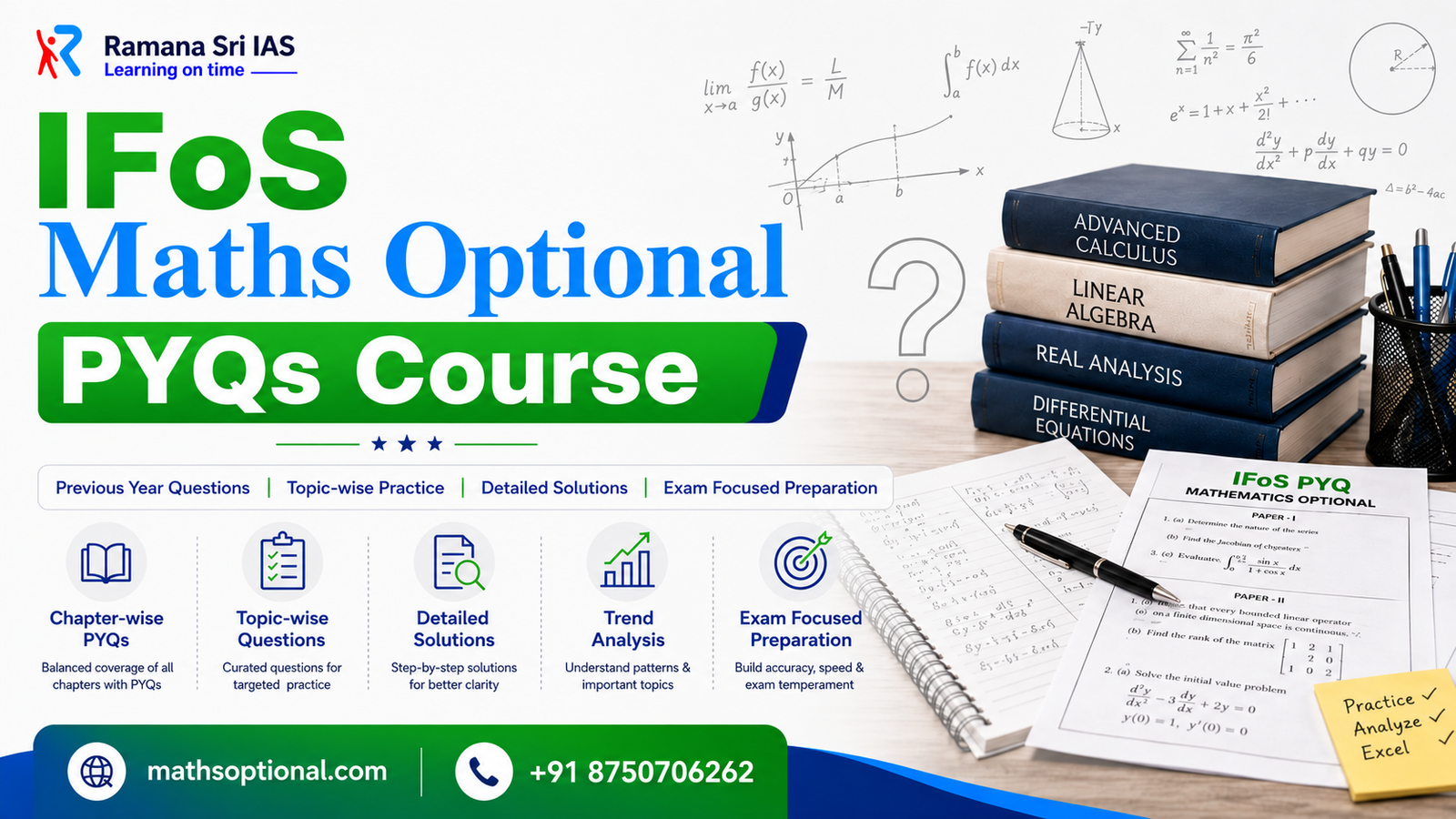
IFoS Maths Optional PYQs Course
IFoS Maths Optional PYQs (Previous Year Questions) Course
Prepare IFoS Maths Optional through previous year questions, topic-wise PYQ practice, exam-pattern analysis, Paper I and Paper II guidance, time management and structured support from Ramana Sri IAS.
IFoS Maths Optional Previous Year Questions Course
IFoS Maths Optional Previous Year Questions, also known as IFoS Maths Optional PYQs, are very useful for students preparing Mathematics Optional for the Indian Forest Service Mains examination.
IFoS and UPSC CSE Maths Optional have syllabus overlap, but the preparation should not be treated exactly the same. IFoS papers may have a different question emphasis, difficulty feel and topic distribution. So students should practise IFoS PYQs separately.
This IFoS Maths Optional PYQs Course helps students practise previous year questions systematically, revise important concepts, understand solution methods, improve time management and prepare Paper I and Paper II with exam-oriented guidance.
When choosing an IFoS Maths Optional PYQ course, students should look for topic-wise coverage, Paper I and Paper II separation, explanation quality, test support, doubt guidance and answer-writing feedback.
This IFoS Maths Optional PYQs Course is designed for students who want focused previous year question practice from 2025 to 2016 with Paper I and Paper II preparation guidance.
Why Previous Year Questions Are Important for Maths Optional
Exam Pattern Clarity
PYQs help students understand how IFoS frames questions from Paper I and Paper II topics.
Topic Priority
Repeated questions help students identify important and frequently tested syllabus areas.
Time Management
Solving PYQs under timed conditions improves speed, accuracy and exam discipline.
Self-Assessment
PYQs allow students to check preparation level and identify weak topics before the exam.
The Toughest Modules of IFoS Maths Optional Video Lectures
IFoS Maths Optional video lectures are an excellent resource for students with limited study time. These lectures help students understand the subject better and make it easier to prepare for the exam.
Accuracy and presentation are important aspects of a good Maths Optional answer. Moreover, the fixed space for questions can be a disadvantage compared to other subjects if students do not know how to write answers clearly and systematically.
Tough modules such as Modern Algebra, Real Analysis, Dynamics, Statics, Mechanics and Fluid Dynamics need focused preparation, repeated PYQ solving and clear conceptual understanding.
Modern Algebra
Requires proof clarity, definitions, theorem understanding and repeated PYQ practice.
Real Analysis
Needs strong command over definitions, sequences, series, continuity and proofs.
Dynamics & Statics
Requires correct formula use, diagrams, concept clarity and step-by-step solutions.
Mechanics & Fluid Dynamics
Needs application-based problem solving, derivation clarity and answer presentation.
Why IFoS Maths Optional PYQ Practice Needs Separate Attention
Many students prepare only through UPSC CSE Maths Optional PYQs and ignore IFoS question papers. This is not the right approach if the target is Indian Forest Service. IFoS PYQs should be practised separately because they help students understand the exact demand of the IFoS exam.
IFoS preparation should include syllabus revision, topic-wise PYQ practice, full-paper practice, solution discussion and answer presentation. Students should also maintain a separate notebook for repeated IFoS concepts, difficult questions and formula mistakes.
Ramana Sri IAS helps students connect IFoS PYQs with the correct syllabus topics and guides them on how to write solutions clearly in the exam.
What a IFoS Maths Optional PYQs Course Should Provide
Topic-wise PYQ Coverage
Previous year questions should be arranged topic-wise so that students can practise after every chapter.
Paper-wise Practice
Paper I and Paper II questions should be separated clearly for focused preparation.
Solution Approach
Students should learn how to start a question, use formulas and present each step clearly.
Mock Test Connection
PYQ practice should be connected with timed tests and full-length paper writing.
IFoS Maths Optional PYQs for Paper I
Linear Algebra
Practise matrices, vector spaces, linearly independent and dependent vectors, bases and dimensions, linear transformations and matrix linear transformations, eigenvalues, eigenvectors, and the Cayley-Hamilton theorem. Practise all kinds of matrices, including finding rank concepts, along with solving matrix equations.
Calculus
Practise limits, continuity, differentiability, maxima-minima, mean value theorems, all kinds of integration such as single, double, and triple integrals, and all types of integrations in Cartesian, polar, cylindrical, and spherical coordinates, along with applications.
Analytical Geometry
Practise straight lines, planes, spheres, cones, cylinders, conicoids, and paraboloids, including generating lines. Practise reduction to canonical forms.
ODE
Practise the formulation of differential equations and solving differential equations of all kinds of order and degree linear and non-linear mentioned in the syllabus, including the method of variation of parameters.
Dynamics, Statics and Hydrostatics
Practise equilibriums, catenary, virtual work, and rectilinear motion, including SHM and Hooke’s law. Practise constrained motion, central orbit force problems, and projectiles. last but not least practise hydrostatics questions as required for IFoS Mathematics Optional
Vector Analysis
Practise gradient, divergence, curl, vector identities, differentiation and integration of vectors, and verification of Green’s, Gauss’s, and Stokes’ theorems, along with derivations of the famous Serret-Frenet formulae. Last but not least, practise curvature and torsion problems.
IFoS Maths Optional PYQs for Paper II
Modern Algebra
Practise groups, subgroups, normal subgroups, cyclic groups, permutation groups, rings, subrings, integral domains, fields, homomorphism, isomorphism, and proof-based questions. Practise Euclidean domains, polynomials, and UFDs.
Real Analysis
Practise sequences, series, limits, continuity, derivatives,and their applications. compactness, Riemann integrals, and convergence. Practise improper integrals of all kinds, uniform convergence, partial derivatives, and their applications, etc.
Complex Analysis
Practise analytic functions, Cauchy’s theorem, Laurent series, and the residue theorem.
Linear Programming
Practise the graphical method, simplex method, duality, transportation, and assignment problems.
PDE
Practise PDE methods of formation and solving all kinds of quasi-linear and nonlinear equations, Charpit’s method, etc.
Numerical Analysis
Practise numerical analysis for finding roots, solving matrices using well-known numerical methods, all kinds of interpolation, integration, and algorithms.
Computer Programming
Practise the basics of computer programming problems, including logic gates and Boolean algebra.
Mechanics
Practise moment of inertia, D’Alembert’s principle, Lagrange’s equations, Hamilton’s equations.
Fluid Dynamics
Practise continuity equation, Euler’s equation of motion, sources and sinks, vortex motion, and Navier-Stokes equation concepts.
How to Use IFoS Maths Optional PYQs Effectively
1
Read the complete IFoS Maths Optional syllabus before starting PYQ practice.
2
Complete one topic and immediately solve previous year questions from that topic.
3
Maintain a notebook of difficult PYQs, repeated concepts, formulas and mistakes.
4
Practise answer writing within fixed space and time to improve exam presentation.
5
Write full-length mock tests using PYQ-based question patterns.
6
Revise weak topics and repeat difficult PYQs until the solution method becomes clear.
IFoS Maths Optional Previous Year Questions Course Format
IFoS Maths Optional Previous Year Questions courses can be offered in online and offline formats. Online courses are useful for students who want flexible access, recorded lectures and repeated revision. Offline courses are useful for students who need classroom discipline and direct interaction.
Both formats should focus on syllabus coverage, topic-wise PYQ practice, test discussion, answer-writing improvement and doubt support. The main purpose is to make students familiar with actual IFoS Maths Optional exam questions and train them to solve questions confidently.
Online PYQ Course
Useful for flexible study, recorded revision, self-paced preparation and remote learners.
Offline PYQ Course
Useful for students who need classroom structure, direct discussion and fixed schedule.
Topic-wise Practice
Useful for strengthening each syllabus unit after concept completion.
Full-Length Practice
Useful for building final exam readiness and time-management ability.
How to Choose a IFoS Maths Optional PYQs Course
Relevance to IFoS
The course should be based on actual IFoS Maths Optional previous year questions.
Quality Material
Study material should be clear, topic-wise and connected with Paper I and Paper II syllabus.
Explanation Quality
Solutions should explain the method, formula use and logical flow clearly.
Test Support
The course should include mock tests, evaluation and improvement guidance.
Why Choose Ramana Sri IAS for IFoS Maths Optional PYQs?
Ramana Sri IAS helps IFoS Maths Optional students prepare previous year questions in a structured and exam-oriented way. The focus is not only on solving questions but also on understanding the method, improving accuracy and presenting answers in a clear step-by-step format.
PYQ practice becomes more powerful when students combine it with concept revision, tough module lectures, mock tests and mentor feedback. This helps students move from passive reading to active exam preparation.
Structured PYQ Practice
Questions are approached topic-wise and paper-wise for better preparation flow.
Tough Module Support
Special focus can be given to Modern Algebra, Real Analysis, Mechanics and Fluid Dynamics.
Answer Presentation
Students learn how to write solutions clearly within limited answer space.
Exam Readiness
PYQs, mock tests and revision support help students prepare confidently.
Related Resources
Continue Your IFoS Maths Optional Preparation
IFoS Maths Optional Syllabus
Check complete IFoS Mathematics Optional syllabus
IFoS Year-wise Papers
Download IFoS Maths Optional Paper I and Paper II question papers
IFoS Module-wise PYQs
Practise IFoS Maths Optional PYQs module-wise
IFoS PYQ Solutions
Use solved answers and method guidance
Maths Optional Test Series
Practise mock tests and answer writing
Fee Structure
Check course-wise fee details
IFoS Maths Optional Previous Year Questions FAQs
What are IFoS Maths Optional PYQs?
IFoS Maths Optional PYQs are previous year questions asked in IFoS Mathematics Optional Paper I and Paper II.
Why are IFoS previous year questions important?
They help students understand IFoS question pattern, repeated topics, difficulty level and expected answer style.
Is IFoS Maths Optional PYQ practice different from UPSC PYQ practice?
Yes. The syllabus overlaps, but IFoS question emphasis may differ, so IFoS PYQs should be practised separately.
Does the IFoS PYQ course cover Paper I and Paper II?
Yes. The course can guide students through IFoS Maths Optional Paper I and Paper II previous year questions.
Should IFoS PYQs be practised topic-wise or paper-wise?
First practise topic-wise after completing each chapter, then practise paper-wise and full-length IFoS-style tests.
IFoS Maths Optional PYQs Course
Start PYQ-Based Maths Optional Preparation with Ramana Sri IAS
Practise previous year questions, strengthen tough modules, improve answer writing and prepare Paper I and Paper II with structured guidance.