Yes*
For Maths Optional Mains Where Permitted
No
For Prelims / Objective Papers
Only
Non-Programmable Scientific Calculator
Check
Latest UPSC Exam Instructions
OverviewCalculator Rule for UPSC Maths Optional
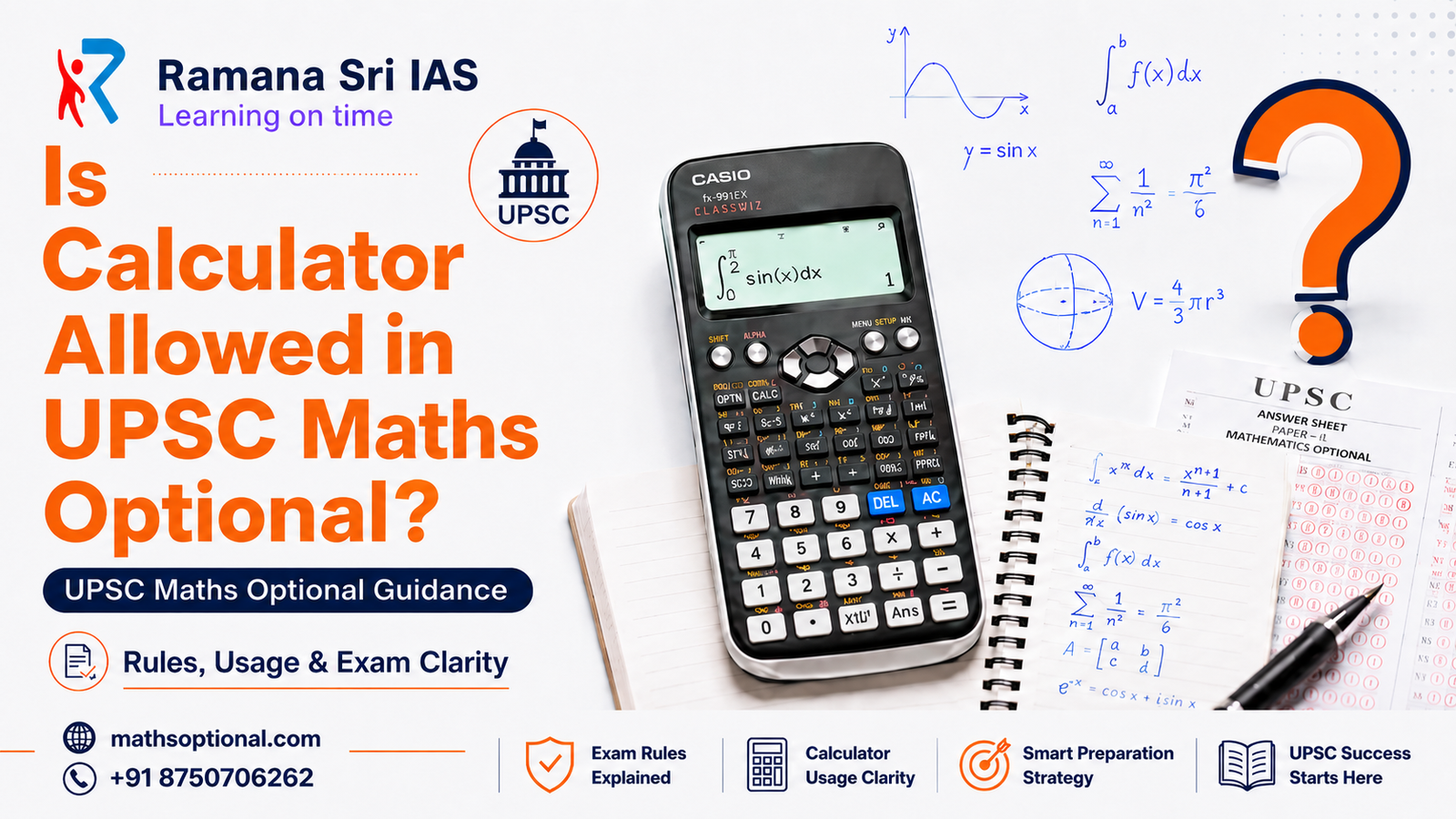
Many UPSC aspirants who choose Mathematics Optional ask one important question:
“Is calculator allowed in UPSC Maths Optional?” The practical answer is that
students should use only a scientific non-programmable calculator where UPSC permits it
in the Mathematics Optional Mains conventional papers.
But students must not depend blindly on any general statement. Calculator-related instructions may appear
in the latest UPSC notification, admit card, question paper instructions, or examination hall guidelines.
Therefore, every student should verify the latest official UPSC instructions before the examination.
Important:
Do not carry a programmable calculator, graphing calculator, formula-storing calculator, mobile phone,
smartwatch, digital device, or any device that can store text, notes, formulas or programs.

Clear AnswerSo, Is Calculator Allowed?
Allowed Where PermittedUPSC Mains Maths Optional
A scientific non-programmable calculator is generally the safe category for Mathematics Optional
Mains conventional papers, subject to the latest UPSC instructions.
Not AllowedPrelims / CSAT / Objective Papers
Calculators are not allowed in objective-type papers. Students must practise speed maths,
approximation and manual calculations for Prelims and CSAT.
Important ExceptionCalculator Rule May Vary by Paper Type
UPSC generally permits scientific non-programmable calculators in conventional-type papers where the examination instructions allow it. However, calculators are not permitted in objective-type papers or test booklets. Students should not apply one paper’s calculator rule blindly to another paper.
Apart from Mathematics Optional, some technical or engineering conventional papers may also have separate calculator instructions. Therefore, the safest approach is to read the latest UPSC notification, admit card, question paper instructions and examination hall guidelines before the exam.
Safe rule:
Use only a scientific non-programmable calculator where UPSC permits it, and never carry a programmable, graphing, formula-storing or text-storing calculator.
Rule SummaryCalculator Usage in UPSC Exam: Simple Table
| Exam / Paper | Calculator Status | Important Note |
|---|
| UPSC Prelims GS Paper | Not Allowed | All calculations must be done manually. |
| UPSC Prelims CSAT | Not Allowed | Practise mental maths, approximation and manual calculation. |
| UPSC Mains General Studies | Generally Not Needed / Not Used | Follow paper-specific instructions printed by UPSC. |
| UPSC Mains Mathematics Optional | Scientific Non-Programmable Calculator Where Permitted | Verify latest admit card, question paper and exam hall instructions. |
| Programmable / Graphing Calculator | Not Safe / Avoid | Do not use any calculator that stores text, formulas, equations or programs. |
Why UPSC Restricts Calculator Use in Many Papers
UPSC examinations are designed to test problem-solving ability, analytical thinking, mathematical aptitude,
logical reasoning and decision-making under time pressure. Because of this, the use of electronic devices
is restricted in objective-type papers to maintain fairness and a level playing field for all candidates.
In Mathematics Optional, even where a calculator is permitted, the real scoring ability still depends on
understanding concepts, writing correct steps, applying the right formula, using proper notation and solving
problems logically.
Problem Solving
UPSC checks whether the student can select the correct method and solve the question logically.
Analytical Skill
Mathematics Optional rewards clear reasoning, not only final numerical answers.
Manual Ability
Manual calculation practice improves speed, confidence and rough-work control.
Fair Examination
Electronic devices are restricted so that every candidate follows the same examination discipline.
Why Calculator Awareness Matters in Maths Optional
Mathematics Optional is a popular optional subject among candidates with a strong mathematical background.
The syllabus is extensive and requires deep understanding of concepts, applications, proofs, methods,
calculations and answer presentation.
Students should not treat the calculator as the main preparation tool. It is only a support tool for some
numerical work. The real preparation should focus on concept clarity, formula discipline, standard methods,
previous year questions and regular test writing.
Paper I Areas
- Linear Algebra
- Calculus
- Analytical Geometry
- Ordinary Differential Equations
- Vector Analysis
- Dynamics and Statics
Paper II Areas
- Modern Algebra
- Real Analysis
- Complex Analysis
- Linear Programming
- Partial Differential Equations
- Numerical Analysis and Computer Programming
- Mechanics and Fluid Dynamics
Why Maths Optional Still Needs Serious Preparation
Mathematics Optional is suitable for students who have studied Mathematics seriously and have genuine interest in the subject. Students should not choose Maths Optional in a hurry only because calculator support may be available in the Mains optional paper. Calculator use can reduce some numerical burden, but it cannot replace concepts, practice, formulas, theorems, proofs and answer presentation.
Mathematics has a more method-based evaluation style compared to many theory-based optional subjects. If the method, calculation, theorem application, diagram, notation and final answer are correct, the answer can fetch strong marks. This is why students with strong mathematical preparation can perform well in Maths Optional.
The competition in Mathematics Optional is usually among students who already have interest and background in the subject. This can be an advantage for serious candidates, but only when they prepare with discipline. A student who has studied Mathematics in college and enjoys problem-solving can consider Maths Optional, but interest and regular practice are essential.
Calculator TypeWhich Calculator Should Maths Optional Students Use?
Students should practise with a simple scientific calculator that does not store programs, equations,
formulas, notes or text. The calculator should be familiar, exam-safe and suitable for standard
mathematical calculations.
Non-Programmable
The calculator should not support programming, formula storage, text storage or custom equation memory.
Scientific Functions
Basic scientific functions are useful for logarithms, trigonometry, roots, powers and numerical work.
Simple and Familiar
Use the same calculator during preparation so that you do not waste time during the examination.
Exam-Safe
Avoid advanced devices, graphing calculators, programmable calculators or any questionable model.
Manual CalculationWhy Manual Calculation Practice is Still Important
Even if calculator usage is permitted in Mathematics Optional Mains, students should not become fully
dependent on it. Many marks are lost because of wrong steps, careless substitution, poor presentation,
missing reasoning, incorrect formulas or calculation mistakes.
A scientific calculator can help reduce silly numerical errors in permitted papers, but students must still know how to check intermediate steps manually. Manual calculation practice is useful for rough work, verification, Prelims/CSAT preparation and building confidence during the Mains paper.
- Improves confidence, speed and accuracy
- Useful for rough work and intermediate steps
- Helps in Prelims, CSAT and objective-type papers
- Builds strong logical reasoning and problem-solving ability
- Reduces dependency on electronic devices
Preparation RuleCalculator is a support tool, not a substitute for concepts.
UPSC Maths Optional rewards clear concepts, correct steps, logical flow, and accurate presentation.
Calculator usage alone cannot improve marks without strong fundamentals.
Join Online Coaching
Avoid TheseWhat Students Should Not Carry
Programmable Calculator
Avoid calculators that can store programs, custom formulas, equations, notes or text data.
Graphing Calculator
Graphing calculators may create exam-hall risk. Use a simple permitted model only.
Mobile / Smart Device
Mobile phones, smartwatches, tablets and digital devices are not substitutes for calculators.
Borrowed Calculator
Do not depend on borrowing in the exam hall. Practise with your own familiar calculator.
How to Prepare Maths Optional with Calculator Awareness
Calculator rules are only one small part of Mathematics Optional preparation. Students must focus on
syllabus completion, concept clarity, manual calculation, standard textbooks, previous year questions,
expert guidance and regular test practice.
1Understand the complete UPSC Mathematics Optional syllabus and exam pattern.
2Practise manual calculations regularly to improve speed, accuracy and confidence.
3Refer to standard textbooks and structured notes for concept clarity.
4Seek expert guidance for difficult topics, shortcuts and exam-oriented methods.
5Solve previous year question papers to understand UPSC question patterns.
6Write tests under time limits and analyse calculation and presentation mistakes.
What Helps More Than Calculator Dependency?
Strong Foundation
Build basic and advanced concepts clearly before depending on numerical shortcuts.
Standard Books
Use reliable textbooks and study material to understand definitions, theorems and methods.
PYQ Practice
Previous year questions help students understand actual UPSC patterns and repeated areas.
Test Series
Timed tests improve speed, accuracy, answer presentation and exam temperament.
Calculator Checklist Before UPSC Maths Optional Paper
✓Carry only a permitted non-programmable scientific calculator.
✓Check calculator battery and functioning before exam day.
✓Use the same calculator during practice and mock tests.
✓Do not carry calculator manuals, slips, formula sheets or saved notes.
✓Read the latest UPSC admit card and paper instructions carefully.
✓Follow invigilator instructions inside the examination hall.
Calculator-Related Mistakes Maths Optional Students Should Avoid
Depending Only on Calculator
Calculator saves time, but it cannot replace theory, concepts, formula understanding and proof clarity.
Not Practising Manual Calculation
Manual calculation is still useful for rough work, checking answers and Prelims/CSAT preparation.
Using New Calculator on Exam Day
A new calculator may slow you down. Use a familiar calculator during preparation.
Ignoring Latest Instructions
UPSC instructions are final. Always follow the latest notification, admit card and paper instructions.
Final Guidance on Calculator Use in UPSC Maths Optional
Calculator may be useful for complex numerical work in Mathematics Optional where permitted, but it is not
the main reason for scoring well. UPSC evaluates your problem-solving ability, logical reasoning, concept
clarity, correct method, step-by-step solution and answer presentation.
Therefore, the best strategy is simple: understand the syllabus, practise manual calculations, use the right
non-programmable scientific calculator where permitted, solve previous year papers, write tests and always
follow the latest UPSC instructions.
Related ResourcesContinue Your Maths Optional Preparation
Use this calculator guidance with syllabus, PYQs, test series, demo videos and structured coaching support.
FAQsCalculator in UPSC Maths Optional FAQs
Is calculator allowed in UPSC Maths Optional?
A scientific non-programmable calculator is generally used where permitted in UPSC Mains Mathematics
Optional papers. Students must verify the latest UPSC admit card, question paper and exam instructions.
Is calculator allowed in UPSC Prelims?
No. Calculator is not allowed in UPSC Prelims or objective-type papers. Students must practise manual
calculation for Prelims and CSAT.
Which calculator is safe for Maths Optional?
A simple scientific non-programmable calculator is the safest category. Avoid programmable,
graphing, formula-storing or text-storing calculators.
Should I practise Maths Optional without calculator?
Yes. Manual calculation practice improves speed, checking ability, confidence and conceptual control.
Can calculator improve Maths Optional marks?
Calculator can reduce some calculation burden, but marks mainly improve through concept clarity,
correct steps, answer presentation, PYQ practice and test writing.
What should I check before exam day?
Check the latest UPSC admit card instructions, calculator type, battery, working condition and
paper-specific instructions.
Need UPSC Maths Optional Guidance?Prepare UPSC Maths Optional with the Right Strategy
Calculator rules are only one part of preparation. Learn concepts, practise manual calculations, solve PYQs, write tests and improve answer presentation with Ramana Sri IAS guidance.
Preparation support includes:- Calculator rule clarity, manual calculation practice and exam-day guidance.
- Syllabus planning, topic-wise PYQ practice and full-length test support.
- Formula revision, mistake analysis, fee details and admission guidance.