Ramana Sri IAS

UPSC Maths Optional Study Method

Learning Pyramid for UPSC Maths Optional Preparation

The Learning Pyramid explains why passive learning gives weak memory, while active learning gives stronger memory. For UPSC Maths Optional, this message is very important because students must solve, write, revise and correct mistakes regularly.

Learning Pyramid for UPSC Maths Optional - Ramana Sri IAS

Learning Pyramid for UPSC Maths Optional Preparation

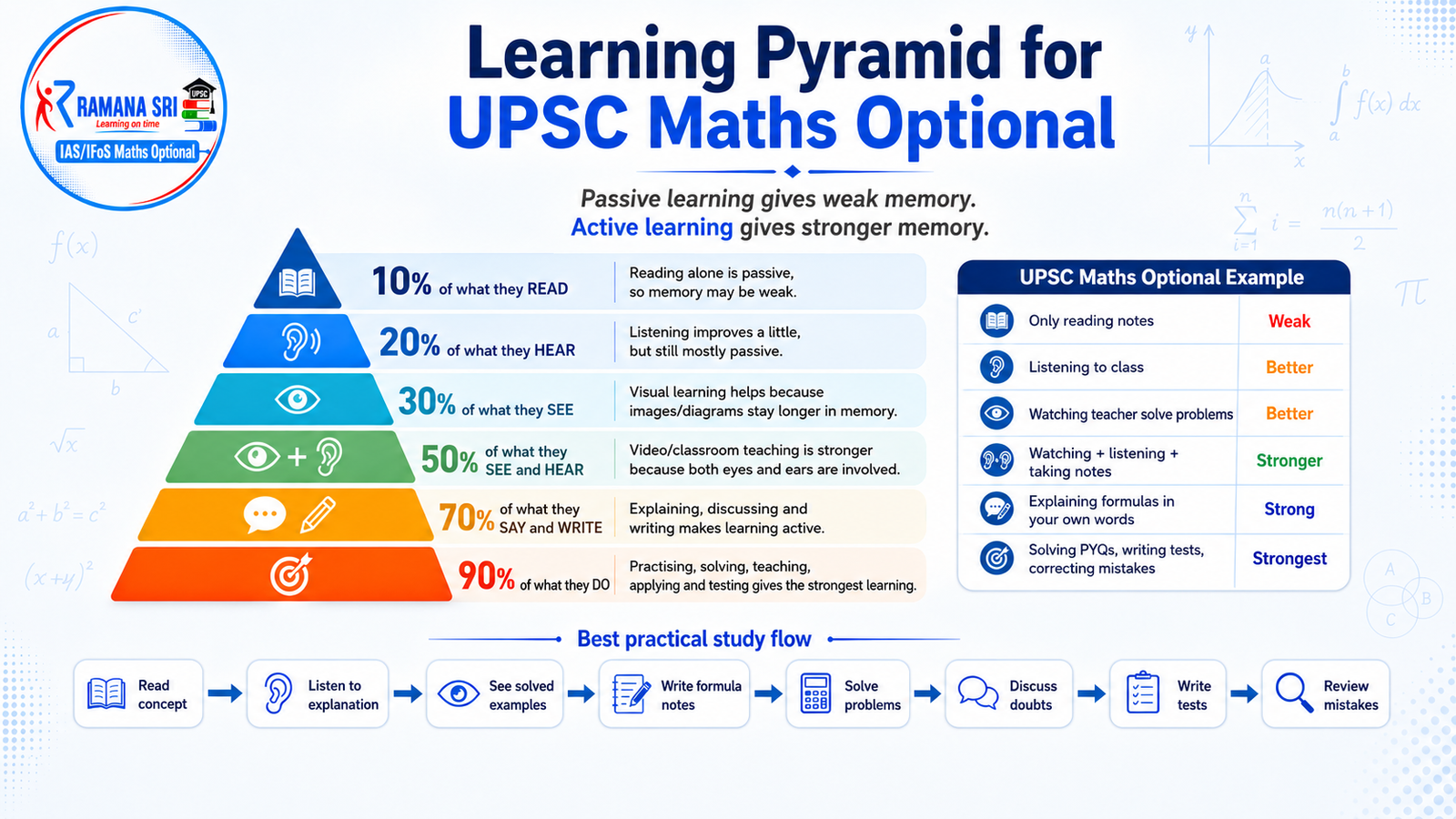
The Learning Pyramid shown in this image explains an important idea for every serious UPSC Maths Optional aspirant: passive learning gives weak memory, while active learning gives stronger memory. In simple words, students remember more when they actively practise, write, solve, discuss, apply and revise, instead of only reading notes or listening to lectures.

This idea is very useful for UPSC Maths Optional because Mathematics is not a purely theoretical subject. It is a concept-based, practice-heavy and answer-writing-oriented optional subject. Students may read books, attend classes and watch videos, but unless they solve problems, write answers, revise formulas, practise PYQs and correct mistakes, their preparation remains incomplete.

The image shows different levels of learning, beginning from the weakest form of learning at the bottom and moving towards the strongest form of learning at the top. The bottom level is 10% of what students read, while the top level is 90% of what students do. This order clearly shows that active practice is more powerful than passive study.

Learning Levels

From Passive Reading to Active Mastery

The Learning Pyramid explains why students should move from only reading and listening to solving, writing, applying and testing.

10%

10% of What They Read

At the base of the pyramid, the image shows 10% of what they read. This means that reading alone is the weakest form of learning. Reading books, notes, formulas and explanations is important, but it is not sufficient by itself.

For UPSC Maths Optional, many students make the mistake of collecting too many books and notes. They keep reading theory repeatedly but do not solve enough problems. This gives a false feeling of preparation. The student may feel that they have understood the topic, but when they sit to solve a question independently, they may struggle.

Reading is useful for building familiarity with a topic. It helps students know definitions, formulas, theorems and basic methods. But Maths Optional requires more than familiarity. It requires accuracy, speed, logical presentation and step-wise solution writing. Therefore, reading should be treated as the first step, not the final step.

For example, a student may read the theory of Real Analysis, Linear Algebra, Ordinary Differential Equations or Mechanics. But unless the student solves examples and writes answers, the concept may not become strong. Reading introduces the topic, but practice strengthens it.

20%

20% of What They Hear

The next level is 20% of what they hear. This means listening to a teacher or lecture improves learning, but it is still mostly passive. When students listen to class explanations, they understand the topic better than reading alone. A good teacher can simplify difficult concepts, explain the logic behind formulas and guide students on what is important for the exam.

In UPSC Maths Optional, listening to a teacher is very helpful because many topics are technical and interconnected. For example, topics like Abstract Algebra, Real Analysis, Partial Differential Equations, Mechanics and Fluid Dynamics may become difficult if students try to understand them only through books. A teacher can explain the sequence, common mistakes and exam-oriented method.

However, listening alone is still not enough. Some students attend classes regularly but do not revise or practise after class. They understand the topic during the lecture but forget it after a few days. This happens because listening is still a passive activity. The student is receiving information but not yet applying it.

At Ramana Sri IAS, students are always encouraged to move beyond listening. A class explanation should be followed by note-making, revision, solved examples and independent problem-solving. Listening gives clarity, but practice gives command.

30%

30% of What They See

The third level is 30% of what they see. Visual learning is stronger than reading or hearing alone because images, diagrams, graphs and solved examples stay longer in memory. For Maths Optional, visual understanding is very important.

Many topics in Mathematics become easier when students see the structure clearly. Graphs, geometric diagrams, coordinate systems, flowcharts, matrices, solution steps and formula maps can help students understand difficult ideas. For example, in Calculus and Analytical Geometry, diagrams help students visualize the problem. In Mechanics, force diagrams and motion diagrams make the solution clearer. In Linear Algebra, matrix structure and transformations become easier when shown visually.

Solved examples also play an important role. When students see a teacher solve a problem step by step, they learn the method, sequence and presentation style. This is especially useful for UPSC Mains, where step-wise answer writing matters. A student must not only know the answer but also know how to present it properly.

Still, seeing solved examples is not the final stage. Students must not become dependent on watching solutions. They must move from “I understand when the teacher solves” to “I can solve independently.” That shift happens only through active practice.

50%

50% of What They See and Hear

The next level is 50% of what they see and hear. This represents video learning, classroom teaching and live explanations where students both watch and listen. This is stronger than only reading, only hearing or only seeing because both eyes and ears are involved.

For UPSC Maths Optional, a good classroom or video-based learning system can be very effective. Students can hear the explanation, see the steps, observe the teacher’s method and understand how to approach exam-level questions. This is why structured coaching, recorded lectures and demo videos can help students build a strong base.

For example, when a teacher explains a theorem, solves a PYQ and shows how each step is written, students learn multiple things at the same time. They learn the concept, the method, the formula application and the answer-writing format. This type of learning is stronger because it combines explanation and visualization.

But even this level is not enough by itself. Many students watch videos and feel satisfied, but they do not write answers or solve problems after watching. This creates passive confidence. The student may think, “I understood the solution,” but actual exam performance depends on whether they can reproduce the solution under time pressure.

Therefore, seeing and hearing should be followed by writing and doing.

70%

70% of What They Say and Write

The fifth level is 70% of what they say and write. This is where learning becomes active. When students explain a concept in their own words, discuss doubts, write formula notes, prepare short summaries and practise answer writing, their understanding becomes much stronger.

In UPSC Maths Optional, writing is extremely important. The final exam is not an oral exam; it is a written exam. Students must write complete solutions in a clear, logical and step-wise manner. Even if a student understands a topic mentally, they must be able to express it on paper.

Writing formula notes is one of the most useful habits for Maths Optional aspirants. Each topic should have a compact formula sheet, important theorem list, common methods and standard problem types. These notes help during revision and before mock tests.

Explaining concepts in your own words is also powerful. If a student can explain a formula, theorem or method without looking at the book, it means the concept is becoming clear. Discussion also helps because doubts come out when students try to explain. Many hidden gaps in understanding are revealed during discussion and writing.

At Ramana Sri IAS, students are guided to build this habit of active writing. Maths Optional preparation must include written practice, formula revision, answer presentation and PYQ discussion. This converts passive understanding into exam-ready ability.

90%

90% of What They Do

The top level of the pyramid is 90% of what they do. This is the strongest form of learning. It includes practising, solving, teaching, applying and testing. For UPSC Maths Optional, this is the most important part of preparation.

Mathematics is mastered by doing. Students must solve questions repeatedly, attempt PYQs, write mock tests, correct mistakes and revise weak areas. This is where real learning happens. Reading and listening prepare the mind, but solving and writing build performance.

When students solve problems independently, they face real difficulties. They may forget a formula, make a calculation mistake, miss a step or fail to present the answer properly. These mistakes are not failures; they are part of the learning process. Each mistake shows what needs to be improved.

PYQ solving is especially important because UPSC Maths Optional has patterns. Previous year questions show the type of questions asked, the depth required, the common areas, the marks distribution and the expected presentation style. Students who practise PYQs regularly understand the exam demand better than students who only read theory.

Mock tests are also essential. They help students improve time management, writing speed, accuracy and presentation. UPSC Maths Optional papers are lengthy, and students must solve questions within a fixed time. Without test practice, even a knowledgeable student may struggle to complete the paper.

This is why the top level of the pyramid is the most powerful: doing creates mastery.

Practical Study Flow

Practical Meaning for UPSC Maths Optional Students

The image gives a clear preparation flow for students:

Read concept Listen to explanation See solved examples Write formula notes Solve problems Discuss doubts Write tests Review mistakes

This sequence is very important. Students should not jump randomly from one resource to another. A structured flow gives better results.

First, students should read the concept to understand the basic idea. Then they should listen to a proper explanation from a teacher or reliable source. After that, they should see solved examples to understand the method. Then they should write formula notes and short revision points.

Next, students must solve problems on their own. This is the most important transition. After solving, they should discuss doubts and clarify mistakes. Then they should write tests to improve exam readiness. Finally, they should review mistakes and revise again.

This cycle should be repeated for every major topic in Paper 1 and Paper 2.

Why This Matters for Ramana Sri IAS Students

At Ramana Sri IAS, UPSC Maths Optional preparation is not limited to theory. The aim is to help students build concept clarity, answer-writing ability and exam confidence. The Learning Pyramid supports the same idea: students must gradually move from passive learning to active learning.

A serious Maths Optional aspirant needs:

  • clear syllabus understanding
  • concept-based learning
  • formula command
  • solved examples
  • PYQ practice
  • regular tests
  • doubt discussion
  • revision planning
  • mistake correction
  • answer-writing improvement

Ramana Sri IAS focuses on this structured preparation approach. Students are encouraged to learn concepts properly, practise questions regularly, write tests and improve presentation. This is especially important because UPSC Maths Optional requires both knowledge and performance.

Avoid These Mistakes

Common Mistakes Students Should Avoid

Many students make the mistake of staying at the lower levels of the pyramid. They read notes, listen to lectures and watch videos, but they do not practise enough. This creates a gap between understanding and performance.

  • reading too many books without solving enough questions
  • watching videos without writing notes
  • understanding solved examples but not solving independently
  • avoiding PYQs because they seem difficult
  • delaying test writing until the syllabus is fully completed
  • not reviewing mistakes after tests
  • not revising formulas regularly
  • focusing only on theory and ignoring presentation
To score well in UPSC Maths Optional, students must avoid these mistakes. The goal should be to reach the top of the pyramid: doing, practising, writing and applying.

Important Note About the Percentages

The exact percentages shown in the Learning Pyramid should not be treated as scientifically fixed numbers. They are commonly used as a practical teaching idea. The main message is more important than the exact numbers.

The useful lesson is simple: students remember better when they actively participate in learning. Reading and listening are useful, but they are not enough. Active practice, problem-solving, writing, explaining and testing create stronger memory and deeper understanding.

For UPSC Maths Optional, this lesson is highly relevant because the subject rewards clarity, accuracy, speed and written presentation.

Final Message

The Learning Pyramid image gives one powerful message for every UPSC Maths Optional aspirant: do not remain a passive learner.

Reading notes is the beginning. Listening to class is helpful. Watching solved examples gives clarity. But real improvement comes when students start writing formulas, solving problems, discussing doubts, writing tests and reviewing mistakes.

For Maths Optional, active practice is not optional; it is compulsory. The student who practises regularly, solves PYQs, writes mock tests and corrects mistakes will develop stronger command over the subject.

At Ramana Sri IAS, this active learning approach helps students prepare UPSC Maths Optional in a structured, exam-oriented and result-focused manner. The final lesson is clear:

For UPSC Maths Optional, active practice wins.
Useful Links

Explore Ramana Sri IAS Maths Optional Resources

Use these pages to understand syllabus, coaching, self-study, test practice, demo videos, fees, admission process and official UPSC reference.

Structured Course Learning

Learn from Ramana Sri IAS YouTube Videos

Students can explore selected Ramana Sri IAS YouTube course videos to understand Maths Optional teaching style, topic coverage and preparation approach before starting serious practice.

YouTube Course

Mathematics Optional by Ramanasri Sir for IAS, UPSC, IFoS and CSE Exams

Helpful for aspirants who want topic-wise Maths Optional learning and preparation direction.

FAQs

Frequently Asked Questions

These answers help students understand the Learning Pyramid and its practical use in UPSC Maths Optional preparation.

What is the Learning Pyramid in UPSC Maths Optional preparation?

The Learning Pyramid is a practical idea that explains how students remember more when they move from passive learning to active learning. For UPSC Maths Optional, it means students should not only read or listen, but also solve problems, write tests, revise formulas and correct mistakes.

Is reading enough for UPSC Maths Optional?

Reading is useful for understanding definitions, formulas and basic concepts, but reading alone is not enough. Maths Optional requires regular problem-solving, PYQ practice, answer writing and test revision.

Why is test writing important in Maths Optional?

Test writing helps students improve speed, accuracy, presentation and time management. It also reveals mistakes that may not be visible during passive reading or video learning.

How should I use the Learning Pyramid for Maths Optional preparation?

Use it as a study flow: read the concept, listen to explanation, see solved examples, write formula notes, solve problems, discuss doubts, write tests and review mistakes.

How does Ramana Sri IAS help students move from passive learning to active practice?

Ramana Sri IAS focuses on concept clarity, PYQ-based preparation, test writing, formula revision, doubt discussion and mistake correction so that students can prepare Maths Optional in a structured and exam-oriented way.

Ready to move from passive study to active Maths Optional practice?

Ramana Sri IAS can help you prepare UPSC Maths Optional through structured learning, PYQ practice, test writing and answer-presentation improvement.

Scroll to Top