
Ramana Sri IAS

Ramana Sri IAS Logo Ramana Sri IAS Admission Form
☰ Menu
UPSC & IFoS Maths Optional Paper II Module

Partial Differential Equations for UPSC & IFoS Maths Optional

Partial Differential Equations for UPSC & IFoS Maths Optional is an important Paper II module that covers formulation of partial differential equations, family of surfaces in three dimensions, quasi-linear partial differential equations of the first order, Cauchy’s method of characteristics, second order linear partial differential equations with constant coefficients, canonical form, vibrating string equation, heat equation and Laplace equation. Ramana Sri IAS helps students prepare Partial Differential Equations with concept clarity, PYQ practice, test guidance and revision support.

Paper II UPSC Maths Optional
11th Maths Optional Module
UPSC Syllabus Topic
IFoS Also Important
PDE Core Area
Cauchy Method Area
Heat Equation Topic
PYQs Must Practise

What Is Partial Differential Equations for UPSC Maths Optional?

Partial Differential Equations, also called PDE, is one of the main modules in UPSC Maths Optional Paper II. It includes formulation of partial differential equations, family of surfaces in three dimensions, first order quasi-linear partial differential equations, Cauchy’s method of characteristics, second order linear PDEs with constant coefficients, canonical form and standard equations.

The standard equation part includes equation of a vibrating string, heat equation and Laplace equation with their solutions. For IFoS Mathematics Optional, students should also give attention to equations of the type dx/p = dy/q = dz/r, orthogonal trajectories, Pfaffian differential equations and Charpit’s method of solutions.

Ramana Sri IAS teaches Partial Differential Equations as part of the complete UPSC Maths Optional course. The preparation approach focuses on concept explanation, method selection, solved examples, PYQ practice, test series, revision planning and step-wise answer presentation.

Teacher’s guidance: PDE should be prepared with method clarity and regular practice. Students should master formulation, Cauchy’s method of characteristics, second order PDE with constant coefficients, canonical form, vibrating string equation, heat equation and Laplace equation with PYQ-based preparation.
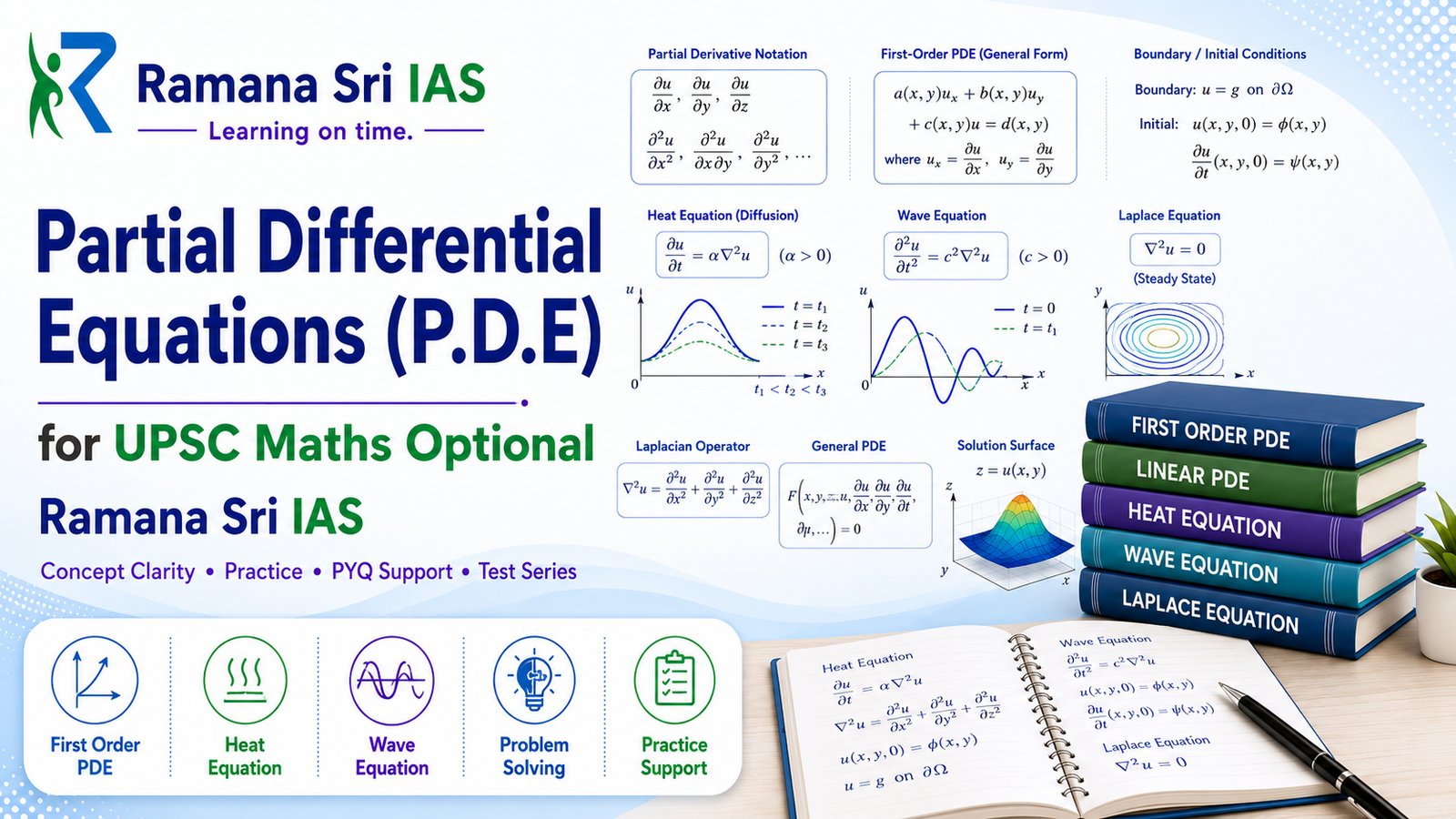
Partial Differential Equations (P.D.E) for UPSC Maths Optional by Ramana Sri IAS

Partial Differential Equations in the 13 UPSC Maths Optional Modules

Ramana Sri IAS covers all major Maths Optional modules from Linear Algebra to Mechanics and Fluid Dynamics. Partial Differential Equations is a Paper II module and requires good command over formulation, method selection, characteristic equations, canonical form and standard physical equations.

Core Paper II Module

Partial Differential Equations is an important Paper II module and should be prepared with clear methods.

Formulation-Based Topic

Formulation of PDE from families of surfaces is a basic and important starting area.

Cauchy’s Method

Cauchy’s method of characteristics is important for first order partial differential equations.

PYQ Relevance

Previous year questions help students understand repeated UPSC models from first order PDE and standard equations.

Medium to Difficult Module

Many students find PDE medium to difficult because it needs method selection and careful calculation.

Canonical Form

Linear PDEs of second order with constant coefficients and canonical form need systematic preparation.

Standard Equations

Vibrating string, heat equation and Laplace equation are important for both concepts and problem solving.

IFoS Extra Areas

IFoS students should additionally prepare Pfaffian equations, Charpit’s method and related first order methods.

Partial Differential Equations for UPSC Maths Optional Syllabus

Partial Differential Equations is an important module of UPSC Maths Optional Paper II. It builds the foundation for PDE formulation, first order quasi-linear equations, Cauchy’s method of characteristics, second order linear PDEs, canonical form and standard equations.

Partial Differential Equations for UPSC Maths Optional Syllabus
Family of surfaces in three dimensions and formulation of partial differential equations; Solution of quasi linear partial differential equations of the first order, Cauchy’s method of characteristics; Linear partial differential equations of the second order with constant coefficients, canonical form; Equation of a vibrating string, heat equation, Laplace equation and their solutions.

In UPSC Mathematics Optional, PDE should not be prepared only by memorising formulas. Students must understand the type of equation, choose the correct method, solve characteristic equations carefully and practise standard models from previous year questions.

Partial Differential Equations for IFoS Maths Optional Syllabus

IFoS Maths Optional also includes Partial Differential Equations with many common UPSC areas. IFoS additionally mentions equations of type dx/p = dy/q = dz/r, orthogonal trajectories, Pfaffian differential equations and Charpit’s method of solutions.

Partial Differential Equations for IFoS Maths Optional Syllabus
Curves and surfaces in three dimensions, formulation of partial differential equations, solutions of equations of type dx/p=dy/q=dz/r; orthogonal trajectories, Pfaffian differential equations; partial differential equations of the first order, solution by Cauchy’s method of characteristics; Charpit’s method of solutions, linear partial differential equations of the second order with constant coefficients, equations of vibrating string, heat equation, Laplace equation.

Check Partial Differential Equations in UPSC and IFoS Maths Optional Syllabus

Partial Differential Equations is an important module for UPSC Maths Optional and IFoS Maths Optional. Students should check the full syllabus carefully before starting preparation, especially if they are preparing in Hindi medium or comparing UPSC and IFoS syllabus topics.

UPSC Maths Optional Syllabus

Check the complete UPSC Maths Optional syllabus in English, including Modern Algebra, Real Analysis, Complex Analysis, Linear Programming, PDE and Numerical Analysis.

IFoS Maths Optional Syllabus

Check the complete IFoS Maths Optional syllabus in English and understand how Partial Differential Equations is useful for IFoS Mathematics Optional preparation.

UPSC Maths Optional Syllabus in Hindi

Hindi medium students can check the UPSC Maths Optional syllabus in Hindi and understand where Partial Differential Equations appears in Paper II preparation.

IFoS Maths Optional Syllabus in Hindi

IFoS Hindi medium students can check the IFoS Maths Optional syllabus in Hindi before planning PDE and other Mathematics Optional modules.

Partial Differential Equations Topics for UPSC and IFoS Maths Optional

Partial Differential Equations has many common areas for UPSC Maths Optional and IFoS Maths Optional. Both syllabi include formulation of PDEs, first order PDEs, Cauchy’s method of characteristics, second order linear PDEs with constant coefficients, vibrating string equation, heat equation and Laplace equation.

IFoS syllabus additionally mentions equations of type dx/p = dy/q = dz/r, orthogonal trajectories, Pfaffian differential equations and Charpit’s method. UPSC explicitly mentions canonical form and solutions of vibrating string, heat and Laplace equations.

Mostly Common Topics

These topics should be prepared carefully by both UPSC and IFoS Maths Optional students:

  • Formulation of partial differential equations
  • First order partial differential equations
  • Cauchy’s method of characteristics
  • Linear partial differential equations of second order with constant coefficients
  • Equation of a vibrating string
  • Heat equation
  • Laplace equation

Additional IFoS Topics

These topics are directly mentioned in the IFoS Maths Optional syllabus:

  • Equations of type dx/p = dy/q = dz/r
  • Orthogonal trajectories
  • Pfaffian differential equations
  • Charpit’s method of solutions
Preparation guidance: UPSC students should focus strongly on Cauchy’s method, canonical form and standard equations. IFoS students should additionally prepare Pfaffian differential equations, Charpit’s method and equations of type dx/p = dy/q = dz/r.

How to Prepare Partial Differential Equations for UPSC Maths Optional

Partial Differential Equations can help students score well in UPSC Maths Optional when it is prepared with method clarity, equation identification and previous year question practice. Students should focus on formulation, first order methods, second order equations and standard models.

Start with PDE Formulation

First understand family of surfaces in three dimensions and formulation of partial differential equations.

Master Cauchy’s Method

Cauchy’s method of characteristics should be prepared with characteristic equations and complete solutions.

Prepare First Order PDE

First order partial differential equations require correct method selection and step-wise solving practice.

Study Canonical Form

Linear partial differential equations of second order with constant coefficients and canonical form are important for UPSC.

Revise Vibrating String

Equation of a vibrating string should be prepared with standard solution format and boundary conditions.

Practise Heat Equation

Heat equation is an important standard equation and should be practised through solved examples and PYQs.

Prepare Laplace Equation

Laplace equation should be revised with standard methods, solution form and repeated question models.

Add IFoS Methods

IFoS students should additionally prepare Pfaffian differential equations, Charpit’s method and related first order methods.

Ramana Sri IAS helps students prepare Partial Differential Equations in a step-by-step way. The focus is on concept clarity, method selection, standard equations, previous year questions, test practice and revision. This approach helps students reduce mistakes and improve accuracy in Paper II.

To score well in PDE, students should maintain short method notes, practise characteristic equations, revise standard solution forms and solve PYQs topic-wise. In Maths Optional, marks are not only for the final answer; correct method, neat presentation and logical steps are also very important.

Ramana Sri IAS guidance: Partial Differential Equations should be prepared with proper classroom explanation, method-based learning, PYQ discussion, test feedback and revision support. With the right method, this module can become a manageable and scoring area in Maths Optional.

Partial Differential Equations PYQ Practice Resources

Partial Differential Equations should be prepared with topic-wise and year-wise previous year questions. PYQs help students understand repeated areas, UPSC pattern and answer-writing demand.

Maths Optional Courses for Partial Differential Equations Preparation

Students preparing Partial Differential Equations can choose the right Maths Optional course mode based on their location, time availability, revision need and preparation level.

Maths Optional Test Series for Partial Differential Equations Practice

Test practice helps students improve accuracy, method selection, equation solving and confidence in PDE.

Useful Resources for UPSC Maths Optional Students

Use these Ramana Sri IAS resources to continue your Maths Optional preparation after studying Partial Differential Equations.

Partial Differential Equations for UPSC Maths Optional FAQs

What is Partial Differential Equations for UPSC Maths Optional?

Partial Differential Equations is a Paper II module in UPSC Maths Optional. It includes formulation of PDEs, first order quasi-linear PDEs, Cauchy’s method of characteristics, second order linear PDEs, canonical form, vibrating string equation, heat equation and Laplace equation.

Is Partial Differential Equations important for UPSC Maths Optional?

Yes. PDE is important because it is a core Paper II module and many questions are based on method selection, characteristic equations, canonical form and standard equations.

Is Partial Differential Equations easy or difficult for UPSC?

PDE is generally a medium to difficult module. It becomes manageable when students practise formulation, Cauchy’s method, canonical form and standard equations regularly.

How should I prepare Partial Differential Equations for UPSC?

Start with formulation of PDEs and first order PDEs. Then prepare Cauchy’s method of characteristics, second order PDEs with constant coefficients, canonical form, vibrating string, heat equation, Laplace equation and PYQs.

Is Partial Differential Equations common for UPSC and IFoS Maths Optional?

Yes. Many PDE topics are common for UPSC and IFoS Maths Optional. IFoS additionally mentions equations of type dx/p = dy/q = dz/r, orthogonal trajectories, Pfaffian differential equations and Charpit’s method.

Does Ramana Sri IAS teach Partial Differential Equations for UPSC?

Yes. Ramana Sri IAS teaches Partial Differential Equations as part of UPSC Maths Optional preparation with concept clarity, method-based explanation, solved examples, PYQ practice, tests and revision guidance.

Where can I practise Partial Differential Equations PYQs?

Students can use Ramana Sri IAS topic-wise PYQs, year-wise question papers and PYQ solutions to practise Partial Differential Equations for UPSC and IFoS Maths Optional.

Need PDE Guidance?

Prepare Partial Differential Equations with Proper Maths Optional Guidance

Partial Differential Equations can become manageable when students prepare it with concept clarity, method selection, PYQ analysis, test writing and regular revision. Ramana Sri IAS helps Maths Optional students build strong fundamentals and improve exam-oriented problem solving.

Guidance support includes:
  • PDE concept clarity and method-based learning.
  • UPSC and IFoS PYQ practice with test guidance.
  • Course, fee, demo video and admission support after enquiry.
Scroll to Top