
Taking Maths As Optional in UPSC Exams
Taking Maths As Optional in UPSC Exams
Understand the benefits, challenges, preparation strategy, scoring potential and right approach before choosing Mathematics as your optional subject for the UPSC Civil Services Examination.
Taking Maths As Optional in UPSC Exams
If you are thinking of taking Maths as optional in UPSC exams, it is important to get the right guidance before starting preparation. Mathematics Optional can be a strong choice for students who have interest in the subject and are ready to practise consistently.
Maths is an exact science with clear right or wrong answers. This makes the subject more objective compared to many other optional subjects. Its static syllabus is also a major advantage because the topics do not change frequently with current affairs.
However, Maths Optional requires concept clarity, formula revision, problem-solving speed, accuracy and proper answer presentation. A good preparation plan, regular practice, previous year questions and mock tests are essential for scoring well.
Taking Maths as Optional in UPSC Exams can be a good decision for aspirants who want a logical, objective and scoring optional subject. Since Mathematics has a static syllabus and definite answers, students can improve their marks through concept clarity, repeated practice, previous year questions and proper test writing.
Before taking Maths as Optional in UPSC Exams, students should honestly check their interest, background, available preparation time and ability to practise problems regularly. With the right guidance, formula revision, mock tests and answer-writing discipline, Maths Optional can become a strong scoring area in the UPSC Mains examination.
Taking Maths as Optional in UPSC Exams can be a good decision for aspirants who want a logical, objective and scoring optional subject. Since Mathematics has a static syllabus and definite answers, students can improve their marks through concept clarity, repeated practice, previous year questions and proper test writing.
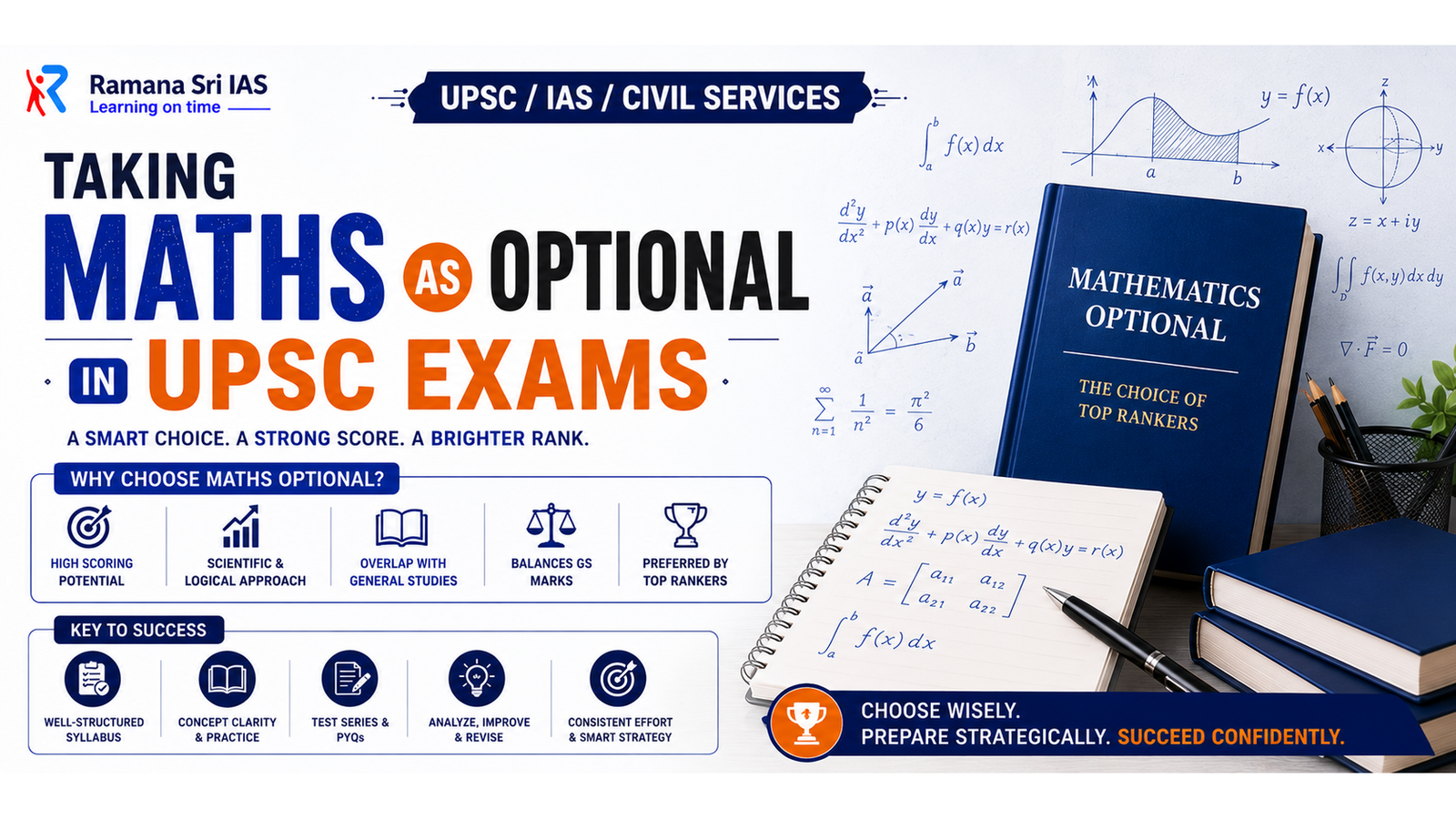
Benefits of Taking Maths As Optional in UPSC Exams
Scoring Subject
Mathematics has a consistent scoring pattern and less room for subjective evaluation when solutions are accurate and well-presented.
Static Syllabus
The syllabus does not change frequently, so students can focus on concept mastery, revision and practice.
Definite Answers
Most questions have clear methods and definite answers, which helps students evaluate their preparation better.
Rank Improvement
A strong score in Mathematics Optional can significantly improve the overall UPSC Mains score and final rank.
Why Maths Optional Is Considered a Scoring Subject
Aspirants who want to score high in the Civil Services Examination may consider Mathematics as one of their optional subjects. It is important to understand that the subject requires hard work, regular practice and a clear preparation strategy.
One of the main reasons Maths is considered scoring is that it has little room for subjective interpretation. If the method, calculation and final answer are correct, the answer has strong scoring potential. Students can improve their performance by solving previous year questions, writing mock tests and revising formulas.
Maths is easier to revise than many other subjects because the syllabus is static. Students do not need to constantly update their preparation with current events. Instead, they can focus on concepts, formulas, theorems and repeated practice.
To score well, students must read questions carefully, avoid silly mistakes, write steps clearly and build logical flow in answers. The questions are generally based on formulas, theorems and applications, so conceptual clarity is essential.
Is Maths Optional Too Time-Consuming?
Maths Optional is challenging, but it can be managed with proper guidance, disciplined study and consistent practice. It becomes time-consuming only when students study without a clear plan or keep changing resources.
Students should choose the right textbooks, maintain a formula sheet and follow a topic-wise schedule. A formula sheet helps in memorizing important equations, theorems and concepts, which saves time during revision and exams.
The syllabus consists of two papers of 250 marks each. Important areas include Modern Algebra, Linear Algebra with Matrices, Calculus, Ordinary Differential Equations, Partial Differential Equations and Analytical Geometry.
A good mains test series can help students gain confidence, solve difficult problems, stay calm in the exam hall and learn how to answer questions quickly and accurately.
Is Maths Optional Difficult?
Mathematics is not as easy as many theory-based subjects for students who do not have interest in the subject. It requires technical understanding, advanced mathematical concepts and regular problem-solving practice.
At the same time, Maths Optional is not impossible. Students from science, engineering, statistics, IT or mathematics backgrounds can perform very well if they prepare diligently from day one.
The key to scoring high is regular practice, avoiding careless mistakes and improving problem-solving speed. Students should solve as many questions as possible, practise previous year papers and take mock tests to check whether they have mastered each topic.
It is also useful to take guidance from experienced mentors so that difficult concepts become clear and preparation remains exam-oriented.
Maths Optional Requires the Right Effort
Know the Syllabus
Students should know the complete syllabus and marking pattern before beginning preparation.
Use Proper Materials
Good textbooks, study notes and solved examples can speed up concept building.
Practise PYQs
Previous year papers help students understand question types and topic-wise weightage.
Take Mock Tests
Mock tests improve speed, accuracy, time management and answer presentation.
How to Prepare After Choosing Maths Optional
1
Read the complete UPSC Maths Optional syllabus and divide it into Paper-1 and Paper-2 topics.
2
Start with basic concepts and gradually move towards advanced problems.
3
Prepare formula sheets, theorem notes and short revision notes for every module.
4
Solve standard examples, previous year questions and topic-wise practice problems regularly.
5
Join a mains test series and write answers under time limits to improve exam readiness.
6
Revise repeatedly and take guidance for difficult topics to avoid conceptual gaps.
Who Should Take Maths As Optional in UPSC?
Maths Optional is suitable for students who have genuine interest in Mathematics and are comfortable with formulas, calculations, proofs and logical problem-solving.
It is especially useful for candidates from Mathematics, Engineering, Science, Statistics, Computer Science or technical backgrounds. However, the final decision should be based on interest, aptitude, available time and willingness to practise regularly.
Students should not choose Maths Optional only because it is scoring. They should choose it only if they are ready to study consistently, solve problems daily and revise formulas repeatedly.
Common Mistakes to Avoid in Maths Optional
Ignoring Basics
Directly solving difficult questions without concept clarity creates confusion and weak preparation.
No Formula Revision
Not revising formulas regularly can reduce speed and accuracy in the exam.
Avoiding Mock Tests
Without mock tests, students may struggle with time management and answer presentation.
Careless Mistakes
Maths rewards accuracy, so calculation errors and missing steps can reduce marks.
Why Take Guidance for Maths Optional?
A good UPSC Maths Optional course or video lecture series can help students understand complex topics and break them down into simple concepts. Structured guidance saves time and keeps preparation focused.
Ramana Sri IAS helps students prepare Maths Optional with syllabus coverage, topic-wise guidance, previous year question practice, mock tests, answer-writing improvement and revision support.
Students who want clear preparation content, sequence-wise learning and mentor support can take guidance to improve their chances of scoring well in the UPSC Maths Optional papers.
Related Resources
Continue Your UPSC Maths Optional Preparation
UPSC Maths Optional Syllabus
Check complete Paper-1 and Paper-2 syllabus
UPSC Maths Optional Books
Download sample books and study materials
Previous Year Questions
Practise UPSC Maths Optional PYQs
Online Coaching
Join structured Maths Optional classes
Online Test Series
Practise mock tests and answer writing
Self-Study Course
Follow a structured self-study roadmap
Demo Videos
Watch Ramana Sri IAS Maths Optional teaching style
Fee Structure
Compare course-wise fee details
Admission Form
Apply for coaching, test series or self-study support
Taking Maths As Optional in UPSC Exams FAQs
Is Maths Optional scoring in UPSC?
Yes. Maths Optional can be highly scoring when students have strong concepts, regular practice, accuracy and good answer presentation.
Is Maths Optional difficult?
Maths Optional is challenging, but it can be mastered with proper guidance, regular practice and strong interest in the subject.
Who should take Maths Optional?
Students with interest in Mathematics, logical reasoning, formulas, proofs and problem-solving can choose Maths Optional.
Does Maths Optional require coaching?
Coaching is not compulsory, but structured guidance can save time, clear doubts and improve preparation quality.
How should I start Maths Optional preparation?
Start with the syllabus, build concepts topic-wise, prepare formula sheets, solve PYQs and write mock tests regularly.
Taking Maths As Optional in UPSC Exams
Need Guidance Before Choosing Maths Optional?
Fill the admission form or contact Ramana Sri IAS to understand whether Maths Optional is the right choice for your UPSC preparation.