
Ramana Sri IAS

Ramana Sri IAS Logo Ramana Sri IAS Admission Form
☰ Menu
UPSC & IFoS Maths Optional Paper I Module

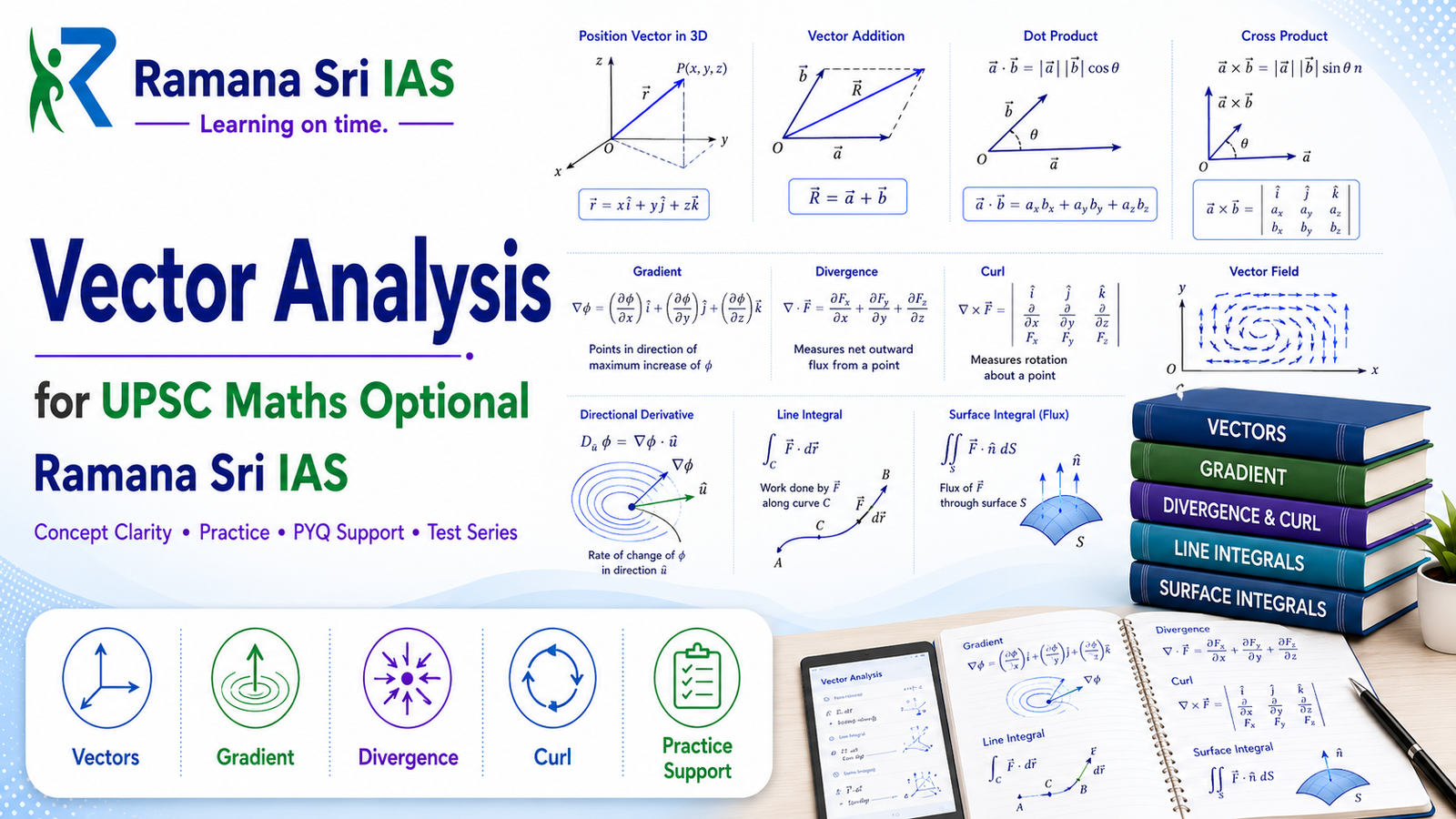
Vector Analysis for UPSC & IFoS Maths Optional

Vector Analysis for UPSC & IFoS Maths Optional is an important Paper I module that covers scalar and vector fields, differentiation of vector functions, gradient, divergence, curl, higher order derivatives, vector identities, vector equations, curves in space, curvature, torsion, Serret-Frenet’s formulae, Gauss theorem, Stokes theorem and Green’s identities. Ramana Sri IAS helps students prepare Vector Analysis with concept clarity, PYQ practice, test guidance and revision support.

Paper I UPSC Maths Optional
6th Maths Optional Module
UPSC Syllabus Topic
IFoS Also Important
Gradient Core Area
Curl Important Topic
Gauss Theorem Area
PYQs Must Practise

What Is Vector Analysis for UPSC Maths Optional?

Vector Analysis is one of the main modules in UPSC Maths Optional Paper I. It includes scalar and vector fields, differentiation of vector functions, gradient, divergence, curl, higher order derivatives, vector identities and vector equations.

The geometry part of Vector Analysis includes curves in space, curvature, torsion and Serret-Frenet’s formulae. The theorem part includes Gauss theorem, Stokes theorem and Green’s identities. Students should also understand triple products, Cartesian coordinates, cylindrical coordinates, spherical coordinates and physical interpretations of gradient, divergence and curl because these help in solving problems in a simpler and more complete way.

Ramana Sri IAS teaches Vector Analysis as part of the complete UPSC Maths Optional course. The preparation approach focuses on concept explanation, formula clarity, solved examples, PYQ practice, test series, revision planning and step-wise answer presentation.

Teacher’s guidance: Vector Analysis should be prepared with formulas, identities, diagrams, geometric understanding and theorem applications. Students should master gradient, divergence, curl, vector identities, curvature, torsion, Serret-Frenet’s formulae, Gauss theorem, Stokes theorem and Green’s identities with regular PYQ practice.
Vector Analysis for UPSC Maths Optional by Ramana Sri IAS

Vector Analysis in the 13 UPSC Maths Optional Modules

Ramana Sri IAS covers all major Maths Optional modules from Linear Algebra to Mechanics and Fluid Dynamics. Vector Analysis is a core Paper I module and is generally considered a scoring area when students prepare formulas, identities, geometry and theorems properly.

Core Paper I Module

Vector Analysis is an important Paper I module and should be prepared with strong formula clarity.

Field-Based Topic

Scalar fields, vector fields, gradient, divergence and curl form the foundation of this module.

Geometry Application

Curves in space, curvature, torsion and Serret-Frenet’s formulae need conceptual understanding.

PYQ Relevance

Previous year questions help students understand repeated UPSC models from vector identities and theorems.

Scoring Module

Many students find Vector Analysis scoring because standard formulas and theorem applications are repeated.

Theorem Area

Gauss theorem, Stokes theorem and Green’s identities are important for both concepts and problem solving.

UPSC and IFoS Relevance

Vector Analysis is useful for both UPSC Maths Optional and IFoS Maths Optional preparation.

Strong Revision Topic

A strong formula notebook and regular revision can make Vector Analysis a high-confidence module.

Vector Analysis for UPSC Maths Optional Syllabus

Vector Analysis is an important module of UPSC Maths Optional Paper I. It builds the foundation for scalar and vector fields, gradient, divergence, curl, vector identities, vector equations, curves in space, curvature, torsion and integral theorems.

6. Vector Analysis
Scalar and vector fields, differentiation of vector field of a scalar variable; Gradient, divergence and curl in Cartesian and cylindrical coordinates; Higher order derivatives; Vector identities and vector equations. Application to geometry: Curves in space, Curvature and torsion; Serret-Frenet’s formulae. Gauss and Stokes’ theorems, Green’s identities.

In UPSC Mathematics Optional, Vector Analysis should not be prepared only by memorising formulas. Students must understand the meaning of gradient, divergence and curl, practise vector identities, revise geometry applications and solve previous year questions regularly.

Vector Analysis for IFoS Maths Optional Syllabus

IFoS Maths Optional also includes Vector Analysis with almost the same preparation demand. The IFoS wording directly mentions triple products, spherical coordinates and physical interpretations, but UPSC students should also prepare these areas because they are useful for solving questions in a simple way.

6. Vector Analysis
Scalar and vector fields, triple, products, differentiation of vector function of a scalar variable, gradient, divergence and curl in Cartesian, cylindrical and spherical coordinates and their physical interpretations. Higher order derivatives, vector identities and vector equations. Application to Geometry: Curves in space, curvature and torsion. Serret-Frenet’s formulae, Gauss and Stokes’ theorems, Green’s identities.

Check Vector Analysis in UPSC and IFoS Maths Optional Syllabus

Vector Analysis is an important module for UPSC Maths Optional and IFoS Maths Optional. Students should check the full syllabus carefully before starting preparation, especially if they are preparing in Hindi medium or comparing UPSC and IFoS syllabus topics.

UPSC Maths Optional Syllabus

Check the complete UPSC Maths Optional syllabus in English, including Linear Algebra, Calculus, Analytical Geometry, ODE, Dynamics and Statics and Vector Analysis.

IFoS Maths Optional Syllabus

Check the complete IFoS Maths Optional syllabus in English and understand how Vector Analysis is useful for IFoS Mathematics Optional preparation.

UPSC Maths Optional Syllabus in Hindi

Hindi medium students can check the UPSC Maths Optional syllabus in Hindi and understand where Vector Analysis appears in Paper I preparation.

IFoS Maths Optional Syllabus in Hindi

IFoS Hindi medium students can check the IFoS Maths Optional syllabus in Hindi before planning Vector Analysis and other Mathematics Optional modules.

Vector Analysis Syllabus for UPSC and IFoS Maths Optional

Vector Analysis is almost the same in preparation approach for both UPSC Maths Optional and IFoS Maths Optional. The wording may slightly vary in the syllabus, but students should prepare the complete topic in an integrated way because the same concepts are required for solving problems effectively.

Students should prepare scalar and vector fields, triple products, differentiation of vector functions, gradient, divergence and curl in Cartesian, cylindrical and spherical coordinates, physical interpretations, higher order derivatives, vector identities, vector equations, curves in space, curvature, torsion, Serret-Frenet’s formulae, Gauss theorem, Stokes theorem and Green’s identities.

UPSC Maths Optional Preparation

UPSC students should prepare Vector Analysis with full conceptual and problem-solving coverage. Even when some terms are not written separately in the UPSC syllabus, they are useful for solving questions in a simple and complete way.

  • Scalar and vector fields
  • Gradient, divergence and curl
  • Cartesian, cylindrical and spherical coordinates
  • Vector identities and vector equations
  • Curvature, torsion and Serret-Frenet’s formulae
  • Gauss theorem, Stokes theorem and Green’s identities

IFoS Maths Optional Preparation

IFoS students should also prepare Vector Analysis in the same complete manner. The IFoS syllabus wording gives more direct mention to some areas, but the preparation method remains practically the same.

  • Triple products
  • Physical interpretations of gradient, divergence and curl
  • Cartesian, cylindrical and spherical coordinates
  • Higher order derivatives
  • Application to geometry
  • Gauss theorem, Stokes theorem and Green’s identities
Preparation guidance: For Vector Analysis, UPSC and IFoS students should not prepare separately. Prepare the full topic together, including spherical coordinates and physical interpretations, because these help in solving questions more easily and accurately.

How to Prepare Vector Analysis for UPSC Maths Optional

Vector Analysis can help students score well in UPSC Maths Optional when it is prepared with concept clarity, formula accuracy, theorem understanding and previous year question practice. Students should focus on both calculation and interpretation.

Start with Fields

First understand scalar fields, vector fields and differentiation of vector functions of a scalar variable.

Master Gradient, Divergence and Curl

Prepare gradient, divergence and curl in Cartesian, cylindrical and spherical coordinates with physical meaning.

Practise Vector Identities

Vector identities and vector equations should be practised repeatedly because they are useful in many PYQs.

Revise Higher Order Derivatives

Higher order derivatives should be prepared with standard formulas and applications in vector calculus.

Prepare Curves in Space

Curves in space, curvature, torsion and Serret-Frenet’s formulae should be studied with geometry understanding.

Apply Integral Theorems

Gauss theorem, Stokes theorem and Green’s identities should be practised with standard examples and PYQs.

Maintain Formula Notes

A short formula notebook for identities, coordinate systems and theorem statements helps in quick revision.

Write Tests and Analyse Mistakes

After completing the module, students should write topic-wise tests and analyse mistakes. This improves speed, accuracy and presentation.

Ramana Sri IAS helps students prepare Vector Analysis in a step-by-step way. The focus is on concept clarity, formula use, theorem applications, previous year questions, test practice and revision. This approach helps students reduce calculation mistakes and improve accuracy in Paper I.

To score well in Vector Analysis, students should maintain formula notes, revise vector identities regularly, practise coordinate-based problems and solve PYQs topic-wise. In Maths Optional, marks are not only for the final answer; correct formula use, neat presentation and logical steps are also very important.

Ramana Sri IAS guidance: Vector Analysis should be prepared with proper classroom explanation, formula-based learning, PYQ discussion, test feedback and revision support. With the right method, this module can become a scoring area in Maths Optional.

Vector Analysis PYQ Practice Resources

Vector Analysis should be prepared with topic-wise and year-wise previous year questions. PYQs help students understand repeated areas, UPSC pattern and answer-writing demand.

Maths Optional Courses for Vector Analysis Preparation

Students preparing Vector Analysis can choose the right Maths Optional course mode based on their location, time availability, revision need and preparation level.

Maths Optional Test Series for Vector Analysis Practice

Test practice helps students improve accuracy, formula application, theorem use and confidence in Vector Analysis.

Useful Resources for UPSC Maths Optional Students

Use these Ramana Sri IAS resources to continue your Maths Optional preparation after studying Vector Analysis.

Vector Analysis for UPSC Maths Optional FAQs

What is Vector Analysis for UPSC Maths Optional?

Vector Analysis is a Paper I module in UPSC Maths Optional. It includes scalar and vector fields, gradient, divergence, curl, vector identities, curves in space, curvature, torsion, Serret-Frenet’s formulae, Gauss theorem, Stokes theorem and Green’s identities.

Is Vector Analysis important for UPSC Maths Optional?

Yes. Vector Analysis is important because it is a core Paper I module and many questions are based on standard formulas, vector identities, coordinate systems and integral theorems.

Is Vector Analysis easy or difficult for UPSC?

Vector Analysis is generally considered a scoring module when students revise formulas, identities and theorem applications regularly. It becomes easier with PYQ practice.

How should I prepare Vector Analysis for UPSC?

Start with scalar and vector fields, then prepare gradient, divergence, curl, vector identities, curves in space, curvature, torsion, Serret-Frenet’s formulae, Gauss theorem, Stokes theorem, Green’s identities and PYQs.

Is Vector Analysis common for UPSC and IFoS Maths Optional?

Yes. Vector Analysis is almost the same in preparation approach for UPSC and IFoS Maths Optional. Students should prepare the full topic together, including coordinate systems, physical interpretations and theorem applications.

Does Ramana Sri IAS teach Vector Analysis for UPSC?

Yes. Ramana Sri IAS teaches Vector Analysis as part of UPSC Maths Optional preparation with concept clarity, formula-based explanation, solved examples, PYQ practice, tests and revision guidance.

Where can I practise Vector Analysis PYQs?

Students can use Ramana Sri IAS topic-wise PYQs, year-wise question papers and PYQ solutions to practise Vector Analysis for UPSC and IFoS Maths Optional.

Need Vector Analysis Guidance?

Prepare Vector Analysis with Proper Maths Optional Guidance

Vector Analysis can become a scoring module when students prepare it with concept clarity, formula revision, theorem understanding, PYQ analysis, test writing and revision. Ramana Sri IAS helps Maths Optional students build strong fundamentals and improve exam-oriented problem solving.

Guidance support includes:
  • Vector Analysis concept clarity and formula-based methods.
  • UPSC and IFoS PYQ practice with test guidance.
  • Course, fee, demo video and admission support after enquiry.
Scroll to Top